FOOD IRRADIATION
By Sophia
MAVOUNGOU
V Year MBBS
Group 29
What is food irradiation ?
• Irradiation is the process of applying radiation
to matter
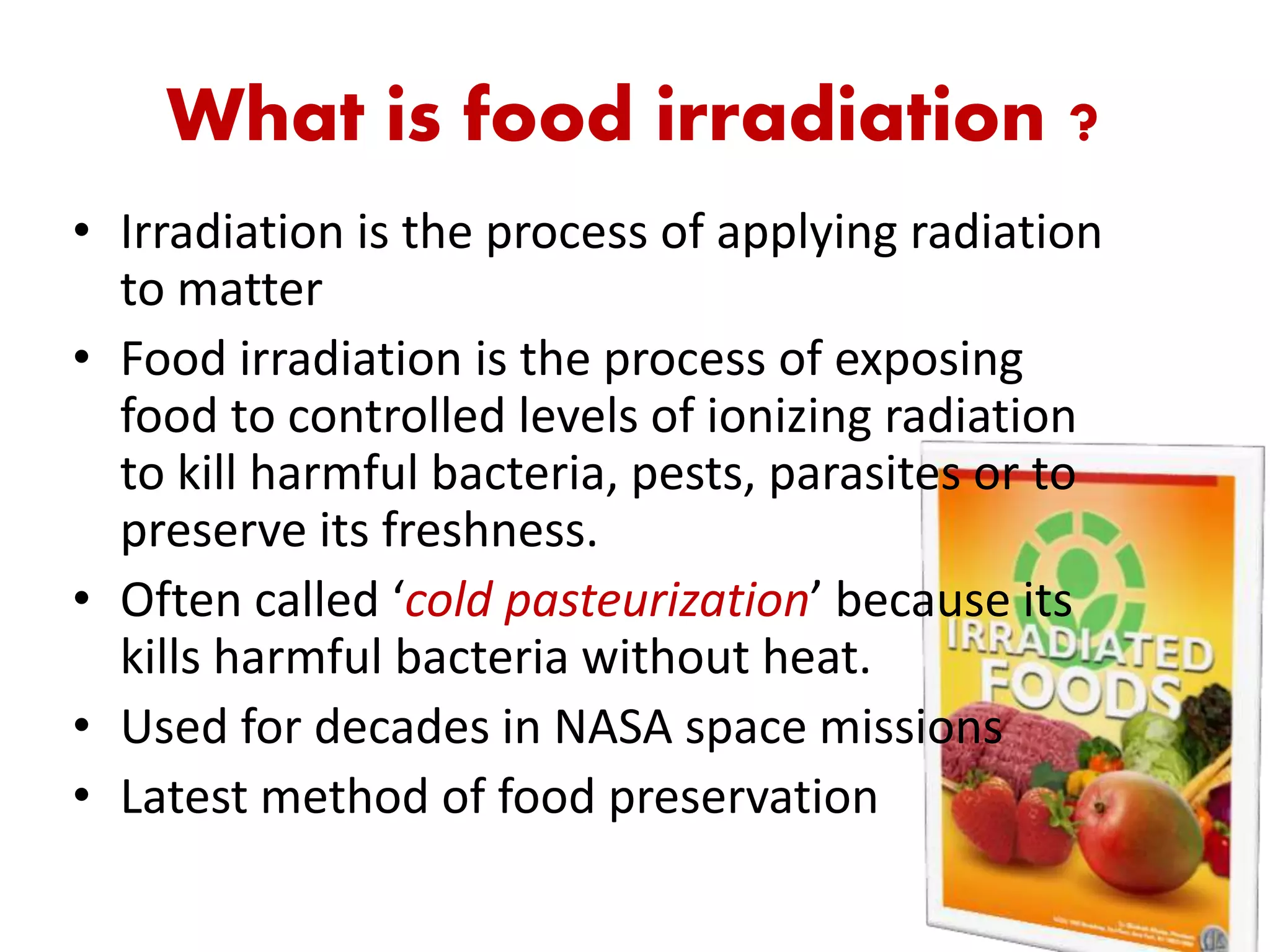
• Food irradiation is the process of exposing
food to controlled levels of ionizing radiation
to kill harmful bacteria, pests, parasites or to
preserve its freshness.
• Often called ‘cold pasteurization’ because its
kills harmful bacteria without heat.
• Used for decades in NASA space missions
• Latest method of food preservation
History of food irradiation
• 1905 : begins the era of food irradiation
• 1921: B. Schwartz published use of X rays for inactivating Trichinae
sp in raw pork
• 1930: O.West killed bacteria in packaged food with X-rays
• 1958: congress defines a source of radiation as a food additive
• 1976: Joint expert committee (IAEA, WHO and FAO) declares food
irradiation a process
• 1980: foods irradiated up to 10 Gy considered to be safe and
wholesome
• 1997: food irradiated at any dose should be considered as safe and
as wholesome as foods treated by any other conventional process
• 2001: Irradiation is used to eliminate possible traces of Anthrax
• 1984-2009: FDA approves the use of irradiation in a variety of foods
Main advantages of food
irradiation
• Prevent food borne illness by reducing
- E.coli 157:H7 (beef)
- Salmonella (poultry)
- Campylobacter (poultry)
- Parasites
• Prevent Spoilage by destroying molds,
bacteria and yeast
• Control insects and parasite infestation
( eg during importation)
• Increase shelf life by slowing ripening
of fresh fruits and vegetables (eg.
Potatoes)
• Sterilization in hospital especially for
patients with impaired immunity
Effects of irradiation on food
components
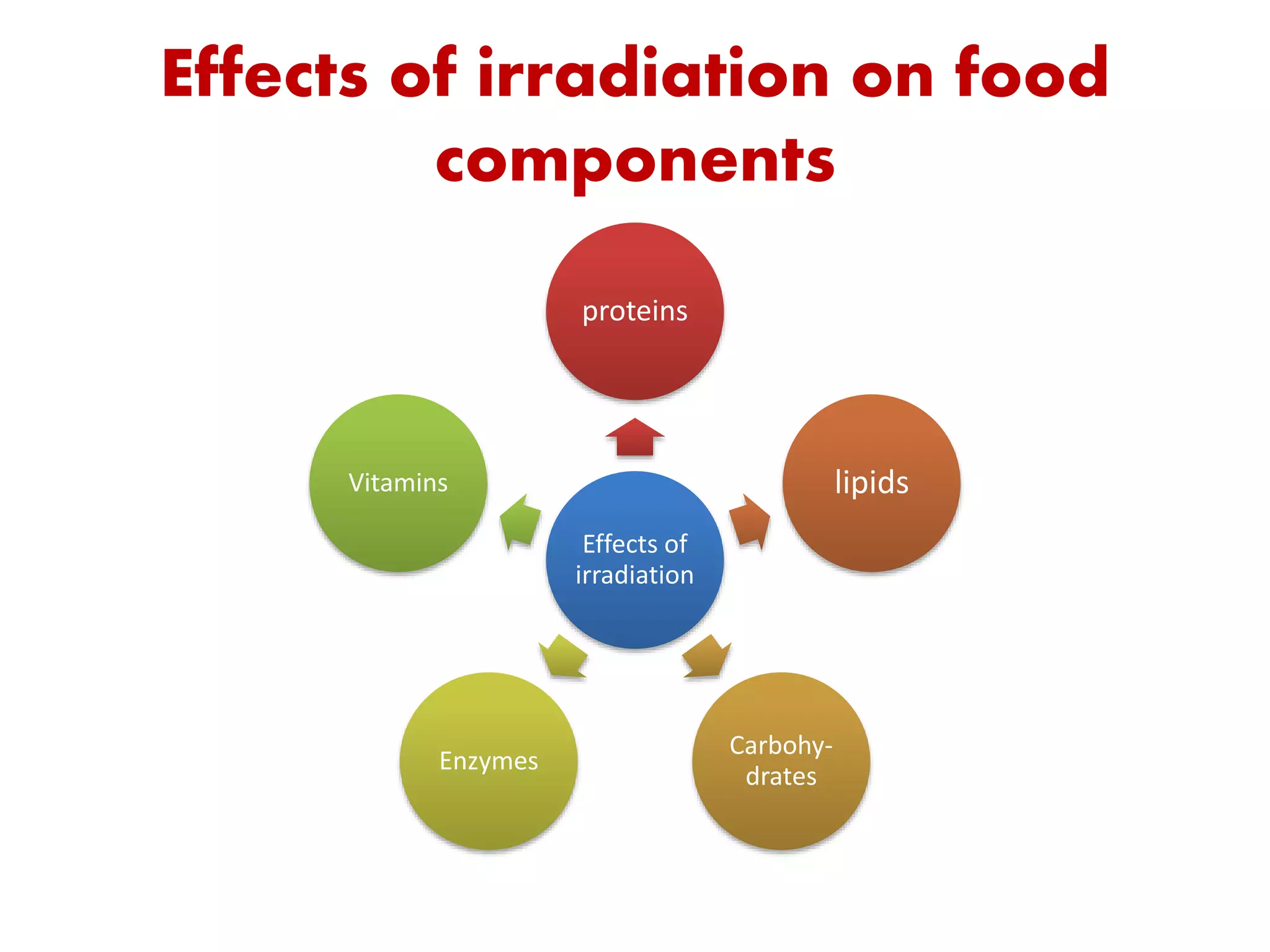
Effects of
irradiation
proteins
lipids
Carbohy-
drates
Enzymes
Vitamins
How food is irradiated
• Gamma rays are emitted from radioactive forms of the
element cobalt (Cobalt 60) or of the element cesium
(Cesium 137). Gamma radiation is used routinely to sterilize
medical, dental, and household products and is also used
for the radiation treatment of cancer.
• X-rays are produced by reflecting a high-energy stream of
electrons off a target substance (usually one of the heavy
metals) into food. X-rays are also widely used in medicine
and industry to produce images of internal structures.
• Electron beam (or e-beam) is similar to X-rays and is a
stream of high-energy electrons propelled from an electron
accelerator into food
Characteristics of irradiation
sources
• The process involves exposing the food, either packaged or in bulk, to carefully
controlled amounts of ionizing radiation for a specific time to achieve certain
desirable objectives.
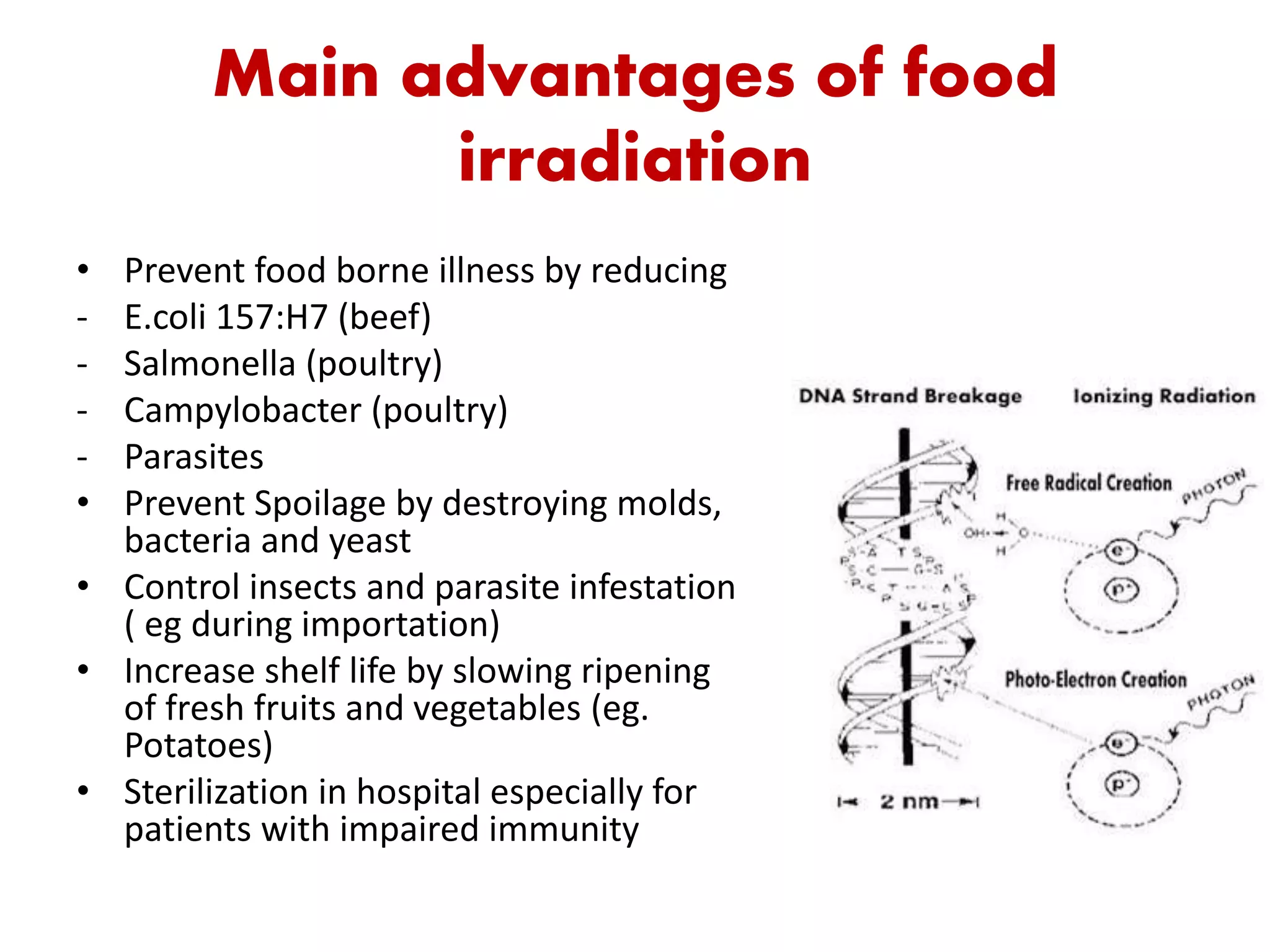
• When microbes present in the food are irradiated, the energy from the radiation
breaks the bonds in the DNA molecules, causing defects in the genetic instructions.
Unless this damage can be repaired, the organism will die or will be unable to
reproduce.
• It matters if the food is frozen or fresh, because it takes larger radiation dose to kill
microbes in frozen foods.
• effectiveness of the process depends also on the organism’s sensitivity to
irradiation, on the rate at which it can repair damaged DNA, and especially on the
amount of DNA in the target organism:
• Parasites and insect pests, which have large amounts of DNA, are rapidly killed by
an extremely low dose of irradiation.
• It takes more irradiation to kill bacteria, because they have less DNA.
• Viruses are the smallest pathogens that have nucleic acid, and they are, in general,
resistant to irradiation at doses approved for foods.
• If the food still has living cells, they will be damaged or killed just as microbes are.
Humans Molds bacteria Viruses
Dose and dose rate
• It can be divide into 3 categories ( unit is Gy)
Radicidation= low doses <1Gy
 Controls insects in grains and fruits
 Inhibit sprouting in tubers
 Delay the ripening of some fruits /vegetables
 Reduces parasites ( eg trichinae in pork)
Radurization= Medium doses 1-10Gy
 Control salmonella, shigella, campylobacter, yersinia, listeria, and
E.coli in meat poultry and fish
Raddapperization= High doses >10Gy
 Kill microorganisms and insects in spices
 Commercially sterilize foods , destroying all microorganisms of
public health concern ( people with weakened immune system)
Quantity of food irradiation in the
world in 2005
Regulation of irradiated food
For approval of any irradiated food, the FDA requires the foods labeled with statement:
- Treated with ionizing radiation/ treated with radiation
Labeling requirement apply only to foods sold in stores
No labeling requirement if minor ingredients in other foods and restaurant foods
The international food irradiation symbol – the radura
Unknown
long-term
effects on
human
health
Increased
consumer
cost
Irradiated
food may
form
chemical
products
called
“radiolytic
products”
such as free
radicals
Undesirable
flavor and
texture
changes
Reduce
some
nutritional
contents
Food irradiation

Food irradiation

  • 1.
  • 2.
    What is foodirradiation ? • Irradiation is the process of applying radiation to matter • Food irradiation is the process of exposing food to controlled levels of ionizing radiation to kill harmful bacteria, pests, parasites or to preserve its freshness. • Often called ‘cold pasteurization’ because its kills harmful bacteria without heat. • Used for decades in NASA space missions • Latest method of food preservation
  • 4.
    History of foodirradiation • 1905 : begins the era of food irradiation • 1921: B. Schwartz published use of X rays for inactivating Trichinae sp in raw pork • 1930: O.West killed bacteria in packaged food with X-rays • 1958: congress defines a source of radiation as a food additive • 1976: Joint expert committee (IAEA, WHO and FAO) declares food irradiation a process • 1980: foods irradiated up to 10 Gy considered to be safe and wholesome • 1997: food irradiated at any dose should be considered as safe and as wholesome as foods treated by any other conventional process • 2001: Irradiation is used to eliminate possible traces of Anthrax • 1984-2009: FDA approves the use of irradiation in a variety of foods
  • 5.
    Main advantages offood irradiation • Prevent food borne illness by reducing - E.coli 157:H7 (beef) - Salmonella (poultry) - Campylobacter (poultry) - Parasites • Prevent Spoilage by destroying molds, bacteria and yeast • Control insects and parasite infestation ( eg during importation) • Increase shelf life by slowing ripening of fresh fruits and vegetables (eg. Potatoes) • Sterilization in hospital especially for patients with impaired immunity
  • 8.
    Effects of irradiationon food components Effects of irradiation proteins lipids Carbohy- drates Enzymes Vitamins
  • 9.
    How food isirradiated • Gamma rays are emitted from radioactive forms of the element cobalt (Cobalt 60) or of the element cesium (Cesium 137). Gamma radiation is used routinely to sterilize medical, dental, and household products and is also used for the radiation treatment of cancer. • X-rays are produced by reflecting a high-energy stream of electrons off a target substance (usually one of the heavy metals) into food. X-rays are also widely used in medicine and industry to produce images of internal structures. • Electron beam (or e-beam) is similar to X-rays and is a stream of high-energy electrons propelled from an electron accelerator into food
  • 11.
  • 12.
    • The processinvolves exposing the food, either packaged or in bulk, to carefully controlled amounts of ionizing radiation for a specific time to achieve certain desirable objectives. • When microbes present in the food are irradiated, the energy from the radiation breaks the bonds in the DNA molecules, causing defects in the genetic instructions. Unless this damage can be repaired, the organism will die or will be unable to reproduce. • It matters if the food is frozen or fresh, because it takes larger radiation dose to kill microbes in frozen foods. • effectiveness of the process depends also on the organism’s sensitivity to irradiation, on the rate at which it can repair damaged DNA, and especially on the amount of DNA in the target organism: • Parasites and insect pests, which have large amounts of DNA, are rapidly killed by an extremely low dose of irradiation. • It takes more irradiation to kill bacteria, because they have less DNA. • Viruses are the smallest pathogens that have nucleic acid, and they are, in general, resistant to irradiation at doses approved for foods. • If the food still has living cells, they will be damaged or killed just as microbes are. Humans Molds bacteria Viruses
  • 13.
    Dose and doserate • It can be divide into 3 categories ( unit is Gy) Radicidation= low doses <1Gy  Controls insects in grains and fruits  Inhibit sprouting in tubers  Delay the ripening of some fruits /vegetables  Reduces parasites ( eg trichinae in pork) Radurization= Medium doses 1-10Gy  Control salmonella, shigella, campylobacter, yersinia, listeria, and E.coli in meat poultry and fish Raddapperization= High doses >10Gy  Kill microorganisms and insects in spices  Commercially sterilize foods , destroying all microorganisms of public health concern ( people with weakened immune system)
  • 18.
    Quantity of foodirradiation in the world in 2005
  • 19.
    Regulation of irradiatedfood For approval of any irradiated food, the FDA requires the foods labeled with statement: - Treated with ionizing radiation/ treated with radiation Labeling requirement apply only to foods sold in stores No labeling requirement if minor ingredients in other foods and restaurant foods The international food irradiation symbol – the radura
  • 20.