A PRESENTATiON
ON
IRRADIATION OF FOOD
PREPARED BY:
Krishna Sedai
(071-BAG-22)
IOE PURWANCHAL CAMPUS
DHARAN,SUNSARI
IRRADIATION OF FOOD
Radiation
• the process in which energy is emitted as
particles or waves.
• Its types are ionizing and non-ionizing
Irradiation
 Irradiation is the process by which an object is exposed to
radiation.
 The exposure can originate from various sources,
including natural sources.
 Most frequently the term refers to ionizing radiation.
 Acted upon by high energy invisble light waves such as
gamma rays,X-rays or electron beams.
 Used for partial or complete sterilization .
Food Irradiation
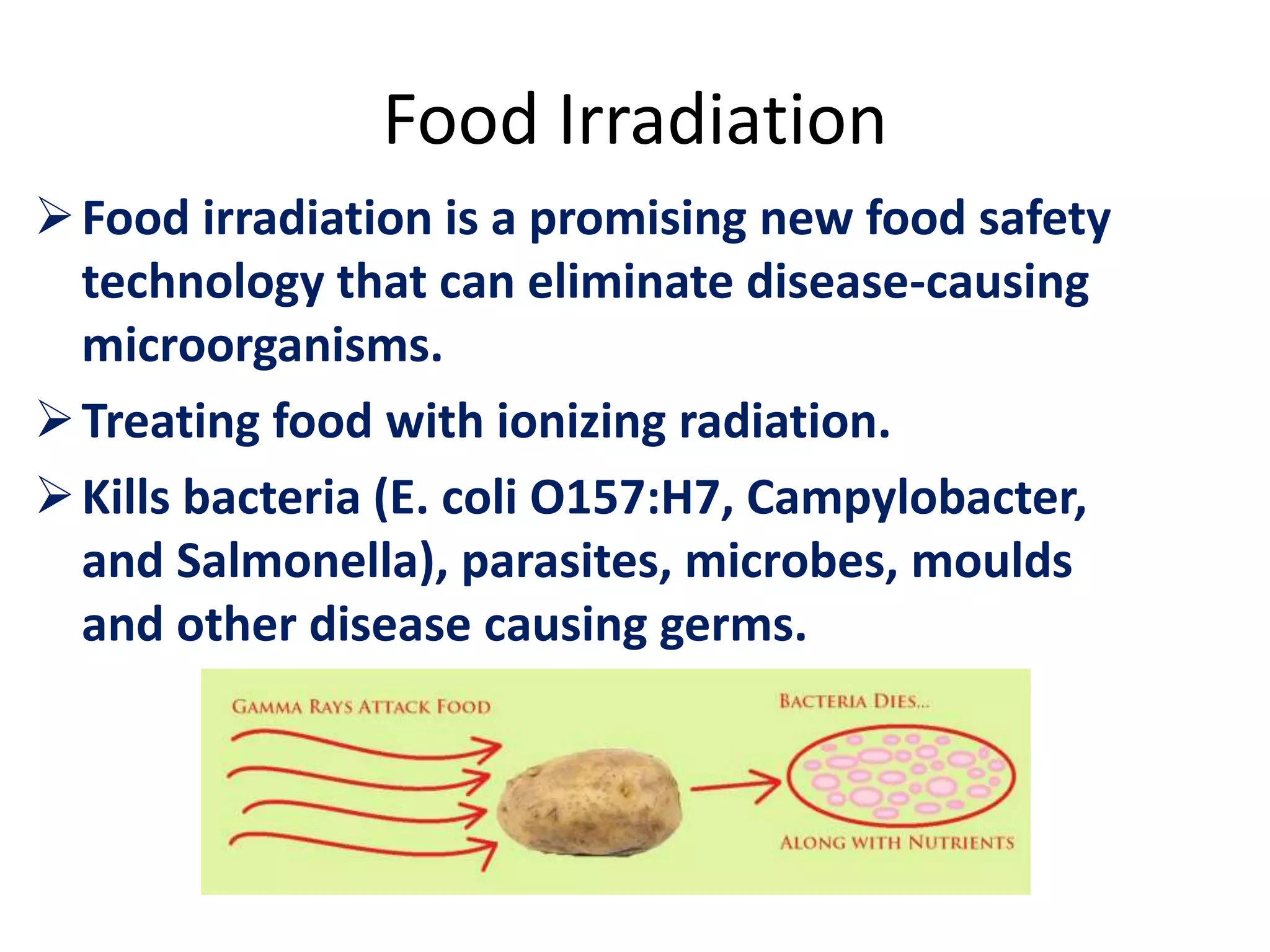
Food irradiation is a promising new food safety
technology that can eliminate disease-causing
microorganisms.
Treating food with ionizing radiation.
Kills bacteria (E. coli O157:H7, Campylobacter,
and Salmonella), parasites, microbes, moulds
and other disease causing germs.
Origin Of Food Irradiation
• 1895-First paper Produced about irradiating food.
• 1905-Scientist used radiation to kill the bacteria in food.
• 1920-French scientist discover irradiation preserves food.
• 1930-O. West killed bacteria in packaged food with X-rays.
• 1940-US army tested irradiation of common foods.
• 1970-NASA adopts irradiation to sterilize foods for astronouts.
• 2004-International Consultative Group on Food
Irradiation(ICGFI) was developed.
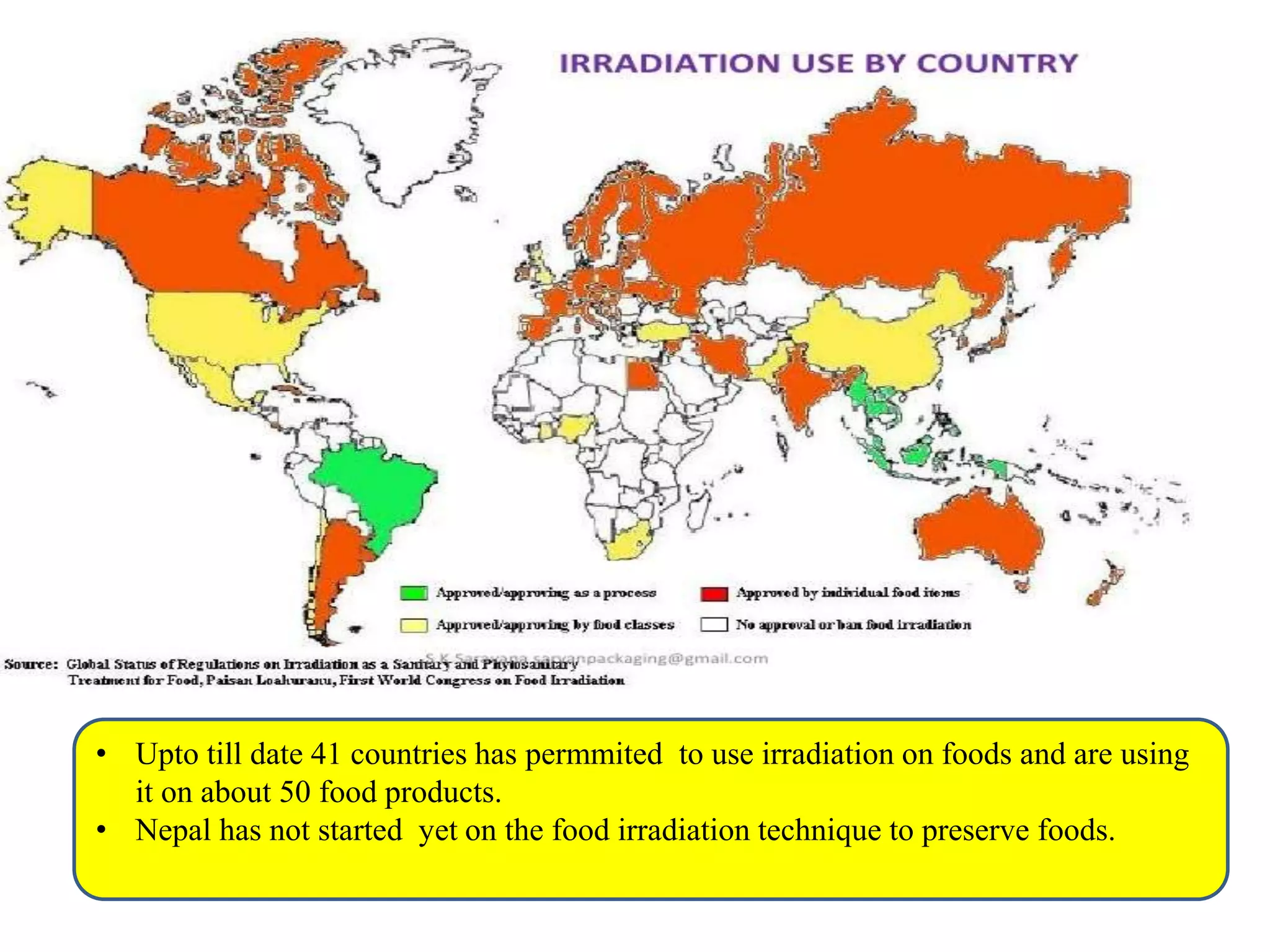
• Upto till date 41 countries has permmited to use irradiation on foods and are using
it on about 50 food products.
• Nepal has not started yet on the food irradiation technique to preserve foods.
How does Irradiation works?
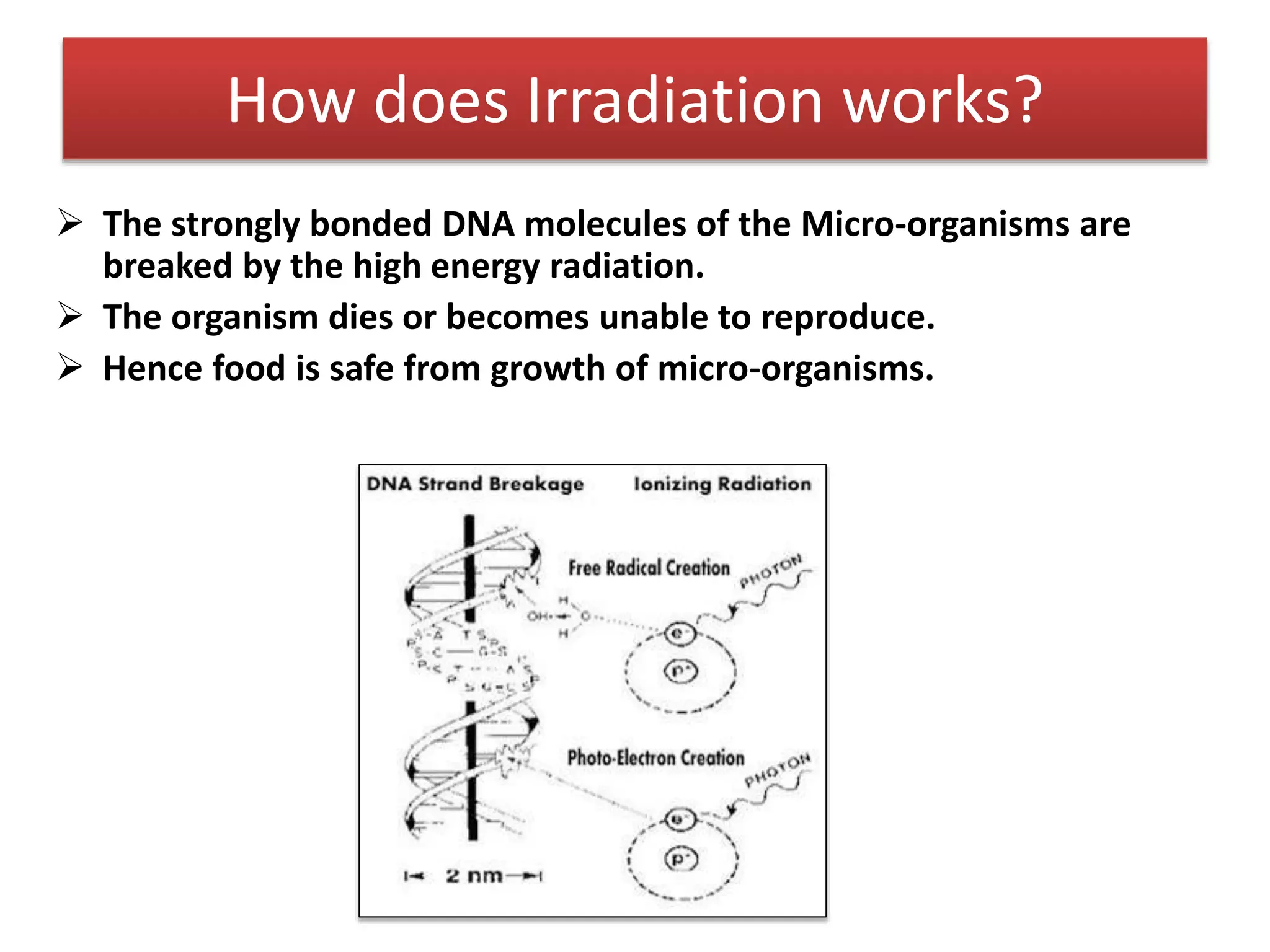
 The strongly bonded DNA molecules of the Micro-organisms are
breaked by the high energy radiation.
 The organism dies or becomes unable to reproduce.
 Hence food is safe from growth of micro-organisms.
Organization which support the use of
irradiation
 American Association of Meat Processors
 American Council on Science and Health
 American Medical Association
 American Veterinary Medical Association
 Food and Drug Administration
 Infectious Diseases Society of America
 National Cattlemen’s Beef Association
 National Food Processors Association
 New England Journal of Medicine
 The Mayo Clinic
 U.S. Department of Agriculture
 World Health Organization
Advantages of Food Radiation
• Does not change the sensory characteristics of foods.
• Disease causing germs are reduced or eliminated.
• Nutritional value of the food is preserved.
• Food poisoning bacteria can be easily destroyed as
they are low resistant to irradiation.
• Decreases incidence of food borne illness.
Disadvantages of Food Irradiation
• High capital cost.
• Applicable for limited range of foods(Not suitable for high fat
foods such as egg).
• Ineffective against viruses.
• Relatively expensive technology.
• Doses used vary with products.
• Can cause oxidation of fat in dairy products.
• Loss of vitamins such as vitamin-C, vitamin-E, etc.
Food Irradiation

Food Irradiation

  • 1.
  • 2.
    PREPARED BY: Krishna Sedai (071-BAG-22) IOEPURWANCHAL CAMPUS DHARAN,SUNSARI IRRADIATION OF FOOD
  • 3.
    Radiation • the processin which energy is emitted as particles or waves. • Its types are ionizing and non-ionizing
  • 4.
    Irradiation  Irradiation isthe process by which an object is exposed to radiation.  The exposure can originate from various sources, including natural sources.  Most frequently the term refers to ionizing radiation.  Acted upon by high energy invisble light waves such as gamma rays,X-rays or electron beams.  Used for partial or complete sterilization .
  • 5.
    Food Irradiation Food irradiationis a promising new food safety technology that can eliminate disease-causing microorganisms. Treating food with ionizing radiation. Kills bacteria (E. coli O157:H7, Campylobacter, and Salmonella), parasites, microbes, moulds and other disease causing germs.
  • 6.
    Origin Of FoodIrradiation • 1895-First paper Produced about irradiating food. • 1905-Scientist used radiation to kill the bacteria in food. • 1920-French scientist discover irradiation preserves food. • 1930-O. West killed bacteria in packaged food with X-rays. • 1940-US army tested irradiation of common foods. • 1970-NASA adopts irradiation to sterilize foods for astronouts. • 2004-International Consultative Group on Food Irradiation(ICGFI) was developed.
  • 7.
    • Upto tilldate 41 countries has permmited to use irradiation on foods and are using it on about 50 food products. • Nepal has not started yet on the food irradiation technique to preserve foods.
  • 8.
    How does Irradiationworks?  The strongly bonded DNA molecules of the Micro-organisms are breaked by the high energy radiation.  The organism dies or becomes unable to reproduce.  Hence food is safe from growth of micro-organisms.
  • 9.
    Organization which supportthe use of irradiation  American Association of Meat Processors  American Council on Science and Health  American Medical Association  American Veterinary Medical Association  Food and Drug Administration  Infectious Diseases Society of America  National Cattlemen’s Beef Association  National Food Processors Association  New England Journal of Medicine  The Mayo Clinic  U.S. Department of Agriculture  World Health Organization
  • 11.
    Advantages of FoodRadiation • Does not change the sensory characteristics of foods. • Disease causing germs are reduced or eliminated. • Nutritional value of the food is preserved. • Food poisoning bacteria can be easily destroyed as they are low resistant to irradiation. • Decreases incidence of food borne illness.
  • 12.
    Disadvantages of FoodIrradiation • High capital cost. • Applicable for limited range of foods(Not suitable for high fat foods such as egg). • Ineffective against viruses. • Relatively expensive technology. • Doses used vary with products. • Can cause oxidation of fat in dairy products. • Loss of vitamins such as vitamin-C, vitamin-E, etc.