Installation instruction
ON DC Inverter VRFDEK
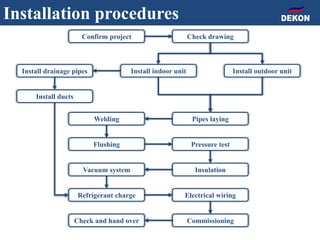
Installation procedures
Confirm project Check drawing
Install indoor unit Install outdoor unitInstall drainage pipes
Flushing
Install ducts
InsulationVacuum system
Electrical wiring
Commissioning
Welding Pipes laying
Pressure test
Refrigerant charge
Check and hand over
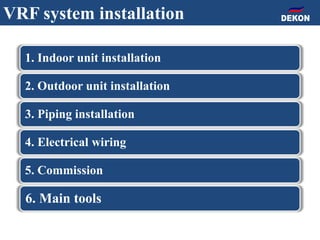
1. Indoor unit installation
2. Outdoor unit installation
3. Piping installation
4. Electrical wiring
5. Commission
6. Main tools
VRF system installation
Indoor unit installation
VRF system installation
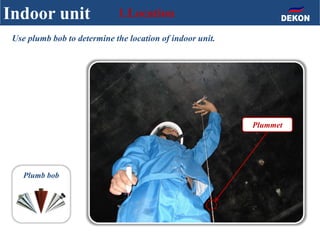
Indoor unit 1.Location
Use plumb bob to determine the location of indoor unit.
Plummet
Plumb bob
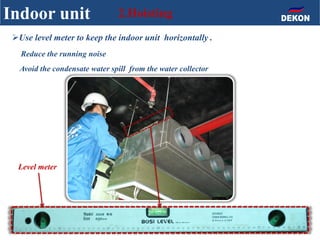
Indoor unit 2.Hoisting
Use level meter to keep the indoor unit horizontally .
Reduce the running noise
Avoid the condensate water spill from the water collector
Level meter
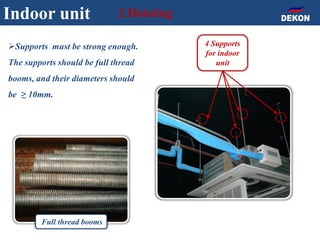
Indoor unit 2.Hoisting
Supports must be strong enough.
The supports should be full thread
booms, and their diameters should
be ≥ 10mm.
Full thread booms
4 Supports
for indoor
unit
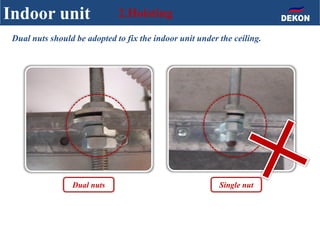
Indoor unit 2.Hoisting
Dual nuts should be adopted to fix the indoor unit under the ceiling.
Dual nuts Single nut
Indoor unit 2.Hoisting
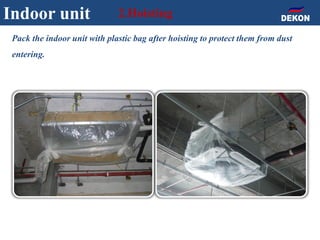
Pack the indoor unit with plastic bag after hoisting to protect them from dust
entering.
Outdoor unit installation
VRF system installation
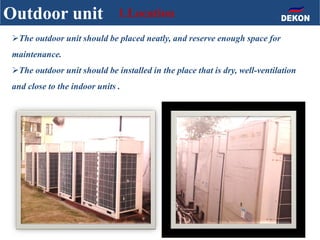
The outdoor unit should be placed neatly, and reserve enough space for
maintenance.
The outdoor unit should be installed in the place that is dry, well-ventilation
and close to the indoor units .
Outdoor unit 1.Location
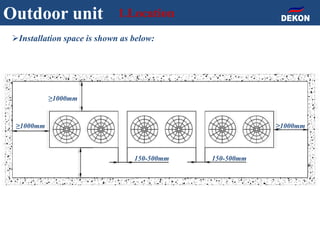
≥1000mm
≥1000mm
150-500mm
≥1000mm
150-500mm
Installation space is shown as below:
Outdoor unit 1.Location
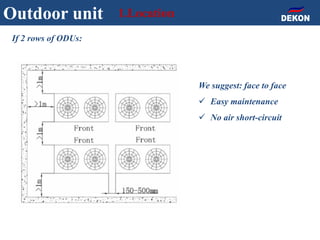
If 2 rows of ODUs:
Outdoor unit 1.Location
We suggest: face to face
 Easy maintenance
 No air short-circuit
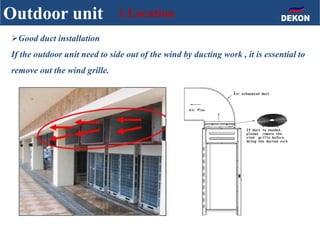
Good duct installation
If the outdoor unit need to side out of the wind by ducting work , it is essential to
remove out the wind grille.
Outdoor unit 1.Location
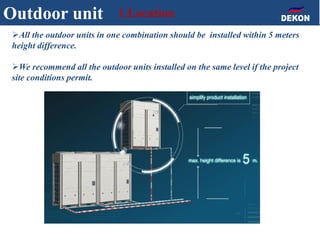
All the outdoor units in one combination should be installed within 5 meters
height difference.
We recommend all the outdoor units installed on the same level if the project
site conditions permit.
Outdoor unit 1.Location
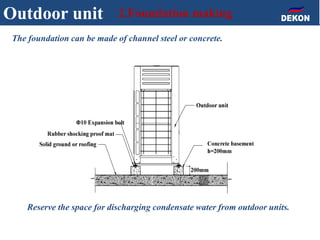
The foundation can be made of channel steel or concrete.
Outdoor unit 2.Foundation making
Reserve the space for discharging condensate water from outdoor units.
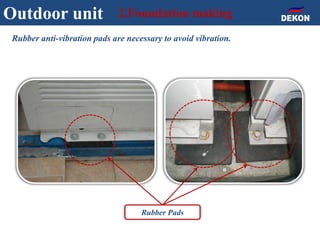
Rubber anti-vibration pads are necessary to avoid vibration.
Rubber Pads
Outdoor unit 2.Foundation making
Piping installation
VRF system installation
Piping 0.Pipe storing
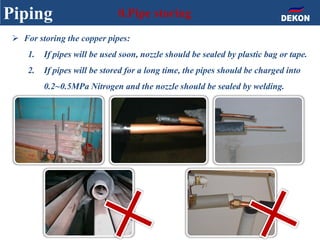
 For storing the copper pipes:
1. If pipes will be used soon, nozzle should be sealed by plastic bag or tape.
2. If pipes will be stored for a long time, the pipes should be charged into
0.2~0.5MPa Nitrogen and the nozzle should be sealed by welding.
Piping 1.Procedures
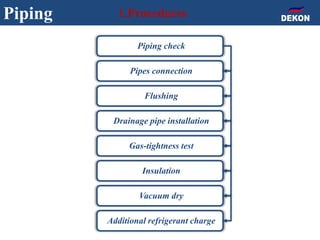
Piping check
Pipes connection
Flushing
Drainage pipe installation
Gas-tightness test
Insulation
Vacuum dry
Additional refrigerant charge
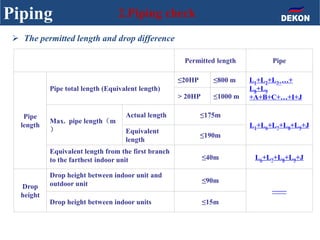
Piping 2.Piping check
 The permitted length and drop difference
Permitted length Pipe
Pipe
length
Pipe total length (Equivalent length)
≤20HP ≤800 m L1+L2+L3+…+
L8+L9
+A+B+C+…+I+J> 20HP ≤1000 m
Max. pipe length(m
)
Actual length ≤175m
L1+L6+L7+L8+L9+J
Equivalent
length
≤190m
Equivalent length from the first branch
to the farthest indoor unit ≤40m L6+L7+L8+L9+J
Drop
height
Drop height between indoor unit and
outdoor unit ≤90m
——
Drop height between indoor units ≤15m
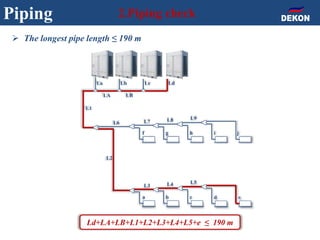
Piping 2.Piping check
LdLcLbLa
LBLA
L1
L6
L2
L7 L8 L9
f g h i j
L3 L4 L5
a b c d e
 The longest pipe length ≤ 190 m
Ld+LA+LB+L1+L2+L3+L4+L5+e ≤ 190 m
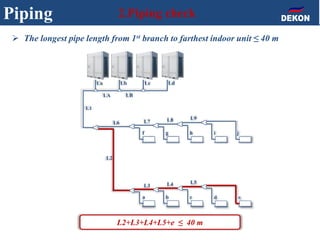
Piping 2.Piping check
LdLcLbLa
LBLA
L1
L6
L2
L7 L8 L9
f g h i j
L3 L4 L5
a b c d e
 The longest pipe length from 1st branch to farthest indoor unit ≤ 40 m
L2+L3+L4+L5+e ≤ 40 m
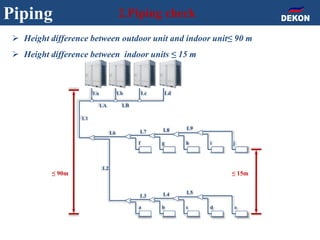
Piping 2.Piping check
LdLcLbLa
LBLA
L1
L6
L2
L7 L8 L9
f g h i j
L3 L4 L5
a b c d e
 Height difference between outdoor unit and indoor unit≤ 90 m
 Height difference between indoor units ≤ 15 m
≤ 15m≤ 90m
Piping 2.Piping check
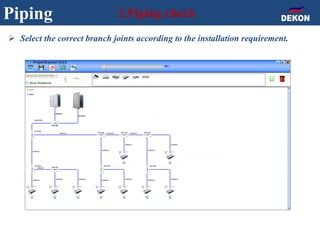
 Select the correct branch joints according to the installation requirement.
Piping 3.Pipe hanging
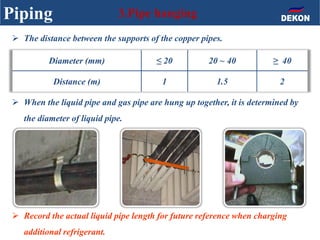
 The distance between the supports of the copper pipes.
 When the liquid pipe and gas pipe are hung up together, it is determined by
the diameter of liquid pipe.
Diameter (mm) ≤ 20 20 ~ 40 ≥ 40
Distance (m) 1 1.5 2
 Record the actual liquid pipe length for future reference when charging
additional refrigerant.
Vertically
Horizontally Horizontally
Vertically
Piping 3.Pipe connection
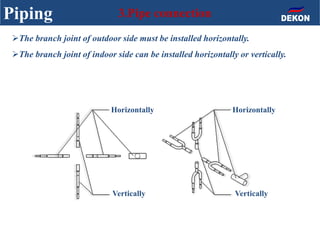
The branch joint of outdoor side must be installed horizontally.
The branch joint of indoor side can be installed horizontally or vertically.
Piping 3.Pipe connection
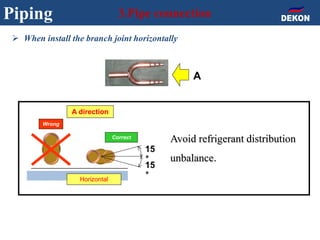
 When install the branch joint horizontally
A
15
°
15
°
A direction
Wrong
Correct
Horizontal
Avoid refrigerant distribution
unbalance.
Piping 3.Pipe connection
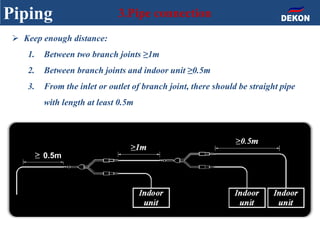
 Keep enough distance:
1. Between two branch joints ≥1m
2. Between branch joints and indoor unit ≥0.5m
3. From the inlet or outlet of branch joint, there should be straight pipe
with length at least 0.5m
0.5m
Piping 3.Pipe connection
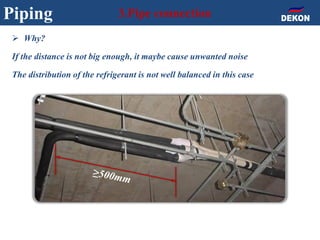
 Why?
If the distance is not big enough, it maybe cause unwanted noise
The distribution of the refrigerant is not well balanced in this case
Piping 3.Pipe connection
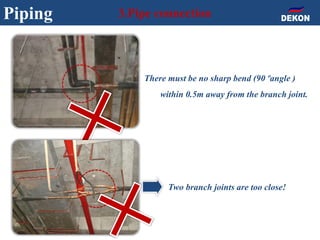
Two branch joints are too close!
There must be no sharp bend (90ºangle )
within 0.5m away from the branch joint.
Piping 3.Pipe connection
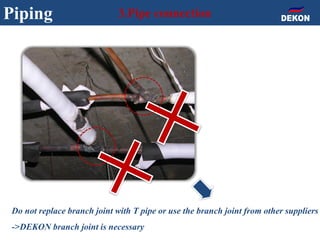
Do not replace branch joint with T pipe or use the branch joint from other suppliers
->DEKON branch joint is necessary
Piping 3.Pipe connection
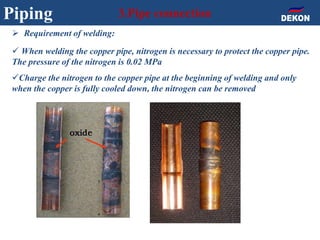
 Requirement of welding:
 When welding the copper pipe, nitrogen is necessary to protect the copper pipe.
The pressure of the nitrogen is 0.02 MPa
Charge the nitrogen to the copper pipe at the beginning of welding and only
when the copper is fully cooled down, the nitrogen can be removed
Piping 3.Pipe connection
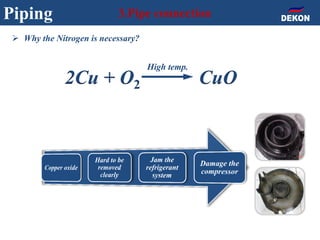
2Cu + O2 CuO
High temp.
 Why the Nitrogen is necessary?
Piping 3.Pipe connection
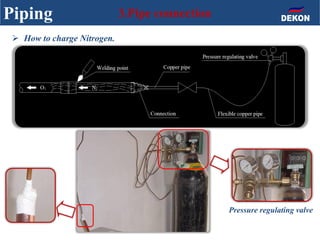
 How to charge Nitrogen.
Pressure regulating valve
Piping 3.Pipe connection
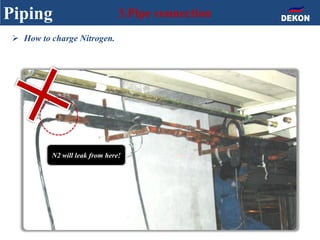
 How to charge Nitrogen.
N2 will leak from here!
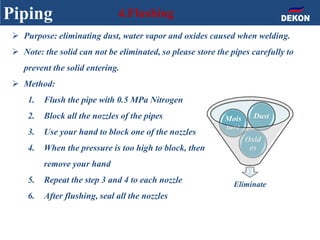
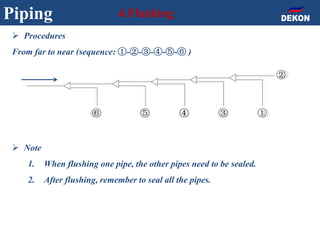
Piping 4.Flushing
 Purpose: eliminating dust, water vapor and oxides caused when welding.
 Note: the solid can not be eliminated, so please store the pipes carefully to
prevent the solid entering.
 Method:
1. Flush the pipe with 0.5 MPa Nitrogen
2. Block all the nozzles of the pipes
3. Use your hand to block one of the nozzles
4. When the pressure is too high to block, then
remove your hand
5. Repeat the step 3 and 4 to each nozzle
6. After flushing, seal all the nozzles
Eliminate
Oxid
es
Mois
ture
Dust
Piping 4.Flushing
②
⑥ ⑤ ④ ③ ①
 Procedures
From far to near (sequence: ①-②-③-④-⑤-⑥ )
 Note
1. When flushing one pipe, the other pipes need to be sealed.
2. After flushing, remember to seal all the pipes.
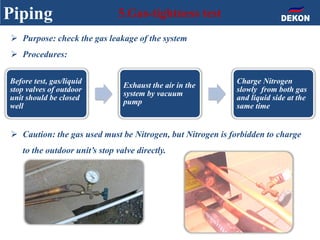
Piping 5.Gas-tightness test
Before test, gas/liquid
stop valves of outdoor
unit should be closed
well
Exhaust the air in the
system by vacuum
pump
Charge Nitrogen
slowly from both gas
and liquid side at the
same time
 Purpose: check the gas leakage of the system
 Procedures:
 Caution: the gas used must be Nitrogen, but Nitrogen is forbidden to charge
to the outdoor unit’s stop valve directly.
Piping 5.Gas-tightness test
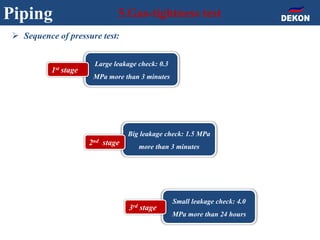
 Sequence of pressure test:
Small leakage check: 4.0
MPa more than 24 hours
3rd stage
Big leakage check: 1.5 MPa
more than 3 minutes
2nd stage
Large leakage check: 0.3
MPa more than 3 minutes
1st stage
Piping 6.Insulation
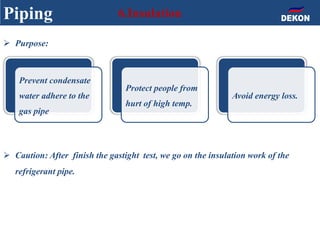
Prevent condensate
water adhere to the
gas pipe
Protect people from
hurt of high temp.
Avoid energy loss.
 Purpose:
 Caution: After finish the gastight test, we go on the insulation work of the
refrigerant pipe.
Piping 6.Insulation
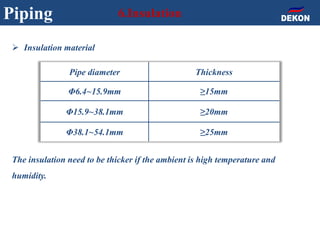
Pipe diameter Thickness
Φ6.4~15.9mm ≥15mm
Φ15.9~38.1mm ≥20mm
Φ38.1~54.1mm ≥25mm
 Insulation material
The insulation need to be thicker if the ambient is high temperature and
humidity.
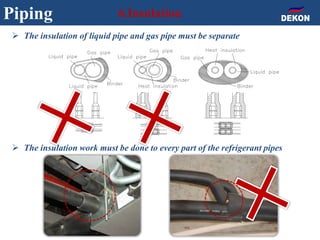
 The insulation of liquid pipe and gas pipe must be separate
 The insulation work must be done to every part of the refrigerant pipes
Piping 6.Insulation
Piping 6.Insulation
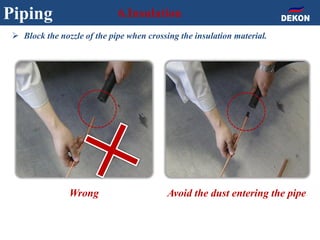
Wrong Avoid the dust entering the pipe
 Block the nozzle of the pipe when crossing the insulation material.
Piping 6.Insulation
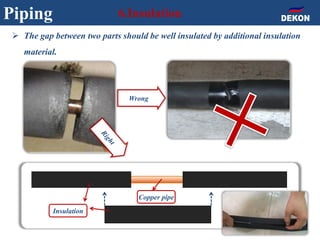
 The gap between two parts should be well insulated by additional insulation
material.
Insulation
Copper pipe
Wrong
Piping 7.Vacuum
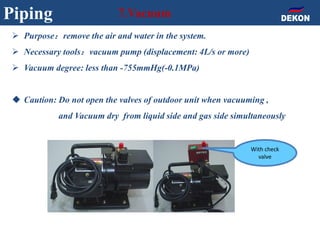
 Purpose:remove the air and water in the system.
 Necessary tools:vacuum pump (displacement: 4L/s or more)
 Vacuum degree: less than -755mmHg(-0.1MPa)
 Caution: Do not open the valves of outdoor unit when vacuuming ,
and Vacuum dry from liquid side and gas side simultaneously
With check
valve
Piping 7.Vacuum
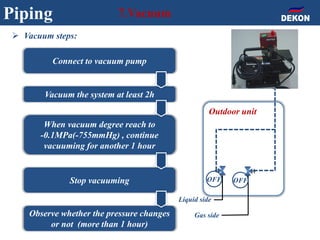
Connect to vacuum pump
When vacuum degree reach to
-0.1MPa(-755mmHg) , continue
vacuuming for another 1 hour
Observe whether the pressure changes
or not (more than 1 hour)
Stop vacuuming
Vacuum the system at least 2h
Outdoor unit
OFF OFF
Gas side
Liquid side
 Vacuum steps:
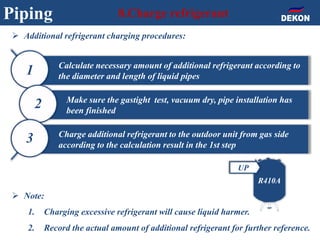
 Additional refrigerant charging procedures:
 Note:
1. Charging excessive refrigerant will cause liquid harmer.
2. Record the actual amount of additional refrigerant for further reference.
Piping 8.Charge refrigerant
Calculate necessary amount of additional refrigerant according to
the diameter and length of liquid pipes1
Make sure the gastight test, vacuum dry, pipe installation has
been finished
2
Charge additional refrigerant to the outdoor unit from gas side
according to the calculation result in the 1st step
3
R410A
UP
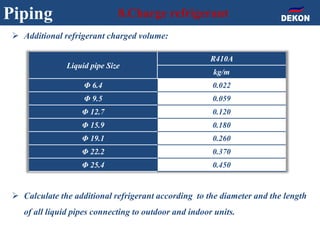
 Additional refrigerant charged volume:
 Calculate the additional refrigerant according to the diameter and the length
of all liquid pipes connecting to outdoor and indoor units.
Piping 8.Charge refrigerant
Liquid pipe Size
R410A
kg/m
Φ 6.4 0.022
Φ 9.5 0.059
Φ 12.7 0.120
Φ 15.9 0.180
Φ 19.1 0.260
Φ 22.2 0.370
Φ 25.4 0.450
Piping 9.Drainage pipe
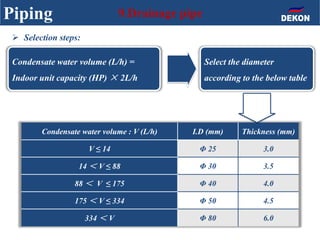
Condensate water volume (L/h) =
Indoor unit capacity (HP) × 2L/h
Select the diameter
according to the below table
Condensate water volume : V (L/h) I.D (mm) Thickness (mm)
V ≤ 14 Φ 25 3.0
14 < V ≤ 88 Φ 30 3.5
88 < V ≤ 175 Φ 40 4.0
175 < V ≤ 334 Φ 50 4.5
334 < V Φ 80 6.0
 Selection steps:
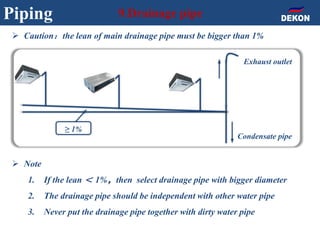
 Caution:the lean of main drainage pipe must be bigger than 1%
 Note
1. If the lean < 1%,then select drainage pipe with bigger diameter
2. The drainage pipe should be independent with other water pipe
3. Never put the drainage pipe together with dirty water pipe
Piping 9.Drainage pipe
Exhaust outlet
Condensate pipe
≥ 1%
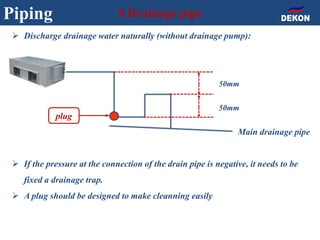
 Discharge drainage water naturally (without drainage pump):
 If the pressure at the connection of the drain pipe is negative, it needs to be
fixed a drainage trap.
 A plug should be designed to make cleanning easily
Piping 9.Drainage pipe
50mm
50mm
plug
Main drainage pipe
Piping 9.Drainage pipe
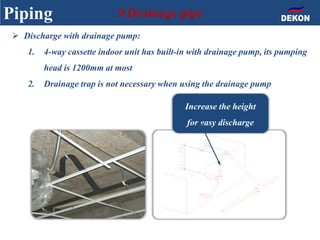
Increase the height
for easy discharge
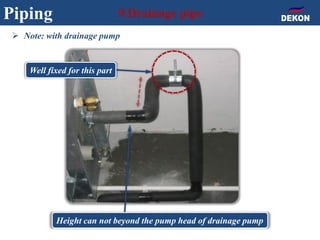
 Discharge with drainage pump:
1. 4-way cassette indoor unit has built-in with drainage pump, its pumping
head is 1200mm at most
2. Drainage trap is not necessary when using the drainage pump
Piping 9.Drainage pipe
 Note: with drainage pump
Height can not beyond the pump head of drainage pump
Well fixed for this part
Piping 9.Drainage pipe
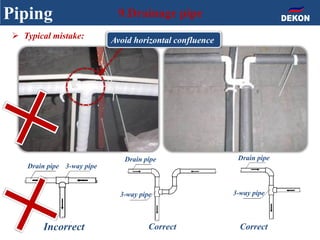
 Typical mistake:
CorrectIncorrect Correct
Drain pipe 3-way pipe
Drain pipe
3-way pipe
Drain pipe
3-way pipe
Avoid horizontal confluence
Piping 9.Drainage pipe
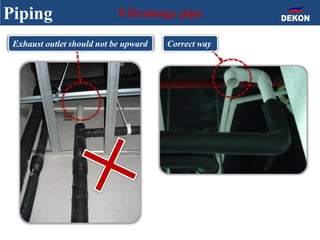
Correct wayExhaust outlet should not be upward
Piping 9.Drainage pipe
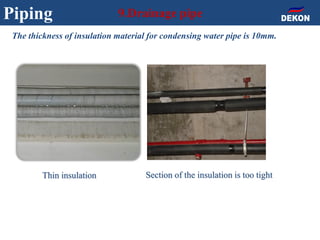
The thickness of insulation material for condensing water pipe is 10mm.
Thin insulation Section of the insulation is too tight
Piping 9.Drainage pipe
 Water leakage test
 Check leakage of water pipe
After finished installation of drainage pipe, filled the pipe with water,
waiting for 24 hours to check whether there’s any leakage.
 Check leakage from the indoor unit
Charge water from the check hole of indoor unit to check whether the
water can be exhausted smoothly or not
Electrical wiring
VRF system installation
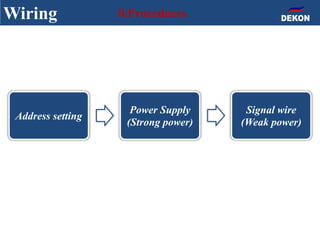
Wiring 0.Procedures
Address setting
Power Supply
(Strong power)
Signal wire
(Weak power)
Wiring 1.DIP switch setting
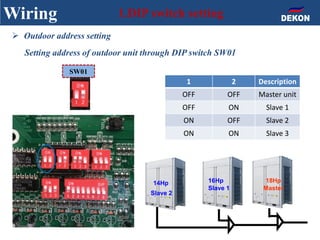
 Outdoor address setting
Setting address of outdoor unit through DIP switch SW01
1 2 Description
OFF OFF Master unit
OFF ON Slave 1
ON OFF Slave 2
ON ON Slave 3
SW01
14Hp
Slave 2
16Hp
Slave 1
18Hp
Master
Wiring 1.DIP switch setting
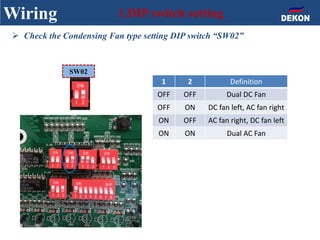
 Check the Condensing Fan type setting DIP switch “SW02”
1 2 Definition
OFF OFF Dual DC Fan
OFF ON DC fan left, AC fan right
ON OFF AC fan right, DC fan left
ON ON Dual AC Fan
SW02
Wiring 1.DIP switch setting
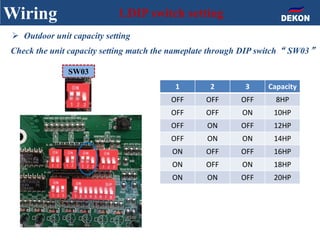
 Outdoor unit capacity setting
Check the unit capacity setting match the nameplate through DIP switch“ SW03”
SW03
1 2 3 Capacity
OFF OFF OFF 8HP
OFF OFF ON 10HP
OFF ON OFF 12HP
OFF ON ON 14HP
ON OFF OFF 16HP
ON OFF ON 18HP
ON ON OFF 20HP
Wiring 1.DIP switch setting
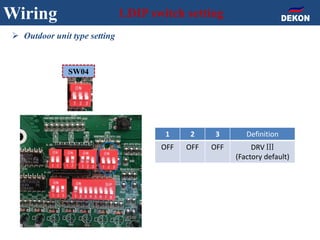
 Outdoor unit type setting
SW04
1 2 3 Definition
OFF OFF OFF DRV Ⅲ
(Factory default)
Wiring 1.DIP switch setting
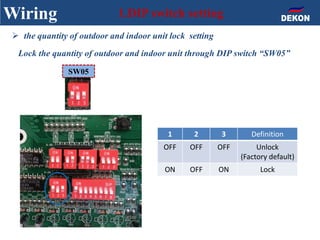
 the quantity of outdoor and indoor unit lock setting
Lock the quantity of outdoor and indoor unit through DIP switch “SW05”
SW05
1 2 3 Definition
OFF OFF OFF Unlock
(Factory default)
ON OFF ON Lock
Wiring 1.Address setting
 Indoor address setting by Remote controller
Indoor unit address
NO.
Methold
Press [Sleep] button 8 times within 5
seconds to enter into the interface of
remote parameter change;
Select “parameter NO.” as “1” to enter
the indoor unit addressing mode;
set “Indoor unit address NO.” as
required on site;
press “sending button” to send order;
When hearing buzzer once, it indicates
successful setting
Wiring 2.Power supply
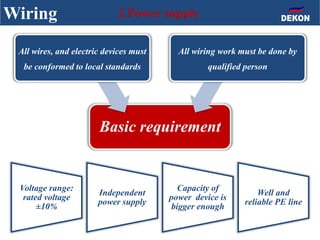
Basic requirement
All wires, and electric devices must
be conformed to local standards
All wiring work must be done by
qualified person
Voltage range:
rated voltage
±10%
Independent
power supply
Capacity of
power device is
bigger enough
Well and
reliable PE line
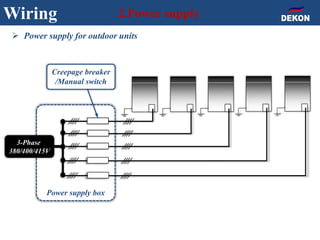
Power supply box
Wiring 2.Power supply
Creepage breaker
/Manual switch
3-Phase
380/400/415V
 Power supply for outdoor units
Wiring 2.Power supply
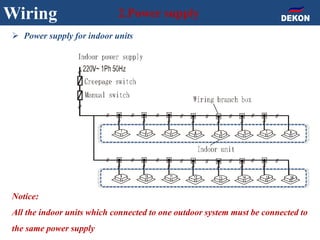
 Power supply for indoor units
Notice:
All the indoor units which connected to one outdoor system must be connected to
the same power supply
Wiring 2.Power supply
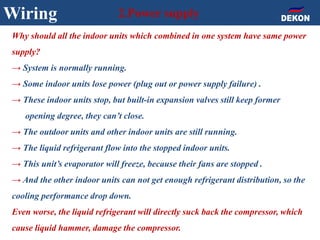
Why should all the indoor units which combined in one system have same power
supply?
→ System is normally running.
→ Some indoor units lose power (plug out or power supply failure) .
→ These indoor units stop, but built-in expansion valves still keep former
opening degree, they can’t close.
→ The outdoor units and other indoor units are still running.
→ The liquid refrigerant flow into the stopped indoor units.
→ This unit’s evaporator will freeze, because their fans are stopped .
→ And the other indoor units can not get enough refrigerant distribution, so the
cooling performance drop down.
Even worse, the liquid refrigerant will directly suck back the compressor, which
cause liquid hammer, damage the compressor.
Wiring 2.Power supply
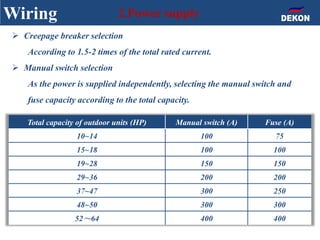
 Creepage breaker selection
According to 1.5-2 times of the total rated current.
 Manual switch selection
As the power is supplied independently, selecting the manual switch and
fuse capacity according to the total capacity.
Total capacity of outdoor units (HP) Manual switch (A) Fuse (A)
10~14 100 75
15~18 100 100
19~28 150 150
29~36 200 200
37~47 300 250
48~50 300 300
52~64 400 400
Wiring 2.Power supply
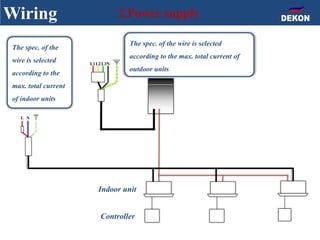
The spec. of the wire is selected
according to the max. total current of
outdoor units
The spec. of the
wire is selected
according to the
max. total current
of indoor units
L N
Indoor unit
Controller
L1L2L3N
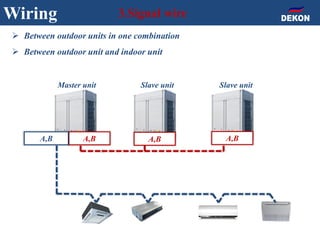
Wiring 3.Signal wire
 Between outdoor units in one combination
 Between outdoor unit and indoor unit
A,BA,B
Master unit Slave unitSlave unit
A,B A,B
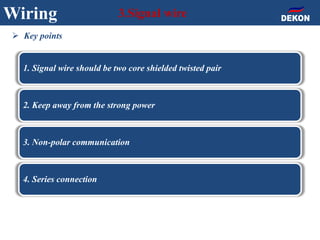
Wiring 3.Signal wire
1. Signal wire should be two core shielded twisted pair
2. Keep away from the strong power
3. Non-polar communication
4. Series connection
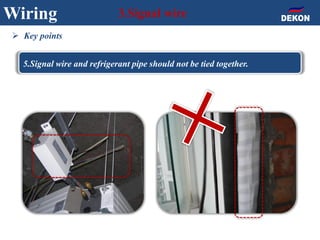
 Key points
Wiring 3.Signal wire
 Key points
5.Signal wire and refrigerant pipe should not be tied together.
Commission
VRF system installation
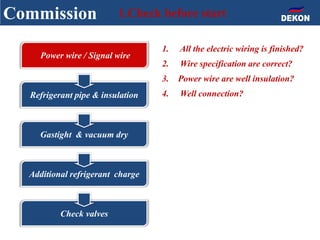
Commission 1.Check before start
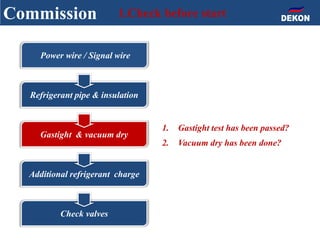
Power wire / Signal wire
Refrigerant pipe & insulation
Gastight & vacuum dry
1. All the electric wiring is finished?
2. Wire specification are correct?
3. Power wire are well insulation?
4. Well connection?
Additional refrigerant charge
Check valves
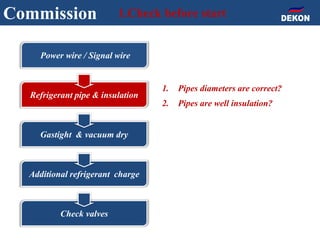
Commission 1.Check before start
1. Pipes diameters are correct?
2. Pipes are well insulation?
Power wire / Signal wire
Refrigerant pipe & insulation
Gastight & vacuum dry
Additional refrigerant charge
Check valves
Commission 1.Check before start
1. Gastight test has been passed?
2. Vacuum dry has been done?
Power wire / Signal wire
Refrigerant pipe & insulation
Gastight & vacuum dry
Additional refrigerant charge
Check valves
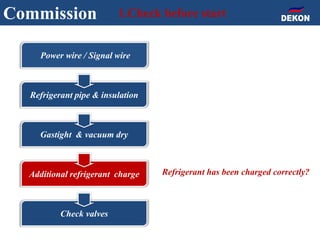
Commission 1.Check before start
Refrigerant has been charged correctly?
Power wire / Signal wire
Refrigerant pipe & insulation
Gastight & vacuum dry
Additional refrigerant charge
Check valves
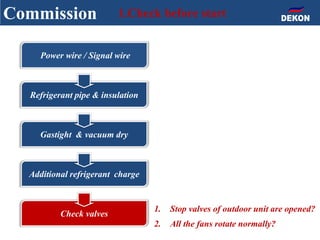
Commission 1.Check before start
1. Stop valves of outdoor unit are opened?
2. All the fans rotate normally?
Power wire / Signal wire
Refrigerant pipe & insulation
Gastight & vacuum dry
Additional refrigerant charge
Check valves
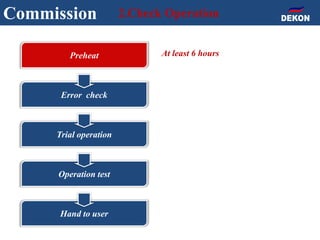
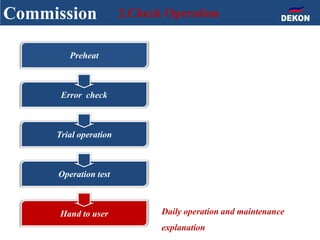
Commission 2.Check Operation
At least 6 hoursPreheat
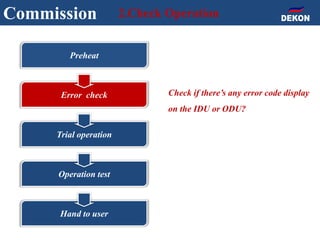
Error check
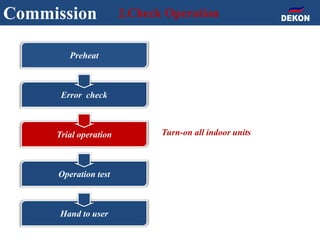
Trial operation
Operation test
Hand to user
Commission 2.Check Operation
Check if there’s any error code display
on the IDU or ODU?
Preheat
Error check
Trial operation
Operation test
Hand to user
Commission 2.Check Operation
Turn-on all indoor units
Preheat
Error check
Trial operation
Operation test
Hand to user
Commission 2.Check Operation
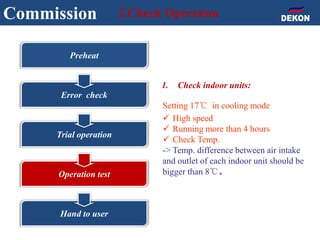
1. Check indoor units:
Preheat
Error check
Trial operation
Operation test
Hand to user
Setting 17℃ in cooling mode
 High speed
 Running more than 4 hours
 Check Temp.
-> Temp. difference between air intake
and outlet of each indoor unit should be
bigger than 8℃。
Commission 2.Check Operation
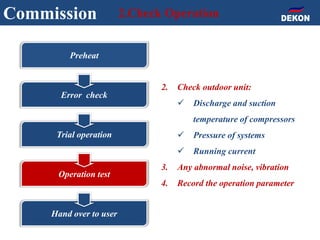
2. Check outdoor unit:
 Discharge and suction
temperature of compressors
 Pressure of systems
 Running current
3. Any abnormal noise, vibration
4. Record the operation parameter
Preheat
Error check
Trial operation
Operation test
Hand over to user
Commission 2.Check Operation
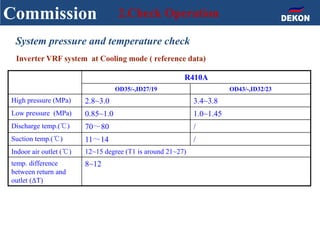
System pressure and temperature check
R410A
OD35/-,ID27/19 OD43/-,ID32/23
High pressure (MPa) 2.8~3.0 3.4~3.8
Low pressure (MPa) 0.85~1.0 1.0~1.45
Discharge temp.(℃) 70~80 /
Suction temp.(℃) 11~14 /
Indoor air outlet (℃) 12~15 degree (T1 is around 21~27)
temp. difference
between return and
outlet (ΔT)
8~12
Commission 2.Check Operation
Daily operation and maintenance
explanation
Preheat
Error check
Trial operation
Operation test
Hand to user
Main tools
VRF system installation
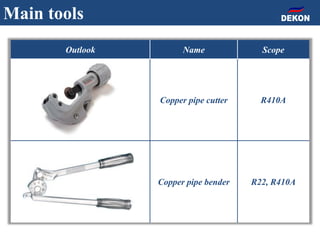
Outlook Name Scope
Copper pipe cutter R410A
Copper pipe bender R22, R410A
Main tools
Outlook Name Scope
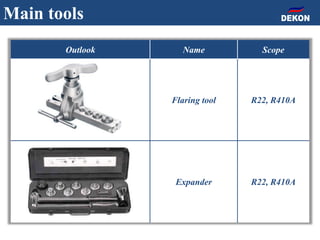
Flaring tool R22, R410A
Expander R22, R410A
Main tools
Outlook Name Scope
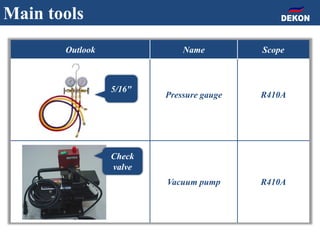
Pressure gauge R410A
Vacuum pump R410A
Main tools
5/16″
Check
valve
Outlook Name
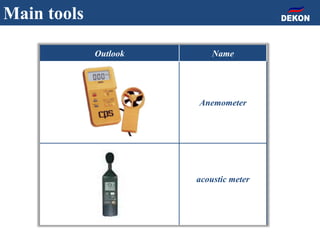
Anemometer
acoustic meter
Main tools
Outlook Name
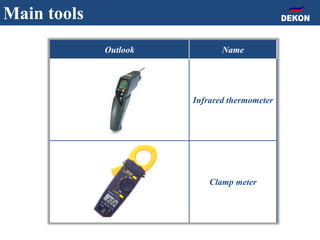
Infrared thermometer
Clamp meter
Main tools
Outlook Name
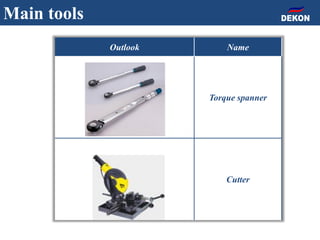
Torque spanner
Cutter
Main tools
Outlook Name
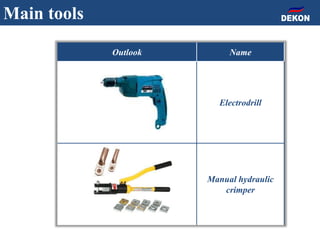
Electrodrill
Manual hydraulic
crimper
Main tools
Thank you!

Dc inverter vrf installation instructions and Tips

  • 1.
  • 2.
    Installation procedures Confirm projectCheck drawing Install indoor unit Install outdoor unitInstall drainage pipes Flushing Install ducts InsulationVacuum system Electrical wiring Commissioning Welding Pipes laying Pressure test Refrigerant charge Check and hand over
  • 3.
    1. Indoor unitinstallation 2. Outdoor unit installation 3. Piping installation 4. Electrical wiring 5. Commission 6. Main tools VRF system installation
  • 4.
    Indoor unit installation VRFsystem installation
  • 5.
    Indoor unit 1.Location Useplumb bob to determine the location of indoor unit. Plummet Plumb bob
  • 6.
    Indoor unit 2.Hoisting Uselevel meter to keep the indoor unit horizontally . Reduce the running noise Avoid the condensate water spill from the water collector Level meter
  • 7.
    Indoor unit 2.Hoisting Supportsmust be strong enough. The supports should be full thread booms, and their diameters should be ≥ 10mm. Full thread booms 4 Supports for indoor unit
  • 8.
    Indoor unit 2.Hoisting Dualnuts should be adopted to fix the indoor unit under the ceiling. Dual nuts Single nut
  • 9.
    Indoor unit 2.Hoisting Packthe indoor unit with plastic bag after hoisting to protect them from dust entering.
  • 10.
    Outdoor unit installation VRFsystem installation
  • 11.
    The outdoor unitshould be placed neatly, and reserve enough space for maintenance. The outdoor unit should be installed in the place that is dry, well-ventilation and close to the indoor units . Outdoor unit 1.Location
  • 12.
  • 13.
    If 2 rowsof ODUs: Outdoor unit 1.Location We suggest: face to face  Easy maintenance  No air short-circuit
  • 14.
    Good duct installation Ifthe outdoor unit need to side out of the wind by ducting work , it is essential to remove out the wind grille. Outdoor unit 1.Location
  • 15.
    All the outdoorunits in one combination should be installed within 5 meters height difference. We recommend all the outdoor units installed on the same level if the project site conditions permit. Outdoor unit 1.Location
  • 16.
    The foundation canbe made of channel steel or concrete. Outdoor unit 2.Foundation making Reserve the space for discharging condensate water from outdoor units.
  • 17.
    Rubber anti-vibration padsare necessary to avoid vibration. Rubber Pads Outdoor unit 2.Foundation making
  • 18.
  • 19.
    Piping 0.Pipe storing For storing the copper pipes: 1. If pipes will be used soon, nozzle should be sealed by plastic bag or tape. 2. If pipes will be stored for a long time, the pipes should be charged into 0.2~0.5MPa Nitrogen and the nozzle should be sealed by welding.
  • 20.
    Piping 1.Procedures Piping check Pipesconnection Flushing Drainage pipe installation Gas-tightness test Insulation Vacuum dry Additional refrigerant charge
  • 21.
    Piping 2.Piping check The permitted length and drop difference Permitted length Pipe Pipe length Pipe total length (Equivalent length) ≤20HP ≤800 m L1+L2+L3+…+ L8+L9 +A+B+C+…+I+J> 20HP ≤1000 m Max. pipe length(m ) Actual length ≤175m L1+L6+L7+L8+L9+J Equivalent length ≤190m Equivalent length from the first branch to the farthest indoor unit ≤40m L6+L7+L8+L9+J Drop height Drop height between indoor unit and outdoor unit ≤90m —— Drop height between indoor units ≤15m
  • 22.
    Piping 2.Piping check LdLcLbLa LBLA L1 L6 L2 L7L8 L9 f g h i j L3 L4 L5 a b c d e  The longest pipe length ≤ 190 m Ld+LA+LB+L1+L2+L3+L4+L5+e ≤ 190 m
  • 23.
    Piping 2.Piping check LdLcLbLa LBLA L1 L6 L2 L7L8 L9 f g h i j L3 L4 L5 a b c d e  The longest pipe length from 1st branch to farthest indoor unit ≤ 40 m L2+L3+L4+L5+e ≤ 40 m
  • 24.
    Piping 2.Piping check LdLcLbLa LBLA L1 L6 L2 L7L8 L9 f g h i j L3 L4 L5 a b c d e  Height difference between outdoor unit and indoor unit≤ 90 m  Height difference between indoor units ≤ 15 m ≤ 15m≤ 90m
  • 25.
    Piping 2.Piping check Select the correct branch joints according to the installation requirement.
  • 26.
    Piping 3.Pipe hanging The distance between the supports of the copper pipes.  When the liquid pipe and gas pipe are hung up together, it is determined by the diameter of liquid pipe. Diameter (mm) ≤ 20 20 ~ 40 ≥ 40 Distance (m) 1 1.5 2  Record the actual liquid pipe length for future reference when charging additional refrigerant.
  • 27.
    Vertically Horizontally Horizontally Vertically Piping 3.Pipeconnection The branch joint of outdoor side must be installed horizontally. The branch joint of indoor side can be installed horizontally or vertically.
  • 28.
    Piping 3.Pipe connection When install the branch joint horizontally A 15 ° 15 ° A direction Wrong Correct Horizontal Avoid refrigerant distribution unbalance.
  • 29.
    Piping 3.Pipe connection Keep enough distance: 1. Between two branch joints ≥1m 2. Between branch joints and indoor unit ≥0.5m 3. From the inlet or outlet of branch joint, there should be straight pipe with length at least 0.5m 0.5m
  • 30.
    Piping 3.Pipe connection Why? If the distance is not big enough, it maybe cause unwanted noise The distribution of the refrigerant is not well balanced in this case
  • 31.
    Piping 3.Pipe connection Twobranch joints are too close! There must be no sharp bend (90ºangle ) within 0.5m away from the branch joint.
  • 32.
    Piping 3.Pipe connection Donot replace branch joint with T pipe or use the branch joint from other suppliers ->DEKON branch joint is necessary
  • 33.
    Piping 3.Pipe connection Requirement of welding:  When welding the copper pipe, nitrogen is necessary to protect the copper pipe. The pressure of the nitrogen is 0.02 MPa Charge the nitrogen to the copper pipe at the beginning of welding and only when the copper is fully cooled down, the nitrogen can be removed
  • 34.
    Piping 3.Pipe connection 2Cu+ O2 CuO High temp.  Why the Nitrogen is necessary?
  • 35.
    Piping 3.Pipe connection How to charge Nitrogen. Pressure regulating valve
  • 36.
    Piping 3.Pipe connection How to charge Nitrogen. N2 will leak from here!
  • 37.
    Piping 4.Flushing  Purpose:eliminating dust, water vapor and oxides caused when welding.  Note: the solid can not be eliminated, so please store the pipes carefully to prevent the solid entering.  Method: 1. Flush the pipe with 0.5 MPa Nitrogen 2. Block all the nozzles of the pipes 3. Use your hand to block one of the nozzles 4. When the pressure is too high to block, then remove your hand 5. Repeat the step 3 and 4 to each nozzle 6. After flushing, seal all the nozzles Eliminate Oxid es Mois ture Dust
  • 38.
    Piping 4.Flushing ② ⑥ ⑤④ ③ ①  Procedures From far to near (sequence: ①-②-③-④-⑤-⑥ )  Note 1. When flushing one pipe, the other pipes need to be sealed. 2. After flushing, remember to seal all the pipes.
  • 39.
    Piping 5.Gas-tightness test Beforetest, gas/liquid stop valves of outdoor unit should be closed well Exhaust the air in the system by vacuum pump Charge Nitrogen slowly from both gas and liquid side at the same time  Purpose: check the gas leakage of the system  Procedures:  Caution: the gas used must be Nitrogen, but Nitrogen is forbidden to charge to the outdoor unit’s stop valve directly.
  • 40.
    Piping 5.Gas-tightness test Sequence of pressure test: Small leakage check: 4.0 MPa more than 24 hours 3rd stage Big leakage check: 1.5 MPa more than 3 minutes 2nd stage Large leakage check: 0.3 MPa more than 3 minutes 1st stage
  • 41.
    Piping 6.Insulation Prevent condensate wateradhere to the gas pipe Protect people from hurt of high temp. Avoid energy loss.  Purpose:  Caution: After finish the gastight test, we go on the insulation work of the refrigerant pipe.
  • 42.
    Piping 6.Insulation Pipe diameterThickness Φ6.4~15.9mm ≥15mm Φ15.9~38.1mm ≥20mm Φ38.1~54.1mm ≥25mm  Insulation material The insulation need to be thicker if the ambient is high temperature and humidity.
  • 43.
     The insulationof liquid pipe and gas pipe must be separate  The insulation work must be done to every part of the refrigerant pipes Piping 6.Insulation
  • 44.
    Piping 6.Insulation Wrong Avoidthe dust entering the pipe  Block the nozzle of the pipe when crossing the insulation material.
  • 45.
    Piping 6.Insulation  Thegap between two parts should be well insulated by additional insulation material. Insulation Copper pipe Wrong
  • 46.
    Piping 7.Vacuum  Purpose:removethe air and water in the system.  Necessary tools:vacuum pump (displacement: 4L/s or more)  Vacuum degree: less than -755mmHg(-0.1MPa)  Caution: Do not open the valves of outdoor unit when vacuuming , and Vacuum dry from liquid side and gas side simultaneously With check valve
  • 47.
    Piping 7.Vacuum Connect tovacuum pump When vacuum degree reach to -0.1MPa(-755mmHg) , continue vacuuming for another 1 hour Observe whether the pressure changes or not (more than 1 hour) Stop vacuuming Vacuum the system at least 2h Outdoor unit OFF OFF Gas side Liquid side  Vacuum steps:
  • 48.
     Additional refrigerantcharging procedures:  Note: 1. Charging excessive refrigerant will cause liquid harmer. 2. Record the actual amount of additional refrigerant for further reference. Piping 8.Charge refrigerant Calculate necessary amount of additional refrigerant according to the diameter and length of liquid pipes1 Make sure the gastight test, vacuum dry, pipe installation has been finished 2 Charge additional refrigerant to the outdoor unit from gas side according to the calculation result in the 1st step 3 R410A UP
  • 49.
     Additional refrigerantcharged volume:  Calculate the additional refrigerant according to the diameter and the length of all liquid pipes connecting to outdoor and indoor units. Piping 8.Charge refrigerant Liquid pipe Size R410A kg/m Φ 6.4 0.022 Φ 9.5 0.059 Φ 12.7 0.120 Φ 15.9 0.180 Φ 19.1 0.260 Φ 22.2 0.370 Φ 25.4 0.450
  • 50.
    Piping 9.Drainage pipe Condensatewater volume (L/h) = Indoor unit capacity (HP) × 2L/h Select the diameter according to the below table Condensate water volume : V (L/h) I.D (mm) Thickness (mm) V ≤ 14 Φ 25 3.0 14 < V ≤ 88 Φ 30 3.5 88 < V ≤ 175 Φ 40 4.0 175 < V ≤ 334 Φ 50 4.5 334 < V Φ 80 6.0  Selection steps:
  • 51.
     Caution:the leanof main drainage pipe must be bigger than 1%  Note 1. If the lean < 1%,then select drainage pipe with bigger diameter 2. The drainage pipe should be independent with other water pipe 3. Never put the drainage pipe together with dirty water pipe Piping 9.Drainage pipe Exhaust outlet Condensate pipe ≥ 1%
  • 52.
     Discharge drainagewater naturally (without drainage pump):  If the pressure at the connection of the drain pipe is negative, it needs to be fixed a drainage trap.  A plug should be designed to make cleanning easily Piping 9.Drainage pipe 50mm 50mm plug Main drainage pipe
  • 53.
    Piping 9.Drainage pipe Increasethe height for easy discharge  Discharge with drainage pump: 1. 4-way cassette indoor unit has built-in with drainage pump, its pumping head is 1200mm at most 2. Drainage trap is not necessary when using the drainage pump
  • 54.
    Piping 9.Drainage pipe Note: with drainage pump Height can not beyond the pump head of drainage pump Well fixed for this part
  • 55.
    Piping 9.Drainage pipe Typical mistake: CorrectIncorrect Correct Drain pipe 3-way pipe Drain pipe 3-way pipe Drain pipe 3-way pipe Avoid horizontal confluence
  • 56.
    Piping 9.Drainage pipe CorrectwayExhaust outlet should not be upward
  • 57.
    Piping 9.Drainage pipe Thethickness of insulation material for condensing water pipe is 10mm. Thin insulation Section of the insulation is too tight
  • 58.
    Piping 9.Drainage pipe Water leakage test  Check leakage of water pipe After finished installation of drainage pipe, filled the pipe with water, waiting for 24 hours to check whether there’s any leakage.  Check leakage from the indoor unit Charge water from the check hole of indoor unit to check whether the water can be exhausted smoothly or not
  • 59.
  • 60.
    Wiring 0.Procedures Address setting PowerSupply (Strong power) Signal wire (Weak power)
  • 61.
    Wiring 1.DIP switchsetting  Outdoor address setting Setting address of outdoor unit through DIP switch SW01 1 2 Description OFF OFF Master unit OFF ON Slave 1 ON OFF Slave 2 ON ON Slave 3 SW01 14Hp Slave 2 16Hp Slave 1 18Hp Master
  • 62.
    Wiring 1.DIP switchsetting  Check the Condensing Fan type setting DIP switch “SW02” 1 2 Definition OFF OFF Dual DC Fan OFF ON DC fan left, AC fan right ON OFF AC fan right, DC fan left ON ON Dual AC Fan SW02
  • 63.
    Wiring 1.DIP switchsetting  Outdoor unit capacity setting Check the unit capacity setting match the nameplate through DIP switch“ SW03” SW03 1 2 3 Capacity OFF OFF OFF 8HP OFF OFF ON 10HP OFF ON OFF 12HP OFF ON ON 14HP ON OFF OFF 16HP ON OFF ON 18HP ON ON OFF 20HP
  • 64.
    Wiring 1.DIP switchsetting  Outdoor unit type setting SW04 1 2 3 Definition OFF OFF OFF DRV Ⅲ (Factory default)
  • 65.
    Wiring 1.DIP switchsetting  the quantity of outdoor and indoor unit lock setting Lock the quantity of outdoor and indoor unit through DIP switch “SW05” SW05 1 2 3 Definition OFF OFF OFF Unlock (Factory default) ON OFF ON Lock
  • 66.
    Wiring 1.Address setting Indoor address setting by Remote controller Indoor unit address NO. Methold Press [Sleep] button 8 times within 5 seconds to enter into the interface of remote parameter change; Select “parameter NO.” as “1” to enter the indoor unit addressing mode; set “Indoor unit address NO.” as required on site; press “sending button” to send order; When hearing buzzer once, it indicates successful setting
  • 67.
    Wiring 2.Power supply Basicrequirement All wires, and electric devices must be conformed to local standards All wiring work must be done by qualified person Voltage range: rated voltage ±10% Independent power supply Capacity of power device is bigger enough Well and reliable PE line
  • 68.
    Power supply box Wiring2.Power supply Creepage breaker /Manual switch 3-Phase 380/400/415V  Power supply for outdoor units
  • 69.
    Wiring 2.Power supply Power supply for indoor units Notice: All the indoor units which connected to one outdoor system must be connected to the same power supply
  • 70.
    Wiring 2.Power supply Whyshould all the indoor units which combined in one system have same power supply? → System is normally running. → Some indoor units lose power (plug out or power supply failure) . → These indoor units stop, but built-in expansion valves still keep former opening degree, they can’t close. → The outdoor units and other indoor units are still running. → The liquid refrigerant flow into the stopped indoor units. → This unit’s evaporator will freeze, because their fans are stopped . → And the other indoor units can not get enough refrigerant distribution, so the cooling performance drop down. Even worse, the liquid refrigerant will directly suck back the compressor, which cause liquid hammer, damage the compressor.
  • 71.
    Wiring 2.Power supply Creepage breaker selection According to 1.5-2 times of the total rated current.  Manual switch selection As the power is supplied independently, selecting the manual switch and fuse capacity according to the total capacity. Total capacity of outdoor units (HP) Manual switch (A) Fuse (A) 10~14 100 75 15~18 100 100 19~28 150 150 29~36 200 200 37~47 300 250 48~50 300 300 52~64 400 400
  • 72.
    Wiring 2.Power supply Thespec. of the wire is selected according to the max. total current of outdoor units The spec. of the wire is selected according to the max. total current of indoor units L N Indoor unit Controller L1L2L3N
  • 73.
    Wiring 3.Signal wire Between outdoor units in one combination  Between outdoor unit and indoor unit A,BA,B Master unit Slave unitSlave unit A,B A,B
  • 74.
    Wiring 3.Signal wire 1.Signal wire should be two core shielded twisted pair 2. Keep away from the strong power 3. Non-polar communication 4. Series connection  Key points
  • 75.
    Wiring 3.Signal wire Key points 5.Signal wire and refrigerant pipe should not be tied together.
  • 76.
  • 77.
    Commission 1.Check beforestart Power wire / Signal wire Refrigerant pipe & insulation Gastight & vacuum dry 1. All the electric wiring is finished? 2. Wire specification are correct? 3. Power wire are well insulation? 4. Well connection? Additional refrigerant charge Check valves
  • 78.
    Commission 1.Check beforestart 1. Pipes diameters are correct? 2. Pipes are well insulation? Power wire / Signal wire Refrigerant pipe & insulation Gastight & vacuum dry Additional refrigerant charge Check valves
  • 79.
    Commission 1.Check beforestart 1. Gastight test has been passed? 2. Vacuum dry has been done? Power wire / Signal wire Refrigerant pipe & insulation Gastight & vacuum dry Additional refrigerant charge Check valves
  • 80.
    Commission 1.Check beforestart Refrigerant has been charged correctly? Power wire / Signal wire Refrigerant pipe & insulation Gastight & vacuum dry Additional refrigerant charge Check valves
  • 81.
    Commission 1.Check beforestart 1. Stop valves of outdoor unit are opened? 2. All the fans rotate normally? Power wire / Signal wire Refrigerant pipe & insulation Gastight & vacuum dry Additional refrigerant charge Check valves
  • 82.
    Commission 2.Check Operation Atleast 6 hoursPreheat Error check Trial operation Operation test Hand to user
  • 83.
    Commission 2.Check Operation Checkif there’s any error code display on the IDU or ODU? Preheat Error check Trial operation Operation test Hand to user
  • 84.
    Commission 2.Check Operation Turn-onall indoor units Preheat Error check Trial operation Operation test Hand to user
  • 85.
    Commission 2.Check Operation 1.Check indoor units: Preheat Error check Trial operation Operation test Hand to user Setting 17℃ in cooling mode  High speed  Running more than 4 hours  Check Temp. -> Temp. difference between air intake and outlet of each indoor unit should be bigger than 8℃。
  • 86.
    Commission 2.Check Operation 2.Check outdoor unit:  Discharge and suction temperature of compressors  Pressure of systems  Running current 3. Any abnormal noise, vibration 4. Record the operation parameter Preheat Error check Trial operation Operation test Hand over to user
  • 87.
    Commission 2.Check Operation Systempressure and temperature check R410A OD35/-,ID27/19 OD43/-,ID32/23 High pressure (MPa) 2.8~3.0 3.4~3.8 Low pressure (MPa) 0.85~1.0 1.0~1.45 Discharge temp.(℃) 70~80 / Suction temp.(℃) 11~14 / Indoor air outlet (℃) 12~15 degree (T1 is around 21~27) temp. difference between return and outlet (ΔT) 8~12
  • 88.
    Commission 2.Check Operation Dailyoperation and maintenance explanation Preheat Error check Trial operation Operation test Hand to user
  • 89.
  • 90.
    Outlook Name Scope Copperpipe cutter R410A Copper pipe bender R22, R410A Main tools
  • 91.
    Outlook Name Scope Flaringtool R22, R410A Expander R22, R410A Main tools
  • 92.
    Outlook Name Scope Pressuregauge R410A Vacuum pump R410A Main tools 5/16″ Check valve
  • 93.
  • 94.
  • 95.
  • 96.
  • 97.