My Experience in Active Learning
Federico Capasso
School of Engineering and Applied
Sciences
Harvard University
Acknowledgements: Prof. Eric Mazur; Dr. Kelly Miller for material
I have been learning from them new teaching methods for the last 3 years:
Still far from being an expert!
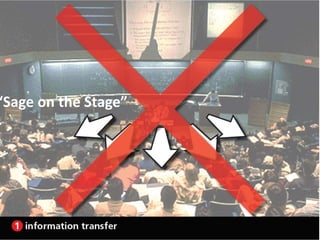
“Sage on the Stage”
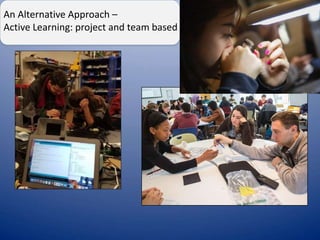
An Alternative Approach –
Active Learning: project and team based
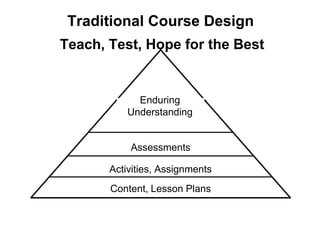
Teach, Test, Hope for the Best
Traditional Course Design
Content, Lesson Plans
Activities, Assignments
Assessments
Enduring
Understanding
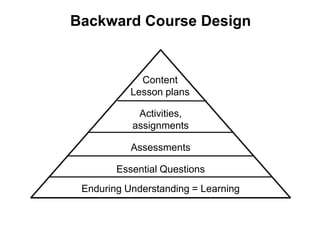
Backward Design
Content
Lesson plans
Enduring Understanding = Learning
Activities,
assignments
Assessments
Essential Questions
Backward Course Design
Backward Design
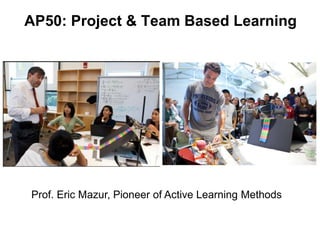
AP50: Project & Team Based Learning
Backward Design
Prof. Eric Mazur, Pioneer of Active Learning Methods
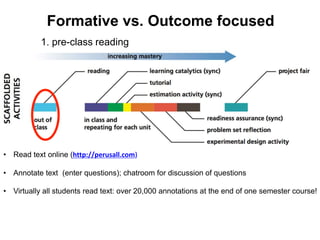
Formative vs. Outcome focused
Backward Design & AP50 Types of Assessment
1. pre-class reading
• Read text online (http://perusall.com)
• Annotate text (enter questions); chatroom for discussion of questions
• Virtually all students read text: over 20,000 annotations at the end of one semester course!
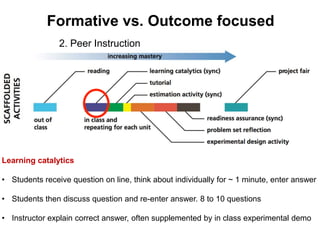
Formative vs. Outcome focused
Backward Design & AP50 Types of Assessment
2. Peer Instruction
Learning catalytics
• Students receive question on line, think about individually for ~ 1 minute, enter answer
• Students then discuss question and re-enter answer. 8 to 10 questions
• Instructor explain correct answer, often supplemented by in class experimental demo
Formative vs. Outcome focused
Backward Design & AP50 Types of Assessment
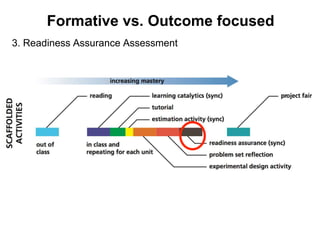
3. Readiness Assurance Assessment
Formative vs. Outcome focused
Backward Design & AP50 Types of Assessment
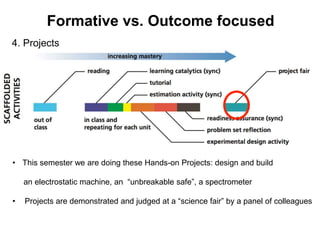
4. Projects
• This semester we are doing these Hands-on Projects: design and build
an electrostatic machine, an “unbreakable safe”, a spectrometer
• Projects are demonstrated and judged at a “science fair” by a panel of colleagues
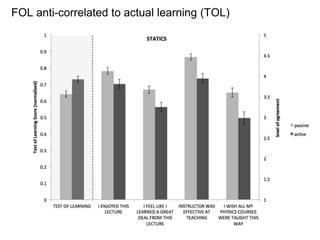
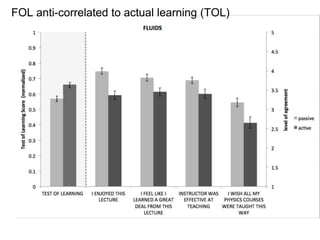
How does Feeling-of-Learning correlate
with Actual Learning for physics majors?
Kelly Miller, Louis Deslauriers, Logan McCarty, Harvard University
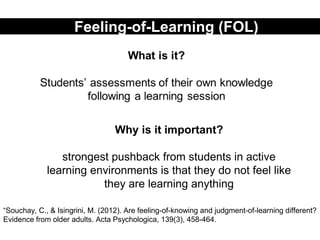
Feeling-of-Learning (FOL)
Why is it important?
strongest pushback from students in active
learning environments is that they do not feel like
they are learning anything
“Souchay, C., & Isingrini, M. (2012). Are feeling-of-knowing and judgment-of-learning different?
Evidence from older adults. Acta Psychologica, 139(3), 458-464.
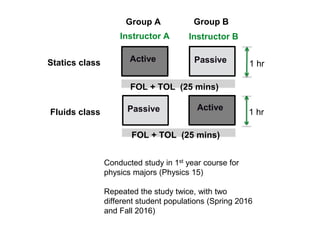
Active PassiveStatics class
Fluids class
Group A Group B
Instructor A Instructor B
1 hr
ActivePassive 1 hr
FOL + TOL (25 mins)
FOL + TOL (25 mins)
Conducted study in 1st year course for
physics majors (Physics 15)
Repeated the study twice, with two
different student populations (Spring 2016
and Fall 2016)
FOL anti-correlated to actual learning (TOL)
Personal Remarks
• Active learning goes back to the Socratic method: it greatly reduces the barriers between
the teacher and the student
• J. Krishnamurti: “All authority is a hindrance, and it is essential that the educator should
not become an authority for the student”
• Be aware of the “imprinting” syndrome: I have heard Profs say: “ I want my
best students become professors (meaning following in my footprints; yes
the imprinting of Konrad Lorentz (little ducks following the big Duck or something
resembling it )
• We should communicate to students some “healthy disrespect” for authorities in our field
• The barriers between disciplines are gradually crumbling: a new synthesis and
renaissance is needed.
• Disciplines are convenient constructs to organize knowledge and teach, but Nature does
know what is physics, chemistry, biology, etc.
• Therefore teaching should be focused more on problem solving than disciplines: Active
Learning is ideally suited for this
• In this way we will train people more capable of tackling big societal challenges

My Experience in Active Learning

  • 1.
    My Experience inActive Learning Federico Capasso School of Engineering and Applied Sciences Harvard University Acknowledgements: Prof. Eric Mazur; Dr. Kelly Miller for material I have been learning from them new teaching methods for the last 3 years: Still far from being an expert!
  • 2.
  • 3.
    An Alternative Approach– Active Learning: project and team based
  • 4.
    Teach, Test, Hopefor the Best Traditional Course Design Content, Lesson Plans Activities, Assignments Assessments Enduring Understanding Backward Design
  • 5.
    Content Lesson plans Enduring Understanding= Learning Activities, assignments Assessments Essential Questions Backward Course Design Backward Design
  • 6.
    AP50: Project &Team Based Learning Backward Design Prof. Eric Mazur, Pioneer of Active Learning Methods
  • 7.
    Formative vs. Outcomefocused Backward Design & AP50 Types of Assessment 1. pre-class reading • Read text online (http://perusall.com) • Annotate text (enter questions); chatroom for discussion of questions • Virtually all students read text: over 20,000 annotations at the end of one semester course!
  • 8.
    Formative vs. Outcomefocused Backward Design & AP50 Types of Assessment 2. Peer Instruction Learning catalytics • Students receive question on line, think about individually for ~ 1 minute, enter answer • Students then discuss question and re-enter answer. 8 to 10 questions • Instructor explain correct answer, often supplemented by in class experimental demo
  • 9.
    Formative vs. Outcomefocused Backward Design & AP50 Types of Assessment 3. Readiness Assurance Assessment
  • 10.
    Formative vs. Outcomefocused Backward Design & AP50 Types of Assessment 4. Projects • This semester we are doing these Hands-on Projects: design and build an electrostatic machine, an “unbreakable safe”, a spectrometer • Projects are demonstrated and judged at a “science fair” by a panel of colleagues
  • 11.
    How does Feeling-of-Learningcorrelate with Actual Learning for physics majors? Kelly Miller, Louis Deslauriers, Logan McCarty, Harvard University
  • 12.
    Feeling-of-Learning (FOL) Why isit important? strongest pushback from students in active learning environments is that they do not feel like they are learning anything “Souchay, C., & Isingrini, M. (2012). Are feeling-of-knowing and judgment-of-learning different? Evidence from older adults. Acta Psychologica, 139(3), 458-464.
  • 13.
    Active PassiveStatics class Fluidsclass Group A Group B Instructor A Instructor B 1 hr ActivePassive 1 hr FOL + TOL (25 mins) FOL + TOL (25 mins) Conducted study in 1st year course for physics majors (Physics 15) Repeated the study twice, with two different student populations (Spring 2016 and Fall 2016)
  • 14.
    FOL anti-correlated toactual learning (TOL)
  • 15.
    FOL anti-correlated toactual learning (TOL)
  • 16.
    Personal Remarks • Activelearning goes back to the Socratic method: it greatly reduces the barriers between the teacher and the student • J. Krishnamurti: “All authority is a hindrance, and it is essential that the educator should not become an authority for the student” • Be aware of the “imprinting” syndrome: I have heard Profs say: “ I want my best students become professors (meaning following in my footprints; yes the imprinting of Konrad Lorentz (little ducks following the big Duck or something resembling it ) • We should communicate to students some “healthy disrespect” for authorities in our field • The barriers between disciplines are gradually crumbling: a new synthesis and renaissance is needed. • Disciplines are convenient constructs to organize knowledge and teach, but Nature does know what is physics, chemistry, biology, etc. • Therefore teaching should be focused more on problem solving than disciplines: Active Learning is ideally suited for this • In this way we will train people more capable of tackling big societal challenges