By: Shefaa Adel Hejazy.
Umm Al-Qura University, Makkah.
Faculty of Medical Sciences. Hematology Dept.
1st Semester 1433/2012
o

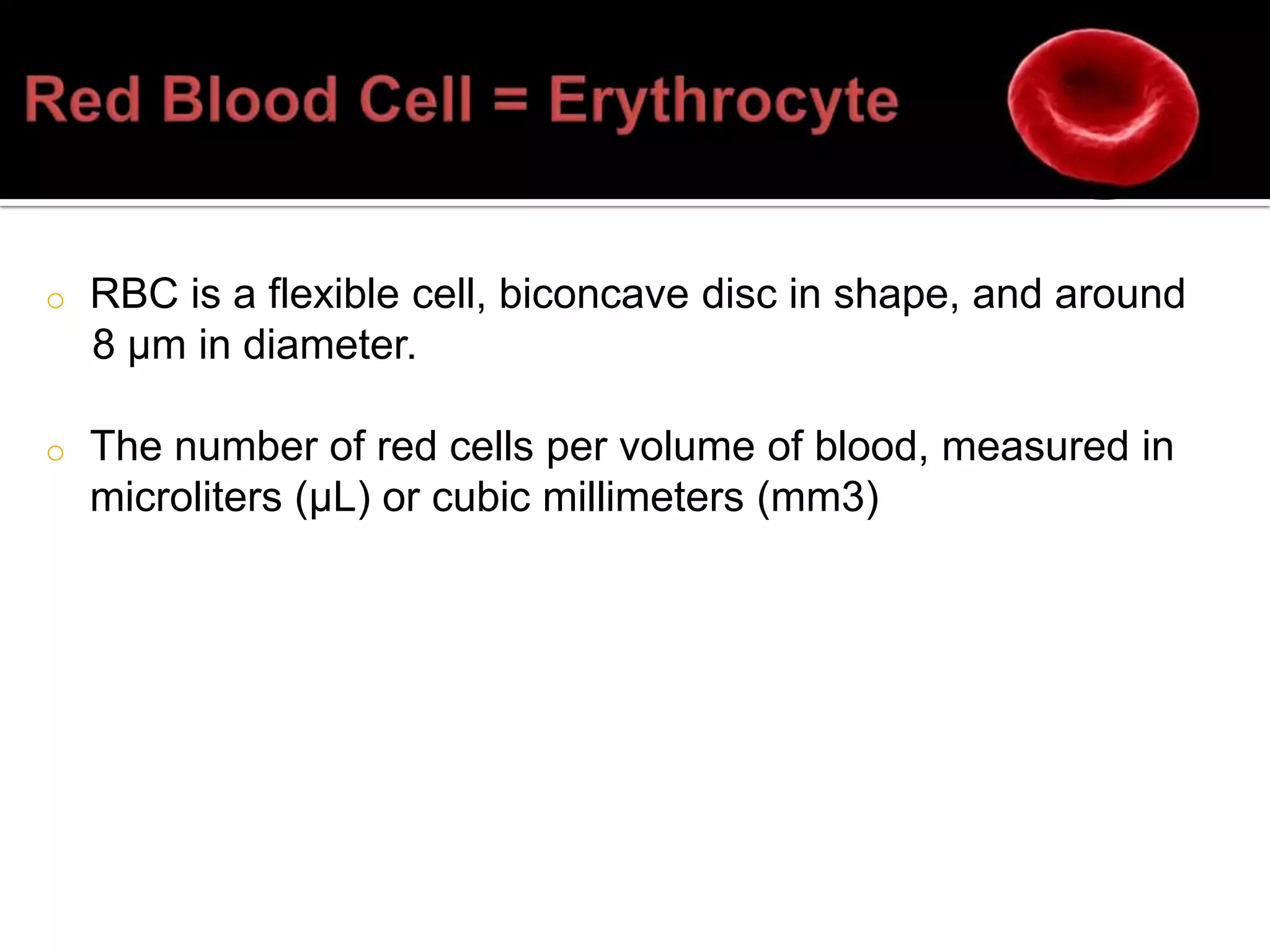
RBC is a flexible cell, biconcave disc in shape, and around
8 µm in diameter.

o

The number of red cells per volume of blood, measured in
microliters (µL) or cubic millimeters (mm3)
Screening:

Follow up:

-Health maintenance

-Response to ttt

-NSAIDs

-Chronic Anemia

To assess
degree of ..
Anemia and blood
loss
Counting of RBCs can be performed either:


Automated Method: (Electronic hematology cell counter, e.g.
COULTER)

OR


Manual Method: (visual using a microscope and counting
chmber), which is a cumbersome and less accurate.
o

The solution used for red cell count is Isotonic with RBCs;
doesn’t lyse leukocytes.

o

Leukocytes are normally too few which can be identified easily
and won’t be interfered with erythrocytes count.
o

Reagents and instruments:

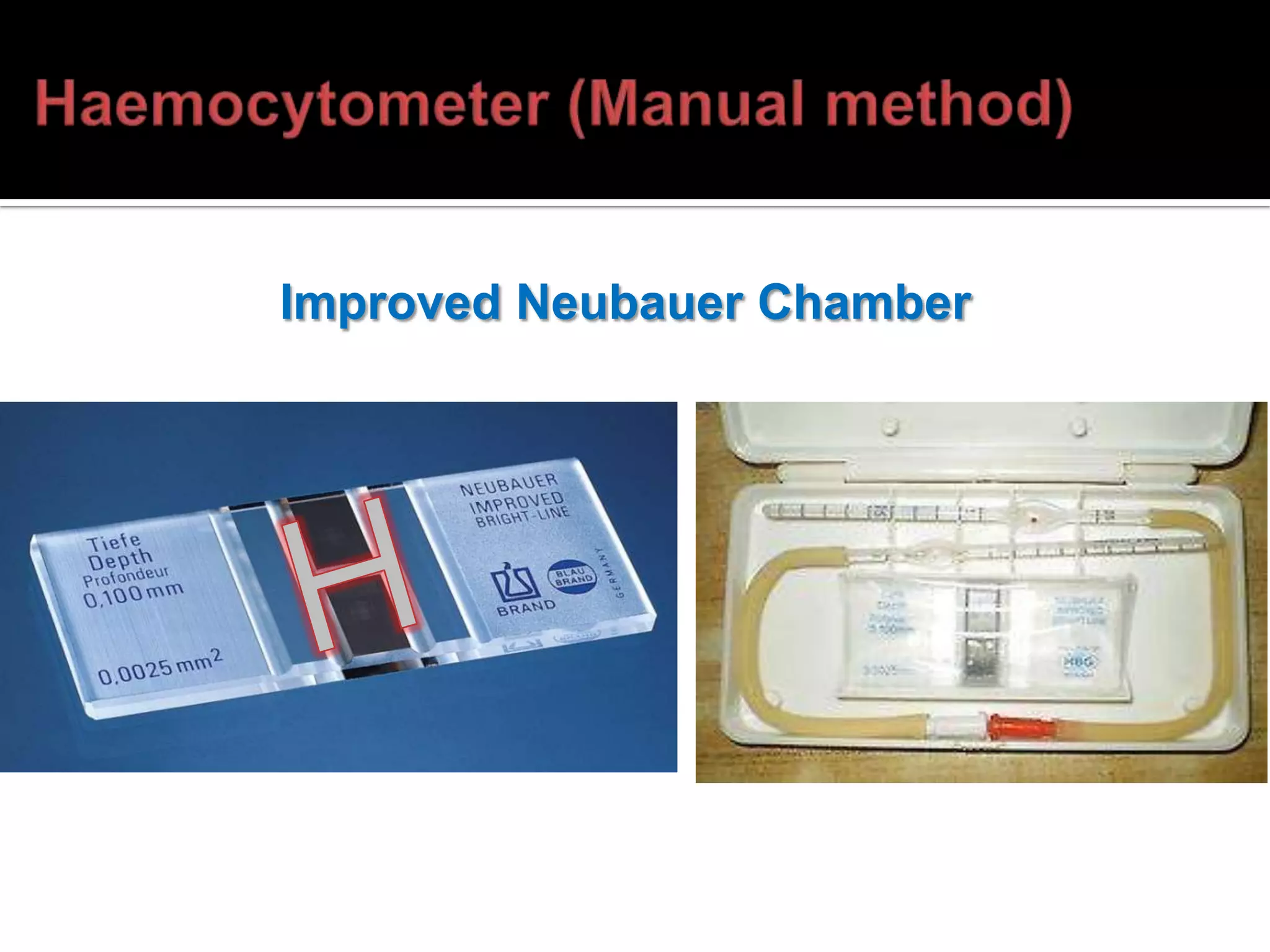
1. Neubauer Chamber (Haemocytometer) & coverslips.
2. RBC diluting fluid/solution.
Consists of 3.2 g of Na-citrate and 1.0 ml of formaldehyde solution
made up to 100 ml with D.W.

o

Sample:
Improved Neubauer Chamber
o

A thick glass slide with H shaped moats in it.

o

The area between two lines of H (center) is 0.1 mm in depth.

o

Moat prevents mixing of 2 samples on either side of chamber.
o

Prepare a plastic tube (labeled).

o

Prepare 1:200 blood dilution (4 ml of diluent + 20 µl Blood).

o

So, add diluent to the tube. Mix the sample (5 times); then
aspirate 20µl and transfer to the tube and mix.

o

Clean the Haemocytometer and coverslip with 70% ethanol
followed by D.W &Leave to dry.

o

Place a coverslip on the Neubauer chamber.
o
o

Then, fill the chamber with the diluent (10 microliter) in each
side.
Leave chamber in humidity (petri-dish with wet filter paper) for
1-2 min. !?

o

Condenser slightly lowered. Iris diaphragm should be almost
closed.

o

Place chamber on microscope stage. Start with 10X to focus;
then with 40X count RBCs.
o

RBCs should be counted in the central square of the
chamber.

o

Select 5 small squares (One at each corner and one in the
center).
W
W

RBC

W
W
25 small
Squares = 1
mm.sq

W
3 mm.sq

R
Central large square
RBCs

WBCs
Count all cells in specified squares, and multiply by the proper conversion
factor; the number of cells per cubic millimeter can be determined.
o

Count all cells within 16 squares and those lying on middle lines,
EXCEPT …
RBCs (1012/L) = No. of RBCs counted X Dilution X 106
Volume (µl)
o

Dilution = 200

o

Depth of the chamber = 0.1 mm.

o

Volume of 5 small squares = 0.02 µl

So,

Red cell count/ liter = N x 0.01 x 10¹²

i.e. RBCs= N x 1012/L
o

Diluent should be correct.

o

No overflow in the moats.

o

No air bubbles and debris in the chamber area.

o

No scratches in the ruled area of the chamber.

o

Pipettes used must be clean and dry.
Age group

RBC count

Adult Male

4.7 – 6.1 X 10¹² /L

Adult Female

4.2 – 5.4 X 10¹² /L

Newborn

4.4 -5.8 X 10¹² /L

Infant/ children

3.8 – 5.5 X 10¹² /L


Decreased value (

RBCs)

1.

Anaemia: due to Blood loss, production of cells, destruction
of cells, and dietary insufficiency.

2.

Diseases which affect the Bone Marrow such as:

i.
ii.
iii.

Leukaemia
MM
Hodgkin’s Lymphoma

1.

Subcutaneous bacterial endocarditis

2.

Rheumatic fever


Increased value ( RBCs)

1.

Polycythaemia vera

2.

Secondary polycythaemia, e.g. smokers, high altitude,
cyanotic heart defects, and COPD.

3.

Dehydration

4.

Acute poisoning

5.

Severe diarrhea
sahejazy@uqu.edu.sa

Red blood cell count

  • 1.
    By: Shefaa AdelHejazy. Umm Al-Qura University, Makkah. Faculty of Medical Sciences. Hematology Dept. 1st Semester 1433/2012
  • 2.
    o RBC is aflexible cell, biconcave disc in shape, and around 8 µm in diameter. o The number of red cells per volume of blood, measured in microliters (µL) or cubic millimeters (mm3)
  • 3.
    Screening: Follow up: -Health maintenance -Responseto ttt -NSAIDs -Chronic Anemia To assess degree of .. Anemia and blood loss
  • 4.
    Counting of RBCscan be performed either:  Automated Method: (Electronic hematology cell counter, e.g. COULTER) OR  Manual Method: (visual using a microscope and counting chmber), which is a cumbersome and less accurate.
  • 5.
    o The solution usedfor red cell count is Isotonic with RBCs; doesn’t lyse leukocytes. o Leukocytes are normally too few which can be identified easily and won’t be interfered with erythrocytes count.
  • 6.
    o Reagents and instruments: 1.Neubauer Chamber (Haemocytometer) & coverslips. 2. RBC diluting fluid/solution. Consists of 3.2 g of Na-citrate and 1.0 ml of formaldehyde solution made up to 100 ml with D.W. o Sample:
  • 7.
  • 8.
    o A thick glassslide with H shaped moats in it. o The area between two lines of H (center) is 0.1 mm in depth. o Moat prevents mixing of 2 samples on either side of chamber.
  • 10.
    o Prepare a plastictube (labeled). o Prepare 1:200 blood dilution (4 ml of diluent + 20 µl Blood). o So, add diluent to the tube. Mix the sample (5 times); then aspirate 20µl and transfer to the tube and mix. o Clean the Haemocytometer and coverslip with 70% ethanol followed by D.W &Leave to dry. o Place a coverslip on the Neubauer chamber.
  • 11.
    o o Then, fill thechamber with the diluent (10 microliter) in each side. Leave chamber in humidity (petri-dish with wet filter paper) for 1-2 min. !? o Condenser slightly lowered. Iris diaphragm should be almost closed. o Place chamber on microscope stage. Start with 10X to focus; then with 40X count RBCs.
  • 12.
    o RBCs should becounted in the central square of the chamber. o Select 5 small squares (One at each corner and one in the center).
  • 13.
  • 14.
    25 small Squares =1 mm.sq W 3 mm.sq R
  • 15.
  • 16.
    Count all cellsin specified squares, and multiply by the proper conversion factor; the number of cells per cubic millimeter can be determined.
  • 17.
    o Count all cellswithin 16 squares and those lying on middle lines, EXCEPT …
  • 18.
    RBCs (1012/L) =No. of RBCs counted X Dilution X 106 Volume (µl) o Dilution = 200 o Depth of the chamber = 0.1 mm. o Volume of 5 small squares = 0.02 µl So, Red cell count/ liter = N x 0.01 x 10¹² i.e. RBCs= N x 1012/L
  • 19.
    o Diluent should becorrect. o No overflow in the moats. o No air bubbles and debris in the chamber area. o No scratches in the ruled area of the chamber. o Pipettes used must be clean and dry.
  • 20.
    Age group RBC count AdultMale 4.7 – 6.1 X 10¹² /L Adult Female 4.2 – 5.4 X 10¹² /L Newborn 4.4 -5.8 X 10¹² /L Infant/ children 3.8 – 5.5 X 10¹² /L
  • 21.
     Decreased value ( RBCs) 1. Anaemia:due to Blood loss, production of cells, destruction of cells, and dietary insufficiency. 2. Diseases which affect the Bone Marrow such as: i. ii. iii. Leukaemia MM Hodgkin’s Lymphoma 1. Subcutaneous bacterial endocarditis 2. Rheumatic fever
  • 22.
     Increased value (RBCs) 1. Polycythaemia vera 2. Secondary polycythaemia, e.g. smokers, high altitude, cyanotic heart defects, and COPD. 3. Dehydration 4. Acute poisoning 5. Severe diarrhea
  • 23.