Shamima Akter
B. Sc (Honours) in Occupational Therapy
& M. Sc in Rehabilitation Science
Assistant Professor,
Department of Occupational Therapy
Bangladesh Health Professions Institute (BHPI)
Centre for the Rehabilitation of the Paralysed (CRP)
Chapain, Savar
Client Factors
• Client factors are specific capacities, characteristics,
or beliefs that reside within the person and that
influence performance in occupations (Table 2).
• Client factors are affected by the presence or absence
of illness, disease, deprivation, disability, and life
experiences.
• Although client factors are not to be confused with
performance skills, client factors can affect
performance skills.
• Thus, client factors may need to be present in whole
or in part for a person to complete an action (skill)
used in the execution of an occupation.
CLIENT FACTORS
• Client factors include:
(1) values, beliefs, and spirituality;
(2) body functions; and
(3)body structures that reside
within the client that influence the
client’s performance in
occupations.
VALUES, BELIEFS, AND SPIRITUALITY
• Clients’ perceptions, motivations,
and related meaning that influence
or are influenced by engagement in
occupations.
Category and Definition Examples
Values- Acquired beliefs and
commitments, derived from
culture, about what is good,
right and important to do.
Person:
• Honesty with self and others
• Commitment to family
Group:
• Obligation to provide a
service
• Fairness
Population:
• Freedom of speech
• Equal opportunities for all
• Tolerance toward others
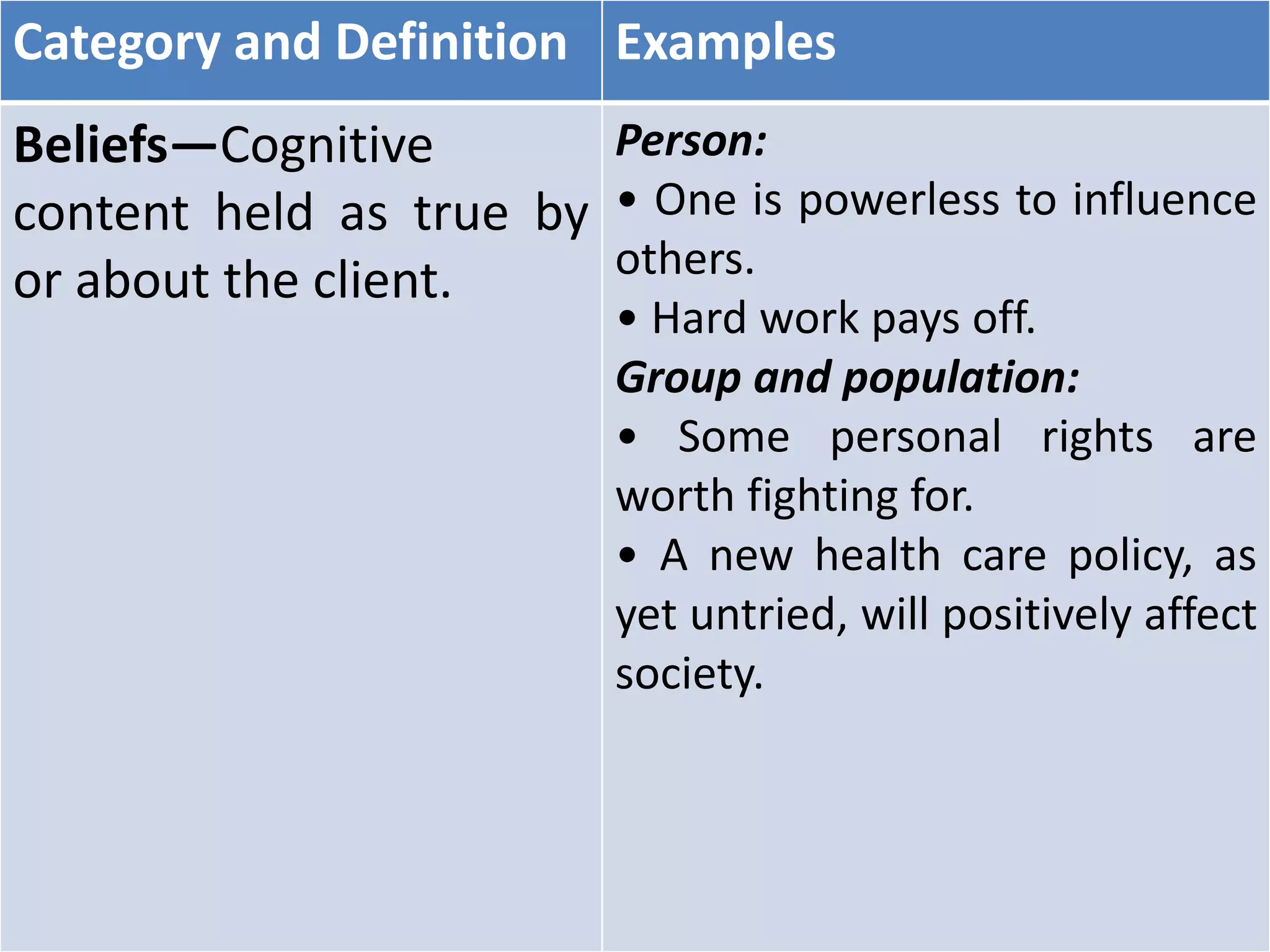
Category and Definition Examples
Beliefs—Cognitive
content held as true by
or about the client.
Person:
• One is powerless to influence
others.
• Hard work pays off.
Group and population:
• Some personal rights are
worth fighting for.
• A new health care policy, as
yet untried, will positively affect
society.
Category and Definition Examples
Spirituality—“The aspect of
humanity that refers to the
way individuals seek and
express meaning and
purpose and the way they
experience their
connectedness to the
moment, to self, to others,
to nature, and to the
significant or sacred”
Person:
• Daily search for purpose and
meaning in one’s life
• Guidance of actions by a
sense of value beyond the
personal acquisition of wealth
or fame
Group and population:
• Common search for purpose
and meaning in life
• Guidance of actions by values
agreed on by the collective
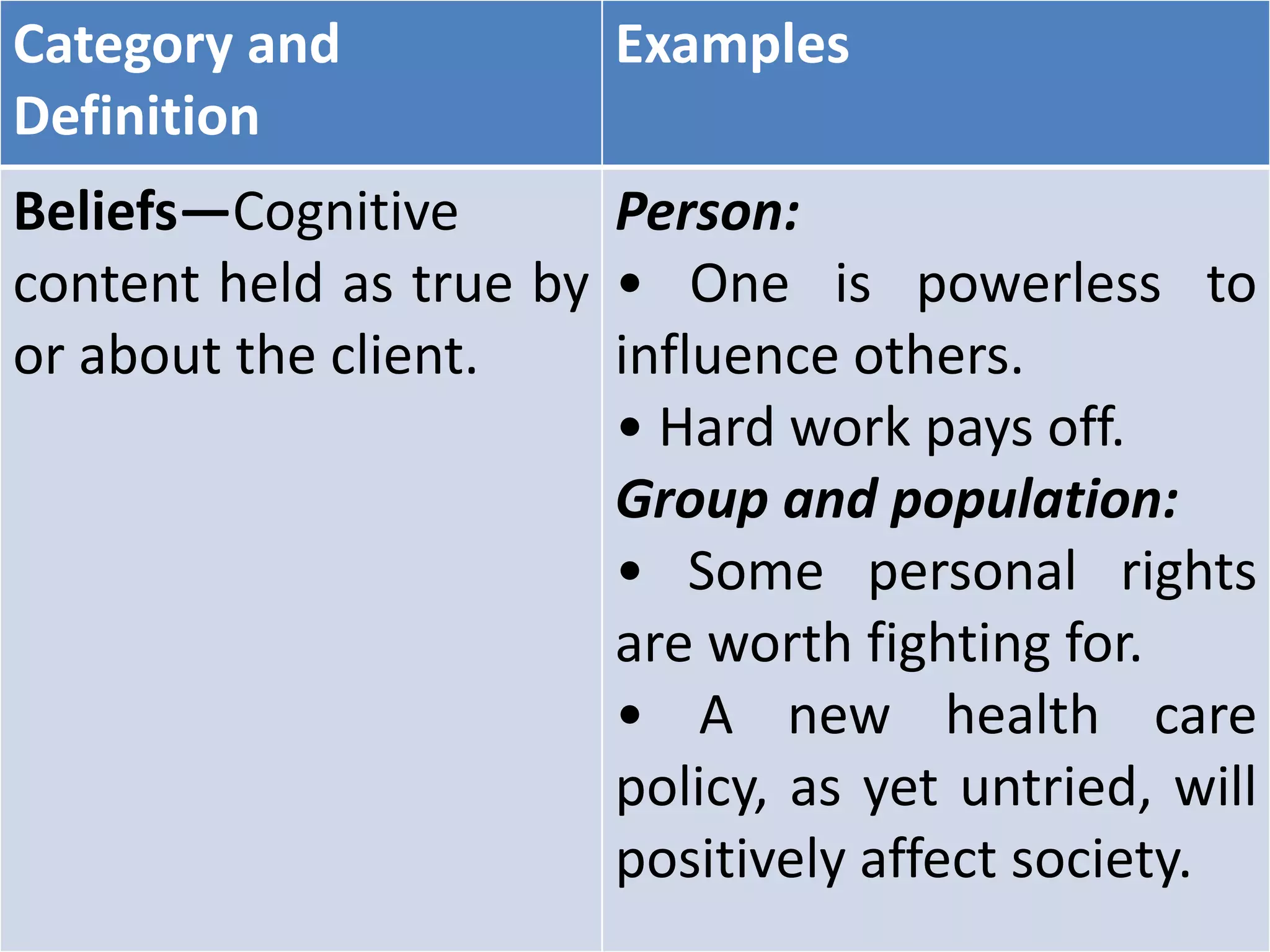
Category and
Definition
Examples
Beliefs—Cognitive
content held as true by
or about the client.
Person:
• One is powerless to
influence others.
• Hard work pays off.
Group and population:
• Some personal rights
are worth fighting for.
• A new health care
policy, as yet untried, will
positively affect society.
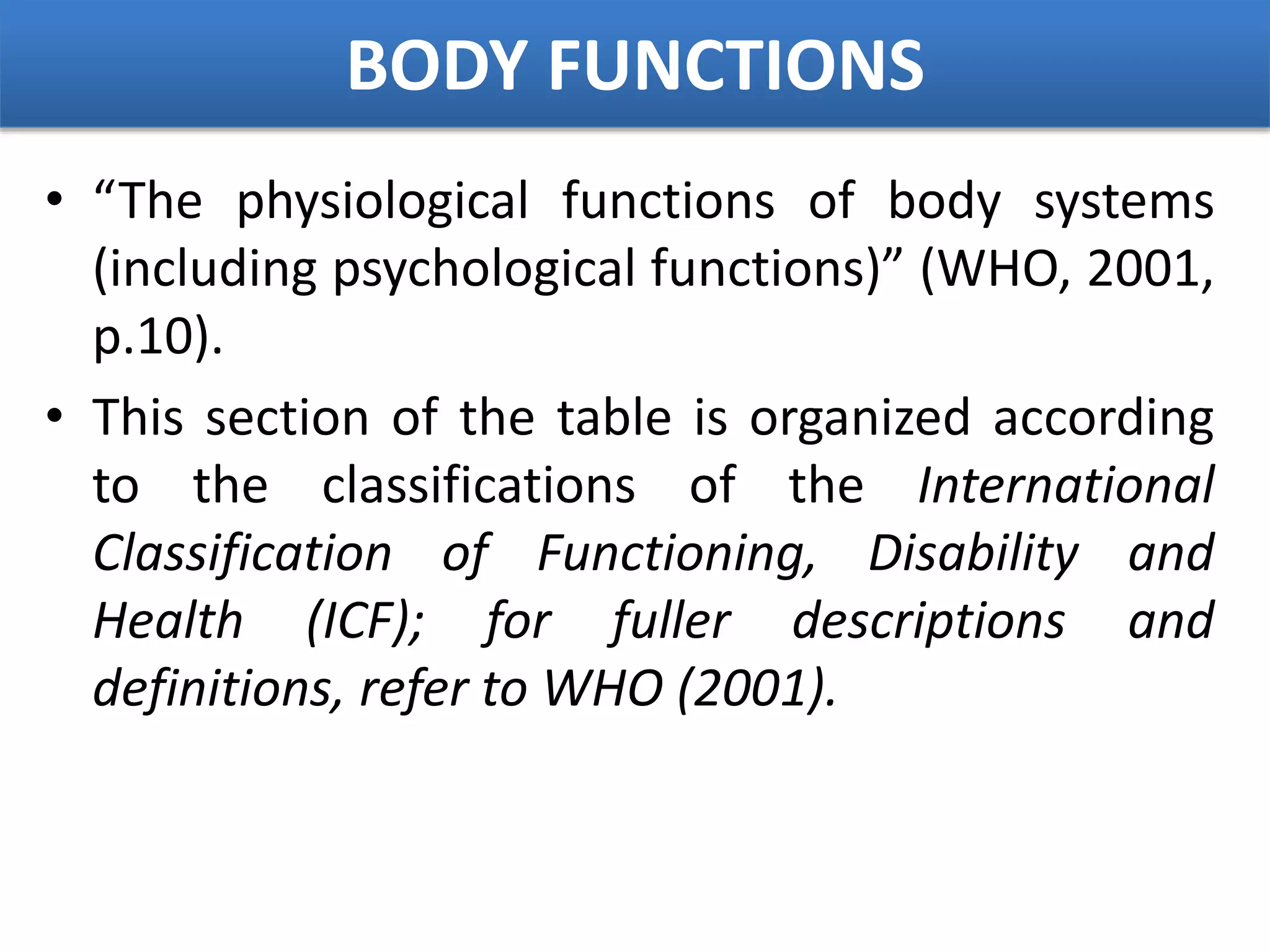
BODY FUNCTIONS
• “The physiological functions of body systems
(including psychological functions)” (WHO, 2001,
p.10).
• This section of the table is organized according
to the classifications of the International
Classification of Functioning, Disability and
Health (ICF); for fuller descriptions and
definitions, refer to WHO (2001).
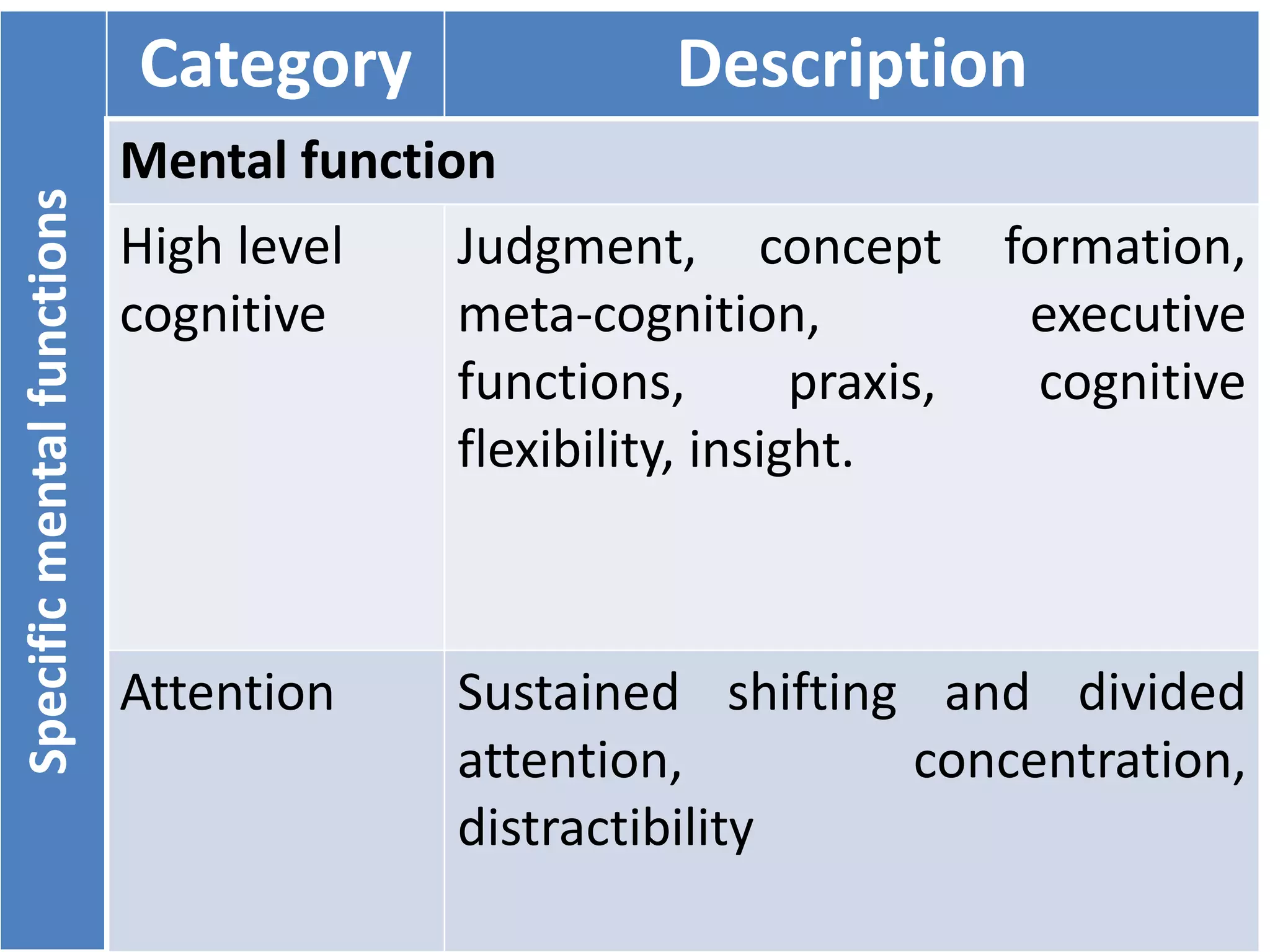
Specificmentalfunctions Category Description
Mental function
High level
cognitive
Judgment, concept formation,
meta-cognition, executive
functions, praxis, cognitive
flexibility, insight.
Attention Sustained shifting and divided
attention, concentration,
distractibility
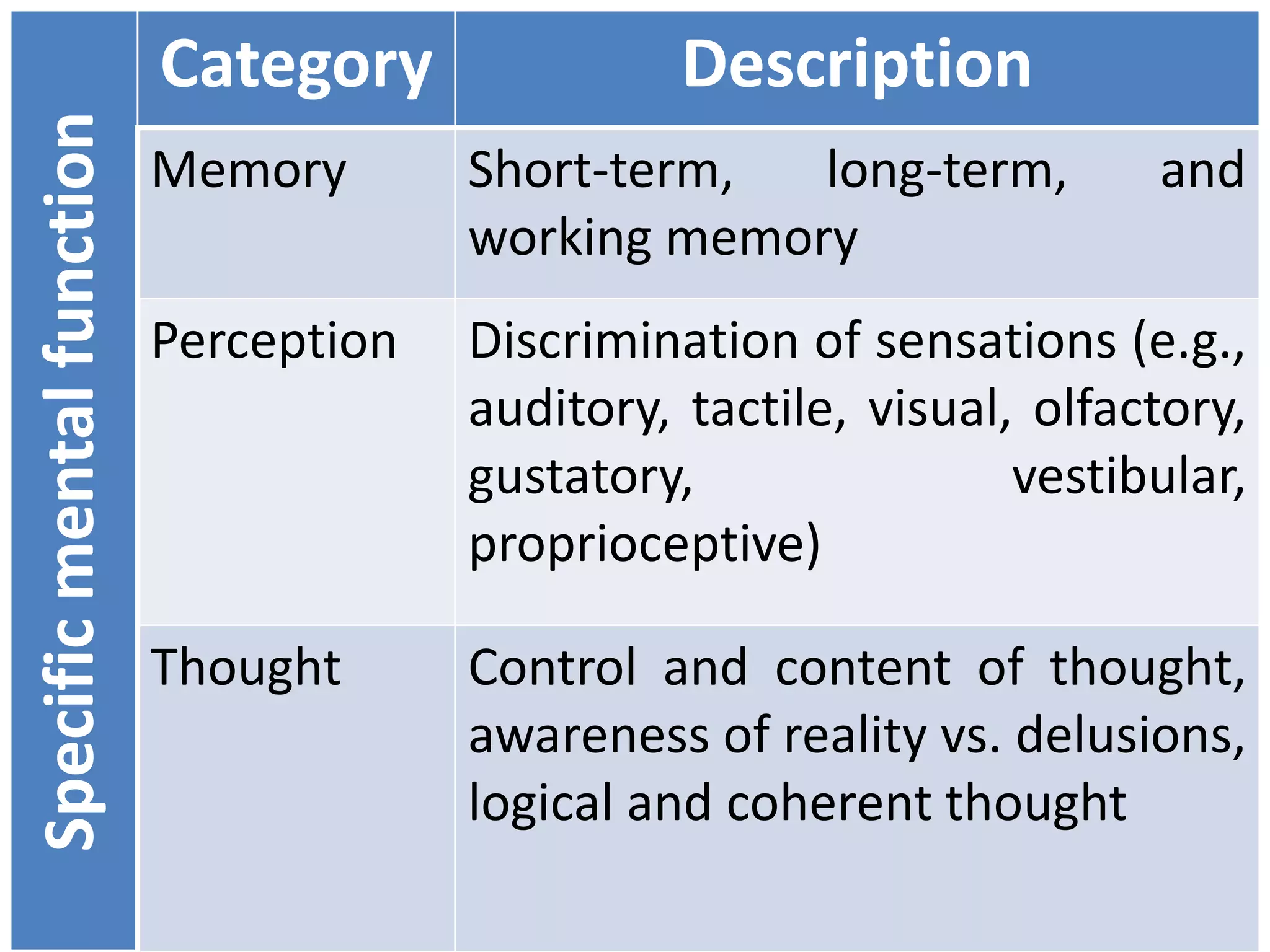
Specificmentalfunction Category Description
Memory Short-term, long-term, and
working memory
Perception Discrimination of sensations (e.g.,
auditory, tactile, visual, olfactory,
gustatory, vestibular,
proprioceptive)
Thought Control and content of thought,
awareness of reality vs. delusions,
logical and coherent thought
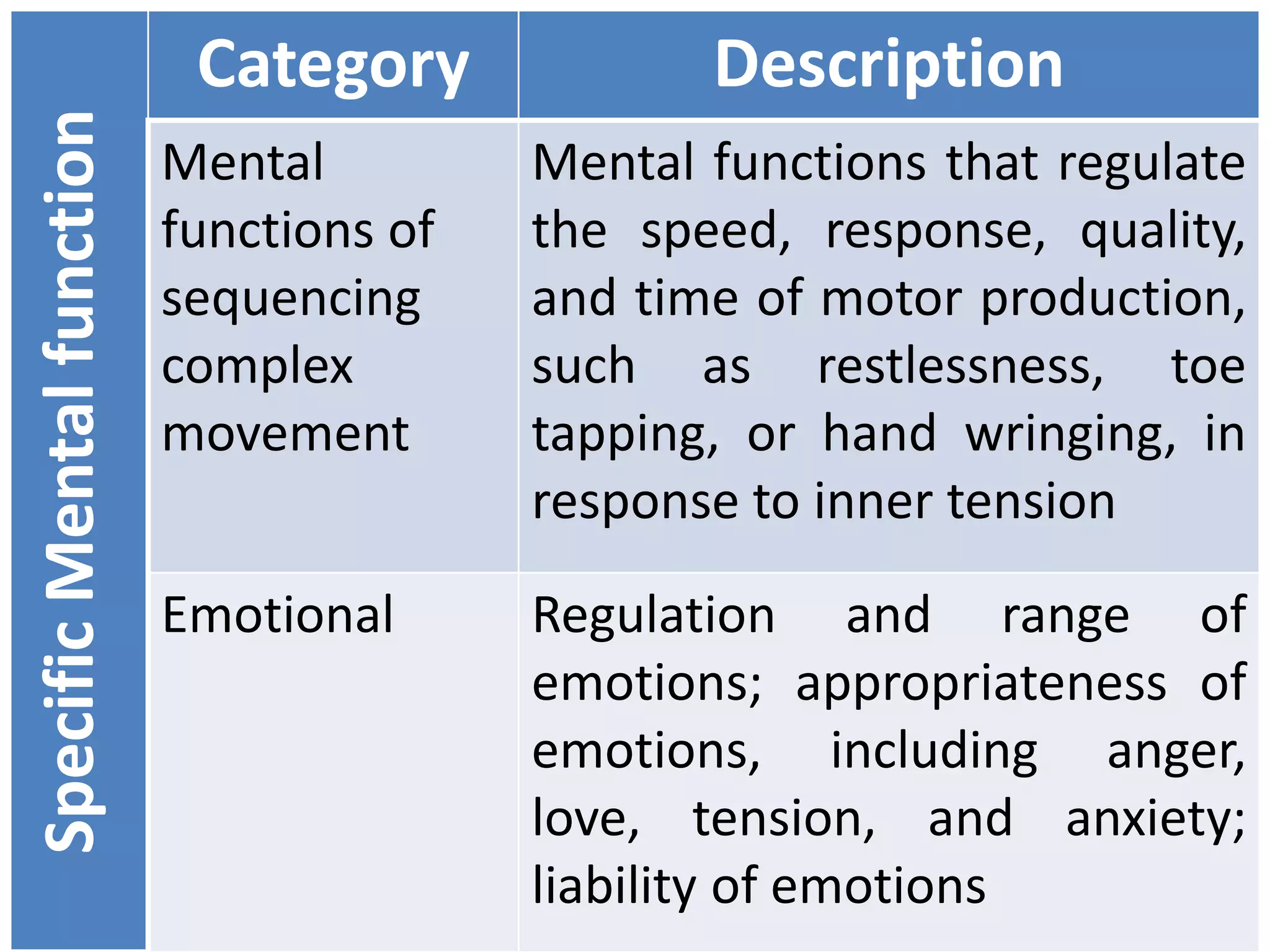
SpecificMentalfunction Category Description
Mental
functions of
sequencing
complex
movement
Mental functions that regulate
the speed, response, quality,
and time of motor production,
such as restlessness, toe
tapping, or hand wringing, in
response to inner tension
Emotional Regulation and range of
emotions; appropriateness of
emotions, including anger,
love, tension, and anxiety;
liability of emotions
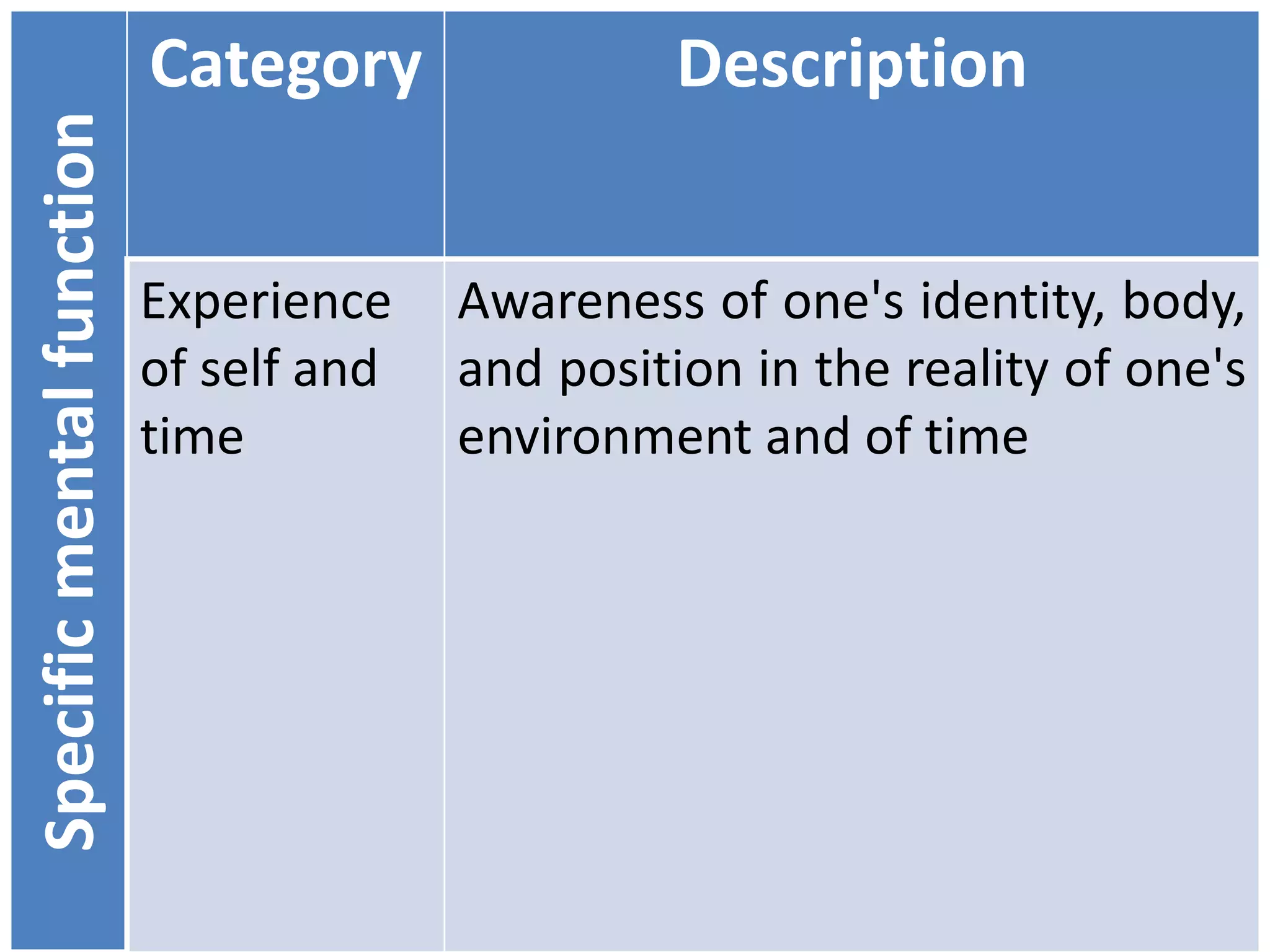
Specificmentalfunction Category Description
Experience
of self and
time
Awareness of one's identity, body,
and position in the reality of one's
environment and of time
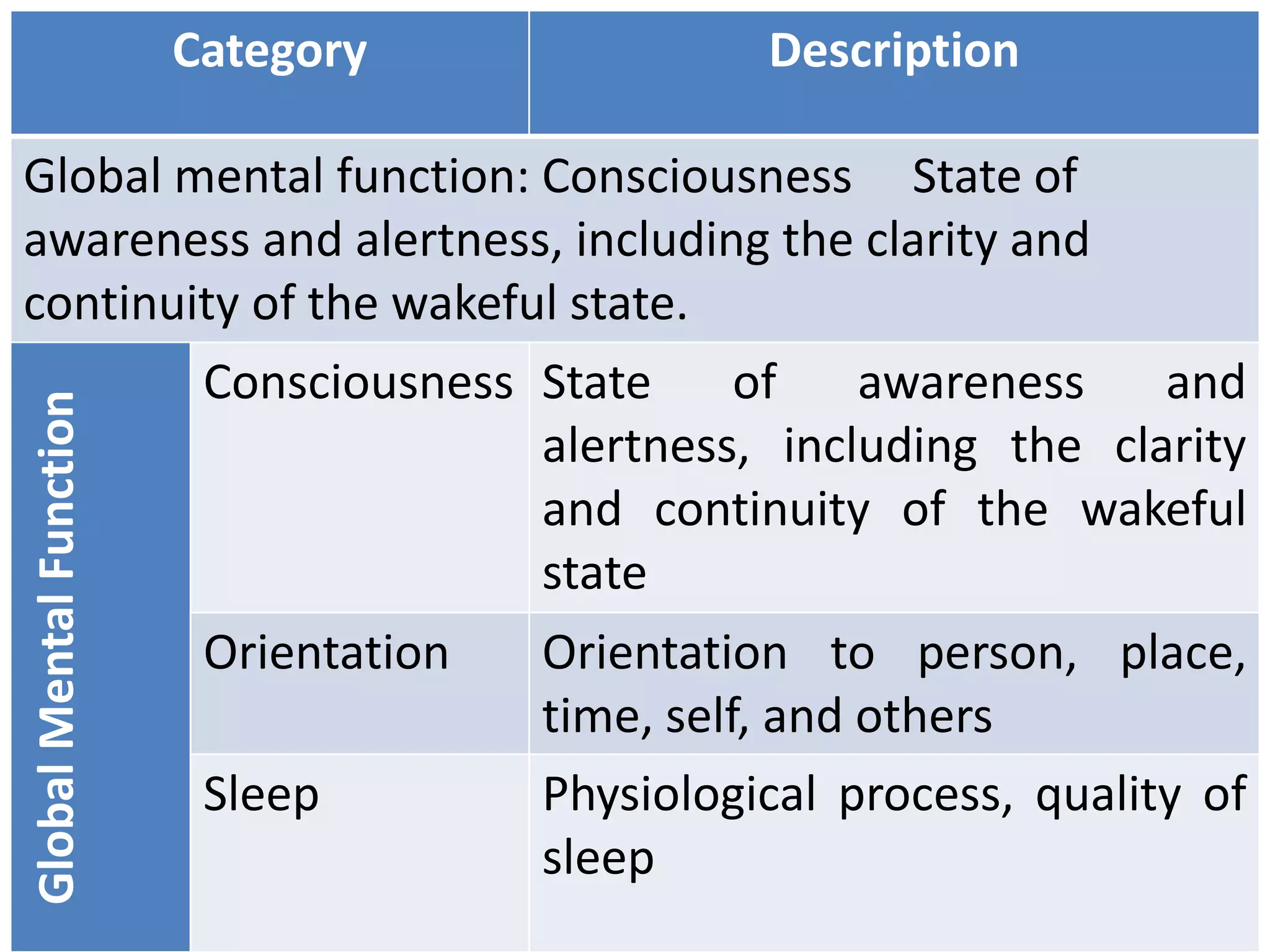
Category Description
Global mental function: Consciousness State of
awareness and alertness, including the clarity and
continuity of the wakeful state.
GlobalMentalFunction
Consciousness State of awareness and
alertness, including the clarity
and continuity of the wakeful
state
Orientation Orientation to person, place,
time, self, and others
Sleep Physiological process, quality of
sleep
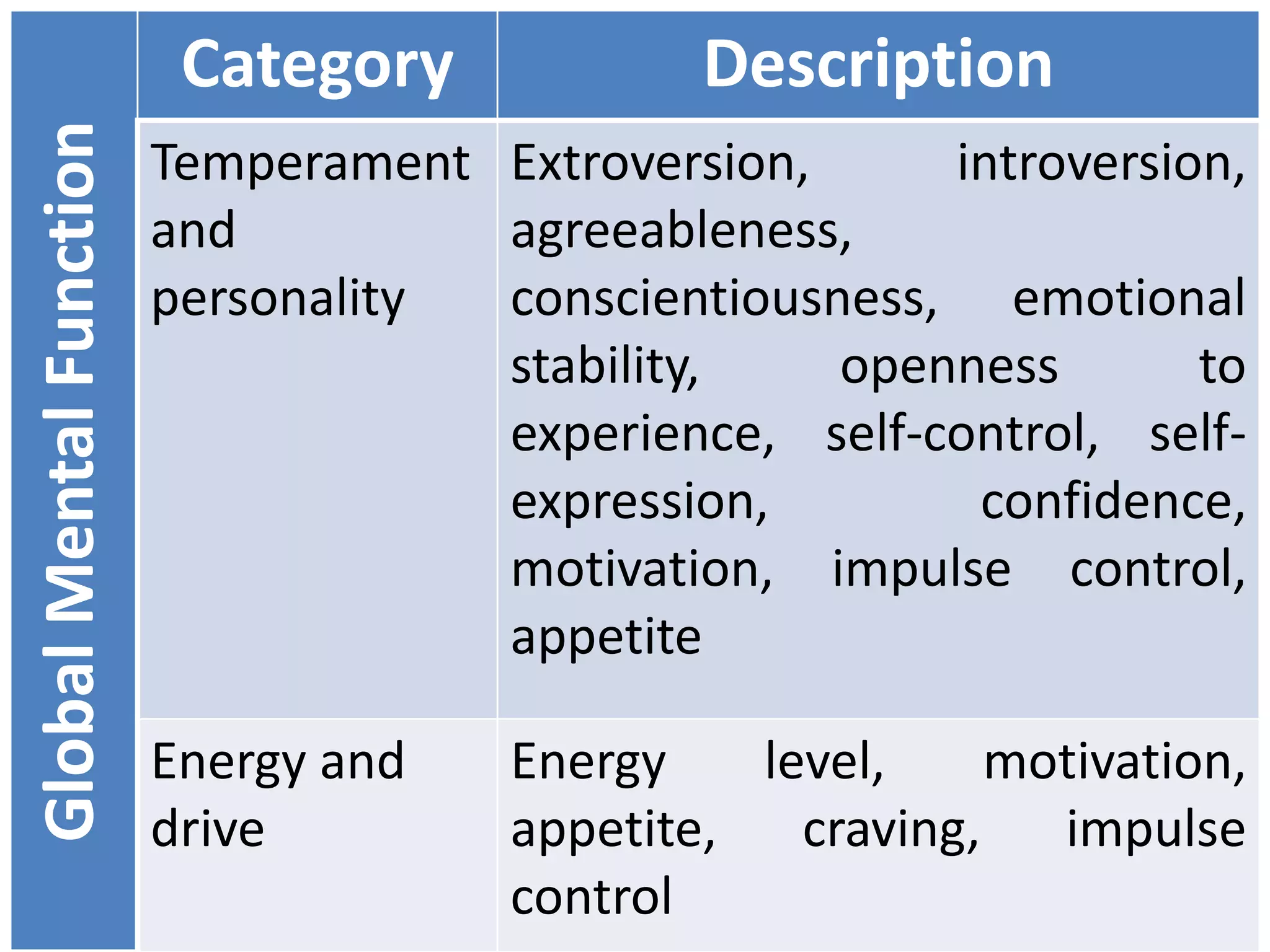
GlobalMentalFunction Category Description
Temperament
and
personality
Extroversion, introversion,
agreeableness,
conscientiousness, emotional
stability, openness to
experience, self-control, self-
expression, confidence,
motivation, impulse control,
appetite
Energy and
drive
Energy level, motivation,
appetite, craving, impulse
control
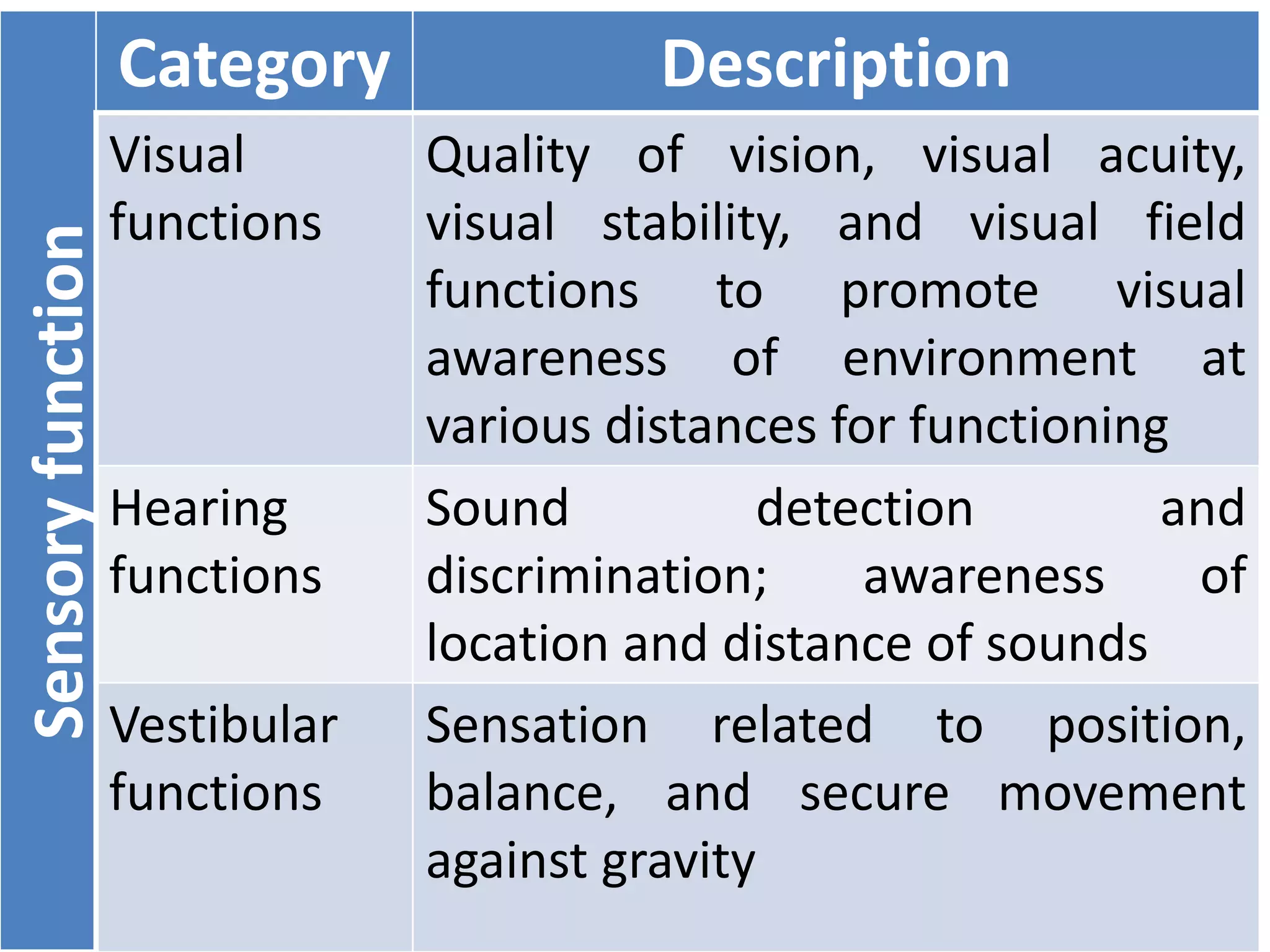
Sensoryfunction Category Description
Visual
functions
Quality of vision, visual acuity,
visual stability, and visual field
functions to promote visual
awareness of environment at
various distances for functioning
Hearing
functions
Sound detection and
discrimination; awareness of
location and distance of sounds
Vestibular
functions
Sensation related to position,
balance, and secure movement
against gravity
Sensoryfunction Category Description
Taste
functions
Association of taste qualities of
bitterness, sweetness, sourness,
and saltiness
Smell
functions
Sensing odors and smells
Proprioceptive
functions
Awareness of body position and
space
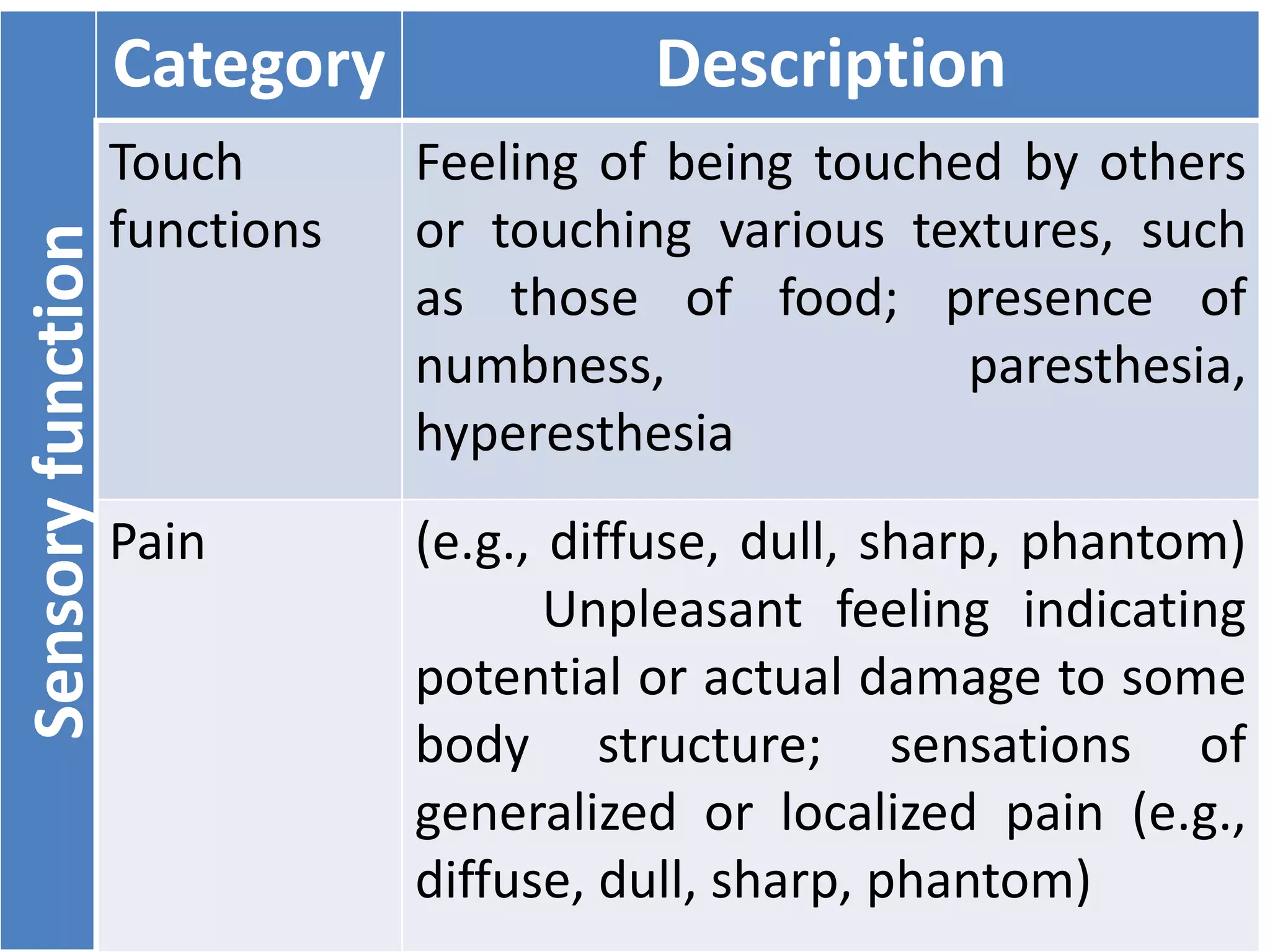
Sensoryfunction Category Description
Touch
functions
Feeling of being touched by others
or touching various textures, such
as those of food; presence of
numbness, paresthesia,
hyperesthesia
Pain (e.g., diffuse, dull, sharp, phantom)
Unpleasant feeling indicating
potential or actual damage to some
body structure; sensations of
generalized or localized pain (e.g.,
diffuse, dull, sharp, phantom)
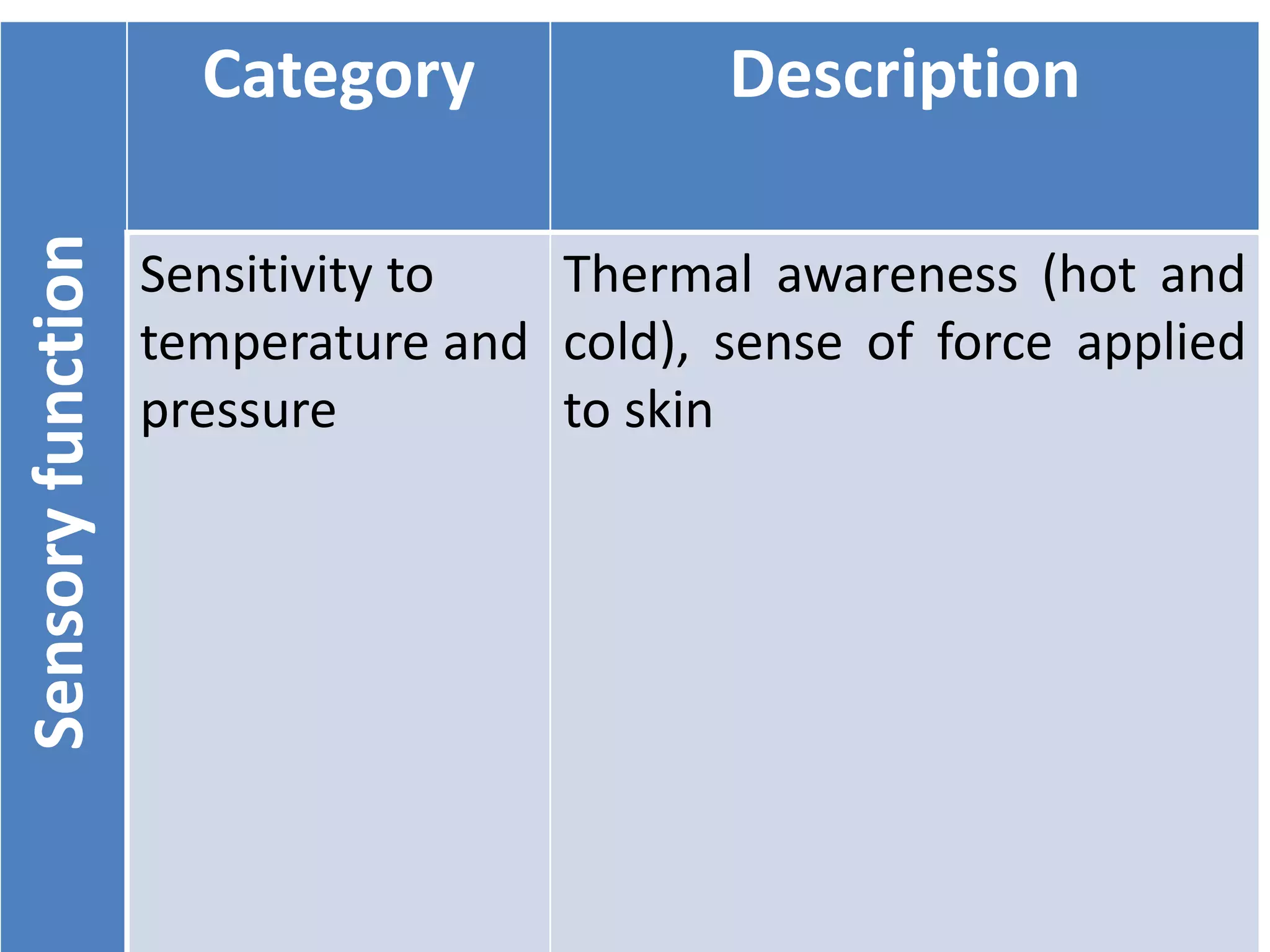
Sensoryfunction Category Description
Sensitivity to
temperature and
pressure
Thermal awareness (hot and
cold), sense of force applied
to skin
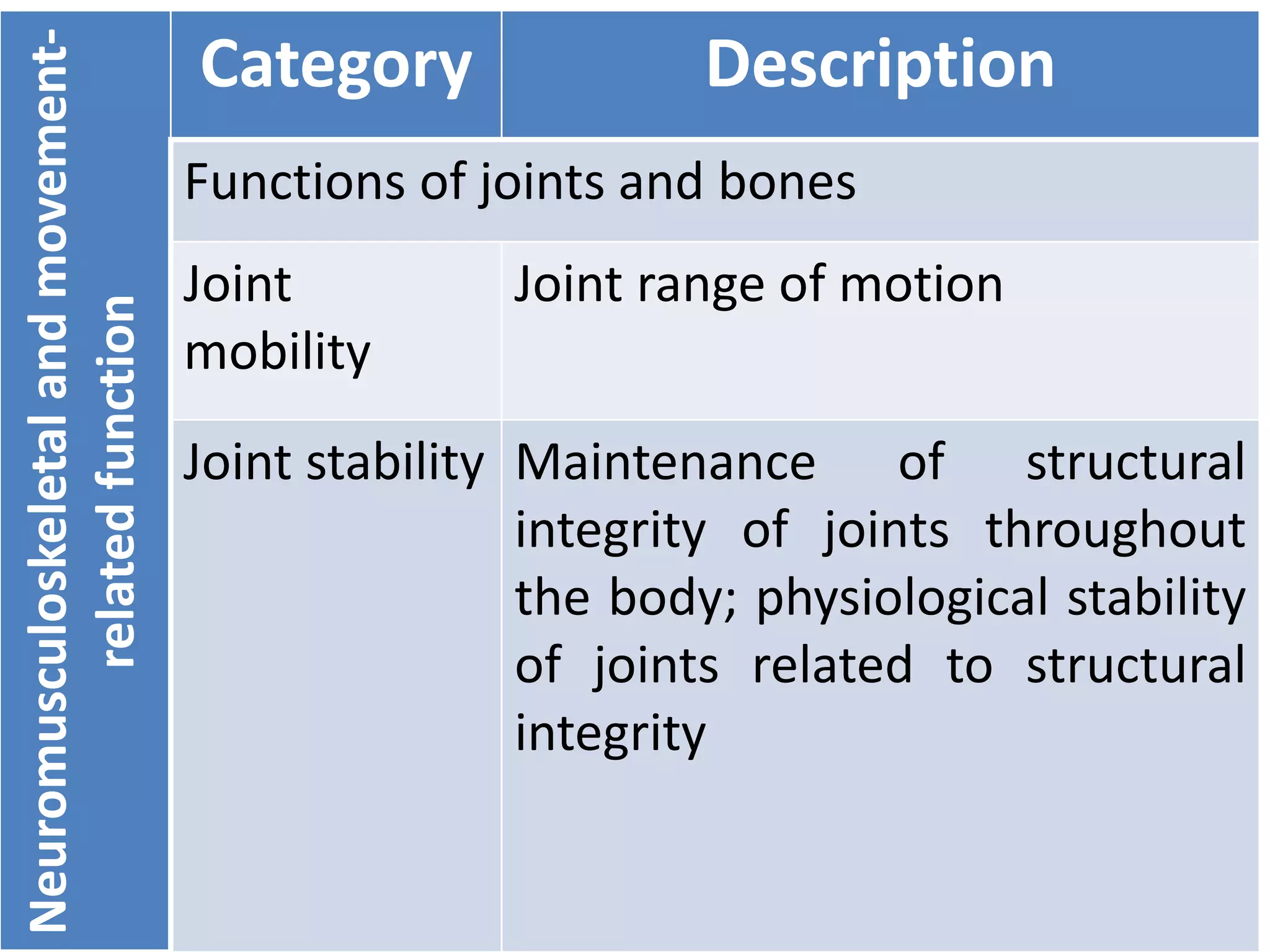
Neuromusculoskeletalandmovement-
relatedfunction
Category Description
Functions of joints and bones
Joint
mobility
Joint range of motion
Joint stability Maintenance of structural
integrity of joints throughout
the body; physiological stability
of joints related to structural
integrity
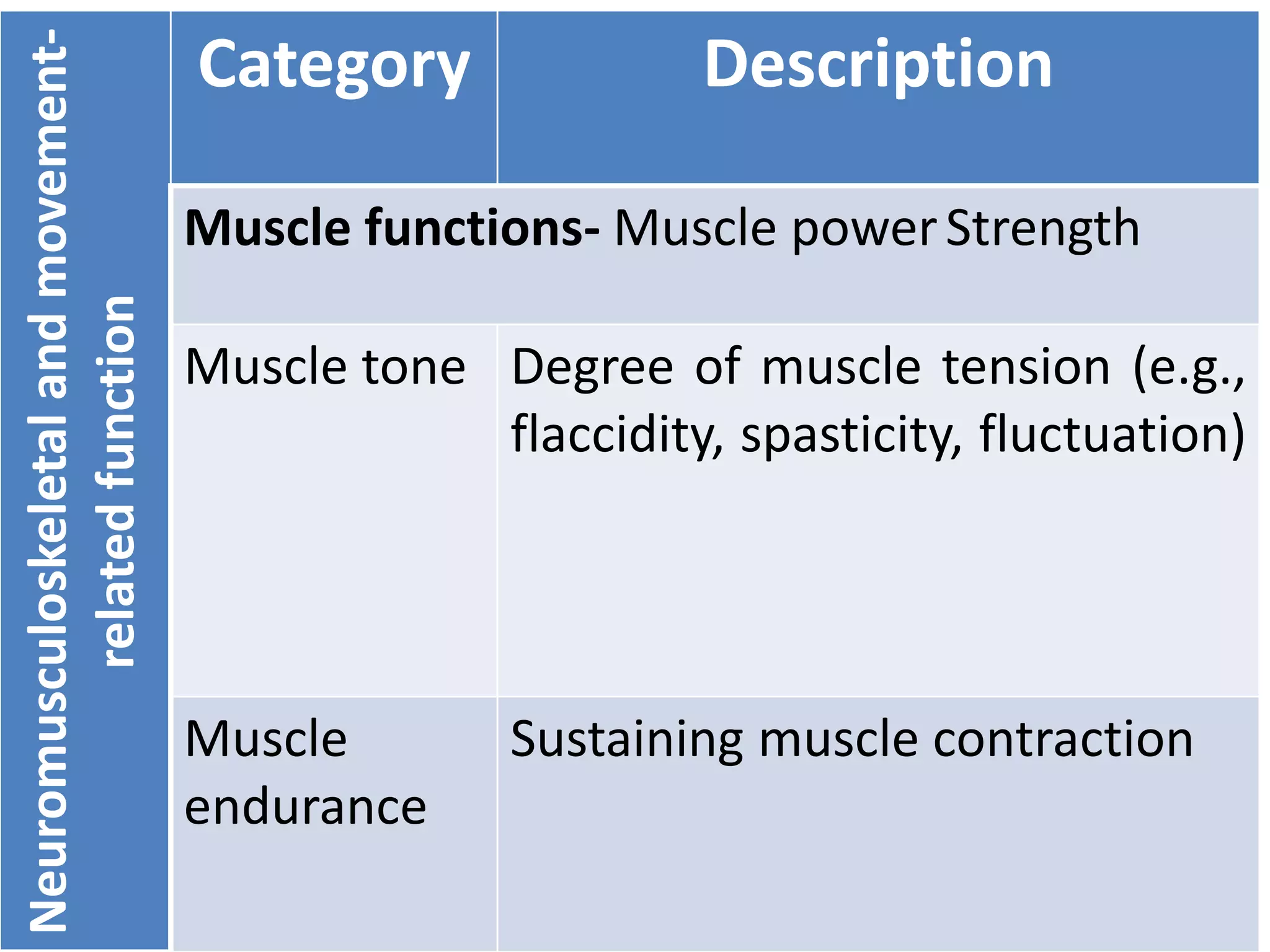
Neuromusculoskeletalandmovement-
relatedfunction
Category Description
Muscle functions- Muscle powerStrength
Muscle tone Degree of muscle tension (e.g.,
flaccidity, spasticity, fluctuation)
Muscle
endurance
Sustaining muscle contraction
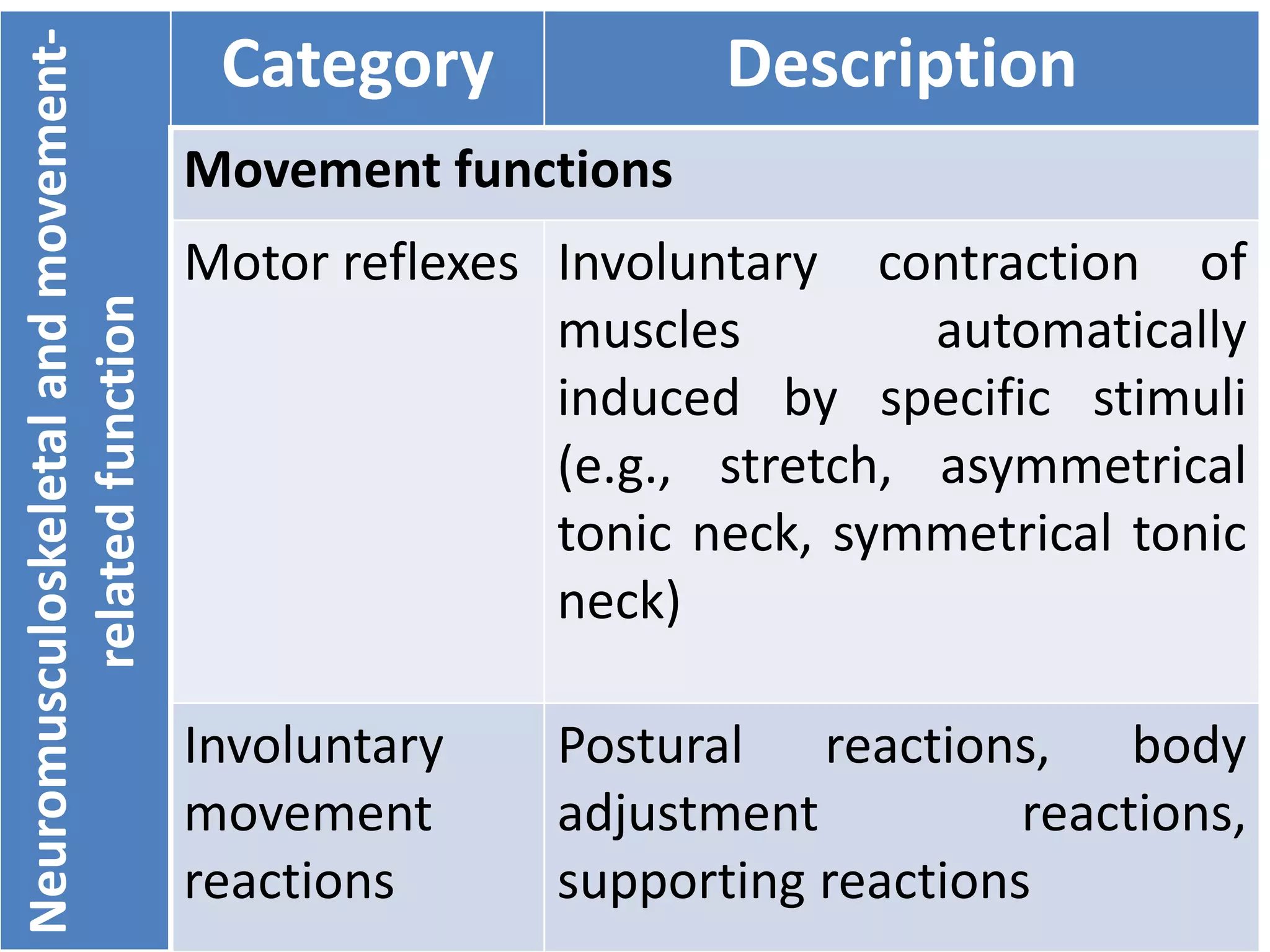
Neuromusculoskeletalandmovement-
relatedfunction
Category Description
Movement functions
Motor reflexes Involuntary contraction of
muscles automatically
induced by specific stimuli
(e.g., stretch, asymmetrical
tonic neck, symmetrical tonic
neck)
Involuntary
movement
reactions
Postural reactions, body
adjustment reactions,
supporting reactions
Neuromusculoskeletalandmovement-
relatedfunction
Category Description
Movement functions
Control of
voluntary
movement
Eye–hand and eye–foot
coordination, bilateral
integration, crossing of the
midline, fine and gross motor
control, and oculomotor
function (e.g., saccades,
pursuits, accommodation,
binocularity)
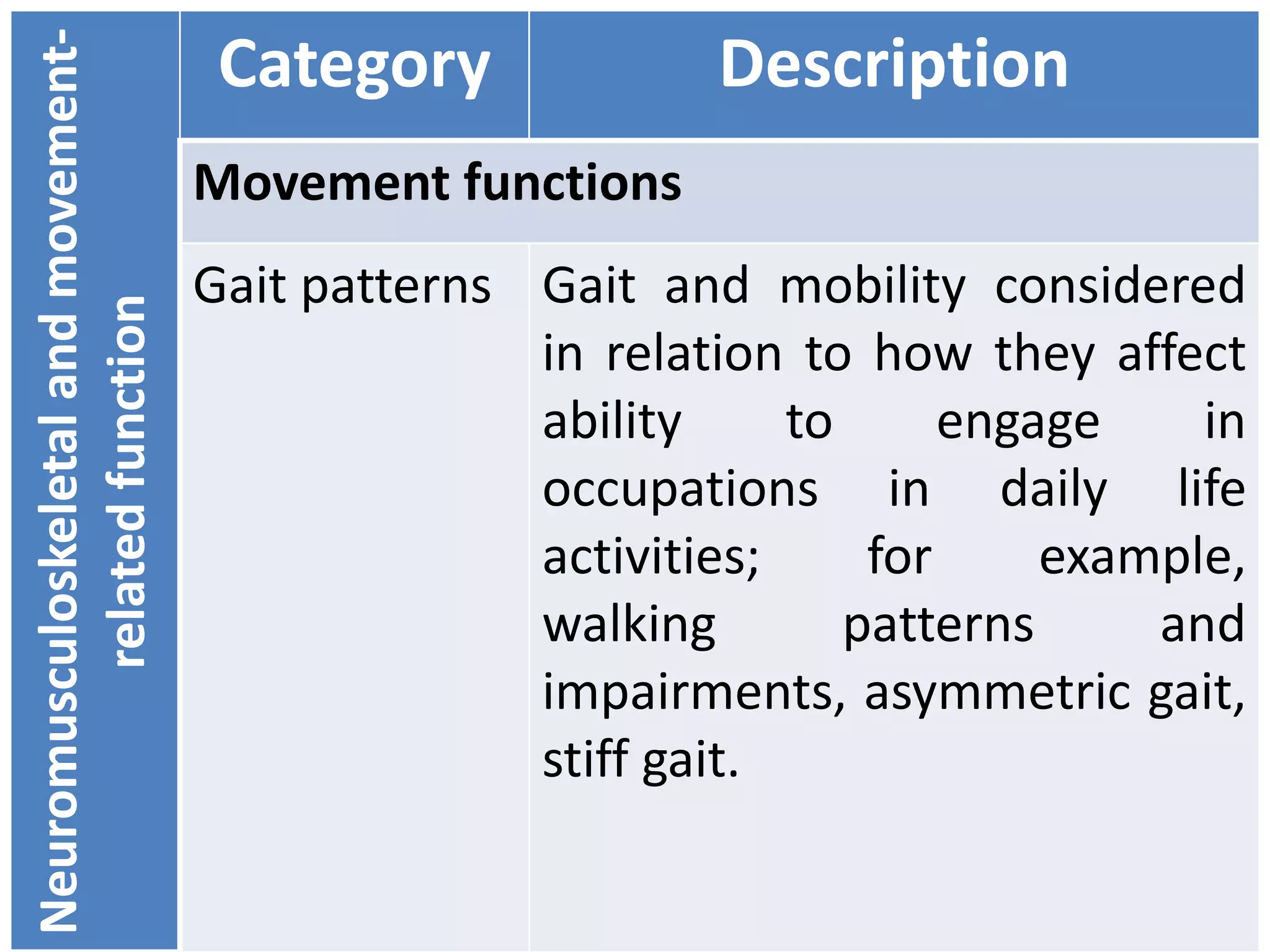
Neuromusculoskeletalandmovement-
relatedfunction
Category Description
Movement functions
Gait patterns Gait and mobility considered
in relation to how they affect
ability to engage in
occupations in daily life
activities; for example,
walking patterns and
impairments, asymmetric gait,
stiff gait.
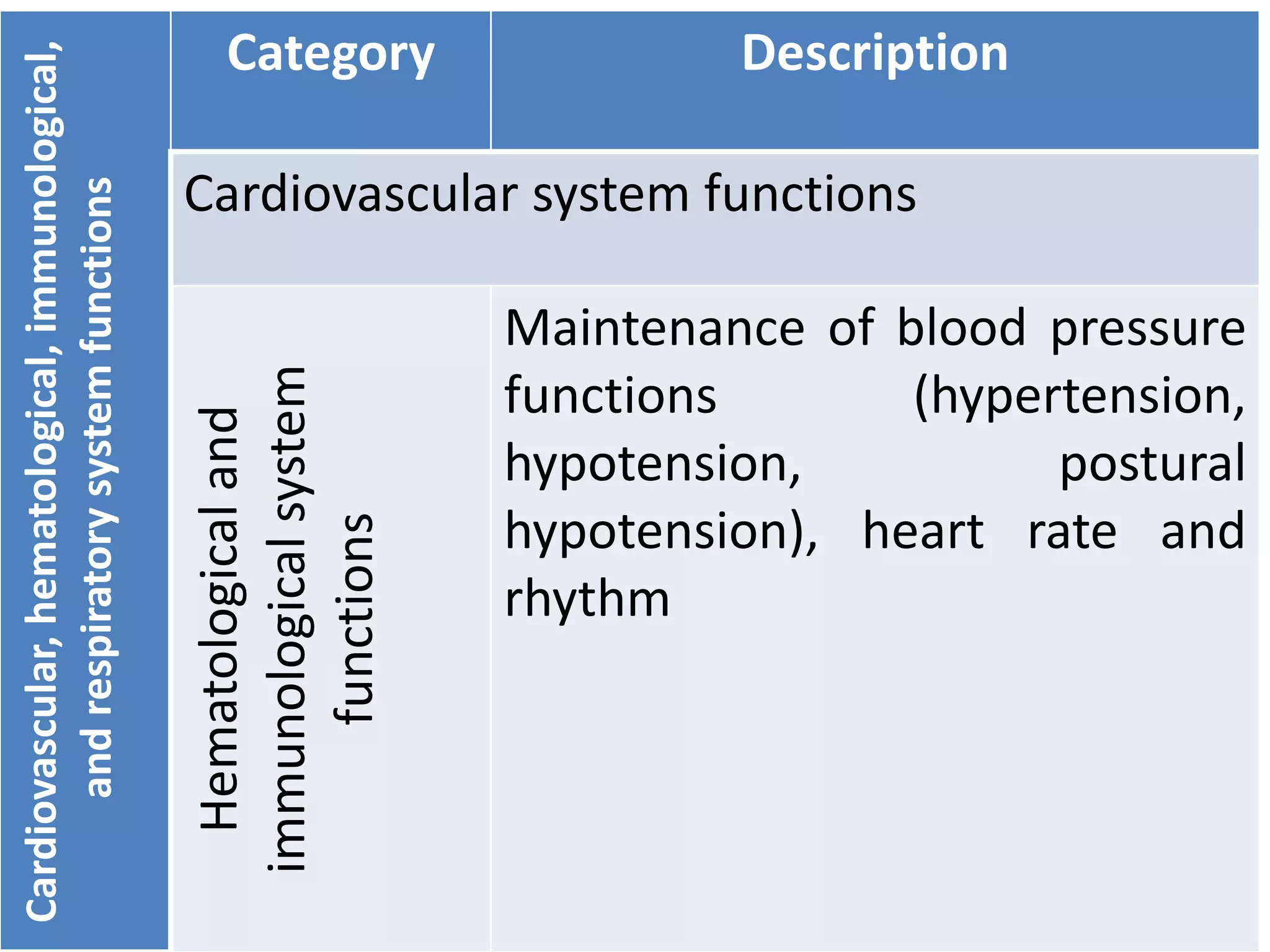
Cardiovascular,hematological,immunological,
andrespiratorysystemfunctions
Category Description
Cardiovascular system functionsHematologicaland
immunologicalsystem
functions Maintenance of blood pressure
functions (hypertension,
hypotension, postural
hypotension), heart rate and
rhythm
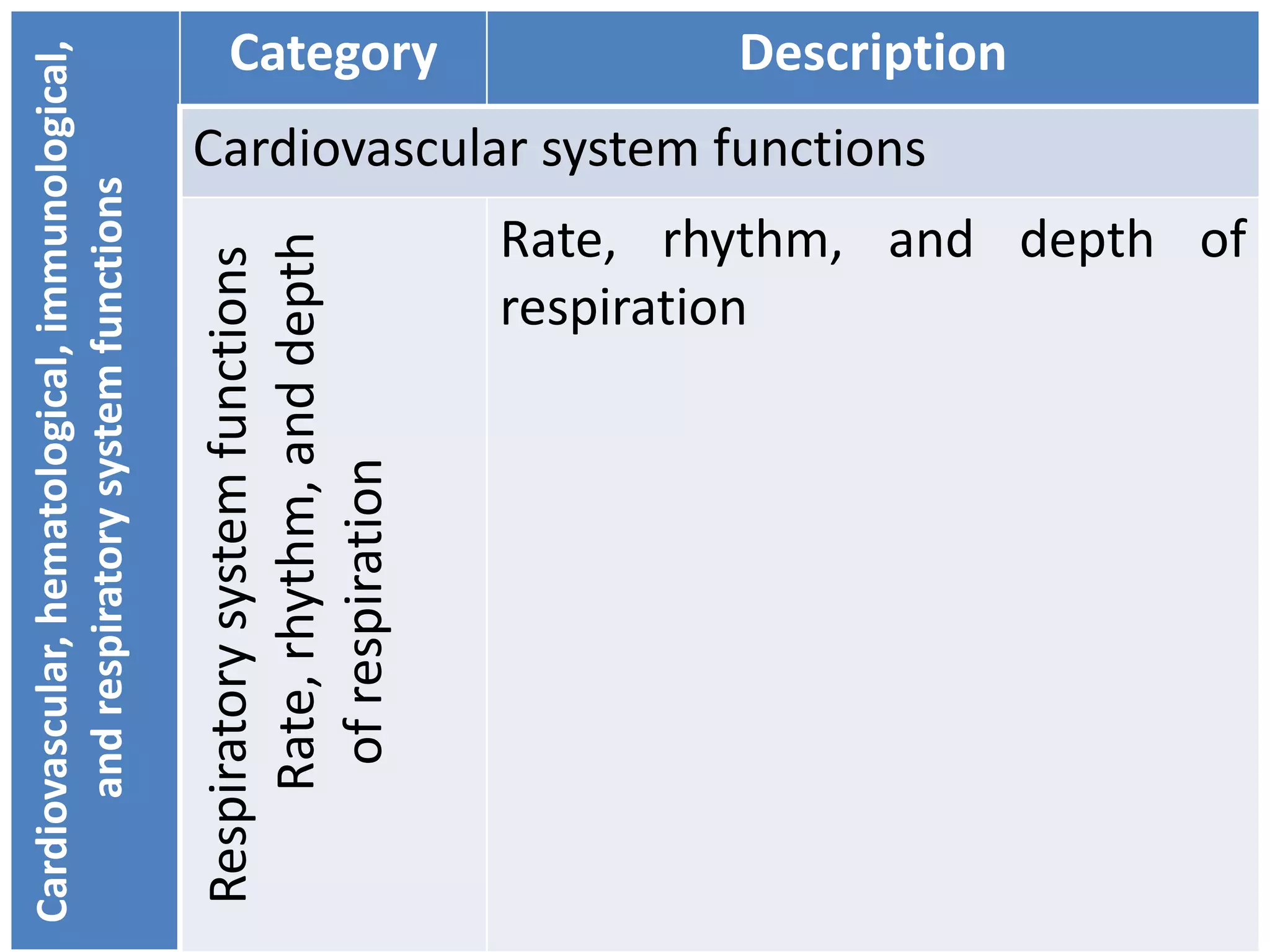
Cardiovascular,hematological,immunological,
andrespiratorysystemfunctions
Category Description
Cardiovascular system functions
Respiratorysystemfunctions
Rate,rhythm,anddepth
ofrespiration
Rate, rhythm, and depth of
respiration
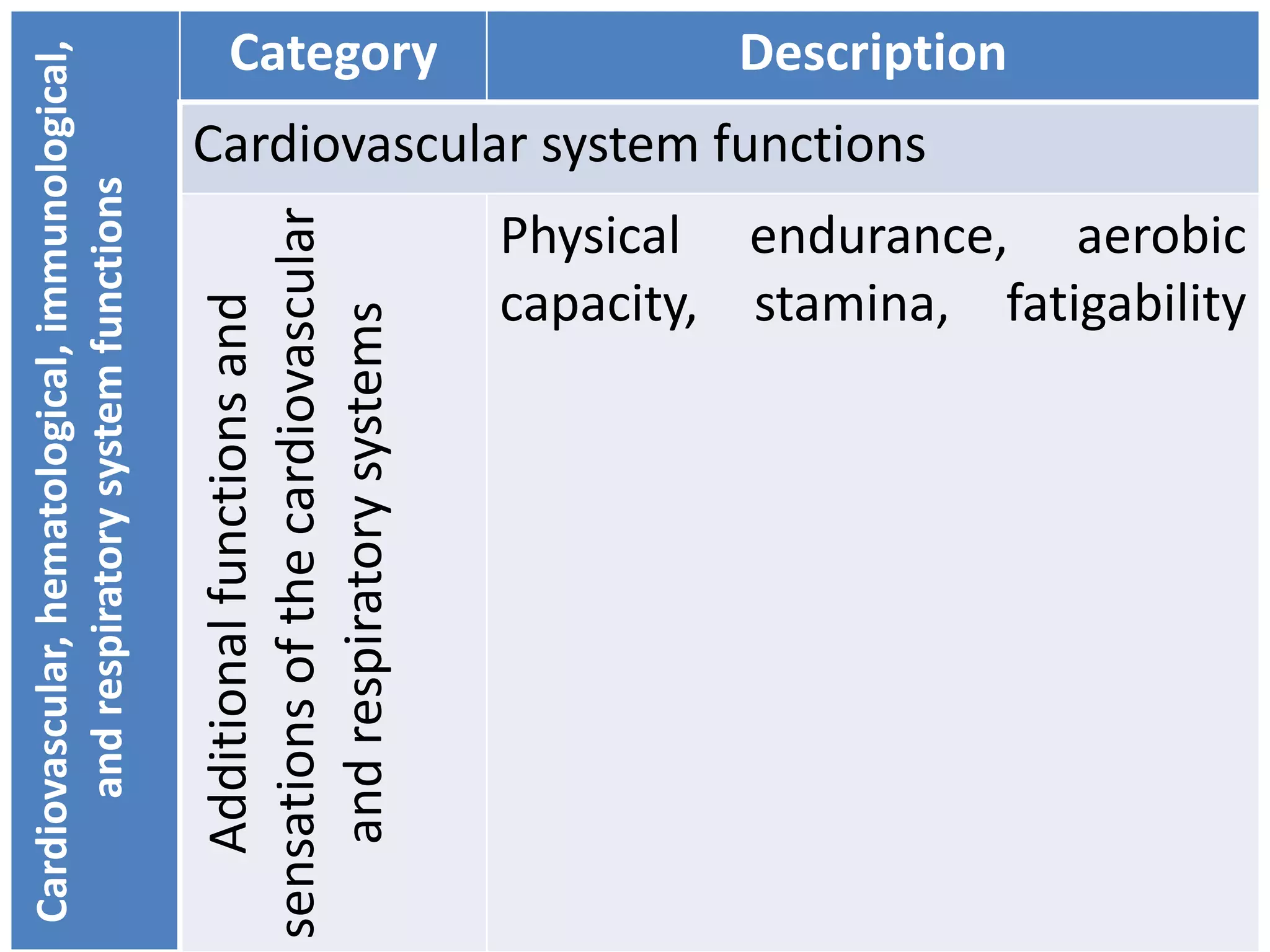
Cardiovascular,hematological,immunological,
andrespiratorysystemfunctions
Category Description
Cardiovascular system functions
Additionalfunctionsand
sensationsofthecardiovascular
andrespiratorysystems
Physical endurance, aerobic
capacity, stamina, fatigability
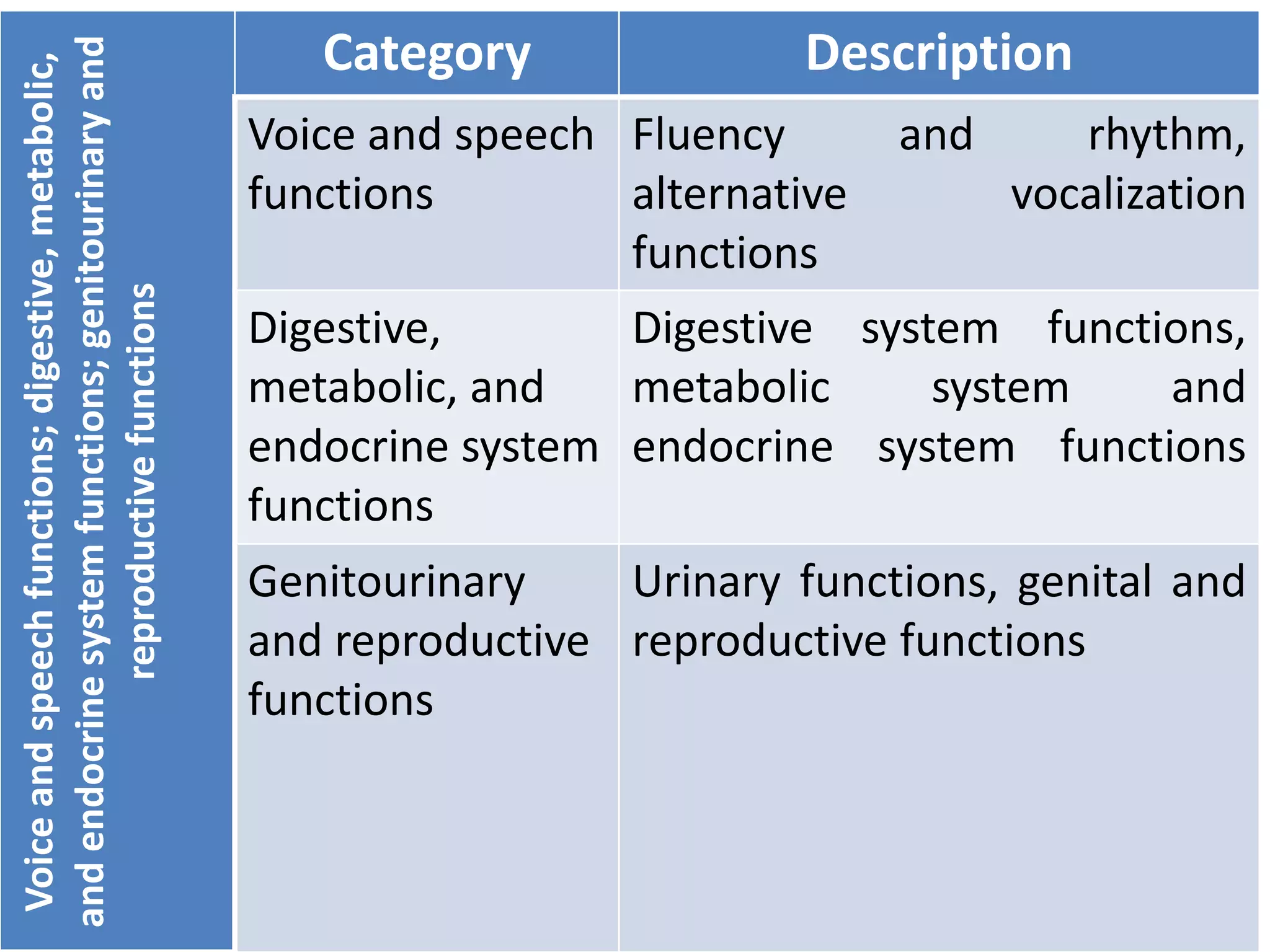
Voiceandspeechfunctions;digestive,metabolic,
andendocrinesystemfunctions;genitourinaryand
reproductivefunctions
Category Description
Voice and speech
functions
Fluency and rhythm,
alternative vocalization
functions
Digestive,
metabolic, and
endocrine system
functions
Digestive system functions,
metabolic system and
endocrine system functions
Genitourinary
and reproductive
functions
Urinary functions, genital and
reproductive functions
Voiceandspeechfunctions;digestive,metabolic,
andendocrinesystemfunctions;genitourinaryand
reproductivefunctions
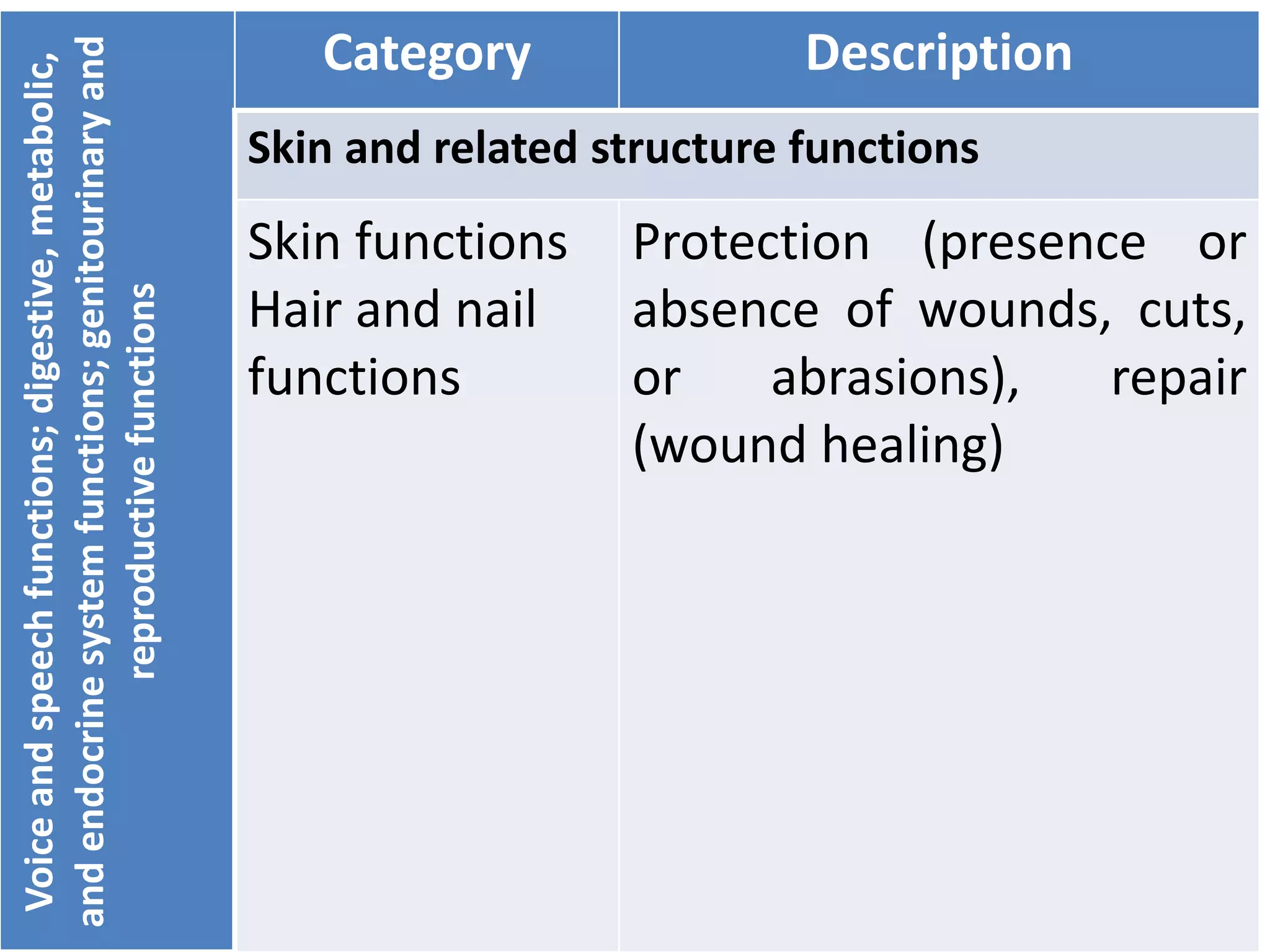
Category Description
Skin and related structure functions
Skin functions
Hair and nail
functions
Protection (presence or
absence of wounds, cuts,
or abrasions), repair
(wound healing)
Category Description
BODY STRUCTURES: “Anatomical parts of the body, such as organs, limbs, and their
components” that support body function (WHO, 2001, p.10).The “Body Structures” section of
the table is organized according to the ICF classifications; for fuller descriptions and definitions,
refer to WHO (2001).
Structure of the nervous system
Eyes, ear, and related structures
Structures involved in voice and speech
Structures of the cardiovascular,
immunological, and respiratory systems
Structures related to the digestive,
metabolic, and endocrine systems
Structures related to the genitourinary and
reproductive systems
Structures related to movement
Skin and related structures
Protection (presence or
absence of wounds, cuts,
or abrasions), repair
(wound healing)
AOTA- OTPF: client factors

AOTA- OTPF: client factors

  • 1.
    Shamima Akter B. Sc(Honours) in Occupational Therapy & M. Sc in Rehabilitation Science Assistant Professor, Department of Occupational Therapy Bangladesh Health Professions Institute (BHPI) Centre for the Rehabilitation of the Paralysed (CRP) Chapain, Savar
  • 2.
    Client Factors • Clientfactors are specific capacities, characteristics, or beliefs that reside within the person and that influence performance in occupations (Table 2). • Client factors are affected by the presence or absence of illness, disease, deprivation, disability, and life experiences. • Although client factors are not to be confused with performance skills, client factors can affect performance skills. • Thus, client factors may need to be present in whole or in part for a person to complete an action (skill) used in the execution of an occupation.
  • 3.
    CLIENT FACTORS • Clientfactors include: (1) values, beliefs, and spirituality; (2) body functions; and (3)body structures that reside within the client that influence the client’s performance in occupations.
  • 4.
    VALUES, BELIEFS, ANDSPIRITUALITY • Clients’ perceptions, motivations, and related meaning that influence or are influenced by engagement in occupations.
  • 5.
    Category and DefinitionExamples Values- Acquired beliefs and commitments, derived from culture, about what is good, right and important to do. Person: • Honesty with self and others • Commitment to family Group: • Obligation to provide a service • Fairness Population: • Freedom of speech • Equal opportunities for all • Tolerance toward others
  • 6.
    Category and DefinitionExamples Beliefs—Cognitive content held as true by or about the client. Person: • One is powerless to influence others. • Hard work pays off. Group and population: • Some personal rights are worth fighting for. • A new health care policy, as yet untried, will positively affect society.
  • 7.
    Category and DefinitionExamples Spirituality—“The aspect of humanity that refers to the way individuals seek and express meaning and purpose and the way they experience their connectedness to the moment, to self, to others, to nature, and to the significant or sacred” Person: • Daily search for purpose and meaning in one’s life • Guidance of actions by a sense of value beyond the personal acquisition of wealth or fame Group and population: • Common search for purpose and meaning in life • Guidance of actions by values agreed on by the collective
  • 8.
    Category and Definition Examples Beliefs—Cognitive content heldas true by or about the client. Person: • One is powerless to influence others. • Hard work pays off. Group and population: • Some personal rights are worth fighting for. • A new health care policy, as yet untried, will positively affect society.
  • 9.
    BODY FUNCTIONS • “Thephysiological functions of body systems (including psychological functions)” (WHO, 2001, p.10). • This section of the table is organized according to the classifications of the International Classification of Functioning, Disability and Health (ICF); for fuller descriptions and definitions, refer to WHO (2001).
  • 10.
    Specificmentalfunctions Category Description Mentalfunction High level cognitive Judgment, concept formation, meta-cognition, executive functions, praxis, cognitive flexibility, insight. Attention Sustained shifting and divided attention, concentration, distractibility
  • 11.
    Specificmentalfunction Category Description MemoryShort-term, long-term, and working memory Perception Discrimination of sensations (e.g., auditory, tactile, visual, olfactory, gustatory, vestibular, proprioceptive) Thought Control and content of thought, awareness of reality vs. delusions, logical and coherent thought
  • 12.
    SpecificMentalfunction Category Description Mental functionsof sequencing complex movement Mental functions that regulate the speed, response, quality, and time of motor production, such as restlessness, toe tapping, or hand wringing, in response to inner tension Emotional Regulation and range of emotions; appropriateness of emotions, including anger, love, tension, and anxiety; liability of emotions
  • 13.
    Specificmentalfunction Category Description Experience ofself and time Awareness of one's identity, body, and position in the reality of one's environment and of time
  • 14.
    Category Description Global mentalfunction: Consciousness State of awareness and alertness, including the clarity and continuity of the wakeful state. GlobalMentalFunction Consciousness State of awareness and alertness, including the clarity and continuity of the wakeful state Orientation Orientation to person, place, time, self, and others Sleep Physiological process, quality of sleep
  • 15.
    GlobalMentalFunction Category Description Temperament and personality Extroversion,introversion, agreeableness, conscientiousness, emotional stability, openness to experience, self-control, self- expression, confidence, motivation, impulse control, appetite Energy and drive Energy level, motivation, appetite, craving, impulse control
  • 16.
    Sensoryfunction Category Description Visual functions Qualityof vision, visual acuity, visual stability, and visual field functions to promote visual awareness of environment at various distances for functioning Hearing functions Sound detection and discrimination; awareness of location and distance of sounds Vestibular functions Sensation related to position, balance, and secure movement against gravity
  • 17.
    Sensoryfunction Category Description Taste functions Associationof taste qualities of bitterness, sweetness, sourness, and saltiness Smell functions Sensing odors and smells Proprioceptive functions Awareness of body position and space
  • 18.
    Sensoryfunction Category Description Touch functions Feelingof being touched by others or touching various textures, such as those of food; presence of numbness, paresthesia, hyperesthesia Pain (e.g., diffuse, dull, sharp, phantom) Unpleasant feeling indicating potential or actual damage to some body structure; sensations of generalized or localized pain (e.g., diffuse, dull, sharp, phantom)
  • 19.
    Sensoryfunction Category Description Sensitivityto temperature and pressure Thermal awareness (hot and cold), sense of force applied to skin
  • 20.
    Neuromusculoskeletalandmovement- relatedfunction Category Description Functions ofjoints and bones Joint mobility Joint range of motion Joint stability Maintenance of structural integrity of joints throughout the body; physiological stability of joints related to structural integrity
  • 21.
    Neuromusculoskeletalandmovement- relatedfunction Category Description Muscle functions-Muscle powerStrength Muscle tone Degree of muscle tension (e.g., flaccidity, spasticity, fluctuation) Muscle endurance Sustaining muscle contraction
  • 22.
    Neuromusculoskeletalandmovement- relatedfunction Category Description Movement functions Motorreflexes Involuntary contraction of muscles automatically induced by specific stimuli (e.g., stretch, asymmetrical tonic neck, symmetrical tonic neck) Involuntary movement reactions Postural reactions, body adjustment reactions, supporting reactions
  • 23.
    Neuromusculoskeletalandmovement- relatedfunction Category Description Movement functions Controlof voluntary movement Eye–hand and eye–foot coordination, bilateral integration, crossing of the midline, fine and gross motor control, and oculomotor function (e.g., saccades, pursuits, accommodation, binocularity)
  • 24.
    Neuromusculoskeletalandmovement- relatedfunction Category Description Movement functions Gaitpatterns Gait and mobility considered in relation to how they affect ability to engage in occupations in daily life activities; for example, walking patterns and impairments, asymmetric gait, stiff gait.
  • 25.
    Cardiovascular,hematological,immunological, andrespiratorysystemfunctions Category Description Cardiovascular systemfunctionsHematologicaland immunologicalsystem functions Maintenance of blood pressure functions (hypertension, hypotension, postural hypotension), heart rate and rhythm
  • 26.
    Cardiovascular,hematological,immunological, andrespiratorysystemfunctions Category Description Cardiovascular systemfunctions Respiratorysystemfunctions Rate,rhythm,anddepth ofrespiration Rate, rhythm, and depth of respiration
  • 27.
    Cardiovascular,hematological,immunological, andrespiratorysystemfunctions Category Description Cardiovascular systemfunctions Additionalfunctionsand sensationsofthecardiovascular andrespiratorysystems Physical endurance, aerobic capacity, stamina, fatigability
  • 28.
    Voiceandspeechfunctions;digestive,metabolic, andendocrinesystemfunctions;genitourinaryand reproductivefunctions Category Description Voice andspeech functions Fluency and rhythm, alternative vocalization functions Digestive, metabolic, and endocrine system functions Digestive system functions, metabolic system and endocrine system functions Genitourinary and reproductive functions Urinary functions, genital and reproductive functions
  • 29.
    Voiceandspeechfunctions;digestive,metabolic, andendocrinesystemfunctions;genitourinaryand reproductivefunctions Category Description Skin andrelated structure functions Skin functions Hair and nail functions Protection (presence or absence of wounds, cuts, or abrasions), repair (wound healing)
  • 30.
    Category Description BODY STRUCTURES:“Anatomical parts of the body, such as organs, limbs, and their components” that support body function (WHO, 2001, p.10).The “Body Structures” section of the table is organized according to the ICF classifications; for fuller descriptions and definitions, refer to WHO (2001). Structure of the nervous system Eyes, ear, and related structures Structures involved in voice and speech Structures of the cardiovascular, immunological, and respiratory systems Structures related to the digestive, metabolic, and endocrine systems Structures related to the genitourinary and reproductive systems Structures related to movement Skin and related structures Protection (presence or absence of wounds, cuts, or abrasions), repair (wound healing)