SCHEMA THEORY
Presented by,
Shambavi Yoganandhan B.tech, B.Ed
Government College of Education for Women
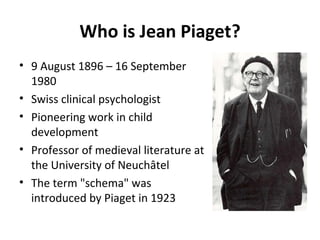
Who is Jean Piaget?
• 9 August 1896 – 16 September
1980
• Swiss clinical psychologist
• Pioneering work in child
development
• Professor of medieval literature at
the University of Neuchâtel
• The term "schema" was
introduced by Piaget in 1923
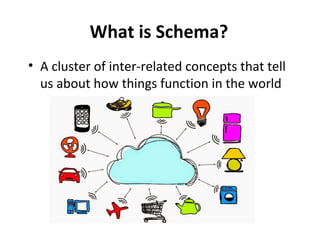
What is Schema?
• A cluster of inter-related concepts that tell
us about how things function in the world
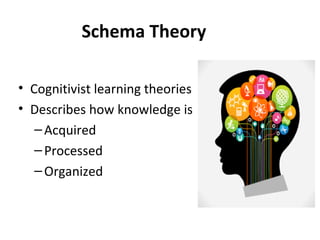
Schema Theory
• Cognitivist learning theories
• Describes how knowledge is
–Acquired
–Processed
–Organized
Schema
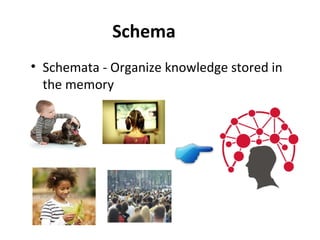
• Schemata - Organize knowledge stored in
the memory
Through schemata - old knowledge influences
new information
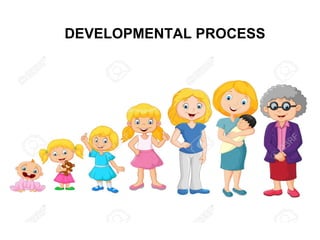
DEVELOPMENTAL PROCESS
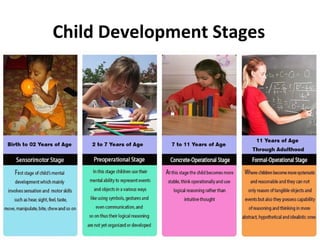
Child Development Stages
The Sensorimotor Stage
Ages: Birth to 2 Years
The Preoperational Stage
Ages: 2 to 7 Years
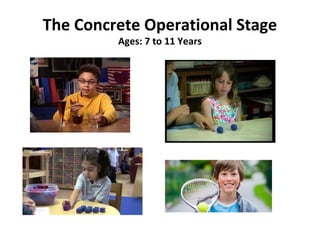
The Concrete Operational Stage
Ages: 7 to 11 Years
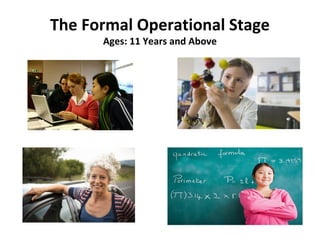
The Formal Operational Stage
Ages: 11 Years and Above
Cognitive Development - Steps
• Assimilation
• Accommodation
• Adaptation
• Organization
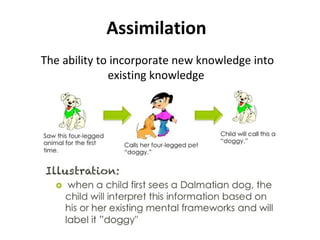
Assimilation
The ability to incorporate new knowledge into
existing knowledge
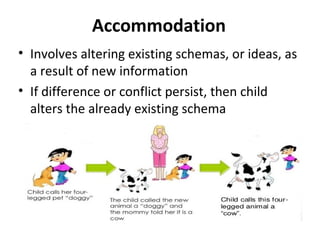
Accommodation
• Involves altering existing schemas, or ideas, as
a result of new information
• If difference or conflict persist, then child
alters the already existing schema
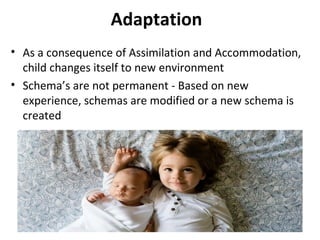
Adaptation
• As a consequence of Assimilation and Accommodation,
child changes itself to new environment
• Schema’s are not permanent - Based on new
experience, schemas are modified or a new schema is
created
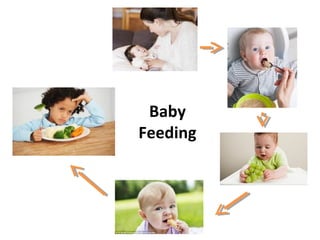
Baby
Feeding
Organization
• Large number of schemas created and they are
organized
• Child’s cognitive structure keeps configuring
• As a result, child gets the knowledge of “Picking
up” what it wants.
Researcher’s on Schema Theory
• Bartlett (1932)
– How Schema influence memory
• Brewer & Treyens (1981)
–Memory recall
• French and Richards (1933)
–Demonstrating schematic
influence
Story Time
The War of Ghosts
-Native American folk tale
The War of Ghost
• One night two young men from Egulac went down to the river to
hunt seals and while they were there it became foggy and calm.
Then they heard war-cries, and they thought: "Maybe this is a war-
party". They escaped to the shore, and hid behind a log. Now
canoes came up, and they heard the noise of paddles, and saw one
canoe coming up to them. There were five men in the canoe, and
they said:
• "What do you think? We wish to take you along. We are going up
the river to make war on the people."
One of the young men said,"I have no arrows."
"Arrows are in the canoe," they said.
• "I will not go along. I might be killed. My relatives do not know
where I have gone. But you," he said, turning to the other, "may go
with them."
• So one of the young men went, but the other returned home.
And the warriors went on up the river to a town on the other side of
Kalama. The people came down to the water and they began to
fight, and many were killed. But presently the young man heard one
of the warriors say, "Quick, let us go home: that Indian has been
hit." Now he thought: "Oh, they are ghosts." He did not feel sick, but
they said he had been shot.
So the canoes went back to Egulac and the young man went ashore
to his house and made a fire. And he told everybody and said:
"Behold I accompanied the ghosts, and we went to fight. Many of
our fellows were killed, and many of those who attacked us were
killed. They said I was hit, and I did not feel sick."
He told it all, and then he became quiet. When the sun rose he fell
down. Something black came out of his mouth. His face became
contorted. The people jumped up and cried.
He was dead.
Sir Frederic Bartlett
• Tested their memory of the story by asking
participants repeating the story
– Serial reproduction
– Repeated reproduction
• Changes undergone in the story
⁻ ‘hunting seals’ changed into ‘fishing’
⁻ ‘canoes’ became ‘boats’.
• Features observed in his participants'
recall included:
–Simplification - stories became more basic
–Addition - adding things in which weren't
present
–Subtraction - removing elements
–Transformation - things were changed to
make them seem more familiar
Brewer & Treyens
• Method:
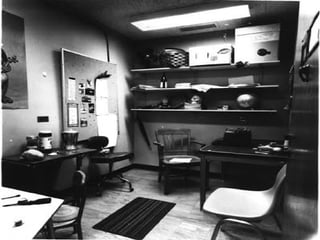
–Participants were taken into a
university student office and left for 35
seconds before being taken to another
room
–They were asked to write down as
much as they could remember from
the office (shown in next slide)
Now!
Write down
Let me know what you have
observed
Conclusion
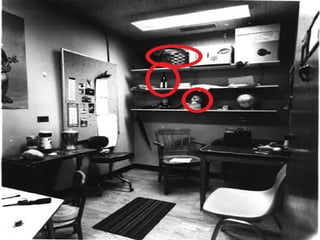
–Participants' schema of an office influenced
their memory of it.
–They did not recall the wine and picnic
basket because it is not part of their “typical
office” schema
Connection
• Provides evidence to support how our
schema can affect our
cognition/cognitive process, particularly
memory
• Our schema influence what we recall in
our memory
French and Richards
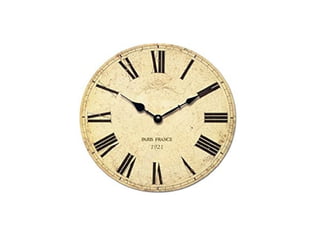
• Aim - To investigate the schemata influence
on memory retrieval
• Methods
– 1: Shown a clock with roman numerals and asked
to draw from memory
– 2: Told before hand that they would be required
to draw the clock from memory
– 3: The clock was left in full view of the participants
and just had to draw it
• Result
– Group 1 & 2 reverted to using IV
– Group 3 used the IIII notation, because of the
direct copy.
• Connection of study to question
– Supports how our schemas can affect our
cognition/cognitive processes, in particular
memory.
– Our schemas influence what we recall in our
memory.
Topics discussed
• Jean Piaget
• What is Schema?
• Schema Theory
• Child development and schema changes
• Cognitive Development – Steps
• Researcher’s on scheme theory
– Sir Frederic Bartlett
– Brewer & Treyens
– French and Richards
Thank You

Schema theory

  • 1.
    SCHEMA THEORY Presented by, ShambaviYoganandhan B.tech, B.Ed Government College of Education for Women
  • 2.
    Who is JeanPiaget? • 9 August 1896 – 16 September 1980 • Swiss clinical psychologist • Pioneering work in child development • Professor of medieval literature at the University of Neuchâtel • The term "schema" was introduced by Piaget in 1923
  • 3.
    What is Schema? •A cluster of inter-related concepts that tell us about how things function in the world
  • 4.
    Schema Theory • Cognitivistlearning theories • Describes how knowledge is –Acquired –Processed –Organized
  • 5.
    Schema • Schemata -Organize knowledge stored in the memory
  • 6.
    Through schemata -old knowledge influences new information
  • 7.
  • 8.
  • 9.
  • 10.
  • 11.
    The Concrete OperationalStage Ages: 7 to 11 Years
  • 12.
    The Formal OperationalStage Ages: 11 Years and Above
  • 13.
    Cognitive Development -Steps • Assimilation • Accommodation • Adaptation • Organization
  • 14.
    Assimilation The ability toincorporate new knowledge into existing knowledge
  • 15.
    Accommodation • Involves alteringexisting schemas, or ideas, as a result of new information • If difference or conflict persist, then child alters the already existing schema
  • 16.
    Adaptation • As aconsequence of Assimilation and Accommodation, child changes itself to new environment • Schema’s are not permanent - Based on new experience, schemas are modified or a new schema is created
  • 17.
  • 18.
    Organization • Large numberof schemas created and they are organized • Child’s cognitive structure keeps configuring • As a result, child gets the knowledge of “Picking up” what it wants.
  • 19.
    Researcher’s on SchemaTheory • Bartlett (1932) – How Schema influence memory • Brewer & Treyens (1981) –Memory recall • French and Richards (1933) –Demonstrating schematic influence
  • 20.
    Story Time The Warof Ghosts -Native American folk tale
  • 21.
    The War ofGhost • One night two young men from Egulac went down to the river to hunt seals and while they were there it became foggy and calm. Then they heard war-cries, and they thought: "Maybe this is a war- party". They escaped to the shore, and hid behind a log. Now canoes came up, and they heard the noise of paddles, and saw one canoe coming up to them. There were five men in the canoe, and they said: • "What do you think? We wish to take you along. We are going up the river to make war on the people." One of the young men said,"I have no arrows." "Arrows are in the canoe," they said. • "I will not go along. I might be killed. My relatives do not know where I have gone. But you," he said, turning to the other, "may go with them."
  • 22.
    • So oneof the young men went, but the other returned home. And the warriors went on up the river to a town on the other side of Kalama. The people came down to the water and they began to fight, and many were killed. But presently the young man heard one of the warriors say, "Quick, let us go home: that Indian has been hit." Now he thought: "Oh, they are ghosts." He did not feel sick, but they said he had been shot. So the canoes went back to Egulac and the young man went ashore to his house and made a fire. And he told everybody and said: "Behold I accompanied the ghosts, and we went to fight. Many of our fellows were killed, and many of those who attacked us were killed. They said I was hit, and I did not feel sick." He told it all, and then he became quiet. When the sun rose he fell down. Something black came out of his mouth. His face became contorted. The people jumped up and cried. He was dead.
  • 23.
    Sir Frederic Bartlett •Tested their memory of the story by asking participants repeating the story – Serial reproduction – Repeated reproduction • Changes undergone in the story ⁻ ‘hunting seals’ changed into ‘fishing’ ⁻ ‘canoes’ became ‘boats’.
  • 24.
    • Features observedin his participants' recall included: –Simplification - stories became more basic –Addition - adding things in which weren't present –Subtraction - removing elements –Transformation - things were changed to make them seem more familiar
  • 25.
    Brewer & Treyens •Method: –Participants were taken into a university student office and left for 35 seconds before being taken to another room –They were asked to write down as much as they could remember from the office (shown in next slide)
  • 27.
    Now! Write down Let meknow what you have observed
  • 29.
    Conclusion –Participants' schema ofan office influenced their memory of it. –They did not recall the wine and picnic basket because it is not part of their “typical office” schema
  • 30.
    Connection • Provides evidenceto support how our schema can affect our cognition/cognitive process, particularly memory • Our schema influence what we recall in our memory
  • 31.
    French and Richards •Aim - To investigate the schemata influence on memory retrieval • Methods – 1: Shown a clock with roman numerals and asked to draw from memory – 2: Told before hand that they would be required to draw the clock from memory – 3: The clock was left in full view of the participants and just had to draw it
  • 33.
    • Result – Group1 & 2 reverted to using IV – Group 3 used the IIII notation, because of the direct copy. • Connection of study to question – Supports how our schemas can affect our cognition/cognitive processes, in particular memory. – Our schemas influence what we recall in our memory.
  • 34.
    Topics discussed • JeanPiaget • What is Schema? • Schema Theory • Child development and schema changes • Cognitive Development – Steps • Researcher’s on scheme theory – Sir Frederic Bartlett – Brewer & Treyens – French and Richards
  • 36.