THIN FILM INTERFERENCE
Selina Lo
33096132
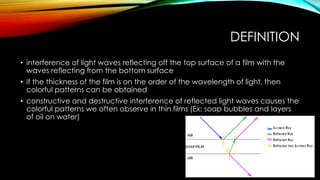
DEFINITION
• interference of light waves reflecting off the top surface of a film with the
waves reflecting from the bottom surface
• if the thickness of the film is on the order of the wavelength of light, then
colorful patterns can be obtained
• constructive and destructive interference of reflected light waves causes the
colorful patterns we often observe in thin films (Ex: soap bubbles and layers
of oil on water)
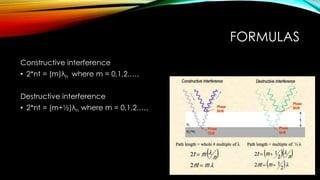
FORMULAS
Constructive interference
• 2*nt = (m)λn where m = 0,1,2,…,
Destructive interference
• 2*nt = (m+½)λn where m = 0,1,2,…,
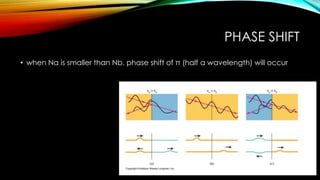
PHASE SHIFT
• when Na is smaller than Nb, phase shift of π (half a wavelength) will occur
EXAMPLES
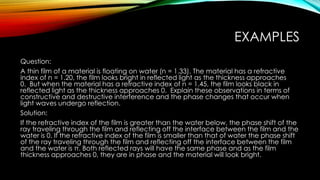
Question:
A thin film of a material is floating on water (n = 1.33). The material has a refractive
index of n = 1.20, the film looks bright in reflected light as the thickness approaches
0. But when the material has a refractive index of n = 1.45, the film looks black in
reflected light as the thickness approaches 0. Explain these observations in terms of
constructive and destructive interference and the phase changes that occur when
light waves undergo reflection.
Solution:
If the refractive index of the film is greater than the water below, the phase shift of the
ray traveling through the film and reflecting off the interface between the film and the
water is 0. If the refractive index of the film is smaller than that of water the phase shift
of the ray traveling through the film and reflecting off the interface between the film
and the water is π. Both reflected rays will have the same phase and as the film
thickness approaches 0, they are in phase and the material will look bright.
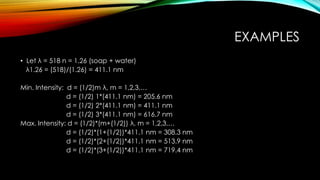
EXAMPLES
• Let λ = 518 n = 1.26 (soap + water)
λ1.26 = (518)/(1.26) = 411.1 nm
Min. Intensity: d = (1/2)m λ, m = 1,2,3,…
d = (1/2) 1*(411.1 nm) = 205.6 nm
d = (1/2) 2*(411.1 nm) = 411.1 nm
d = (1/2) 3*(411.1 nm) = 616.7 nm
Max. Intensity: d = (1/2)*(m+(1/2)) λ, m = 1,2,3,…
d = (1/2)*(1+(1/2))*411.1 nm = 308.3 nm
d = (1/2)*(2+(1/2))*411.1 nm = 513.9 nm
d = (1/2)*(3+(1/2))*411.1 nm = 719.4 nm
BIBLIOGRAPHY
• Thin-film interference. Retrieved March 22, 2015, from
http://labman.phys.utk.edu/phys222core/modules/m9/Thin films.htm
• Hawks, R.,Iqbal, J. Mansour, F, Milner-Bolotin, M. & Williams P. 2014. Physics for
Scientists and Engineers: An Interactive Approach (1st ed.) Nelson Education
Ltd.

Physics 101 learning object 9

  • 1.
  • 2.
    DEFINITION • interference oflight waves reflecting off the top surface of a film with the waves reflecting from the bottom surface • if the thickness of the film is on the order of the wavelength of light, then colorful patterns can be obtained • constructive and destructive interference of reflected light waves causes the colorful patterns we often observe in thin films (Ex: soap bubbles and layers of oil on water)
  • 3.
    FORMULAS Constructive interference • 2*nt= (m)λn where m = 0,1,2,…, Destructive interference • 2*nt = (m+½)λn where m = 0,1,2,…,
  • 4.
    PHASE SHIFT • whenNa is smaller than Nb, phase shift of π (half a wavelength) will occur
  • 5.
    EXAMPLES Question: A thin filmof a material is floating on water (n = 1.33). The material has a refractive index of n = 1.20, the film looks bright in reflected light as the thickness approaches 0. But when the material has a refractive index of n = 1.45, the film looks black in reflected light as the thickness approaches 0. Explain these observations in terms of constructive and destructive interference and the phase changes that occur when light waves undergo reflection. Solution: If the refractive index of the film is greater than the water below, the phase shift of the ray traveling through the film and reflecting off the interface between the film and the water is 0. If the refractive index of the film is smaller than that of water the phase shift of the ray traveling through the film and reflecting off the interface between the film and the water is π. Both reflected rays will have the same phase and as the film thickness approaches 0, they are in phase and the material will look bright.
  • 6.
    EXAMPLES • Let λ= 518 n = 1.26 (soap + water) λ1.26 = (518)/(1.26) = 411.1 nm Min. Intensity: d = (1/2)m λ, m = 1,2,3,… d = (1/2) 1*(411.1 nm) = 205.6 nm d = (1/2) 2*(411.1 nm) = 411.1 nm d = (1/2) 3*(411.1 nm) = 616.7 nm Max. Intensity: d = (1/2)*(m+(1/2)) λ, m = 1,2,3,… d = (1/2)*(1+(1/2))*411.1 nm = 308.3 nm d = (1/2)*(2+(1/2))*411.1 nm = 513.9 nm d = (1/2)*(3+(1/2))*411.1 nm = 719.4 nm
  • 7.
    BIBLIOGRAPHY • Thin-film interference.Retrieved March 22, 2015, from http://labman.phys.utk.edu/phys222core/modules/m9/Thin films.htm • Hawks, R.,Iqbal, J. Mansour, F, Milner-Bolotin, M. & Williams P. 2014. Physics for Scientists and Engineers: An Interactive Approach (1st ed.) Nelson Education Ltd.