DR. A.P.J. ABDUL KALAM TECHNICAL
UNIVERSITY, LUCKNOW
PHYSICS
DR. A.P.J. ABDUL KALAM TECHNICAL
UNIVERSITY, LUCKNOW
PHYSICS
INTERFERENCE
Lecture: 02
Presented by
Dr. S. H. ABDI
Babu Banarasi Das National Institute of Technology &
Management, Lucknow
CONTENT
• Necessity of an Extended Source
• Interference due to wedge shaped thin film
• Derivation for path difference
• Nature of Interference Fringes
• Fringe width in wedge shaped thin film
• Interference colour pattern on the
surface of a soap bubble
• Determination of wedge angle θ
• Necessity of an Extended Source
• Interference due to wedge shaped thin film
• Derivation for path difference
• Nature of Interference Fringes
• Fringe width in wedge shaped thin film
• Interference colour pattern on the
surface of a soap bubble
• Determination of wedge angle θ
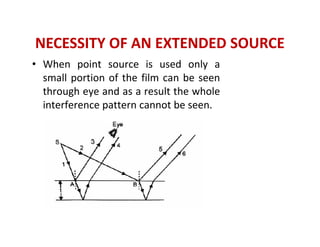
• When point source is used only a
small portion of the film can be seen
through eye and as a result the whole
interference pattern cannot be seen.
NECESSITY OF AN EXTENDED SOURCE
.
When a broad source is used rays of light
are incident at different angles and
reflected parallel beam reach the eye and
whole beam and complete pattern is
visible.
Interference in Wedge Shaped Film
(Reflected Rays)
The wedge shaped film has a thin film of
varying thickness, having thickness zero
at one end and increases at the other.
The angle of wedge is θ.
• Let AB is the incident ray of monochromatic
light on the upper surface of the film.
• BR1 is reflected and BC is refracted ray.
• After reflection from the lower surface of the
film at C, it will emerge out from the film in the
direction DR2.
• Thus producing two coherent sources.
• For path difference draw normal from D.
• On BC and BR1 as DN and DM.
Derivation for path difference
• Let AB is the incident ray of monochromatic
light on the upper surface of the film.
• BR1 is reflected and BC is refracted ray.
• After reflection from the lower surface of the
film at C, it will emerge out from the film in the
direction DR2.
• Thus producing two coherent sources.
• For path difference draw normal from D.
• On BC and BR1 as DN and DM.
• The optical path difference therefore is
Δ=µ(BC+CD)-BM
Δ=µ(BN+NC+CD)-BM ..(1)
• From geometry ∠BDM=i and ∠BDN=r
• From right angled ΔBDM and ΔBDN
sini=BM/BD and sinr=BN/BD,
• As, µ=sini/sinr ,
• Putting the value of sini and sinr from
above equations,
• µ=(BM/BD)/(BN/BD)=BM/BN,
So, BM=µBN…..(2)
• The optical path difference therefore is
Δ=µ(BC+CD)-BM
Δ=µ(BN+NC+CD)-BM ..(1)
• From geometry ∠BDM=i and ∠BDN=r
• From right angled ΔBDM and ΔBDN
sini=BM/BD and sinr=BN/BD,
• As, µ=sini/sinr ,
• Putting the value of sini and sinr from
above equations,
• µ=(BM/BD)/(BN/BD)=BM/BN,
So, BM=µBN…..(2)
• Substituting the value of BM from(2) in (1),we
have, path difference Δ=µ(BN+NC+CD)-µBN
OR Δ= µ(NC+CD)…(3)
• From geometry ,CD=CL ….(4)
• Substituting the value of CD from (4)to(3),we
have, Δ= µ(NL)…(5)
• From right angled Δ NLD,
• NL/DL=cos(r+θ)
OR NL=DL cos(r+θ)
• Because DL=2t
∴ NL=2tcos(r+θ)
• Substituting the value of BM from(2) in (1),we
have, path difference Δ=µ(BN+NC+CD)-µBN
OR Δ= µ(NC+CD)…(3)
• From geometry ,CD=CL ….(4)
• Substituting the value of CD from (4)to(3),we
have, Δ= µ(NL)…(5)
• From right angled Δ NLD,
• NL/DL=cos(r+θ)
OR NL=DL cos(r+θ)
• Because DL=2t
∴ NL=2tcos(r+θ)
• Therefore, Δ=2µtcos(θ+r)
• As ray BR1 is reflected from denser
medium an additional path difference of
λ/2 occurs.
• So, Δ= 2µtcos(θ+r)+ λ/2
• Condition for maxima,
Δ=2µtcos(θ+r)+ λ/2 =n λ
Or, Δ=2µtcos(θ+r) =(2n-1) λ/2
• Condition for minima,
Δ= 2µtcos(θ+r)+ λ/2 =(2n+1) λ/2
Or, Δ=2µtcos(θ+r)=n λ
• Therefore, Δ=2µtcos(θ+r)
• As ray BR1 is reflected from denser
medium an additional path difference of
λ/2 occurs.
• So, Δ= 2µtcos(θ+r)+ λ/2
• Condition for maxima,
Δ=2µtcos(θ+r)+ λ/2 =n λ
Or, Δ=2µtcos(θ+r) =(2n-1) λ/2
• Condition for minima,
Δ= 2µtcos(θ+r)+ λ/2 =(2n+1) λ/2
Or, Δ=2µtcos(θ+r)=n λ
Nature of Interference Fringes
• When wedge shape film is illuminated by
Parallel beam of monochromatic light,
then the straight fringes parallel to the
edge are obtained.
• As µ, r and θ are constant for particular
incident light, hence particular point of
thickness t will appear bright or dark
depending on condition of maxima or
minima is satisfied.
• Since locus of all points of constant
thickness is straight line, therefore the
straight line Fringes will be observed.
• When wedge shape film is illuminated by
Parallel beam of monochromatic light,
then the straight fringes parallel to the
edge are obtained.
• As µ, r and θ are constant for particular
incident light, hence particular point of
thickness t will appear bright or dark
depending on condition of maxima or
minima is satisfied.
• Since locus of all points of constant
thickness is straight line, therefore the
straight line Fringes will be observed.
Fringe Width
• The condition for minima in Wedge Shaped
film is, 2µtcos(θ+r)+λ/2=(2n+1) λ/2
Or,2µtcos(θ+r)=n λ…(1)
• Let the distance of nth dark fringe from edge
of the film be X.
• If t be the thickness of the film, then
t/X=tanθ…..(2)
So using equation (2) in equation (1) we get,
2µXtanθcos(θ+r)=nλ…(3)
• Similarly if Y is the distance of (n+1)th dark
fringe, then
2µYtanθcos(θ+r)=(n+1)λ…(4)
• The condition for minima in Wedge Shaped
film is, 2µtcos(θ+r)+λ/2=(2n+1) λ/2
Or,2µtcos(θ+r)=n λ…(1)
• Let the distance of nth dark fringe from edge
of the film be X.
• If t be the thickness of the film, then
t/X=tanθ…..(2)
So using equation (2) in equation (1) we get,
2µXtanθcos(θ+r)=nλ…(3)
• Similarly if Y is the distance of (n+1)th dark
fringe, then
2µYtanθcos(θ+r)=(n+1)λ…(4)
Subtracting equation (3) from equation
(4),we get the equation
for Fringe width,
ω=Y-X
OR ω=λ/2µtanθcos(θ+r)
• For normal incidence; i=r=0, and for small
angle of wedge,
ω=λ/2µθ
This is formula for fringe width.
For air film,µ=1
ω=λ/2θ
Subtracting equation (3) from equation
(4),we get the equation
for Fringe width,
ω=Y-X
OR ω=λ/2µtanθcos(θ+r)
• For normal incidence; i=r=0, and for small
angle of wedge,
ω=λ/2µθ
This is formula for fringe width.
For air film,µ=1
ω=λ/2θ
Interference Colour Pattern on the
surface of a Soap Bubble
• When white light is incident on a soap bubble,
the bubbles appears coloured and the
colouration of the bubble varies with the
thickness of the surface of the bubble. As, in
bubble, the soap solution drains to the bottom,
the soap film gets thinner at the top and the
colours become more brilliant. when the
thickness becomes less than the order of
wavelentgth, a black band is formed at the top.
So the interference pattern on the surface of a
soap bubble changes continuously.
• When white light is incident on a soap bubble,
the bubbles appears coloured and the
colouration of the bubble varies with the
thickness of the surface of the bubble. As, in
bubble, the soap solution drains to the bottom,
the soap film gets thinner at the top and the
colours become more brilliant. when the
thickness becomes less than the order of
wavelentgth, a black band is formed at the top.
So the interference pattern on the surface of a
soap bubble changes continuously.
Determination of wedge Angle θ
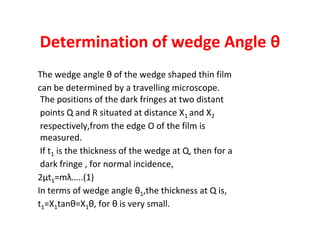
The wedge angle θ of the wedge shaped thin film
can be determined by a travelling microscope.
The positions of the dark fringes at two distant
points Q and R situated at distance X1 and X2
respectively,from the edge O of the film is
measured.
If t1 is the thickness of the wedge at Q, then for a
dark fringe , for normal incidence,
2µt1=mλ…..(1)
In terms of wedge angle θ1,the thickness at Q is,
t1=X1tanθ=X1θ, for θ is very small.
The wedge angle θ of the wedge shaped thin film
can be determined by a travelling microscope.
The positions of the dark fringes at two distant
points Q and R situated at distance X1 and X2
respectively,from the edge O of the film is
measured.
If t1 is the thickness of the wedge at Q, then for a
dark fringe , for normal incidence,
2µt1=mλ…..(1)
In terms of wedge angle θ1,the thickness at Q is,
t1=X1tanθ=X1θ, for θ is very small.
FIGURE.3
Therefore 2µX1θ=mλ…..(2)
similarly if t2 be the thickness of the wedge at R,
again for a dark ring
2µt2=(m+n)λ…….(3)
where n is the no. of dark fringes between Q and R.
In terms of wedge angle
t2=X2θ
2µX2θ=(m+n)λ….(4)
subtracting equation (2) from equation(4),we get
2µ(X2-X1)θ=nλ
Therefore 2µX1θ=mλ…..(2)
similarly if t2 be the thickness of the wedge at R,
again for a dark ring
2µt2=(m+n)λ…….(3)
where n is the no. of dark fringes between Q and R.
In terms of wedge angle
t2=X2θ
2µX2θ=(m+n)λ….(4)
subtracting equation (2) from equation(4),we get
2µ(X2-X1)θ=nλ
Or, θ=nλ/2µ(X2-X1)
For air film µ=1,then
Or,θ=nλ/(X2-X1),
Thus by measuring X2 and X1 from travelling
microscope and number of dark fringes between
Qand R, the angle of wedge is determined.
THANK YOU
THANK YOU

Interference_ppt_2.2 (1).pdf

  • 1.
    DR. A.P.J. ABDULKALAM TECHNICAL UNIVERSITY, LUCKNOW PHYSICS DR. A.P.J. ABDUL KALAM TECHNICAL UNIVERSITY, LUCKNOW PHYSICS INTERFERENCE Lecture: 02 Presented by Dr. S. H. ABDI Babu Banarasi Das National Institute of Technology & Management, Lucknow
  • 2.
    CONTENT • Necessity ofan Extended Source • Interference due to wedge shaped thin film • Derivation for path difference • Nature of Interference Fringes • Fringe width in wedge shaped thin film • Interference colour pattern on the surface of a soap bubble • Determination of wedge angle θ • Necessity of an Extended Source • Interference due to wedge shaped thin film • Derivation for path difference • Nature of Interference Fringes • Fringe width in wedge shaped thin film • Interference colour pattern on the surface of a soap bubble • Determination of wedge angle θ
  • 3.
    • When pointsource is used only a small portion of the film can be seen through eye and as a result the whole interference pattern cannot be seen. NECESSITY OF AN EXTENDED SOURCE
  • 4.
    . When a broadsource is used rays of light are incident at different angles and reflected parallel beam reach the eye and whole beam and complete pattern is visible.
  • 5.
    Interference in WedgeShaped Film (Reflected Rays) The wedge shaped film has a thin film of varying thickness, having thickness zero at one end and increases at the other. The angle of wedge is θ.
  • 6.
    • Let ABis the incident ray of monochromatic light on the upper surface of the film. • BR1 is reflected and BC is refracted ray. • After reflection from the lower surface of the film at C, it will emerge out from the film in the direction DR2. • Thus producing two coherent sources. • For path difference draw normal from D. • On BC and BR1 as DN and DM. Derivation for path difference • Let AB is the incident ray of monochromatic light on the upper surface of the film. • BR1 is reflected and BC is refracted ray. • After reflection from the lower surface of the film at C, it will emerge out from the film in the direction DR2. • Thus producing two coherent sources. • For path difference draw normal from D. • On BC and BR1 as DN and DM.
  • 7.
    • The opticalpath difference therefore is Δ=µ(BC+CD)-BM Δ=µ(BN+NC+CD)-BM ..(1) • From geometry ∠BDM=i and ∠BDN=r • From right angled ΔBDM and ΔBDN sini=BM/BD and sinr=BN/BD, • As, µ=sini/sinr , • Putting the value of sini and sinr from above equations, • µ=(BM/BD)/(BN/BD)=BM/BN, So, BM=µBN…..(2) • The optical path difference therefore is Δ=µ(BC+CD)-BM Δ=µ(BN+NC+CD)-BM ..(1) • From geometry ∠BDM=i and ∠BDN=r • From right angled ΔBDM and ΔBDN sini=BM/BD and sinr=BN/BD, • As, µ=sini/sinr , • Putting the value of sini and sinr from above equations, • µ=(BM/BD)/(BN/BD)=BM/BN, So, BM=µBN…..(2)
  • 8.
    • Substituting thevalue of BM from(2) in (1),we have, path difference Δ=µ(BN+NC+CD)-µBN OR Δ= µ(NC+CD)…(3) • From geometry ,CD=CL ….(4) • Substituting the value of CD from (4)to(3),we have, Δ= µ(NL)…(5) • From right angled Δ NLD, • NL/DL=cos(r+θ) OR NL=DL cos(r+θ) • Because DL=2t ∴ NL=2tcos(r+θ) • Substituting the value of BM from(2) in (1),we have, path difference Δ=µ(BN+NC+CD)-µBN OR Δ= µ(NC+CD)…(3) • From geometry ,CD=CL ….(4) • Substituting the value of CD from (4)to(3),we have, Δ= µ(NL)…(5) • From right angled Δ NLD, • NL/DL=cos(r+θ) OR NL=DL cos(r+θ) • Because DL=2t ∴ NL=2tcos(r+θ)
  • 9.
    • Therefore, Δ=2µtcos(θ+r) •As ray BR1 is reflected from denser medium an additional path difference of λ/2 occurs. • So, Δ= 2µtcos(θ+r)+ λ/2 • Condition for maxima, Δ=2µtcos(θ+r)+ λ/2 =n λ Or, Δ=2µtcos(θ+r) =(2n-1) λ/2 • Condition for minima, Δ= 2µtcos(θ+r)+ λ/2 =(2n+1) λ/2 Or, Δ=2µtcos(θ+r)=n λ • Therefore, Δ=2µtcos(θ+r) • As ray BR1 is reflected from denser medium an additional path difference of λ/2 occurs. • So, Δ= 2µtcos(θ+r)+ λ/2 • Condition for maxima, Δ=2µtcos(θ+r)+ λ/2 =n λ Or, Δ=2µtcos(θ+r) =(2n-1) λ/2 • Condition for minima, Δ= 2µtcos(θ+r)+ λ/2 =(2n+1) λ/2 Or, Δ=2µtcos(θ+r)=n λ
  • 10.
    Nature of InterferenceFringes • When wedge shape film is illuminated by Parallel beam of monochromatic light, then the straight fringes parallel to the edge are obtained. • As µ, r and θ are constant for particular incident light, hence particular point of thickness t will appear bright or dark depending on condition of maxima or minima is satisfied. • Since locus of all points of constant thickness is straight line, therefore the straight line Fringes will be observed. • When wedge shape film is illuminated by Parallel beam of monochromatic light, then the straight fringes parallel to the edge are obtained. • As µ, r and θ are constant for particular incident light, hence particular point of thickness t will appear bright or dark depending on condition of maxima or minima is satisfied. • Since locus of all points of constant thickness is straight line, therefore the straight line Fringes will be observed.
  • 11.
    Fringe Width • Thecondition for minima in Wedge Shaped film is, 2µtcos(θ+r)+λ/2=(2n+1) λ/2 Or,2µtcos(θ+r)=n λ…(1) • Let the distance of nth dark fringe from edge of the film be X. • If t be the thickness of the film, then t/X=tanθ…..(2) So using equation (2) in equation (1) we get, 2µXtanθcos(θ+r)=nλ…(3) • Similarly if Y is the distance of (n+1)th dark fringe, then 2µYtanθcos(θ+r)=(n+1)λ…(4) • The condition for minima in Wedge Shaped film is, 2µtcos(θ+r)+λ/2=(2n+1) λ/2 Or,2µtcos(θ+r)=n λ…(1) • Let the distance of nth dark fringe from edge of the film be X. • If t be the thickness of the film, then t/X=tanθ…..(2) So using equation (2) in equation (1) we get, 2µXtanθcos(θ+r)=nλ…(3) • Similarly if Y is the distance of (n+1)th dark fringe, then 2µYtanθcos(θ+r)=(n+1)λ…(4)
  • 12.
    Subtracting equation (3)from equation (4),we get the equation for Fringe width, ω=Y-X OR ω=λ/2µtanθcos(θ+r) • For normal incidence; i=r=0, and for small angle of wedge, ω=λ/2µθ This is formula for fringe width. For air film,µ=1 ω=λ/2θ Subtracting equation (3) from equation (4),we get the equation for Fringe width, ω=Y-X OR ω=λ/2µtanθcos(θ+r) • For normal incidence; i=r=0, and for small angle of wedge, ω=λ/2µθ This is formula for fringe width. For air film,µ=1 ω=λ/2θ
  • 13.
    Interference Colour Patternon the surface of a Soap Bubble • When white light is incident on a soap bubble, the bubbles appears coloured and the colouration of the bubble varies with the thickness of the surface of the bubble. As, in bubble, the soap solution drains to the bottom, the soap film gets thinner at the top and the colours become more brilliant. when the thickness becomes less than the order of wavelentgth, a black band is formed at the top. So the interference pattern on the surface of a soap bubble changes continuously. • When white light is incident on a soap bubble, the bubbles appears coloured and the colouration of the bubble varies with the thickness of the surface of the bubble. As, in bubble, the soap solution drains to the bottom, the soap film gets thinner at the top and the colours become more brilliant. when the thickness becomes less than the order of wavelentgth, a black band is formed at the top. So the interference pattern on the surface of a soap bubble changes continuously.
  • 14.
    Determination of wedgeAngle θ The wedge angle θ of the wedge shaped thin film can be determined by a travelling microscope. The positions of the dark fringes at two distant points Q and R situated at distance X1 and X2 respectively,from the edge O of the film is measured. If t1 is the thickness of the wedge at Q, then for a dark fringe , for normal incidence, 2µt1=mλ…..(1) In terms of wedge angle θ1,the thickness at Q is, t1=X1tanθ=X1θ, for θ is very small. The wedge angle θ of the wedge shaped thin film can be determined by a travelling microscope. The positions of the dark fringes at two distant points Q and R situated at distance X1 and X2 respectively,from the edge O of the film is measured. If t1 is the thickness of the wedge at Q, then for a dark fringe , for normal incidence, 2µt1=mλ…..(1) In terms of wedge angle θ1,the thickness at Q is, t1=X1tanθ=X1θ, for θ is very small.
  • 15.
  • 16.
    Therefore 2µX1θ=mλ…..(2) similarly ift2 be the thickness of the wedge at R, again for a dark ring 2µt2=(m+n)λ…….(3) where n is the no. of dark fringes between Q and R. In terms of wedge angle t2=X2θ 2µX2θ=(m+n)λ….(4) subtracting equation (2) from equation(4),we get 2µ(X2-X1)θ=nλ Therefore 2µX1θ=mλ…..(2) similarly if t2 be the thickness of the wedge at R, again for a dark ring 2µt2=(m+n)λ…….(3) where n is the no. of dark fringes between Q and R. In terms of wedge angle t2=X2θ 2µX2θ=(m+n)λ….(4) subtracting equation (2) from equation(4),we get 2µ(X2-X1)θ=nλ
  • 17.
    Or, θ=nλ/2µ(X2-X1) For airfilm µ=1,then Or,θ=nλ/(X2-X1), Thus by measuring X2 and X1 from travelling microscope and number of dark fringes between Qand R, the angle of wedge is determined.
  • 18.