Coastal landscapes
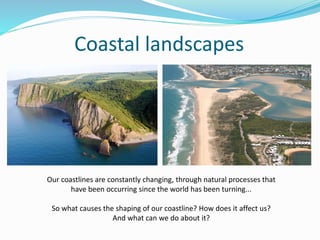
Our coastlines are constantly changing, through natural processes that
have been occurring since the world has been turning...
So what causes the shaping of our coastline? How does it affect us?
And what can we do about it?
Coastal erosion
Destructive waves,
strong swash/backwash
and tidal currents cause:
 Hydraulic action
 Abrasion
 Attrition
 Solution
The sea shapes the coastal landscape.
Coastal erosion is the wearing away and
breaking up of rock along the coast.
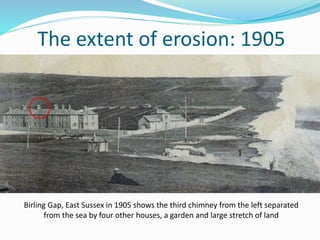
Birling Gap, East Sussex in 1905 shows the third chimney from the left separated
from the sea by four other houses, a garden and large stretch of land
The extent of erosion: 1905
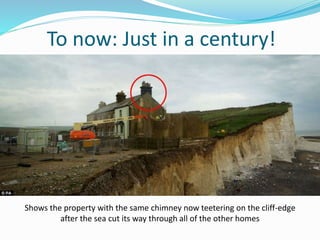
To now: Just in a century!
Shows the property with the same chimney now teetering on the cliff-edge
after the sea cut its way through all of the other homes
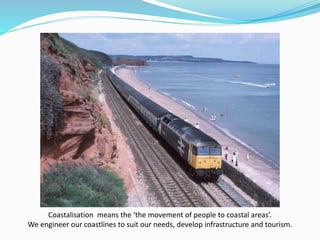
Coastalisation means the ‘the movement of people to coastal areas’.
We engineer our coastlines to suit our needs, develop infrastructure and tourism.
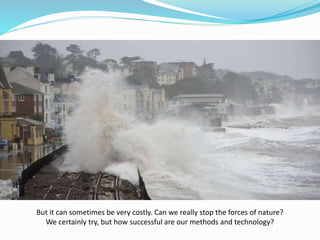
But it can sometimes be very costly. Can we really stop the forces of nature?
We certainly try, but how successful are our methods and technology?
Coastal defences - Hard engineering
Porthleven, Cornwall, during a storm.
Sea walls:
Permanent stone or brick
structures built to protect
settlements or cliff bases
from erosion. Although
seemingly effective they do
not absorb the waves
energy, rather reflects it
actually causing beach
erosion, sometimes
undercutting the structure.
Tend to be expensive, short-term options that may also have a high impact
on the landscape or environment and considered to be unsustainable.
Coastal defences - Hard engineering
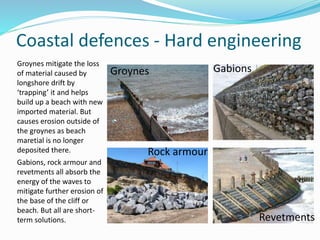
Groynes mitigate the loss
of material caused by
longshore drift by
‘trapping’ it and helps
build up a beach with new
imported material. But
causes erosion outside of
the groynes as beach
maretial is no longer
deposited there.
Gabions, rock armour and
revetments all absorb the
energy of the waves to
mitigate further erosion of
the base of the cliff or
beach. But all are short-
term solutions.
Groynes
Rock armour
Gabions
Revetments
Coastal defences – Soft engineering
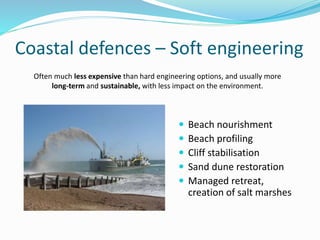
 Beach nourishment
 Beach profiling
 Cliff stabilisation
 Sand dune restoration
 Managed retreat,
creation of salt marshes
Often much less expensive than hard engineering options, and usually more
long-term and sustainable, with less impact on the environment.
Managed retreats – Most sustainable
Advantages
 Land becomes a marsh, slowing
waves and reducing erosion
 Creates new habitats and
promotes biodiversity
 Good for recreation, walking and
bird watching
Disadvantages
 Arable/development land is lost
 Can be costly depending on scale
of human resettlement
Managed realignment involves altering the location of the line of defence,
to provide a more sustainable position to manage flood and erosion risks.
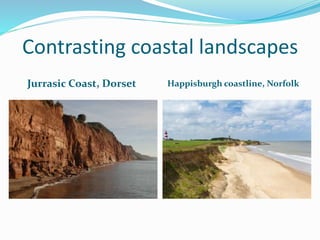
Contrasting coastal landscapes
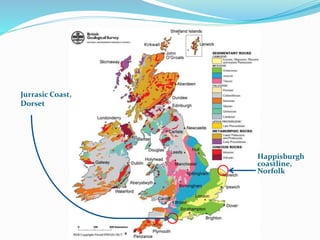
Jurrasic Coast, Dorset Happisburgh coastline, Norfolk
Jurrasic Coast,
Dorset
Happisburgh
coastline,
Norfolk
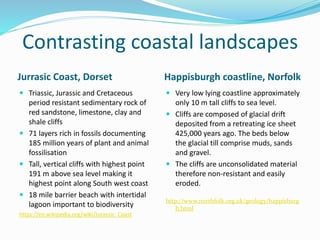
Contrasting coastal landscapes
Jurrasic Coast, Dorset Happisburgh coastline, Norfolk
 Triassic, Jurassic and Cretaceous
period resistant sedimentary rock of
red sandstone, limestone, clay and
shale cliffs
 71 layers rich in fossils documenting
185 million years of plant and animal
fossilisation
 Tall, vertical cliffs with highest point
191 m above sea level making it
highest point along South west coast
 18 mile barrier beach with intertidal
lagoon important to biodiversity
https://en.wikipedia.org/wiki/Jurassic_Coast
 Very low lying coastline approximately
only 10 m tall cliffs to sea level.
 Cliffs are composed of glacial drift
deposited from a retreating ice sheet
425,000 years ago. The beds below
the glacial till comprise muds, sands
and gravel.
 The cliffs are unconsolidated material
therefore non-resistant and easily
eroded.
http://www.northfolk.org.uk/geology/happisburg
h.html
Case study: Happisburgh
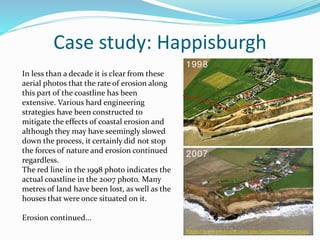
In less than a decade it is clear from these
aerial photos that the rate of erosion along
this part of the coastline has been
extensive. Various hard engineering
strategies have been constructed to
mitigate the effects of coastal erosion and
although they may have seemingly slowed
down the process, it certainly did not stop
the forces of nature and erosion continued
regardless.
The red line in the 1998 photo indicates the
actual coastline in the 2007 photo. Many
metres of land have been lost, as well as the
houses that were once situated on it.
Erosion continued...
https://www.pinterest.com/pin/545920786062323545/
Case study: Happisburgh
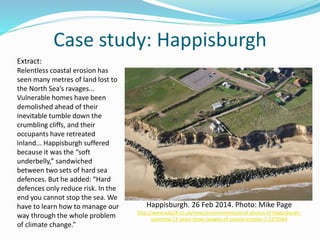
Happisburgh. 26 Feb 2014. Photo: Mike Page
http://www.edp24.co.uk/news/environment/aerial-photos-of-happisburgh-
spanning-13-years-show-ravages-of-coastal-erosion-1-3370564
Extract:
Relentless coastal erosion has
seen many metres of land lost to
the North Sea’s ravages...
Vulnerable homes have been
demolished ahead of their
inevitable tumble down the
crumbling cliffs, and their
occupants have retreated
inland... Happisburgh suffered
because it was the “soft
underbelly,” sandwiched
between two sets of hard sea
defences. But he added: “Hard
defences only reduce risk. In the
end you cannot stop the sea. We
have to learn how to manage our
way through the whole problem
of climate change.”
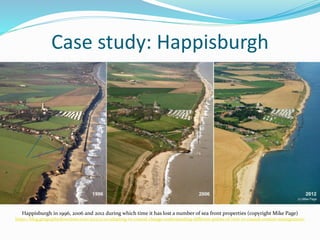
Case study: Happisburgh
Happisburgh in 1996, 2006 and 2012 during which time it has lost a number of sea front properties (copyright Mike Page)
https://blog.geographydirections.com/2013/11/01/adapting-to-coastal-change-understanding-different-points-of-view-in-coastal-erosion-management/
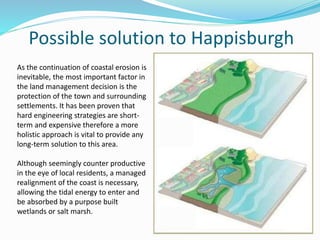
Possible solution to Happisburgh
As the continuation of coastal erosion is
inevitable, the most important factor in
the land management decision is the
protection of the town and surrounding
settlements. It has been proven that
hard engineering strategies are short-
term and expensive therefore a more
holistic approach is vital to provide any
long-term solution to this area.
Although seemingly counter productive
in the eye of local residents, a managed
realignment of the coast is necessary,
allowing the tidal energy to enter and
be absorbed by a purpose built
wetlands or salt marsh.
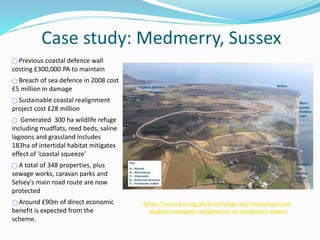
Case study: Medmerry, Sussex
https://www.ice.org.uk/knowledge-and-resources/case-
studies/managed-realignment-at-medmerry-sussex
⃝ Previous coastal defence wall
costing £300,000 PA to maintain
⃝ Breach of sea defence in 2008 cost
£5 million in damage
⃝ Sustainable coastal realignment
project cost £28 million
⃝ Generated 300 ha wildlife refuge
including mudflats, reed beds, saline
lagoons and grassland includes
183ha of intertidal habitat mitigates
effect of ‘coastal squeeze’
⃝ A total of 348 properties, plus
sewage works, caravan parks and
Selsey's main road route are now
protected
⃝ Around £90m of direct economic
benefit is expected from the
scheme.
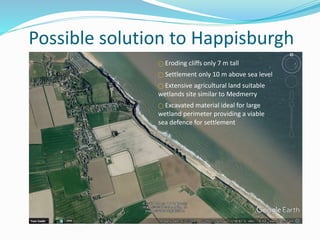
Possible solution to Happisburgh
⃝ Eroding cliffs only 7 m tall
⃝ Settlement only 10 m above sea level
⃝ Extensive agricultural land suitable
wetlands site similar to Medmerry
⃝ Excavated material ideal for large
wetland perimeter providing a viable
sea defence for settlement
Conclusion
⃝ Coastal landscapes are diverse, formed
of a variety of rock types with variable
resistance to erosion.
⃝ We create human settlements in
vulnerable areas along the coast, therefore
require engineering strategies to protect
our towns from storm surge and coastal
erosion.
⃝ Hard engineering strategies are
expensive to build and need regular
maintenance which is costly and only
short-term solutions
⃝ Low laying coastal areas prone to
erosion or flooding are ideal sites to create
salt marshes and wetlands, creating
protected areas to promote biodiversity.
⃝ A managed realignment of the coastline
is a holistic approach to safeguarding
settlements, working ‘with’ the forces of
nature.
⃝ Agricultural land more viable to realign
coastline minimising costs of relocating
local residents.
⃝ Created wildlife habitats also good for
recreation activities and tourism as well as
boosting the local economy.

Coastal landscapes

  • 1.
    Coastal landscapes Our coastlinesare constantly changing, through natural processes that have been occurring since the world has been turning... So what causes the shaping of our coastline? How does it affect us? And what can we do about it?
  • 2.
    Coastal erosion Destructive waves, strongswash/backwash and tidal currents cause:  Hydraulic action  Abrasion  Attrition  Solution The sea shapes the coastal landscape. Coastal erosion is the wearing away and breaking up of rock along the coast.
  • 3.
    Birling Gap, EastSussex in 1905 shows the third chimney from the left separated from the sea by four other houses, a garden and large stretch of land The extent of erosion: 1905
  • 4.
    To now: Justin a century! Shows the property with the same chimney now teetering on the cliff-edge after the sea cut its way through all of the other homes
  • 5.
    Coastalisation means the‘the movement of people to coastal areas’. We engineer our coastlines to suit our needs, develop infrastructure and tourism.
  • 6.
    But it cansometimes be very costly. Can we really stop the forces of nature? We certainly try, but how successful are our methods and technology?
  • 7.
    Coastal defences -Hard engineering Porthleven, Cornwall, during a storm. Sea walls: Permanent stone or brick structures built to protect settlements or cliff bases from erosion. Although seemingly effective they do not absorb the waves energy, rather reflects it actually causing beach erosion, sometimes undercutting the structure. Tend to be expensive, short-term options that may also have a high impact on the landscape or environment and considered to be unsustainable.
  • 8.
    Coastal defences -Hard engineering Groynes mitigate the loss of material caused by longshore drift by ‘trapping’ it and helps build up a beach with new imported material. But causes erosion outside of the groynes as beach maretial is no longer deposited there. Gabions, rock armour and revetments all absorb the energy of the waves to mitigate further erosion of the base of the cliff or beach. But all are short- term solutions. Groynes Rock armour Gabions Revetments
  • 9.
    Coastal defences –Soft engineering  Beach nourishment  Beach profiling  Cliff stabilisation  Sand dune restoration  Managed retreat, creation of salt marshes Often much less expensive than hard engineering options, and usually more long-term and sustainable, with less impact on the environment.
  • 10.
    Managed retreats –Most sustainable Advantages  Land becomes a marsh, slowing waves and reducing erosion  Creates new habitats and promotes biodiversity  Good for recreation, walking and bird watching Disadvantages  Arable/development land is lost  Can be costly depending on scale of human resettlement Managed realignment involves altering the location of the line of defence, to provide a more sustainable position to manage flood and erosion risks.
  • 11.
    Contrasting coastal landscapes JurrasicCoast, Dorset Happisburgh coastline, Norfolk
  • 12.
  • 13.
    Contrasting coastal landscapes JurrasicCoast, Dorset Happisburgh coastline, Norfolk  Triassic, Jurassic and Cretaceous period resistant sedimentary rock of red sandstone, limestone, clay and shale cliffs  71 layers rich in fossils documenting 185 million years of plant and animal fossilisation  Tall, vertical cliffs with highest point 191 m above sea level making it highest point along South west coast  18 mile barrier beach with intertidal lagoon important to biodiversity https://en.wikipedia.org/wiki/Jurassic_Coast  Very low lying coastline approximately only 10 m tall cliffs to sea level.  Cliffs are composed of glacial drift deposited from a retreating ice sheet 425,000 years ago. The beds below the glacial till comprise muds, sands and gravel.  The cliffs are unconsolidated material therefore non-resistant and easily eroded. http://www.northfolk.org.uk/geology/happisburg h.html
  • 14.
    Case study: Happisburgh Inless than a decade it is clear from these aerial photos that the rate of erosion along this part of the coastline has been extensive. Various hard engineering strategies have been constructed to mitigate the effects of coastal erosion and although they may have seemingly slowed down the process, it certainly did not stop the forces of nature and erosion continued regardless. The red line in the 1998 photo indicates the actual coastline in the 2007 photo. Many metres of land have been lost, as well as the houses that were once situated on it. Erosion continued... https://www.pinterest.com/pin/545920786062323545/
  • 15.
    Case study: Happisburgh Happisburgh.26 Feb 2014. Photo: Mike Page http://www.edp24.co.uk/news/environment/aerial-photos-of-happisburgh- spanning-13-years-show-ravages-of-coastal-erosion-1-3370564 Extract: Relentless coastal erosion has seen many metres of land lost to the North Sea’s ravages... Vulnerable homes have been demolished ahead of their inevitable tumble down the crumbling cliffs, and their occupants have retreated inland... Happisburgh suffered because it was the “soft underbelly,” sandwiched between two sets of hard sea defences. But he added: “Hard defences only reduce risk. In the end you cannot stop the sea. We have to learn how to manage our way through the whole problem of climate change.”
  • 16.
    Case study: Happisburgh Happisburghin 1996, 2006 and 2012 during which time it has lost a number of sea front properties (copyright Mike Page) https://blog.geographydirections.com/2013/11/01/adapting-to-coastal-change-understanding-different-points-of-view-in-coastal-erosion-management/
  • 17.
    Possible solution toHappisburgh As the continuation of coastal erosion is inevitable, the most important factor in the land management decision is the protection of the town and surrounding settlements. It has been proven that hard engineering strategies are short- term and expensive therefore a more holistic approach is vital to provide any long-term solution to this area. Although seemingly counter productive in the eye of local residents, a managed realignment of the coast is necessary, allowing the tidal energy to enter and be absorbed by a purpose built wetlands or salt marsh.
  • 18.
    Case study: Medmerry,Sussex https://www.ice.org.uk/knowledge-and-resources/case- studies/managed-realignment-at-medmerry-sussex ⃝ Previous coastal defence wall costing £300,000 PA to maintain ⃝ Breach of sea defence in 2008 cost £5 million in damage ⃝ Sustainable coastal realignment project cost £28 million ⃝ Generated 300 ha wildlife refuge including mudflats, reed beds, saline lagoons and grassland includes 183ha of intertidal habitat mitigates effect of ‘coastal squeeze’ ⃝ A total of 348 properties, plus sewage works, caravan parks and Selsey's main road route are now protected ⃝ Around £90m of direct economic benefit is expected from the scheme.
  • 19.
    Possible solution toHappisburgh ⃝ Eroding cliffs only 7 m tall ⃝ Settlement only 10 m above sea level ⃝ Extensive agricultural land suitable wetlands site similar to Medmerry ⃝ Excavated material ideal for large wetland perimeter providing a viable sea defence for settlement
  • 20.
    Conclusion ⃝ Coastal landscapesare diverse, formed of a variety of rock types with variable resistance to erosion. ⃝ We create human settlements in vulnerable areas along the coast, therefore require engineering strategies to protect our towns from storm surge and coastal erosion. ⃝ Hard engineering strategies are expensive to build and need regular maintenance which is costly and only short-term solutions ⃝ Low laying coastal areas prone to erosion or flooding are ideal sites to create salt marshes and wetlands, creating protected areas to promote biodiversity. ⃝ A managed realignment of the coastline is a holistic approach to safeguarding settlements, working ‘with’ the forces of nature. ⃝ Agricultural land more viable to realign coastline minimising costs of relocating local residents. ⃝ Created wildlife habitats also good for recreation activities and tourism as well as boosting the local economy.