By Sayanta Mitra
Bacteria According
To The
Temperature
 First life forms to appear on the earth.
 Unicellular prokaryotic biological cell.
 0.5µm to 1.5µm in length.
 Have numbers of shapes like rod, spiral.
 Inhibit in soil, water.
 Live in symbiotic and parasitic relationship with
plants and animals.
What is bacteria?
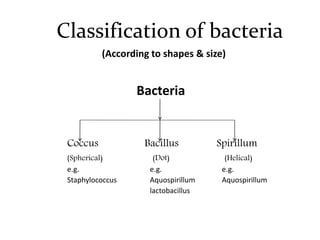
Classification of bacteria
(According to shapes & size)
Bacteria
Coccus Bacillus Spirillum
(Spherical) (Dot) (Helical)
e.g. e.g. e.g.
Staphylococcus Aquospirillum
lactobacillus
Aquospirillum
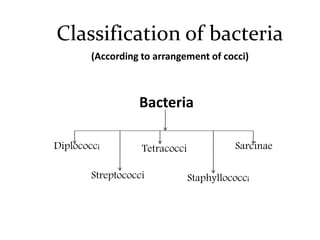
Classification of bacteria
(According to arrangement of cocci)
Bacteria
Diplococci Tetracocci
Streptococci Staphyllococci
Sarcinae
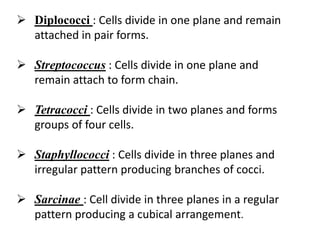
 Diplococci : Cells divide in one plane and remain
attached in pair forms.
 Streptococcus : Cells divide in one plane and
remain attach to form chain.
 Tetracocci : Cells divide in two planes and forms
groups of four cells.
 Staphyllococci : Cells divide in three planes and
irregular pattern producing branches of cocci.
 Sarcinae : Cell divide in three planes in a regular
pattern producing a cubical arrangement.
120
110
100
90
80
70
60
50
40
30
20
10
0
-10
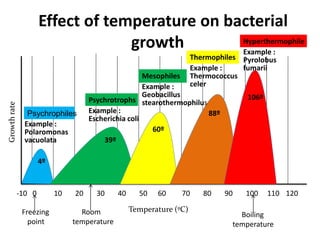
Effect of temperature on bacterial
growth
Temperature (ºC)
Growth
rate
Psychrophiles
Example :
Polaromonas
Mesophiles
Example :
Escherichia coli
Thermophiles
Example :
Geobacillus
Hyperthermophile
Psychrotrophs stearothermophilus
vacuolata
Example :
Example :
Thermococcus
celer
Pyrolobus
fumarii
4º
39º
60º
88º
106º
Freezing
point
Room
temperature
Boiling
temperature
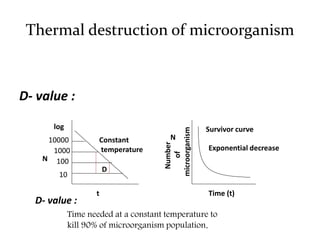
D- value :
10
100
1000
10000
D
log
t
Constant
temperature
Number
of
microorganism
N
N
Time (t)
Exponential decrease
Survivor curve
Time needed at a constant temperature to
kill 90% of microorganism population.
D- value :
Thermal destruction of microorganism
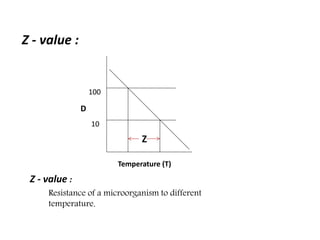
Z - value :
Z
100
10
D
Temperature (T)
Z - value :
Resistance of a microorganism to different
temperature.
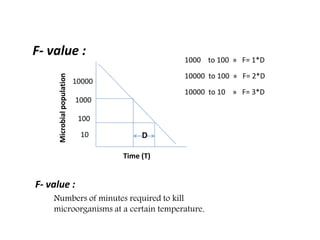
F- value :
10
100
1000
10000
D
F- value :
Numbers of minutes required to kill
microorganisms at a certain temperature.
Time (T)
Microbial
population 1000 to 100 » F= 1*D
10000 to 100 » F= 2*D
10000 to 10 » F= 3*D

Bacteria according to the temperature SlideShare

  • 1.
    By Sayanta Mitra BacteriaAccording To The Temperature
  • 2.
     First lifeforms to appear on the earth.  Unicellular prokaryotic biological cell.  0.5µm to 1.5µm in length.  Have numbers of shapes like rod, spiral.  Inhibit in soil, water.  Live in symbiotic and parasitic relationship with plants and animals. What is bacteria?
  • 3.
    Classification of bacteria (Accordingto shapes & size) Bacteria Coccus Bacillus Spirillum (Spherical) (Dot) (Helical) e.g. e.g. e.g. Staphylococcus Aquospirillum lactobacillus Aquospirillum
  • 4.
    Classification of bacteria (Accordingto arrangement of cocci) Bacteria Diplococci Tetracocci Streptococci Staphyllococci Sarcinae
  • 5.
     Diplococci :Cells divide in one plane and remain attached in pair forms.  Streptococcus : Cells divide in one plane and remain attach to form chain.  Tetracocci : Cells divide in two planes and forms groups of four cells.  Staphyllococci : Cells divide in three planes and irregular pattern producing branches of cocci.  Sarcinae : Cell divide in three planes in a regular pattern producing a cubical arrangement.
  • 6.
    120 110 100 90 80 70 60 50 40 30 20 10 0 -10 Effect of temperatureon bacterial growth Temperature (ºC) Growth rate Psychrophiles Example : Polaromonas Mesophiles Example : Escherichia coli Thermophiles Example : Geobacillus Hyperthermophile Psychrotrophs stearothermophilus vacuolata Example : Example : Thermococcus celer Pyrolobus fumarii 4º 39º 60º 88º 106º Freezing point Room temperature Boiling temperature
  • 7.
    D- value : 10 100 1000 10000 D log t Constant temperature Number of microorganism N N Time(t) Exponential decrease Survivor curve Time needed at a constant temperature to kill 90% of microorganism population. D- value : Thermal destruction of microorganism
  • 8.
    Z - value: Z 100 10 D Temperature (T) Z - value : Resistance of a microorganism to different temperature.
  • 9.
    F- value : 10 100 1000 10000 D F-value : Numbers of minutes required to kill microorganisms at a certain temperature. Time (T) Microbial population 1000 to 100 » F= 1*D 10000 to 100 » F= 2*D 10000 to 10 » F= 3*D