CLASSROOM
RULES
Raise your hand to speak or when
you want to volunteer
01
02 Listen to what the teacher says and
follow directions carefully.
03 Be active and cooperative.
04 Respect each other’s ideas and opinions
even if you disagree with them.
______________
CLASSROOM
RULES
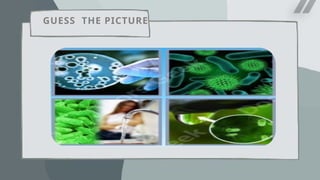
GUESS THE PICTURE
GUESS THE PICTURE
B A C T E R I A
WHAT IS BACTERIA?
GENERAL
CHARACTERISTICS OF
BACTERIA
A C T I V I T Y
This are the three basic shapes of bacteria.
the spherical or round shape bacteria is called (cocci)
and the rod shape bacteria is called (bacilli) and lastly the
spiral shape bacteria are called (spirillum).
There are helical bacteria which have a specialized
internal structure known as the axial filaments which is
responsible for rotation of the cell in spiral fasion and
consequent locomotion, and other are gliding bacteria.
THE CLASSIFICATION
OF BACTERIA
Classificatio
n of Bacteria
Bacteria are classify
mainly into:
1.Cocci
2. Bacilli
3. Vibrios
4. Spririlla
5. Spirocheates
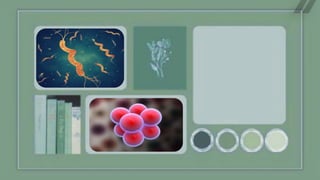
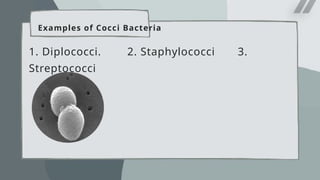
Examples of Cocci Bacteria
1. Diplococci. 2. Staphylococci 3.
Streptococci
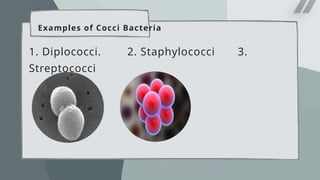
Examples of Cocci Bacteria
1. Diplococci. 2. Staphylococci 3.
Streptococci
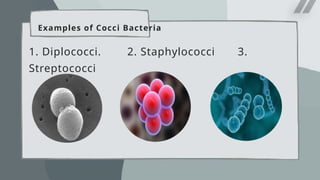
Examples of Cocci Bacteria
1. Diplococci. 2. Staphylococci 3.
Streptococci
Examples of Cocci Bacteria
1. Diplococci. 2. Staphylococci 3.
Streptococci
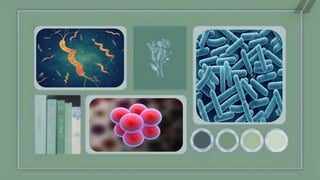
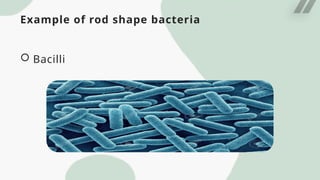
Example of rod shape bacteria
 Bacilli
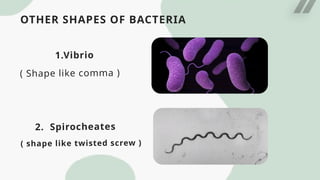
OTHER SHAPES OF BACTERIA
1.Vibrio
( Shape like comma )
2. Spirocheates
( shape like twisted screw )
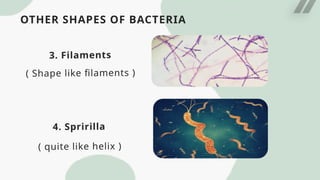
OTHER SHAPES OF BACTERIA
3. Filaments
( Shape like filaments )
4. Spririlla
( quite like helix )
Bacteria are ubiquitous , free living organisms
often consisting of one biological cell.
U B I Q U I T O U S
U B I Q U I T O U S
- Means present, or found
everywhere.
SOURCES OF BACTERIA
Sources of Bacteria:
 Soil
 Rocks
 Ocean
 Artic snow
 Contaminated food, especially undercooked ground beef,
unpasteurized (raw) milk and juice, soft cheeses made from
raw milk, and raw fruits and vegetables (such as lettuce,
other leafy greens, and sprouts). Contaminated water,
including drinking untreated water and swimming in
contaminated water.
A C T I V I T Y
A C T I V I T Y
Direction:
In a one whole sheet of paper/ bond paper. your task is to illustrate
the different bacterial shapes listed below and label their parts and
discription correctly, and then later on each group will choose a
representative to present your work in front and will be graded
through the given rubrics.
Q U I Z
Q U I Z:
TRUEE OR FALSE
1.Bacteria is multicellular.
Q U I Z:
TRUEE OR FALSE
2.Coccus is a bacterial organisms typically
shape like rod and vary in sizes.
Q U I Z:
TRUEE OR FALSE
3. Coccibacillus is the combination of
between a spherical shape and spirillum
bacteria.
Q U I Z:
TRUEE OR FALSE
4. Nucleus is not a part of bacteria.
Q U I Z:
TRUEE OR FALSE
5. Bacteria uses Flagella in oder to
move.
A S S I N G M E N T
DIRECTION:
in a 1/2 sheet of paper. sites some bacteria that is good
for our health and explain why they are beneficial to our
body.
technology for teaching and llearning PowerPoint bacteria deml.pptx

technology for teaching and llearning PowerPoint bacteria deml.pptx

  • 2.
  • 3.
    Raise your handto speak or when you want to volunteer 01 02 Listen to what the teacher says and follow directions carefully. 03 Be active and cooperative. 04 Respect each other’s ideas and opinions even if you disagree with them. ______________ CLASSROOM RULES
  • 4.
  • 5.
  • 6.
    B A CT E R I A
  • 7.
  • 8.
  • 9.
    A C TI V I T Y
  • 14.
    This are thethree basic shapes of bacteria. the spherical or round shape bacteria is called (cocci) and the rod shape bacteria is called (bacilli) and lastly the spiral shape bacteria are called (spirillum).
  • 16.
    There are helicalbacteria which have a specialized internal structure known as the axial filaments which is responsible for rotation of the cell in spiral fasion and consequent locomotion, and other are gliding bacteria.
  • 17.
  • 18.
    Classificatio n of Bacteria Bacteriaare classify mainly into: 1.Cocci 2. Bacilli 3. Vibrios 4. Spririlla 5. Spirocheates
  • 19.
  • 20.
    Examples of CocciBacteria 1. Diplococci. 2. Staphylococci 3. Streptococci
  • 21.
    Examples of CocciBacteria 1. Diplococci. 2. Staphylococci 3. Streptococci
  • 22.
    Examples of CocciBacteria 1. Diplococci. 2. Staphylococci 3. Streptococci
  • 23.
    Examples of CocciBacteria 1. Diplococci. 2. Staphylococci 3. Streptococci
  • 24.
    Example of rodshape bacteria  Bacilli
  • 25.
    OTHER SHAPES OFBACTERIA 1.Vibrio ( Shape like comma ) 2. Spirocheates ( shape like twisted screw )
  • 26.
    OTHER SHAPES OFBACTERIA 3. Filaments ( Shape like filaments ) 4. Spririlla ( quite like helix )
  • 27.
    Bacteria are ubiquitous, free living organisms often consisting of one biological cell.
  • 28.
    U B IQ U I T O U S
  • 29.
    U B IQ U I T O U S - Means present, or found everywhere.
  • 30.
  • 31.
    Sources of Bacteria: Soil  Rocks  Ocean  Artic snow  Contaminated food, especially undercooked ground beef, unpasteurized (raw) milk and juice, soft cheeses made from raw milk, and raw fruits and vegetables (such as lettuce, other leafy greens, and sprouts). Contaminated water, including drinking untreated water and swimming in contaminated water.
  • 32.
    A C TI V I T Y
  • 33.
    A C TI V I T Y Direction: In a one whole sheet of paper/ bond paper. your task is to illustrate the different bacterial shapes listed below and label their parts and discription correctly, and then later on each group will choose a representative to present your work in front and will be graded through the given rubrics.
  • 36.
  • 37.
    Q U IZ: TRUEE OR FALSE 1.Bacteria is multicellular.
  • 38.
    Q U IZ: TRUEE OR FALSE 2.Coccus is a bacterial organisms typically shape like rod and vary in sizes.
  • 39.
    Q U IZ: TRUEE OR FALSE 3. Coccibacillus is the combination of between a spherical shape and spirillum bacteria.
  • 40.
    Q U IZ: TRUEE OR FALSE 4. Nucleus is not a part of bacteria.
  • 41.
    Q U IZ: TRUEE OR FALSE 5. Bacteria uses Flagella in oder to move.
  • 42.
    A S SI N G M E N T DIRECTION: in a 1/2 sheet of paper. sites some bacteria that is good for our health and explain why they are beneficial to our body.