Bacteria- Morphology and
Classification
Mr. MAN BAHADUR RANA
ACAS,BPH, Microbiology
07.09.08 Dr Ekta Chourasia
Size of Bacteria
• Unit of measurement in bacteriology is the
micron (micrometre, µm)
• Bacteria of medical importance
– 0.2 – 1.5 µm in diameter
– 3 – 5 µm in length
07.09.08 Dr Ekta Chourasia
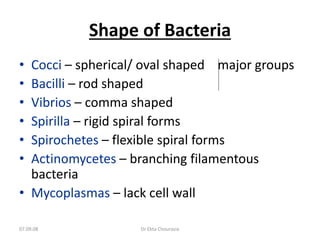
Shape of Bacteria
• Cocci – spherical/ oval shaped major groups
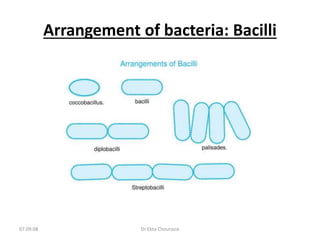
• Bacilli – rod shaped
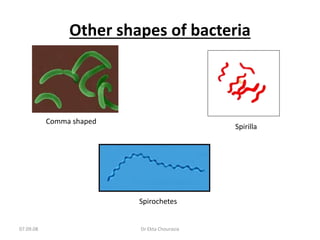
• Vibrios – comma shaped
• Spirilla – rigid spiral forms
• Spirochetes – flexible spiral forms
• Actinomycetes – branching filamentous
bacteria
• Mycoplasmas – lack cell wall
07.09.08 Dr Ekta Chourasia
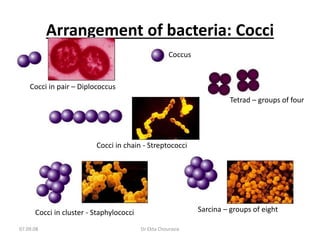
Arrangement of bacteria: Cocci
Cocci in pair – Diplococcus
Sarcina – groups of eight
Tetrad – groups of four
Cocci in chain - Streptococci
Cocci in cluster - Staphylococci
Coccus
07.09.08 Dr Ekta Chourasia
Arrangement of bacteria: Bacilli
07.09.08 Dr Ekta Chourasia
Other shapes of bacteria
Comma shaped
Spirochetes
Spirilla
7
Temperature
• Minimum Temperature: Temperature below which
growth ceases, or lowest temperature at which
microbes will grow.
• Optimum Temperature: Temperature at which its
growth rate is the fastest.
• Maximum Temperature: Temperature above which
growth ceases, or highest temperature at which
microbes will grow.
8
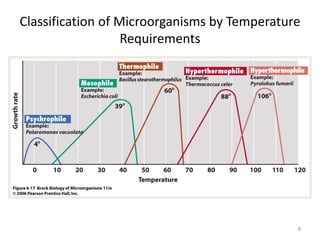
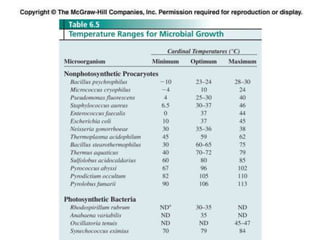
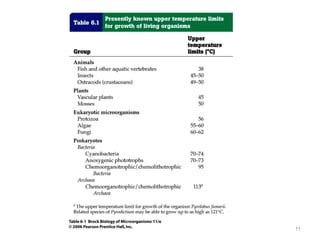
Classification of Microorganisms by Temperature
Requirements
9
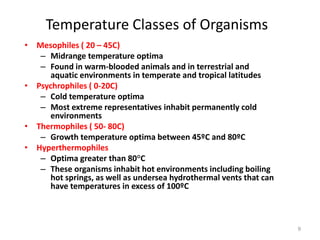
Temperature Classes of Organisms
• Mesophiles ( 20 – 45C)
– Midrange temperature optima
– Found in warm-blooded animals and in terrestrial and
aquatic environments in temperate and tropical latitudes
• Psychrophiles ( 0-20C)
– Cold temperature optima
– Most extreme representatives inhabit permanently cold
environments
• Thermophiles ( 50- 80C)
– Growth temperature optima between 45ºC and 80ºC
• Hyperthermophiles
– Optima greater than 80°C
– These organisms inhabit hot environments including boiling
hot springs, as well as undersea hydrothermal vents that can
have temperatures in excess of 100ºC
10
11
12
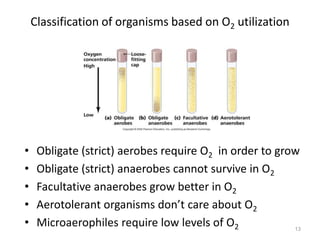
Classification of organisms based on O2 utilization
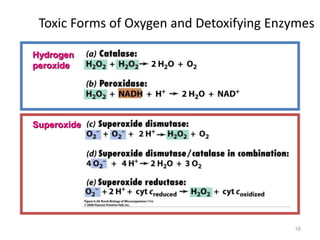
• Utilization of O2 during metabolism yields toxic
by-products including O2
-, singlet oxygen (1O2)
and/or H2O2.
• Toxic O2 products can be converted to harmless
substances if the organism has catalase (or
peroxidase) and superoxide dismutase (SOD)
• SOD converts O2
- into H2O2 and O2
• Catalase breaks down H2O2 into H2O and O2
• Any organism that can live in or requires O2 has
SOD and catalase (peroxidase)
13
Classification of organisms based on O2 utilization
• Obligate (strict) aerobes require O2 in order to grow
• Obligate (strict) anaerobes cannot survive in O2
• Facultative anaerobes grow better in O2
• Aerotolerant organisms don’t care about O2
• Microaerophiles require low levels of O2
14
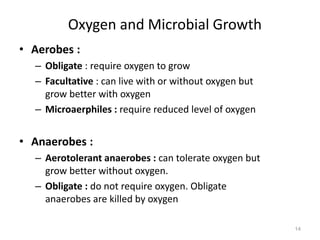
Oxygen and Microbial Growth
• Aerobes :
– Obligate : require oxygen to grow
– Facultative : can live with or without oxygen but
grow better with oxygen
– Microaerphiles : require reduced level of oxygen
• Anaerobes :
– Aerotolerant anaerobes : can tolerate oxygen but
grow better without oxygen.
– Obligate : do not require oxygen. Obligate
anaerobes are killed by oxygen
15
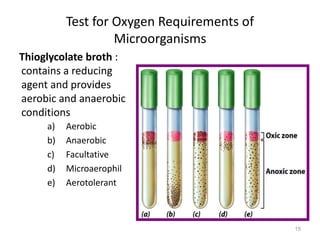
Test for Oxygen Requirements of
Microorganisms
Thioglycolate broth :
contains a reducing
agent and provides
aerobic and anaerobic
conditions
a) Aerobic
b) Anaerobic
c) Facultative
d) Microaerophil
e) Aerotolerant
16
Toxic Forms of Oxygen and Detoxifying Enzymes
Hydrogen
peroxide
Superoxide

Bacteria morphology and classification

  • 1.
    Bacteria- Morphology and Classification Mr.MAN BAHADUR RANA ACAS,BPH, Microbiology
  • 2.
    07.09.08 Dr EktaChourasia Size of Bacteria • Unit of measurement in bacteriology is the micron (micrometre, µm) • Bacteria of medical importance – 0.2 – 1.5 µm in diameter – 3 – 5 µm in length
  • 3.
    07.09.08 Dr EktaChourasia Shape of Bacteria • Cocci – spherical/ oval shaped major groups • Bacilli – rod shaped • Vibrios – comma shaped • Spirilla – rigid spiral forms • Spirochetes – flexible spiral forms • Actinomycetes – branching filamentous bacteria • Mycoplasmas – lack cell wall
  • 4.
    07.09.08 Dr EktaChourasia Arrangement of bacteria: Cocci Cocci in pair – Diplococcus Sarcina – groups of eight Tetrad – groups of four Cocci in chain - Streptococci Cocci in cluster - Staphylococci Coccus
  • 5.
    07.09.08 Dr EktaChourasia Arrangement of bacteria: Bacilli
  • 6.
    07.09.08 Dr EktaChourasia Other shapes of bacteria Comma shaped Spirochetes Spirilla
  • 7.
    7 Temperature • Minimum Temperature:Temperature below which growth ceases, or lowest temperature at which microbes will grow. • Optimum Temperature: Temperature at which its growth rate is the fastest. • Maximum Temperature: Temperature above which growth ceases, or highest temperature at which microbes will grow.
  • 8.
    8 Classification of Microorganismsby Temperature Requirements
  • 9.
    9 Temperature Classes ofOrganisms • Mesophiles ( 20 – 45C) – Midrange temperature optima – Found in warm-blooded animals and in terrestrial and aquatic environments in temperate and tropical latitudes • Psychrophiles ( 0-20C) – Cold temperature optima – Most extreme representatives inhabit permanently cold environments • Thermophiles ( 50- 80C) – Growth temperature optima between 45ºC and 80ºC • Hyperthermophiles – Optima greater than 80°C – These organisms inhabit hot environments including boiling hot springs, as well as undersea hydrothermal vents that can have temperatures in excess of 100ºC
  • 10.
  • 11.
  • 12.
    12 Classification of organismsbased on O2 utilization • Utilization of O2 during metabolism yields toxic by-products including O2 -, singlet oxygen (1O2) and/or H2O2. • Toxic O2 products can be converted to harmless substances if the organism has catalase (or peroxidase) and superoxide dismutase (SOD) • SOD converts O2 - into H2O2 and O2 • Catalase breaks down H2O2 into H2O and O2 • Any organism that can live in or requires O2 has SOD and catalase (peroxidase)
  • 13.
    13 Classification of organismsbased on O2 utilization • Obligate (strict) aerobes require O2 in order to grow • Obligate (strict) anaerobes cannot survive in O2 • Facultative anaerobes grow better in O2 • Aerotolerant organisms don’t care about O2 • Microaerophiles require low levels of O2
  • 14.
    14 Oxygen and MicrobialGrowth • Aerobes : – Obligate : require oxygen to grow – Facultative : can live with or without oxygen but grow better with oxygen – Microaerphiles : require reduced level of oxygen • Anaerobes : – Aerotolerant anaerobes : can tolerate oxygen but grow better without oxygen. – Obligate : do not require oxygen. Obligate anaerobes are killed by oxygen
  • 15.
    15 Test for OxygenRequirements of Microorganisms Thioglycolate broth : contains a reducing agent and provides aerobic and anaerobic conditions a) Aerobic b) Anaerobic c) Facultative d) Microaerophil e) Aerotolerant
  • 16.
    16 Toxic Forms ofOxygen and Detoxifying Enzymes Hydrogen peroxide Superoxide