Work Stress and its
Management
Prepared by: Sabira Qamar Gilani
Manager Human Resources
Harvest Group
Nature of Stress
What is Stress
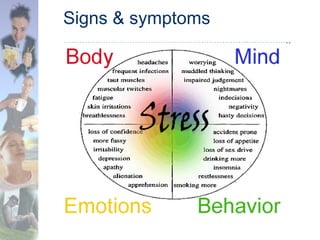
Signs and symptoms of Stress
Cause of stress
Factors affecting Stress
Performance vs Stress
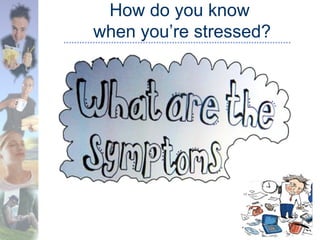
How do you know
when you’re stressed?
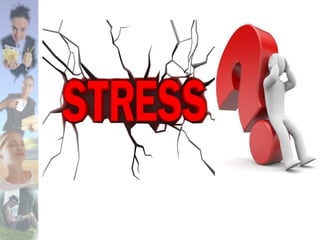
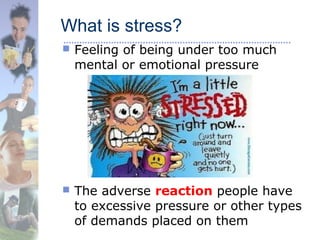
What is stress?
 Feeling of being under too much
mental or emotional pressure
 The adverse reaction people have
to excessive pressure or other types
of demands placed on them
Signs and Symptoms of
Stress
 Signs: What you can see in yourself
and others
 Symptoms: subjective experience-
what you feel
Signs & symptoms
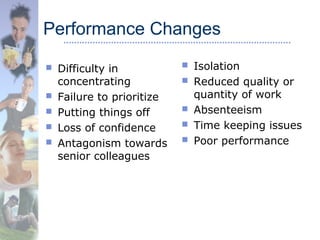
Performance Changes
 Difficulty in
concentrating
 Failure to prioritize
 Putting things off
 Loss of confidence
 Antagonism towards
senior colleagues
 Isolation
 Reduced quality or
quantity of work
 Absenteeism
 Time keeping issues
 Poor performance
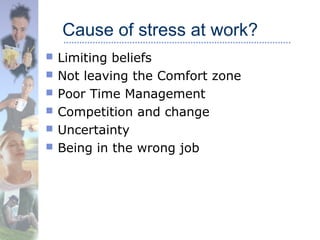
Cause of stress at work?
 Limiting beliefs
 Not leaving the Comfort zone
 Poor Time Management
 Competition and change
 Uncertainty
 Being in the wrong job
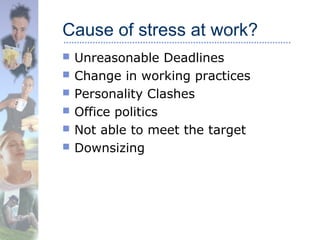
Cause of stress at work?
 Unreasonable Deadlines
 Change in working practices
 Personality Clashes
 Office politics
 Not able to meet the target
 Downsizing
Psychology and Anatomy of Stress?
 Psychological factors
 Physiological Factors
PSYCHOLOGICAL FACTORS
Its not the load that breaks you down, it’s the way you
carry it
Limiting Beliefs
Belief: A thought not necessarily a
fact
 Related to person’s values
 can be learnt, accepted, experienced
or changed
 Influence your perception, judgment
against any situation
Limiting Beliefs
Core Beliefs
 Established from childhood
 learnt from parents or
 Other significant people around us
 Influence our behavior
Limiting Beliefs
Can cause a tremendous
amount of stress and hold us
back from being who and what
we would like to be.
Common Limiting Beliefs
 I can’t do that ….
 I have to eat everything on my plate
 Taking time for myself is selfish
 I’m too fat/not fir enough to go to the gym
 I can’t do it as well as others can
 I must be the perfect BDE
 I don’t like to say NO, its not nice
 I need
cigarettes/chocolates/caffeine/alcohol/drugs
to get me through it/help me to relax
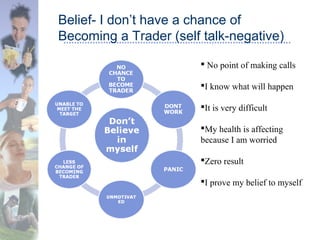
Belief- I don’t have a chance of
Becoming a Trader (self talk-negative)
 No point of making calls
I know what will happen
It is very difficult
My health is affecting
because I am worried
Zero result
I prove my belief to myself
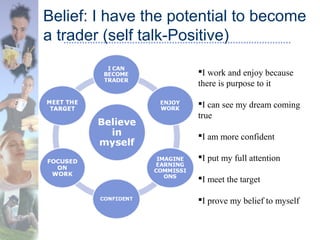
Belief: I have the potential to become
a trader (self talk-Positive)
I work and enjoy because
there is purpose to it
I can see my dream coming
true
I am more confident
I put my full attention
I meet the target
I prove my belief to myself
Personal Stressors
 Unrealistic Expectations we
have of ourselves- Life scripts :
fixed beliefs of how are lives
should be
 Comes from direct instructions,
by modeling behaviors to us, by
rewarding certain behaviors
5 Main Personal Stressors
 Need to be perfect
 Have to be strong
 Always be helpful
 Should be stubborn
 Must be busy
Religious Quotes
 "Verily Allah does not change men's
condition unless they change their
inner selves" (Quran 13:11)
 TIE YOUR CAMEL
Religious Quotes
 “Cast your burden upon the Lord:
and he will sustain you; He will
never allow the righteous to be
shaken.”(psalm 55:22)
 “Cast your all anxiety on Him
because He cares for You.”
(1Peter5:7)
PHYSIOLOGICAL FACTORS
The body is the battlefield for the war games of the mind.”
—Brian Luke Seaward
Fight, Flight or Freeze?
Survival Mechanism –When your body goes
into these states, changes happen automatically
in your body
Fight, Flight or Freeze?
 Fight or flight response
– Stimuli from senses are sent to the
brain
– Brain deciphers it as a threat or not
– If threat, body systems are activated
for defense or escape, and stay
activated until threat is over
– Body returns to homeostasis
 Same response
– Whether threat is real or imagined
– Whether physical threat, or threat to
the ego
Signs of Adrenal Stress and
fatigue
 You might find it hard to get up in
the morning
 Takes longer to complete every day
tasks
 Forgetful and unable to concentrate
 Need stimulants to get you through
the day
Signs of Adrenal Stress and fatigue
 Feeling tired and lack of energy
even after lots of sleep
 Poor immune system
 Impatient
 Craving salty foods
Types of stress
 Eustress or Good Stress
– Good stress from motivating or
inspiring situations
 Neustress or neutral stress
– Stimuli that have no consequential
effect
 Distress or Bad Stress
– Nick name “stress,” includes acute and
chronic stress
Why do we care
if we’re stressed?
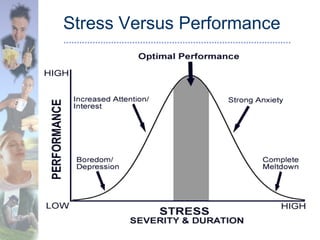
 Stress can help, or hinder our
performance
 Between 70 and 80% of all disease
and illness is stress-related
Stress Versus Performance
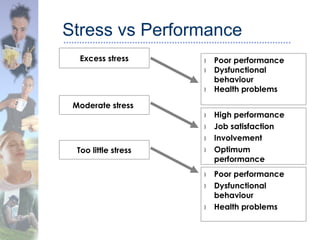
Stress vs Performance
Excess stress › Poor performance
› Dysfunctional
behaviour
› Health problems
› High performance
› Job satisfaction
› Involvement
› Optimum
performance
› Poor performance
› Dysfunctional
behaviour
› Health problems
Too little stress
Moderate stress
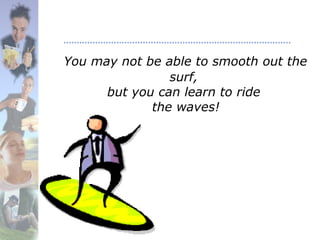
You may not be able to smooth out the
surf,
but you can learn to ride
the waves!
Manage your Stress Through…
 Recognition: Understand reactions
to stress
 Thinking Strategies: Managing
your mental state
 Health, Exercise and Relaxation
 Integration of Strategies
Thinking Strategies
“Begin challenging your own
assumptions. Your assumptions are
your windows on the world. Scrub
them off every once in a while, or
the light wont come in.”
Alan Alda
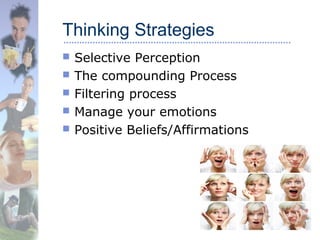
Thinking Strategies
 Selective Perception
 The compounding Process
 Filtering process
 Manage your emotions
 Positive Beliefs/Affirmations
Video
Focus on Health
YOU ARE WHAT YOU EAT!
(Gillian Mc Keith)
Health Facts & Benefits
 60% of all world deaths are related to poor diets,
with people consuming high amounts of salt and
sugar.
 It is estimated that 30% to 40% of cancers could
be prevented with better diet.
 Eating healthy strengthened immune system
 Increased concentration and mental clarity
 Stabilizing hormones and mood swings
 Hydrate your body through drinking
water at least 12-16 glass of water
daily.
 Eat more fruits and vegetables
 Eat essential fats: Unsalted Nuts,
oily fish- tuna, trout salmamon
 Eat less meat approx 4% of daily
consumption
Exercise
 Dancing
 Walking
 Running
 Gardening
 Swimming
 Skiing
 Skipping
 Yoga
 Pilates
 Team sports
 Cycling
 Aerobics
Relaxation techniques
Breathing
Yoga
Massage therapy
Nutrition and exercise
Mental imagery and visualization
Music therapy
Stress Beating
Strategies
BREATHING EXERCISE
Time management
 Roadblocks
– Workaholics
– Multitasking
– Procrastination
– Perfectionism
– Can’t-say-no
 Myths about time
management
– Time is adjustable,
not fixed
– Time-management
techniques do not
work
– Being organized is
boring – longing for
the rush of crisis
Skills of time management
 Prioritizing
 Scheduling
 Execution
 Managing
interruptions
 Allowing for personal
time each day
 Organization
 Decision-making
 Delegation
Summary and Tips to Beat Stress
 Recognition
 Beliefs & Attitudes
 Positive self Talk
 Embrace Change
 Analyze your current
position and desired
position
 Healthy eating and
hydration
 Exercise
 Breathe
 Seek help
 Manage your time
 Take good Sleep
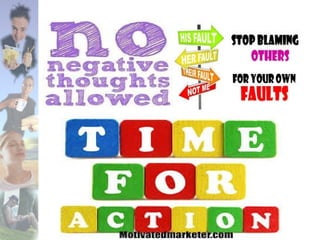
 Make a Plan, take
action
Stress management ppt

Stress management ppt

  • 1.
    Work Stress andits Management Prepared by: Sabira Qamar Gilani Manager Human Resources Harvest Group
  • 4.
    Nature of Stress Whatis Stress Signs and symptoms of Stress Cause of stress Factors affecting Stress Performance vs Stress
  • 5.
    How do youknow when you’re stressed?
  • 6.
    What is stress? Feeling of being under too much mental or emotional pressure  The adverse reaction people have to excessive pressure or other types of demands placed on them
  • 7.
    Signs and Symptomsof Stress  Signs: What you can see in yourself and others  Symptoms: subjective experience- what you feel
  • 8.
  • 9.
    Performance Changes  Difficultyin concentrating  Failure to prioritize  Putting things off  Loss of confidence  Antagonism towards senior colleagues  Isolation  Reduced quality or quantity of work  Absenteeism  Time keeping issues  Poor performance
  • 10.
    Cause of stressat work?  Limiting beliefs  Not leaving the Comfort zone  Poor Time Management  Competition and change  Uncertainty  Being in the wrong job
  • 11.
    Cause of stressat work?  Unreasonable Deadlines  Change in working practices  Personality Clashes  Office politics  Not able to meet the target  Downsizing
  • 12.
    Psychology and Anatomyof Stress?  Psychological factors  Physiological Factors
  • 13.
    PSYCHOLOGICAL FACTORS Its notthe load that breaks you down, it’s the way you carry it
  • 14.
    Limiting Beliefs Belief: Athought not necessarily a fact  Related to person’s values  can be learnt, accepted, experienced or changed  Influence your perception, judgment against any situation
  • 15.
    Limiting Beliefs Core Beliefs Established from childhood  learnt from parents or  Other significant people around us  Influence our behavior
  • 16.
    Limiting Beliefs Can causea tremendous amount of stress and hold us back from being who and what we would like to be.
  • 17.
    Common Limiting Beliefs I can’t do that ….  I have to eat everything on my plate  Taking time for myself is selfish  I’m too fat/not fir enough to go to the gym  I can’t do it as well as others can  I must be the perfect BDE  I don’t like to say NO, its not nice  I need cigarettes/chocolates/caffeine/alcohol/drugs to get me through it/help me to relax
  • 18.
    Belief- I don’thave a chance of Becoming a Trader (self talk-negative)  No point of making calls I know what will happen It is very difficult My health is affecting because I am worried Zero result I prove my belief to myself
  • 19.
    Belief: I havethe potential to become a trader (self talk-Positive) I work and enjoy because there is purpose to it I can see my dream coming true I am more confident I put my full attention I meet the target I prove my belief to myself
  • 20.
    Personal Stressors  UnrealisticExpectations we have of ourselves- Life scripts : fixed beliefs of how are lives should be  Comes from direct instructions, by modeling behaviors to us, by rewarding certain behaviors
  • 21.
    5 Main PersonalStressors  Need to be perfect  Have to be strong  Always be helpful  Should be stubborn  Must be busy
  • 22.
    Religious Quotes  "VerilyAllah does not change men's condition unless they change their inner selves" (Quran 13:11)  TIE YOUR CAMEL
  • 23.
    Religious Quotes  “Castyour burden upon the Lord: and he will sustain you; He will never allow the righteous to be shaken.”(psalm 55:22)  “Cast your all anxiety on Him because He cares for You.” (1Peter5:7)
  • 24.
    PHYSIOLOGICAL FACTORS The bodyis the battlefield for the war games of the mind.” —Brian Luke Seaward
  • 25.
    Fight, Flight orFreeze? Survival Mechanism –When your body goes into these states, changes happen automatically in your body
  • 26.
    Fight, Flight orFreeze?  Fight or flight response – Stimuli from senses are sent to the brain – Brain deciphers it as a threat or not – If threat, body systems are activated for defense or escape, and stay activated until threat is over – Body returns to homeostasis  Same response – Whether threat is real or imagined – Whether physical threat, or threat to the ego
  • 28.
    Signs of AdrenalStress and fatigue  You might find it hard to get up in the morning  Takes longer to complete every day tasks  Forgetful and unable to concentrate  Need stimulants to get you through the day
  • 29.
    Signs of AdrenalStress and fatigue  Feeling tired and lack of energy even after lots of sleep  Poor immune system  Impatient  Craving salty foods
  • 30.
    Types of stress Eustress or Good Stress – Good stress from motivating or inspiring situations  Neustress or neutral stress – Stimuli that have no consequential effect  Distress or Bad Stress – Nick name “stress,” includes acute and chronic stress
  • 31.
    Why do wecare if we’re stressed?  Stress can help, or hinder our performance  Between 70 and 80% of all disease and illness is stress-related
  • 32.
  • 33.
    Stress vs Performance Excessstress › Poor performance › Dysfunctional behaviour › Health problems › High performance › Job satisfaction › Involvement › Optimum performance › Poor performance › Dysfunctional behaviour › Health problems Too little stress Moderate stress
  • 35.
    You may notbe able to smooth out the surf, but you can learn to ride the waves!
  • 36.
    Manage your StressThrough…  Recognition: Understand reactions to stress  Thinking Strategies: Managing your mental state  Health, Exercise and Relaxation  Integration of Strategies
  • 37.
    Thinking Strategies “Begin challengingyour own assumptions. Your assumptions are your windows on the world. Scrub them off every once in a while, or the light wont come in.” Alan Alda
  • 38.
    Thinking Strategies  SelectivePerception  The compounding Process  Filtering process  Manage your emotions  Positive Beliefs/Affirmations
  • 39.
  • 40.
    Focus on Health YOUARE WHAT YOU EAT! (Gillian Mc Keith)
  • 41.
    Health Facts &Benefits  60% of all world deaths are related to poor diets, with people consuming high amounts of salt and sugar.  It is estimated that 30% to 40% of cancers could be prevented with better diet.  Eating healthy strengthened immune system  Increased concentration and mental clarity  Stabilizing hormones and mood swings
  • 42.
     Hydrate yourbody through drinking water at least 12-16 glass of water daily.  Eat more fruits and vegetables  Eat essential fats: Unsalted Nuts, oily fish- tuna, trout salmamon  Eat less meat approx 4% of daily consumption
  • 43.
    Exercise  Dancing  Walking Running  Gardening  Swimming  Skiing  Skipping  Yoga  Pilates  Team sports  Cycling  Aerobics
  • 44.
    Relaxation techniques Breathing Yoga Massage therapy Nutritionand exercise Mental imagery and visualization Music therapy
  • 46.
  • 47.
  • 48.
    Time management  Roadblocks –Workaholics – Multitasking – Procrastination – Perfectionism – Can’t-say-no  Myths about time management – Time is adjustable, not fixed – Time-management techniques do not work – Being organized is boring – longing for the rush of crisis
  • 49.
    Skills of timemanagement  Prioritizing  Scheduling  Execution  Managing interruptions  Allowing for personal time each day  Organization  Decision-making  Delegation
  • 50.
    Summary and Tipsto Beat Stress  Recognition  Beliefs & Attitudes  Positive self Talk  Embrace Change  Analyze your current position and desired position  Healthy eating and hydration  Exercise  Breathe  Seek help  Manage your time  Take good Sleep  Make a Plan, take action

Editor's Notes

  • #7 Perceived (Hawaii example, page 5)
  • #11 Bioecological triggers (seasonal affective disorder) Psychointrapersonal influences (most of our stressors – the thoughts, values, beliefs, attitudes, and perceptions that we hold and use) Social influences (overcrowding, socioeconomics)
  • #27 Think of a dill pickle Think of chewing on aluminum foil Think of nails on a chalkboard
  • #31 Eustress Good stress from motivating or inspiring situations (falling in love)
  • #32 Stress can help, or hinder our performance (Yerkes-Dodson Curve, page 7)
  • #37 Understand the mental and physical reactions to perceived stress Using several coping techniques to resolve the causes of stress Regular practice of relaxation techniques Regular evaluation of the effectiveness of coping and relaxation
  • #44 Social engineering (following a path of least resistance without avoidance; reorganize and manipulate factors and elements in the environment to your best advantage)
  • #45 Primary purpose is to intercept the stress response and return the body and the mind to physiological homeostasis Mental imagery and visualization (examples from page 365) Music therapy (play Fanfare for the Common man)
  • #49 Time management Defined as the ability to prioritize, schedule, and execute responsibilities to personal satisfaction