R. N. Lerch1, C. H. Lin2, K. W. Goyne3,
R. J. Kremer1, and S. H. Anderson3
Vegetative Buffer Strips for Reducing
Herbicide Transport in Runoff:
Effects of Season, Vegetation, and
Buffer Width
1USDA-ARS, Cropping Systems and Water Quality Research Unit, Columbia, MO
2 Center for Agroforestry, University of Missouri
3Department of Soil, Environmental and Atmospheric Sciences, University of Missouri
Rationale and Objectives
• Rationale:
– The ability of vegetative buffer strips (VBS) to reduce the transport of
herbicides has not been evaluated for high runoff potential soils such as
those in the Central Claypan Region of northeastern Missouri.
– Data to needed to support design criteria for implementation relative to
contaminant of interest, choice of grass species, and buffer width
• Objectives:
1) Assess the effects of season, vegetation, and buffer width on runoff
transport of herbicides
2) Develop design criteria for buffer widths
3) Assess soil quality in the buffers since their implementation in 2002.
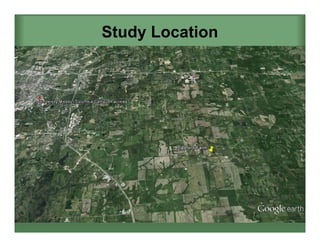
Study Location
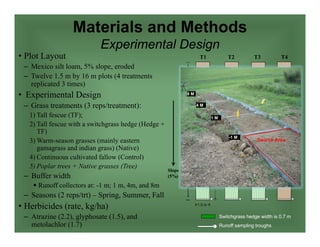
• Plot Layout
– Mexico silt loam, 5% slope, eroded
– Twelve 1.5 m by 16 m plots (4 treatments
replicated 3 times)
• Experimental Design
– Grass treatments (3 reps/treatment):
1) Tall fescue (TF);
2) Tall fescue with a switchgrass hedge (Hedge +
TF)
3) Warm-season grasses (mainly eastern
gamagrass and indian grass) (Native)
4) Continuous cultivated fallow (Control)
5) Poplar trees + Native grasses (Tree)
– Buffer width
 Runoff collectors at: -1 m; 1 m, 4m, and 8m
– Seasons (2 reps/trt) – Spring, Summer, Fall
• Herbicides (rate, kg/ha)
– Atrazine (2.2), glyphosate (1.5), and
metolachlor (1.7)
Materials and Methods
Experimental Design
8 m
1.0 m
4 m
Slope
(5%)
Fescue
Runoff sampling troughs
Fescue
T1
Native
T2 T3 T4
Tilled
Area
Switchgrass hedge width is 0.7 m
8 m
Tilled
Area
Tilled
Area
Tilled
Area
Tilled
Area
1.5 m
1 M
4 M
Source Area
-1 M
8 M
Materials and Methods
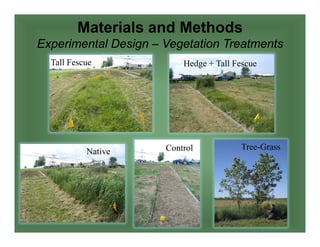
Experimental Design – Vegetation Treatments
Control
Tall Fescue
Native
Hedge + Tall Fescue
Tree-Grass
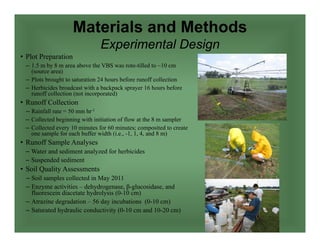
• Plot Preparation
– 1.5 m by 8 m area above the VBS was roto-tilled to ~10 cm
(source area)
– Plots brought to saturation 24 hours before runoff collection
– Herbicides broadcast with a backpack sprayer 16 hours before
runoff collection (not incorporated)
• Runoff Collection
– Rainfall rate = 50 mm hr-1
– Collected beginning with initiation of flow at the 8 m sampler
– Collected every 10 minutes for 60 minutes; composited to create
one sample for each buffer width (i.e., -1, 1, 4, and 8 m)
• Runoff Sample Analyses
– Water and sediment analyzed for herbicides
– Suspended sediment
• Soil Quality Assessments
– Soil samples collected in May 2011
– Enzyme activities – dehydrogenase, β-glucosidase, and
fluorescein diacetate hydrolysis (0-10 cm)
– Atrazine degradation – 56 day incubations (0-10 cm)
– Saturated hydraulic conductivity (0-10 cm and 10-20 cm)
Materials and Methods
Experimental Design
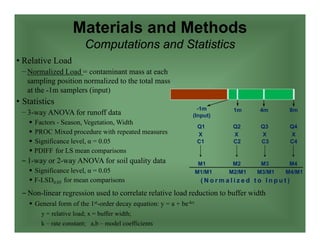
• Relative Load
− Normalized Load = contaminant mass at each
sampling position normalized to the total mass
at the -1m samplers (input)
• Statistics
− 3-way ANOVA for runoff data
 Factors - Season, Vegetation, Width
 PROC Mixed procedure with repeated measures
 Significance level, α = 0.05
 PDIFF for LS mean comparisons
– 1-way or 2-way ANOVA for soil quality data
 Significance level, α = 0.05
 F-LSD0.05 for mean comparisons
Materials and Methods
Computations and Statistics
-1m
(Input)
1m 4m 8m
X X X X
C1 C2 C3 C4
M1 M2 M3 M4
M1/M1 M2/M1 M3/M1 M4/M1
( N o r m a l i z e d t o I n p u t )
Q1 Q2 Q3 Q4
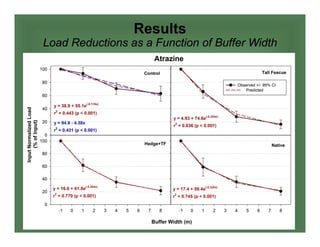
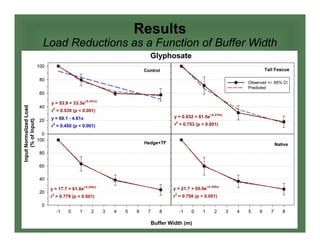
– Non-linear regression used to correlate relative load reduction to buffer width
 General form of the 1st-order decay equation: y = a + be-kx
y = relative load; x = buffer width;
k – rate constant; a,b – model coefficients
Results
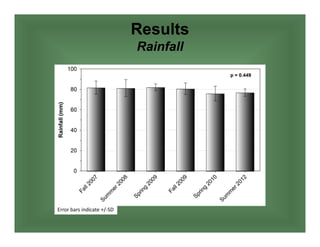
Rainfall
Error bars indicate +/‐SD
Results
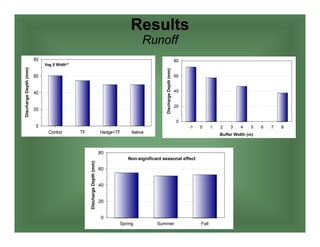
Runoff
Results
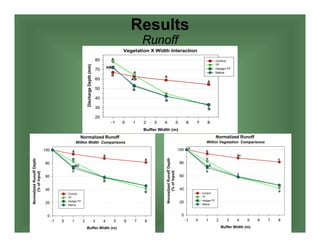
Runoff
Results
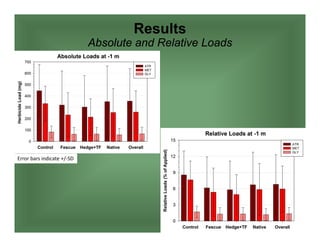
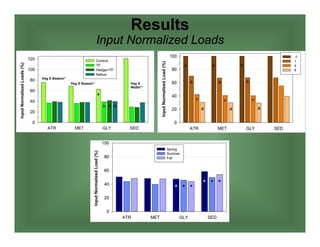
Absolute and Relative Loads
Error bars indicate +/‐SD
Results
Input Normalized Loads
Results
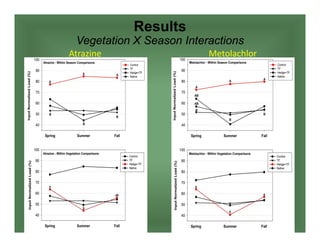
Vegetation X Season Interactions
Atrazine Metolachlor
Results
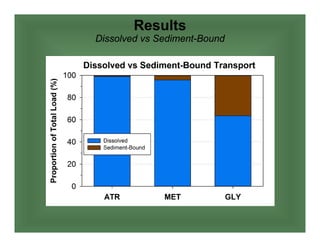
Dissolved vs Sediment-Bound
Results
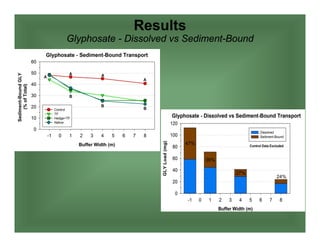
Glyphosate - Dissolved vs Sediment-Bound
47%
36%
27%
24%
Results
Load Reductions as a Function of Buffer Width
Results
Load Reductions as a Function of Buffer Width
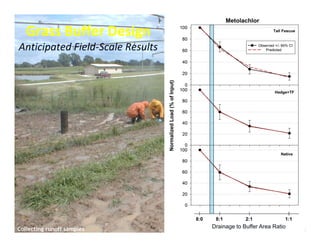
Grass Buffer Design
Anticipated Field‐Scale Results
Collecting runoff samples Drainage to Buffer Area Ratio
8:1 2:1 1:18:0
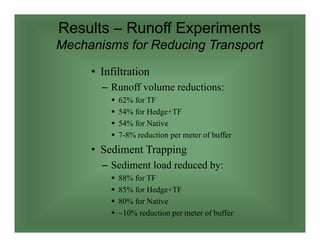
Results – Runoff Experiments
Mechanisms for Reducing Transport
• Infiltration
– Runoff volume reductions:
 62% for TF
 54% for Hedge+TF
 54% for Native
 7-8% reduction per meter of buffer
• Sediment Trapping
– Sediment load reduced by:
 88% for TF
 85% for Hedge+TF
 80% for Native
 ~10% reduction per meter of buffer
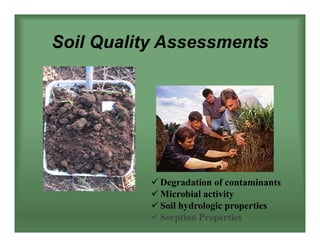
Soil Quality Assessments
 Degradation of contaminants
 Microbial activity
 Soil hydrologic properties
 Sorption Properties
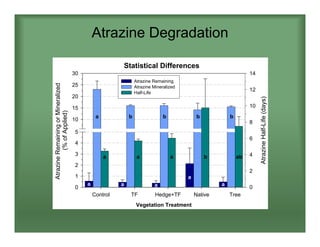
Atrazine Degradation
Statistical Differences
Vegetation Treatment
Control TF Hedge+TF Native Tree
AtrazineRemainingorMineralized
(%ofApplied)
0
1
2
3
4
5
10
15
20
25
30
AtrazineHalf-Life(days)
0
2
4
6
8
10
12
14
Atrazine Remaining
Atrazine Mineralized
Half-Life
a a a
a
a
a b b b b
a a a b ab
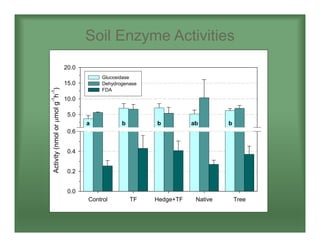
Soil Enzyme Activities
Control TF Hedge+TF Native Tree
Activity(nmolormolg
-1
h
-1
)
0.0
0.2
0.4
0.6
5.0
10.0
15.0
20.0
Glucosidase
Dehydrogenase
FDA
a abb b b
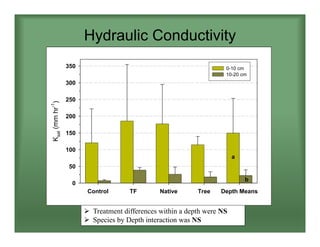
Hydraulic Conductivity
 Treatment differences within a depth were NS
 Species by Depth interaction was NS
Control TF Native Tree Depth Means
Ksat(mmhr
-1
)
0
50
100
150
200
250
300
350 0-10 cm
10-20 cm
a
b
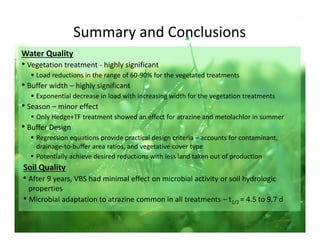
Summary and Conclusions
Water Quality
• Vegetation treatment ‐ highly significant
 Load reductions in the range of 60‐90% for the vegetated treatments
• Buffer width – highly significant
 Exponential decrease in load with increasing width for the vegetation treatments
• Season – minor effect
 Only Hedge+TF treatment showed an effect for atrazine and metolachlor in summer
• Buffer Design 
 Regression equations provide practical design criteria – accounts for contaminant, 
drainage‐to‐buffer area ratios, and vegetative cover type
 Potentially achieve desired reductions with less land taken out of production
Soil Quality
• After 9 years, VBS had minimal effect on microbial activity or soil hydrologic 
properties
• Microbial adaptation to atrazine common in all treatments – t1/2 = 4.5 to 9.7 d

Vegetative buffer strips for reducing herbicide

  • 1.
    R. N. Lerch1,C. H. Lin2, K. W. Goyne3, R. J. Kremer1, and S. H. Anderson3 Vegetative Buffer Strips for Reducing Herbicide Transport in Runoff: Effects of Season, Vegetation, and Buffer Width 1USDA-ARS, Cropping Systems and Water Quality Research Unit, Columbia, MO 2 Center for Agroforestry, University of Missouri 3Department of Soil, Environmental and Atmospheric Sciences, University of Missouri
  • 2.
    Rationale and Objectives •Rationale: – The ability of vegetative buffer strips (VBS) to reduce the transport of herbicides has not been evaluated for high runoff potential soils such as those in the Central Claypan Region of northeastern Missouri. – Data to needed to support design criteria for implementation relative to contaminant of interest, choice of grass species, and buffer width • Objectives: 1) Assess the effects of season, vegetation, and buffer width on runoff transport of herbicides 2) Develop design criteria for buffer widths 3) Assess soil quality in the buffers since their implementation in 2002.
  • 3.
  • 4.
    • Plot Layout –Mexico silt loam, 5% slope, eroded – Twelve 1.5 m by 16 m plots (4 treatments replicated 3 times) • Experimental Design – Grass treatments (3 reps/treatment): 1) Tall fescue (TF); 2) Tall fescue with a switchgrass hedge (Hedge + TF) 3) Warm-season grasses (mainly eastern gamagrass and indian grass) (Native) 4) Continuous cultivated fallow (Control) 5) Poplar trees + Native grasses (Tree) – Buffer width  Runoff collectors at: -1 m; 1 m, 4m, and 8m – Seasons (2 reps/trt) – Spring, Summer, Fall • Herbicides (rate, kg/ha) – Atrazine (2.2), glyphosate (1.5), and metolachlor (1.7) Materials and Methods Experimental Design 8 m 1.0 m 4 m Slope (5%) Fescue Runoff sampling troughs Fescue T1 Native T2 T3 T4 Tilled Area Switchgrass hedge width is 0.7 m 8 m Tilled Area Tilled Area Tilled Area Tilled Area 1.5 m 1 M 4 M Source Area -1 M 8 M
  • 5.
    Materials and Methods ExperimentalDesign – Vegetation Treatments Control Tall Fescue Native Hedge + Tall Fescue Tree-Grass
  • 6.
    • Plot Preparation –1.5 m by 8 m area above the VBS was roto-tilled to ~10 cm (source area) – Plots brought to saturation 24 hours before runoff collection – Herbicides broadcast with a backpack sprayer 16 hours before runoff collection (not incorporated) • Runoff Collection – Rainfall rate = 50 mm hr-1 – Collected beginning with initiation of flow at the 8 m sampler – Collected every 10 minutes for 60 minutes; composited to create one sample for each buffer width (i.e., -1, 1, 4, and 8 m) • Runoff Sample Analyses – Water and sediment analyzed for herbicides – Suspended sediment • Soil Quality Assessments – Soil samples collected in May 2011 – Enzyme activities – dehydrogenase, β-glucosidase, and fluorescein diacetate hydrolysis (0-10 cm) – Atrazine degradation – 56 day incubations (0-10 cm) – Saturated hydraulic conductivity (0-10 cm and 10-20 cm) Materials and Methods Experimental Design
  • 7.
    • Relative Load −Normalized Load = contaminant mass at each sampling position normalized to the total mass at the -1m samplers (input) • Statistics − 3-way ANOVA for runoff data  Factors - Season, Vegetation, Width  PROC Mixed procedure with repeated measures  Significance level, α = 0.05  PDIFF for LS mean comparisons – 1-way or 2-way ANOVA for soil quality data  Significance level, α = 0.05  F-LSD0.05 for mean comparisons Materials and Methods Computations and Statistics -1m (Input) 1m 4m 8m X X X X C1 C2 C3 C4 M1 M2 M3 M4 M1/M1 M2/M1 M3/M1 M4/M1 ( N o r m a l i z e d t o I n p u t ) Q1 Q2 Q3 Q4 – Non-linear regression used to correlate relative load reduction to buffer width  General form of the 1st-order decay equation: y = a + be-kx y = relative load; x = buffer width; k – rate constant; a,b – model coefficients
  • 8.
  • 9.
  • 10.
  • 11.
    Results Absolute and RelativeLoads Error bars indicate +/‐SD
  • 12.
  • 13.
    Results Vegetation X SeasonInteractions Atrazine Metolachlor
  • 14.
  • 15.
    Results Glyphosate - Dissolvedvs Sediment-Bound 47% 36% 27% 24%
  • 16.
    Results Load Reductions asa Function of Buffer Width
  • 17.
    Results Load Reductions asa Function of Buffer Width
  • 18.
  • 19.
    Results – RunoffExperiments Mechanisms for Reducing Transport • Infiltration – Runoff volume reductions:  62% for TF  54% for Hedge+TF  54% for Native  7-8% reduction per meter of buffer • Sediment Trapping – Sediment load reduced by:  88% for TF  85% for Hedge+TF  80% for Native  ~10% reduction per meter of buffer
  • 20.
    Soil Quality Assessments Degradation of contaminants  Microbial activity  Soil hydrologic properties  Sorption Properties
  • 21.
    Atrazine Degradation Statistical Differences VegetationTreatment Control TF Hedge+TF Native Tree AtrazineRemainingorMineralized (%ofApplied) 0 1 2 3 4 5 10 15 20 25 30 AtrazineHalf-Life(days) 0 2 4 6 8 10 12 14 Atrazine Remaining Atrazine Mineralized Half-Life a a a a a a b b b b a a a b ab
  • 22.
    Soil Enzyme Activities ControlTF Hedge+TF Native Tree Activity(nmolormolg -1 h -1 ) 0.0 0.2 0.4 0.6 5.0 10.0 15.0 20.0 Glucosidase Dehydrogenase FDA a abb b b
  • 23.
    Hydraulic Conductivity  Treatmentdifferences within a depth were NS  Species by Depth interaction was NS Control TF Native Tree Depth Means Ksat(mmhr -1 ) 0 50 100 150 200 250 300 350 0-10 cm 10-20 cm a b
  • 24.
    Summary and Conclusions Water Quality • Vegetation treatment ‐ highly significant Load reductions in the range of 60‐90% for the vegetated treatments • Buffer width – highly significant  Exponential decrease in load with increasing width for the vegetation treatments • Season – minor effect  Only Hedge+TF treatment showed an effect for atrazine and metolachlor in summer • Buffer Design   Regression equations provide practical design criteria – accounts for contaminant,  drainage‐to‐buffer area ratios, and vegetative cover type  Potentially achieve desired reductions with less land taken out of production Soil Quality • After 9 years, VBS had minimal effect on microbial activity or soil hydrologic  properties • Microbial adaptation to atrazine common in all treatments – t1/2 = 4.5 to 9.7 d