Introduction to Cryogenics
Unit I
Mr.S.A.Wani
Assistant Professor
Department of Mechanical Engineering
P.V.P.I.T.Budhgaon
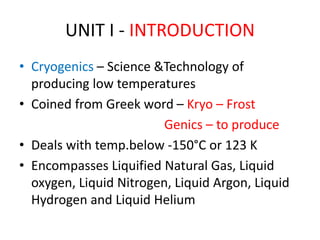
UNIT I - INTRODUCTION
• Cryogenics – Science &Technology of
producing low temperatures
• Coined from Greek word – Kryo – Frost
Genics – to produce
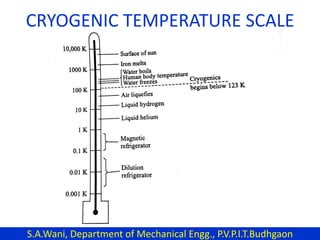
• Deals with temp.below -150°C or 123 K
• Encompasses Liquified Natural Gas, Liquid
oxygen, Liquid Nitrogen, Liquid Argon, Liquid
Hydrogen and Liquid Helium
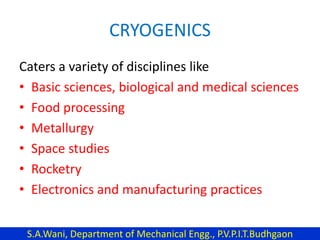
CRYOGENICS
Caters a variety of disciplines like
• Basic sciences, biological and medical sciences
• Food processing
• Metallurgy
• Space studies
• Rocketry
• Electronics and manufacturing practices
S.A.Wani, Department of Mechanical Engg., P.V.P.I.T.Budhgaon
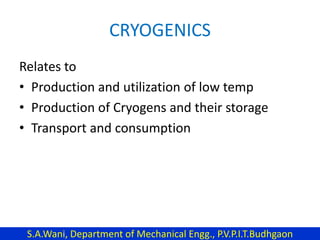
CRYOGENICS
Relates to
• Production and utilization of low temp
• Production of Cryogens and their storage
• Transport and consumption
S.A.Wani, Department of Mechanical Engg., P.V.P.I.T.Budhgaon
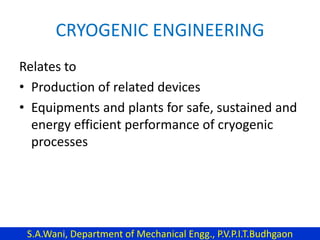
CRYOGENIC ENGINEERING
Relates to
• Production of related devices
• Equipments and plants for safe, sustained and
energy efficient performance of cryogenic
processes
S.A.Wani, Department of Mechanical Engg., P.V.P.I.T.Budhgaon
CRYOGENIC TEMPERATURE SCALE
S.A.Wani, Department of Mechanical Engg., P.V.P.I.T.Budhgaon
DEVELOPMENTAL HISTORY
• First ever liquefaction of cryogenic gas in 1877
by French Mining engineer Cailletet
• Succeded in precooling a container filled with
oxygen at 300 atm. and then expanding it
• Swiss physicists, succeded in liquefying oxygen
and nitrogen.
• After a year later, the succeded in liquefying
hydrogen at 100 atm.
S.A.Wani, Department of Mechanical Engg., P.V.P.I.T.Budhgaon
DEVELOPMENTAL HISTORY
• James Dewar developed vacuum jacketed
double walled containers in 1892
• Kammerling Onnes developed low temp
physics laboratory in Holland in 1908
• French Engineer Claude established air
liquefaction system in 1902
• Linde installed first air liquefaction plant in
1907.
S.A.Wani, Department of Mechanical Engg., P.V.P.I.T.Budhgaon
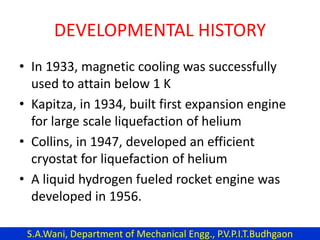
DEVELOPMENTAL HISTORY
• In 1933, magnetic cooling was successfully
used to attain below 1 K
• Kapitza, in 1934, built first expansion engine
for large scale liquefaction of helium
• Collins, in 1947, developed an efficient
cryostat for liquefaction of helium
• A liquid hydrogen fueled rocket engine was
developed in 1956.
S.A.Wani, Department of Mechanical Engg., P.V.P.I.T.Budhgaon
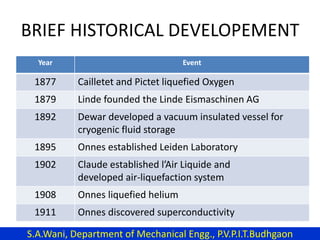
BRIEF HISTORICAL DEVELOPEMENT
Year Event
1877 Cailletet and Pictet liquefied Oxygen
1879 Linde founded the Linde Eismaschinen AG
1892 Dewar developed a vacuum insulated vessel for
cryogenic fluid storage
1895 Onnes established Leiden Laboratory
1902 Claude established l’Air Liquide and
developed air-liquefaction system
1908 Onnes liquefied helium
1911 Onnes discovered superconductivity
S.A.Wani, Department of Mechanical Engg., P.V.P.I.T.Budhgaon
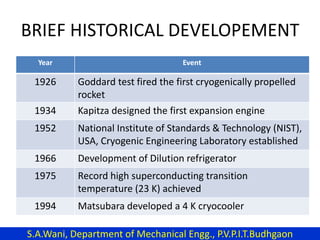
BRIEF HISTORICAL DEVELOPEMENT
Year Event
1926 Goddard test fired the first cryogenically propelled
rocket
1934 Kapitza designed the first expansion engine
1952 National Institute of Standards & Technology (NIST),
USA, Cryogenic Engineering Laboratory established
1966 Development of Dilution refrigerator
1975 Record high superconducting transition
temperature (23 K) achieved
1994 Matsubara developed a 4 K cryocooler
S.A.Wani, Department of Mechanical Engg., P.V.P.I.T.Budhgaon
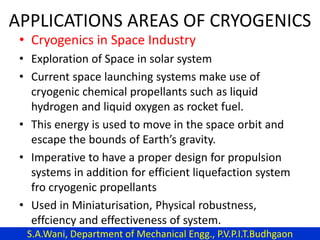
APPLICATIONS AREAS OF CRYOGENICS
• Cryogenics in Space Industry
• Exploration of Space in solar system
• Current space launching systems make use of
cryogenic chemical propellants such as liquid
hydrogen and liquid oxygen as rocket fuel.
• This energy is used to move in the space orbit and
escape the bounds of Earth’s gravity.
• Imperative to have a proper design for propulsion
systems in addition for efficient liquefaction system
fro cryogenic propellants
• Used in Miniaturisation, Physical robustness,
effciency and effectiveness of system.
S.A.Wani, Department of Mechanical Engg., P.V.P.I.T.Budhgaon
APPLICATIONS AREAS OF CRYOGENICS
• Cryogenics in Aviation and Aerospace Industry
• Used in production and reconditioning of
static storage tanks and some bearing metal
components.
• Military aircraft uses argon in space over fuel
in tanks and fill aircraft tyres with nitrogen
• Liquid oxygen is stored as lightweight source
of breathing gas for pilot.
• Helium gas is used in large volumes for filling
balloons and airships.
S.A.Wani, Department of Mechanical Engg., P.V.P.I.T.Budhgaon
APPLICATIONS AREAS OF CRYOGENICS
• Cryo-Metallurgy
• Cryo processsing has emerged to increase wear
resistance and life of all the metals.
• The retained stresses cause uneven expansion,
increased dimensional stability etc
• Cryogenic tempering transforms structure into more
durable, stronger and stable.
• Cryogenic processes has been proved for improving
performance, reliability, durability of racing engines.
• Also used for improving the strength of drive lines,
machine parts, punching dies.
S.A.Wani, Department of Mechanical Engg., P.V.P.I.T.Budhgaon
APPLICATIONS AREAS OF CRYOGENICS
• Cryobiology
• Cryobiology is the study of effects of freezing and low
temperatures on living organisms.
• Cryobiology is known to have the potential for
improving the quality of lives in future.
• Practice of freezing humans who are not curable by
current medical technology in future to bring them
to life. It is known as suspended animation.
• Ways of repairing the damage caused by freezing
process are developed, as well as when cures of
diseases.
S.A.Wani, Department of Mechanical Engg., P.V.P.I.T.Budhgaon
APPLICATIONS AREAS OF CRYOGENICS
• Cryosurgery
• Cryosurgery are for treatment of certain types of skin
lesions, for benign and dysplastic mucosal lesions.
• Involves different techniques to achieve selective
necrosis of tissues, by freezing at extremely low
temperatures through precise cooling.
• Each technique involves specific procedure in order to
cater requirement of surgery for specific purpose.
• Uses a pre-cooled metal acessory that is directly applied
to lesion.
• Has added more benefits which includes lack of need of
general anesthesia, Optional need for local
anesthesia,Simplicity and Safety
S.A.Wani, Department of Mechanical Engg., P.V.P.I.T.Budhgaon
APPLICATIONS AREAS OF CRYOGENICS
• Cryopreservation of tissue and blood
• Cryopreservation of foods
• Cryo transport
S.A.Wani, Department of Mechanical Engg., P.V.P.I.T.Budhgaon
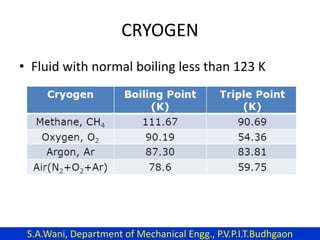
CRYOGEN
• Fluid with normal boiling less than 123 K
S.A.Wani, Department of Mechanical Engg., P.V.P.I.T.Budhgaon
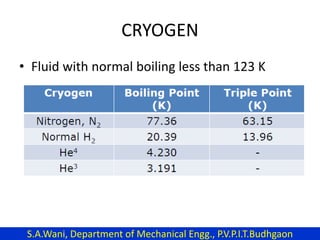
CRYOGEN
• Fluid with normal boiling less than 123 K
S.A.Wani, Department of Mechanical Engg., P.V.P.I.T.Budhgaon
CRYOGENIC FLUIDS
• Hydrogen
• Helium
• Liquid Methane
• Liquid Neon
• Liquid Nitrogen
• Liquid Oxygen
• Liquid Argon
• Liquid Air
S.A.Wani, Department of Mechanical Engg., P.V.P.I.T.Budhgaon
PROPERTIES OF CRYOGENIC FLUIDS
• Hydrogen
• Exists in Diatomic form as H2
• Normal Boiling Point = 20.27 K
• Normal Freezing Point = 13.95 K
• Critical Pressure = 1.315 Mpa
• Critical Temperature = 33.19 K
• Liquid Hydrogen Density = 70.79 kg/m3
• Latent Heat = 443 KJ/kg
S.A.Wani, Department of Mechanical Engg., P.V.P.I.T.Budhgaon
PROPERTIES OF CRYOGENIC FLUIDS
• Hydrogen – Uses
• Cryogenic engines are powered by propellants
like liquid hydrogen.
• It is being considered as fuel for automobiles.
• Cryocoolers working on a closed cycle use
hydrogen as working fluid
• Hydrogen codes and standards should be
followed to ensure safety while handling liquid
hydrogen.
S.A.Wani, Department of Mechanical Engg., P.V.P.I.T.Budhgaon
PROPERTIES OF CRYOGENIC FLUIDS
• Helium
• Helium is an inert gas and exists in
monoatomic state
• Normal Boiling Point = 4.25 K
• Critical Pressure = 0.277 Mpa
• Critical Temperature = 5.25 K
• Liquid Helium Density = 124.8 kg/m3
• Latent Heat = 20.28 KJ/kg
S.A.Wani, Department of Mechanical Engg., P.V.P.I.T.Budhgaon
PROPERTIES OF CRYOGENIC FLUIDS
• Liquid Methane
• It boils at 111.7 K
• Can be used as a rocket fuel
• It’s a form of Compressed Natural Gas (CNG)
S.A.Wani, Department of Mechanical Engg., P.V.P.I.T.Budhgaon
PROPERTIES OF CRYOGENIC FLUIDS
• Liquid Neon
• It is a clear, colorless liquid with boiling point
at 27.1 K
• Liquid neon is commercially used as a
cryogenic refrigerant
• It is compact, inert and less expensive as
compared to liquid helium
S.A.Wani, Department of Mechanical Engg., P.V.P.I.T.Budhgaon
PROPERTIES OF CRYOGENIC FLUIDS
• Liquid Nitrogen
• It boils at 77.36 K and freezes at 63.2 K
• Resembles water in appearance
• Density = 807 kg/m3
• Latent Heat of vaporisation = 199.3KJ/kg
S.A.Wani, Department of Mechanical Engg., P.V.P.I.T.Budhgaon
PROPERTIES OF CRYOGENIC FLUIDS
• Liquid Nitrogen - Uses
• Used as a liquid for providing refrigeration
• For Food preservation, Blood, cells
preservation
• High temperature Superconductivity
• Use for providing an inert atmosphere in
chemical and metallurgical industries
S.A.Wani, Department of Mechanical Engg., P.V.P.I.T.Budhgaon
PROPERTIES OF CRYOGENIC FLUIDS
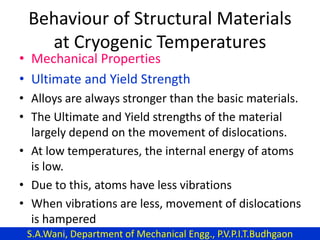
• Liquid Oxygen
• Blue in Colour
• Boils at 90.18 K
• Freezes at 54.4 K
• Density = 1141 kg/m3
• Slightly magnetic
S.A.Wani, Department of Mechanical Engg., P.V.P.I.T.Budhgaon
PROPERTIES OF CRYOGENIC FLUIDS
• Liquid Oxygen - Uses
• Widely used in industries and for medical
purposes
• Largely used in iron and steel manufacturing
industry
• Oxidizer propellant for spacecraft rocket
applications
S.A.Wani, Department of Mechanical Engg., P.V.P.I.T.Budhgaon
PROPERTIES OF CRYOGENIC FLUIDS
• Liquid Argon
• Colorless, Inert and Toxic Gas
• Boils at 87.3 K
• Freezes at 83.8 K
• Density = 1394 kg/m3
S.A.Wani, Department of Mechanical Engg., P.V.P.I.T.Budhgaon
PROPERTIES OF CRYOGENIC FLUIDS
• Liquid Argon - Uses
• Used to purge molds in casting industry
• Argon – oxygen decarburization (AOD) process
in stainless steel industry
• Offers inert atmosphere for welding stainless
steel, aluminium, titanium etc
S.A.Wani, Department of Mechanical Engg., P.V.P.I.T.Budhgaon
PROPERTIES OF CRYOGENIC FLUIDS
• Liquid Air
• Considered as a mixture 78% Nitrogen, 21%
Oxygen, 1% Argon and others
• Boiling point = 78.9 K
• Density = 874 kg/m3
• Was earlier used as pre-coolant for low
temperature application
• Primarily used for production of Pure
nitrogen, oxygen and rare gases
S.A.Wani, Department of Mechanical Engg., P.V.P.I.T.Budhgaon
Behaviour of Structural Materials
at Cryogenic Temperatures
• Mechanical Properties
• Ultimate and Yield Strength
• Fatigue Strength
• Impact Strength
• Hardness and Ductility
• Elastic Moduli
S.A.Wani, Department of Mechanical Engg., P.V.P.I.T.Budhgaon
Behaviour of Structural Materials
at Cryogenic Temperatures
• Cryogenic Engineer should have knowledge of
all the mechanical and thermophysical
properties of material of construction.
• Essential to have the sound knowledge of
behaviour of properties of materials at
cryogenic temperatures for reliable and safe
design of cryogenic equipment
S.A.Wani, Department of Mechanical Engg., P.V.P.I.T.Budhgaon
Behaviour of Structural Materials
at Cryogenic Temperatures
• Mechanical Properties
• Ultimate and Yield Strength
• Stress-Strain relationship of any material exhibits its
uniqueness.
• Ultimate Strength of a material - It is the maximum
nominal stress attained by a test specimen during a
simple tensile test.
• Yield Strength of a material - It is the stress at which
the strain of a material shows a rapid increase with
an increase in stress, when subjected to a simple
tensile test.
S.A.Wani, Department of Mechanical Engg., P.V.P.I.T.Budhgaon
Behaviour of Structural Materials
at Cryogenic Temperatures
• Mechanical Properties
• Ultimate and Yield Strength
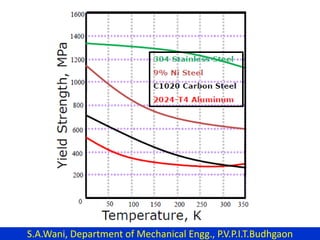
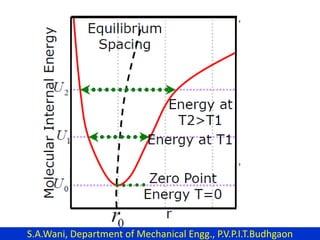
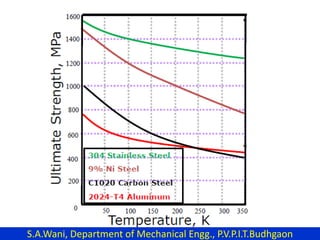
• Alloys are always stronger than the basic materials.
• The Ultimate and Yield strengths of the material
largely depend on the movement of dislocations.
• At low temperatures, the internal energy of atoms
is low.
• Due to this, atoms have less vibrations
• When vibrations are less, movement of dislocations
is hampered
S.A.Wani, Department of Mechanical Engg., P.V.P.I.T.Budhgaon
Behaviour of Structural Materials
at Cryogenic Temperatures
• Mechanical Properties
• Ultimate and Yield Strength
• It requires a very large stress to tear the
dislocations from their equilibrium positions
• So, materials exhibit high yield and ultimate
strength at low temperatures.
S.A.Wani, Department of Mechanical Engg., P.V.P.I.T.Budhgaon
Behaviour of Structural Materials
at Cryogenic Temperatures
• Mechanical Properties
• Fatigue Strength
• Fatigue strength is defined as the stress required
for failure after a number of repeated cycles.
• Materials exhibit fatigue failure when they are
subjected to fluctuating loads.
• These failures can happen even if the stress
applied is much lower than the ultimate stress
values.
S.A.Wani, Department of Mechanical Engg., P.V.P.I.T.Budhgaon
Behaviour of Structural Materials
at Cryogenic Temperatures
• Mechanical Properties
• Fatigue Strength
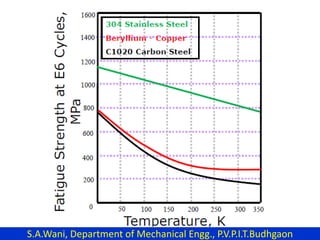
• Fatigue failure begins with a microcrack initiation.
• At low temperatures, a large stress is required to
stretch the crack due to increase in ultimate
strength.
• Therefore, like ultimate strength, the fatigue
strength increases as the temperature decreases.
S.A.Wani, Department of Mechanical Engg., P.V.P.I.T.Budhgaon
Behaviour of Structural Materials
at Cryogenic Temperatures
• Mechanical Properties
• Fatigue Strength
• To avoid Fatigue failure, when a specimen is
subjected to fluctuating loads, working stress
is maintained below a certain value called as
Endurance Limit.
• Beryllium – Copper alloy is used in
manufacturing
S.A.Wani, Department of Mechanical Engg., P.V.P.I.T.Budhgaon
Behaviour of Structural Materials
at Cryogenic Temperatures
• Mechanical Properties
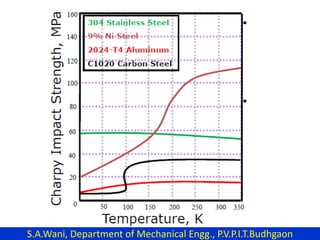
• Impact Strength
• It indicates the energy needed for a fracture by
an impact or a suddenly applied force.
• Impact behaviour is usually decided by lattice
structure
• At low temperatures, the materials with Body
Centered Cubic (BCC) lattice, break easily.
• The materials with Face Centered Cubic (FCC) or
Hexagonal lattice have more slip planes.
S.A.Wani, Department of Mechanical Engg., P.V.P.I.T.Budhgaon
Behaviour of Structural Materials
at Cryogenic Temperatures
• Mechanical Properties
• Impact Strength
• These slip planes assist in plastic deformation
(rather than breaking) and hence increase the
impact strength of material even at low
temperatures.
• The materials with FCC and HCP lattices are
preferred for cryogenic applications.
S.A.Wani, Department of Mechanical Engg., P.V.P.I.T.Budhgaon
Behaviour of Structural Materials
at Cryogenic Temperatures
• Mechanical Properties
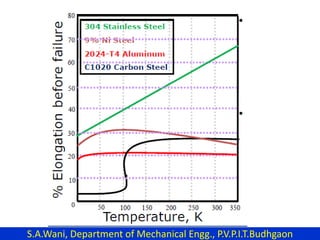
• Ductility and Hardness
• Ductility is the measure of the capacity to
elongate by a simple tensile force and is indicated
by % elongation.
• A material which elongates more than 5% of the
original length before failure is called as ductile
material.
• It is measure of % elongation in length or %
reduction in cross sectional area of specimen
S.A.Wani, Department of Mechanical Engg., P.V.P.I.T.Budhgaon
Behaviour of Structural Materials
at Cryogenic Temperatures
• Mechanical Properties
• Ductility and Hardness
• Hardness is the measure of depth of the
standard indentation made on the surface of
the specimen by a standard indenter.
• Hardness is directly proportional to the
ultimate stress of a material. Hence, it follows
the same trend, i.e. increases as the
temperature is decreased.
S.A.Wani, Department of Mechanical Engg., P.V.P.I.T.Budhgaon
Behaviour of Structural Materials
at Cryogenic Temperatures
• Mechanical Properties
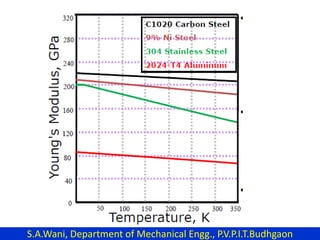
• Elastic Moduli
• There are three types of elastic moduli –
• Young’s Modulus – Ratio of change of tensile
stress with respect to strain
• Shear Modulus – Ratio of change of shear
stress to shear strain
• Bulk Modulus – Ratio of rate of change in
pressure to the volumetric strain
S.A.Wani, Department of Mechanical Engg., P.V.P.I.T.Budhgaon
Behaviour of Structural Materials
at Cryogenic Temperatures
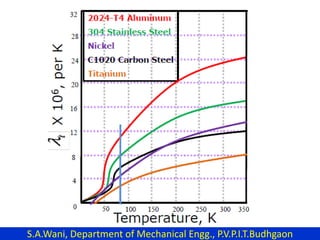
• Thermal Properties
• Thermal Expansion / Contraction
• Specific heat of Solids
• Thermal Conductivity
S.A.Wani, Department of Mechanical Engg., P.V.P.I.T.Budhgaon
Behaviour of Structural Materials
at Cryogenic Temperatures
• Thermal Properties
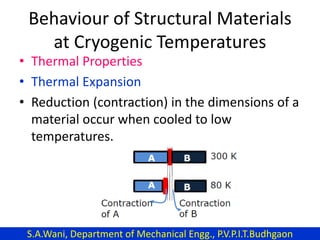
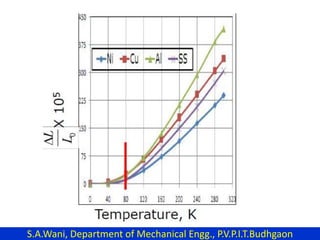
• Thermal Expansion
• Reduction (contraction) in the dimensions of a
material occur when cooled to low
temperatures.
S.A.Wani, Department of Mechanical Engg., P.V.P.I.T.Budhgaon
Behaviour of Structural Materials
at Cryogenic Temperatures
• Thermal Properties
• Thermal Expansion
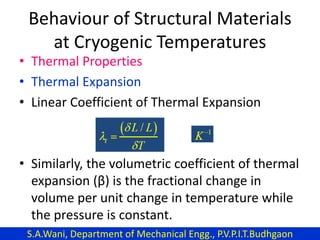
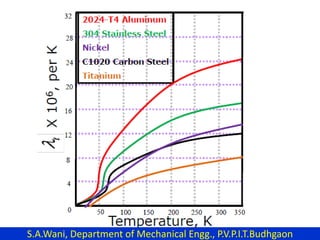
• Linear Coefficient of Thermal Expansion
• Similarly, the volumetric coefficient of thermal
expansion (β) is the fractional change in
volume per unit change in temperature while
the pressure is constant.
S.A.Wani, Department of Mechanical Engg., P.V.P.I.T.Budhgaon
Behaviour of Structural Materials
at Cryogenic Temperatures
• Thermal Properties
• Specific Heat of Solids
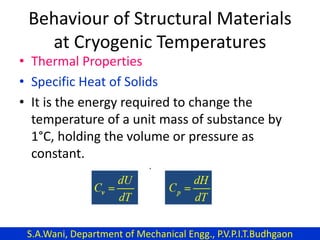
• It is the energy required to change the
temperature of a unit mass of substance by
1°C, holding the volume or pressure as
constant.
S.A.Wani, Department of Mechanical Engg., P.V.P.I.T.Budhgaon
Behaviour of Structural Materials
at Cryogenic Temperatures
• Thermal Properties
• Specific Heat of Solids – Einstein and Debye
Theory
• Einstein treated the solid as a system of simple harmonic
oscillators. It was assumed that, all the oscillators are of same
frequency.
• However, Debye treated solid as an infinite elastic continuum
and considered all the possible standing waves in the
material.
• He presented a model to compute lattice heat capacity per
mole, which accounts for all the vibration frequencies of all
the lattice points.
S.A.Wani, Department of Mechanical Engg., P.V.P.I.T.Budhgaon
Behaviour of Structural Materials
at Cryogenic Temperatures
• Thermal Properties
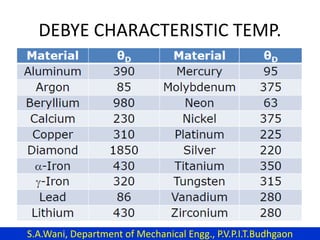
• Specific Heat of Solids – Debye Theory
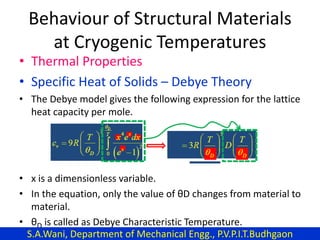
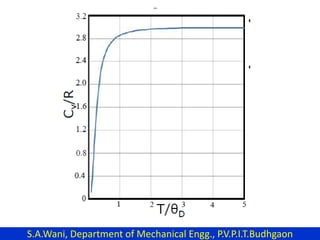
• The Debye model gives the following expression for the lattice
heat capacity per mole.
• x is a dimensionless variable.
• In the equation, only the value of θD changes from material to
material.
• θD is called as Debye Characteristic Temperature.
S.A.Wani, Department of Mechanical Engg., P.V.P.I.T.Budhgaon
DEBYE CHARACTERISTIC TEMP.
S.A.Wani, Department of Mechanical Engg., P.V.P.I.T.Budhgaon
Behaviour of Structural Materials
at Cryogenic Temperatures
• Thermal Properties
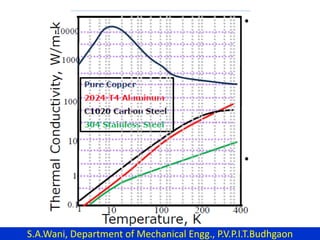
• Thermal Conductivity in Solids
• In a cryostat, the solid members made of a metal or a
non metal conduct heat from high temperature to low
temperature.
• For these members, the thermal conductivity K, should
be as low as possible to minimize the heat loss
• On the other hand, for achieving best heat transfer of
cold generated, copper can be used as a medium due
to its very high thermal conductivity.
S.A.Wani, Department of Mechanical Engg., P.V.P.I.T.Budhgaon
Behaviour of Structural Materials
at Cryogenic Temperatures
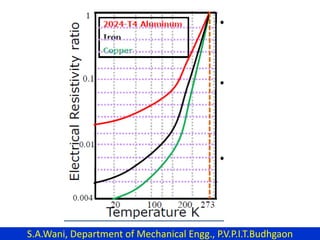
• Electric and Magnetic Properties
• Electrical Conductivity
• Defined as the electric current per unit cross sectional area
divided by the voltage gradient in the direction of the current
flow.
• Electrical Resistivity
• Reciprocal of Electrical Conductivity
• Decreasing the temperature decreases the vibration energy of
the ions. This results in smaller interference with electron
motion.
• Therefore, electrical conductivity of the metallic conductors
increases at low temperature.
S.A.Wani, Department of Mechanical Engg., P.V.P.I.T.Budhgaon
TEST
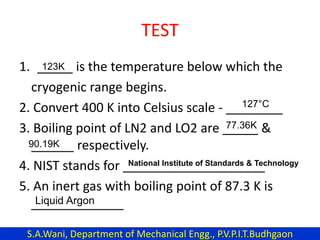
1. _____ is the temperature below which the
cryogenic range begins.
2. Convert 400 K into Celsius scale - ________
3. Boiling point of LN2 and LO2 are _____ &
______ respectively.
4. NIST stands for ____________________
5. An inert gas with boiling point of 87.3 K is
_____________
123K
127°C
77.36K
90.19K
National Institute of Standards & Technology
Liquid Argon
S.A.Wani, Department of Mechanical Engg., P.V.P.I.T.Budhgaon
TEST
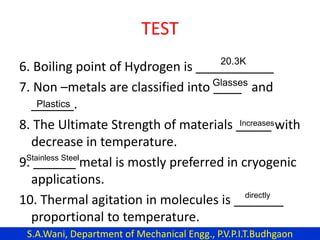
6. Boiling point of Hydrogen is ___________
7. Non –metals are classified into ____ and
______.
8. The Ultimate Strength of materials _____ with
decrease in temperature.
9. ______ metal is mostly preferred in cryogenic
applications.
10. Thermal agitation in molecules is _______
proportional to temperature.
20.3K
Glasses
Plastics
Increases
Stainless Steel
directly
S.A.Wani, Department of Mechanical Engg., P.V.P.I.T.Budhgaon
TEST
11. ______ failure occurs when materials are
subjected to fluctuating loads.
12. ________ is used in manufacturing of flexure
bearings.
13. ________ governs the impact strength of a
material.
14. ________ property of the material decreases
with decrease in temperature
15. ________ material cannot be used at low temp
Fatigue
Beryllium-copper alloy
Lattice Structure
% elongation
Carbon Steel
S.A.Wani, Department of Mechanical Engg., P.V.P.I.T.Budhgaon
TEST
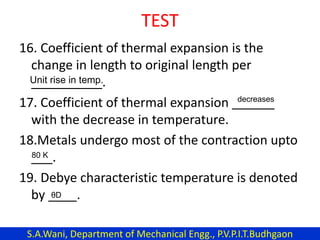
16. Coefficient of thermal expansion is the
change in length to original length per
__________.
17. Coefficient of thermal expansion ______
with the decrease in temperature.
18.Metals undergo most of the contraction upto
___.
19. Debye characteristic temperature is denoted
by ____.
Unit rise in temp.
decreases
80 K
θD
S.A.Wani, Department of Mechanical Engg., P.V.P.I.T.Budhgaon
TEST
20. K decreases with the _________ in the
temperature for impure metals.
21. Specific heat of the material __________
with decrease in temperature.
22. Electrical conductivity of the metallic
conductors __________ at low temperature.
Decrease
Increase
Decrease
S.A.Wani, Department of Mechanical Engg., P.V.P.I.T.Budhgaon
THANK YOU

Unit i introduction to Cryogenics

  • 1.
    Introduction to Cryogenics UnitI Mr.S.A.Wani Assistant Professor Department of Mechanical Engineering P.V.P.I.T.Budhgaon
  • 2.
    UNIT I -INTRODUCTION • Cryogenics – Science &Technology of producing low temperatures • Coined from Greek word – Kryo – Frost Genics – to produce • Deals with temp.below -150°C or 123 K • Encompasses Liquified Natural Gas, Liquid oxygen, Liquid Nitrogen, Liquid Argon, Liquid Hydrogen and Liquid Helium
  • 3.
    CRYOGENICS Caters a varietyof disciplines like • Basic sciences, biological and medical sciences • Food processing • Metallurgy • Space studies • Rocketry • Electronics and manufacturing practices S.A.Wani, Department of Mechanical Engg., P.V.P.I.T.Budhgaon
  • 4.
    CRYOGENICS Relates to • Productionand utilization of low temp • Production of Cryogens and their storage • Transport and consumption S.A.Wani, Department of Mechanical Engg., P.V.P.I.T.Budhgaon
  • 5.
    CRYOGENIC ENGINEERING Relates to •Production of related devices • Equipments and plants for safe, sustained and energy efficient performance of cryogenic processes S.A.Wani, Department of Mechanical Engg., P.V.P.I.T.Budhgaon
  • 6.
    CRYOGENIC TEMPERATURE SCALE S.A.Wani,Department of Mechanical Engg., P.V.P.I.T.Budhgaon
  • 7.
    DEVELOPMENTAL HISTORY • Firstever liquefaction of cryogenic gas in 1877 by French Mining engineer Cailletet • Succeded in precooling a container filled with oxygen at 300 atm. and then expanding it • Swiss physicists, succeded in liquefying oxygen and nitrogen. • After a year later, the succeded in liquefying hydrogen at 100 atm. S.A.Wani, Department of Mechanical Engg., P.V.P.I.T.Budhgaon
  • 8.
    DEVELOPMENTAL HISTORY • JamesDewar developed vacuum jacketed double walled containers in 1892 • Kammerling Onnes developed low temp physics laboratory in Holland in 1908 • French Engineer Claude established air liquefaction system in 1902 • Linde installed first air liquefaction plant in 1907. S.A.Wani, Department of Mechanical Engg., P.V.P.I.T.Budhgaon
  • 9.
    DEVELOPMENTAL HISTORY • In1933, magnetic cooling was successfully used to attain below 1 K • Kapitza, in 1934, built first expansion engine for large scale liquefaction of helium • Collins, in 1947, developed an efficient cryostat for liquefaction of helium • A liquid hydrogen fueled rocket engine was developed in 1956. S.A.Wani, Department of Mechanical Engg., P.V.P.I.T.Budhgaon
  • 10.
    BRIEF HISTORICAL DEVELOPEMENT YearEvent 1877 Cailletet and Pictet liquefied Oxygen 1879 Linde founded the Linde Eismaschinen AG 1892 Dewar developed a vacuum insulated vessel for cryogenic fluid storage 1895 Onnes established Leiden Laboratory 1902 Claude established l’Air Liquide and developed air-liquefaction system 1908 Onnes liquefied helium 1911 Onnes discovered superconductivity S.A.Wani, Department of Mechanical Engg., P.V.P.I.T.Budhgaon
  • 11.
    BRIEF HISTORICAL DEVELOPEMENT YearEvent 1926 Goddard test fired the first cryogenically propelled rocket 1934 Kapitza designed the first expansion engine 1952 National Institute of Standards & Technology (NIST), USA, Cryogenic Engineering Laboratory established 1966 Development of Dilution refrigerator 1975 Record high superconducting transition temperature (23 K) achieved 1994 Matsubara developed a 4 K cryocooler S.A.Wani, Department of Mechanical Engg., P.V.P.I.T.Budhgaon
  • 12.
    APPLICATIONS AREAS OFCRYOGENICS • Cryogenics in Space Industry • Exploration of Space in solar system • Current space launching systems make use of cryogenic chemical propellants such as liquid hydrogen and liquid oxygen as rocket fuel. • This energy is used to move in the space orbit and escape the bounds of Earth’s gravity. • Imperative to have a proper design for propulsion systems in addition for efficient liquefaction system fro cryogenic propellants • Used in Miniaturisation, Physical robustness, effciency and effectiveness of system. S.A.Wani, Department of Mechanical Engg., P.V.P.I.T.Budhgaon
  • 13.
    APPLICATIONS AREAS OFCRYOGENICS • Cryogenics in Aviation and Aerospace Industry • Used in production and reconditioning of static storage tanks and some bearing metal components. • Military aircraft uses argon in space over fuel in tanks and fill aircraft tyres with nitrogen • Liquid oxygen is stored as lightweight source of breathing gas for pilot. • Helium gas is used in large volumes for filling balloons and airships. S.A.Wani, Department of Mechanical Engg., P.V.P.I.T.Budhgaon
  • 14.
    APPLICATIONS AREAS OFCRYOGENICS • Cryo-Metallurgy • Cryo processsing has emerged to increase wear resistance and life of all the metals. • The retained stresses cause uneven expansion, increased dimensional stability etc • Cryogenic tempering transforms structure into more durable, stronger and stable. • Cryogenic processes has been proved for improving performance, reliability, durability of racing engines. • Also used for improving the strength of drive lines, machine parts, punching dies. S.A.Wani, Department of Mechanical Engg., P.V.P.I.T.Budhgaon
  • 15.
    APPLICATIONS AREAS OFCRYOGENICS • Cryobiology • Cryobiology is the study of effects of freezing and low temperatures on living organisms. • Cryobiology is known to have the potential for improving the quality of lives in future. • Practice of freezing humans who are not curable by current medical technology in future to bring them to life. It is known as suspended animation. • Ways of repairing the damage caused by freezing process are developed, as well as when cures of diseases. S.A.Wani, Department of Mechanical Engg., P.V.P.I.T.Budhgaon
  • 16.
    APPLICATIONS AREAS OFCRYOGENICS • Cryosurgery • Cryosurgery are for treatment of certain types of skin lesions, for benign and dysplastic mucosal lesions. • Involves different techniques to achieve selective necrosis of tissues, by freezing at extremely low temperatures through precise cooling. • Each technique involves specific procedure in order to cater requirement of surgery for specific purpose. • Uses a pre-cooled metal acessory that is directly applied to lesion. • Has added more benefits which includes lack of need of general anesthesia, Optional need for local anesthesia,Simplicity and Safety S.A.Wani, Department of Mechanical Engg., P.V.P.I.T.Budhgaon
  • 17.
    APPLICATIONS AREAS OFCRYOGENICS • Cryopreservation of tissue and blood • Cryopreservation of foods • Cryo transport S.A.Wani, Department of Mechanical Engg., P.V.P.I.T.Budhgaon
  • 18.
    CRYOGEN • Fluid withnormal boiling less than 123 K S.A.Wani, Department of Mechanical Engg., P.V.P.I.T.Budhgaon
  • 19.
    CRYOGEN • Fluid withnormal boiling less than 123 K S.A.Wani, Department of Mechanical Engg., P.V.P.I.T.Budhgaon
  • 20.
    CRYOGENIC FLUIDS • Hydrogen •Helium • Liquid Methane • Liquid Neon • Liquid Nitrogen • Liquid Oxygen • Liquid Argon • Liquid Air S.A.Wani, Department of Mechanical Engg., P.V.P.I.T.Budhgaon
  • 21.
    PROPERTIES OF CRYOGENICFLUIDS • Hydrogen • Exists in Diatomic form as H2 • Normal Boiling Point = 20.27 K • Normal Freezing Point = 13.95 K • Critical Pressure = 1.315 Mpa • Critical Temperature = 33.19 K • Liquid Hydrogen Density = 70.79 kg/m3 • Latent Heat = 443 KJ/kg S.A.Wani, Department of Mechanical Engg., P.V.P.I.T.Budhgaon
  • 22.
    PROPERTIES OF CRYOGENICFLUIDS • Hydrogen – Uses • Cryogenic engines are powered by propellants like liquid hydrogen. • It is being considered as fuel for automobiles. • Cryocoolers working on a closed cycle use hydrogen as working fluid • Hydrogen codes and standards should be followed to ensure safety while handling liquid hydrogen. S.A.Wani, Department of Mechanical Engg., P.V.P.I.T.Budhgaon
  • 23.
    PROPERTIES OF CRYOGENICFLUIDS • Helium • Helium is an inert gas and exists in monoatomic state • Normal Boiling Point = 4.25 K • Critical Pressure = 0.277 Mpa • Critical Temperature = 5.25 K • Liquid Helium Density = 124.8 kg/m3 • Latent Heat = 20.28 KJ/kg S.A.Wani, Department of Mechanical Engg., P.V.P.I.T.Budhgaon
  • 24.
    PROPERTIES OF CRYOGENICFLUIDS • Liquid Methane • It boils at 111.7 K • Can be used as a rocket fuel • It’s a form of Compressed Natural Gas (CNG) S.A.Wani, Department of Mechanical Engg., P.V.P.I.T.Budhgaon
  • 25.
    PROPERTIES OF CRYOGENICFLUIDS • Liquid Neon • It is a clear, colorless liquid with boiling point at 27.1 K • Liquid neon is commercially used as a cryogenic refrigerant • It is compact, inert and less expensive as compared to liquid helium S.A.Wani, Department of Mechanical Engg., P.V.P.I.T.Budhgaon
  • 26.
    PROPERTIES OF CRYOGENICFLUIDS • Liquid Nitrogen • It boils at 77.36 K and freezes at 63.2 K • Resembles water in appearance • Density = 807 kg/m3 • Latent Heat of vaporisation = 199.3KJ/kg S.A.Wani, Department of Mechanical Engg., P.V.P.I.T.Budhgaon
  • 27.
    PROPERTIES OF CRYOGENICFLUIDS • Liquid Nitrogen - Uses • Used as a liquid for providing refrigeration • For Food preservation, Blood, cells preservation • High temperature Superconductivity • Use for providing an inert atmosphere in chemical and metallurgical industries S.A.Wani, Department of Mechanical Engg., P.V.P.I.T.Budhgaon
  • 28.
    PROPERTIES OF CRYOGENICFLUIDS • Liquid Oxygen • Blue in Colour • Boils at 90.18 K • Freezes at 54.4 K • Density = 1141 kg/m3 • Slightly magnetic S.A.Wani, Department of Mechanical Engg., P.V.P.I.T.Budhgaon
  • 29.
    PROPERTIES OF CRYOGENICFLUIDS • Liquid Oxygen - Uses • Widely used in industries and for medical purposes • Largely used in iron and steel manufacturing industry • Oxidizer propellant for spacecraft rocket applications S.A.Wani, Department of Mechanical Engg., P.V.P.I.T.Budhgaon
  • 30.
    PROPERTIES OF CRYOGENICFLUIDS • Liquid Argon • Colorless, Inert and Toxic Gas • Boils at 87.3 K • Freezes at 83.8 K • Density = 1394 kg/m3 S.A.Wani, Department of Mechanical Engg., P.V.P.I.T.Budhgaon
  • 31.
    PROPERTIES OF CRYOGENICFLUIDS • Liquid Argon - Uses • Used to purge molds in casting industry • Argon – oxygen decarburization (AOD) process in stainless steel industry • Offers inert atmosphere for welding stainless steel, aluminium, titanium etc S.A.Wani, Department of Mechanical Engg., P.V.P.I.T.Budhgaon
  • 32.
    PROPERTIES OF CRYOGENICFLUIDS • Liquid Air • Considered as a mixture 78% Nitrogen, 21% Oxygen, 1% Argon and others • Boiling point = 78.9 K • Density = 874 kg/m3 • Was earlier used as pre-coolant for low temperature application • Primarily used for production of Pure nitrogen, oxygen and rare gases S.A.Wani, Department of Mechanical Engg., P.V.P.I.T.Budhgaon
  • 33.
    Behaviour of StructuralMaterials at Cryogenic Temperatures • Mechanical Properties • Ultimate and Yield Strength • Fatigue Strength • Impact Strength • Hardness and Ductility • Elastic Moduli S.A.Wani, Department of Mechanical Engg., P.V.P.I.T.Budhgaon
  • 34.
    Behaviour of StructuralMaterials at Cryogenic Temperatures • Cryogenic Engineer should have knowledge of all the mechanical and thermophysical properties of material of construction. • Essential to have the sound knowledge of behaviour of properties of materials at cryogenic temperatures for reliable and safe design of cryogenic equipment S.A.Wani, Department of Mechanical Engg., P.V.P.I.T.Budhgaon
  • 35.
    Behaviour of StructuralMaterials at Cryogenic Temperatures • Mechanical Properties • Ultimate and Yield Strength • Stress-Strain relationship of any material exhibits its uniqueness. • Ultimate Strength of a material - It is the maximum nominal stress attained by a test specimen during a simple tensile test. • Yield Strength of a material - It is the stress at which the strain of a material shows a rapid increase with an increase in stress, when subjected to a simple tensile test. S.A.Wani, Department of Mechanical Engg., P.V.P.I.T.Budhgaon
  • 36.
    S.A.Wani, Department ofMechanical Engg., P.V.P.I.T.Budhgaon
  • 37.
    S.A.Wani, Department ofMechanical Engg., P.V.P.I.T.Budhgaon
  • 38.
    Behaviour of StructuralMaterials at Cryogenic Temperatures • Mechanical Properties • Ultimate and Yield Strength • Alloys are always stronger than the basic materials. • The Ultimate and Yield strengths of the material largely depend on the movement of dislocations. • At low temperatures, the internal energy of atoms is low. • Due to this, atoms have less vibrations • When vibrations are less, movement of dislocations is hampered S.A.Wani, Department of Mechanical Engg., P.V.P.I.T.Budhgaon
  • 39.
    Behaviour of StructuralMaterials at Cryogenic Temperatures • Mechanical Properties • Ultimate and Yield Strength • It requires a very large stress to tear the dislocations from their equilibrium positions • So, materials exhibit high yield and ultimate strength at low temperatures. S.A.Wani, Department of Mechanical Engg., P.V.P.I.T.Budhgaon
  • 40.
    Behaviour of StructuralMaterials at Cryogenic Temperatures • Mechanical Properties • Fatigue Strength • Fatigue strength is defined as the stress required for failure after a number of repeated cycles. • Materials exhibit fatigue failure when they are subjected to fluctuating loads. • These failures can happen even if the stress applied is much lower than the ultimate stress values. S.A.Wani, Department of Mechanical Engg., P.V.P.I.T.Budhgaon
  • 41.
    S.A.Wani, Department ofMechanical Engg., P.V.P.I.T.Budhgaon
  • 42.
    Behaviour of StructuralMaterials at Cryogenic Temperatures • Mechanical Properties • Fatigue Strength • Fatigue failure begins with a microcrack initiation. • At low temperatures, a large stress is required to stretch the crack due to increase in ultimate strength. • Therefore, like ultimate strength, the fatigue strength increases as the temperature decreases. S.A.Wani, Department of Mechanical Engg., P.V.P.I.T.Budhgaon
  • 43.
    Behaviour of StructuralMaterials at Cryogenic Temperatures • Mechanical Properties • Fatigue Strength • To avoid Fatigue failure, when a specimen is subjected to fluctuating loads, working stress is maintained below a certain value called as Endurance Limit. • Beryllium – Copper alloy is used in manufacturing S.A.Wani, Department of Mechanical Engg., P.V.P.I.T.Budhgaon
  • 44.
    Behaviour of StructuralMaterials at Cryogenic Temperatures • Mechanical Properties • Impact Strength • It indicates the energy needed for a fracture by an impact or a suddenly applied force. • Impact behaviour is usually decided by lattice structure • At low temperatures, the materials with Body Centered Cubic (BCC) lattice, break easily. • The materials with Face Centered Cubic (FCC) or Hexagonal lattice have more slip planes. S.A.Wani, Department of Mechanical Engg., P.V.P.I.T.Budhgaon
  • 45.
    Behaviour of StructuralMaterials at Cryogenic Temperatures • Mechanical Properties • Impact Strength • These slip planes assist in plastic deformation (rather than breaking) and hence increase the impact strength of material even at low temperatures. • The materials with FCC and HCP lattices are preferred for cryogenic applications. S.A.Wani, Department of Mechanical Engg., P.V.P.I.T.Budhgaon
  • 46.
    S.A.Wani, Department ofMechanical Engg., P.V.P.I.T.Budhgaon
  • 47.
    Behaviour of StructuralMaterials at Cryogenic Temperatures • Mechanical Properties • Ductility and Hardness • Ductility is the measure of the capacity to elongate by a simple tensile force and is indicated by % elongation. • A material which elongates more than 5% of the original length before failure is called as ductile material. • It is measure of % elongation in length or % reduction in cross sectional area of specimen S.A.Wani, Department of Mechanical Engg., P.V.P.I.T.Budhgaon
  • 48.
    S.A.Wani, Department ofMechanical Engg., P.V.P.I.T.Budhgaon
  • 49.
    Behaviour of StructuralMaterials at Cryogenic Temperatures • Mechanical Properties • Ductility and Hardness • Hardness is the measure of depth of the standard indentation made on the surface of the specimen by a standard indenter. • Hardness is directly proportional to the ultimate stress of a material. Hence, it follows the same trend, i.e. increases as the temperature is decreased. S.A.Wani, Department of Mechanical Engg., P.V.P.I.T.Budhgaon
  • 50.
    Behaviour of StructuralMaterials at Cryogenic Temperatures • Mechanical Properties • Elastic Moduli • There are three types of elastic moduli – • Young’s Modulus – Ratio of change of tensile stress with respect to strain • Shear Modulus – Ratio of change of shear stress to shear strain • Bulk Modulus – Ratio of rate of change in pressure to the volumetric strain S.A.Wani, Department of Mechanical Engg., P.V.P.I.T.Budhgaon
  • 51.
    S.A.Wani, Department ofMechanical Engg., P.V.P.I.T.Budhgaon
  • 52.
    Behaviour of StructuralMaterials at Cryogenic Temperatures • Thermal Properties • Thermal Expansion / Contraction • Specific heat of Solids • Thermal Conductivity S.A.Wani, Department of Mechanical Engg., P.V.P.I.T.Budhgaon
  • 53.
    Behaviour of StructuralMaterials at Cryogenic Temperatures • Thermal Properties • Thermal Expansion • Reduction (contraction) in the dimensions of a material occur when cooled to low temperatures. S.A.Wani, Department of Mechanical Engg., P.V.P.I.T.Budhgaon
  • 54.
    Behaviour of StructuralMaterials at Cryogenic Temperatures • Thermal Properties • Thermal Expansion • Linear Coefficient of Thermal Expansion • Similarly, the volumetric coefficient of thermal expansion (β) is the fractional change in volume per unit change in temperature while the pressure is constant. S.A.Wani, Department of Mechanical Engg., P.V.P.I.T.Budhgaon
  • 55.
    S.A.Wani, Department ofMechanical Engg., P.V.P.I.T.Budhgaon
  • 56.
    S.A.Wani, Department ofMechanical Engg., P.V.P.I.T.Budhgaon
  • 57.
    S.A.Wani, Department ofMechanical Engg., P.V.P.I.T.Budhgaon
  • 58.
    S.A.Wani, Department ofMechanical Engg., P.V.P.I.T.Budhgaon
  • 59.
    Behaviour of StructuralMaterials at Cryogenic Temperatures • Thermal Properties • Specific Heat of Solids • It is the energy required to change the temperature of a unit mass of substance by 1°C, holding the volume or pressure as constant. S.A.Wani, Department of Mechanical Engg., P.V.P.I.T.Budhgaon
  • 60.
    Behaviour of StructuralMaterials at Cryogenic Temperatures • Thermal Properties • Specific Heat of Solids – Einstein and Debye Theory • Einstein treated the solid as a system of simple harmonic oscillators. It was assumed that, all the oscillators are of same frequency. • However, Debye treated solid as an infinite elastic continuum and considered all the possible standing waves in the material. • He presented a model to compute lattice heat capacity per mole, which accounts for all the vibration frequencies of all the lattice points. S.A.Wani, Department of Mechanical Engg., P.V.P.I.T.Budhgaon
  • 61.
    Behaviour of StructuralMaterials at Cryogenic Temperatures • Thermal Properties • Specific Heat of Solids – Debye Theory • The Debye model gives the following expression for the lattice heat capacity per mole. • x is a dimensionless variable. • In the equation, only the value of θD changes from material to material. • θD is called as Debye Characteristic Temperature. S.A.Wani, Department of Mechanical Engg., P.V.P.I.T.Budhgaon
  • 62.
    S.A.Wani, Department ofMechanical Engg., P.V.P.I.T.Budhgaon
  • 63.
    DEBYE CHARACTERISTIC TEMP. S.A.Wani,Department of Mechanical Engg., P.V.P.I.T.Budhgaon
  • 64.
    Behaviour of StructuralMaterials at Cryogenic Temperatures • Thermal Properties • Thermal Conductivity in Solids • In a cryostat, the solid members made of a metal or a non metal conduct heat from high temperature to low temperature. • For these members, the thermal conductivity K, should be as low as possible to minimize the heat loss • On the other hand, for achieving best heat transfer of cold generated, copper can be used as a medium due to its very high thermal conductivity. S.A.Wani, Department of Mechanical Engg., P.V.P.I.T.Budhgaon
  • 65.
    S.A.Wani, Department ofMechanical Engg., P.V.P.I.T.Budhgaon
  • 66.
    Behaviour of StructuralMaterials at Cryogenic Temperatures • Electric and Magnetic Properties • Electrical Conductivity • Defined as the electric current per unit cross sectional area divided by the voltage gradient in the direction of the current flow. • Electrical Resistivity • Reciprocal of Electrical Conductivity • Decreasing the temperature decreases the vibration energy of the ions. This results in smaller interference with electron motion. • Therefore, electrical conductivity of the metallic conductors increases at low temperature. S.A.Wani, Department of Mechanical Engg., P.V.P.I.T.Budhgaon
  • 67.
    S.A.Wani, Department ofMechanical Engg., P.V.P.I.T.Budhgaon
  • 68.
    TEST 1. _____ isthe temperature below which the cryogenic range begins. 2. Convert 400 K into Celsius scale - ________ 3. Boiling point of LN2 and LO2 are _____ & ______ respectively. 4. NIST stands for ____________________ 5. An inert gas with boiling point of 87.3 K is _____________ 123K 127°C 77.36K 90.19K National Institute of Standards & Technology Liquid Argon S.A.Wani, Department of Mechanical Engg., P.V.P.I.T.Budhgaon
  • 69.
    TEST 6. Boiling pointof Hydrogen is ___________ 7. Non –metals are classified into ____ and ______. 8. The Ultimate Strength of materials _____ with decrease in temperature. 9. ______ metal is mostly preferred in cryogenic applications. 10. Thermal agitation in molecules is _______ proportional to temperature. 20.3K Glasses Plastics Increases Stainless Steel directly S.A.Wani, Department of Mechanical Engg., P.V.P.I.T.Budhgaon
  • 70.
    TEST 11. ______ failureoccurs when materials are subjected to fluctuating loads. 12. ________ is used in manufacturing of flexure bearings. 13. ________ governs the impact strength of a material. 14. ________ property of the material decreases with decrease in temperature 15. ________ material cannot be used at low temp Fatigue Beryllium-copper alloy Lattice Structure % elongation Carbon Steel S.A.Wani, Department of Mechanical Engg., P.V.P.I.T.Budhgaon
  • 71.
    TEST 16. Coefficient ofthermal expansion is the change in length to original length per __________. 17. Coefficient of thermal expansion ______ with the decrease in temperature. 18.Metals undergo most of the contraction upto ___. 19. Debye characteristic temperature is denoted by ____. Unit rise in temp. decreases 80 K θD S.A.Wani, Department of Mechanical Engg., P.V.P.I.T.Budhgaon
  • 72.
    TEST 20. K decreaseswith the _________ in the temperature for impure metals. 21. Specific heat of the material __________ with decrease in temperature. 22. Electrical conductivity of the metallic conductors __________ at low temperature. Decrease Increase Decrease S.A.Wani, Department of Mechanical Engg., P.V.P.I.T.Budhgaon
  • 73.