
Growing Native Plants 
From Seed 
Cornell Plantations 
and the 
Finger Lakes Native Plant Society
What IS a native plant? 
• A plant that grows in the same habitat in 
which it originated. 
• Plants can be native to a continent, state, 
or region.
Why plant native plants? 
• Well adapted to local habitats and conditions 
– Can be easy to maintain if planted in appropriate 
setting 
• Attractive 
– Diverse forms and colors 
• Wildflowers, shrubs, vines, trees, ferns, mosses 
• Manage biodiversity
Plant Habitats aka 
Vegetation of the Cayuga Lake Basin 
( Mohler, Marks and Gardescu 2006 “Guide to Plant Communities 
of the Central Finger Lakes Region”) 
Dry Uplands: e.g., Oak Forest 
Moist Uplands: e.g., Hemlock-Beech-Birch Forest 
Floodplain Forest: e.g., Sycamore-Cottonwood Forest 
Swamp Forests: e.g., Red/silver Maple Swamp 
Wetlands: e.g., Cattail wetlands, Rich Fens 
Bogs: e.g., Leatherleaf Bog 
Old Fields 
Unique habitats: e.g., Lake Cliffs
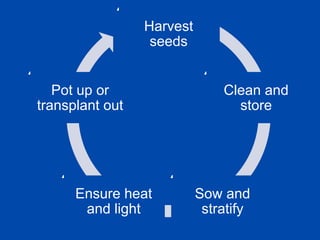
Harvest 
seeds 
Clean and 
store 
Sow and 
stratify 
Pot up or 
transplant out 
Ensure heat 
and light
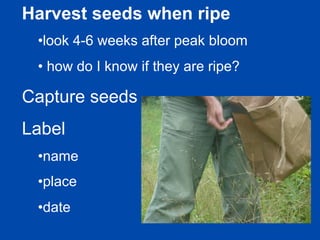
Harvest seeds when ripe 
• look 4-6 weeks after peak bloom 
• how do I know if they are ripe? 
Capture seeds 
Label 
• name 
• place 
• date
Cautions and Exceptions 
• Harvest only with permission 
• Take only 10% from a healthy population 
• Some seeds are harvested slightly green 
– Trillium 
– small tree/shrub fruits 
• Moist seeds require special treatment 
– harvest in plastic bag and keep moist
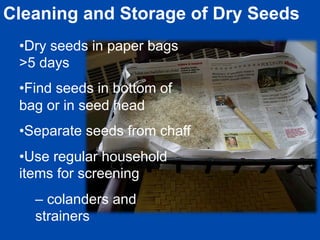
Cleaning and Storage of Dry Seeds 
• Dry seeds in paper bags 
>5 days 
• Find seeds in bottom of 
bag or in seed head 
• Separate seeds from chaff 
• Use regular household 
items for screening 
– colanders and 
strainers
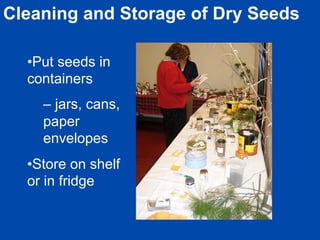
Cleaning and Storage of Dry Seeds 
• Put seeds in 
containers 
– jars, cans, 
paper 
envelopes 
• Store on shelf 
or in fridge
Cleaning & Storage of Moist Seeds 
(berries and most spring ephemerals) 
• Remove fleshy covering or pods ASAP 
– soak berries 
• Put in plastic bags or jars with moist medium 
• Keep warm or refrigerate 
– spring ephemerals are kept warm for 30-90 
days
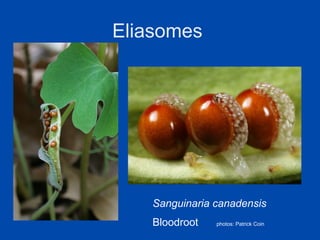
Eliasomes 
Sanguinaria canadensis 
Bloodroot photos: Patrick Coin
Seed Stratification 
Stratification mimics the natural temperature 
cycle of warm & cold, moist conditions. 
• Most native plant seeds require cold/moist followed by warming 
(CW) 
– “Cold” = ~40º “Warm” = ~65-70º (room temp) 
– Some grasses (warm season) require 75-80º 
• Seeds that ripen in early summer need warm, then cold, & back 
to warm (WCW). 
• Some native plant seeds require multiple cycles
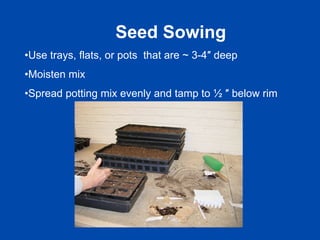
Seed Sowing 
• Use trays, flats, or pots that are ~ 3-4″ deep 
• Moisten mix 
• Spread potting mix evenly and tamp to ½ ″ below rim
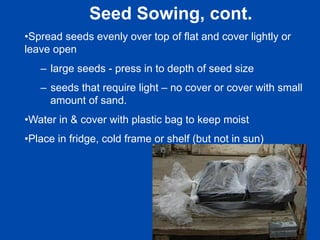
Seed Sowing, cont. 
• Spread seeds evenly over top of flat and cover lightly or 
leave open 
– large seeds - press in to depth of seed size 
– seeds that require light – no cover or cover with small 
amount of sand. 
• Water in & cover with plastic bag to keep moist 
• Place in fridge, cold frame or shelf (but not in sun)
Add Light and Heat 
• After cold/moist treatment is finished 
• Put flats in direct sunlight or under lights 
– 16 hours, 2-3″ from light 
– Gro-lights or 1 warm & 1 cool fluorescent OK 
– leave plastic bag partly open or perforate 
• Keep warm and moist 
– 70º is best for germination 
– not too wet or too dry 
• Slowly open plastic bag after germination to acclimate 
• Dilute fertilizer about 4 weeks after germination 
– no fertilizer for spring ephemerals
Pot Up or Transplant Out 
Which one depends on plant and your time frame 
• Look at size of plant and root growth 
– Plants need transplanting or potting up if they are too 
big or if roots are growing out of flat 
• Wait to transplant 
– if they are tiny 
– if they are slow to germinate 
– if they are developing roots and not shoots 
• Examples: Smilacina, Actaea, Arisaema, Trillium, 
Lilium
Cultural Conditions 
• Sun, Shade 
• Wet, Dry 
• Soil Type 
– Acid, Basic (limey) 
– Drainage
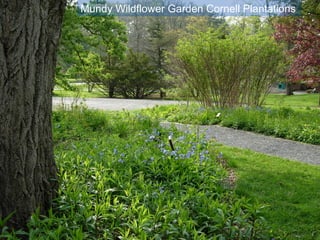
Mundy Wildflower Garden Cornell Plantations
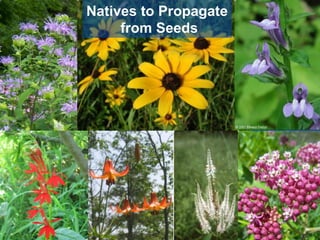
Natives to Propagate 
from Seeds
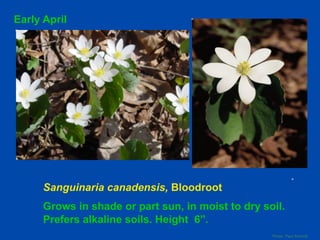
Sanguinaria canadensis, Bloodroot 
Grows in shade or part sun, in moist to dry soil. 
Prefers alkaline soils. Height 6”. 
Photo Paul Schmitt 
Early April
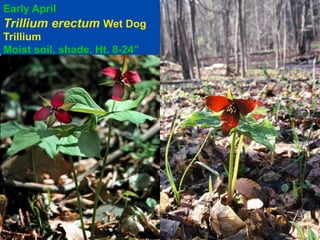
Early April 
Trillium erectum Wet Dog 
Trillium 
Moist soil, shade. Ht. 8-24”
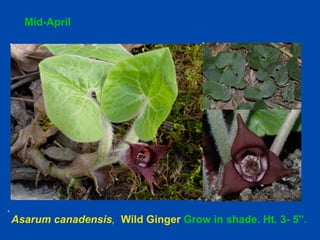
Mid-April 
Asarum canadensis, Wild Ginger Grow in shade. Ht. 3- 5”.
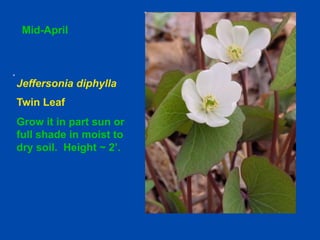
Mid-April 
Jeffersonia diphylla 
Twin Leaf 
Grow it in part sun or 
full shade in moist to 
dry soil. Height ~ 2’.
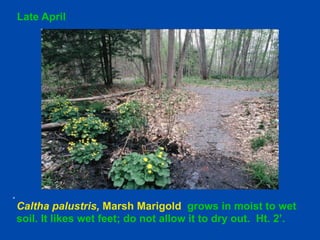
Late April 
Caltha palustris, Marsh Marigold grows in moist to wet 
soil. It likes wet feet; do not allow it to dry out. Ht. 2’.
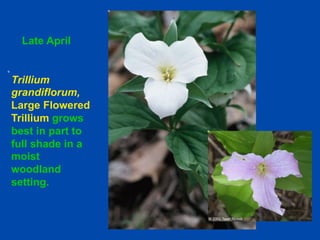
Late April 
Trillium 
grandiflorum, 
Large Flowered 
Trillium grows 
best in part to 
full shade in a 
moist 
woodland 
setting.
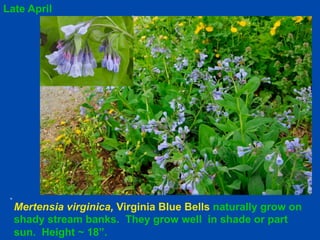
Late April 
Mertensia virginica, Virginia Blue Bells naturally grow on 
shady stream banks. They grow well in shade or part 
sun. Height ~ 18”.
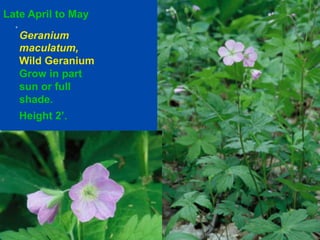
Late April to May 
Geranium 
maculatum, 
Wild Geranium 
Grow in part 
sun or full 
shade. 
Height 2’.
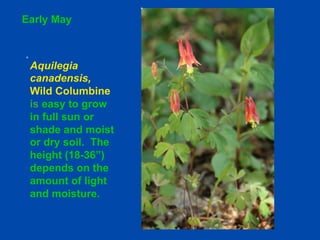
Early May 
Aquilegia 
canadensis, 
Wild Columbine 
is easy to grow 
in full sun or 
shade and moist 
or dry soil. The 
height (18-36”) 
depends on the 
amount of light 
and moisture.
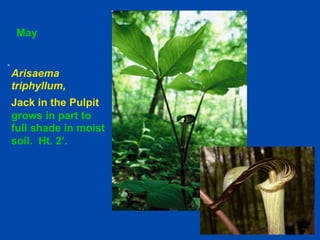
May 
Arisaema 
triphyllum, 
Jack in the Pulpit 
grows in part to 
full shade in moist 
soil. Ht. 2’.
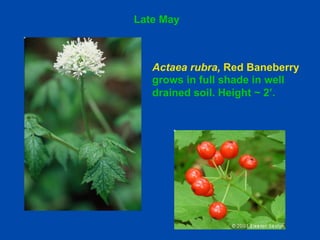
Late May 
Actaea rubra, Red Baneberry 
grows in full shade in well 
drained soil. Height ~ 2’.
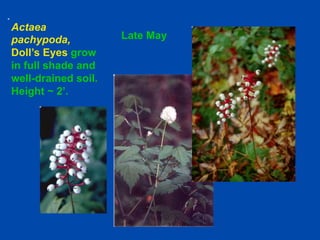
Actaea 
pachypoda, 
Doll’s Eyes grow 
in full shade and 
well-drained soil. 
Height ~ 2’. 
Late May
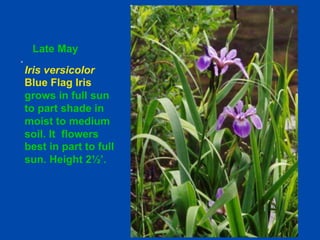
Late May 
Iris versicolor 
Blue Flag Iris 
grows in full sun 
to part shade in 
moist to medium 
soil. It flowers 
best in part to full 
sun. Height 2½’.
Late May 
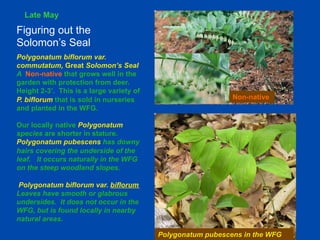
Polygonatum biflorum var. 
commutatum, Great Solomon’s Seal 
A Non-native that grows well in the 
garden with protection from deer. 
Height 2-3’. This is a large variety of 
P. biflorum that is sold in nurseries 
and planted in the WFG. 
Our locally native Polygonatum 
species are shorter in stature. 
Polygonatum pubescens has downy 
hairs covering the underside of the 
leaf. It occurs naturally in the WFG 
on the steep woodland slopes. 
Polygonatum biflorum var. biflorum 
Leaves have smooth or glabrous 
undersides. It does not occur in the 
WFG, but is found locally in nearby 
natural areas. 
Non-native 
Polygonatum pubescens in the WFG 
Figuring out the 
Solomon’s Seal
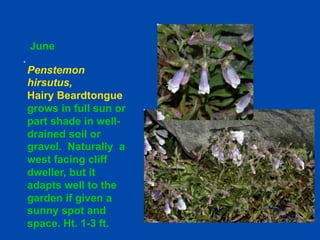
June 
Penstemon 
hirsutus, 
Hairy Beardtongue 
grows in full sun or 
part shade in well-drained 
soil or 
gravel. Naturally a 
west facing cliff 
dweller, but it 
adapts well to the 
garden if given a 
sunny spot and 
space. Ht. 1-3 ft.
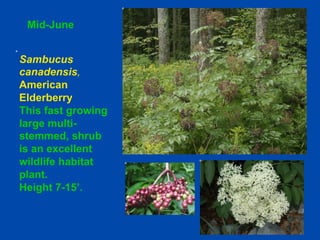
Mid-June 
Sambucus 
canadensis, 
American 
Elderberry 
This fast growing 
large multi-stemmed, 
shrub 
is an excellent 
wildlife habitat 
plant. 
Height 7-15’.
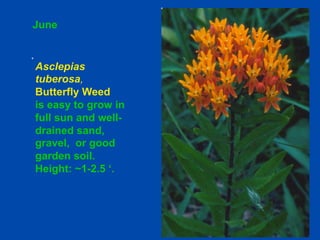
June 
Asclepias 
tuberosa, 
Butterfly Weed 
is easy to grow in 
full sun and well-drained 
sand, 
gravel, or good 
garden soil. 
Height: ~1-2.5 ‘.
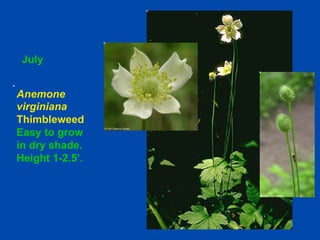
July 
Anemone 
virginiana 
Thimbleweed 
Easy to grow 
in dry shade. 
Height 1-2.5’.
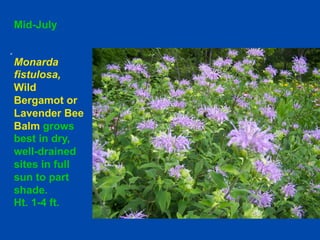
Mid-July 
Monarda 
fistulosa, 
Wild 
Bergamot or 
Lavender Bee 
Balm grows 
best in dry, 
well-drained 
sites in full 
sun to part 
shade. 
Ht. 1-4 ft.
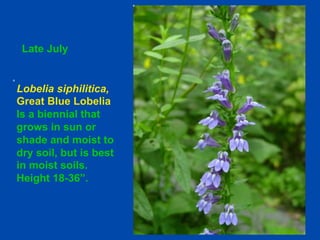
Late July 
Lobelia siphilitica, 
Great Blue Lobelia 
Is a biennial that 
grows in sun or 
shade and moist to 
dry soil, but is best 
in moist soils. 
Height 18-36”.
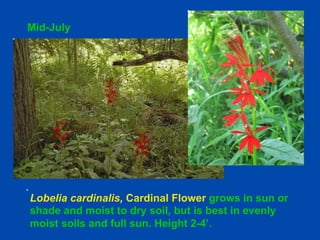
Mid-July 
Lobelia cardinalis, Cardinal Flower grows in sun or 
shade and moist to dry soil, but is best in evenly 
moist soils and full sun. Height 2-4’.
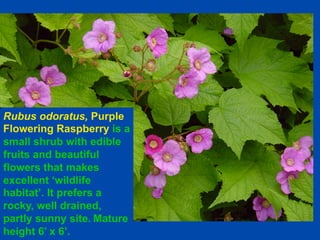
Mid-June 
Rubus odoratus, Purple 
Flowering Raspberry is a 
small shrub with edible 
fruits and beautiful 
flowers that makes 
excellent ‘wildlife 
habitat’. It prefers a 
rocky, well drained, 
partly sunny site. Mature 
height 6’ x 6’.
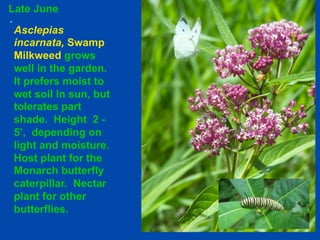
Late June 
Asclepias 
incarnata, Swamp 
Milkweed grows 
well in the garden. 
It prefers moist to 
wet soil in sun, but 
tolerates part 
shade. Height 2 - 
5’, depending on 
light and moisture. 
Host plant for the 
Monarch butterfly 
caterpillar. Nectar 
plant for other 
butterflies.
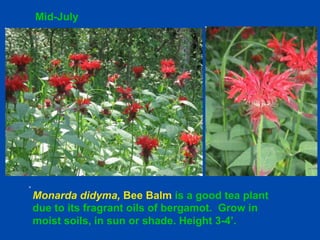
Mid-July 
Monarda didyma, Bee Balm is a good tea plant 
due to its fragrant oils of bergamot. Grow in 
moist soils, in sun or shade. Height 3-4’.
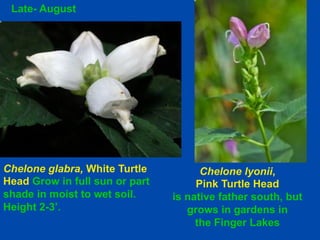
Chelone glabra, White Turtle 
Head Grow in full sun or part 
shade in moist to wet soil. 
Height 2-3’. 
Chelone lyonii, 
Pink Turtle Head 
is native father south, but 
grows in gardens in 
the Finger Lakes 
Late- August
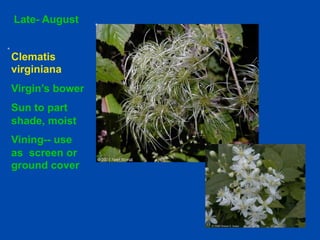
Late- August 
Clematis 
virginiana 
Virgin’s bower 
Sun to part 
shade, moist 
Vining-- use 
as screen or 
ground cover
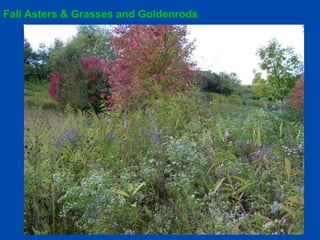
Fall Asters & Grasses and Goldenrods
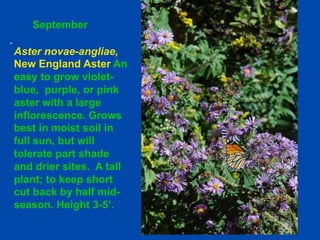
September 
Aster novae-angliae, 
New England Aster An 
easy to grow violet-blue, 
purple, or pink 
aster with a large 
inflorescence. Grows 
best in moist soil in 
full sun, but will 
tolerate part shade 
and drier sites. A tall 
plant; to keep short 
cut back by half mid-season. 
Height 3-5’.
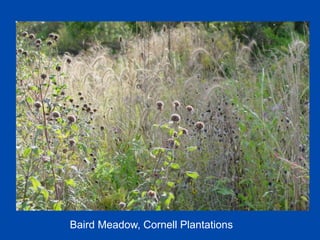
Baird Meadow, Cornell Plantations
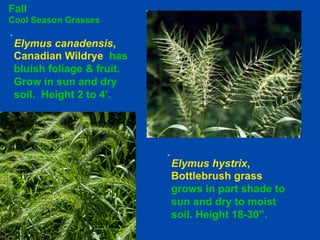
Elymus hystrix, 
Bottlebrush grass 
grows in part shade to 
sun and dry to moist 
soil. Height 18-30”. 
Fall 
Cool Season Grasses 
Elymus canadensis, 
Canadian Wildrye has 
bluish foliage & fruit. 
Grow in sun and dry 
soil. Height 2 to 4’.
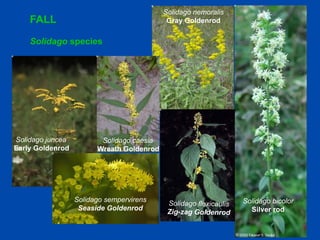
FALL 
Solidago species 
Solidago juncea 
Early Goldenrod 
Solidago bicolor 
Silver rod 
Solidago nemoralis 
Gray Goldenrod 
Solidago flexicaulis 
Zig-zag Goldenrod 
Solidago caesia 
Wreath Goldenrod 
Solidago sempervirens 
Seaside Goldenrod
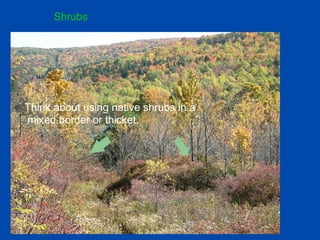
Shrubs 
Think about using native shrubs in a 
mixed border or thicket.
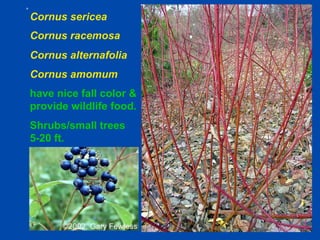
Cornus sericea 
Cornus racemosa 
Cornus alternafolia 
Cornus amomum 
have nice fall color & 
provide wildlife food. 
Shrubs/small trees 
5-20 ft.
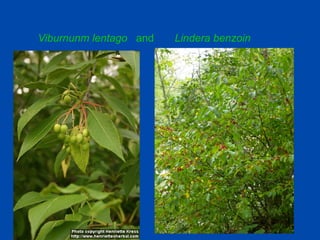
Viburnunm lentago and Lindera benzoin
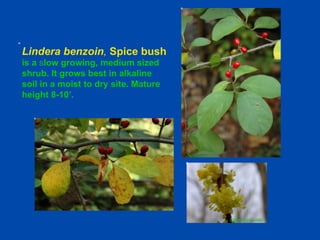
Lindera benzoin, Spice bush 
is a slow growing, medium sized 
shrub. It grows best in alkaline 
soil in a moist to dry site. Mature 
height 8-10’. 
2006 Lawrence Kelly
Learn Native Plants and Habitats 
• FLNPS : Walks, Talks and People 
• Petersons: A Field Guide to Wildflowers of the 
Northeast and North Central North America 
• Cornell Plantations Mundy Wildflower Garden 
• Finger Lakes Land Trust walks 
• Lime Hollow Nature Center
Sources 
• Plant Sale in May 
• October: FLNPS seed collecting 
• December: FLNPS Seed Exchange 
• Local nurseries: 
– Plantsmen www.plantsmen.com 
– White Oak Nursery www.whiteoaknursery.biz 
• Remember: Choose native species that have 
been propagated from seed. Do not dig plants 
from the wild!
Acknowledgements 
Many thanks to those who have contributed their 
photographs and their time. 
Drew Noden Susanne Lorbeer 
Irene Lekstutis Jesse Hoffman 
Paul Schmitt Ann Kelly 
Robert Wesley Rosemarie Parker 
Melanie Uhler Krissy Faust 
Kevin Nixon Meredith Cosgrove 
Anna Stalter Bill Hecht

Growing Native Plants From Seed - Cornell University, New York

  • 1.
    Growing Native Plants From Seed Cornell Plantations and the Finger Lakes Native Plant Society
  • 2.
    What IS anative plant? • A plant that grows in the same habitat in which it originated. • Plants can be native to a continent, state, or region.
  • 3.
    Why plant nativeplants? • Well adapted to local habitats and conditions – Can be easy to maintain if planted in appropriate setting • Attractive – Diverse forms and colors • Wildflowers, shrubs, vines, trees, ferns, mosses • Manage biodiversity
  • 4.
    Plant Habitats aka Vegetation of the Cayuga Lake Basin ( Mohler, Marks and Gardescu 2006 “Guide to Plant Communities of the Central Finger Lakes Region”) Dry Uplands: e.g., Oak Forest Moist Uplands: e.g., Hemlock-Beech-Birch Forest Floodplain Forest: e.g., Sycamore-Cottonwood Forest Swamp Forests: e.g., Red/silver Maple Swamp Wetlands: e.g., Cattail wetlands, Rich Fens Bogs: e.g., Leatherleaf Bog Old Fields Unique habitats: e.g., Lake Cliffs
  • 5.
    Harvest seeds Cleanand store Sow and stratify Pot up or transplant out Ensure heat and light
  • 6.
    Harvest seeds whenripe • look 4-6 weeks after peak bloom • how do I know if they are ripe? Capture seeds Label • name • place • date
  • 7.
    Cautions and Exceptions • Harvest only with permission • Take only 10% from a healthy population • Some seeds are harvested slightly green – Trillium – small tree/shrub fruits • Moist seeds require special treatment – harvest in plastic bag and keep moist
  • 8.
    Cleaning and Storageof Dry Seeds • Dry seeds in paper bags >5 days • Find seeds in bottom of bag or in seed head • Separate seeds from chaff • Use regular household items for screening – colanders and strainers
  • 9.
    Cleaning and Storageof Dry Seeds • Put seeds in containers – jars, cans, paper envelopes • Store on shelf or in fridge
  • 10.
    Cleaning & Storageof Moist Seeds (berries and most spring ephemerals) • Remove fleshy covering or pods ASAP – soak berries • Put in plastic bags or jars with moist medium • Keep warm or refrigerate – spring ephemerals are kept warm for 30-90 days
  • 11.
    Eliasomes Sanguinaria canadensis Bloodroot photos: Patrick Coin
  • 12.
    Seed Stratification Stratificationmimics the natural temperature cycle of warm & cold, moist conditions. • Most native plant seeds require cold/moist followed by warming (CW) – “Cold” = ~40º “Warm” = ~65-70º (room temp) – Some grasses (warm season) require 75-80º • Seeds that ripen in early summer need warm, then cold, & back to warm (WCW). • Some native plant seeds require multiple cycles
  • 13.
    Seed Sowing •Use trays, flats, or pots that are ~ 3-4″ deep • Moisten mix • Spread potting mix evenly and tamp to ½ ″ below rim
  • 14.
    Seed Sowing, cont. • Spread seeds evenly over top of flat and cover lightly or leave open – large seeds - press in to depth of seed size – seeds that require light – no cover or cover with small amount of sand. • Water in & cover with plastic bag to keep moist • Place in fridge, cold frame or shelf (but not in sun)
  • 15.
    Add Light andHeat • After cold/moist treatment is finished • Put flats in direct sunlight or under lights – 16 hours, 2-3″ from light – Gro-lights or 1 warm & 1 cool fluorescent OK – leave plastic bag partly open or perforate • Keep warm and moist – 70º is best for germination – not too wet or too dry • Slowly open plastic bag after germination to acclimate • Dilute fertilizer about 4 weeks after germination – no fertilizer for spring ephemerals
  • 16.
    Pot Up orTransplant Out Which one depends on plant and your time frame • Look at size of plant and root growth – Plants need transplanting or potting up if they are too big or if roots are growing out of flat • Wait to transplant – if they are tiny – if they are slow to germinate – if they are developing roots and not shoots • Examples: Smilacina, Actaea, Arisaema, Trillium, Lilium
  • 17.
    Cultural Conditions •Sun, Shade • Wet, Dry • Soil Type – Acid, Basic (limey) – Drainage
  • 18.
    Mundy Wildflower GardenCornell Plantations
  • 19.
  • 20.
    Sanguinaria canadensis, Bloodroot Grows in shade or part sun, in moist to dry soil. Prefers alkaline soils. Height 6”. Photo Paul Schmitt Early April
  • 21.
    Early April Trilliumerectum Wet Dog Trillium Moist soil, shade. Ht. 8-24”
  • 22.
    Mid-April Asarum canadensis,Wild Ginger Grow in shade. Ht. 3- 5”.
  • 23.
    Mid-April Jeffersonia diphylla Twin Leaf Grow it in part sun or full shade in moist to dry soil. Height ~ 2’.
  • 24.
    Late April Calthapalustris, Marsh Marigold grows in moist to wet soil. It likes wet feet; do not allow it to dry out. Ht. 2’.
  • 25.
    Late April Trillium grandiflorum, Large Flowered Trillium grows best in part to full shade in a moist woodland setting.
  • 26.
    Late April Mertensiavirginica, Virginia Blue Bells naturally grow on shady stream banks. They grow well in shade or part sun. Height ~ 18”.
  • 27.
    Late April toMay Geranium maculatum, Wild Geranium Grow in part sun or full shade. Height 2’.
  • 28.
    Early May Aquilegia canadensis, Wild Columbine is easy to grow in full sun or shade and moist or dry soil. The height (18-36”) depends on the amount of light and moisture.
  • 29.
    May Arisaema triphyllum, Jack in the Pulpit grows in part to full shade in moist soil. Ht. 2’.
  • 30.
    Late May Actaearubra, Red Baneberry grows in full shade in well drained soil. Height ~ 2’.
  • 31.
    Actaea pachypoda, Doll’sEyes grow in full shade and well-drained soil. Height ~ 2’. Late May
  • 32.
    Late May Irisversicolor Blue Flag Iris grows in full sun to part shade in moist to medium soil. It flowers best in part to full sun. Height 2½’.
  • 33.
    Late May Polygonatumbiflorum var. commutatum, Great Solomon’s Seal A Non-native that grows well in the garden with protection from deer. Height 2-3’. This is a large variety of P. biflorum that is sold in nurseries and planted in the WFG. Our locally native Polygonatum species are shorter in stature. Polygonatum pubescens has downy hairs covering the underside of the leaf. It occurs naturally in the WFG on the steep woodland slopes. Polygonatum biflorum var. biflorum Leaves have smooth or glabrous undersides. It does not occur in the WFG, but is found locally in nearby natural areas. Non-native Polygonatum pubescens in the WFG Figuring out the Solomon’s Seal
  • 34.
    June Penstemon hirsutus, Hairy Beardtongue grows in full sun or part shade in well-drained soil or gravel. Naturally a west facing cliff dweller, but it adapts well to the garden if given a sunny spot and space. Ht. 1-3 ft.
  • 35.
    Mid-June Sambucus canadensis, American Elderberry This fast growing large multi-stemmed, shrub is an excellent wildlife habitat plant. Height 7-15’.
  • 36.
    June Asclepias tuberosa, Butterfly Weed is easy to grow in full sun and well-drained sand, gravel, or good garden soil. Height: ~1-2.5 ‘.
  • 37.
    July Anemone virginiana Thimbleweed Easy to grow in dry shade. Height 1-2.5’.
  • 38.
    Mid-July Monarda fistulosa, Wild Bergamot or Lavender Bee Balm grows best in dry, well-drained sites in full sun to part shade. Ht. 1-4 ft.
  • 39.
    Late July Lobeliasiphilitica, Great Blue Lobelia Is a biennial that grows in sun or shade and moist to dry soil, but is best in moist soils. Height 18-36”.
  • 40.
    Mid-July Lobelia cardinalis,Cardinal Flower grows in sun or shade and moist to dry soil, but is best in evenly moist soils and full sun. Height 2-4’.
  • 41.
    Mid-June Rubus odoratus,Purple Flowering Raspberry is a small shrub with edible fruits and beautiful flowers that makes excellent ‘wildlife habitat’. It prefers a rocky, well drained, partly sunny site. Mature height 6’ x 6’.
  • 42.
    Late June Asclepias incarnata, Swamp Milkweed grows well in the garden. It prefers moist to wet soil in sun, but tolerates part shade. Height 2 - 5’, depending on light and moisture. Host plant for the Monarch butterfly caterpillar. Nectar plant for other butterflies.
  • 43.
    Mid-July Monarda didyma,Bee Balm is a good tea plant due to its fragrant oils of bergamot. Grow in moist soils, in sun or shade. Height 3-4’.
  • 44.
    Chelone glabra, WhiteTurtle Head Grow in full sun or part shade in moist to wet soil. Height 2-3’. Chelone lyonii, Pink Turtle Head is native father south, but grows in gardens in the Finger Lakes Late- August
  • 45.
    Late- August Clematis virginiana Virgin’s bower Sun to part shade, moist Vining-- use as screen or ground cover
  • 46.
    Fall Asters &Grasses and Goldenrods
  • 47.
    September Aster novae-angliae, New England Aster An easy to grow violet-blue, purple, or pink aster with a large inflorescence. Grows best in moist soil in full sun, but will tolerate part shade and drier sites. A tall plant; to keep short cut back by half mid-season. Height 3-5’.
  • 48.
  • 49.
    Elymus hystrix, Bottlebrushgrass grows in part shade to sun and dry to moist soil. Height 18-30”. Fall Cool Season Grasses Elymus canadensis, Canadian Wildrye has bluish foliage & fruit. Grow in sun and dry soil. Height 2 to 4’.
  • 50.
    FALL Solidago species Solidago juncea Early Goldenrod Solidago bicolor Silver rod Solidago nemoralis Gray Goldenrod Solidago flexicaulis Zig-zag Goldenrod Solidago caesia Wreath Goldenrod Solidago sempervirens Seaside Goldenrod
  • 51.
    Shrubs Think aboutusing native shrubs in a mixed border or thicket.
  • 52.
    Cornus sericea Cornusracemosa Cornus alternafolia Cornus amomum have nice fall color & provide wildlife food. Shrubs/small trees 5-20 ft.
  • 53.
    Viburnunm lentago andLindera benzoin
  • 54.
    Lindera benzoin, Spicebush is a slow growing, medium sized shrub. It grows best in alkaline soil in a moist to dry site. Mature height 8-10’. 2006 Lawrence Kelly
  • 55.
    Learn Native Plantsand Habitats • FLNPS : Walks, Talks and People • Petersons: A Field Guide to Wildflowers of the Northeast and North Central North America • Cornell Plantations Mundy Wildflower Garden • Finger Lakes Land Trust walks • Lime Hollow Nature Center
  • 56.
    Sources • PlantSale in May • October: FLNPS seed collecting • December: FLNPS Seed Exchange • Local nurseries: – Plantsmen www.plantsmen.com – White Oak Nursery www.whiteoaknursery.biz • Remember: Choose native species that have been propagated from seed. Do not dig plants from the wild!
  • 57.
    Acknowledgements Many thanksto those who have contributed their photographs and their time. Drew Noden Susanne Lorbeer Irene Lekstutis Jesse Hoffman Paul Schmitt Ann Kelly Robert Wesley Rosemarie Parker Melanie Uhler Krissy Faust Kevin Nixon Meredith Cosgrove Anna Stalter Bill Hecht