Residential Rain Gardens 
Rick Durham 
Consumer Horticulture Extension Specialist 
University of Kentucky
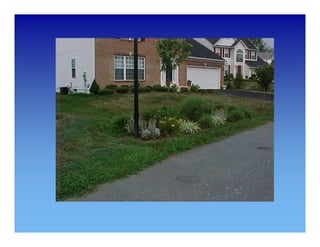
Rain garden – strategically located low area 
planted with native vegetation that intercepts 
runoff and allows it to infiltrate the soil.
Photo Copyright 1999, Center for Watershed Protection 
Why Should We Consider 
Rain Gardens?
Run Off 
• Typical run off from a city block is 9X 
greater than a wooded area of similar 
size due to pavement 
•• Grass lawn reduces run-off 
substantially, but not completely 
• Rain gardens promote 30% more 
infiltration than lawns
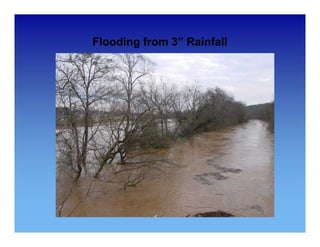
Flooding from 3” Rainfall
Rain Garden? 
No! Erosion and nutrient run off upstream results in 
siltation downstream.
Rain Gardens 
• Increase the amount of water that 
infiltrates the soil to recharges aquifers 
• Help protect community from flooding 
and drainage problems 
• Help protect streams and lakes from 
pollutants carried in run off 
• Enhance neighborhood beauty 
• Provide wildlife habitat
Rain Gardens Can Be Beautiful
Excavation of an infiltration trench
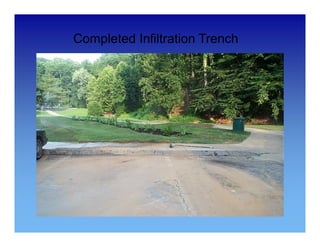
Completed Infiltration Trench
Overflow to Storm Drain
Stormwater Runoff Solutions begin by 
reducing the amount of impermeable 
surfaces.
Grass Pave
Single Family 
Residence or 
Commercial Property
Ok, Let’s Now Take a Look 
at Rain Gardens
Getting Started 
• How Big does it need to be? 
• Where do I need to locate it? 
• Soil Considerations? 
•• What Plants should we use?
How big do I make my rain 
garden ? 
•Design it to handle a 1.25 inch rain event 
(this captures 80% of rainfall events) 
••Square footage x 1.25 in. (or .104 ft) = X cu ft of water
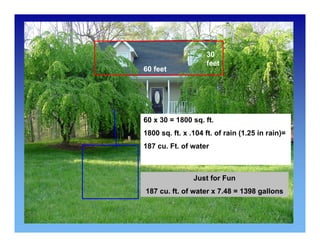
60 feet 
30 
feet 
60 x 30 = 1800 sq. ft. 
1800 sq. ft. x .104 ft. of rain (1.25 in rain)= 
187 cu. Ft. of water 
Just for Fun 
187 cu. ft. of water x 7.48 = 1398 gallons
187 cu. Ft. of water 
10 x 12 x 1.5 feet deep = 180 cu. Ft.
Size of Rain Garden 
• Rain Gardens can be of any size or 
shape 
• Sandy soil, garden should be 20-30% of 
the size of the drain area 
• Heavy clay soils, garden should be 50- 
60% the size of the drain area 
• Most residential rain gardens will be 
100-300 sq. ft.
Where does it need to be? 
• Locate the rain garden down slope from any 
buildings 
• Away from large trees (easier digging) 
•• In areas that take advantage of natural slope. 
• Consider the size and placement in the 
landscape design. It may be easier to create 
two separate rain gardens.
Excavating 
• For large projects it may be easier to hire a 
landscaper. 
• For smaller projects use the excavated soil 
to build a berm on the downhill side of the 
garden. 
• Use a rope or water hose to layout the edge 
of the garden, use stakes and string to level. 
• For deep gardens set aside the top 4-6 
inches of soil (topsoil), excavate the hole 
then use the top soil to backfill the planting 
area.
Soil Considerations 
• Do a perk test. Dig a hole 8 inches deep and fill with 
water. If it takes more than 24 hours to drain then 
the soil needs to be amended. 
• On poorly drained soil excavate 10-12 inches of soil 
from hole, mix 3-6 inches of coarse sand or small 
gravel with excavated soil and replace into rain 
garden. 
• Bring 2 cups of soil to Extension Office for soil test 
Add lime and fertilizer according to soil test results, 
3-6 inches of organic matter then till to a depth of 6 
inches. 
• Rain garden soil mix = 50-60% sand, 20-30% top soil, 
20-30% compost (Rain Gardens of Western 
Michigan)
What about mosquitoes? 
• Life cycle requires 7-14 days from egg 
to adult 
• Require standing water during juvenile 
stages 
• Most rain gardens will drain within 3-4 
days, usually sooner 
A properly designed rain garden will not 
breed mosquitoes!
Now the fun part… Picking the 
plants 
• Determine sun exposure 
– Full sun = 6 or more hours of direct sun 
– Part Sun to Part Shade= 
• less than 6 hours of direct sun 
– Shade = virtually no direct sun - problems 
• Don’t forget specific site problems 
– Plants will need to be watered until established 
– Weed management strategy needed for first year 
or so 
– Choose native were possible. Drought tolerant, 
deep rooted, deer resistant?
Trees 
• Deciduous / Evergreen 
• Plant as Specimens or in Groups 
• Consider Bark / Shape / Flowering 
• Provide Habitats for Birds
Trees for Rain Gardens 
• Sweetbay Magnolia 
• Winter King 
Hawthorn 
• Hackberry 
• Red Maple 
• River Birch 
• Black Gum 
• Bald Cypress 
• Fringetree 
• Ginko 
• Willow Oak 
• Sycamore
River Birch 
• Distinguished by 
bark 
• 50' X 50' mature size 
•• Drought tolerance 
• Multi-stemmed
Baldcypress 
• Drought 
Tolerance 
• Deciduous 
•• Knees? 
• 60' x 25' 
• Plant as 
Specimen or in 
Groups
Red Maple 
• 40'-60' x 40'-60' 
• Drought 
Tolerance 
• Excellent Fall 
Color
Ginkgo 
• 25'-50' X 20'-40' 
• Pest Free / Resistance 
to Damage 
• Tolerates Most Soil 
Conditions
Ginkgo - Fruit / Leaf 
• Fan Shaped 
Leaf 
• Undesirable 
Fruit
Black Gum 
• Nyssa sylvatica 
• 60-80 feet 
• Deciduous
Willow Oak 
• Quercus phellos 
• 40-60 ft. 
• ‘Hightower’
Sweetbay Magnolia 
• Magnolia virginiana 
• 20-30 ft. 
• Evergreen 
•• fragrant
Winter King Hawthorn 
• Crategus virdis 
'Winter King‘ 
• Slow growth 
•• 15-20 ft. 
• Deciduous 
• Fall/winter berries
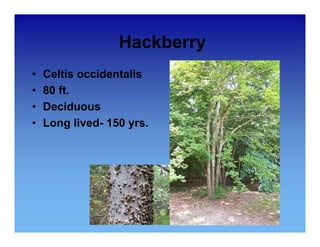
Hackberry 
• Celtis occidentalis 
• 80 ft. 
• Deciduous 
•• Long lived- 150 yrs.
Fringetree 
• Chionanthus 
virginicus 
• Small understory 
tree 
• deciduous
Shrubs for Rain Gardens 
• Arrowwood 
• Buttonbush 
• Summersweet 
Clethra 
• American 
Beautyberry 
• Bottlebrush 
Buckeye 
• Wax Myrtle 
• Inkberry 
• Oakleaf Hydrangea 
• Sweetspire
Inkberry 
• Drought 
Tolerance 
•• 5' x 5' 
• Withstands Heavy 
Pruning 
• Adapted to 
Various Soil 
Types
Arrow wood 
• Viburnum 
dentatum 
• 8 ft tall x 6 ft. 
•• Fruit eaten by 
birds 
• Fall color red to 
reddish purple
Bottlebrush Buckeye 
• Aesculus parviflora 
• 8-15 ft. 
• Deciduous 
•• 8-12 inch flower 
stalk in June
Oakleaf Hydrangea 
• Hydrangea 
quercifolia 
• 6 feet 
•• Deciduous 
• Great fall color
Sweetspire 
• Itea 
• 4-5 feet tall and wide 
• Great burgundy fall 
color 
• May-June white 
fragrant flowers 
resembling fluffy 
caterpillars
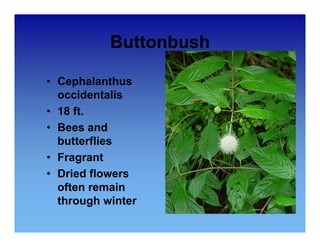
Buttonbush 
• Cephalanthus 
occidentalis 
• 18 ft. 
•• Bees and 
butterflies 
• Fragrant 
• Dried flowers 
often remain 
through winter
Sweet Pepperbush 
(Summer Sweet Clethra) 
• Clethra alnifolia 
• Blooms June- 
July 
• Drought Tolerant 
• Yellow Fall Color 
• Excellent 
Fragrance 
• 10 ft.
American Beautyberry 
• 6' x 6' 
• Drought 
Tolerance 
• Cut Back Each 
Year 
• Berries for 
Wildlife
Herbaceous Plants for Rain 
Gardens 
• Swamp Milkweed 
• Cinnamon Fern 
• Canna Lilies 
• Yellow Flag Iris 
• Asters 
• Blackeyed Susan 
• Lobelia 
• Goldenrod 
• Rushes 
• Liriope/Mondograss 
• Ironweed 
• Joe Pye Weed 
• St. Johns Wort
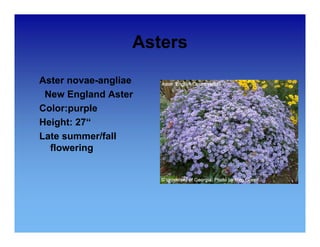
Asters 
Aster novae-angliae 
New England Aster 
Color:purple 
Height: 27““ 
Late summer/fall 
flowering
Blackeyed Susan 
• Rudbeckia 
• 'Indian Summer‘ 
• ‘Goldstrum’ 
•• Mid to late summer 
flowering 
• Foliage 8-12 inches 
• Flowers up to 2 feet
Cardinal Flower 
• Lobelia cardinalis – 
Cardinal Flower 
• Red flowers in later 
summer and fall 
• 2-4 feet tall 
• Few pests
Goldenrod 
• Solidago 
Goldenrod 
• Height: cultivar 
dependent, 3-6 feet 
• Late summer/fall 
flowering 
• Not considered a 
contributor to hay 
fever
St. Johns Wort 
• Hypericum spp. 
• 200 species 
• Ground cover to 
medium shrub
Swamp Milkweed 
• Asclepias incarnata 
• Summer flowers 
• Butterflies 
•• Might see some 
aphids
Ironweed 
• Vernonia 
noveboracensis 
• Flowers mid to late 
summer 
• Height to 6 feet 
• Butterflies
Liriope 
• Great Border 
• Ground Cover 
• Grows in Moist 
Areas 
• Easy to Grow 
• Increase by 
Division
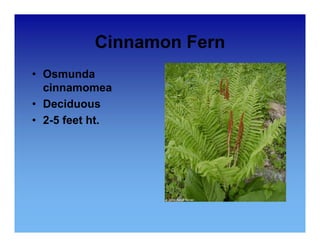
Cinnamon Fern 
• Osmunda 
cinnamomea 
• Deciduous 
•• 2-5 feet ht.
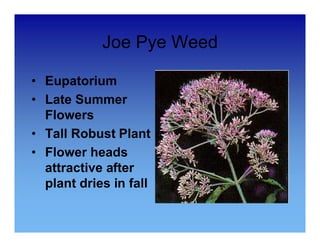
Joe Pye Weed 
• Eupatorium 
• Late Summer 
Flowers 
• Tall Robust Plant 
• Flower heads 
attractive after 
plant dries in fall
Miscanthus sinensis 
Silver Grass 
Grasses 
Pennisetum alopecuroides 
Fountain Grass 
Phalaris arundinaceae 
Ribbon Grass 
Festuca cinerea 
Silver Fescue
Rushes and Sedges 
• Juncus and Carex 
• Grass-like 
• Tolerant of wet sites 
•• Drought tolerant as 
well
Planting Trees and Shrubs 
 When planting individual plants, dig the hole 
2-times wider than the root ball. 
 When planting a group of plants, cultivate 
the planting area to a 12-inch depth. 
 Do not add amendments to individual 
planting holes. Instead, incorporate 
amendments uniformly into the top 12 
inches of the soil. 
 Remove the wire or cord from around the 
stem of B&B plants.
Planting Trees and Shrubs 
 Slice or break apart the root ball of pot-bound 
container-grown plants. 
 Install guy wires on trees, if necessary, 
but remove them after establishment. 
 A water saucer may be used to help 
direct water to the roots, but it is only 
temporary. 
 Mulch. 
 Water to settle soil.
If a water saucer is used, rake it outward and 
away from the planting hole. Smooth saucer 2 to 3 
months after planting to keep it from eroding over 
the roots
Planting herbaceous plants 
• Plant in waves rather than as single plants 
• Consider height and period/color of bloom 
• Plant no deeper than previously growing 
•• Water thoroughly at planting 
• Provide 1” water per week until established 
• Prune back vegetation prior to regrowth in 
spring
Mulch 
– A minimum of 2” needed, not more than 4” 
– Keeps weeds down 
– Acts as sponge to capture heavy metals, 
oils and grease 
– Holds moisture 
– Maintains even temperature 
– Shredded hardwood mulch or pine straw 
recommended
Pondering Points 
• The planting plan design should 
include species that tolerate extremes. 
•• Rain gardens can be left to evolve into 
a natural wild condition. 
• Native plants are best adapted to local 
climate and once established are 
generally low maintenance.
Pondering Points 
(continued) 
• When planted with native species rain 
gardens can have additional value as a 
wildlife habitant. 
• Shrub, trees, and ground covers absorb 
up to 14 times more rainwater than a 
grass lawn.
Maintenance? 
• No special maintenance required once 
established 
•• Routine periodic landscaping 
maintenance 
– Weeding 
– Irrigation 
– Pruning/vegetation removal
For more information: 
• Rain Gardens of Western Michigan 
http://www.raingardens.org/Index.php 
• Rain Gardens – Gardening with water quality in 
mind. http://www.mninter.net/~stack/rain/ 
•• Rain gardens infiltrating Wisconsin 
http://www.dnr.state.wi.us/org/water/wm/nps/rg/ 
Credits: 
• Residential Rain Gardens. Todd Hurt, UGA/ 
Cherokee Co. Extension. Milti-state Master Gardener 
Educator Training: Landscape Water Quality 
Workshop, Griffin, GA. 2004.

Kentucky Residential Rain Gardens ~ University of Kentucky

  • 1.
    Residential Rain Gardens Rick Durham Consumer Horticulture Extension Specialist University of Kentucky
  • 2.
    Rain garden –strategically located low area planted with native vegetation that intercepts runoff and allows it to infiltrate the soil.
  • 3.
    Photo Copyright 1999,Center for Watershed Protection Why Should We Consider Rain Gardens?
  • 4.
    Run Off •Typical run off from a city block is 9X greater than a wooded area of similar size due to pavement •• Grass lawn reduces run-off substantially, but not completely • Rain gardens promote 30% more infiltration than lawns
  • 8.
  • 9.
    Rain Garden? No!Erosion and nutrient run off upstream results in siltation downstream.
  • 10.
    Rain Gardens •Increase the amount of water that infiltrates the soil to recharges aquifers • Help protect community from flooding and drainage problems • Help protect streams and lakes from pollutants carried in run off • Enhance neighborhood beauty • Provide wildlife habitat
  • 11.
    Rain Gardens CanBe Beautiful
  • 15.
    Excavation of aninfiltration trench
  • 16.
  • 17.
  • 18.
    Stormwater Runoff Solutionsbegin by reducing the amount of impermeable surfaces.
  • 21.
  • 22.
    Single Family Residenceor Commercial Property
  • 23.
    Ok, Let’s NowTake a Look at Rain Gardens
  • 24.
    Getting Started •How Big does it need to be? • Where do I need to locate it? • Soil Considerations? •• What Plants should we use?
  • 25.
    How big doI make my rain garden ? •Design it to handle a 1.25 inch rain event (this captures 80% of rainfall events) ••Square footage x 1.25 in. (or .104 ft) = X cu ft of water
  • 26.
    60 feet 30 feet 60 x 30 = 1800 sq. ft. 1800 sq. ft. x .104 ft. of rain (1.25 in rain)= 187 cu. Ft. of water Just for Fun 187 cu. ft. of water x 7.48 = 1398 gallons
  • 27.
    187 cu. Ft.of water 10 x 12 x 1.5 feet deep = 180 cu. Ft.
  • 28.
    Size of RainGarden • Rain Gardens can be of any size or shape • Sandy soil, garden should be 20-30% of the size of the drain area • Heavy clay soils, garden should be 50- 60% the size of the drain area • Most residential rain gardens will be 100-300 sq. ft.
  • 29.
    Where does itneed to be? • Locate the rain garden down slope from any buildings • Away from large trees (easier digging) •• In areas that take advantage of natural slope. • Consider the size and placement in the landscape design. It may be easier to create two separate rain gardens.
  • 30.
    Excavating • Forlarge projects it may be easier to hire a landscaper. • For smaller projects use the excavated soil to build a berm on the downhill side of the garden. • Use a rope or water hose to layout the edge of the garden, use stakes and string to level. • For deep gardens set aside the top 4-6 inches of soil (topsoil), excavate the hole then use the top soil to backfill the planting area.
  • 31.
    Soil Considerations •Do a perk test. Dig a hole 8 inches deep and fill with water. If it takes more than 24 hours to drain then the soil needs to be amended. • On poorly drained soil excavate 10-12 inches of soil from hole, mix 3-6 inches of coarse sand or small gravel with excavated soil and replace into rain garden. • Bring 2 cups of soil to Extension Office for soil test Add lime and fertilizer according to soil test results, 3-6 inches of organic matter then till to a depth of 6 inches. • Rain garden soil mix = 50-60% sand, 20-30% top soil, 20-30% compost (Rain Gardens of Western Michigan)
  • 32.
    What about mosquitoes? • Life cycle requires 7-14 days from egg to adult • Require standing water during juvenile stages • Most rain gardens will drain within 3-4 days, usually sooner A properly designed rain garden will not breed mosquitoes!
  • 33.
    Now the funpart… Picking the plants • Determine sun exposure – Full sun = 6 or more hours of direct sun – Part Sun to Part Shade= • less than 6 hours of direct sun – Shade = virtually no direct sun - problems • Don’t forget specific site problems – Plants will need to be watered until established – Weed management strategy needed for first year or so – Choose native were possible. Drought tolerant, deep rooted, deer resistant?
  • 34.
    Trees • Deciduous/ Evergreen • Plant as Specimens or in Groups • Consider Bark / Shape / Flowering • Provide Habitats for Birds
  • 35.
    Trees for RainGardens • Sweetbay Magnolia • Winter King Hawthorn • Hackberry • Red Maple • River Birch • Black Gum • Bald Cypress • Fringetree • Ginko • Willow Oak • Sycamore
  • 36.
    River Birch •Distinguished by bark • 50' X 50' mature size •• Drought tolerance • Multi-stemmed
  • 37.
    Baldcypress • Drought Tolerance • Deciduous •• Knees? • 60' x 25' • Plant as Specimen or in Groups
  • 38.
    Red Maple •40'-60' x 40'-60' • Drought Tolerance • Excellent Fall Color
  • 39.
    Ginkgo • 25'-50'X 20'-40' • Pest Free / Resistance to Damage • Tolerates Most Soil Conditions
  • 40.
    Ginkgo - Fruit/ Leaf • Fan Shaped Leaf • Undesirable Fruit
  • 41.
    Black Gum •Nyssa sylvatica • 60-80 feet • Deciduous
  • 42.
    Willow Oak •Quercus phellos • 40-60 ft. • ‘Hightower’
  • 43.
    Sweetbay Magnolia •Magnolia virginiana • 20-30 ft. • Evergreen •• fragrant
  • 44.
    Winter King Hawthorn • Crategus virdis 'Winter King‘ • Slow growth •• 15-20 ft. • Deciduous • Fall/winter berries
  • 45.
    Hackberry • Celtisoccidentalis • 80 ft. • Deciduous •• Long lived- 150 yrs.
  • 46.
    Fringetree • Chionanthus virginicus • Small understory tree • deciduous
  • 47.
    Shrubs for RainGardens • Arrowwood • Buttonbush • Summersweet Clethra • American Beautyberry • Bottlebrush Buckeye • Wax Myrtle • Inkberry • Oakleaf Hydrangea • Sweetspire
  • 48.
    Inkberry • Drought Tolerance •• 5' x 5' • Withstands Heavy Pruning • Adapted to Various Soil Types
  • 49.
    Arrow wood •Viburnum dentatum • 8 ft tall x 6 ft. •• Fruit eaten by birds • Fall color red to reddish purple
  • 50.
    Bottlebrush Buckeye •Aesculus parviflora • 8-15 ft. • Deciduous •• 8-12 inch flower stalk in June
  • 51.
    Oakleaf Hydrangea •Hydrangea quercifolia • 6 feet •• Deciduous • Great fall color
  • 52.
    Sweetspire • Itea • 4-5 feet tall and wide • Great burgundy fall color • May-June white fragrant flowers resembling fluffy caterpillars
  • 53.
    Buttonbush • Cephalanthus occidentalis • 18 ft. •• Bees and butterflies • Fragrant • Dried flowers often remain through winter
  • 54.
    Sweet Pepperbush (SummerSweet Clethra) • Clethra alnifolia • Blooms June- July • Drought Tolerant • Yellow Fall Color • Excellent Fragrance • 10 ft.
  • 55.
    American Beautyberry •6' x 6' • Drought Tolerance • Cut Back Each Year • Berries for Wildlife
  • 56.
    Herbaceous Plants forRain Gardens • Swamp Milkweed • Cinnamon Fern • Canna Lilies • Yellow Flag Iris • Asters • Blackeyed Susan • Lobelia • Goldenrod • Rushes • Liriope/Mondograss • Ironweed • Joe Pye Weed • St. Johns Wort
  • 57.
    Asters Aster novae-angliae New England Aster Color:purple Height: 27““ Late summer/fall flowering
  • 58.
    Blackeyed Susan •Rudbeckia • 'Indian Summer‘ • ‘Goldstrum’ •• Mid to late summer flowering • Foliage 8-12 inches • Flowers up to 2 feet
  • 59.
    Cardinal Flower •Lobelia cardinalis – Cardinal Flower • Red flowers in later summer and fall • 2-4 feet tall • Few pests
  • 60.
    Goldenrod • Solidago Goldenrod • Height: cultivar dependent, 3-6 feet • Late summer/fall flowering • Not considered a contributor to hay fever
  • 61.
    St. Johns Wort • Hypericum spp. • 200 species • Ground cover to medium shrub
  • 62.
    Swamp Milkweed •Asclepias incarnata • Summer flowers • Butterflies •• Might see some aphids
  • 63.
    Ironweed • Vernonia noveboracensis • Flowers mid to late summer • Height to 6 feet • Butterflies
  • 64.
    Liriope • GreatBorder • Ground Cover • Grows in Moist Areas • Easy to Grow • Increase by Division
  • 65.
    Cinnamon Fern •Osmunda cinnamomea • Deciduous •• 2-5 feet ht.
  • 66.
    Joe Pye Weed • Eupatorium • Late Summer Flowers • Tall Robust Plant • Flower heads attractive after plant dries in fall
  • 67.
    Miscanthus sinensis SilverGrass Grasses Pennisetum alopecuroides Fountain Grass Phalaris arundinaceae Ribbon Grass Festuca cinerea Silver Fescue
  • 68.
    Rushes and Sedges • Juncus and Carex • Grass-like • Tolerant of wet sites •• Drought tolerant as well
  • 69.
    Planting Trees andShrubs  When planting individual plants, dig the hole 2-times wider than the root ball.  When planting a group of plants, cultivate the planting area to a 12-inch depth.  Do not add amendments to individual planting holes. Instead, incorporate amendments uniformly into the top 12 inches of the soil.  Remove the wire or cord from around the stem of B&B plants.
  • 70.
    Planting Trees andShrubs  Slice or break apart the root ball of pot-bound container-grown plants.  Install guy wires on trees, if necessary, but remove them after establishment.  A water saucer may be used to help direct water to the roots, but it is only temporary.  Mulch.  Water to settle soil.
  • 73.
    If a watersaucer is used, rake it outward and away from the planting hole. Smooth saucer 2 to 3 months after planting to keep it from eroding over the roots
  • 77.
    Planting herbaceous plants • Plant in waves rather than as single plants • Consider height and period/color of bloom • Plant no deeper than previously growing •• Water thoroughly at planting • Provide 1” water per week until established • Prune back vegetation prior to regrowth in spring
  • 78.
    Mulch – Aminimum of 2” needed, not more than 4” – Keeps weeds down – Acts as sponge to capture heavy metals, oils and grease – Holds moisture – Maintains even temperature – Shredded hardwood mulch or pine straw recommended
  • 79.
    Pondering Points •The planting plan design should include species that tolerate extremes. •• Rain gardens can be left to evolve into a natural wild condition. • Native plants are best adapted to local climate and once established are generally low maintenance.
  • 80.
    Pondering Points (continued) • When planted with native species rain gardens can have additional value as a wildlife habitant. • Shrub, trees, and ground covers absorb up to 14 times more rainwater than a grass lawn.
  • 81.
    Maintenance? • Nospecial maintenance required once established •• Routine periodic landscaping maintenance – Weeding – Irrigation – Pruning/vegetation removal
  • 82.
    For more information: • Rain Gardens of Western Michigan http://www.raingardens.org/Index.php • Rain Gardens – Gardening with water quality in mind. http://www.mninter.net/~stack/rain/ •• Rain gardens infiltrating Wisconsin http://www.dnr.state.wi.us/org/water/wm/nps/rg/ Credits: • Residential Rain Gardens. Todd Hurt, UGA/ Cherokee Co. Extension. Milti-state Master Gardener Educator Training: Landscape Water Quality Workshop, Griffin, GA. 2004.