VOLUME IV ISSUE II EDITOR: MARGARET MURPHY, MASTER GARDENER MAY, 2012
MINNEHAHAMASTERGARDENERS@HOTMAIL.COM WWW.SDSTATE.EDU/SDCES/DISTRICTS/SOUTH/1/HORTICULTURE.CFM
By: Margaret Murphy, Master Gardener
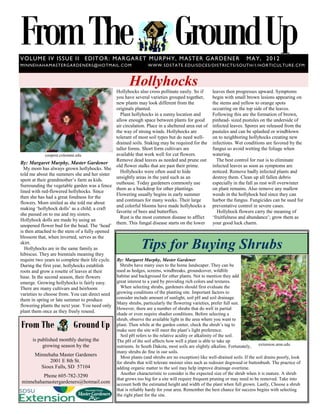
My mom has always grown hollyhocks. She
told me about the summers she and her sister
spent at their grandmother’s farm as kids.
Surrounding the vegetable garden was a fence
lined with red-flowered hollyhocks. Since
then she has had a great fondness for the
flowers. Mom smiled as she told me about
making ‘hollyhock dolls’ as a child; a craft
she passed on to me and my sisters.
Hollyhock dolls are made by using an
unopened flower bud for the head. The ‘head’
is then attached to the stem of a fully opened
blossom that, when inverted, serves as the
skirt.
Hollyhocks are in the same family as
hibiscus. They are biennials meaning they
require two years to complete their life cycle.
During the first year, hollyhocks establish
roots and grow a rosette of leaves at their
base. In the second season, their flowers
emerge. Growing hollyhocks is fairly easy.
There are many cultivars and heirloom
varieties to choose from. You can direct seed
them in spring or late summer to produce
flowering plants the next year. You need only
plant them once as they freely reseed.
Hollyhocks also cross pollinate easily. So if
you have several varieties grouped together,
new plants may look different from the
originals planted.
Plant hollyhocks in a sunny location and
allow enough space between plants for good
air circulation. Place in a sheltered area out of
the way of strong winds. Hollyhocks are
tolerant of most soil types but do need well-
drained soils. Staking may be required for the
taller forms. Short form cultivars are
available that work well for cut flowers.
Remove dead leaves as needed and prune out
old flower stalks that are past their prime.
Hollyhocks were often used to hide
unsightly areas in the yard such as an
outhouse. Today gardeners commonly use
them as a backdrop for other plantings.
Flowering usually begins in early summer
and continues for many weeks. Their large
and colorful blooms have made hollyhocks a
favorite of bees and butterflies.
Rust is the most common disease to afflict
them. This fungal disease starts on the lower
leaves then progresses upward. Symptoms
begin with small brown lesions appearing on
the stems and yellow to orange spots
occurring on the top side of the leaves.
Following this are the formation of brown,
pinhead- sized pustules on the underside of
infected leaves. Spores are released from the
pustules and can be splashed or windblown
on to neighboring hollyhocks creating new
infections. Wet conditions are favored by the
fungus so avoid wetting the foliage when
watering.
The best control for rust is to eliminate
infected leaves as soon as symptoms are
noticed. Remove badly infected plants and
destroy them. Clean up all fallen debris
especially in the fall as rust will overwinter
on plant remains. Also remove any mallow
weeds in the hollyhock bed since they can
harbor the fungus. Fungicides can be used for
preventative control in severe cases.
Hollyhock flowers carry the meaning of
‘fruitfulness and abundance’; grow them as
your good luck charm.
From The Ground Up
is published monthly during the
growing season by the
Minnehaha Master Gardeners
2001 E 8th St.
Sioux Falls, SD 57104
Phone 605-782-3290
minnehahamastergardeners@hotmail.com
Hollyhocks
Tips for Buying Shrubs
FromThe GroundUpFromThe GroundUpFromThe GroundUp
By: Margaret Murphy, Master Gardener
Shrubs have many uses to the home landscaper. They can be
used as hedges, screens, windbreaks, groundcover, wildlife
habitat and background for other plants. Not to mention they add
great interest to a yard by providing rich colors and textures.
When selecting shrubs, gardeners should first evaluate the
growing conditions of the planting site. Important factors to
consider include amount of sunlight, soil pH and soil drainage.
Many shrubs, particularly the flowering varieties, prefer full sun.
However, there are a number of shrubs that do well in partial
shade or even require shadier conditions. Before selecting a
shrub, observe the available light in the area where you want to
plant. Then while at the garden center, check the shrub’s tag to
make sure the site will meet the plant’s light preference.
Soil pH refers to the relative acidity or alkalinity of the soil.
The pH of the soil affects how well a plant is able to take up
nutrients. In South Dakota, most soils are slightly alkaline. Fortunately,
many shrubs do fine in our soils.
Most plants (and shrubs are no exception) like well-drained soils. If the soil drains poorly, look
for shrubs that will tolerate moister sites such as redosier dogwood or buttonbush. The practice of
adding organic matter to the soil may help improve drainage overtime.
Another characteristic to consider is the expected size of the shrub when it is mature. A shrub
that grows too big for a site will require frequent pruning or may need to be removed. Take into
account both the estimated height and width of the plant when full grown. Lastly, Choose a shrub
that is reliably hardy for your area. Remember the best chance for success begins with selecting
the right plant for the site.
extension.umn.edu
coopext.colostate.edu
VOLUME IV ISSUE II FROM THE GROUND UP EDITOR: MARGARET MURPHY, MASTER GARDENER PAGE 2
MAY 2012
Weed of the Month: Pennsylvania Pellitory By Paulette Keller, Master Gardener
Growth: Pennsylvania pellitory can be found throughout the Great Plains in waste
sites, gardens, lawns, cropland, woodlands, rangeland, and fence rows. The leaves
are arranged alternately on the stem. They are oblong and blade like with gradually
to rounded or pointed tips. The flowers are green or brown in color, lack petals and
are found on the axils of middle and upper leaves. This weed can grow to over a
foot high and reproduces by seed. It likes to grow in dense colonies.
Duration: Pennsylvania pellitory is an annual and blooms from May to September.
Control: The plant is easy to pull due to its shallow roots. It can also be controlled
by an herbicide. Red admiral butterfly caterpillars love to eat the leaves if you miss
a few plants.
Other: Pennsylvania pellitory is a member of the nettle family but lacks the
stinging hairs.
Calendar
By Kathy Osterloh, Master Gardener
 For all nursery plants - go early in May for best
selection, less stressed plants.
 Pick off excess apple/pear blossoms or fruit for
larger fruit. The center blossom of a cluster, on
apple trees, is usually the 'main' one.
 Plant trees in early May. Water as needed.
 Do NOT use 'weed and feed' type products where they may reach
the trees' roots.
 First year of planting June bearer strawberries - pick off all blossoms
for the first year so plants do not become stressed (you'll reap
rewards for years after for doing this). For 'everbearer' strawberries,
just remove the first set of blossoms they set, then let them bear.
 Divide perennials that bloom in late summer or fall.
 Do not remove the foliage of bulbs (such as tulip or daffodil) until it
yellows and dies.
After last average frost date:
 Plant seedlings of warm-season annual flowers, such as marigolds,
impatiens, petunias.
 Direct seed outdoors easy, fast-growing annuals that like warmer
weather, such as sunflowers, cosmos, nasturtiums, zinnias, and
hollyhocks.
 Plant seedlings of warm-season annual vegetables such as tomatoes,
peppers, and eggplant. Remember to harden off plants which are
being transplanted outdoors.
 Plant seedlings of warm-season herbs such as basil.
 Plant summer-flowering tropical bulbs and tubers, such as cannas,
elephant’s ear, gladiolus, and tuberous begonias.
 You can also plant seedlings of squashes, cucumbers, and melons
now. (Plant seeds of these a little later, if you choose to go that
route. They need warm soil to germinate but are okay to
plant as seedlings now since they need less warmth once
already started.)
 Thin seedlings to prevent overcrowding and weak growth.
 Stagger plantings of beans and corn for extended harvest.
Herb Garden
By Priscilla Jurkovich, Master Gardener
Herbs that can be grown in the South Dakota region.
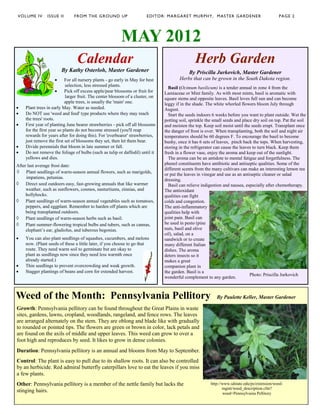
Basil (Ocimum basilicum) is a tender annual in zone 4 from the
Lamiaceae or Mint family. As with most mints, basil is aromatic with
square stems and opposite leaves. Basil loves full sun and can become
leggy if in the shade. The white whorled flowers bloom July through
August.
Start the seeds indoors 6 weeks before you want to plant outside. Wet the
potting soil, sprinkle the small seeds and place dry soil on top. Pat the soil
and moisten the top. Keep soil moist until the seeds erupt. Transplant once
the danger of frost is over. When transplanting, both the soil and night air
temperatures should be 60 degrees F. To encourage the basil to become
bushy, once it has 6 sets of leaves, pinch back the tops. When harvesting,
storing in the refrigerator can cause the leaves to turn black. Keep them
fresh in a flower vase, enjoy the aroma and keep out of the sunlight.
The aroma can be an antidote to mental fatigue and forgetfulness. The
phenol constituents have antibiotic and antiseptic qualities. Some of the
different scents from the many cultivars can make an interesting lemon tea
or put the leaves in vinegar and use as an antiseptic cleaner or salad
dressing.
Basil can relieve indigestion and nausea, especially after chemotherapy.
The antioxidant
qualities can fight
colds and congestion.
The anti-inflammatory
qualities help with
joint pain. Basil can
be used in pesto (pine
nuts, basil and olive
oil), salad, on a
sandwich or to create
many different Italian
dishes. The aroma
deters insects so it
makes a great
companion plant in
the garden. Basil is a
wonderful complement to any garden.
Photo: Priscilla Jurkovich
http://www.sdstate.edu/ps/extension/weed-
mgmt/weed_description.cfm?
weed=Pennsylvania Pellitory
The other day I was comparing notes with a
friend of mine. We both have trouble spots in
our yards where grass just doesn’t grow or the
terrain makes it difficult to mow. Thinking
about alternatives, we began to discuss the
benefits of perennial groundcovers. Most
spread quickly and can be used to carpet large
areas of landscape.
Groundcovers come in a huge assortment.
Whether your site is in full sun or full shade
has dry conditions or moist you can find a
variety that will work. Groundcovers can be an
effective solution to many problems in the
yard.
One issue they can solve is the nuisance of
mowing steep slopes or uneven terrain.
Replacing the turf in these areas with
groundcover eliminates the need to mow. They
also serve to stabilize the soil.
If you have trouble keeping grass alive under
trees or shrubs, consider installing ground -
cover instead. Several types grow well in
shade plus many handle dry soil conditions.
Drier soil is often common under trees that
have thick canopies. The canopy can deflect
rainfall from the ground directly beneath it.
Another advantage of growing groundcover
under a tree is not having to mow around the
tree. This prevents injury to the trunk by the
lawn mower. Groundcovers will also help keep
weeds down so there is no more temptation to
weed whack around tree trunks.
My backyard has a hill with several steep-
faced slopes. The hill remains in dappled
sunlight all day due to several beautiful, old
shade trees. The slope faces have shallow soil
with descent sized rocks jutting out here and
there. Clearly areas I’m not interested in
maneuvering a lawn mow through. So I need
plants that will tolerate less than perfect
growing conditions.
Gratefully, I have several choices of
perennial groundcovers to rescue me. One of
the most prolific groundcovers to conquer my
slopes is the ‘Beacon Silver’, a spotted dead
nettle. This mounding plant has silver leaves
edged in green, which compliment nicely the
clusters of lavender-colored flowers. Near the
cement steps that bisect the hill are several
varieties of sedum or stonecrops. Most grow as
a mat covering the soil and do a great job
controlling erosion.
Then there is the commonly grown vining
groundcover, Vinca minor or periwinkle. This
perennial plant is a good choice for the
roughest areas as it forms a dense, weed-
smothering cover that trails over outcrops of
rock. Pretty pale blue or purple flowers poke
up through its evergreen leaves in early spring.
Utilizing groundcovers in areas where turf
is difficult to grow offers an opportunity to
introduce a range of different colors, textures
and form into the yard. It also cuts down on
overall mow time and creates mow-free zones
providing extra protection to wildlife
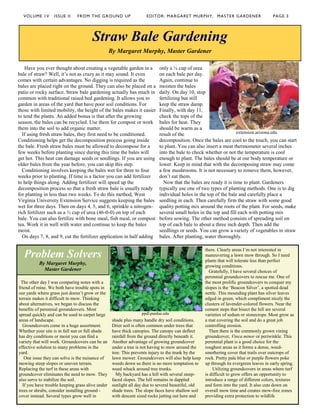
Have you ever thought about creating a vegetable garden in a
bale of straw? Well, it’s not as crazy as it may sound. It even
comes with certain advantages. No digging is required as the
bales are placed right on the ground. They can also be placed on a
patio or rocky surface. Straw bale gardening actually has much in
common with traditional raised bed gardening. It allows you to
garden in areas of the yard that have poor soil conditions. For
those with limited mobility, the height of the bales makes it easier
to tend the plants. An added bonus is that after the growing
season, the bales can be recycled. Use them for compost or work
them into the soil to add organic matter.
If using fresh straw bales, they first need to be conditioned.
Conditioning helps get the decomposition process going inside
the bale. Fresh straw bales must be allowed to decompose for a
few weeks before planting since during this time the bales will
get hot. This heat can damage seeds or seedlings. If you are using
older bales from the year before, you can skip this step.
Conditioning involves keeping the bales wet for three to four
weeks prior to planting. If time is a factor you can add fertilizer
to help things along. Adding fertilizer will speed up the
decomposition process so that a fresh straw bale is usually ready
for planting in less than two weeks. To do this method, West
Virginia University Extension Service suggests keeping the bales
wet for three days. Then on days 4, 5, and 6, sprinkle a nitrogen-
rich fertilizer such as a ½ cup of urea (46-0-0) on top of each
bale. You can also fertilize with bone meal, fish meal, or compost
tea. Work it in well with water and continue to keep the bales
moist.
On days 7, 8, and 9, cut the fertilizer application in half adding
only a ¼ cup of urea
on each bale per day.
Again, continue to
moisten the bales
daily. On day 10, stop
fertilizing but still
keep the straw damp.
Finally, with day 11,
check the tops of the
bales for heat. They
should be warm as a
result of the
decomposition. Once the bales are cool to the touch, you can start
to plant. You can also insert a meat thermometer several inches
into the bale to check whether or not the temperature is cool
enough to plant. The bales should be at our body temperature or
lower. Keep in mind that with the decomposing straw may come
a few mushrooms. It is not necessary to remove them, however,
don’t eat them.
Now that the bales are ready it is time to plant. Gardeners
typically use one of two types of planting methods. One is to dig
individual holes in the top of the bale and carefully place a
seedling in each. Then carefully firm the straw with some good
quality potting mix around the roots of the plant. For seeds, make
several small holes in the top and fill each with potting mix
before sowing. The other method consists of spreading soil on
top of each bale to about a three inch depth. Then add the
seedlings or seeds. You can grow a variety of vegetables in straw
bales. After planting, water thoroughly.
Problem Solvers
By Margaret Murphy,
Master Gardener
VOLUME 1V ISSUE II FROM THE GROUND UP EDITOR: MARGARET MURPHY, MASTER GARDENER PAGE 3
Straw Bale Gardening
By Margaret Murphy, Master Gardener
ppdl.purdue.edu
extension.arizona.edu
South Dakota State University, South Dakota Counties and U.S. Department of Agriculture Cooperating South Dakota State University is an Affirmative Action/
Equal Opportunity Employer (Male/Female) and offers all benefits, services, education, and employment opportunities without regard for ancestry, age, race, citizen
ship, color, creed, religion, gender, disability, national origin, sexual preference, or Vietnam Era veteran status.
By Jayne Wessels,
Master Gardener
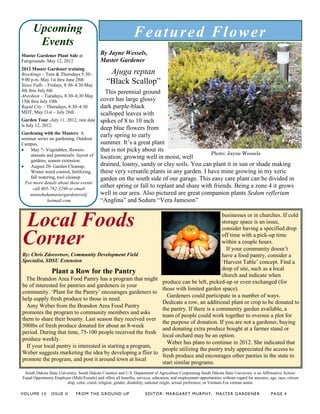
Ajuga reptan
“Black Scallop”
This perennial ground
cover has large glossy
dark purple-black
scalloped leaves with
spikes of 8 to 10 inch
deep blue flowers from
early spring to early
summer. It’s a great plant
that is not picky about its
location; growing well in moist, well
drained, loamy, sandy or clay soils. You can plant it in sun or shade making
these very versatile plants in any garden. I have mine growing in my xeric
garden on the south side of our garage. This easy care plant can be divided in
either spring or fall to replant and share with friends. Being a zone 4 it grows
well in our area. Also pictured are great companion plants Sedum reflerium
“Anglina” and Sedum “Vera Jameson”
Featured Flower
VOLUME 1V ISSUE II FROM THE GROUND UP EDITOR: MARGARET MURPHY, MASTER GARDENER PAGE 4
Master Gardener Plant Sale at
Fairgrounds- May 12, 2012
2012 Master Gardener training
Brookings – Tues & Thursdays 5:30–
9:00 p.m. May 1st thru June 28th
Sioux Falls – Fridays, 8:30–4:30 May
4th thru July 6th
Aberdeen – Tuesdays, 8:30–4:30 May
15th thru July 10th
Rapid City – Thursdays, 8:30–4:30
MDT, May 31st – July 26th
Garden Tour -July 11, 2012; rain date
is July 12, 2012.
Gardening with the Masters: A
seminar series on gardening, Outdoor
Campus,
 May 7- Vegetables, flowers-
annuals and perennials- layout of
gardens, season extension.
 August 20- Garden Cleanup,
Winter weed control, fertilizing,
fall watering, tool cleanup
For more details about these events
call 605-782-3290 or email
minnehahamastergardeners@
hotmail.com
Upcoming
Events
Local Foods
Corner
By: Chris Zdorovtsov, Community Development Field
Specialist, SDSU Extension
Plant a Row for the Pantry
The Brandon Area Food Pantry has a program that might
be of interested for pantries and gardeners in your
community. ‘Plant for the Pantry’ encourages gardeners to
help supply fresh produce to those in need.
Amy Weber from the Brandon Area Food Pantry
promotes the program to community members and asks
them to share their bounty. Last season they received over
300lbs of fresh produce donated for about an 8-week
period. During that time, 75-100 people received the fresh
produce weekly.
If your local pantry is interested in starting a program,
Weber suggests marketing the idea by developing a flier to
promote the program, and post it around town at local
businesses or in churches. If cold
storage space is an issue,
consider having a specified drop
off time with a pick-up time
within a couple hours.
If your community doesn’t
have a food pantry, consider a
‘Harvest Table’ concept. Find a
drop of site, such as a local
church and indicate when
produce can be left, picked-up or even exchanged (for
those with limited garden space).
Gardeners could participate in a number of ways.
Dedicate a row, an additional plant or crop to be donated to
the pantry. If there is a community garden available, a
team of people could work together to oversee a plot for
the purpose of donation. If you are not a gardener, buying
and donating extra produce bought at a farmer stand or
local orchard may be an option.
Weber has plans to continue in 2012. She indicated that
people utilizing the pantry truly appreciated the access to
fresh produce and encourages other panties in the state to
start similar programs.
Photo: Jayne Wessels

Straw Bale Gardening ~ South Dakota

  • 1.
    VOLUME IV ISSUEII EDITOR: MARGARET MURPHY, MASTER GARDENER MAY, 2012 MINNEHAHAMASTERGARDENERS@HOTMAIL.COM WWW.SDSTATE.EDU/SDCES/DISTRICTS/SOUTH/1/HORTICULTURE.CFM By: Margaret Murphy, Master Gardener My mom has always grown hollyhocks. She told me about the summers she and her sister spent at their grandmother’s farm as kids. Surrounding the vegetable garden was a fence lined with red-flowered hollyhocks. Since then she has had a great fondness for the flowers. Mom smiled as she told me about making ‘hollyhock dolls’ as a child; a craft she passed on to me and my sisters. Hollyhock dolls are made by using an unopened flower bud for the head. The ‘head’ is then attached to the stem of a fully opened blossom that, when inverted, serves as the skirt. Hollyhocks are in the same family as hibiscus. They are biennials meaning they require two years to complete their life cycle. During the first year, hollyhocks establish roots and grow a rosette of leaves at their base. In the second season, their flowers emerge. Growing hollyhocks is fairly easy. There are many cultivars and heirloom varieties to choose from. You can direct seed them in spring or late summer to produce flowering plants the next year. You need only plant them once as they freely reseed. Hollyhocks also cross pollinate easily. So if you have several varieties grouped together, new plants may look different from the originals planted. Plant hollyhocks in a sunny location and allow enough space between plants for good air circulation. Place in a sheltered area out of the way of strong winds. Hollyhocks are tolerant of most soil types but do need well- drained soils. Staking may be required for the taller forms. Short form cultivars are available that work well for cut flowers. Remove dead leaves as needed and prune out old flower stalks that are past their prime. Hollyhocks were often used to hide unsightly areas in the yard such as an outhouse. Today gardeners commonly use them as a backdrop for other plantings. Flowering usually begins in early summer and continues for many weeks. Their large and colorful blooms have made hollyhocks a favorite of bees and butterflies. Rust is the most common disease to afflict them. This fungal disease starts on the lower leaves then progresses upward. Symptoms begin with small brown lesions appearing on the stems and yellow to orange spots occurring on the top side of the leaves. Following this are the formation of brown, pinhead- sized pustules on the underside of infected leaves. Spores are released from the pustules and can be splashed or windblown on to neighboring hollyhocks creating new infections. Wet conditions are favored by the fungus so avoid wetting the foliage when watering. The best control for rust is to eliminate infected leaves as soon as symptoms are noticed. Remove badly infected plants and destroy them. Clean up all fallen debris especially in the fall as rust will overwinter on plant remains. Also remove any mallow weeds in the hollyhock bed since they can harbor the fungus. Fungicides can be used for preventative control in severe cases. Hollyhock flowers carry the meaning of ‘fruitfulness and abundance’; grow them as your good luck charm. From The Ground Up is published monthly during the growing season by the Minnehaha Master Gardeners 2001 E 8th St. Sioux Falls, SD 57104 Phone 605-782-3290 minnehahamastergardeners@hotmail.com Hollyhocks Tips for Buying Shrubs FromThe GroundUpFromThe GroundUpFromThe GroundUp By: Margaret Murphy, Master Gardener Shrubs have many uses to the home landscaper. They can be used as hedges, screens, windbreaks, groundcover, wildlife habitat and background for other plants. Not to mention they add great interest to a yard by providing rich colors and textures. When selecting shrubs, gardeners should first evaluate the growing conditions of the planting site. Important factors to consider include amount of sunlight, soil pH and soil drainage. Many shrubs, particularly the flowering varieties, prefer full sun. However, there are a number of shrubs that do well in partial shade or even require shadier conditions. Before selecting a shrub, observe the available light in the area where you want to plant. Then while at the garden center, check the shrub’s tag to make sure the site will meet the plant’s light preference. Soil pH refers to the relative acidity or alkalinity of the soil. The pH of the soil affects how well a plant is able to take up nutrients. In South Dakota, most soils are slightly alkaline. Fortunately, many shrubs do fine in our soils. Most plants (and shrubs are no exception) like well-drained soils. If the soil drains poorly, look for shrubs that will tolerate moister sites such as redosier dogwood or buttonbush. The practice of adding organic matter to the soil may help improve drainage overtime. Another characteristic to consider is the expected size of the shrub when it is mature. A shrub that grows too big for a site will require frequent pruning or may need to be removed. Take into account both the estimated height and width of the plant when full grown. Lastly, Choose a shrub that is reliably hardy for your area. Remember the best chance for success begins with selecting the right plant for the site. extension.umn.edu coopext.colostate.edu
  • 2.
    VOLUME IV ISSUEII FROM THE GROUND UP EDITOR: MARGARET MURPHY, MASTER GARDENER PAGE 2 MAY 2012 Weed of the Month: Pennsylvania Pellitory By Paulette Keller, Master Gardener Growth: Pennsylvania pellitory can be found throughout the Great Plains in waste sites, gardens, lawns, cropland, woodlands, rangeland, and fence rows. The leaves are arranged alternately on the stem. They are oblong and blade like with gradually to rounded or pointed tips. The flowers are green or brown in color, lack petals and are found on the axils of middle and upper leaves. This weed can grow to over a foot high and reproduces by seed. It likes to grow in dense colonies. Duration: Pennsylvania pellitory is an annual and blooms from May to September. Control: The plant is easy to pull due to its shallow roots. It can also be controlled by an herbicide. Red admiral butterfly caterpillars love to eat the leaves if you miss a few plants. Other: Pennsylvania pellitory is a member of the nettle family but lacks the stinging hairs. Calendar By Kathy Osterloh, Master Gardener  For all nursery plants - go early in May for best selection, less stressed plants.  Pick off excess apple/pear blossoms or fruit for larger fruit. The center blossom of a cluster, on apple trees, is usually the 'main' one.  Plant trees in early May. Water as needed.  Do NOT use 'weed and feed' type products where they may reach the trees' roots.  First year of planting June bearer strawberries - pick off all blossoms for the first year so plants do not become stressed (you'll reap rewards for years after for doing this). For 'everbearer' strawberries, just remove the first set of blossoms they set, then let them bear.  Divide perennials that bloom in late summer or fall.  Do not remove the foliage of bulbs (such as tulip or daffodil) until it yellows and dies. After last average frost date:  Plant seedlings of warm-season annual flowers, such as marigolds, impatiens, petunias.  Direct seed outdoors easy, fast-growing annuals that like warmer weather, such as sunflowers, cosmos, nasturtiums, zinnias, and hollyhocks.  Plant seedlings of warm-season annual vegetables such as tomatoes, peppers, and eggplant. Remember to harden off plants which are being transplanted outdoors.  Plant seedlings of warm-season herbs such as basil.  Plant summer-flowering tropical bulbs and tubers, such as cannas, elephant’s ear, gladiolus, and tuberous begonias.  You can also plant seedlings of squashes, cucumbers, and melons now. (Plant seeds of these a little later, if you choose to go that route. They need warm soil to germinate but are okay to plant as seedlings now since they need less warmth once already started.)  Thin seedlings to prevent overcrowding and weak growth.  Stagger plantings of beans and corn for extended harvest. Herb Garden By Priscilla Jurkovich, Master Gardener Herbs that can be grown in the South Dakota region. Basil (Ocimum basilicum) is a tender annual in zone 4 from the Lamiaceae or Mint family. As with most mints, basil is aromatic with square stems and opposite leaves. Basil loves full sun and can become leggy if in the shade. The white whorled flowers bloom July through August. Start the seeds indoors 6 weeks before you want to plant outside. Wet the potting soil, sprinkle the small seeds and place dry soil on top. Pat the soil and moisten the top. Keep soil moist until the seeds erupt. Transplant once the danger of frost is over. When transplanting, both the soil and night air temperatures should be 60 degrees F. To encourage the basil to become bushy, once it has 6 sets of leaves, pinch back the tops. When harvesting, storing in the refrigerator can cause the leaves to turn black. Keep them fresh in a flower vase, enjoy the aroma and keep out of the sunlight. The aroma can be an antidote to mental fatigue and forgetfulness. The phenol constituents have antibiotic and antiseptic qualities. Some of the different scents from the many cultivars can make an interesting lemon tea or put the leaves in vinegar and use as an antiseptic cleaner or salad dressing. Basil can relieve indigestion and nausea, especially after chemotherapy. The antioxidant qualities can fight colds and congestion. The anti-inflammatory qualities help with joint pain. Basil can be used in pesto (pine nuts, basil and olive oil), salad, on a sandwich or to create many different Italian dishes. The aroma deters insects so it makes a great companion plant in the garden. Basil is a wonderful complement to any garden. Photo: Priscilla Jurkovich http://www.sdstate.edu/ps/extension/weed- mgmt/weed_description.cfm? weed=Pennsylvania Pellitory
  • 3.
    The other dayI was comparing notes with a friend of mine. We both have trouble spots in our yards where grass just doesn’t grow or the terrain makes it difficult to mow. Thinking about alternatives, we began to discuss the benefits of perennial groundcovers. Most spread quickly and can be used to carpet large areas of landscape. Groundcovers come in a huge assortment. Whether your site is in full sun or full shade has dry conditions or moist you can find a variety that will work. Groundcovers can be an effective solution to many problems in the yard. One issue they can solve is the nuisance of mowing steep slopes or uneven terrain. Replacing the turf in these areas with groundcover eliminates the need to mow. They also serve to stabilize the soil. If you have trouble keeping grass alive under trees or shrubs, consider installing ground - cover instead. Several types grow well in shade plus many handle dry soil conditions. Drier soil is often common under trees that have thick canopies. The canopy can deflect rainfall from the ground directly beneath it. Another advantage of growing groundcover under a tree is not having to mow around the tree. This prevents injury to the trunk by the lawn mower. Groundcovers will also help keep weeds down so there is no more temptation to weed whack around tree trunks. My backyard has a hill with several steep- faced slopes. The hill remains in dappled sunlight all day due to several beautiful, old shade trees. The slope faces have shallow soil with descent sized rocks jutting out here and there. Clearly areas I’m not interested in maneuvering a lawn mow through. So I need plants that will tolerate less than perfect growing conditions. Gratefully, I have several choices of perennial groundcovers to rescue me. One of the most prolific groundcovers to conquer my slopes is the ‘Beacon Silver’, a spotted dead nettle. This mounding plant has silver leaves edged in green, which compliment nicely the clusters of lavender-colored flowers. Near the cement steps that bisect the hill are several varieties of sedum or stonecrops. Most grow as a mat covering the soil and do a great job controlling erosion. Then there is the commonly grown vining groundcover, Vinca minor or periwinkle. This perennial plant is a good choice for the roughest areas as it forms a dense, weed- smothering cover that trails over outcrops of rock. Pretty pale blue or purple flowers poke up through its evergreen leaves in early spring. Utilizing groundcovers in areas where turf is difficult to grow offers an opportunity to introduce a range of different colors, textures and form into the yard. It also cuts down on overall mow time and creates mow-free zones providing extra protection to wildlife Have you ever thought about creating a vegetable garden in a bale of straw? Well, it’s not as crazy as it may sound. It even comes with certain advantages. No digging is required as the bales are placed right on the ground. They can also be placed on a patio or rocky surface. Straw bale gardening actually has much in common with traditional raised bed gardening. It allows you to garden in areas of the yard that have poor soil conditions. For those with limited mobility, the height of the bales makes it easier to tend the plants. An added bonus is that after the growing season, the bales can be recycled. Use them for compost or work them into the soil to add organic matter. If using fresh straw bales, they first need to be conditioned. Conditioning helps get the decomposition process going inside the bale. Fresh straw bales must be allowed to decompose for a few weeks before planting since during this time the bales will get hot. This heat can damage seeds or seedlings. If you are using older bales from the year before, you can skip this step. Conditioning involves keeping the bales wet for three to four weeks prior to planting. If time is a factor you can add fertilizer to help things along. Adding fertilizer will speed up the decomposition process so that a fresh straw bale is usually ready for planting in less than two weeks. To do this method, West Virginia University Extension Service suggests keeping the bales wet for three days. Then on days 4, 5, and 6, sprinkle a nitrogen- rich fertilizer such as a ½ cup of urea (46-0-0) on top of each bale. You can also fertilize with bone meal, fish meal, or compost tea. Work it in well with water and continue to keep the bales moist. On days 7, 8, and 9, cut the fertilizer application in half adding only a ¼ cup of urea on each bale per day. Again, continue to moisten the bales daily. On day 10, stop fertilizing but still keep the straw damp. Finally, with day 11, check the tops of the bales for heat. They should be warm as a result of the decomposition. Once the bales are cool to the touch, you can start to plant. You can also insert a meat thermometer several inches into the bale to check whether or not the temperature is cool enough to plant. The bales should be at our body temperature or lower. Keep in mind that with the decomposing straw may come a few mushrooms. It is not necessary to remove them, however, don’t eat them. Now that the bales are ready it is time to plant. Gardeners typically use one of two types of planting methods. One is to dig individual holes in the top of the bale and carefully place a seedling in each. Then carefully firm the straw with some good quality potting mix around the roots of the plant. For seeds, make several small holes in the top and fill each with potting mix before sowing. The other method consists of spreading soil on top of each bale to about a three inch depth. Then add the seedlings or seeds. You can grow a variety of vegetables in straw bales. After planting, water thoroughly. Problem Solvers By Margaret Murphy, Master Gardener VOLUME 1V ISSUE II FROM THE GROUND UP EDITOR: MARGARET MURPHY, MASTER GARDENER PAGE 3 Straw Bale Gardening By Margaret Murphy, Master Gardener ppdl.purdue.edu extension.arizona.edu
  • 4.
    South Dakota StateUniversity, South Dakota Counties and U.S. Department of Agriculture Cooperating South Dakota State University is an Affirmative Action/ Equal Opportunity Employer (Male/Female) and offers all benefits, services, education, and employment opportunities without regard for ancestry, age, race, citizen ship, color, creed, religion, gender, disability, national origin, sexual preference, or Vietnam Era veteran status. By Jayne Wessels, Master Gardener Ajuga reptan “Black Scallop” This perennial ground cover has large glossy dark purple-black scalloped leaves with spikes of 8 to 10 inch deep blue flowers from early spring to early summer. It’s a great plant that is not picky about its location; growing well in moist, well drained, loamy, sandy or clay soils. You can plant it in sun or shade making these very versatile plants in any garden. I have mine growing in my xeric garden on the south side of our garage. This easy care plant can be divided in either spring or fall to replant and share with friends. Being a zone 4 it grows well in our area. Also pictured are great companion plants Sedum reflerium “Anglina” and Sedum “Vera Jameson” Featured Flower VOLUME 1V ISSUE II FROM THE GROUND UP EDITOR: MARGARET MURPHY, MASTER GARDENER PAGE 4 Master Gardener Plant Sale at Fairgrounds- May 12, 2012 2012 Master Gardener training Brookings – Tues & Thursdays 5:30– 9:00 p.m. May 1st thru June 28th Sioux Falls – Fridays, 8:30–4:30 May 4th thru July 6th Aberdeen – Tuesdays, 8:30–4:30 May 15th thru July 10th Rapid City – Thursdays, 8:30–4:30 MDT, May 31st – July 26th Garden Tour -July 11, 2012; rain date is July 12, 2012. Gardening with the Masters: A seminar series on gardening, Outdoor Campus,  May 7- Vegetables, flowers- annuals and perennials- layout of gardens, season extension.  August 20- Garden Cleanup, Winter weed control, fertilizing, fall watering, tool cleanup For more details about these events call 605-782-3290 or email minnehahamastergardeners@ hotmail.com Upcoming Events Local Foods Corner By: Chris Zdorovtsov, Community Development Field Specialist, SDSU Extension Plant a Row for the Pantry The Brandon Area Food Pantry has a program that might be of interested for pantries and gardeners in your community. ‘Plant for the Pantry’ encourages gardeners to help supply fresh produce to those in need. Amy Weber from the Brandon Area Food Pantry promotes the program to community members and asks them to share their bounty. Last season they received over 300lbs of fresh produce donated for about an 8-week period. During that time, 75-100 people received the fresh produce weekly. If your local pantry is interested in starting a program, Weber suggests marketing the idea by developing a flier to promote the program, and post it around town at local businesses or in churches. If cold storage space is an issue, consider having a specified drop off time with a pick-up time within a couple hours. If your community doesn’t have a food pantry, consider a ‘Harvest Table’ concept. Find a drop of site, such as a local church and indicate when produce can be left, picked-up or even exchanged (for those with limited garden space). Gardeners could participate in a number of ways. Dedicate a row, an additional plant or crop to be donated to the pantry. If there is a community garden available, a team of people could work together to oversee a plot for the purpose of donation. If you are not a gardener, buying and donating extra produce bought at a farmer stand or local orchard may be an option. Weber has plans to continue in 2012. She indicated that people utilizing the pantry truly appreciated the access to fresh produce and encourages other panties in the state to start similar programs. Photo: Jayne Wessels