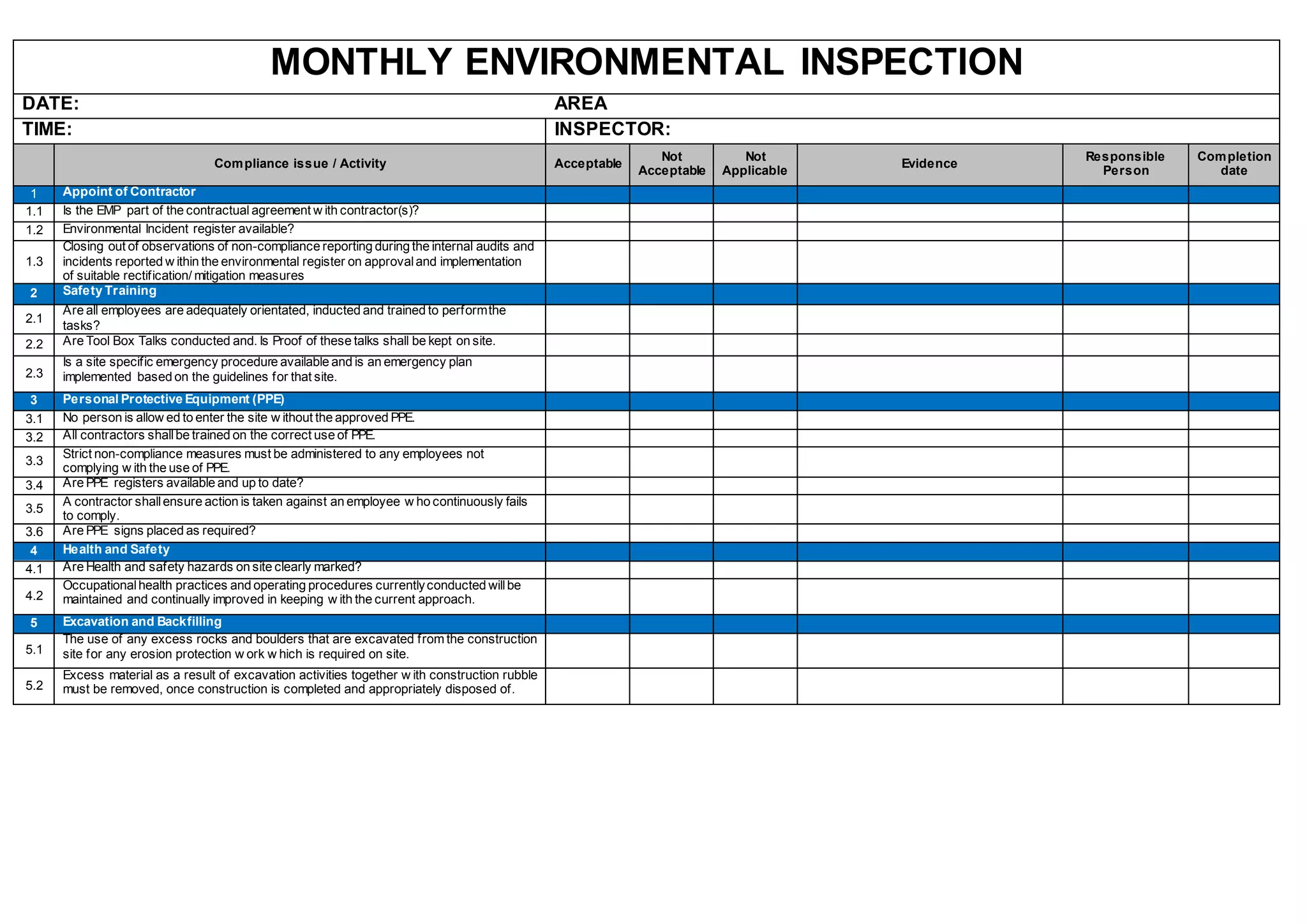
MONTHLY ENVIRONMENTAL INSPECTION
DATE: AREA
TIME: INSPECTOR:
Compliance issue / Activity Acceptable
Not
Acceptable
Not
Applicable
Evidence
Responsible
Person
Completion
date
1 Appoint of Contractor
1.1 Is the EMP part of the contractual agreement w ith contractor(s)?
1.2 Environmental Incident register available?
1.3
Closing out of observations of non-compliance reporting during the internal audits and
incidents reported w ithin the environmental register on approvaland implementation
of suitable rectification/ mitigation measures
2 Safety Training
2.1
Are all employees are adequately orientated, inducted and trained to performthe
tasks?
2.2 Are Tool Box Talks conducted and. Is Proof of these talks shall be kept on site.
2.3
Is a site specific emergency procedure available and is an emergency plan
implemented based on the guidelines for that site.
3 Personal Protective Equipment (PPE)
3.1 No person is allow ed to enter the site w ithout the approved PPE.
3.2 All contractors shallbe trained on the correct use of PPE.
3.3
Strict non-compliance measures must be administered to any employees not
complying w ith the use of PPE.
3.4 Are PPE registers available and up to date?
3.5
A contractor shallensure action is taken against an employee w ho continuously fails
to comply.
3.6 Are PPE signs placed as required?
4 Health and Safety
4.1 Are Health and safety hazards on site clearly marked?
4.2
Occupationalhealth practices and operating procedures currentlyconducted willbe
maintained and continually improved in keeping w ith the current approach.
5 Excavation and Backfilling
5.1
The use of any excess rocks and boulders that are excavated from the construction
site for any erosion protection w ork w hich is required on site.
5.2
Excess material as a result of excavation activities together w ith construction rubble
must be removed, once construction is completed and appropriately disposed of.
Compliance issue / Activity Acceptable
Not
Acceptable
Not
Applicable
Evidence
Responsible
Person
Completion
date
5.3
Suitable excavated material is to be stockpiled next to excavations for use as backfill
and all unsuitable or excess material must be loaded onto trucks and hauled to
designated areas.
5.4
Backfill material must be from excavated material or dolerite/ash obtained from a
licensed source.
6
Dust Control (Sources:dolerite / ash for foundation purposes;blasting;
construction vehicles transporting of equipmentto site;preparationof surface
areas)
6.1
Dust must be suppressed on the construction site during dry periods by the regular
application of w ater. Water used for this purpose must be used in quantities that w ill
not result in the generation of run-off.
6.2
Dust dispersion fromconstruction activities, roads, spoildumps and other construction
locations w illbe limited and suppressed to the maximum extent practical.
6.3 Spoil dumps w illbe positioned such that they are not vulnerable to w ind erosion
6.4 Cover skips and trucks w hich are loaded w ith construction materials.
7
Water Management
(Sources:domestic waste water;storm water;water used to clean equipment)
7.1 Waste w ater should be directed into proper stormw ater drains.
7.2
Sew age water should not be channelled through storm w ater drains or be allow ed to
flow freely or stagnate on the soil surface.
7.3
Storm w ater management structures (channels, bunded areas, sumps) should be
designed into the project to trap any potentially contaminated stormw ater and return it
to the relevant process or allow
7.4 Proper storm w ater drains should be constructed.
7.5
Temporary chemical toilets or permanent toilets must be provided for construction
w orkers.
7.6
All w orkersshould be trained in the correct procedure forhandling contaminated
w ater.
8 Noise
8.1 Operations should meet the noise standard requirements of legislation
8.2
Construction staff working in areas w here the 8-hour ambient noise levels exceed 85
dBA should w ear ear protection equipment.
9
Storage and Handling of Hazardous Substances
(Sources: paint; engine/lubricating oil; diesel)
9.1
The Contractor must comply w ith all national, regional and local legislation w ith regard
to the storage, transport, use and disposal of chemicals, harmful and hazardous
substances and materials.
9.2
Workers should be trained on clean up procedures and any hazardous waste from the
clean-up must be disposed of at a hazardous w aste site.
Compliance issue / Activity Acceptable
Not
Acceptable
Not
Applicable
Evidence
Responsible
Person
Completion
date
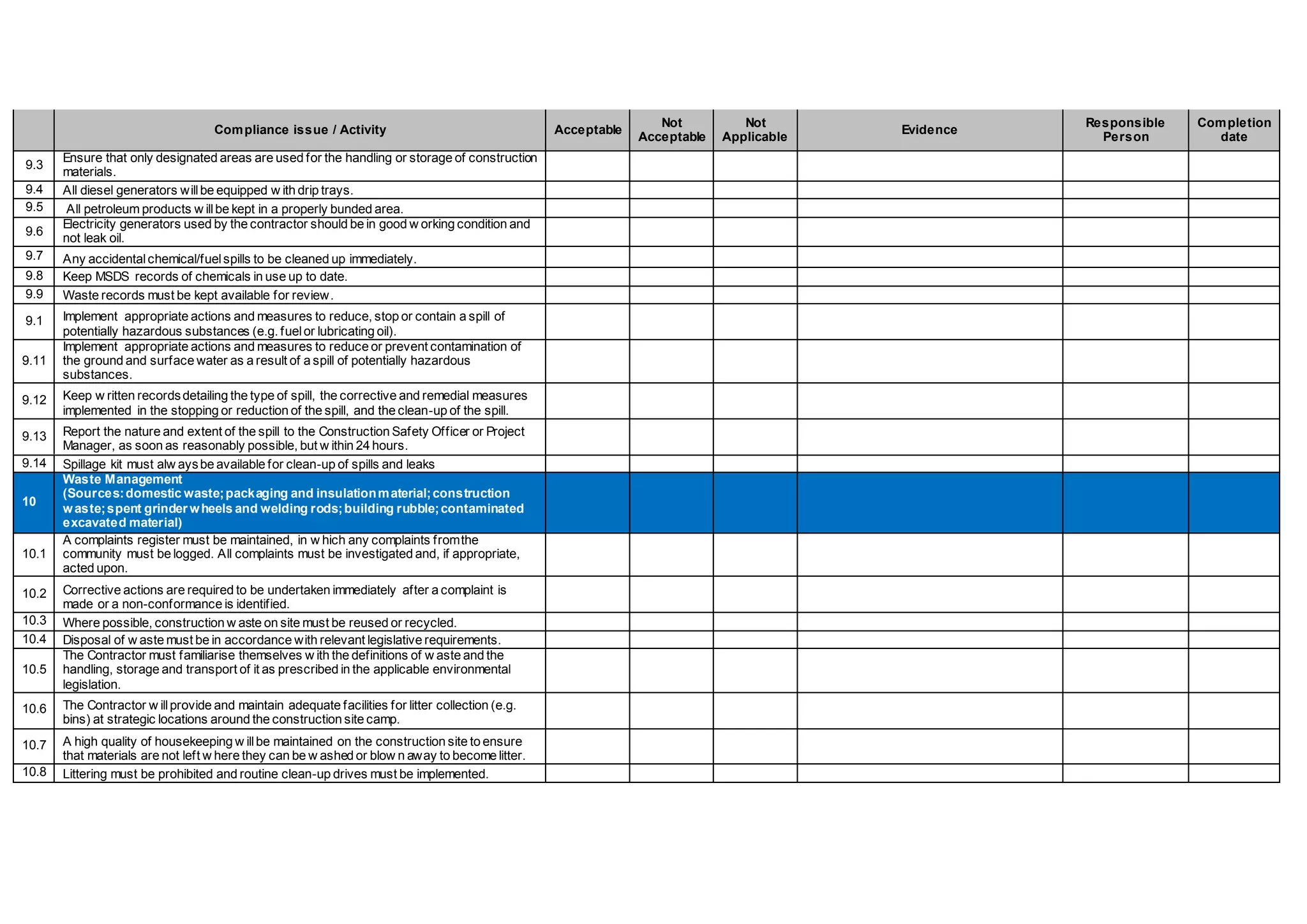
9.3
Ensure that only designated areas are used for the handling or storage of construction
materials.
9.4 All diesel generators willbe equipped w ith drip trays.
9.5 All petroleum products w illbe kept in a properly bunded area.
9.6
Electricity generators used by the contractor should be in good w orking condition and
not leak oil.
9.7 Any accidentalchemical/fuelspills to be cleaned up immediately.
9.8 Keep MSDS records of chemicals in use up to date.
9.9 Waste records must be kept available for review.
9.1 Implement appropriate actions and measures to reduce, stop or contain a spill of
potentially hazardous substances (e.g. fuelor lubricating oil).
9.11
Implement appropriate actions and measures to reduce or prevent contamination of
the ground and surface water as a result of a spill of potentially hazardous
substances.
9.12 Keep w ritten recordsdetailing the type of spill, the corrective and remedial measures
implemented in the stopping or reduction of the spill, and the clean-up of the spill.
9.13 Report the nature and extent of the spill to the Construction Safety Officer or Project
Manager, as soon as reasonably possible, but w ithin 24 hours.
9.14 Spillage kit must alw aysbe available for clean-up of spills and leaks
10
Waste Management
(Sources:domestic waste;packaging and insulationmaterial;construction
waste;spent grinder wheels and welding rods;building rubble;contaminated
excavated material)
10.1
A complaints register must be maintained, in w hich any complaints fromthe
community must be logged. All complaints must be investigated and, if appropriate,
acted upon.
10.2 Corrective actions are required to be undertaken immediately after a complaint is
made or a non-conformance is identified.
10.3 Where possible, construction w aste on site must be reused or recycled.
10.4 Disposal of w aste must be in accordance with relevant legislative requirements.
10.5
The Contractor must familiarise themselves w ith the definitions of w aste and the
handling, storage and transport of it as prescribed in the applicable environmental
legislation.
10.6 The Contractor w illprovide and maintain adequate facilities for litter collection (e.g.
bins) at strategic locations around the construction site camp.
10.7 A high quality of housekeeping w illbe maintained on the construction site to ensure
that materials are not left w here they can be w ashed or blow n away to become litter.
10.8 Littering must be prohibited and routine clean-up drives must be implemented.
Compliance issue / Activity Acceptable
Not
Acceptable
Not
Applicable
Evidence
Responsible
Person
Completion
date
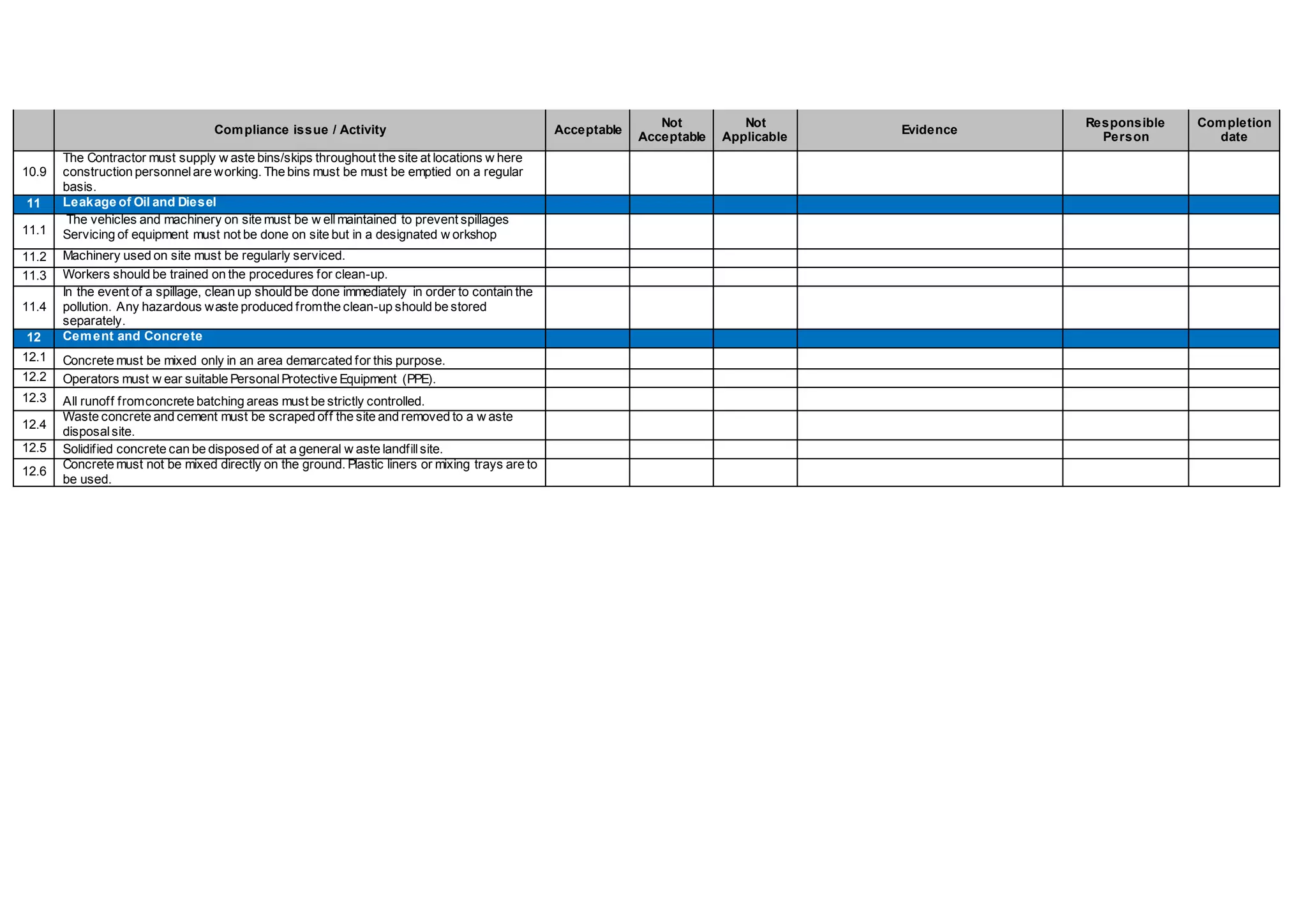
10.9
The Contractor must supply w aste bins/skips throughout the site at locations w here
construction personnelare working. The bins must be must be emptied on a regular
basis.
11 Leakage of Oil and Diesel
11.1
The vehicles and machinery on site must be w ellmaintained to prevent spillages
Servicing of equipment must not be done on site but in a designated w orkshop
11.2 Machinery used on site must be regularly serviced.
11.3 Workers should be trained on the procedures for clean-up.
11.4
In the event of a spillage, clean up should be done immediately in order to contain the
pollution. Any hazardous waste produced fromthe clean-up should be stored
separately.
12 Cement and Concrete
12.1 Concrete must be mixed only in an area demarcated for this purpose.
12.2 Operators must w ear suitable PersonalProtective Equipment (PPE).
12.3 All runoff fromconcrete batching areas must be strictly controlled.
12.4
Waste concrete and cement must be scraped off the site and removed to a w aste
disposalsite.
12.5 Solidified concrete can be disposed of at a general w aste landfillsite.
12.6
Concrete must not be mixed directly on the ground. Plastic liners or mixing trays are to
be used.

Monthly Environmental Inspection

  • 1.
    MONTHLY ENVIRONMENTAL INSPECTION DATE:AREA TIME: INSPECTOR: Compliance issue / Activity Acceptable Not Acceptable Not Applicable Evidence Responsible Person Completion date 1 Appoint of Contractor 1.1 Is the EMP part of the contractual agreement w ith contractor(s)? 1.2 Environmental Incident register available? 1.3 Closing out of observations of non-compliance reporting during the internal audits and incidents reported w ithin the environmental register on approvaland implementation of suitable rectification/ mitigation measures 2 Safety Training 2.1 Are all employees are adequately orientated, inducted and trained to performthe tasks? 2.2 Are Tool Box Talks conducted and. Is Proof of these talks shall be kept on site. 2.3 Is a site specific emergency procedure available and is an emergency plan implemented based on the guidelines for that site. 3 Personal Protective Equipment (PPE) 3.1 No person is allow ed to enter the site w ithout the approved PPE. 3.2 All contractors shallbe trained on the correct use of PPE. 3.3 Strict non-compliance measures must be administered to any employees not complying w ith the use of PPE. 3.4 Are PPE registers available and up to date? 3.5 A contractor shallensure action is taken against an employee w ho continuously fails to comply. 3.6 Are PPE signs placed as required? 4 Health and Safety 4.1 Are Health and safety hazards on site clearly marked? 4.2 Occupationalhealth practices and operating procedures currentlyconducted willbe maintained and continually improved in keeping w ith the current approach. 5 Excavation and Backfilling 5.1 The use of any excess rocks and boulders that are excavated from the construction site for any erosion protection w ork w hich is required on site. 5.2 Excess material as a result of excavation activities together w ith construction rubble must be removed, once construction is completed and appropriately disposed of.
  • 2.
    Compliance issue /Activity Acceptable Not Acceptable Not Applicable Evidence Responsible Person Completion date 5.3 Suitable excavated material is to be stockpiled next to excavations for use as backfill and all unsuitable or excess material must be loaded onto trucks and hauled to designated areas. 5.4 Backfill material must be from excavated material or dolerite/ash obtained from a licensed source. 6 Dust Control (Sources:dolerite / ash for foundation purposes;blasting; construction vehicles transporting of equipmentto site;preparationof surface areas) 6.1 Dust must be suppressed on the construction site during dry periods by the regular application of w ater. Water used for this purpose must be used in quantities that w ill not result in the generation of run-off. 6.2 Dust dispersion fromconstruction activities, roads, spoildumps and other construction locations w illbe limited and suppressed to the maximum extent practical. 6.3 Spoil dumps w illbe positioned such that they are not vulnerable to w ind erosion 6.4 Cover skips and trucks w hich are loaded w ith construction materials. 7 Water Management (Sources:domestic waste water;storm water;water used to clean equipment) 7.1 Waste w ater should be directed into proper stormw ater drains. 7.2 Sew age water should not be channelled through storm w ater drains or be allow ed to flow freely or stagnate on the soil surface. 7.3 Storm w ater management structures (channels, bunded areas, sumps) should be designed into the project to trap any potentially contaminated stormw ater and return it to the relevant process or allow 7.4 Proper storm w ater drains should be constructed. 7.5 Temporary chemical toilets or permanent toilets must be provided for construction w orkers. 7.6 All w orkersshould be trained in the correct procedure forhandling contaminated w ater. 8 Noise 8.1 Operations should meet the noise standard requirements of legislation 8.2 Construction staff working in areas w here the 8-hour ambient noise levels exceed 85 dBA should w ear ear protection equipment. 9 Storage and Handling of Hazardous Substances (Sources: paint; engine/lubricating oil; diesel) 9.1 The Contractor must comply w ith all national, regional and local legislation w ith regard to the storage, transport, use and disposal of chemicals, harmful and hazardous substances and materials. 9.2 Workers should be trained on clean up procedures and any hazardous waste from the clean-up must be disposed of at a hazardous w aste site.
  • 3.
    Compliance issue /Activity Acceptable Not Acceptable Not Applicable Evidence Responsible Person Completion date 9.3 Ensure that only designated areas are used for the handling or storage of construction materials. 9.4 All diesel generators willbe equipped w ith drip trays. 9.5 All petroleum products w illbe kept in a properly bunded area. 9.6 Electricity generators used by the contractor should be in good w orking condition and not leak oil. 9.7 Any accidentalchemical/fuelspills to be cleaned up immediately. 9.8 Keep MSDS records of chemicals in use up to date. 9.9 Waste records must be kept available for review. 9.1 Implement appropriate actions and measures to reduce, stop or contain a spill of potentially hazardous substances (e.g. fuelor lubricating oil). 9.11 Implement appropriate actions and measures to reduce or prevent contamination of the ground and surface water as a result of a spill of potentially hazardous substances. 9.12 Keep w ritten recordsdetailing the type of spill, the corrective and remedial measures implemented in the stopping or reduction of the spill, and the clean-up of the spill. 9.13 Report the nature and extent of the spill to the Construction Safety Officer or Project Manager, as soon as reasonably possible, but w ithin 24 hours. 9.14 Spillage kit must alw aysbe available for clean-up of spills and leaks 10 Waste Management (Sources:domestic waste;packaging and insulationmaterial;construction waste;spent grinder wheels and welding rods;building rubble;contaminated excavated material) 10.1 A complaints register must be maintained, in w hich any complaints fromthe community must be logged. All complaints must be investigated and, if appropriate, acted upon. 10.2 Corrective actions are required to be undertaken immediately after a complaint is made or a non-conformance is identified. 10.3 Where possible, construction w aste on site must be reused or recycled. 10.4 Disposal of w aste must be in accordance with relevant legislative requirements. 10.5 The Contractor must familiarise themselves w ith the definitions of w aste and the handling, storage and transport of it as prescribed in the applicable environmental legislation. 10.6 The Contractor w illprovide and maintain adequate facilities for litter collection (e.g. bins) at strategic locations around the construction site camp. 10.7 A high quality of housekeeping w illbe maintained on the construction site to ensure that materials are not left w here they can be w ashed or blow n away to become litter. 10.8 Littering must be prohibited and routine clean-up drives must be implemented.
  • 4.
    Compliance issue /Activity Acceptable Not Acceptable Not Applicable Evidence Responsible Person Completion date 10.9 The Contractor must supply w aste bins/skips throughout the site at locations w here construction personnelare working. The bins must be must be emptied on a regular basis. 11 Leakage of Oil and Diesel 11.1 The vehicles and machinery on site must be w ellmaintained to prevent spillages Servicing of equipment must not be done on site but in a designated w orkshop 11.2 Machinery used on site must be regularly serviced. 11.3 Workers should be trained on the procedures for clean-up. 11.4 In the event of a spillage, clean up should be done immediately in order to contain the pollution. Any hazardous waste produced fromthe clean-up should be stored separately. 12 Cement and Concrete 12.1 Concrete must be mixed only in an area demarcated for this purpose. 12.2 Operators must w ear suitable PersonalProtective Equipment (PPE). 12.3 All runoff fromconcrete batching areas must be strictly controlled. 12.4 Waste concrete and cement must be scraped off the site and removed to a w aste disposalsite. 12.5 Solidified concrete can be disposed of at a general w aste landfillsite. 12.6 Concrete must not be mixed directly on the ground. Plastic liners or mixing trays are to be used.