BASELINE RISK ASSESSMENT
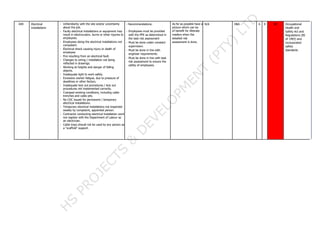
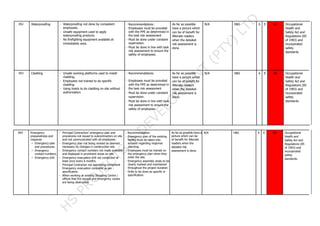
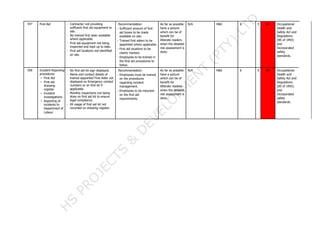
PREPARED BY: _______________________________
APPROVED BY: ____________________________
ISSUE DATE: _____________________________
REVISION: _______________________________
Project: _________________________________
.
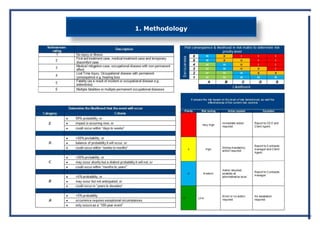
1 Methodology
The procedure(s) for hazard identification and risk assessment shall take into account:
a) routine and non-routine activities;
b) activities of all persons having access to the workplace (including contractors and visitors);
c) human behaviour, capabilities and other human factors;
d) identified hazards originating outside the workplace capable of adversely affecting the health and safety of persons under the control of the organization within the
workplace;
e) hazards created in the vicinity of the workplace by work-related activities under the control of the organization;
NOTE 1 It may be more appropriate for such hazards to be assessed as an environmental aspect.
f) infrastructure, equipment and materials at the workplace, whether provided by the organization or others;
g) changes or proposed changes in the organization, its activities, or materials;
h) modifications to the OH&S management system, including temporary changes, and their impacts on operations, processes, and activities;
I) any applicable legal obligations relating to risk assessment and implementation of necessary controls;
j) the design of work areas, processes, installations, machinery/equipment, operating procedures and work organization, including their adaptation to human capabilities.
The organization’s methodology for hazard identification and risk assessment shall:
a) be defined with respect to its scope, nature and timing to ensure it is proactive rather than reactive; and
b) provide for the identification, prioritization and documentation of risks, and the application of controls, as appropriate.
For the management of change, the organization shall identify the OH&S hazards and OH&S risks associated with changes in the organization, the OH&S management
system, or its activities, prior to the introduction of such changes. When determining controls, or considering changes to existing controls, consideration shall be given to
reducing the risks according to the following hierarchy:
Before construction start, the Baseline Risk Assessment is a theoretical assessment before the construction start in order to highlight the foreseen hazards, but this is not
intended to be seen as an absolute 100% of hazards that may occur.
The Principal Contractor or their appointed Contractor should take this and whatever hazards that may be presented, due to the unique process which get used to execute
the specific construction activity.
This Baseline Risk Assessment provides recommendations regarding the control measures, it is however the Principal Contractor duties to ensure that
detailed control measured are addressed in the applicable unique Risk Assessment by the Principal Contractor or their appointed Contractor. The risk
rating is deliberately rated high because there are no controls in this and without the required controls the possibility of the potential risk is very high,
as indicated.
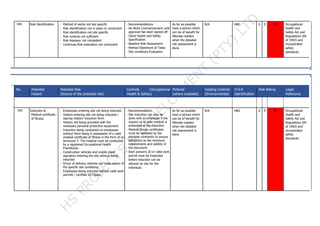
No. Potential
Hazard
Potential Risk
(Source of the potential risk)
Controls (Occupational
Health & Safety)
Pictorial
(where available)
Existing Controls
(Environmental)
H-S-E
Identification
Risk Rating Legal
Reference
S L Final
Rating
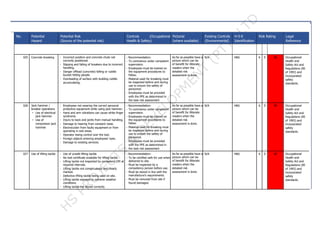
001 File Approval as per
OHS
Requirements and
Client
Specification
- Work commencing prior to file being
available and approved.
- No valid registration with COID.
- Expired Documentation (e.g. competencies,
equipment load test, medicals, work permits)
- Documentation not available or approved as
per required Client Spec and OHS act.
: Recommendations:
- No Work Commencement until
approval has been signed off.
- Client Health and Safety
Specification.
- Baseline Risk Assessment
- Site Conditions evaluation
As far as possible
have a picture which
can be of benefit for
illiterate readers
when the detailed
risk assessment is
done.
N/A H&S 6 E 6E Occupational
Health and
Safety Act and
Regulations (85
of 1993) and
incorporated
safety
standards.
002 Legal
Appointments and
Competency
- Employees appointed not in possession of
required or valid competencies as per Client
Spec and OHS Act.
- Appointment not as per legal requirements.
- Lack of experience for appointed position.
: Recommendation
- No Work Commencement until
approval has been signed off.
- Client Health and Safety
Specification.
- Baseline Risk Assessment
As far as possible
have a picture which
can be of benefit for
illiterate readers
when the detailed
risk assessment is
done.
N/A H&S 6 E 6E Occupational
Health and
Safety Act and
Regulations (85
of 1993) and
incorporated
safety
standards.
003 Required legal
documentation as
per OHS act
- Documentation not Site Specific.
- Policies and Procedure not in place and
approved.
- Employees not trained in Policies and
Procedures and legal requirements.
: Recommendations
- No Work Commencement until
approval has been signed off.
- Client Health and Safety
Specification.
- Baseline Risk Assessment
- Training Needs analysis to be
conducted by Contractor.
- Communication of required
documentation
As far as possible
have a picture which
can be of benefit for
illiterate readers
when the detailed
risk assessment is
done.
N/A H&S 6 E 6E Occupational
Health and
Safety Act and
Regulations (85
of 1993) and
incorporated
safety
standards.
004 Risk Identification - Method of works not site specific
- Risk identification not in place or conducted
- Risk identification not site specific
- Risk controls not sufficient
- Risk Assessor not competent
- Continues Risk evaluation not conducted
: Recommendations
- No Work Commencement until
approval has been signed off.
- Client Health and Safety
Specification.
- Baseline Risk Assessment
- Method Statement of Tasks
- Site conditions Evaluation
As far as possible
have a picture which
can be of benefit for
illiterate readers
when the detailed
risk assessment is
done.
N/A H&S 6 E 6E Occupational
Health and
Safety Act and
Regulations (85
of 1993) and
incorporated
safety
standards.
No. Potential
Hazard
Potential Risk
(Source of the potential risk)
Controls (Occupational
Health & Safety)
Pictorial
(where available)
Existing Controls
(Environmental)
H-S-E
Identification
Risk Rating Legal
Reference
S L Final
Rating
005 Induction &
Medical certificate
of fitness
- Employees entering site not being inducted.
- Visitors entering site not being inducted /
signing visitors’ induction form.
- Visitors not being provided with the
necessary personal protective equipment.
- Induction being conducted on employees
without them being in possession of a valid
medical certificate of fitness in the form of an
Annexure 3. The medical must be conducted
by a registered Occupational Health
Practitioner.
- Construction vehicles and mobile plant
operators entering the site without being
inducted.
- Driver of delivery vehicles not made aware of
the specific site conditions.
- Employees being inducted without valid work
permits / certified ID Copies.
: Recommendation:
- Site induction can only be
done with an employee if the
require up to date medical is
presented at the induction.
- Medical fitness certificates
must be validated by the
principle contractor to ensure
adherence to the minimum
requirements and validity of
the document.
- Each person’s ID or valid work
permit must be inspected
before induction can be
allowed on site for the
individual.
As far as possible
have a picture which
can be of benefit for
illiterate readers
when the detailed
risk assessment is
done.
N/A H&S 6 E 6E Occupational
Health and
Safety Act and
Regulations (85
of 1993) and
incorporated
safety
standards.
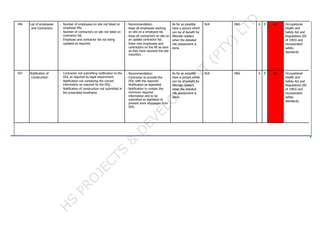
006 List of employees
and Contractors
- Number of employees on site not listed on
employee lifts.
- Number of contractors on site not listed on
contractor list.
- Employee and contractor list not being
updated as required.
: Recommendation:
- Keep all employees working
on site on a employee list.
- Keep all contractors on site on
an update contractor list.
- Enter new employees and
contractors on the lift as soon
as they have received the site
induction.
As far as possible
have a picture which
can be of benefit for
illiterate readers
when the detailed
risk assessment is
done.
N/A H&S 6 E 6E Occupational
Health and
Safety Act and
Regulations (85
of 1993) and
incorporated
safety
standards.
007 Notification of
Construction
- Contractor not submitting notification to the
DOL as required by legal requirement.
- Notification not containing the correct
information as required by the DOL.
- Notification of construction not submitted in
the prescribed timeframe.
: Recommendation:
- Contractor to provide the
DOL with the required
Notification as legislated.
- Notification to contain the
minimum required
information and to be
submitted as legislated to
prevent work stoppages from
DOL.
As far as possible
have a picture which
can be of benefit for
illiterate readers
when the detailed
risk assessment is
done.
N/A H&S 6 E 6E Occupational
Health and
Safety Act and
Regulations (85
of 1993) and
incorporated
safety
standards.
008 Client and Designer
Duties
- Client not following requirements as
stipulated in the regulations.
- Designers not appointed in writing and not
made aware of their duties.
- Designers not following their legal duties
throughout the project.
: Recommendation:
- Client to follow legal
requirements as stipulated in
the regulations before and
during the construction
process.
- Designers on the project to
sign agreement in
acknowledgement of their
duties on the project.
- Designers to conduct the
required inspections and
review the required
documentation as stipulated in
the regulations.
As far as possible
have a picture which
can be of benefit for
illiterate readers
when the detailed
risk assessment is
done.
N/A H&S 6 E 6E Occupational
Health and
Safety Act and
Regulations (85
of 1993) and
incorporated
safety
standards.
Site Establishment
009 Temporary
hoarding to
separate public
and construction
work.
Existing boundary
fences.
- The erector must follow the specific position
as required.
- When digging for fence poles, services can
be damaged.
- When posts get knocked in it can damage
services.
: Recommendation:
- The site must be fenced off
as a minimum with diamond
mesh fence 1,8meters in
height.
- Fence installation areas to be
demarcated with netting
when posts and fence is
being installed.
- Movable hoarding must be
secured with weights at the
base of the hoarding to
prevent displacement.
As far as possible
have a picture which
can be of benefit for
illiterate readers
when the detailed
risk assessment is
done.
N/A H & S 6 E 6E Occupational
Health and
Safety Act and
Regulations (85
of 1993) and
incorporated
safety
standards.
010 Security - No security in place at entrances to
construction site.
- Unauthorized entry to site.
- Theft of materials and equipment.
: Recommendation:
- The principal contractor must
appoint full time security
personnel to control the
access onto site at all times.
- Dedicated access control sign
books to be available for
visitor sign ins.
As far as possible
have a picture which
can be of benefit for
illiterate readers
when the detailed
risk assessment is
done.
N/A H & S 6 E 6E Occupational
Health and
Safety Act and
Regulations (85
of 1993) and
incorporated
safety
standards.
Copyrighted by : Industrial Consultants (Pty) Ltd ©
No. Potential
Hazard
Potential Risk
(Source of the potential risk)
Controls (Occupational
Health & Safety)
Pictorial
(where available)
Existing Controls
(Environmental)
H-S-E
Identification
Risk Rating Legal
Reference
S L Final
Rating
011 Access control - To prevent unauthorized entry into the
construction area, beyond the area which
was fenced off as per the Engineers drawing,
from the gate which the contractor controls
up to the furthest point of the hoarded area.
- Access control measures not in place at
access gates.
- Accessing site from unsafe areas.
- Unauthorized entry onto site due to lack of
access control measures.
: Recommendations:
- Only designated access gates
may be kept unlocked pending
that full time security is placed
at the gates.
- Only use access gates at
approved by the client.
As far as possible
have a picture which
can be of benefit for
illiterate readers
when the detailed
risk assessment is
done.
N/A H&S 6 E 6E Occupational
Health and
Safety Act and
Regulations (85
of 1993) and
incorporated
safety
standards.
012 Site Clearing - Use of unsafe mobile plant or machinery.
- Damage of site fence due to site clearing
operations.
- Damage to existing services not marked or
pointed out to the Principal Contractor.
- Employees being struck by moving plant
working in the area.
- No dust control measures in place.
- Removing tall trees unsafely.
- Damage to neighboring properties.
- Several construction vehicles and mobile
plant operating in confined space area and
unsafe / uncontrolled interaction with
employees on site.
- Construction vehicle and mobile plants
reverse hooters not working.
- Unsafe stockpiles of soil or other materials on
site.
- Unauthorized removal of indigenous &
endangered fauna & flora.
: Recommendation:
- All services on site must be
pointed out by the client to
the principal contractor.
- Safe distance from site fence
and services must be
established by contractor and
must be maintained and
marked.
- Dust control measures must
be implemented by the
principal contractor as
determined by the
environmental requirements.
- All construction vehicles on
site must be inspected when
delivered to site to ensure
adherence to the legal
requirements before any
usage of the plant
As far as possible
have a picture which
can be of benefit for
illiterate readers
when the detailed
risk assessment is
done.
N/A H&S 6 E 6E Occupational
Health and
Safety Act and
Regulations (85
of 1993) and
incorporated
safety
standards.
013 Site establishment
• Transporting
containers /
temporary
offices to site.
• Offloading
containers /
offices.
• Container /
offices
placement.
• Demobilisation
• Cleaning
- Safety signs and notice boards not placed
close to entrance of main gate.
- Lay down areas not off sufficient size.
- No toilets provided as per requirements.
- Not informing employees and public what the
site rules are.
- Damaged / loose wires exposed at site
offices.
- Material handling can cause crush injuries
and falling objects.
- Incorrect placement / position of containers /
site offices.
- Tripping hazards / Fall risk
: Recommendations:
- Mandatary signage must be
installed at the gates leading
to site.
- Toilet facilities must be
installed and in working
condition when employees
start work on site.
- Installation of offices must be
done under the supervision of
a competent person.
As far as possible
have a picture which
can be of benefit for
illiterate readers
when the detailed
risk assessment is
done.
N/A H&S 6 E 6E Occupational
Health and
Safety Act and
Regulations (85
of 1993) and
incorporated
safety
standards.
S L Final
Rating
014 Employee facilities - Insufficient employee facilities on site,
causing employees to pollute the site.
- Polluting the environment.
- Facilities not being cleaned and maintained.
- No changing facilities available for employees
on site.
- No canteen / dining / sheltered eating areas
available for employees on site.
- No inspections conducted and no checklist
completed as per the : Specification.
: Recommendation:
- There must be toilet facilities
provided in line with legal
requirements for each sex
working on site.
- Facilities to be cleaned daily
by appointed members as per
specification requirements.
- Eating areas to be established
at a safe and secure location
on site.
- Waste bins to be placed at
strategic locations throughout
site.
- Changing facilities to be
provided to contractors /
employees.
As far as possible
have a picture which
can be of benefit for
illiterate readers
when the detailed
risk assessment is
done.
N/A H&S 6 E 6E Occupational
Health and
Safety Act and
Regulations (85
of 1993) and
incorporated
safety
standards.
Site Activities
015 Exit / entry into
the public roads
- Injuries to pedestrians / members of public.
- Collision with public vehicles.
- No points men / flagmen positioned at access
gates.
- No warning signage displayed at the access
gates to site for vehicles turning.
- No stop and go process in place should it be
applicable.
: Recommendation:
- Construction vehicle turning
areas must be fitted with the
applicable signage.
- Areas effected next to public
way must have designated
flagmen.
As far as possible
have a picture which
can be of benefit for
illiterate readers
when the detailed
risk assessment is
done.
N/A H&S 6 E 6E Occupational
Health and
Safety Act and
Regulations (85
of 1993) and
incorporated
safety
standards.
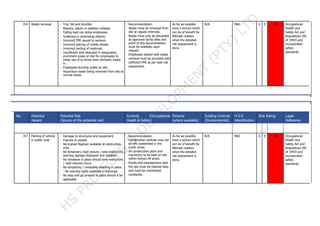
016 Waste removal - Trip, fall and stumble.
- Bearers, stacks or palettes collapse.
- Falling load can strike employees.
- Scattered or protruding objects.
- Incorrect PPE issued to workers.
- Incorrect placing of rubble shoots.
- Incorrect sorting of materials.
- Insufficient bins allocated in designated,
prominent areas on site for employees to
make use of to throw their domestic waste
in.
- Employees burning waste on site.
- Hazardous waste being removed from site as
normal waste.
: Recommendation:
- Waste must be removed from
site at regular intervals.
- Waste must only be discarded
at approved dump sites and
proof of this documentation
must be available upon
request.
- Employees tasked with waste
removal must be provided with
sufficient PPE as per task risk
assessment.
As far as possible
have a picture which
can be of benefit for
illiterate readers
when the detailed
risk assessment is
done.
N/A H&S 6 E 6E Occupational
Health and
Safety Act and
Regulations (85
of 1993) and
incorporated
safety
standards.
No. Potential
Hazard
Potential Risk
(Source of the potential risk)
Controls (Occupational
Health & Safety)
Pictorial
(where available)
Existing Controls
(Environmental)
H-S-E
Identification
Risk Rating Legal
Reference
S L Final
Rating
017 Parking of vehicle
in public road
- Damage to structures and equipment.
- Injuries to people.
- No trained flagman available at obstruction
area.
- No temporary road closure / lane restrictions
warning signage displayed and installed.
- No wayleave in place should lane restrictions
/ road closures occur.
- No temporary / moveable hoarding in place.
- No warning lights available in evenings.
- No stop and go process in place should it be
applicable.
: Recommendation:
- Construction vehicles may not
be left unattended in the
public areas.
- All construction plant and
machinery to be kept on site
within fenced off areas.
- Roads and passageways past
the site must be cleaned daily
and must be maintained
constantly.
As far as possible
have a picture which
can be of benefit for
illiterate readers
when the detailed
risk assessment is
done.
N/A H&S 6 E 6E Occupational
Health and
Safety Act and
Regulations (85
of 1993) and
incorporated
safety
standards.
018 Working in
confined spaces
- Poisonous gas, fume or vapour present in
confined space.
- Lack of oxygen for employees working in
confined space area.
- The presence of flammable gasses in
confined space can lead to fire or explosion.
- Employees being exposed to high noise
levels in confined space.
- Employees being exposed to extreme
temperatures / changes in temperature in
confined space.
- Insufficient safe access for employees in and
out of work area.
- Risk of exposure to hazards associated with
lack of adequate ventilation for activities in
confined spaces.
: Recommendation:
- Confined spaces to be
inspected and tested before
employees can be allowed to
enter the area.
- Employees must be trained by
accredited training provider
for the work inside confined
spaces.
- Safe and secured access must
be provided to confined space
area at all times.
- Detailed risk assessment must
be communicated with
employees before work
commence on site.
As far as possible
have a picture which
can be of benefit for
illiterate readers
when the detailed
risk assessment is
done.
N/A H&S 6 E 6E Occupational
Health and
Safety Act and
Regulations (85
of 1993) and
incorporated
safety
standards.
019 Material &
equipment
handling
Receiving and
off-loading and
loading of
equipment
and/or material
- Delivery vehicle driver not familiar with the
site.
- Driver not instructed on site rules.
- Vehicle parking in unauthorized area.
- Loads incorrectly / unsafely off loaded from
vehicle.
- Loads incorrectly loaded onto vehicle or
stacked incorrectly.
- No wayleave in place when offloading
materials in public road.
- Materials have moved on / inside truck or
delivery vehicle making it unstable.
- Overloading of vehicle.
- Materials falling onto employee.
- Employee handling materials sustaining hand
injuries.
- Materials offloaded in the incorrect area /
unsafe area.
: Recommendation:
- Must be done under the
supervision of an appointed
stacking inspector as per
specification.
- Must be loaded at designated
areas only.
- Must be demarcated when
loads are off loaded.
- Employees must be provided
with the PPE as determined in
the task risk assessment.
As far as possible
have a picture which
can be of benefit for
illiterate readers
when the detailed
risk assessment is
done.
N/A H&S 6 E 6E Occupational
Health and
Safety Act and
Regulations (85
of 1993) and
incorporated
safety
standards.
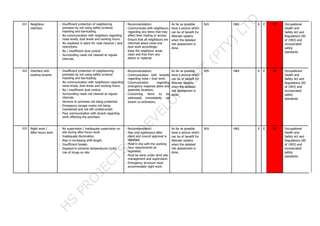
020 Interface with
adjacent
construction
activities of other
contractors.
- No communication with other contractors on
premises in close vicinity of work area.
: Recommendation: Must
communicate daily regarding
items that may affect 3rd
party
or site access.
As far as possible
have a picture which
can be of benefit for
illiterate readers
when the detailed
risk assessment is
done.
N/A H&S 6 E 6E Occupational
Health and
Safety Act and
Regulations (85
of 1993) and
incorporated
safety
standards.
021 Neighbour
interface
- Insufficient protection of neighboring
premises by not using safety screens/
hoarding and barricading.
- No communication with neighbors regarding
noise levels, dust levels and working hours.
- No wayleave in place for road closures / lane
restrictions.
- No / insufficient dust control.
- Surrounding roads not cleaned at regular
intervals.
: Recommendation:
- Communicate with neighbours
regarding any items that may
affect their trading or access.
- Ensure that all neighbours are
informed about noise and
dust work accordingly.
- Keep the neighbour areas
clean and free from any
debris or material.
As far as possible
have a picture which
can be of benefit for
illiterate readers
when the detailed
risk assessment is
done.
N/A H&S 6 E 6E Occupational
Health and
Safety Act and
Regulations (85
of 1993) and
incorporated
safety
standards.
022 Interface with
existing tenants
- Insufficient protection of neighbouring
premises by not using safety screens/
hoarding and barricading.
- No communication with neighbours regarding
noise levels, dust levels and working hours.
- No / insufficient dust control.
- Surrounding roads not cleaned at regular
intervals.
- Services to premises not being protected.
- Emergency escape routes not being
maintained and not left unobstructed.
- Poor communication with tenant regarding
work effecting the premises.
: Recommendation:
- Communication with tenants
regarding noise / dust work.
- Communication regarding
emergency response plans and
assembly locations.
- Concerning items to be
addressed immediately via
tenant co-ordinators.
As far as possible
have a picture which
can be of benefit for
illiterate readers
when the detailed
risk assessment is
done.
N/A H&S 6 E 6E Occupational
Health and
Safety Act and
Regulations (85
of 1993) and
incorporated
safety
standards.
023 Night work /
After-hours work
- No supervision / inadequate supervision on
site during after-hours work.
- Inadequate illumination.
- Rise in increasing shift length.
- Insufficient breaks.
- Exposed to extreme temperatures (cold) -
Use of drugs on site.
: Recommendation:
- May only commence after
client and council approval is
obtained.
- Must in line with the working
hour requirements as
legislated.
- Must be done under strict site
management and supervision.
- Emergency structure must
accommodate night work.
As far as possible
have a picture which
can be of benefit for
illiterate readers
when the detailed
risk assessment is
done.
N/A H&S 6 E 6E Occupational
Health and
Safety Act and
Regulations (85
of 1993) and
incorporated
safety
standards.
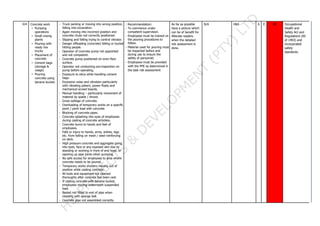
024 Concrete work
• Pumping
operations
• Small mixing
plants
• Pouring with
ready mix
trucks
• Placement of
concrete
• Cement bags
(storage &
usage)
• Pouring
concrete using
banana bucket.
- Truck parking or moving into wrong position,
falling into excavation.
- Again moving into incorrect position and
concrete chute not correctly positioned.
- Slipping and falling trying to control vibrator.
- Danger offloading (concrete) falling or bucket
hitting people.
- Operator of concrete pump not appointed
and not competent.
- Concrete pump positioned on even floor
surface.
- Operator not conducting pre-inspection on
pump before operating.
- Exposure to silica while handling cement
bags.
- Excessive noise and vibration particularly
with vibrating pokers, power floats and
mechanical screed boards.
- Manual handling – particularly movement of
material by spade / shovel.
- Gross spillage of concrete.
- Overloading of temporary works on a specific
point / point load with concrete.
- Blocking of concrete pipes.
- Concrete splashing into eyes of employees
during casting of concrete activities.
- Concrete burns to hands and feet of
employees.
- Falls or injury to hands, arms, ankles, legs
etc. from falling on mesh / steel reinforcing
on deck.
- High pressure concrete and aggregate going
into eyes, face or any exposed skin due to
standing or working in front of end hose, or
opening up pipe joints when pumping.
- No safe access for employees to area where
concrete needs to be poured.
- Temporary works shutters moving out of
position while casting concrete.
- All tools and equipment not cleaned
thoroughly after concrete has been cast.
- If casting concrete with banana bucket,
employees moving underneath suspended
load.
- Basket not fitted to end of pipe when
cleaning with sponge ball.
- Concrete pipe not assembled correctly.
: Recommendation:
- To commence under
competent supervision.
- Employees must be trained on
the pouring procedures to
follow.
- Material used for pouring must
be inspected before and
during use to ensure the
safety of personnel.
- Employees must be provided
with the PPE as determined in
the task risk assessment
As far as possible
have a picture which
can be of benefit for
illiterate readers
when the detailed
risk assessment is
done.
N/A H&S 6 E 6E Occupational
Health and
Safety Act and
Regulations (85
of 1993) and
incorporated
safety
standards.
- Incorrect cleaning method of pipe.
No. Potential
Hazard
Potential Risk
(Source of the potential risk)
Controls (Occupational
Health & Safety)
Pictorial
(where available)
Existing Controls
(Environmental)
H-S-E
Identification
Risk Rating Legal
Reference
S L Final
Rating
025 Concrete breaking - Incorrect position and concrete chute not
correctly positioned.
- Slipping and falling of breakers due to incorrect
handling.
- Danger offload (concrete) falling or rubble
bucket hitting people.
- Overloading of surface with building rubble
accumulating.
: Recommendation:
- To commence under competent
supervision.
- Employees must be trained on
the equipment procedures to
follow.
- Material used for breaking must
be inspected before and during
use to ensure the safety of
personnel.
- Employees must be provided
with the PPE as determined in
the task risk assessment
As far as possible have a
picture which can be
of benefit for illiterate
readers when the
detailed risk
assessment is done.
N/A H&S 6 E 6E Occupational
Health and
Safety Act and
Regulations (85
of 1993) and
incorporated
safety
standards.
026 Jack hammer /
breaker operations
• Use of electrical
jack hammer
• Use of
compressor jack
hammer
- Employees not wearing the correct personal
protective equipment while using jack hammer.
- Hand and arm vibrations can cause white finger
syndrome.
- Injury to back and joints from manual handling.
- Damage to hearing from constant noise.
- Electrocution from faulty equipment or from
operating in wet areas.
- Operator losing control over the tool.
- Foreign objects entering employees’ eyes.
- Damage to existing services.
: Recommendation:
- To commence under competent
supervision.
- Employees must be trained on
the equipment procedures to
follow.
- Material used for breaking must
be inspected before and during
use to ensure the safety of
personnel.
- Employees must be provided
with the PPE as determined in
the task risk assessment
As far as possible have a
picture which can be
of benefit for illiterate
readers when the
detailed risk
assessment is done.
N/A H&S 6 E 6E Occupational
Health and
Safety Act and
Regulations (85
of 1993) and
incorporated
safety
standards.
027 Use of lifting tackle - Use of unsafe lifting tackle.
- No test certificate available for lifting tackle.
- Lifting tackle not inspected by competent LMI at
required intervals.
- Lifting tackle not conspicuously and clearly
marked.
- Defective lifting tackle being used on site.
- Lifting tackle exposed to extreme weather
conditions.
- Lifting tackle not stored correctly.
: Recommendation:
- To be certified safe for use when
delivered to site.
- Must be inspected by a
competency person before use.
- Must be stored in line with the
manufacture’s requirements.
- Must be removed from site if
found damaged.
As far as possible have a
picture which can be
of benefit for illiterate
readers when the
detailed risk
assessment is done.
N/A H&S 6 E 6E Occupational
Health and
Safety Act and
Regulations (85
of 1993) and
incorporated
safety
standards.
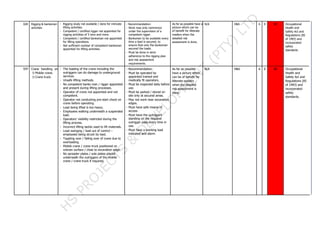
028 Rigging & banksman
activities
- Rigging study not available / done for intricate
lifting activities.
- Competent / certified rigger not appointed for
rigging activities of 5 tons and more.
- Competent / certified banksman not appointed
for lifting operations.
- Not sufficient number of competent banksman
appointed for lifting activities.
: Recommendation:
- Work may only commence
under the supervision of a
competent rigger.
- Banksmen to be available every
time a load is secured, to
ensure that only the banksmen
secured the loads.
- Must be done in strict
adherence to the rigging plan
and risk assessment
requirements.
As far as possible have a
picture which can be
of benefit for illiterate
readers when the
detailed risk
assessment is done.
N/A H&S 6 E 6E Occupational
Health and
Safety Act and
Regulations (85
of 1993) and
incorporated
safety
standards.
029 Crane handling on
Mobile crane.
Crane truck.
- The loading of the crane including the
outriggers can do damage to underground
services.
- Unsafe lifting methods.
- No competent banks man / rigger appointed
and present during lifting processes.
- Operator of crane not appointed and not
competent.
- Operator not conducting pre-start check on
crane before operating.
- Load being lifted is too heavy.
- Employees walking underneath a suspended
load.
- Operators’ visibility restricted during the
lifting process.
- Incorrect lifting tackle used to lift materials.
- Load swinging / load out of control –
employees being struck by load.
- Toppling over / falling over of crane due to
overloading.
- Mobile crane / crane truck positioned on
uneven surface / close to excavation edge.
- No spreader plates / sole plates placed
underneath the outriggers of the mobile
crane / crane truck if required.
: Recommendation:
- Must be operated by
appointed trained and
medically fit operators.
- Must be inspected daily before
use.
- Must be parked / stored on
site only at secured areas.
- May not work near excavation
edges.
- Must have safe means of
access.
- Must have the outriggers
standing on the required
outrigger pads every time in
use.
- Must have a working load
indicated and alarm.
As far as possible
have a picture which
can be of benefit for
illiterate readers
when the detailed
risk assessment is
done.
N/A H&S 6 E 6E Occupational
Health and
Safety Act and
Regulations (85
of 1993) and
incorporated
safety
standards.
030 Man cage / Lifting
cradle / Personnel
cage
- Employee over reaching whilst carrying out
work from a man cage.
- Man cage not register / approved with the
Department of Labour.
- No design available for man cage.
- No load test available for mane cage.
- Man cage used during inclement weather
conditions.
- No risk assessment conducted for the lifting
of persons.
: Recommendation:
- Must have a working load
indicated.
- Must be registered with the
local DOL.
- Must have design certificates
and drawings available on site.
- Must be inspected before use.
As far as possible
have a picture which
can be of benefit for
illiterate readers
when the detailed
risk assessment is
done.
N/A H&S 6 E 6E Occupational
Health and
Safety Act and
Regulations (85
of 1993) and
incorporated
safety
standards.
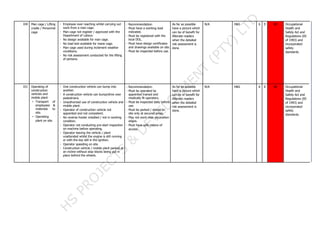
031 Operating of
construction
vehicles and
mobile plant
• Transport of
employees &
materials to
site.
• Operating
plant on site.
- One construction vehicle can bump into
another.
- A construction vehicle can bump/drive over
pedestrians.
- Unauthorized use of construction vehicle and
mobile plant.
- Operator of construction vehicle not
appointed and not competent.
- No reverse hooter installed / not in working
condition.
- Operator not conducting pre-start inspection
on machine before operating.
- Operator leaving the vehicle / plant
unattended whilst the engine is still running
or with the key still in the ignition.
- Operator speeding on site.
- Construction vehicle / mobile plant parked at
an incline without stop blocks being put in
place behind the wheels.
: Recommendation:
- Must be operated by
appointed trained and
medically fit operators.
- Must be inspected daily before
use.
- Must be parked / stored on
site only at secured areas.
- May not work near excavation
edges.
- Must have safe means of
access.
As far as possible
have a picture which
can be of benefit for
illiterate readers
when the detailed
risk assessment is
done.
N/A H&S 6 E 6E Occupational
Health and
Safety Act and
Regulations (85
of 1993) and
incorporated
safety
standards.
032 Operating of
construction
vehicles and
mobile plant
• Transport of
employees &
materials to
site.
• Operating
plant on site.
- Construction vehicle or mobile plant
overturning.
- Construction vehicles and mobile plant
operating in close vicinity or next to power
lines.
- Inclement weather.
- Operator speeding on site.
- Unauthorized / unsafe transportation of
employees.
- Integration between pedestrians and
construction vehicles not planned and
controlled.
: Recommendation:
- Must be operated by appointed
trained and medically fit
operators.
- Must be inspected daily before
use.
- Must be parked / stored on site
only at secured areas.
- May not work near excavation
edges.
- Must have safe means of access.
As far as possible
have a picture which
can be of benefit for
illiterate readers
when the detailed
risk assessment is
done.
N/A H&S 6 E 6E Occupational
Health and
Safety Act and
Regulations (85
of 1993) and
incorporated
safety
standards.
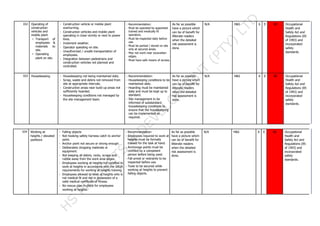
033 Housekeeping - Housekeeping not being maintained daily.
- Scrap, waste and debris not removed from
site at appropriate intervals.
- Construction areas near build up areas not
sufficiently hoarded.
- Housekeeping conditions not managed by
the site management team.
: Recommendation:
- Housekeeping conditions to be
maintained daily.
- Hoarding must be maintained
daily and must be kept up to
standard.
- Site management to be
informed of substandard
housekeeping conditions to
ensure that the housekeeping
can be implemented as
required.
As far as possible
have a picture which
can be of benefit for
illiterate readers
when the detailed
risk assessment is
done.
N/A H&S 6 E 6E Occupational
Health and
Safety Act and
Regulations (85
of 1993) and
incorporated
safety
standards.
034 Working at
heights / elevated
positions
- Falling objects
- Not hooking safety harness catch to anchor
point.
- Anchor point not secure or strong enough.
- Deliberately dropping materials or
equipment.
- Not keeping all debris, rocks, scraps and
rubble away from the work area edges.
- Employees working at heights not certified to
work at heights in accordance with the SAQA
requirements for working at heights training.
- Employees allowed to work at heights who is
not medical fit and not in possession of a
valid medical certificate of fitness.
- No rescue plan in place for employees
working at heights.
: Recommendation:
- Employees required to work at
heights must be formally
trained for the task at hand.
- Anchorage points must be
certified by a competent
person before being used.
- Fall arrest or restraints to be
inspected before use.
- Tools to be secured while
working at heights to prevent
falling objects.
As far as possible
have a picture which
can be of benefit for
illiterate readers
when the detailed
risk assessment is
done.
N/A H&S 6 E 6E Occupational
Health and
Safety Act and
Regulations (85
of 1993) and
incorporated
safety
standards.
035 Fall protection - No site and task specific fall protection plan
available for the work at hand.
- Employees not trained on the fall protection
plan.
- Fall protection plan not compiled and
approved by a competent and approved fall
protection planner.
- Fall protection plan not implemented and
maintained throughout project.
: Recommendation:
- Competent fall protection
planner to be appointed and
must compile and sign off the
fall protection plan.
- Fall protection plan to address
all site-specific conditions.
- Fall protection plan to be
implemented before height
work can commence.
- Fall protection plan to be
updated throughout the
project should the need arise
for scope changes.
As far as possible
have a picture which
can be of benefit for
illiterate readers
when the detailed
risk assessment is
done.
N/A H&S 6 E 6E Occupational
Health and
Safety Act and
Regulations (85
of 1993) and
incorporated
safety
standards.
036 Structures - No structure inspections being done to
prevent any part of the structure from being
overloaded or becoming unstable.
- The structure information not being made
available on site to ensure the designs are
being complied with.
- Structure records and maintenance not done
by the owner.
- Structure not inspected as legislated in the
regulations.
: Recommendation:
- Strict adherence to allowable
loads must be maintained.
- Structure designs to be
available on site if any
uncertainty arises or
information is required.
- The client to ensure that
structure inspections are
conducted as legislated.
- Structure maintenance records
to be kept.
As far as possible
have a picture which
can be of benefit for
illiterate readers
when the detailed
risk assessment is
done.
N/A H&S 6 E 6E Occupational
Health and
Safety Act and
Regulations (85
of 1993) and
incorporated
safety
standards.
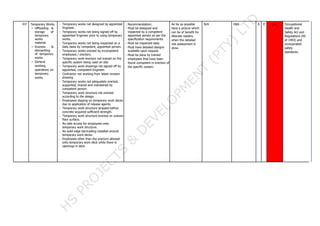
037 Temporary Works
• Offloading &
storage of
temporary
works
material.
• Erection &
dismantling
of temporary
works.
• General
working
operations on
temporary
works.
- Temporary works not designed by appointed
Engineer.
- Temporary works not being signed off by
appointed Engineer prior to using temporary
works.
- Temporary works not being inspected on a
daily basis by competent, appointed person.
- Temporary works erected by incompetent
employees / erectors.
- Temporary work erectors not trained on the
specific system being used on site.
- Temporary work drawings not signed off by
appointed, competent Engineer.
- Contractor not working from latest revision
drawing.
- Temporary works not adequately erected,
supported, braced and maintained by
competent person.
- Temporary work structure not erected
according to the design.
- Employees slipping on temporary work decks
due to application of release agents.
- Temporary work structure stripped before
concrete acquired sufficient strength.
- Temporary work structure erected on uneven
floor surface.
- No safe access for employees onto
temporary work structure.
- No solid edge barricading installed around
temporary work decks.
- Employees other than the erectors allowed
onto temporary work deck while there is
openings in deck.
: Recommendation:
- Must be designed and
inspected by a competent
appointed person as per the
specification requirements.
- Must be inspected daily.
- Must have detailed designs
available upon request.
- Must be done by trained
employees that have been
found competent in erection of
the specific system.
As far as possible
have a picture which
can be of benefit for
illiterate readers
when the detailed
risk assessment is
done.
N/A H&S 6 E 6E Occupational
Health and
Safety Act and
Regulations (85
of 1993) and
incorporated
safety
standards.
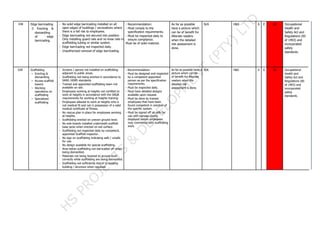
038 Edge barricading
Erecting &
dismantling
of edge
barricading.
- No solid edge barricading installed on all
open edges of buildings / excavations where
there is a fall risk to employees.
- Edge barricading not secured into position.
Only installing guard rails and no knee rails in
scaffolding tubing or similar system.
- Edge barricading not inspected daily.
- Unauthorized removal of edge barricading.
: Recommendation:
- Must comply to the
specification requirements.
- Must be inspected daily to
ensure compliance.
Must be of solid material.
As far as possible
have a picture which
can be of benefit for
illiterate readers
when the detailed
risk assessment is
done.
N/A H&S 6 E 6E Occupational
Health and
Safety Act and
Regulations (85
of 1993) and
incorporated
safety
standards.
039 Scaffolding
• Erecting &
dismantling
• Access scaffold
towers
• Working
operations on
scaffolding
• Specialized
scaffolding
- Screens / aprons not installed on scaffolding
adjacent to public areas.
- Scaffolding not being erected in accordance to
SANS 10085 standards.
- Trained and appointed scaffolding team not
available on site.
- Employees working at heights not certified to
work at heights in accordance with the SAQA
requirements for working at heights training.
- Employees allowed to work at heights who is
not medical fit and not in possession of a valid
medical certificate of fitness.
- No rescue plan in place for employees working
at heights.
- Scaffolding erected on uneven ground level.
- No sole boards installed underneath scaffold
base jacks when erected on soil surface.
- Scaffolding not inspected daily by competent,
appointed Scaffold inspector.
- No sign on scaffolding indicating safe / unsafe
for use.
- No design available for special scaffolding.
- Area below scaffolding not barricaded off when
being dismantled.
- Materials not being lowered to ground level
correctly while scaffolding are being dismantled.
- Scaffolding not sufficiently tied in to existing
building / structure when required.
: Recommendation:
- Must be designed and inspected
by a competent appointed
person as per the specification
requirements.
- Must be inspected daily.
- Must have detailed designs
available upon request.
- Must be done by trained
employees that have been
found competent in erection of
the specific system.
- Must be signed off as safe for
use with signage clearly
displayed before employees
may commence with scaffolding
work.
As far as possible have a
picture which can be
of benefit for illiterate
readers when the
detailed risk
assessment is done.
N/A H&S 6 E 6E Occupational
Health and
Safety Act and
Regulations (85
of 1993) and
incorporated
safety
standards.
040 Rope access work - Employees conducting work not sufficiently
trained / qualified.
- No / inadequate supervision.
- Working in poor weather conditions.
- Unsafe access to work area.
- No rescue plan / insufficient rescue plan in
place.
- Unsafe / defective equipment being used on
site.
- Unforeseen movement of rope access
equipment / equipment coming into contact
with employees.
- Anchor system - Risk of falling due to fault or
inappropriate use.
- Incorrect positioning of work equipment can
lead to possible trip hazard for technicians and
third parties.
- Loose equipment falling to the ground during
work operations.
- Detergent being used to for cleaning coming
into contact with employee.
: Recommendation:
- Must be designed and inspected
by a competent appointed
person as per the specification
requirements.
- Must be inspected daily.
- May only commence by trained
and certified employees.
- Must have a detailed risk
assessment available for the
activity.
As far as possible have a
picture which can be
of benefit for illiterate
readers when the
detailed risk
assessment is done.
N/A H&S 6 E 6E Occupational
Health and
Safety Act and
Regulations (85
of 1993) and
incorporated
safety
standards.
041 Mobile elevated
working platform
operations
- Operator not trained to operate MEWP.
- Operator not conducting daily pre-inspection
before operating MEWP.
- No valid load test available.
- Operator not medically fit to operate MEWP.
- Operator falling from machine basket during
work operations.
- Operator trapped between part of the basket
and a fixed structure, e.g. when manoeuvring in
confined overhead areas.
- Operator operating machine on uneven surfaces
and possibility of machine overturning.
- The vehicle may collide with pedestrians,
overhead cables or nearby vehicles.
- Operator using MEWP in close proximity to
overhead power lines.
- Materials not properly secured in basket of
machine, falling from elevated positions.
- Working platform not kept tidy, tripping
hazards.
- Outriggers not extended and chocked before
raising the platform.
- Work platform not fitted with effective guard
rails and toe boards.
- Employees not wearing a harness with a short
work restraint lanyard or not securing it to a
suitable manufacturer provided anchorage point
within the basket to stop the wearer from
getting into a position where they could fall
from the carrier where there is a risk of falling.
- Working in high winds can tilt platforms and
make them unstable.
- Materials being lifted not properly secured.
- Gate of the platform not closed while in use.
: Recommendation:
- Must be operated by appointed
trained and medically fit
operators.
- Must be inspected daily before
use.
- Must be parked / stored on site
only at secured areas.
- May not work near excavation
edges.
- Must have safe means of access.
- Fall arrest equipment to be worn
and used in line with the
machine design.
As far as possible have a
picture which can be
of benefit for illiterate
readers when the
detailed risk
assessment is done.
N/A H&S 6 E 6E Occupational
Health and
Safety Act and
Regulations (85
of 1993) and
incorporated
safety
standards.
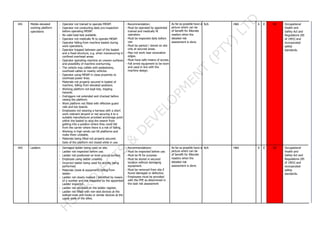
042 Ladders - Damaged ladder being used on site.
- Ladder not inspected before use.
- Ladder not positioned on level ground surface.
- Employee using ladder unsafely.
- Incorrect ladder being used for activity being
performed.
- Materials (tools & equipment) falling from
ladder.
- Ladder not clearly marked / identified by means
of a number and not inspected by the appointed
Ladder inspector.
- Ladder not recorded on the ladder register.
- Ladder not fitted with non-skid devices at the
bottom ends and hooks or similar devices at the
upper ends of the stiles.
: Recommendations:
- Must be inspected before use.
- Must be fit for purpose.
- Must be stored in secured
location without damaging
equipment.
- Must be removed from site if
found damaged or defective.
- Employees must be provided
with the PPE as determined in
the task risk assessment
As far as possible have a
picture which can be
of benefit for illiterate
readers when the
detailed risk
assessment is done.
N/A H&S 6 E 6E Occupational
Health and
Safety Act and
Regulations (85
of 1993) and
incorporated
safety
standards.
- Ladders not stored correctly.
No. Potential
Hazard
Potential Risk
(Source of the potential risk)
Controls (Occupational
Health & Safety)
Pictorial
(where available)
Existing Controls
(Environmental)
H-S-E
Identification
Risk Rating Legal
Reference
S L Final
Rating
043 Electrical Tools - Incorrect wiring.
- Incorrect use of the equipment.
- Persons not properly trained.
- Tools not inspected prior to use or issue.
- Electrical tools being used in inclement
weather.
- Operator of electrical being electrocuted.
- Operator of electrical tool being exposed to
high noise levels.
- Contact with rotating or moving parts.
- Injuries due to materials being ejected.
- Electrical fires.
- Moving parts – entanglement.
- Vibration.
- Dust inhalation.
: Recommendations:
- Must be inspected before use.
- Must be fit for purpose.
- Must be stored in secured
location without damaging
equipment.
- Must be removed from site if
found damaged or defective.
- Employees must be provided
with the PPE as determined in
the task risk assessment
As far as possible
have a picture which
can be of benefit for
illiterate readers
when the detailed
risk assessment is
done.
N/A H&S 6 E 6E Occupational
Health and
Safety Act and
Regulations (85
of 1993) and
incorporated
safety
standards.
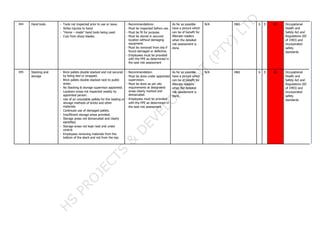
044 Hand tools - Tools not inspected prior to use or issue.
- Strike injuries to hand.
- “Home – made” hand tools being used.
- Cuts from sharp blades.
: Recommendations:
- Must be inspected before use.
- Must be fit for purpose.
- Must be stored in secured
location without damaging
equipment.
- Must be removed from site if
found damaged or defective.
- Employees must be provided
with the PPE as determined in
the task risk assessment
As far as possible
have a picture which
can be of benefit for
illiterate readers
when the detailed
risk assessment is
done.
N/A H&S 6 E 6E Occupational
Health and
Safety Act and
Regulations (85
of 1993) and
incorporated
safety
standards.
045 Stacking and
storage
- Brick pallets double stacked and not secured
by being tied or wrapped.
- Brick pallets double stacked next to public
areas.
- No Stacking & storage supervisor appointed.
- Laydown areas not inspected weekly by
appointed person.
- Use of an unsuitable pallets for the loading or
storage methods of bricks and other
materials.
- Continued use of damaged pallets.
- Insufficient storage areas provided.
- Storage areas not demarcated and clearly
identified.
- Storage areas not kept neat and under
control.
- Employees removing materials from the
bottom of the stack and not from the top.
: Recommendation:
- Must be done under appointed
supervision.
- Must be done as per site
requirements at designated
areas clearly marked and
demarcated.
- Employees must be provided
with the PPE as determined in
the task risk assessment
As far as possible
have a picture which
can be of benefit for
illiterate readers
when the detailed
risk assessment is
done.
N/A H&S 6 E 6E Occupational
Health and
Safety Act and
Regulations (85
of 1993) and
incorporated
safety
standards.
046 Housekeeping - Materials / equipment not stored properly.
- Waste, scrap and debris not removed from
site at appropriate intervals.
- Materials on site obstructing means of access
to and from site / work areas and
passageways / walkways.
- Materials not being used on site is
accumulating and not removed.
- Construction sites not properly / sufficiently
fenced off and access points not being
controlled.
- Catch platforms not erected where overhead
work is taking place.
- No Housekeeping supervisor appointed as
per the : Specification.
- No weekly housekeeping checklist completed
as per the : specification.
: Recommendation:
- Must be done daily and must
be managed by the principal
contractor.
- Waste and rubble to be
removed from site at
appropriate intervals.
- Employees must be provided
with the PPE as determined in
the task risk assessment
As far as possible
have a picture which
can be of benefit for
illiterate readers
when the detailed
risk assessment is
done.
N/A H&S 6 E 6E Occupational
Health and
Safety Act and
Regulations (85
of 1993) and
incorporated
safety
standards.
047 Storage and use
of flammable
liquids
- Flammable liquids solids, and gasses not
stored correctly.
- Required notices and signs not clearly
displayed in the area where flammable
liquids, solids or gasses is stored / located.
- No fire extinguishers / insufficient fire
extinguishers available in close proximity.
- Material safety data sheets not available &
not communicated with employees.
: Recommendation:
- Must be done under appointed
supervision.
- Must be done as per site
requirements at designated
areas clearly marked and
demarcated.
- Employees must be provided
with the PPE as determined in
the task risk assessment
As far as possible
have a picture which
can be of benefit for
illiterate readers
when the detailed
risk assessment is
done.
N/A H&S 6 E 6E Occupational
Health and
Safety Act and
Regulations (85
of 1993) and
incorporated
safety
standards.
049 Electrical
installations
- Unfamiliarity with the site and/or uncertainty
about the job.
- Faulty electrical installations or equipment may
result in electrocution, burns or other injuries to
employees.
- Employees doing the electrical installations not
competent.
- Electrical shock causing injury or death of
employee.
- Fire resulting from an electrical fault.
- Changes to wiring / installation not being
reflected in drawings.
- Working at heights and danger of falling
objects.
- Inadequate light to work safely.
- Excessive worker fatigue, due to pressure of
deadlines or other factors.
- Inadequate lock out procedures / lock out
procedures not implemented correctly.
- Cramped working conditions, including cable
trenches and cable pits.
- No COC issued for permanent / temporary
electrical installations.
- Temporary electrical installations not inspected
weekly by competent, appointed person.
- Contractor conducting electrical installation work
not register with the Department of Labour as
an electrician.
- Cable trays should not be used by any person as
a “scaffold” support.
: Recommendations:
- Employees must be provided
with the PPE as determined in
the task risk assessment
- Must be done under constant
supervision.
- Must be done in line with
engineer requirements.
- Must be done in line with task
risk assessment to ensure the
safety of employees.
As far as possible have a
picture which can be
of benefit for illiterate
readers when the
detailed risk
assessment is done.
N/A H&S 6 E 6E Occupational
Health and
Safety Act and
Regulations (85
of 1993) and
incorporated
safety
standards.
050 Roof structure
installations
- Falling down.
- Roof structure not secured properly and if
sufficient temporary bracing is not in place,
structure could fall.
- Tools falling down top areas below.
- Incorrect levels and alignment.
- Employees erecting structure falling from
height.
: Recommendations:
- Employees must be provided
with the PPE as determined in
the task risk assessment
- Must be done under constant
supervision.
- Must be done in line with task
risk assessment to ensure the
safety of employees.
- Employees must be medically fit
to work at heights and must be
trained at fall risk work.
- Must be done in close reference
to fall protection plan.
As far as possible have a
picture which can be
of benefit for illiterate
readers when the
detailed risk
assessment is done.
N/A H&S 6 E 6E Occupational
Health and
Safety Act and
Regulations (85
of 1993) and
incorporated
safety
standards.
051 Roof coverings /
Sheeting / Tiling
etc.
- If not secured properly, covering could fall.
- Tools could fall down.
- Overloading of structure with covering.
- Falling objects.
- Not hooking safety belt catch to anchor
point.
- Anchor point not secure or strong enough.
- Deliberately dropping materials or
equipment.
: Recommendations:
- Employees must be provided
with the PPE as determined in
the task risk assessment
- Must be done under constant
supervision.
- Must be done in line with task
risk assessment to ensure the
safety of employees.
- Employees must be medically
fit to work at heights and must
be trained at fall risk work.
- Must be done in close
reference to fall protection
plan.
As far as possible
have a picture which
can be of benefit for
illiterate readers
when the detailed
risk assessment is
done.
N/A H&S 6 E 6E Occupational
Health and
Safety Act and
Regulations (85
of 1993) and
incorporated
safety
standards.
052 Waterproofing - Waterproofing not done by competent
employees.
- Unsafe equipment used to apply
waterproofing products.
- No firefighting equipment available at
immediately area.
: Recommendations:
- Employees must be provided
with the PPE as determined in
the task risk assessment
- Must be done under constant
supervision.
- Must be done in line with task
risk assessment to ensure the
safety of employees.
As far as possible
have a picture which
can be of benefit for
illiterate readers
when the detailed
risk assessment is
done.
N/A H&S 6 E 6E Occupational
Health and
Safety Act and
Regulations (85
of 1993) and
incorporated
safety
standards.
053 Cladding - Unsafe working platforms used to install
cladding.
- Employees not trained to do specific
cladding.
- Using hoists to do cladding on site without
authorization.
: Recommendations:
- Employees must be provided
with the PPE as determined in
the task risk assessment
- Must be done under constant
supervision.
- Must be done in line with task
risk assessment to ensure the
safety of employees
As far as possible
have a picture which
can be of benefit for
illiterate readers
when the detailed
risk assessment is
done.
N/A H&S 6 E 6E Occupational
Health and
Safety Act and
Regulations (85
of 1993) and
incorporated
safety
standards.
054 Emergency
preparedness and
response
• Emergency plan
and procedures.
• Emergency
contact numbers.
• Emergency drill.
- Principal Contractors’ emergency plan and
procedures not issued to subcontractors on site
and not communicated with all employees.
- Emergency plan not being revised as deemed
necessary by changes in construction site.
- Emergency contact numbers not made available
and displayed in prominent areas on site.
- Emergency evacuation drill not conducted at
least once every 6 months.
- Principal Contractor not appointing competent
Emergency evacuation controller as per :
specification.
- When working at existing Shopping Centre /
offices that fire escape and emergency routes
are being obstructed.
: Recommendation:
- Emergency plan of the existing
facility must be taken into
account regarding response
planning.
- Employees must be trained on
the emergency plan when they
enter the site.
- Emergency assembly areas to be
clearly marked and maintained
throughout the project duration.
- Drills to be done as specific in
specification.
As far as possible have a
picture which can be
of benefit for illiterate
readers when the
detailed risk
assessment is done.
N/A H&S 6 E 6E Occupational
Health and
Safety Act and
Regulations (85
of 1993) and
incorporated
safety
standards.
055 Incident Reporting
procedures
• First Aid
• First aid dressing
register
• Incident
investigations
• Reporting of
incidents to
Department of
Labour
- Incidents not reported as per the : specification.
- Incidents not being reported to the supervisor
immediately or before end of shift.
- Incident report not comprehensive in terms of
the requirements as per the : specification.
- Incident not investigated by competent
appointed person.
- Preventative measures not communicated to
employees on site.
- Employees not being trained on Incident
reporting procedures.
- No trained First aider appointed.
- No first aid kit readily available on site.
: Recommendation:
- Emergency plan of the existing
facility must be taken into
account regarding response
planning.
- Employees must be trained on
the emergency plan when they
enter the site.
- Emergency assembly areas to be
clearly marked and maintained
throughout the project duration.
- Drills to be done as specific in
specification.
As far as possible have a
picture which can be
of benefit for illiterate
readers when the
detailed risk
assessment is done.
N/A H&S 6 E 6E Occupational
Health and
Safety Act and
Regulations (85
of 1993) and
incorporated
safety
standards.
056 Fire Fighting
• Fire
fighting
• Fire
prevention
• Fire
extinguisher
Extinguishing of
fire.
- No competent fire equipment inspector
appointed.
- Not sufficient employees trained in firefighting.
- No suitable and sufficient fire-extinguisher
equipment available.
- Fire extinguishers not clearly identified in terms
of a number and not inspected monthly by a
competent person.
- Fire extinguisher not serviced at required
intervals.
- Incorrect type of fire extinguisher available.
: Recommendations:
- Employees must be trained in
the usage and sage storage of
equipment.
- Site to be inspected to
determine if the number of
equipment is sufficient.
- Equipment to be serviced
annually.
As far as possible have a
picture which can be
of benefit for illiterate
readers when the
detailed risk
assessment is done.
N/A H&S 6 E 6E Occupational
Health and
Safety Act and
Regulations (85
of 1993) and
incorporated
safety
standards.
057 First Aid - Contractor not providing
sufficient first aid equipment to
site.
- No trained first aider available
where applicable.
- First aid equipment not being
inspected and kept up to date.
- First aid locations not identified
on site.
Recommendation:
- Sufficient amount of first
aid boxes to be made
available on site.
- Trained first aiders to be
appointed where applicable.
- First aid locations to be
clearly marked.
- Employees to be trained in
the first aid procedures to
follow.
As far as possible
have a picture
which can be of
benefit for
illiterate readers
when the detailed
risk assessment is
done.
N/A H&S 6 E 6E Occupational
Health and
Safety Act and
Regulations
(85 of 1993)
and
incorporated
safety
standards.
058 Incident Reporting
procedures
• First Aid
• First aid
dressing
register
• Incident
investigations
• Reporting of
incidents to
Department of
Labour
- No first aid kit sign displayed.
- Name and contact details of
trained appointed First Aider not
displayed on Emergency contact
numbers or on first kit if
applicable.
- Monthly inspections not being
done on first aid kit to ensure
legal compliance.
- All usage of first aid kit not
recorded on dressing register.
Recommendation:
- Employees must be trained
on the procedures
regarding incident
management.
- Employees to be inducted
on the first aid
requirements.
As far as possible
have a picture
which can be of
benefit for
illiterate readers
when the detailed
risk assessment is
done.
N/A H&S 6 E 6E Occupational
Health and
Safety Act and
Regulations
(85 of 1993)
and
incorporated
safety
standards.

HS Project Baseline Risk Assessment.docx

  • 1.
    BASELINE RISK ASSESSMENT PREPAREDBY: _______________________________ APPROVED BY: ____________________________ ISSUE DATE: _____________________________ REVISION: _______________________________ Project: _________________________________
  • 2.
  • 3.
    The procedure(s) forhazard identification and risk assessment shall take into account: a) routine and non-routine activities; b) activities of all persons having access to the workplace (including contractors and visitors); c) human behaviour, capabilities and other human factors; d) identified hazards originating outside the workplace capable of adversely affecting the health and safety of persons under the control of the organization within the workplace; e) hazards created in the vicinity of the workplace by work-related activities under the control of the organization; NOTE 1 It may be more appropriate for such hazards to be assessed as an environmental aspect. f) infrastructure, equipment and materials at the workplace, whether provided by the organization or others; g) changes or proposed changes in the organization, its activities, or materials; h) modifications to the OH&S management system, including temporary changes, and their impacts on operations, processes, and activities; I) any applicable legal obligations relating to risk assessment and implementation of necessary controls; j) the design of work areas, processes, installations, machinery/equipment, operating procedures and work organization, including their adaptation to human capabilities. The organization’s methodology for hazard identification and risk assessment shall: a) be defined with respect to its scope, nature and timing to ensure it is proactive rather than reactive; and b) provide for the identification, prioritization and documentation of risks, and the application of controls, as appropriate. For the management of change, the organization shall identify the OH&S hazards and OH&S risks associated with changes in the organization, the OH&S management system, or its activities, prior to the introduction of such changes. When determining controls, or considering changes to existing controls, consideration shall be given to reducing the risks according to the following hierarchy: Before construction start, the Baseline Risk Assessment is a theoretical assessment before the construction start in order to highlight the foreseen hazards, but this is not intended to be seen as an absolute 100% of hazards that may occur. The Principal Contractor or their appointed Contractor should take this and whatever hazards that may be presented, due to the unique process which get used to execute the specific construction activity.
  • 4.
    This Baseline RiskAssessment provides recommendations regarding the control measures, it is however the Principal Contractor duties to ensure that detailed control measured are addressed in the applicable unique Risk Assessment by the Principal Contractor or their appointed Contractor. The risk rating is deliberately rated high because there are no controls in this and without the required controls the possibility of the potential risk is very high, as indicated. No. Potential Hazard Potential Risk (Source of the potential risk) Controls (Occupational Health & Safety) Pictorial (where available) Existing Controls (Environmental) H-S-E Identification Risk Rating Legal Reference S L Final Rating 001 File Approval as per OHS Requirements and Client Specification - Work commencing prior to file being available and approved. - No valid registration with COID. - Expired Documentation (e.g. competencies, equipment load test, medicals, work permits) - Documentation not available or approved as per required Client Spec and OHS act. : Recommendations: - No Work Commencement until approval has been signed off. - Client Health and Safety Specification. - Baseline Risk Assessment - Site Conditions evaluation As far as possible have a picture which can be of benefit for illiterate readers when the detailed risk assessment is done. N/A H&S 6 E 6E Occupational Health and Safety Act and Regulations (85 of 1993) and incorporated safety standards. 002 Legal Appointments and Competency - Employees appointed not in possession of required or valid competencies as per Client Spec and OHS Act. - Appointment not as per legal requirements. - Lack of experience for appointed position. : Recommendation - No Work Commencement until approval has been signed off. - Client Health and Safety Specification. - Baseline Risk Assessment As far as possible have a picture which can be of benefit for illiterate readers when the detailed risk assessment is done. N/A H&S 6 E 6E Occupational Health and Safety Act and Regulations (85 of 1993) and incorporated safety standards. 003 Required legal documentation as per OHS act - Documentation not Site Specific. - Policies and Procedure not in place and approved. - Employees not trained in Policies and Procedures and legal requirements. : Recommendations - No Work Commencement until approval has been signed off. - Client Health and Safety Specification. - Baseline Risk Assessment - Training Needs analysis to be conducted by Contractor. - Communication of required documentation As far as possible have a picture which can be of benefit for illiterate readers when the detailed risk assessment is done. N/A H&S 6 E 6E Occupational Health and Safety Act and Regulations (85 of 1993) and incorporated safety standards.
  • 5.
    004 Risk Identification- Method of works not site specific - Risk identification not in place or conducted - Risk identification not site specific - Risk controls not sufficient - Risk Assessor not competent - Continues Risk evaluation not conducted : Recommendations - No Work Commencement until approval has been signed off. - Client Health and Safety Specification. - Baseline Risk Assessment - Method Statement of Tasks - Site conditions Evaluation As far as possible have a picture which can be of benefit for illiterate readers when the detailed risk assessment is done. N/A H&S 6 E 6E Occupational Health and Safety Act and Regulations (85 of 1993) and incorporated safety standards. No. Potential Hazard Potential Risk (Source of the potential risk) Controls (Occupational Health & Safety) Pictorial (where available) Existing Controls (Environmental) H-S-E Identification Risk Rating Legal Reference S L Final Rating 005 Induction & Medical certificate of fitness - Employees entering site not being inducted. - Visitors entering site not being inducted / signing visitors’ induction form. - Visitors not being provided with the necessary personal protective equipment. - Induction being conducted on employees without them being in possession of a valid medical certificate of fitness in the form of an Annexure 3. The medical must be conducted by a registered Occupational Health Practitioner. - Construction vehicles and mobile plant operators entering the site without being inducted. - Driver of delivery vehicles not made aware of the specific site conditions. - Employees being inducted without valid work permits / certified ID Copies. : Recommendation: - Site induction can only be done with an employee if the require up to date medical is presented at the induction. - Medical fitness certificates must be validated by the principle contractor to ensure adherence to the minimum requirements and validity of the document. - Each person’s ID or valid work permit must be inspected before induction can be allowed on site for the individual. As far as possible have a picture which can be of benefit for illiterate readers when the detailed risk assessment is done. N/A H&S 6 E 6E Occupational Health and Safety Act and Regulations (85 of 1993) and incorporated safety standards.
  • 6.
    006 List ofemployees and Contractors - Number of employees on site not listed on employee lifts. - Number of contractors on site not listed on contractor list. - Employee and contractor list not being updated as required. : Recommendation: - Keep all employees working on site on a employee list. - Keep all contractors on site on an update contractor list. - Enter new employees and contractors on the lift as soon as they have received the site induction. As far as possible have a picture which can be of benefit for illiterate readers when the detailed risk assessment is done. N/A H&S 6 E 6E Occupational Health and Safety Act and Regulations (85 of 1993) and incorporated safety standards. 007 Notification of Construction - Contractor not submitting notification to the DOL as required by legal requirement. - Notification not containing the correct information as required by the DOL. - Notification of construction not submitted in the prescribed timeframe. : Recommendation: - Contractor to provide the DOL with the required Notification as legislated. - Notification to contain the minimum required information and to be submitted as legislated to prevent work stoppages from DOL. As far as possible have a picture which can be of benefit for illiterate readers when the detailed risk assessment is done. N/A H&S 6 E 6E Occupational Health and Safety Act and Regulations (85 of 1993) and incorporated safety standards.
  • 7.
    008 Client andDesigner Duties - Client not following requirements as stipulated in the regulations. - Designers not appointed in writing and not made aware of their duties. - Designers not following their legal duties throughout the project. : Recommendation: - Client to follow legal requirements as stipulated in the regulations before and during the construction process. - Designers on the project to sign agreement in acknowledgement of their duties on the project. - Designers to conduct the required inspections and review the required documentation as stipulated in the regulations. As far as possible have a picture which can be of benefit for illiterate readers when the detailed risk assessment is done. N/A H&S 6 E 6E Occupational Health and Safety Act and Regulations (85 of 1993) and incorporated safety standards. Site Establishment 009 Temporary hoarding to separate public and construction work. Existing boundary fences. - The erector must follow the specific position as required. - When digging for fence poles, services can be damaged. - When posts get knocked in it can damage services. : Recommendation: - The site must be fenced off as a minimum with diamond mesh fence 1,8meters in height. - Fence installation areas to be demarcated with netting when posts and fence is being installed. - Movable hoarding must be secured with weights at the base of the hoarding to prevent displacement. As far as possible have a picture which can be of benefit for illiterate readers when the detailed risk assessment is done. N/A H & S 6 E 6E Occupational Health and Safety Act and Regulations (85 of 1993) and incorporated safety standards.
  • 8.
    010 Security -No security in place at entrances to construction site. - Unauthorized entry to site. - Theft of materials and equipment. : Recommendation: - The principal contractor must appoint full time security personnel to control the access onto site at all times. - Dedicated access control sign books to be available for visitor sign ins. As far as possible have a picture which can be of benefit for illiterate readers when the detailed risk assessment is done. N/A H & S 6 E 6E Occupational Health and Safety Act and Regulations (85 of 1993) and incorporated safety standards. Copyrighted by : Industrial Consultants (Pty) Ltd © No. Potential Hazard Potential Risk (Source of the potential risk) Controls (Occupational Health & Safety) Pictorial (where available) Existing Controls (Environmental) H-S-E Identification Risk Rating Legal Reference S L Final Rating 011 Access control - To prevent unauthorized entry into the construction area, beyond the area which was fenced off as per the Engineers drawing, from the gate which the contractor controls up to the furthest point of the hoarded area. - Access control measures not in place at access gates. - Accessing site from unsafe areas. - Unauthorized entry onto site due to lack of access control measures. : Recommendations: - Only designated access gates may be kept unlocked pending that full time security is placed at the gates. - Only use access gates at approved by the client. As far as possible have a picture which can be of benefit for illiterate readers when the detailed risk assessment is done. N/A H&S 6 E 6E Occupational Health and Safety Act and Regulations (85 of 1993) and incorporated safety standards.
  • 9.
    012 Site Clearing- Use of unsafe mobile plant or machinery. - Damage of site fence due to site clearing operations. - Damage to existing services not marked or pointed out to the Principal Contractor. - Employees being struck by moving plant working in the area. - No dust control measures in place. - Removing tall trees unsafely. - Damage to neighboring properties. - Several construction vehicles and mobile plant operating in confined space area and unsafe / uncontrolled interaction with employees on site. - Construction vehicle and mobile plants reverse hooters not working. - Unsafe stockpiles of soil or other materials on site. - Unauthorized removal of indigenous & endangered fauna & flora. : Recommendation: - All services on site must be pointed out by the client to the principal contractor. - Safe distance from site fence and services must be established by contractor and must be maintained and marked. - Dust control measures must be implemented by the principal contractor as determined by the environmental requirements. - All construction vehicles on site must be inspected when delivered to site to ensure adherence to the legal requirements before any usage of the plant As far as possible have a picture which can be of benefit for illiterate readers when the detailed risk assessment is done. N/A H&S 6 E 6E Occupational Health and Safety Act and Regulations (85 of 1993) and incorporated safety standards. 013 Site establishment • Transporting containers / temporary offices to site. • Offloading containers / offices. • Container / offices placement. • Demobilisation • Cleaning - Safety signs and notice boards not placed close to entrance of main gate. - Lay down areas not off sufficient size. - No toilets provided as per requirements. - Not informing employees and public what the site rules are. - Damaged / loose wires exposed at site offices. - Material handling can cause crush injuries and falling objects. - Incorrect placement / position of containers / site offices. - Tripping hazards / Fall risk : Recommendations: - Mandatary signage must be installed at the gates leading to site. - Toilet facilities must be installed and in working condition when employees start work on site. - Installation of offices must be done under the supervision of a competent person. As far as possible have a picture which can be of benefit for illiterate readers when the detailed risk assessment is done. N/A H&S 6 E 6E Occupational Health and Safety Act and Regulations (85 of 1993) and incorporated safety standards. S L Final Rating
  • 10.
    014 Employee facilities- Insufficient employee facilities on site, causing employees to pollute the site. - Polluting the environment. - Facilities not being cleaned and maintained. - No changing facilities available for employees on site. - No canteen / dining / sheltered eating areas available for employees on site. - No inspections conducted and no checklist completed as per the : Specification. : Recommendation: - There must be toilet facilities provided in line with legal requirements for each sex working on site. - Facilities to be cleaned daily by appointed members as per specification requirements. - Eating areas to be established at a safe and secure location on site. - Waste bins to be placed at strategic locations throughout site. - Changing facilities to be provided to contractors / employees. As far as possible have a picture which can be of benefit for illiterate readers when the detailed risk assessment is done. N/A H&S 6 E 6E Occupational Health and Safety Act and Regulations (85 of 1993) and incorporated safety standards. Site Activities 015 Exit / entry into the public roads - Injuries to pedestrians / members of public. - Collision with public vehicles. - No points men / flagmen positioned at access gates. - No warning signage displayed at the access gates to site for vehicles turning. - No stop and go process in place should it be applicable. : Recommendation: - Construction vehicle turning areas must be fitted with the applicable signage. - Areas effected next to public way must have designated flagmen. As far as possible have a picture which can be of benefit for illiterate readers when the detailed risk assessment is done. N/A H&S 6 E 6E Occupational Health and Safety Act and Regulations (85 of 1993) and incorporated safety standards.
  • 11.
    016 Waste removal- Trip, fall and stumble. - Bearers, stacks or palettes collapse. - Falling load can strike employees. - Scattered or protruding objects. - Incorrect PPE issued to workers. - Incorrect placing of rubble shoots. - Incorrect sorting of materials. - Insufficient bins allocated in designated, prominent areas on site for employees to make use of to throw their domestic waste in. - Employees burning waste on site. - Hazardous waste being removed from site as normal waste. : Recommendation: - Waste must be removed from site at regular intervals. - Waste must only be discarded at approved dump sites and proof of this documentation must be available upon request. - Employees tasked with waste removal must be provided with sufficient PPE as per task risk assessment. As far as possible have a picture which can be of benefit for illiterate readers when the detailed risk assessment is done. N/A H&S 6 E 6E Occupational Health and Safety Act and Regulations (85 of 1993) and incorporated safety standards. No. Potential Hazard Potential Risk (Source of the potential risk) Controls (Occupational Health & Safety) Pictorial (where available) Existing Controls (Environmental) H-S-E Identification Risk Rating Legal Reference S L Final Rating 017 Parking of vehicle in public road - Damage to structures and equipment. - Injuries to people. - No trained flagman available at obstruction area. - No temporary road closure / lane restrictions warning signage displayed and installed. - No wayleave in place should lane restrictions / road closures occur. - No temporary / moveable hoarding in place. - No warning lights available in evenings. - No stop and go process in place should it be applicable. : Recommendation: - Construction vehicles may not be left unattended in the public areas. - All construction plant and machinery to be kept on site within fenced off areas. - Roads and passageways past the site must be cleaned daily and must be maintained constantly. As far as possible have a picture which can be of benefit for illiterate readers when the detailed risk assessment is done. N/A H&S 6 E 6E Occupational Health and Safety Act and Regulations (85 of 1993) and incorporated safety standards.
  • 12.
    018 Working in confinedspaces - Poisonous gas, fume or vapour present in confined space. - Lack of oxygen for employees working in confined space area. - The presence of flammable gasses in confined space can lead to fire or explosion. - Employees being exposed to high noise levels in confined space. - Employees being exposed to extreme temperatures / changes in temperature in confined space. - Insufficient safe access for employees in and out of work area. - Risk of exposure to hazards associated with lack of adequate ventilation for activities in confined spaces. : Recommendation: - Confined spaces to be inspected and tested before employees can be allowed to enter the area. - Employees must be trained by accredited training provider for the work inside confined spaces. - Safe and secured access must be provided to confined space area at all times. - Detailed risk assessment must be communicated with employees before work commence on site. As far as possible have a picture which can be of benefit for illiterate readers when the detailed risk assessment is done. N/A H&S 6 E 6E Occupational Health and Safety Act and Regulations (85 of 1993) and incorporated safety standards. 019 Material & equipment handling Receiving and off-loading and loading of equipment and/or material - Delivery vehicle driver not familiar with the site. - Driver not instructed on site rules. - Vehicle parking in unauthorized area. - Loads incorrectly / unsafely off loaded from vehicle. - Loads incorrectly loaded onto vehicle or stacked incorrectly. - No wayleave in place when offloading materials in public road. - Materials have moved on / inside truck or delivery vehicle making it unstable. - Overloading of vehicle. - Materials falling onto employee. - Employee handling materials sustaining hand injuries. - Materials offloaded in the incorrect area / unsafe area. : Recommendation: - Must be done under the supervision of an appointed stacking inspector as per specification. - Must be loaded at designated areas only. - Must be demarcated when loads are off loaded. - Employees must be provided with the PPE as determined in the task risk assessment. As far as possible have a picture which can be of benefit for illiterate readers when the detailed risk assessment is done. N/A H&S 6 E 6E Occupational Health and Safety Act and Regulations (85 of 1993) and incorporated safety standards. 020 Interface with adjacent construction activities of other contractors. - No communication with other contractors on premises in close vicinity of work area. : Recommendation: Must communicate daily regarding items that may affect 3rd party or site access. As far as possible have a picture which can be of benefit for illiterate readers when the detailed risk assessment is done. N/A H&S 6 E 6E Occupational Health and Safety Act and Regulations (85 of 1993) and incorporated safety standards.
  • 13.
    021 Neighbour interface - Insufficientprotection of neighboring premises by not using safety screens/ hoarding and barricading. - No communication with neighbors regarding noise levels, dust levels and working hours. - No wayleave in place for road closures / lane restrictions. - No / insufficient dust control. - Surrounding roads not cleaned at regular intervals. : Recommendation: - Communicate with neighbours regarding any items that may affect their trading or access. - Ensure that all neighbours are informed about noise and dust work accordingly. - Keep the neighbour areas clean and free from any debris or material. As far as possible have a picture which can be of benefit for illiterate readers when the detailed risk assessment is done. N/A H&S 6 E 6E Occupational Health and Safety Act and Regulations (85 of 1993) and incorporated safety standards. 022 Interface with existing tenants - Insufficient protection of neighbouring premises by not using safety screens/ hoarding and barricading. - No communication with neighbours regarding noise levels, dust levels and working hours. - No / insufficient dust control. - Surrounding roads not cleaned at regular intervals. - Services to premises not being protected. - Emergency escape routes not being maintained and not left unobstructed. - Poor communication with tenant regarding work effecting the premises. : Recommendation: - Communication with tenants regarding noise / dust work. - Communication regarding emergency response plans and assembly locations. - Concerning items to be addressed immediately via tenant co-ordinators. As far as possible have a picture which can be of benefit for illiterate readers when the detailed risk assessment is done. N/A H&S 6 E 6E Occupational Health and Safety Act and Regulations (85 of 1993) and incorporated safety standards. 023 Night work / After-hours work - No supervision / inadequate supervision on site during after-hours work. - Inadequate illumination. - Rise in increasing shift length. - Insufficient breaks. - Exposed to extreme temperatures (cold) - Use of drugs on site. : Recommendation: - May only commence after client and council approval is obtained. - Must in line with the working hour requirements as legislated. - Must be done under strict site management and supervision. - Emergency structure must accommodate night work. As far as possible have a picture which can be of benefit for illiterate readers when the detailed risk assessment is done. N/A H&S 6 E 6E Occupational Health and Safety Act and Regulations (85 of 1993) and incorporated safety standards.
  • 14.
    024 Concrete work •Pumping operations • Small mixing plants • Pouring with ready mix trucks • Placement of concrete • Cement bags (storage & usage) • Pouring concrete using banana bucket. - Truck parking or moving into wrong position, falling into excavation. - Again moving into incorrect position and concrete chute not correctly positioned. - Slipping and falling trying to control vibrator. - Danger offloading (concrete) falling or bucket hitting people. - Operator of concrete pump not appointed and not competent. - Concrete pump positioned on even floor surface. - Operator not conducting pre-inspection on pump before operating. - Exposure to silica while handling cement bags. - Excessive noise and vibration particularly with vibrating pokers, power floats and mechanical screed boards. - Manual handling – particularly movement of material by spade / shovel. - Gross spillage of concrete. - Overloading of temporary works on a specific point / point load with concrete. - Blocking of concrete pipes. - Concrete splashing into eyes of employees during casting of concrete activities. - Concrete burns to hands and feet of employees. - Falls or injury to hands, arms, ankles, legs etc. from falling on mesh / steel reinforcing on deck. - High pressure concrete and aggregate going into eyes, face or any exposed skin due to standing or working in front of end hose, or opening up pipe joints when pumping. - No safe access for employees to area where concrete needs to be poured. - Temporary works shutters moving out of position while casting concrete. - All tools and equipment not cleaned thoroughly after concrete has been cast. - If casting concrete with banana bucket, employees moving underneath suspended load. - Basket not fitted to end of pipe when cleaning with sponge ball. - Concrete pipe not assembled correctly. : Recommendation: - To commence under competent supervision. - Employees must be trained on the pouring procedures to follow. - Material used for pouring must be inspected before and during use to ensure the safety of personnel. - Employees must be provided with the PPE as determined in the task risk assessment As far as possible have a picture which can be of benefit for illiterate readers when the detailed risk assessment is done. N/A H&S 6 E 6E Occupational Health and Safety Act and Regulations (85 of 1993) and incorporated safety standards.
  • 15.
    - Incorrect cleaningmethod of pipe.
  • 16.
    No. Potential Hazard Potential Risk (Sourceof the potential risk) Controls (Occupational Health & Safety) Pictorial (where available) Existing Controls (Environmental) H-S-E Identification Risk Rating Legal Reference S L Final Rating 025 Concrete breaking - Incorrect position and concrete chute not correctly positioned. - Slipping and falling of breakers due to incorrect handling. - Danger offload (concrete) falling or rubble bucket hitting people. - Overloading of surface with building rubble accumulating. : Recommendation: - To commence under competent supervision. - Employees must be trained on the equipment procedures to follow. - Material used for breaking must be inspected before and during use to ensure the safety of personnel. - Employees must be provided with the PPE as determined in the task risk assessment As far as possible have a picture which can be of benefit for illiterate readers when the detailed risk assessment is done. N/A H&S 6 E 6E Occupational Health and Safety Act and Regulations (85 of 1993) and incorporated safety standards. 026 Jack hammer / breaker operations • Use of electrical jack hammer • Use of compressor jack hammer - Employees not wearing the correct personal protective equipment while using jack hammer. - Hand and arm vibrations can cause white finger syndrome. - Injury to back and joints from manual handling. - Damage to hearing from constant noise. - Electrocution from faulty equipment or from operating in wet areas. - Operator losing control over the tool. - Foreign objects entering employees’ eyes. - Damage to existing services. : Recommendation: - To commence under competent supervision. - Employees must be trained on the equipment procedures to follow. - Material used for breaking must be inspected before and during use to ensure the safety of personnel. - Employees must be provided with the PPE as determined in the task risk assessment As far as possible have a picture which can be of benefit for illiterate readers when the detailed risk assessment is done. N/A H&S 6 E 6E Occupational Health and Safety Act and Regulations (85 of 1993) and incorporated safety standards. 027 Use of lifting tackle - Use of unsafe lifting tackle. - No test certificate available for lifting tackle. - Lifting tackle not inspected by competent LMI at required intervals. - Lifting tackle not conspicuously and clearly marked. - Defective lifting tackle being used on site. - Lifting tackle exposed to extreme weather conditions. - Lifting tackle not stored correctly. : Recommendation: - To be certified safe for use when delivered to site. - Must be inspected by a competency person before use. - Must be stored in line with the manufacture’s requirements. - Must be removed from site if found damaged. As far as possible have a picture which can be of benefit for illiterate readers when the detailed risk assessment is done. N/A H&S 6 E 6E Occupational Health and Safety Act and Regulations (85 of 1993) and incorporated safety standards.
  • 17.
    028 Rigging &banksman activities - Rigging study not available / done for intricate lifting activities. - Competent / certified rigger not appointed for rigging activities of 5 tons and more. - Competent / certified banksman not appointed for lifting operations. - Not sufficient number of competent banksman appointed for lifting activities. : Recommendation: - Work may only commence under the supervision of a competent rigger. - Banksmen to be available every time a load is secured, to ensure that only the banksmen secured the loads. - Must be done in strict adherence to the rigging plan and risk assessment requirements. As far as possible have a picture which can be of benefit for illiterate readers when the detailed risk assessment is done. N/A H&S 6 E 6E Occupational Health and Safety Act and Regulations (85 of 1993) and incorporated safety standards. 029 Crane handling on Mobile crane. Crane truck. - The loading of the crane including the outriggers can do damage to underground services. - Unsafe lifting methods. - No competent banks man / rigger appointed and present during lifting processes. - Operator of crane not appointed and not competent. - Operator not conducting pre-start check on crane before operating. - Load being lifted is too heavy. - Employees walking underneath a suspended load. - Operators’ visibility restricted during the lifting process. - Incorrect lifting tackle used to lift materials. - Load swinging / load out of control – employees being struck by load. - Toppling over / falling over of crane due to overloading. - Mobile crane / crane truck positioned on uneven surface / close to excavation edge. - No spreader plates / sole plates placed underneath the outriggers of the mobile crane / crane truck if required. : Recommendation: - Must be operated by appointed trained and medically fit operators. - Must be inspected daily before use. - Must be parked / stored on site only at secured areas. - May not work near excavation edges. - Must have safe means of access. - Must have the outriggers standing on the required outrigger pads every time in use. - Must have a working load indicated and alarm. As far as possible have a picture which can be of benefit for illiterate readers when the detailed risk assessment is done. N/A H&S 6 E 6E Occupational Health and Safety Act and Regulations (85 of 1993) and incorporated safety standards.
  • 18.
    030 Man cage/ Lifting cradle / Personnel cage - Employee over reaching whilst carrying out work from a man cage. - Man cage not register / approved with the Department of Labour. - No design available for man cage. - No load test available for mane cage. - Man cage used during inclement weather conditions. - No risk assessment conducted for the lifting of persons. : Recommendation: - Must have a working load indicated. - Must be registered with the local DOL. - Must have design certificates and drawings available on site. - Must be inspected before use. As far as possible have a picture which can be of benefit for illiterate readers when the detailed risk assessment is done. N/A H&S 6 E 6E Occupational Health and Safety Act and Regulations (85 of 1993) and incorporated safety standards. 031 Operating of construction vehicles and mobile plant • Transport of employees & materials to site. • Operating plant on site. - One construction vehicle can bump into another. - A construction vehicle can bump/drive over pedestrians. - Unauthorized use of construction vehicle and mobile plant. - Operator of construction vehicle not appointed and not competent. - No reverse hooter installed / not in working condition. - Operator not conducting pre-start inspection on machine before operating. - Operator leaving the vehicle / plant unattended whilst the engine is still running or with the key still in the ignition. - Operator speeding on site. - Construction vehicle / mobile plant parked at an incline without stop blocks being put in place behind the wheels. : Recommendation: - Must be operated by appointed trained and medically fit operators. - Must be inspected daily before use. - Must be parked / stored on site only at secured areas. - May not work near excavation edges. - Must have safe means of access. As far as possible have a picture which can be of benefit for illiterate readers when the detailed risk assessment is done. N/A H&S 6 E 6E Occupational Health and Safety Act and Regulations (85 of 1993) and incorporated safety standards.
  • 19.
    032 Operating of construction vehiclesand mobile plant • Transport of employees & materials to site. • Operating plant on site. - Construction vehicle or mobile plant overturning. - Construction vehicles and mobile plant operating in close vicinity or next to power lines. - Inclement weather. - Operator speeding on site. - Unauthorized / unsafe transportation of employees. - Integration between pedestrians and construction vehicles not planned and controlled. : Recommendation: - Must be operated by appointed trained and medically fit operators. - Must be inspected daily before use. - Must be parked / stored on site only at secured areas. - May not work near excavation edges. - Must have safe means of access. As far as possible have a picture which can be of benefit for illiterate readers when the detailed risk assessment is done. N/A H&S 6 E 6E Occupational Health and Safety Act and Regulations (85 of 1993) and incorporated safety standards. 033 Housekeeping - Housekeeping not being maintained daily. - Scrap, waste and debris not removed from site at appropriate intervals. - Construction areas near build up areas not sufficiently hoarded. - Housekeeping conditions not managed by the site management team. : Recommendation: - Housekeeping conditions to be maintained daily. - Hoarding must be maintained daily and must be kept up to standard. - Site management to be informed of substandard housekeeping conditions to ensure that the housekeeping can be implemented as required. As far as possible have a picture which can be of benefit for illiterate readers when the detailed risk assessment is done. N/A H&S 6 E 6E Occupational Health and Safety Act and Regulations (85 of 1993) and incorporated safety standards. 034 Working at heights / elevated positions - Falling objects - Not hooking safety harness catch to anchor point. - Anchor point not secure or strong enough. - Deliberately dropping materials or equipment. - Not keeping all debris, rocks, scraps and rubble away from the work area edges. - Employees working at heights not certified to work at heights in accordance with the SAQA requirements for working at heights training. - Employees allowed to work at heights who is not medical fit and not in possession of a valid medical certificate of fitness. - No rescue plan in place for employees working at heights. : Recommendation: - Employees required to work at heights must be formally trained for the task at hand. - Anchorage points must be certified by a competent person before being used. - Fall arrest or restraints to be inspected before use. - Tools to be secured while working at heights to prevent falling objects. As far as possible have a picture which can be of benefit for illiterate readers when the detailed risk assessment is done. N/A H&S 6 E 6E Occupational Health and Safety Act and Regulations (85 of 1993) and incorporated safety standards.
  • 20.
    035 Fall protection- No site and task specific fall protection plan available for the work at hand. - Employees not trained on the fall protection plan. - Fall protection plan not compiled and approved by a competent and approved fall protection planner. - Fall protection plan not implemented and maintained throughout project. : Recommendation: - Competent fall protection planner to be appointed and must compile and sign off the fall protection plan. - Fall protection plan to address all site-specific conditions. - Fall protection plan to be implemented before height work can commence. - Fall protection plan to be updated throughout the project should the need arise for scope changes. As far as possible have a picture which can be of benefit for illiterate readers when the detailed risk assessment is done. N/A H&S 6 E 6E Occupational Health and Safety Act and Regulations (85 of 1993) and incorporated safety standards. 036 Structures - No structure inspections being done to prevent any part of the structure from being overloaded or becoming unstable. - The structure information not being made available on site to ensure the designs are being complied with. - Structure records and maintenance not done by the owner. - Structure not inspected as legislated in the regulations. : Recommendation: - Strict adherence to allowable loads must be maintained. - Structure designs to be available on site if any uncertainty arises or information is required. - The client to ensure that structure inspections are conducted as legislated. - Structure maintenance records to be kept. As far as possible have a picture which can be of benefit for illiterate readers when the detailed risk assessment is done. N/A H&S 6 E 6E Occupational Health and Safety Act and Regulations (85 of 1993) and incorporated safety standards.
  • 21.
    037 Temporary Works •Offloading & storage of temporary works material. • Erection & dismantling of temporary works. • General working operations on temporary works. - Temporary works not designed by appointed Engineer. - Temporary works not being signed off by appointed Engineer prior to using temporary works. - Temporary works not being inspected on a daily basis by competent, appointed person. - Temporary works erected by incompetent employees / erectors. - Temporary work erectors not trained on the specific system being used on site. - Temporary work drawings not signed off by appointed, competent Engineer. - Contractor not working from latest revision drawing. - Temporary works not adequately erected, supported, braced and maintained by competent person. - Temporary work structure not erected according to the design. - Employees slipping on temporary work decks due to application of release agents. - Temporary work structure stripped before concrete acquired sufficient strength. - Temporary work structure erected on uneven floor surface. - No safe access for employees onto temporary work structure. - No solid edge barricading installed around temporary work decks. - Employees other than the erectors allowed onto temporary work deck while there is openings in deck. : Recommendation: - Must be designed and inspected by a competent appointed person as per the specification requirements. - Must be inspected daily. - Must have detailed designs available upon request. - Must be done by trained employees that have been found competent in erection of the specific system. As far as possible have a picture which can be of benefit for illiterate readers when the detailed risk assessment is done. N/A H&S 6 E 6E Occupational Health and Safety Act and Regulations (85 of 1993) and incorporated safety standards.
  • 22.
    038 Edge barricading Erecting& dismantling of edge barricading. - No solid edge barricading installed on all open edges of buildings / excavations where there is a fall risk to employees. - Edge barricading not secured into position. Only installing guard rails and no knee rails in scaffolding tubing or similar system. - Edge barricading not inspected daily. - Unauthorized removal of edge barricading. : Recommendation: - Must comply to the specification requirements. - Must be inspected daily to ensure compliance. Must be of solid material. As far as possible have a picture which can be of benefit for illiterate readers when the detailed risk assessment is done. N/A H&S 6 E 6E Occupational Health and Safety Act and Regulations (85 of 1993) and incorporated safety standards. 039 Scaffolding • Erecting & dismantling • Access scaffold towers • Working operations on scaffolding • Specialized scaffolding - Screens / aprons not installed on scaffolding adjacent to public areas. - Scaffolding not being erected in accordance to SANS 10085 standards. - Trained and appointed scaffolding team not available on site. - Employees working at heights not certified to work at heights in accordance with the SAQA requirements for working at heights training. - Employees allowed to work at heights who is not medical fit and not in possession of a valid medical certificate of fitness. - No rescue plan in place for employees working at heights. - Scaffolding erected on uneven ground level. - No sole boards installed underneath scaffold base jacks when erected on soil surface. - Scaffolding not inspected daily by competent, appointed Scaffold inspector. - No sign on scaffolding indicating safe / unsafe for use. - No design available for special scaffolding. - Area below scaffolding not barricaded off when being dismantled. - Materials not being lowered to ground level correctly while scaffolding are being dismantled. - Scaffolding not sufficiently tied in to existing building / structure when required. : Recommendation: - Must be designed and inspected by a competent appointed person as per the specification requirements. - Must be inspected daily. - Must have detailed designs available upon request. - Must be done by trained employees that have been found competent in erection of the specific system. - Must be signed off as safe for use with signage clearly displayed before employees may commence with scaffolding work. As far as possible have a picture which can be of benefit for illiterate readers when the detailed risk assessment is done. N/A H&S 6 E 6E Occupational Health and Safety Act and Regulations (85 of 1993) and incorporated safety standards.
  • 23.
    040 Rope accesswork - Employees conducting work not sufficiently trained / qualified. - No / inadequate supervision. - Working in poor weather conditions. - Unsafe access to work area. - No rescue plan / insufficient rescue plan in place. - Unsafe / defective equipment being used on site. - Unforeseen movement of rope access equipment / equipment coming into contact with employees. - Anchor system - Risk of falling due to fault or inappropriate use. - Incorrect positioning of work equipment can lead to possible trip hazard for technicians and third parties. - Loose equipment falling to the ground during work operations. - Detergent being used to for cleaning coming into contact with employee. : Recommendation: - Must be designed and inspected by a competent appointed person as per the specification requirements. - Must be inspected daily. - May only commence by trained and certified employees. - Must have a detailed risk assessment available for the activity. As far as possible have a picture which can be of benefit for illiterate readers when the detailed risk assessment is done. N/A H&S 6 E 6E Occupational Health and Safety Act and Regulations (85 of 1993) and incorporated safety standards.
  • 24.
    041 Mobile elevated workingplatform operations - Operator not trained to operate MEWP. - Operator not conducting daily pre-inspection before operating MEWP. - No valid load test available. - Operator not medically fit to operate MEWP. - Operator falling from machine basket during work operations. - Operator trapped between part of the basket and a fixed structure, e.g. when manoeuvring in confined overhead areas. - Operator operating machine on uneven surfaces and possibility of machine overturning. - The vehicle may collide with pedestrians, overhead cables or nearby vehicles. - Operator using MEWP in close proximity to overhead power lines. - Materials not properly secured in basket of machine, falling from elevated positions. - Working platform not kept tidy, tripping hazards. - Outriggers not extended and chocked before raising the platform. - Work platform not fitted with effective guard rails and toe boards. - Employees not wearing a harness with a short work restraint lanyard or not securing it to a suitable manufacturer provided anchorage point within the basket to stop the wearer from getting into a position where they could fall from the carrier where there is a risk of falling. - Working in high winds can tilt platforms and make them unstable. - Materials being lifted not properly secured. - Gate of the platform not closed while in use. : Recommendation: - Must be operated by appointed trained and medically fit operators. - Must be inspected daily before use. - Must be parked / stored on site only at secured areas. - May not work near excavation edges. - Must have safe means of access. - Fall arrest equipment to be worn and used in line with the machine design. As far as possible have a picture which can be of benefit for illiterate readers when the detailed risk assessment is done. N/A H&S 6 E 6E Occupational Health and Safety Act and Regulations (85 of 1993) and incorporated safety standards. 042 Ladders - Damaged ladder being used on site. - Ladder not inspected before use. - Ladder not positioned on level ground surface. - Employee using ladder unsafely. - Incorrect ladder being used for activity being performed. - Materials (tools & equipment) falling from ladder. - Ladder not clearly marked / identified by means of a number and not inspected by the appointed Ladder inspector. - Ladder not recorded on the ladder register. - Ladder not fitted with non-skid devices at the bottom ends and hooks or similar devices at the upper ends of the stiles. : Recommendations: - Must be inspected before use. - Must be fit for purpose. - Must be stored in secured location without damaging equipment. - Must be removed from site if found damaged or defective. - Employees must be provided with the PPE as determined in the task risk assessment As far as possible have a picture which can be of benefit for illiterate readers when the detailed risk assessment is done. N/A H&S 6 E 6E Occupational Health and Safety Act and Regulations (85 of 1993) and incorporated safety standards.
  • 25.
    - Ladders notstored correctly. No. Potential Hazard Potential Risk (Source of the potential risk) Controls (Occupational Health & Safety) Pictorial (where available) Existing Controls (Environmental) H-S-E Identification Risk Rating Legal Reference S L Final Rating 043 Electrical Tools - Incorrect wiring. - Incorrect use of the equipment. - Persons not properly trained. - Tools not inspected prior to use or issue. - Electrical tools being used in inclement weather. - Operator of electrical being electrocuted. - Operator of electrical tool being exposed to high noise levels. - Contact with rotating or moving parts. - Injuries due to materials being ejected. - Electrical fires. - Moving parts – entanglement. - Vibration. - Dust inhalation. : Recommendations: - Must be inspected before use. - Must be fit for purpose. - Must be stored in secured location without damaging equipment. - Must be removed from site if found damaged or defective. - Employees must be provided with the PPE as determined in the task risk assessment As far as possible have a picture which can be of benefit for illiterate readers when the detailed risk assessment is done. N/A H&S 6 E 6E Occupational Health and Safety Act and Regulations (85 of 1993) and incorporated safety standards.
  • 26.
    044 Hand tools- Tools not inspected prior to use or issue. - Strike injuries to hand. - “Home – made” hand tools being used. - Cuts from sharp blades. : Recommendations: - Must be inspected before use. - Must be fit for purpose. - Must be stored in secured location without damaging equipment. - Must be removed from site if found damaged or defective. - Employees must be provided with the PPE as determined in the task risk assessment As far as possible have a picture which can be of benefit for illiterate readers when the detailed risk assessment is done. N/A H&S 6 E 6E Occupational Health and Safety Act and Regulations (85 of 1993) and incorporated safety standards. 045 Stacking and storage - Brick pallets double stacked and not secured by being tied or wrapped. - Brick pallets double stacked next to public areas. - No Stacking & storage supervisor appointed. - Laydown areas not inspected weekly by appointed person. - Use of an unsuitable pallets for the loading or storage methods of bricks and other materials. - Continued use of damaged pallets. - Insufficient storage areas provided. - Storage areas not demarcated and clearly identified. - Storage areas not kept neat and under control. - Employees removing materials from the bottom of the stack and not from the top. : Recommendation: - Must be done under appointed supervision. - Must be done as per site requirements at designated areas clearly marked and demarcated. - Employees must be provided with the PPE as determined in the task risk assessment As far as possible have a picture which can be of benefit for illiterate readers when the detailed risk assessment is done. N/A H&S 6 E 6E Occupational Health and Safety Act and Regulations (85 of 1993) and incorporated safety standards.
  • 27.
    046 Housekeeping -Materials / equipment not stored properly. - Waste, scrap and debris not removed from site at appropriate intervals. - Materials on site obstructing means of access to and from site / work areas and passageways / walkways. - Materials not being used on site is accumulating and not removed. - Construction sites not properly / sufficiently fenced off and access points not being controlled. - Catch platforms not erected where overhead work is taking place. - No Housekeeping supervisor appointed as per the : Specification. - No weekly housekeeping checklist completed as per the : specification. : Recommendation: - Must be done daily and must be managed by the principal contractor. - Waste and rubble to be removed from site at appropriate intervals. - Employees must be provided with the PPE as determined in the task risk assessment As far as possible have a picture which can be of benefit for illiterate readers when the detailed risk assessment is done. N/A H&S 6 E 6E Occupational Health and Safety Act and Regulations (85 of 1993) and incorporated safety standards. 047 Storage and use of flammable liquids - Flammable liquids solids, and gasses not stored correctly. - Required notices and signs not clearly displayed in the area where flammable liquids, solids or gasses is stored / located. - No fire extinguishers / insufficient fire extinguishers available in close proximity. - Material safety data sheets not available & not communicated with employees. : Recommendation: - Must be done under appointed supervision. - Must be done as per site requirements at designated areas clearly marked and demarcated. - Employees must be provided with the PPE as determined in the task risk assessment As far as possible have a picture which can be of benefit for illiterate readers when the detailed risk assessment is done. N/A H&S 6 E 6E Occupational Health and Safety Act and Regulations (85 of 1993) and incorporated safety standards.
  • 29.
    049 Electrical installations - Unfamiliaritywith the site and/or uncertainty about the job. - Faulty electrical installations or equipment may result in electrocution, burns or other injuries to employees. - Employees doing the electrical installations not competent. - Electrical shock causing injury or death of employee. - Fire resulting from an electrical fault. - Changes to wiring / installation not being reflected in drawings. - Working at heights and danger of falling objects. - Inadequate light to work safely. - Excessive worker fatigue, due to pressure of deadlines or other factors. - Inadequate lock out procedures / lock out procedures not implemented correctly. - Cramped working conditions, including cable trenches and cable pits. - No COC issued for permanent / temporary electrical installations. - Temporary electrical installations not inspected weekly by competent, appointed person. - Contractor conducting electrical installation work not register with the Department of Labour as an electrician. - Cable trays should not be used by any person as a “scaffold” support. : Recommendations: - Employees must be provided with the PPE as determined in the task risk assessment - Must be done under constant supervision. - Must be done in line with engineer requirements. - Must be done in line with task risk assessment to ensure the safety of employees. As far as possible have a picture which can be of benefit for illiterate readers when the detailed risk assessment is done. N/A H&S 6 E 6E Occupational Health and Safety Act and Regulations (85 of 1993) and incorporated safety standards.
  • 30.
    050 Roof structure installations -Falling down. - Roof structure not secured properly and if sufficient temporary bracing is not in place, structure could fall. - Tools falling down top areas below. - Incorrect levels and alignment. - Employees erecting structure falling from height. : Recommendations: - Employees must be provided with the PPE as determined in the task risk assessment - Must be done under constant supervision. - Must be done in line with task risk assessment to ensure the safety of employees. - Employees must be medically fit to work at heights and must be trained at fall risk work. - Must be done in close reference to fall protection plan. As far as possible have a picture which can be of benefit for illiterate readers when the detailed risk assessment is done. N/A H&S 6 E 6E Occupational Health and Safety Act and Regulations (85 of 1993) and incorporated safety standards. 051 Roof coverings / Sheeting / Tiling etc. - If not secured properly, covering could fall. - Tools could fall down. - Overloading of structure with covering. - Falling objects. - Not hooking safety belt catch to anchor point. - Anchor point not secure or strong enough. - Deliberately dropping materials or equipment. : Recommendations: - Employees must be provided with the PPE as determined in the task risk assessment - Must be done under constant supervision. - Must be done in line with task risk assessment to ensure the safety of employees. - Employees must be medically fit to work at heights and must be trained at fall risk work. - Must be done in close reference to fall protection plan. As far as possible have a picture which can be of benefit for illiterate readers when the detailed risk assessment is done. N/A H&S 6 E 6E Occupational Health and Safety Act and Regulations (85 of 1993) and incorporated safety standards.
  • 31.
    052 Waterproofing -Waterproofing not done by competent employees. - Unsafe equipment used to apply waterproofing products. - No firefighting equipment available at immediately area. : Recommendations: - Employees must be provided with the PPE as determined in the task risk assessment - Must be done under constant supervision. - Must be done in line with task risk assessment to ensure the safety of employees. As far as possible have a picture which can be of benefit for illiterate readers when the detailed risk assessment is done. N/A H&S 6 E 6E Occupational Health and Safety Act and Regulations (85 of 1993) and incorporated safety standards. 053 Cladding - Unsafe working platforms used to install cladding. - Employees not trained to do specific cladding. - Using hoists to do cladding on site without authorization. : Recommendations: - Employees must be provided with the PPE as determined in the task risk assessment - Must be done under constant supervision. - Must be done in line with task risk assessment to ensure the safety of employees As far as possible have a picture which can be of benefit for illiterate readers when the detailed risk assessment is done. N/A H&S 6 E 6E Occupational Health and Safety Act and Regulations (85 of 1993) and incorporated safety standards. 054 Emergency preparedness and response • Emergency plan and procedures. • Emergency contact numbers. • Emergency drill. - Principal Contractors’ emergency plan and procedures not issued to subcontractors on site and not communicated with all employees. - Emergency plan not being revised as deemed necessary by changes in construction site. - Emergency contact numbers not made available and displayed in prominent areas on site. - Emergency evacuation drill not conducted at least once every 6 months. - Principal Contractor not appointing competent Emergency evacuation controller as per : specification. - When working at existing Shopping Centre / offices that fire escape and emergency routes are being obstructed. : Recommendation: - Emergency plan of the existing facility must be taken into account regarding response planning. - Employees must be trained on the emergency plan when they enter the site. - Emergency assembly areas to be clearly marked and maintained throughout the project duration. - Drills to be done as specific in specification. As far as possible have a picture which can be of benefit for illiterate readers when the detailed risk assessment is done. N/A H&S 6 E 6E Occupational Health and Safety Act and Regulations (85 of 1993) and incorporated safety standards.
  • 32.
    055 Incident Reporting procedures •First Aid • First aid dressing register • Incident investigations • Reporting of incidents to Department of Labour - Incidents not reported as per the : specification. - Incidents not being reported to the supervisor immediately or before end of shift. - Incident report not comprehensive in terms of the requirements as per the : specification. - Incident not investigated by competent appointed person. - Preventative measures not communicated to employees on site. - Employees not being trained on Incident reporting procedures. - No trained First aider appointed. - No first aid kit readily available on site. : Recommendation: - Emergency plan of the existing facility must be taken into account regarding response planning. - Employees must be trained on the emergency plan when they enter the site. - Emergency assembly areas to be clearly marked and maintained throughout the project duration. - Drills to be done as specific in specification. As far as possible have a picture which can be of benefit for illiterate readers when the detailed risk assessment is done. N/A H&S 6 E 6E Occupational Health and Safety Act and Regulations (85 of 1993) and incorporated safety standards. 056 Fire Fighting • Fire fighting • Fire prevention • Fire extinguisher Extinguishing of fire. - No competent fire equipment inspector appointed. - Not sufficient employees trained in firefighting. - No suitable and sufficient fire-extinguisher equipment available. - Fire extinguishers not clearly identified in terms of a number and not inspected monthly by a competent person. - Fire extinguisher not serviced at required intervals. - Incorrect type of fire extinguisher available. : Recommendations: - Employees must be trained in the usage and sage storage of equipment. - Site to be inspected to determine if the number of equipment is sufficient. - Equipment to be serviced annually. As far as possible have a picture which can be of benefit for illiterate readers when the detailed risk assessment is done. N/A H&S 6 E 6E Occupational Health and Safety Act and Regulations (85 of 1993) and incorporated safety standards.
  • 33.
    057 First Aid- Contractor not providing sufficient first aid equipment to site. - No trained first aider available where applicable. - First aid equipment not being inspected and kept up to date. - First aid locations not identified on site. Recommendation: - Sufficient amount of first aid boxes to be made available on site. - Trained first aiders to be appointed where applicable. - First aid locations to be clearly marked. - Employees to be trained in the first aid procedures to follow. As far as possible have a picture which can be of benefit for illiterate readers when the detailed risk assessment is done. N/A H&S 6 E 6E Occupational Health and Safety Act and Regulations (85 of 1993) and incorporated safety standards. 058 Incident Reporting procedures • First Aid • First aid dressing register • Incident investigations • Reporting of incidents to Department of Labour - No first aid kit sign displayed. - Name and contact details of trained appointed First Aider not displayed on Emergency contact numbers or on first kit if applicable. - Monthly inspections not being done on first aid kit to ensure legal compliance. - All usage of first aid kit not recorded on dressing register. Recommendation: - Employees must be trained on the procedures regarding incident management. - Employees to be inducted on the first aid requirements. As far as possible have a picture which can be of benefit for illiterate readers when the detailed risk assessment is done. N/A H&S 6 E 6E Occupational Health and Safety Act and Regulations (85 of 1993) and incorporated safety standards.