An Introduction to Computer Architecture and Organization Asmara Alias
LEARNING OBJECTIVES To describe the meaning of computer system. To describe the structure and functions of computer. To classify the computer To state the evolution and history of computer development Computer Architecture and Organization
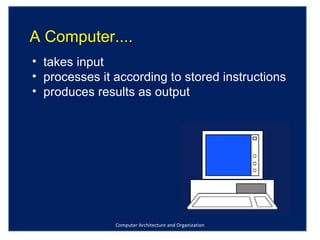
Computer Architecture and Organization A Computer.... takes input processes it according to stored instructions produces results as output
Computer Architecture and Organization A Computer.... The word computer was taken from the Latin –  Computare  – which means ‘calculate’ Computer  is a machine that only can  execute instructions  that given by  the user  and operate the data base on the related instruction. The computer will  process  the data to  produce information .
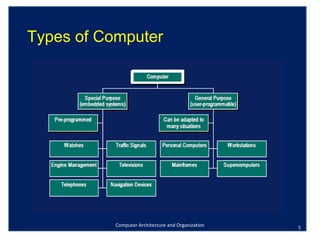
Computer Architecture and Organization Types of Computer
Computer Architecture and Organization Data  vs  Information  Data  is a raw fact. There are 5 types of data: Text :  alphabetic, numeric, special symbol Graphics :  picture Audio: any kind of sound Video: a series of photograph frame which record the real Animation: A series of image which is displayed one by one to produce a movement illusion Information –  data that has been processed  and contains meaning.
Computer Architecture and Organization Structure Function Is the way how each component/unit of computer communicates to each other. Refers to the operation of each component which include in a structure.
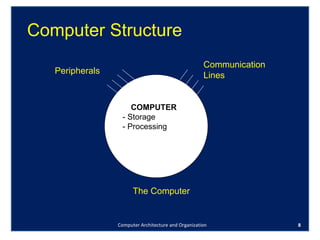
Computer Structure Computer Architecture and Organization Communication Lines Peripherals The Computer COMPUTER - Storage - Processing
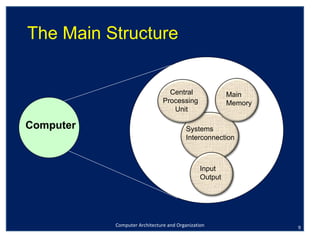
Computer Architecture and Organization The Main Structure Computer Main  Memory Input Output Systems Interconnection Central Processing  Unit
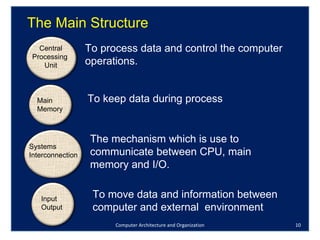
Computer Architecture and Organization Central Processing  Unit To process data and control the computer operations. Main  Memory To keep data during process The Main Structure Systems Interconnection The mechanism which is use to communicate between CPU, main memory and I/O. Input Output To move data and information between computer and external  environment
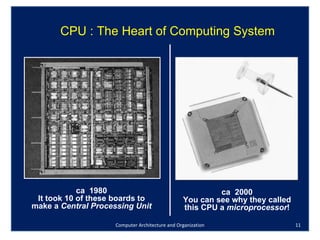
Computer Architecture and Organization ca  2000 You can see why they called this CPU a  microprocessor ! ca  1980 It took 10 of these boards to make a  Central Processing Unit CPU : The Heart of Computing System
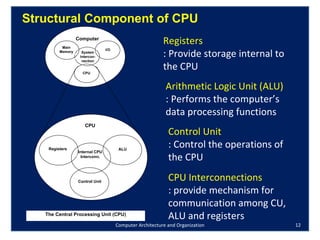
Computer Architecture and Organization Structural Component of CPU Registers : Provide storage internal to the CPU Arithmetic Logic Unit (ALU) : Performs the computer’s data processing functions Control Unit : Control the operations of the CPU CPU Interconnections : provide mechanism for communication among CU, ALU and registers Computer Main Memory CPU I/O System Intercon-nection The Central Processing Unit (CPU) Registers Control Unit ALU Internal CPU Interconn. CPU
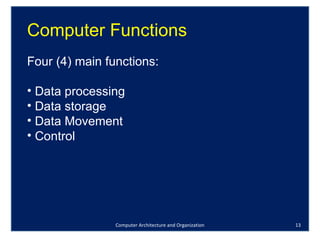
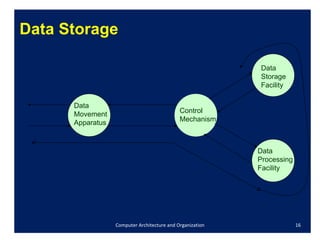
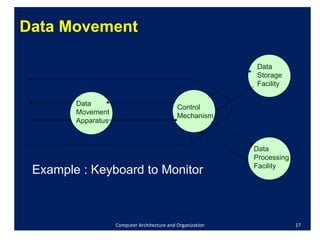
Computer Architecture and Organization Computer Functions Four (4) main functions: Data processing Data storage Data Movement Control
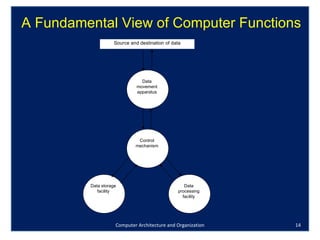
Computer Architecture and Organization A Fundamental View of Computer Functions Data movement apparatus Control mechanism Data storage facility Data processing facility Source and destination of data
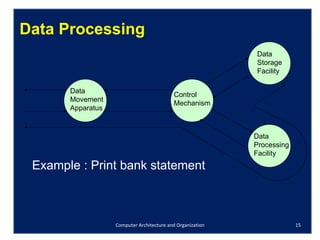
Computer Architecture and Organization Data Processing Example : Print bank statement Data Movement Apparatus Control Mechanism Data Storage Facility Data Processing Facility
Computer Architecture and Organization Data Storage Data Movement Apparatus Control Mechanism Data Storage Facility Data Processing Facility
Computer Architecture and Organization Data Movement Apparatus Control Mechanism Data Storage Facility Data Processing Facility Data Movement Example : Keyboard to Monitor
Computer Architecture and Organization COMPUTER SYSTEM?
Computer System Computer Architecture and Organization Basically it is divided into :  Computer Architecture Computer Organization
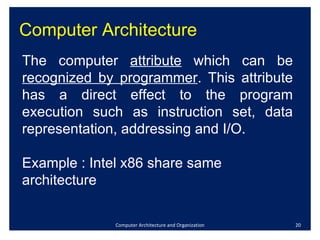
Computer Architecture Computer Architecture and Organization The computer  attribute  which can be  recognized by programmer . This attribute has a direct effect to the program execution such as instruction set, data representation, addressing and I/O. Example : Intel x86 share same architecture
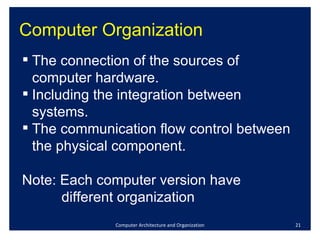
Computer Organization Computer Architecture and Organization The connection of the sources of computer hardware. Including the integration between systems. The communication flow control between the physical component. Note: Each computer version have  different organization
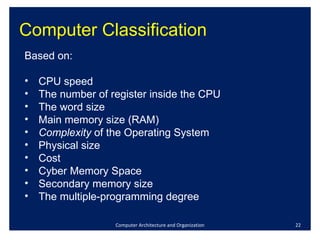
Computer Classification Computer Architecture and Organization Based on: CPU speed The number of register inside the CPU The word size Main memory size (RAM) Complexity  of the Operating System Physical size Cost  Cyber Memory Space Secondary memory size The multiple-programming degree
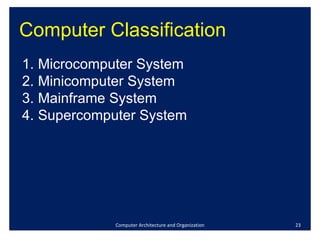
Computer Classification Computer Architecture and Organization Microcomputer System Minicomputer System Mainframe System Supercomputer System
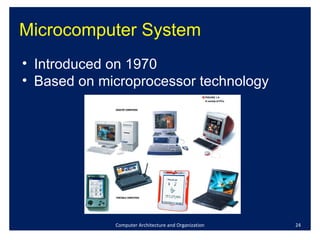
Microcomputer System Computer Architecture and Organization Introduced on 1970 Based on microprocessor technology
Minicomputer System Computer Architecture and Organization Able to execute arithmetic function and basic  logic and supports the number of programming  language for enormous computer. The size is smaller than a main frame.  Suitable for the processing task which doesn’t  need the huge date access.
Mainframe System  Computer Architecture and Organization Bigger then minicomputer. The processing capability is higher than  minicomputer. Very suitable to operate the gigantic database  which needs a central management.  Always used by big company and government.  Example. : KWSP & bank.
The IBM 7094, a typical mainframe computer [photo courtesy of IBM]  Computer Architecture and Organization
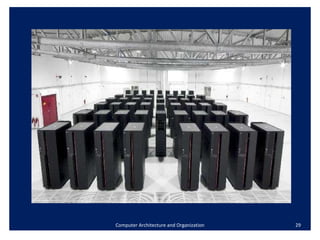
Supercomputer System  Computer Architecture and Organization The highest processing capability. Able to execute million of instructions per  second (MIPS).  Suitable for huge calculation which includes the  big value and needs efficiency. Example: Aerospace & nuclear
Computer Architecture and Organization
Two Pillars of Computing  Computer Architecture and Organization 1. Universal Computing Devices Given enough time and memory, all computers are capable of computing exactly the same things (irrespective of speed, size or cost). Turing’s Thesis: every computation can be  performed by some “ Turing Machine ”.
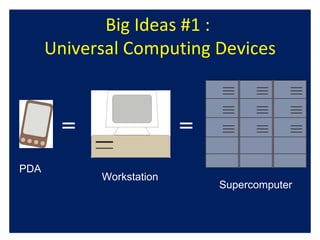
Computer Architecture and Organization Big Ideas #1 :  Universal Computing Devices = = PDA Workstation Supercomputer
Turing Machine Computer Architecture and Organization is a theoretical device that manipulates symbols on a strip of tape according to a table of rules. Despite its simplicity, a Turing machine can be adapted to simulate the logic of any computer algorithm, and is particularly useful in explaining the functions of a CPU inside a computer. Read more : http://www.mapageweb.umontreal.ca/cousined/lego/5-machines/turing/turing.html
From Theory to Practice Computer Architecture and Organization In theory, computer can  compute  anything  that’s possible to compute - given enough  memory  and  time In practice,  solving problems   involves    computing under constraints. Time - weather forecast, next frame of animation, ...  Cost - cell phone, automotive engine controller, ... Power - cell phone, handheld video game, ...
Two Pillars of Computing (Cont’)  Computer Architecture and Organization 2.  Problem Transformation The ultimate objective is to transform a  problem expressed in natural language into  electrons running around a circuit! That’s what Computer Science and  Computer Engineering are all about: a  continuum that embraces software &  hardware .
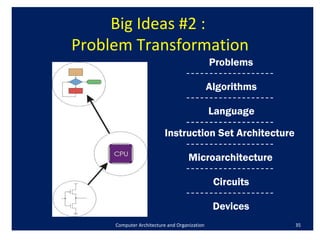
Computer Architecture and Organization Big Ideas #2 :  Problem Transformation Problems Language Instruction Set Architecture  Microarchitecture Circuits Devices Algorithms
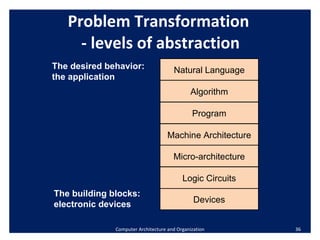
Problem Transformation  - levels of abstraction The desired behavior: the application The building blocks:  electronic devices Computer Architecture and Organization Natural Language Algorithm Program Machine Architecture Devices Micro-architecture Logic Circuits
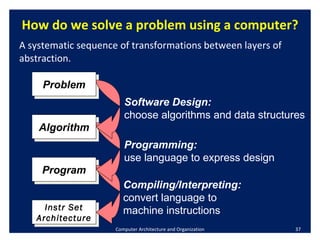
How do we solve a problem using a computer? A systematic sequence of transformations between layers of abstraction. Computer Architecture and Organization Problem Algorithm Program Software Design: choose algorithms and data structures Programming: use language to express design Instr Set Architecture Compiling/Interpreting: convert language to  machine instructions
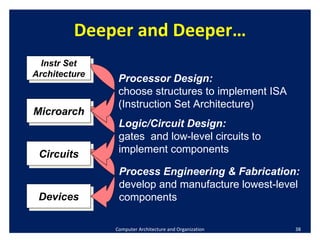
Deeper and Deeper… Computer Architecture and Organization Instr Set Architecture Microarch Circuits Processor Design: choose structures to implement ISA  (Instruction Set Architecture) Logic/Circuit Design: gates  and low-level circuits to implement components Devices Process Engineering & Fabrication: develop and manufacture lowest-level  components
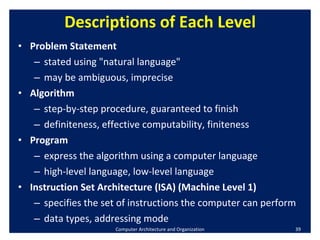
Descriptions of Each Level Problem Statement stated using "natural language" may be ambiguous, imprecise Algorithm step-by-step procedure, guaranteed to finish definiteness, effective computability, finiteness Program express the algorithm using a computer language high-level language, low-level language Instruction Set Architecture (ISA) (Machine Level 1) specifies the set of instructions the computer can perform data types, addressing mode Computer Architecture and Organization
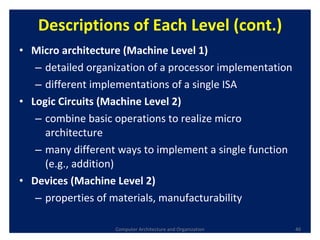
Descriptions of Each Level (cont.) Micro architecture (Machine Level 1) detailed organization of a processor implementation different implementations of a single ISA Logic Circuits (Machine Level 2) combine basic operations to realize micro architecture many different ways to implement a single function  (e.g., addition) Devices (Machine Level 2) properties of materials, manufacturability Computer Architecture and Organization
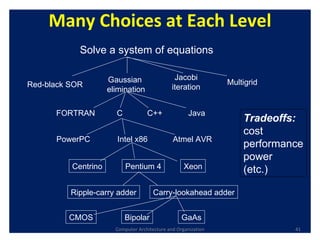
Many Choices at Each Level Computer Architecture and Organization Tradeoffs: cost performance power (etc.) Solve a system of equations Gaussian  elimination Jacobi iteration Red-black SOR Multigrid FORTRAN C C++ Java Intel x86 PowerPC Atmel AVR Centrino Pentium 4 Xeon Ripple-carry adder Carry-lookahead adder CMOS Bipolar GaAs
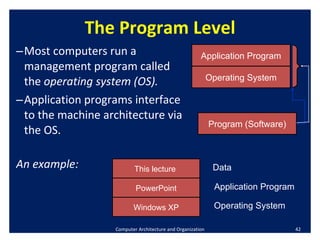
The Program Level Most computers run a management program called the  operating system (OS). Application programs interface to the machine architecture via the OS. An example: Computer Architecture and Organization Application Program Operating System Program (Software) This lecture  PowerPoint Windows XP Data Application Program Operating System
Computer Architecture and Organization The History & Evolution Of Computer Basically, the history of computer development is divided into 2 parts :  before 1940 & after 1940 .
Computer Architecture and Organization A long time ago, human are using their  fingers, stones etc to do calculation. At the  same time, they are trying to create an  apparatus that could facilitate the calculation  process.  After a few trial, finally the complex and  advance calculation system has been  produced and it is known as a computer.
Before Computer Architecture and Organization 1940
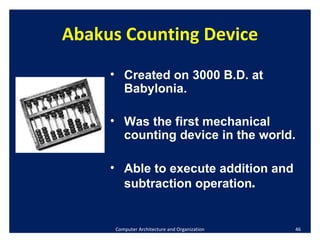
Computer Architecture and Organization Created on 3000 B.D. at Babylonia. Was the first mechanical counting device in the world. Able to execute addition and subtraction operation . Abakus Counting Device
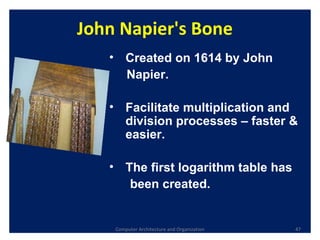
Computer Architecture and Organization John Napier's Bone Created on 1614 by John  Napier. Facilitate multiplication and division processes – faster & easier.  The first logarithm table has  been created.
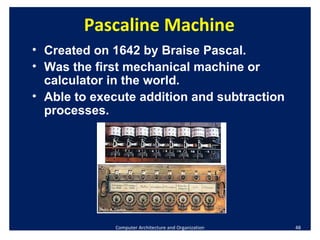
Computer Architecture and Organization Pascaline Machine Created on 1642 by Braise Pascal. Was the first mechanical machine or calculator in the world. Able to execute addition and subtraction processes.
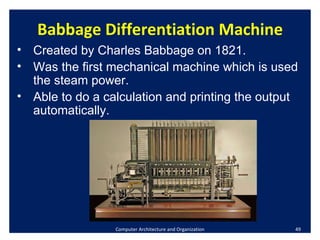
Computer Architecture and Organization Babbage Differentiation Machine Created by Charles Babbage on 1821. Was the first mechanical machine which is used the steam power. Able to do a calculation and printing the output automatically.
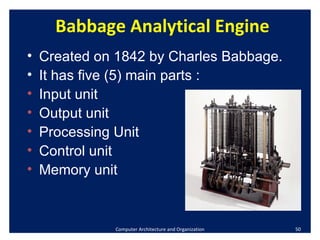
Computer Architecture and Organization Babbage Analytical Engine Created on 1842 by Charles Babbage.  It has five (5) main parts : Input unit Output unit Processing Unit Control unit Memory unit
Computer Architecture and Organization His invention has became a theory model for today's  computer technology. Because of that, Charles Babbage has been known as  The Ancestor of A Modern Computer .
After Computer Architecture and Organization 1940
Computer Architecture and Organization This part indicates the starting point of computer generation. The computer which used electrical power has been introduced. Starting Point
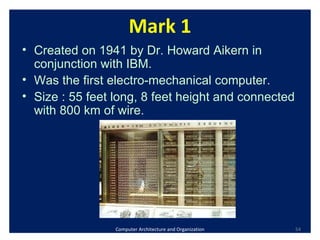
Computer Architecture and Organization Mark 1 Created on 1941 by Dr. Howard Aikern in conjunction with IBM. Was the first electro-mechanical computer. Size : 55 feet long, 8 feet height and connected with 800 km of wire.
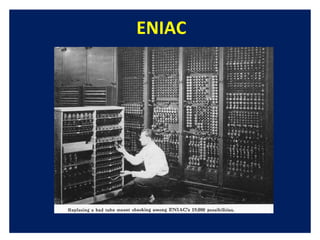
Computer Architecture and Organization ENIAC Electronic Numerical Integrator And Computer Was the first electronic computer.  Created on 1946 by J. Presper Eckert & John W. Munchly from the  University of Pennsylvania . Was used until  1955. Contained of 18,000 vacuum tubes, 70,000 resistors, 10,000 capacitors and 15,000 sq feet of space is needed. Needs 150 kW power and the weight is 30 ton. Used decimal number and 20 accumulators of 10 digits. digit. Able to execute 5,000 addition process per second. 1,000 times faster than Mark 1.
Computer Architecture and Organization ENIAC
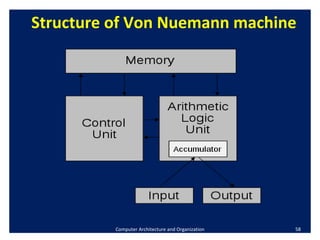
Von Neumann/Turing Apply the concept of embedded code. Main memory keeps the program and data. ALU uses binary data. CU interpret the instruction from memory during the execution.  CU also controls I/O operation. Princeton Institute for Advanced Studies  IAS Completed 1952 Computer Architecture and Organization
Computer Architecture and Organization Structure of Von Nuemann machine
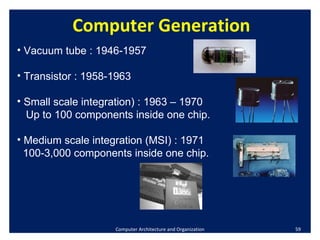
Computer Architecture and Organization Computer Generation Vacuum tube : 1946-1957  Transistor : 1958-1963 Small scale integration) : 1963 – 1970 Up to 100 components inside one chip. Medium scale integration (MSI) : 1971 100-3,000 components inside one chip.
Computer Architecture and Organization Large scale integration (LSI) : 1971-1977 3,000 - 100,000 components inside one chip. Very large  scale integration (VLSI) ) : 1978 – now 100,000 - 100,000,000 components inside one chip. Ultra large scale integration Over 100,000,000 components inside one chip. Computer Generation
Extra references http://www.softlord.com /comp/ http://www.studyweb.com/ComputerScience / Computer Architecture and Organization
REFLECTION You have to know the importance of learning this subject. You have to know the main component of a computer.  You have to know the computer functions.  You have to know the computer classification and separate the usage. You have to know the computer evolution. Computer Architecture and Organization
DISCUSSIONS Huraikah apakah yang boleh dilakukan oleh sesebuah komputer? Bincangkan apakah sebab yang telah mendorong manusia untuk mencipta komputer? Bincangkan apakah sebab yang telah mendorong kepada evolusi komputer? Bincangkan apakah faktor yang telah mendorong kepada perubahan generasi komputer? Computer Architecture and Organization
Think!! You don’t need to know everything, the only thing you have to know is how to get it when you want to use it Enstein Computer Architecture and Organization
   http://www.youtube.com/watch?v=tXLxcCTwr2E&feature=player_detailpage/ http:// www.youtube.com/watch?v=PSFh-ME83Bk&feature=player_detailpage/ Computer Architecture and Organization http://www.youtube.com/watch?v=SD0W0_J_28A&feature=player_detailpage/ Computer in Future....

Ntroduction to computer architecture and organization

  • 1.
    An Introduction toComputer Architecture and Organization Asmara Alias
  • 2.
    LEARNING OBJECTIVES Todescribe the meaning of computer system. To describe the structure and functions of computer. To classify the computer To state the evolution and history of computer development Computer Architecture and Organization
  • 3.
    Computer Architecture andOrganization A Computer.... takes input processes it according to stored instructions produces results as output
  • 4.
    Computer Architecture andOrganization A Computer.... The word computer was taken from the Latin – Computare – which means ‘calculate’ Computer is a machine that only can execute instructions that given by the user and operate the data base on the related instruction. The computer will process the data to produce information .
  • 5.
    Computer Architecture andOrganization Types of Computer
  • 6.
    Computer Architecture andOrganization Data vs Information Data is a raw fact. There are 5 types of data: Text : alphabetic, numeric, special symbol Graphics : picture Audio: any kind of sound Video: a series of photograph frame which record the real Animation: A series of image which is displayed one by one to produce a movement illusion Information – data that has been processed and contains meaning.
  • 7.
    Computer Architecture andOrganization Structure Function Is the way how each component/unit of computer communicates to each other. Refers to the operation of each component which include in a structure.
  • 8.
    Computer Structure ComputerArchitecture and Organization Communication Lines Peripherals The Computer COMPUTER - Storage - Processing
  • 9.
    Computer Architecture andOrganization The Main Structure Computer Main Memory Input Output Systems Interconnection Central Processing Unit
  • 10.
    Computer Architecture andOrganization Central Processing Unit To process data and control the computer operations. Main Memory To keep data during process The Main Structure Systems Interconnection The mechanism which is use to communicate between CPU, main memory and I/O. Input Output To move data and information between computer and external environment
  • 11.
    Computer Architecture andOrganization ca 2000 You can see why they called this CPU a microprocessor ! ca 1980 It took 10 of these boards to make a Central Processing Unit CPU : The Heart of Computing System
  • 12.
    Computer Architecture andOrganization Structural Component of CPU Registers : Provide storage internal to the CPU Arithmetic Logic Unit (ALU) : Performs the computer’s data processing functions Control Unit : Control the operations of the CPU CPU Interconnections : provide mechanism for communication among CU, ALU and registers Computer Main Memory CPU I/O System Intercon-nection The Central Processing Unit (CPU) Registers Control Unit ALU Internal CPU Interconn. CPU
  • 13.
    Computer Architecture andOrganization Computer Functions Four (4) main functions: Data processing Data storage Data Movement Control
  • 14.
    Computer Architecture andOrganization A Fundamental View of Computer Functions Data movement apparatus Control mechanism Data storage facility Data processing facility Source and destination of data
  • 15.
    Computer Architecture andOrganization Data Processing Example : Print bank statement Data Movement Apparatus Control Mechanism Data Storage Facility Data Processing Facility
  • 16.
    Computer Architecture andOrganization Data Storage Data Movement Apparatus Control Mechanism Data Storage Facility Data Processing Facility
  • 17.
    Computer Architecture andOrganization Data Movement Apparatus Control Mechanism Data Storage Facility Data Processing Facility Data Movement Example : Keyboard to Monitor
  • 18.
    Computer Architecture andOrganization COMPUTER SYSTEM?
  • 19.
    Computer System ComputerArchitecture and Organization Basically it is divided into : Computer Architecture Computer Organization
  • 20.
    Computer Architecture ComputerArchitecture and Organization The computer attribute which can be recognized by programmer . This attribute has a direct effect to the program execution such as instruction set, data representation, addressing and I/O. Example : Intel x86 share same architecture
  • 21.
    Computer Organization ComputerArchitecture and Organization The connection of the sources of computer hardware. Including the integration between systems. The communication flow control between the physical component. Note: Each computer version have different organization
  • 22.
    Computer Classification ComputerArchitecture and Organization Based on: CPU speed The number of register inside the CPU The word size Main memory size (RAM) Complexity of the Operating System Physical size Cost Cyber Memory Space Secondary memory size The multiple-programming degree
  • 23.
    Computer Classification ComputerArchitecture and Organization Microcomputer System Minicomputer System Mainframe System Supercomputer System
  • 24.
    Microcomputer System ComputerArchitecture and Organization Introduced on 1970 Based on microprocessor technology
  • 25.
    Minicomputer System ComputerArchitecture and Organization Able to execute arithmetic function and basic logic and supports the number of programming language for enormous computer. The size is smaller than a main frame. Suitable for the processing task which doesn’t need the huge date access.
  • 26.
    Mainframe System Computer Architecture and Organization Bigger then minicomputer. The processing capability is higher than minicomputer. Very suitable to operate the gigantic database which needs a central management. Always used by big company and government. Example. : KWSP & bank.
  • 27.
    The IBM 7094,a typical mainframe computer [photo courtesy of IBM] Computer Architecture and Organization
  • 28.
    Supercomputer System Computer Architecture and Organization The highest processing capability. Able to execute million of instructions per second (MIPS). Suitable for huge calculation which includes the big value and needs efficiency. Example: Aerospace & nuclear
  • 29.
  • 30.
    Two Pillars ofComputing Computer Architecture and Organization 1. Universal Computing Devices Given enough time and memory, all computers are capable of computing exactly the same things (irrespective of speed, size or cost). Turing’s Thesis: every computation can be performed by some “ Turing Machine ”.
  • 31.
    Computer Architecture andOrganization Big Ideas #1 : Universal Computing Devices = = PDA Workstation Supercomputer
  • 32.
    Turing Machine ComputerArchitecture and Organization is a theoretical device that manipulates symbols on a strip of tape according to a table of rules. Despite its simplicity, a Turing machine can be adapted to simulate the logic of any computer algorithm, and is particularly useful in explaining the functions of a CPU inside a computer. Read more : http://www.mapageweb.umontreal.ca/cousined/lego/5-machines/turing/turing.html
  • 33.
    From Theory toPractice Computer Architecture and Organization In theory, computer can compute anything that’s possible to compute - given enough memory and time In practice, solving problems involves computing under constraints. Time - weather forecast, next frame of animation, ... Cost - cell phone, automotive engine controller, ... Power - cell phone, handheld video game, ...
  • 34.
    Two Pillars ofComputing (Cont’) Computer Architecture and Organization 2. Problem Transformation The ultimate objective is to transform a problem expressed in natural language into electrons running around a circuit! That’s what Computer Science and Computer Engineering are all about: a continuum that embraces software & hardware .
  • 35.
    Computer Architecture andOrganization Big Ideas #2 : Problem Transformation Problems Language Instruction Set Architecture Microarchitecture Circuits Devices Algorithms
  • 36.
    Problem Transformation - levels of abstraction The desired behavior: the application The building blocks: electronic devices Computer Architecture and Organization Natural Language Algorithm Program Machine Architecture Devices Micro-architecture Logic Circuits
  • 37.
    How do wesolve a problem using a computer? A systematic sequence of transformations between layers of abstraction. Computer Architecture and Organization Problem Algorithm Program Software Design: choose algorithms and data structures Programming: use language to express design Instr Set Architecture Compiling/Interpreting: convert language to machine instructions
  • 38.
    Deeper and Deeper…Computer Architecture and Organization Instr Set Architecture Microarch Circuits Processor Design: choose structures to implement ISA (Instruction Set Architecture) Logic/Circuit Design: gates and low-level circuits to implement components Devices Process Engineering & Fabrication: develop and manufacture lowest-level components
  • 39.
    Descriptions of EachLevel Problem Statement stated using "natural language" may be ambiguous, imprecise Algorithm step-by-step procedure, guaranteed to finish definiteness, effective computability, finiteness Program express the algorithm using a computer language high-level language, low-level language Instruction Set Architecture (ISA) (Machine Level 1) specifies the set of instructions the computer can perform data types, addressing mode Computer Architecture and Organization
  • 40.
    Descriptions of EachLevel (cont.) Micro architecture (Machine Level 1) detailed organization of a processor implementation different implementations of a single ISA Logic Circuits (Machine Level 2) combine basic operations to realize micro architecture many different ways to implement a single function (e.g., addition) Devices (Machine Level 2) properties of materials, manufacturability Computer Architecture and Organization
  • 41.
    Many Choices atEach Level Computer Architecture and Organization Tradeoffs: cost performance power (etc.) Solve a system of equations Gaussian elimination Jacobi iteration Red-black SOR Multigrid FORTRAN C C++ Java Intel x86 PowerPC Atmel AVR Centrino Pentium 4 Xeon Ripple-carry adder Carry-lookahead adder CMOS Bipolar GaAs
  • 42.
    The Program LevelMost computers run a management program called the operating system (OS). Application programs interface to the machine architecture via the OS. An example: Computer Architecture and Organization Application Program Operating System Program (Software) This lecture PowerPoint Windows XP Data Application Program Operating System
  • 43.
    Computer Architecture andOrganization The History & Evolution Of Computer Basically, the history of computer development is divided into 2 parts : before 1940 & after 1940 .
  • 44.
    Computer Architecture andOrganization A long time ago, human are using their fingers, stones etc to do calculation. At the same time, they are trying to create an apparatus that could facilitate the calculation process. After a few trial, finally the complex and advance calculation system has been produced and it is known as a computer.
  • 45.
    Before Computer Architectureand Organization 1940
  • 46.
    Computer Architecture andOrganization Created on 3000 B.D. at Babylonia. Was the first mechanical counting device in the world. Able to execute addition and subtraction operation . Abakus Counting Device
  • 47.
    Computer Architecture andOrganization John Napier's Bone Created on 1614 by John Napier. Facilitate multiplication and division processes – faster & easier. The first logarithm table has been created.
  • 48.
    Computer Architecture andOrganization Pascaline Machine Created on 1642 by Braise Pascal. Was the first mechanical machine or calculator in the world. Able to execute addition and subtraction processes.
  • 49.
    Computer Architecture andOrganization Babbage Differentiation Machine Created by Charles Babbage on 1821. Was the first mechanical machine which is used the steam power. Able to do a calculation and printing the output automatically.
  • 50.
    Computer Architecture andOrganization Babbage Analytical Engine Created on 1842 by Charles Babbage. It has five (5) main parts : Input unit Output unit Processing Unit Control unit Memory unit
  • 51.
    Computer Architecture andOrganization His invention has became a theory model for today's computer technology. Because of that, Charles Babbage has been known as The Ancestor of A Modern Computer .
  • 52.
    After Computer Architectureand Organization 1940
  • 53.
    Computer Architecture andOrganization This part indicates the starting point of computer generation. The computer which used electrical power has been introduced. Starting Point
  • 54.
    Computer Architecture andOrganization Mark 1 Created on 1941 by Dr. Howard Aikern in conjunction with IBM. Was the first electro-mechanical computer. Size : 55 feet long, 8 feet height and connected with 800 km of wire.
  • 55.
    Computer Architecture andOrganization ENIAC Electronic Numerical Integrator And Computer Was the first electronic computer. Created on 1946 by J. Presper Eckert & John W. Munchly from the University of Pennsylvania . Was used until 1955. Contained of 18,000 vacuum tubes, 70,000 resistors, 10,000 capacitors and 15,000 sq feet of space is needed. Needs 150 kW power and the weight is 30 ton. Used decimal number and 20 accumulators of 10 digits. digit. Able to execute 5,000 addition process per second. 1,000 times faster than Mark 1.
  • 56.
    Computer Architecture andOrganization ENIAC
  • 57.
    Von Neumann/Turing Applythe concept of embedded code. Main memory keeps the program and data. ALU uses binary data. CU interpret the instruction from memory during the execution. CU also controls I/O operation. Princeton Institute for Advanced Studies IAS Completed 1952 Computer Architecture and Organization
  • 58.
    Computer Architecture andOrganization Structure of Von Nuemann machine
  • 59.
    Computer Architecture andOrganization Computer Generation Vacuum tube : 1946-1957 Transistor : 1958-1963 Small scale integration) : 1963 – 1970 Up to 100 components inside one chip. Medium scale integration (MSI) : 1971 100-3,000 components inside one chip.
  • 60.
    Computer Architecture andOrganization Large scale integration (LSI) : 1971-1977 3,000 - 100,000 components inside one chip. Very large scale integration (VLSI) ) : 1978 – now 100,000 - 100,000,000 components inside one chip. Ultra large scale integration Over 100,000,000 components inside one chip. Computer Generation
  • 61.
    Extra references http://www.softlord.com/comp/ http://www.studyweb.com/ComputerScience / Computer Architecture and Organization
  • 62.
    REFLECTION You haveto know the importance of learning this subject. You have to know the main component of a computer. You have to know the computer functions. You have to know the computer classification and separate the usage. You have to know the computer evolution. Computer Architecture and Organization
  • 63.
    DISCUSSIONS Huraikah apakahyang boleh dilakukan oleh sesebuah komputer? Bincangkan apakah sebab yang telah mendorong manusia untuk mencipta komputer? Bincangkan apakah sebab yang telah mendorong kepada evolusi komputer? Bincangkan apakah faktor yang telah mendorong kepada perubahan generasi komputer? Computer Architecture and Organization
  • 64.
    Think!! You don’tneed to know everything, the only thing you have to know is how to get it when you want to use it Enstein Computer Architecture and Organization
  • 65.
    http://www.youtube.com/watch?v=tXLxcCTwr2E&feature=player_detailpage/ http:// www.youtube.com/watch?v=PSFh-ME83Bk&feature=player_detailpage/ Computer Architecture and Organization http://www.youtube.com/watch?v=SD0W0_J_28A&feature=player_detailpage/ Computer in Future....

Editor's Notes

  • #38 Sistem Komputer : Pengenalan Disediakan oleh : Saira Banu & Norasikin
  • #39 Sistem Komputer : Pengenalan Disediakan oleh : Saira Banu & Norasikin
  • #40 Sistem Komputer : Pengenalan Disediakan oleh : Saira Banu & Norasikin
  • #41 Sistem Komputer : Pengenalan Disediakan oleh : Saira Banu & Norasikin
  • #42 Sistem Komputer : Pengenalan Disediakan oleh : Saira Banu & Norasikin Sun and Java are trademarks of Sun Microsystems, Inc. Intel, Pentium, Centrino, and Xeon are trademarks of Intel Corporation. AMD and Athlon and trademarks of Advanced Micro Devices, Inc. Atmel and AVR are registered trademarks of Atmel Corporation. PowerPC is a trademark of International Business Machines Corporation.
  • #58 Sistem Komputer : Pengenalan Disediakan oleh : Saira Banu & Norasikin