21CSS201T
COMPUTER ORGANIZATION
AND ARCHITECTURE
UNIT-1
Course Learning Rationale (CLR):
• CLR-1: understand the Fundamentals of computers, Memory operations and
Addressing Modes
• CLR-2: know about Functions of Arithmetic and Logic unit
• CLR-3: explore the Operations of Control Unit, Execution of Instruction and Pipelining
• CLR-4: classify the Need for Parallelism, Multicore and Multiprocessor Systems
• CLR-5: understand the Concepts and functions of Memory unit, I/O unit
Course Outcomes (CO)
• CO-1: identify the computer hardware and how software interacts with computer
hardware
• CO-2: apply Boolean algebra as related to designing computer logic, through simple
combinational and sequential logic circuits
• CO-3: examine the detailed operation of Basic Processing units and the performance
of Pipelining
• CO-4: analyze concepts of parallelism and multi-core processors
• CO-5: classify the memory technologies, input-output systems and evaluate the
performance of memory system
Syllabus
• Introduction to Number System and Logic Gates: Number Systems- Binary, Decimal, Octal, Hexadecimal; Codes-
Grey, BCD, Excess-3, ASCII, Parity; Binary Arithmetic- Addition, Subtraction, Multiplication, Division using Sign
Magnitude,1’s compliment, 2’s compliment, BCD Arithmetic; Logic Gates-AND, OR, NOT, NAND, NOR, EX-OR, EX-
NOR.
5
⮚Know the difference between computer organization and computer
architecture.
⮚Understand units of measure common to computer systems
⮚Appreciate the evolution of computers.
⮚Understand the computer as a layered system.
⮚Be able to explain the von Neumann architecture and the function of basic
computer components.
Computer Architecture
Objectives
6
• A modern computer is an electronic, digital, general purpose computing machine that
automatically follows a step-by-step list of instructions to solve a problem. This step-by step
list of instructions that a computer follows is also called an algorithm or a computer
program.
• Why to study computer organization and architecture?
• Design better programs, including system software such as compilers, operating
systems, and device drivers.
• Optimize program behavior.
• Evaluate (benchmark) computer system performance.
• Understand time, space, and price tradeoffs.
• Computer organization
• Encompasses all physical aspects of computer systems.
• E.g., circuit design, control signals, memory types.
• How does a computer work?
COMPUTER ARCHITECTURE AND ORGANIZATION OVERVIEW
⮚Focuses on the structure (the way in which the components are interrelated) and
behavior of the computer system and refers to the logical aspects of system
implementation as seen by the programmer
⮚Computer architecture includes many elements such as
instruction sets and formats, operation codes, data types, the number and types of
registers, addressing modes, main memory access methods, and various I/O
mechanisms.
⮚The architecture of a system directly affects the logical execution of programs.
⮚The computer architecture for a given machine is the combination of its hardware
components plus its instruction set architecture (ISA).
⮚The ISA is the interface between all the software that runs on the machine and the hard
⮚Studying computer architecture helps us to answer the question: How do I design a
computer?
7
COMPUTER ARCHITECTURE AND ORGANIZATION OVERVIEW
8
⮚In the case of the IBM, SUN and Intel ISAs, it is possible to purchase processors which
execute the same instructions from more than one manufacturer
⮚All these processors may have quite different internal organizations, but they all appear
identical to a programmer, because their instruction sets are the same
⮚Organization & Architecture enables a family of computer models
▪ Same Architecture, but with differences in Organization
▪ Different price and performance characteristics
⮚When technology changes, only organization changes.
⮚This gives code compatibility (backwards)
COMPUTER ARCHITECTURE AND ORGANIZATION OVERVIEW
9
COMPUTER COMPONENTS
At the most basic level, a computer is a device consisting of 3 pieces
A processor to interpret and execute programs
A memory ( Includes Cache, RAM, ROM) to store both data and
program instructions
A mechanism for transferring data to and from the outside world.
⮚ I/O to communicate between computer and the world
⮚ Bus to move info from one computer component to another
10
Contd..
• Computers with large main memory capacity can run larger programs with
greater speed than computers having small memories.
• RAM is an acronym for random access memory. Random access means that
memory contents can be accessed directly if you know its location.
• Cache is a type of temporary memory that can be accessed faster than RAM.
12
⮚Through the principle of abstraction, we can imagine the machine to be built from
a hierarchy of levels, in which each level has a specific function and exists as a
distinct hypothetical Machine
⮚Abstraction is the ability to focus on important aspects of a situation at a higher
level while ignoring the underlying complex details
⮚We call the hypothetical computer at each level a virtual machine.
⮚Each level’s virtual machine executes its own particular set of instructions,
calling upon machines at lower levels to carry out the tasks when necessary
The Computer Level Hierarchy
Level 6: The User Level
• Composed of applications and is the level with which everyone is most familiar.
• At this level, we run programs such as word processors, graphics packages, or games.
• The lower levels are nearly invisible from the User Level.
13
The Computer Level Hierarchy
Level 5: High-Level Language Level
• The level with which we interact when we write programs in languages such
as C, Pascal, Lisp, and Java
• These languages must be translated to a language the machine can understand.
(using compiler / interpreter)
• Compiled languages are translated into assembly language and then
assembled into machine code. (They are translated to the next lower level.)
• The user at this level sees very little of the lower levels
14
The Computer Level Hierarchy
15
Level 4: Assembly Language Level
• Acts upon assembly language produced from Level 5, as well as instructions
programmed directly at this level
• As previously mentioned, compiled higher-level languages are first translated to
assembly, which is then directly translated to machine language. This is a one-to-one
translation, meaning that one assembly language instruction is translated to exactly
one machine language instruction.
• By having separate levels, we reduce the semantic gap between a high-level
language and the actual machine language
The Computer Level Hierarchy
Level 3: System Software Level
• deals with operating system instructions.
• This level is responsible for multiprogramming, protecting memory,
synchronizing processes, and various other important functions.
• Often, instructions translated from assembly language to machine language are
passed through this level unmodified
16
The Computer Level Hierarchy
Level 2: Machine Level
• Consists of instructions (ISA)that are particular to the architecture of the
machine
• Programs written in machine language need no compilers, interpreters, or
assemblers
Level 1: Control Level
• A control unit decodes and executes instructions and moves data through the
system.
• Control units can be microprogrammed or hardwired
• A microprogram is a program written in a low-level language that is
implemented by the hardware.
• Hardwired control units consist of hardware that directly executes machine
instruction
17
The Computer Level Hierarchy
Level 0: Digital Logic Level
• This level is where we find digital circuits (the chips)
• Digital circuits consist of gates and wires.
• These components implement the mathematical logic of all other levels
18
The Computer Level Hierarchy
Introduction to Number System and
Logic Gates
⮚Number Systems- Binary, Decimal, Octal, Hexadecimal
⮚Codes- Grey, BCD,Excess-3,
⮚ASCII, Parity
⮚Binary Arithmetic- Addition, Subtraction, Multiplication, Division using
Sign Magnitude
⮚1’s complement, 2’s complement,
⮚BCD Arithmetic;
⮚ Logic Gates-AND, OR, NOT, NAND,
⮚NOR, EX-OR, EX-NOR
Chapter 1 20
Digital System
• Takes a set of discrete information inputs and discrete internal information
(system state) and generates a set of discrete information outputs.
System
State
Discrete
Information
Processing
System
Discret
e
Inputs Discret
e
Outputs
Chapter 1 22
Signal Examples Over Time
Analog
Asynchronous
Synchronous
Time
Continuous
in value &
time
Discrete in
value &
continuous
in time
Discrete in
value & time
Digital
Computer-System Architecture
Most systems use a single general-purpose processor
Most systems have special-purpose processors as well
Multiprocessors systems growing in use and importance
Also known as parallel systems, tightly-coupled systems
Advantages include:
1. Increased throughput
2. Economy of scale
3. Increased reliability – graceful degradation or fault tolerance
Two types:
1. Asymmetric Multiprocessing – each processor is assigned a specific task.
2. Symmetric Multiprocessing – each processor performs all tasks
*
21CSC202J Operating Systems
UNIT 1
24
Single
Processor
Multi
Processor
Cluster
system
25
26
Dual-Core Design
Multi-chip and multicore
Systems containing all chips
Chassis containing multiple separate systems
*
21CSC202J Operating Systems
UNIT 1
27
Symmetric Multiprocessing Architecture
(10.25)10 to Binary
Octal
Hexa
BINARY ARITHMETIC
Signed Binary Numbers
• Two ways of representing signed numbers:
• 1) Sign-magnitude form, 2) Complement form.
• Most of computers use complement form for negative number notation.
• 1’s complement and 2’s complement are two different methods in this
type.
21CSS201T-COA 54
1’s Complement
• 1’s complement of a binary number is obtained by
subtracting each digit of that binary number from 1.
• Example
21CSS201T-COA 55
Shortcut: Invert the numbers from 0 to 1
and 1 to 0
2’s Complement
• 2’s complement of a binary number is obtained by
adding 1 to its 1’s complement.
• Example
21CSS201T-COA 56
Shortcut: Starting from right side, all bits are same till first 1 occurs and then invert
rest of the bits
Subtraction using 1’s complement
• Using 1’s complement
• Obtain 1’s complement of subtrahend
• Add the result to minuend and call it intermediate result
• If carry is generated then answer is positive and add the carry to Least
Significant Digit (LSD)
• If there is no carry then answer is negative and take 1’s complement of
intermediate result and place negative sign to the result.
21CSS201T-COA 57
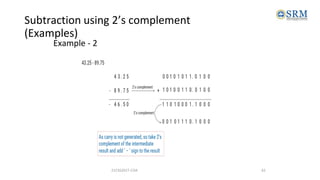
Subtraction using 2’s complement
• Using 2’s complement
• Obtain 2’s complement of subtrahend
• Add the result to minuend
• If carry is generated then answer is positive, ignore carry and result itself is
answer
• If there is no carry then answer is negative and take 2’s complement of
intermediate result and place negative sign to the result.
21CSS201T-COA 58
Subtraction using 1’s complement
(Examples)
Example - 1
21CSS201T-COA 59
Subtraction using 1’s complement
(Examples)
Example - 2
21CSS201T-COA 60
Subtraction using 2’s complement
(Examples)
Example - 1
21CSS201T-COA 61
Subtraction using 2’s complement
(Examples)
Example - 2
21CSS201T-COA 62
BCD ARITHMETIC
21CSS201T-COA 63
BCD Addition
Example - 1
21CSS201T-COA 64
Rule: If there is an illegal code or carry is generated as a result
of addition, then add 0110 to particular that 4 bits of
result.
BCD Addition
Example - 2
21CSS201T-COA 65
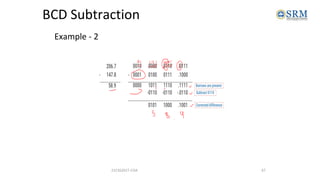
BCD Subtraction
Example - 1
21CSS201T-COA 66
Rule: If one 4-bit group needs to take borrow from neighbor, then
subtract 0110 from the group which is receiving borrow.
BCD Subtraction
Example - 2
21CSS201T-COA 67
GRAY CODE
• Gray code is the arrangement of binary number system such that each
incremental value can only differ by one bit.
• This code is also known as Reflected Binary Code (RBC), Cyclic
Code and Reflected Binary (RB). The reason for calling this code as
reflected binary code is the first N/2 values compared with those of the last
N/2 values in reverse order.
• In gray code when transverse from one step to another step the only one bit
will be change of the group. This means that the two adjacent code numbers
differ from each other by only one bit.
• It is popular for unit distance code but it is not use from arithmetic
operations. This code has some application like convert analog to digital,
error correction in digital communication.
21CSS201T-COA 70
Binary- Gray code conversion
• STEPS
• The most significant bit of gray code is equal to the first bit of the given
binary bit.
• The second bit of gray code will be exclusive-or (XOR) of the first and
second bit of the given binary bit.
• The third bit of gray code is equal to the exclusive-or (XOR) of the
second and third binary bits. For father gray code result this process will
be continuing.
71
21CSS201T-COA
Explanation
Truth Table of
XOR
A B C
0 0 0
0 1 1
1 0 1
1 1 0
• The given binary digit is 01001
Example
• The gray code of the given binary code is (010.01)2 ??
• The first MSB bit of binary is same in the first bit of gray code. In this example the
binary bit is “0”. So, gray bit also “0”.
• Next gray bit is equal to the XOR of the first and the second binary bit. The first bit is
0, and the second bit is 1. The bits are different so resultant gray bit will be “1” (second
gray codes bit)
• The XOR of the second and third binary bit. The second bit is 1 and third is 0. These
bits are again different so the resultant gray bit will be 1 (third gray codes bit)
• Next we perform the XOR operation on third and fourth binary bit. The third bit is 0,
and the fourth bit is 0. The both bits are same than resultant gray codes will be 0
(fourth gray codes bit).
• Take the XOR of the fourth and fifth binary bit. The fourth bit is 0 and fifth bit is 1.
These bits are different than resultant gray codes will be 1 (fifth gray code bit)
• The result of binary to gray codes conversion is 01101.
21CSS201T-COA 73
• You can convert n bit (bnb(n-1)…b2b1b0) binary number to gray code
(gng(n-1)…g2g1g0). For most significant bit bn=gn, and rest of the bit by
XORing b(n-1)=g(n-1)⊕gn, ….
21CSS201T-COA 74
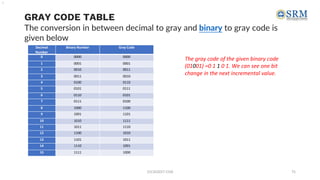
GRAY CODE TABLE
The conversion in between decimal to gray and binary to gray code is
given below
Decimal
Number
Binary Number Gray Code
0 0000 0000
1 0001 0001
2 0010 0011
3 0011 0010
4 0100 0110
5 0101 0111
6 0110 0101
7 0111 0100
8 1000 1100
9 1001 1101
10 1010 1111
11 1011 1110
12 1100 1010
13 1101 1011
14 1110 1001
15 1111 1000
21CSS201T-COA 75
:
The gray code of the given binary code
(01001) =0 1 1 0 1. We can see one bit
change in the next incremental value.
Gray-Binary code conversion
• STEPS
1.The most significant bit of gray codes is equal in binary number.
2.Now move to the next gray bit, as it is 1 the previous bit will be alter i.e it will be 1,
thus the second binary bit will be 1.
3.Next see the third bit, in this example the third bit is 1 again, the third binary bit will be
alter of second binary bit and the third binary bit will be 0.
4.Now fourth bit of the, here the fourth bit of gray code is 0. So the fourth bit will be
same as a previous binary bit, i.e 4th binary bit will be 0.
5.The last fifth bit of gray codes is 1; the fifth binary number is altering of fourth binary
number.
6.Therefore the gray code (01101) equivalent in binary number is (01001)
21CSS201T-COA 76
Explanation
• The given gray code is 01101
0 1 1 0 1 (Gray)
77
MSB LSB
Binary code Conversion
21CSS201T-COA
Truth Table of
XOR
A B C
0 0 0
0 1 1
1 0 1
1 1 0
Merits & Demerits of Gray Code
Advantages of gray code
❖ It is best for error minimization in conversion of analog to digital signals.
❖ It is best for minimize a logic circuit
❖ Decreases the “Hamming Walls” which is undesirable state, when used
in genetic algorithms
❖ It is useful in clock domain crossing
Disadvantages of gray code
• Not suitable for arithmetic operations
• It has limited use.
21CSS201T-COA 78
Chapter 1 79
Binary Codes for Decimal Digits
Decimal 8,4,2,1 Excess3 8,4,-2,-1 Gray
0 0000 0011 0000 0000
1 0001 0100 0111 0100
2 0010 0101 0110 0101
3 0011 0110 0101 0111
4 0100 0111 0100 0110
5 0101 1000 1011 0010
6 0110 1001 1010 0011
7 0111 1010 1001 0001
8 1000 1011 1000 1001
9 1001 1100 1111 1000
▪ There are over 8,000 ways that you can chose 10 elements from the 16
binary numbers of 4 bits. A few are useful:
Chapter 1 80
Binary Coded Decimal (BCD)
• The BCD code is the 8,4,2,1 code.
• This code is the simplest, most intuitive binary code for decimal
digits and uses the same powers of 2 as a binary number, but only
encodes the first ten values from 0 to 9.
• Example: 1001 (9) = 1000 (8) + 0001 (1)
• How many “invalid” code words are there?
• What are the “invalid” code words?
Chapter 1 81
• What interesting property is common to these two codes?
Excess 3 Code and 8, 4, –2, –1 Code
Decimal Excess 3 8, 4, –2, –1
0 0011 0000
1 0100 0111
2 0101 0110
3 0110 0101
4 0111 0100
5 1000 1011
6 1001 1010
7 1010 1001
8 1011 1000
9 1100 1111
Decimal to BCD
•
21CSS201T-COA 82
Binary to BCD conversion
•
21CSS201T-COA 83
Advantages of BCD
• Easy to encode and Decode decimals into BCD and Vice-versa
• Easy to implement a hardware algorithm for BCD converter
• Very useful in digital systems whenever decimal information reqd.
– Digital voltmeters, frequency converters and digital clocks all use BCD as
they display output information in decimal.
21CSS201T-COA 84
Disadvantages of BCD Code
• Require more bits than straight binary code
• Difficult to be used in high speed digital computer when the size and capacity
of their internal registers are restricted or limited.
• The arithmetic operations using BCD code require a complex design of
Arithmetic and Logic Unit (ALU) than the straight binary number system.
• The speed of the arithmetic operations that can be realized using BCD code is
naturally slow due to the complex hardware circuitry involved.
•
21CSS201T-COA 85
Excess-3 code
• The excess-3 code is also treated as XS-3 code. The
excess-3 code is a non-weighted and self-
complementary BCD code used to represent the decimal
numbers.
• This code has a biased representation. This code plays an
important role in arithmetic operations because it resolves
deficiencies encountered when we use the 8421 BCD
code for adding two decimal digits whose sum is greater
than 9.
• The Excess-3 code uses a special type of algorithm, which
differs from the binary positional number system or normal
non-biased BCD.
21CSS201T-COA 86
Decimal to Excess-3 code conversion
Step-1: We find the decimal number of the given binary number.
Step-2: Then we add 3 in each digit of the decimal number.
Step-3: Now, we find the binary code of each digit of the newly
generated decimal number.
Alternatively,
• We can also add 0011 in each 4-bit BCD code of the decimal
number for getting excess-3 code.
21CSS201T-COA 87
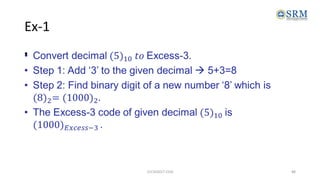
Ex-1
•
21CSS201T-COA 88
Ex-2
•
21CSS201T-COA 89
Ex-3
•
21CSS201T-COA 90
Excess-3 code
21CSS201T-COA 91
Ex-4
•
21CSS201T-COA 92
Decimal BCD
8 1000
1 0001
6 0110
1 0001
BCD+ 0011 Excess-3
1000+0011 1011
0001+0011 0100
0110+0011 1001
0001+0011 0100
Ex 5
• Convert (11110)2 to Excess-3 using binary
• Step 1: Convert binary to Decimal. (11110)2 = (30)10
• Step 2: Add ‘3’ to individual digits to decimal number
3 0
3 3
6 3
Step 3: Find binary values of (63)10 = (01100011)Excess-3
21CSS201T-COA 93
Ex 6
• Convert (01100011) Excess-3 to binary.
• Step- 1 : Find the decimal by dividing it four digits
• (01100011) Excess-3 = (0110 0011) Excess-3 = (30) 10
•Step-2 : Find the binary value of the decimal
thorugh division method.
(01100011) Excess-3 = (11110)2
21CSS201T-COA 94
Advantages
1.These codes are self-complementary.
2.These codes use biased representation.
3.The excess-3 code has no limitation, so that it considerably
simplifies arithmetic operations.
4.The codes 0000 and 1111 can cause a fault in the transmission
line. The excess-3 code doesn't use these codes and gives an
advantage for memory organization.
5.These codes are usually unweighted binary decimal codes.
6.This code has a vital role in arithmetic operations. It is because it
resolves deficiencies which are encountered when we use the
8421 BCD code for adding two decimal digits whose sum is greater
than 9.
21CSS201T-COA 95
ASCII
• The ASCII stands for American Standard Code for
Information Interchange. The ASCII code is an
alphanumeric code used for data communication in
digital computers.
• The ASCII is a 7-bit code capable of representing
27 or 128 number of different characters. The ASCII
code is made up of a three-bit group, which is
followed by a four-bit code.
21CSS201T-COA 96
ASCII Characters
• Control Characters-0 to 31 and 127
• Special Characters- 32 to 47, 58 to 64, 91 to 96, and 123 to
126
• Numbers Characters- 0 to 9
• Letters Characters - 65 to 90 and 97 to 122
• ASCII Character Set
21CSS201T-COA 97
Ex 1
• Encode
(10010101100001111011011000011010100111000011011111
101001 110111011101001000000011000101100100110011)2
to ASCII.
21CSS201T-COA 98
• Step 1:
• The given binary data is grouped into 7-bits because the
ASCII code is 7 bit.
• 1001010 1100001 1110110 1100001 1010100 1110000 1101111
1101001 1101110 1110100 1000000 0110001 0110010 0110011
• Step 2:
• Then, we find the equivalent decimal number of the binary
digits either from the ASCII table or 64 32 16 8 4 2 1 scheme.
21CSS201T-COA 99
Cont’d
21CSS201T-COA 100
Binary 64 32 16 8 4 2 1 DECIMAL ASCII
1100011 1 1 0 0 0 1 1 99 C
1101111 1 1 0 1 1 1 1 111 O
1101101 1 1 0 1 1 0 1 109 M
1110000 1 1 1 0 0 0 0 112 P
1110101 1 1 1 0 1 0 1 117 U
1110100 1 1 1 0 1 0 0 116 T
1100101 1 1 0 0 1 0 1 101 E
1110010 1 1 1 0 0 1 0 114 R
So the given binary digits results in ASCII Keyword COMPUTER
Parity Code
• The parity code is used for the purpose of detecting errors during the
transmission of binary information. The parity code is a bit that is
included with the binary data to be transmitted.
• The inclusion of a parity bit will make the number of 1’s either odd or
even. Based on the number of 1’s in the transmitted data, the parity
code is of two types.
• Even parity code
• Odd parity code
21CSS201T-COA 101
• In even parity, the added parity bit will make the total number of 1’s
an even number.
• If the added parity bit make the total number of 1’s as odd number,
such parity code is said to be odd parity code.
21CSS201T-COA 102
Explanation
21CSS201T-COA 103
• On the receiver side, if the received data is other than the sent data, then it
is an error. If the sent date is even parity code and the received data is odd
parity, then there is an error.
• So, both even and odd parity codes are used only for the detection of error
and not for the correction in the transmitted data. Even parity is commonly
used and it has almost become a convention.
21CSS201T-COA 104
Logic Gates
Goal:
To understand how digital a computer can work, at the
lowest level.
To understand what is possible and the limitations of what
is possible for a digital computer.
105
Logic Gates
• All digital computers for the past 50 years have been
constructed using the same type of components.
• These components are called logic gates.
• Logic gates have been implemented in many different
ways.
• Currently, logic gates are most commonly implemented
using electronic VLSI transistor logic.
106
• A logic gate is a simple switching circuit that determines whether an input pulse can pass through
to the output in digital circuits.
• The building blocks of a digital circuit are logic gates, which execute numerous logical operations
that are required by any digital circuit.
• These can take two or more inputs but only produce one output.
• The mix of inputs applied across a logic gate determines its output. Logic gates use Boolean
algebra to execute logical processes.
• Logic gates are found in nearly every digital gadget we use on a regular basis.
• Logic gates are used in the architecture of our telephones, laptops, tablets, and memory devices.
107
Logic Gates
All basic logic gates have the ability to accept either one or two input
signals (depending upon the type of gate) and generate one output
signal.
108
Logic Gates
Truth Table
• The outputs for all conceivable combinations of inputs that may be applied to a logic gate or circuit are
listed in a truth table.
• When we enter values into a truth table, we usually express them as 1 or 0, with 1 denoting True logic
and 0 denoting False logic.
109
Classification
110
Basic Logic Gates-
• Basic Logic Gates are the fundamental logic gates using which
universal logic gates and other logic gates are constructed.
They have the following properties-
• Basic logic gates are associative in nature.
• Basic logic gates are commutative in nature.
There are following three basic logic gates-
1. AND Gate
2. OR Gate
3. NOT Gate
111
AND gate
• The output of AND gate is high (‘1’) if all of its inputs are high
(‘1’).
• The output of AND gate is low (‘0’) if any one of its inputs is low
(‘0’).
112
OR Gate
The output of OR gate is high (‘1’) if any one of its inputs is high (‘1’).
The output of OR gate is low (‘0’) if all of its inputs are low (‘0’).
113
Logic Symbol-
The logic symbol for OR Gate is as shown below-
NOT Gate
• The output of NOT gate is high (‘1’) if its input is low (‘0’).
• The output of NOT gate is low (‘0’) if its input is high (‘1’).
From here-
• It is clear that NOT gate simply inverts the given input.
• Since NOT gate simply inverts the given input, therefore it is
also known as Inverter Gate.
114
Universal Logic Gates
Universal logic gates are the logic gates that are capable of implementing
any Boolean function without requiring any other type of gate.
They are called as “Universal Gates” because-
• They can realize all the binary operations.
• All the basic logic gates can be derived from them.
They have the following properties-
• Universal gates are not associative in nature.
• Universal gates are commutative in nature.
115
• A NAND Gate is constructed by connecting a NOT Gate at the output
terminal of the AND Gate.
• The output of NAND gate is high (‘1’) if at least one of its inputs is low
(‘0’).
• The output of NAND gate is low (‘0’) if all of its inputs are high (‘1’).
116
NAND GATE
NOR Gate
• A NOR Gate is constructed by connecting a NOT Gate at the
output terminal of the OR Gate.
• The output of OR gate is high (‘1’) if all of its inputs are low (‘0’).
• The output of OR gate is low (‘0’) if any of its inputs is high (‘1’).
117
EX-OR
• An XOR gate (also known as an EOR, or EXOR gate) – pronounced as “Exclusive OR
gate” – is a digital logic gate that gives a true (i.e. a HIGH or 1) output when the
number of true inputs is odd.
• An XOR gate implements an exclusive OR, i.e., a true output result occurs if one – and
only one – of the gate’s inputs is true. If both inputs are false (i.e. LOW or 0) or both
inputs are true, the output is false.
EX-NOR
• The XNOR gate (also known as an XORN’T, ENOR, EXNOR or NXOR) – and
pronounced as Exclusive NOR – is a digital logic gate whose function is the logical
complement of the exclusive OR gate (XOR gate). Logically, an XNOR gate is a NOT
gate followed by an XOR gate.
• The XOR operation of inputs A and B is A ⊕ B; therefore, the XNOR operation of those
inputs will be (A + B) ̅. That means the output of the XOR gate is inverted in the XNOR
gate.
Example
120
Example 1
Q = A AND (B AND C)
Step 1 – Start with the brackets, this is the “B AND C” part.
Step 2 – Add the outer expression, this is the “A AND” part.
Example
121
Example 2.
Q = NOT (A OR B)
Step 1 – Start with the brackets, this is the “A OR B” part
Step 2 – Add the outer expression, this is the “NOT” part.
Computer organization and architecture.pptx

Computer organization and architecture.pptx

  • 1.
  • 2.
    Course Learning Rationale(CLR): • CLR-1: understand the Fundamentals of computers, Memory operations and Addressing Modes • CLR-2: know about Functions of Arithmetic and Logic unit • CLR-3: explore the Operations of Control Unit, Execution of Instruction and Pipelining • CLR-4: classify the Need for Parallelism, Multicore and Multiprocessor Systems • CLR-5: understand the Concepts and functions of Memory unit, I/O unit
  • 3.
    Course Outcomes (CO) •CO-1: identify the computer hardware and how software interacts with computer hardware • CO-2: apply Boolean algebra as related to designing computer logic, through simple combinational and sequential logic circuits • CO-3: examine the detailed operation of Basic Processing units and the performance of Pipelining • CO-4: analyze concepts of parallelism and multi-core processors • CO-5: classify the memory technologies, input-output systems and evaluate the performance of memory system
  • 4.
    Syllabus • Introduction toNumber System and Logic Gates: Number Systems- Binary, Decimal, Octal, Hexadecimal; Codes- Grey, BCD, Excess-3, ASCII, Parity; Binary Arithmetic- Addition, Subtraction, Multiplication, Division using Sign Magnitude,1’s compliment, 2’s compliment, BCD Arithmetic; Logic Gates-AND, OR, NOT, NAND, NOR, EX-OR, EX- NOR.
  • 5.
    5 ⮚Know the differencebetween computer organization and computer architecture. ⮚Understand units of measure common to computer systems ⮚Appreciate the evolution of computers. ⮚Understand the computer as a layered system. ⮚Be able to explain the von Neumann architecture and the function of basic computer components. Computer Architecture Objectives
  • 6.
    6 • A moderncomputer is an electronic, digital, general purpose computing machine that automatically follows a step-by-step list of instructions to solve a problem. This step-by step list of instructions that a computer follows is also called an algorithm or a computer program. • Why to study computer organization and architecture? • Design better programs, including system software such as compilers, operating systems, and device drivers. • Optimize program behavior. • Evaluate (benchmark) computer system performance. • Understand time, space, and price tradeoffs. • Computer organization • Encompasses all physical aspects of computer systems. • E.g., circuit design, control signals, memory types. • How does a computer work? COMPUTER ARCHITECTURE AND ORGANIZATION OVERVIEW
  • 7.
    ⮚Focuses on thestructure (the way in which the components are interrelated) and behavior of the computer system and refers to the logical aspects of system implementation as seen by the programmer ⮚Computer architecture includes many elements such as instruction sets and formats, operation codes, data types, the number and types of registers, addressing modes, main memory access methods, and various I/O mechanisms. ⮚The architecture of a system directly affects the logical execution of programs. ⮚The computer architecture for a given machine is the combination of its hardware components plus its instruction set architecture (ISA). ⮚The ISA is the interface between all the software that runs on the machine and the hard ⮚Studying computer architecture helps us to answer the question: How do I design a computer? 7 COMPUTER ARCHITECTURE AND ORGANIZATION OVERVIEW
  • 8.
    8 ⮚In the caseof the IBM, SUN and Intel ISAs, it is possible to purchase processors which execute the same instructions from more than one manufacturer ⮚All these processors may have quite different internal organizations, but they all appear identical to a programmer, because their instruction sets are the same ⮚Organization & Architecture enables a family of computer models ▪ Same Architecture, but with differences in Organization ▪ Different price and performance characteristics ⮚When technology changes, only organization changes. ⮚This gives code compatibility (backwards) COMPUTER ARCHITECTURE AND ORGANIZATION OVERVIEW
  • 9.
    9 COMPUTER COMPONENTS At themost basic level, a computer is a device consisting of 3 pieces A processor to interpret and execute programs A memory ( Includes Cache, RAM, ROM) to store both data and program instructions A mechanism for transferring data to and from the outside world. ⮚ I/O to communicate between computer and the world ⮚ Bus to move info from one computer component to another
  • 10.
    10 Contd.. • Computers withlarge main memory capacity can run larger programs with greater speed than computers having small memories. • RAM is an acronym for random access memory. Random access means that memory contents can be accessed directly if you know its location. • Cache is a type of temporary memory that can be accessed faster than RAM.
  • 12.
    12 ⮚Through the principleof abstraction, we can imagine the machine to be built from a hierarchy of levels, in which each level has a specific function and exists as a distinct hypothetical Machine ⮚Abstraction is the ability to focus on important aspects of a situation at a higher level while ignoring the underlying complex details ⮚We call the hypothetical computer at each level a virtual machine. ⮚Each level’s virtual machine executes its own particular set of instructions, calling upon machines at lower levels to carry out the tasks when necessary The Computer Level Hierarchy
  • 13.
    Level 6: TheUser Level • Composed of applications and is the level with which everyone is most familiar. • At this level, we run programs such as word processors, graphics packages, or games. • The lower levels are nearly invisible from the User Level. 13 The Computer Level Hierarchy
  • 14.
    Level 5: High-LevelLanguage Level • The level with which we interact when we write programs in languages such as C, Pascal, Lisp, and Java • These languages must be translated to a language the machine can understand. (using compiler / interpreter) • Compiled languages are translated into assembly language and then assembled into machine code. (They are translated to the next lower level.) • The user at this level sees very little of the lower levels 14 The Computer Level Hierarchy
  • 15.
    15 Level 4: AssemblyLanguage Level • Acts upon assembly language produced from Level 5, as well as instructions programmed directly at this level • As previously mentioned, compiled higher-level languages are first translated to assembly, which is then directly translated to machine language. This is a one-to-one translation, meaning that one assembly language instruction is translated to exactly one machine language instruction. • By having separate levels, we reduce the semantic gap between a high-level language and the actual machine language The Computer Level Hierarchy
  • 16.
    Level 3: SystemSoftware Level • deals with operating system instructions. • This level is responsible for multiprogramming, protecting memory, synchronizing processes, and various other important functions. • Often, instructions translated from assembly language to machine language are passed through this level unmodified 16 The Computer Level Hierarchy
  • 17.
    Level 2: MachineLevel • Consists of instructions (ISA)that are particular to the architecture of the machine • Programs written in machine language need no compilers, interpreters, or assemblers Level 1: Control Level • A control unit decodes and executes instructions and moves data through the system. • Control units can be microprogrammed or hardwired • A microprogram is a program written in a low-level language that is implemented by the hardware. • Hardwired control units consist of hardware that directly executes machine instruction 17 The Computer Level Hierarchy
  • 18.
    Level 0: DigitalLogic Level • This level is where we find digital circuits (the chips) • Digital circuits consist of gates and wires. • These components implement the mathematical logic of all other levels 18 The Computer Level Hierarchy
  • 19.
    Introduction to NumberSystem and Logic Gates ⮚Number Systems- Binary, Decimal, Octal, Hexadecimal ⮚Codes- Grey, BCD,Excess-3, ⮚ASCII, Parity ⮚Binary Arithmetic- Addition, Subtraction, Multiplication, Division using Sign Magnitude ⮚1’s complement, 2’s complement, ⮚BCD Arithmetic; ⮚ Logic Gates-AND, OR, NOT, NAND, ⮚NOR, EX-OR, EX-NOR
  • 20.
    Chapter 1 20 DigitalSystem • Takes a set of discrete information inputs and discrete internal information (system state) and generates a set of discrete information outputs. System State Discrete Information Processing System Discret e Inputs Discret e Outputs
  • 21.
    Chapter 1 22 SignalExamples Over Time Analog Asynchronous Synchronous Time Continuous in value & time Discrete in value & continuous in time Discrete in value & time Digital
  • 23.
    Computer-System Architecture Most systemsuse a single general-purpose processor Most systems have special-purpose processors as well Multiprocessors systems growing in use and importance Also known as parallel systems, tightly-coupled systems Advantages include: 1. Increased throughput 2. Economy of scale 3. Increased reliability – graceful degradation or fault tolerance Two types: 1. Asymmetric Multiprocessing – each processor is assigned a specific task. 2. Symmetric Multiprocessing – each processor performs all tasks * 21CSC202J Operating Systems UNIT 1 24 Single Processor Multi Processor Cluster system
  • 24.
  • 25.
  • 26.
    Dual-Core Design Multi-chip andmulticore Systems containing all chips Chassis containing multiple separate systems * 21CSC202J Operating Systems UNIT 1 27 Symmetric Multiprocessing Architecture
  • 28.
  • 49.
  • 53.
    Signed Binary Numbers •Two ways of representing signed numbers: • 1) Sign-magnitude form, 2) Complement form. • Most of computers use complement form for negative number notation. • 1’s complement and 2’s complement are two different methods in this type. 21CSS201T-COA 54
  • 54.
    1’s Complement • 1’scomplement of a binary number is obtained by subtracting each digit of that binary number from 1. • Example 21CSS201T-COA 55 Shortcut: Invert the numbers from 0 to 1 and 1 to 0
  • 55.
    2’s Complement • 2’scomplement of a binary number is obtained by adding 1 to its 1’s complement. • Example 21CSS201T-COA 56 Shortcut: Starting from right side, all bits are same till first 1 occurs and then invert rest of the bits
  • 56.
    Subtraction using 1’scomplement • Using 1’s complement • Obtain 1’s complement of subtrahend • Add the result to minuend and call it intermediate result • If carry is generated then answer is positive and add the carry to Least Significant Digit (LSD) • If there is no carry then answer is negative and take 1’s complement of intermediate result and place negative sign to the result. 21CSS201T-COA 57
  • 57.
    Subtraction using 2’scomplement • Using 2’s complement • Obtain 2’s complement of subtrahend • Add the result to minuend • If carry is generated then answer is positive, ignore carry and result itself is answer • If there is no carry then answer is negative and take 2’s complement of intermediate result and place negative sign to the result. 21CSS201T-COA 58
  • 58.
    Subtraction using 1’scomplement (Examples) Example - 1 21CSS201T-COA 59
  • 59.
    Subtraction using 1’scomplement (Examples) Example - 2 21CSS201T-COA 60
  • 60.
    Subtraction using 2’scomplement (Examples) Example - 1 21CSS201T-COA 61
  • 61.
    Subtraction using 2’scomplement (Examples) Example - 2 21CSS201T-COA 62
  • 62.
  • 63.
    BCD Addition Example -1 21CSS201T-COA 64 Rule: If there is an illegal code or carry is generated as a result of addition, then add 0110 to particular that 4 bits of result.
  • 64.
    BCD Addition Example -2 21CSS201T-COA 65
  • 65.
    BCD Subtraction Example -1 21CSS201T-COA 66 Rule: If one 4-bit group needs to take borrow from neighbor, then subtract 0110 from the group which is receiving borrow.
  • 66.
    BCD Subtraction Example -2 21CSS201T-COA 67
  • 69.
    GRAY CODE • Graycode is the arrangement of binary number system such that each incremental value can only differ by one bit. • This code is also known as Reflected Binary Code (RBC), Cyclic Code and Reflected Binary (RB). The reason for calling this code as reflected binary code is the first N/2 values compared with those of the last N/2 values in reverse order. • In gray code when transverse from one step to another step the only one bit will be change of the group. This means that the two adjacent code numbers differ from each other by only one bit. • It is popular for unit distance code but it is not use from arithmetic operations. This code has some application like convert analog to digital, error correction in digital communication. 21CSS201T-COA 70
  • 70.
    Binary- Gray codeconversion • STEPS • The most significant bit of gray code is equal to the first bit of the given binary bit. • The second bit of gray code will be exclusive-or (XOR) of the first and second bit of the given binary bit. • The third bit of gray code is equal to the exclusive-or (XOR) of the second and third binary bits. For father gray code result this process will be continuing. 71 21CSS201T-COA
  • 71.
    Explanation Truth Table of XOR AB C 0 0 0 0 1 1 1 0 1 1 1 0 • The given binary digit is 01001
  • 72.
    Example • The graycode of the given binary code is (010.01)2 ?? • The first MSB bit of binary is same in the first bit of gray code. In this example the binary bit is “0”. So, gray bit also “0”. • Next gray bit is equal to the XOR of the first and the second binary bit. The first bit is 0, and the second bit is 1. The bits are different so resultant gray bit will be “1” (second gray codes bit) • The XOR of the second and third binary bit. The second bit is 1 and third is 0. These bits are again different so the resultant gray bit will be 1 (third gray codes bit) • Next we perform the XOR operation on third and fourth binary bit. The third bit is 0, and the fourth bit is 0. The both bits are same than resultant gray codes will be 0 (fourth gray codes bit). • Take the XOR of the fourth and fifth binary bit. The fourth bit is 0 and fifth bit is 1. These bits are different than resultant gray codes will be 1 (fifth gray code bit) • The result of binary to gray codes conversion is 01101. 21CSS201T-COA 73
  • 73.
    • You canconvert n bit (bnb(n-1)…b2b1b0) binary number to gray code (gng(n-1)…g2g1g0). For most significant bit bn=gn, and rest of the bit by XORing b(n-1)=g(n-1)⊕gn, …. 21CSS201T-COA 74
  • 74.
    GRAY CODE TABLE Theconversion in between decimal to gray and binary to gray code is given below Decimal Number Binary Number Gray Code 0 0000 0000 1 0001 0001 2 0010 0011 3 0011 0010 4 0100 0110 5 0101 0111 6 0110 0101 7 0111 0100 8 1000 1100 9 1001 1101 10 1010 1111 11 1011 1110 12 1100 1010 13 1101 1011 14 1110 1001 15 1111 1000 21CSS201T-COA 75 : The gray code of the given binary code (01001) =0 1 1 0 1. We can see one bit change in the next incremental value.
  • 75.
    Gray-Binary code conversion •STEPS 1.The most significant bit of gray codes is equal in binary number. 2.Now move to the next gray bit, as it is 1 the previous bit will be alter i.e it will be 1, thus the second binary bit will be 1. 3.Next see the third bit, in this example the third bit is 1 again, the third binary bit will be alter of second binary bit and the third binary bit will be 0. 4.Now fourth bit of the, here the fourth bit of gray code is 0. So the fourth bit will be same as a previous binary bit, i.e 4th binary bit will be 0. 5.The last fifth bit of gray codes is 1; the fifth binary number is altering of fourth binary number. 6.Therefore the gray code (01101) equivalent in binary number is (01001) 21CSS201T-COA 76
  • 76.
    Explanation • The givengray code is 01101 0 1 1 0 1 (Gray) 77 MSB LSB Binary code Conversion 21CSS201T-COA Truth Table of XOR A B C 0 0 0 0 1 1 1 0 1 1 1 0
  • 77.
    Merits & Demeritsof Gray Code Advantages of gray code ❖ It is best for error minimization in conversion of analog to digital signals. ❖ It is best for minimize a logic circuit ❖ Decreases the “Hamming Walls” which is undesirable state, when used in genetic algorithms ❖ It is useful in clock domain crossing Disadvantages of gray code • Not suitable for arithmetic operations • It has limited use. 21CSS201T-COA 78
  • 78.
    Chapter 1 79 BinaryCodes for Decimal Digits Decimal 8,4,2,1 Excess3 8,4,-2,-1 Gray 0 0000 0011 0000 0000 1 0001 0100 0111 0100 2 0010 0101 0110 0101 3 0011 0110 0101 0111 4 0100 0111 0100 0110 5 0101 1000 1011 0010 6 0110 1001 1010 0011 7 0111 1010 1001 0001 8 1000 1011 1000 1001 9 1001 1100 1111 1000 ▪ There are over 8,000 ways that you can chose 10 elements from the 16 binary numbers of 4 bits. A few are useful:
  • 79.
    Chapter 1 80 BinaryCoded Decimal (BCD) • The BCD code is the 8,4,2,1 code. • This code is the simplest, most intuitive binary code for decimal digits and uses the same powers of 2 as a binary number, but only encodes the first ten values from 0 to 9. • Example: 1001 (9) = 1000 (8) + 0001 (1) • How many “invalid” code words are there? • What are the “invalid” code words?
  • 80.
    Chapter 1 81 •What interesting property is common to these two codes? Excess 3 Code and 8, 4, –2, –1 Code Decimal Excess 3 8, 4, –2, –1 0 0011 0000 1 0100 0111 2 0101 0110 3 0110 0101 4 0111 0100 5 1000 1011 6 1001 1010 7 1010 1001 8 1011 1000 9 1100 1111
  • 81.
  • 82.
    Binary to BCDconversion • 21CSS201T-COA 83
  • 83.
    Advantages of BCD •Easy to encode and Decode decimals into BCD and Vice-versa • Easy to implement a hardware algorithm for BCD converter • Very useful in digital systems whenever decimal information reqd. – Digital voltmeters, frequency converters and digital clocks all use BCD as they display output information in decimal. 21CSS201T-COA 84
  • 84.
    Disadvantages of BCDCode • Require more bits than straight binary code • Difficult to be used in high speed digital computer when the size and capacity of their internal registers are restricted or limited. • The arithmetic operations using BCD code require a complex design of Arithmetic and Logic Unit (ALU) than the straight binary number system. • The speed of the arithmetic operations that can be realized using BCD code is naturally slow due to the complex hardware circuitry involved. • 21CSS201T-COA 85
  • 85.
    Excess-3 code • Theexcess-3 code is also treated as XS-3 code. The excess-3 code is a non-weighted and self- complementary BCD code used to represent the decimal numbers. • This code has a biased representation. This code plays an important role in arithmetic operations because it resolves deficiencies encountered when we use the 8421 BCD code for adding two decimal digits whose sum is greater than 9. • The Excess-3 code uses a special type of algorithm, which differs from the binary positional number system or normal non-biased BCD. 21CSS201T-COA 86
  • 86.
    Decimal to Excess-3code conversion Step-1: We find the decimal number of the given binary number. Step-2: Then we add 3 in each digit of the decimal number. Step-3: Now, we find the binary code of each digit of the newly generated decimal number. Alternatively, • We can also add 0011 in each 4-bit BCD code of the decimal number for getting excess-3 code. 21CSS201T-COA 87
  • 87.
  • 88.
  • 89.
  • 90.
  • 91.
    Ex-4 • 21CSS201T-COA 92 Decimal BCD 81000 1 0001 6 0110 1 0001 BCD+ 0011 Excess-3 1000+0011 1011 0001+0011 0100 0110+0011 1001 0001+0011 0100
  • 92.
    Ex 5 • Convert(11110)2 to Excess-3 using binary • Step 1: Convert binary to Decimal. (11110)2 = (30)10 • Step 2: Add ‘3’ to individual digits to decimal number 3 0 3 3 6 3 Step 3: Find binary values of (63)10 = (01100011)Excess-3 21CSS201T-COA 93
  • 93.
    Ex 6 • Convert(01100011) Excess-3 to binary. • Step- 1 : Find the decimal by dividing it four digits • (01100011) Excess-3 = (0110 0011) Excess-3 = (30) 10 •Step-2 : Find the binary value of the decimal thorugh division method. (01100011) Excess-3 = (11110)2 21CSS201T-COA 94
  • 94.
    Advantages 1.These codes areself-complementary. 2.These codes use biased representation. 3.The excess-3 code has no limitation, so that it considerably simplifies arithmetic operations. 4.The codes 0000 and 1111 can cause a fault in the transmission line. The excess-3 code doesn't use these codes and gives an advantage for memory organization. 5.These codes are usually unweighted binary decimal codes. 6.This code has a vital role in arithmetic operations. It is because it resolves deficiencies which are encountered when we use the 8421 BCD code for adding two decimal digits whose sum is greater than 9. 21CSS201T-COA 95
  • 95.
    ASCII • The ASCIIstands for American Standard Code for Information Interchange. The ASCII code is an alphanumeric code used for data communication in digital computers. • The ASCII is a 7-bit code capable of representing 27 or 128 number of different characters. The ASCII code is made up of a three-bit group, which is followed by a four-bit code. 21CSS201T-COA 96
  • 96.
    ASCII Characters • ControlCharacters-0 to 31 and 127 • Special Characters- 32 to 47, 58 to 64, 91 to 96, and 123 to 126 • Numbers Characters- 0 to 9 • Letters Characters - 65 to 90 and 97 to 122 • ASCII Character Set 21CSS201T-COA 97
  • 97.
    Ex 1 • Encode (10010101100001111011011000011010100111000011011111 101001110111011101001000000011000101100100110011)2 to ASCII. 21CSS201T-COA 98
  • 98.
    • Step 1: •The given binary data is grouped into 7-bits because the ASCII code is 7 bit. • 1001010 1100001 1110110 1100001 1010100 1110000 1101111 1101001 1101110 1110100 1000000 0110001 0110010 0110011 • Step 2: • Then, we find the equivalent decimal number of the binary digits either from the ASCII table or 64 32 16 8 4 2 1 scheme. 21CSS201T-COA 99
  • 99.
    Cont’d 21CSS201T-COA 100 Binary 6432 16 8 4 2 1 DECIMAL ASCII 1100011 1 1 0 0 0 1 1 99 C 1101111 1 1 0 1 1 1 1 111 O 1101101 1 1 0 1 1 0 1 109 M 1110000 1 1 1 0 0 0 0 112 P 1110101 1 1 1 0 1 0 1 117 U 1110100 1 1 1 0 1 0 0 116 T 1100101 1 1 0 0 1 0 1 101 E 1110010 1 1 1 0 0 1 0 114 R So the given binary digits results in ASCII Keyword COMPUTER
  • 100.
    Parity Code • Theparity code is used for the purpose of detecting errors during the transmission of binary information. The parity code is a bit that is included with the binary data to be transmitted. • The inclusion of a parity bit will make the number of 1’s either odd or even. Based on the number of 1’s in the transmitted data, the parity code is of two types. • Even parity code • Odd parity code 21CSS201T-COA 101
  • 101.
    • In evenparity, the added parity bit will make the total number of 1’s an even number. • If the added parity bit make the total number of 1’s as odd number, such parity code is said to be odd parity code. 21CSS201T-COA 102
  • 102.
  • 103.
    • On thereceiver side, if the received data is other than the sent data, then it is an error. If the sent date is even parity code and the received data is odd parity, then there is an error. • So, both even and odd parity codes are used only for the detection of error and not for the correction in the transmitted data. Even parity is commonly used and it has almost become a convention. 21CSS201T-COA 104
  • 104.
    Logic Gates Goal: To understandhow digital a computer can work, at the lowest level. To understand what is possible and the limitations of what is possible for a digital computer. 105
  • 105.
    Logic Gates • Alldigital computers for the past 50 years have been constructed using the same type of components. • These components are called logic gates. • Logic gates have been implemented in many different ways. • Currently, logic gates are most commonly implemented using electronic VLSI transistor logic. 106
  • 106.
    • A logicgate is a simple switching circuit that determines whether an input pulse can pass through to the output in digital circuits. • The building blocks of a digital circuit are logic gates, which execute numerous logical operations that are required by any digital circuit. • These can take two or more inputs but only produce one output. • The mix of inputs applied across a logic gate determines its output. Logic gates use Boolean algebra to execute logical processes. • Logic gates are found in nearly every digital gadget we use on a regular basis. • Logic gates are used in the architecture of our telephones, laptops, tablets, and memory devices. 107 Logic Gates
  • 107.
    All basic logicgates have the ability to accept either one or two input signals (depending upon the type of gate) and generate one output signal. 108 Logic Gates
  • 108.
    Truth Table • Theoutputs for all conceivable combinations of inputs that may be applied to a logic gate or circuit are listed in a truth table. • When we enter values into a truth table, we usually express them as 1 or 0, with 1 denoting True logic and 0 denoting False logic. 109
  • 109.
  • 110.
    Basic Logic Gates- •Basic Logic Gates are the fundamental logic gates using which universal logic gates and other logic gates are constructed. They have the following properties- • Basic logic gates are associative in nature. • Basic logic gates are commutative in nature. There are following three basic logic gates- 1. AND Gate 2. OR Gate 3. NOT Gate 111
  • 111.
    AND gate • Theoutput of AND gate is high (‘1’) if all of its inputs are high (‘1’). • The output of AND gate is low (‘0’) if any one of its inputs is low (‘0’). 112
  • 112.
    OR Gate The outputof OR gate is high (‘1’) if any one of its inputs is high (‘1’). The output of OR gate is low (‘0’) if all of its inputs are low (‘0’). 113 Logic Symbol- The logic symbol for OR Gate is as shown below-
  • 113.
    NOT Gate • Theoutput of NOT gate is high (‘1’) if its input is low (‘0’). • The output of NOT gate is low (‘0’) if its input is high (‘1’). From here- • It is clear that NOT gate simply inverts the given input. • Since NOT gate simply inverts the given input, therefore it is also known as Inverter Gate. 114
  • 114.
    Universal Logic Gates Universallogic gates are the logic gates that are capable of implementing any Boolean function without requiring any other type of gate. They are called as “Universal Gates” because- • They can realize all the binary operations. • All the basic logic gates can be derived from them. They have the following properties- • Universal gates are not associative in nature. • Universal gates are commutative in nature. 115
  • 115.
    • A NANDGate is constructed by connecting a NOT Gate at the output terminal of the AND Gate. • The output of NAND gate is high (‘1’) if at least one of its inputs is low (‘0’). • The output of NAND gate is low (‘0’) if all of its inputs are high (‘1’). 116 NAND GATE
  • 116.
    NOR Gate • ANOR Gate is constructed by connecting a NOT Gate at the output terminal of the OR Gate. • The output of OR gate is high (‘1’) if all of its inputs are low (‘0’). • The output of OR gate is low (‘0’) if any of its inputs is high (‘1’). 117
  • 117.
    EX-OR • An XORgate (also known as an EOR, or EXOR gate) – pronounced as “Exclusive OR gate” – is a digital logic gate that gives a true (i.e. a HIGH or 1) output when the number of true inputs is odd. • An XOR gate implements an exclusive OR, i.e., a true output result occurs if one – and only one – of the gate’s inputs is true. If both inputs are false (i.e. LOW or 0) or both inputs are true, the output is false.
  • 118.
    EX-NOR • The XNORgate (also known as an XORN’T, ENOR, EXNOR or NXOR) – and pronounced as Exclusive NOR – is a digital logic gate whose function is the logical complement of the exclusive OR gate (XOR gate). Logically, an XNOR gate is a NOT gate followed by an XOR gate. • The XOR operation of inputs A and B is A ⊕ B; therefore, the XNOR operation of those inputs will be (A + B) ̅. That means the output of the XOR gate is inverted in the XNOR gate.
  • 119.
    Example 120 Example 1 Q =A AND (B AND C) Step 1 – Start with the brackets, this is the “B AND C” part. Step 2 – Add the outer expression, this is the “A AND” part.
  • 120.
    Example 121 Example 2. Q =NOT (A OR B) Step 1 – Start with the brackets, this is the “A OR B” part Step 2 – Add the outer expression, this is the “NOT” part.