Agenda
Presentation title
1
yyyy-mm-dd
Three things:
Reactive/Proactive Connectivity Management
in a Tactical Service-Oriented Infrastructure
Roberto Rigolin F. Lopes, Mikko Nieminen, Antti Viidanoja, Stephen D. Wolthusen
roberto.lopes@fkie.fraunhofer.de , antti.viidanoja@patria.fi
15th May 2017 - Oulu, Finland
# ICMCIS2017
Agenda
Agenda
2
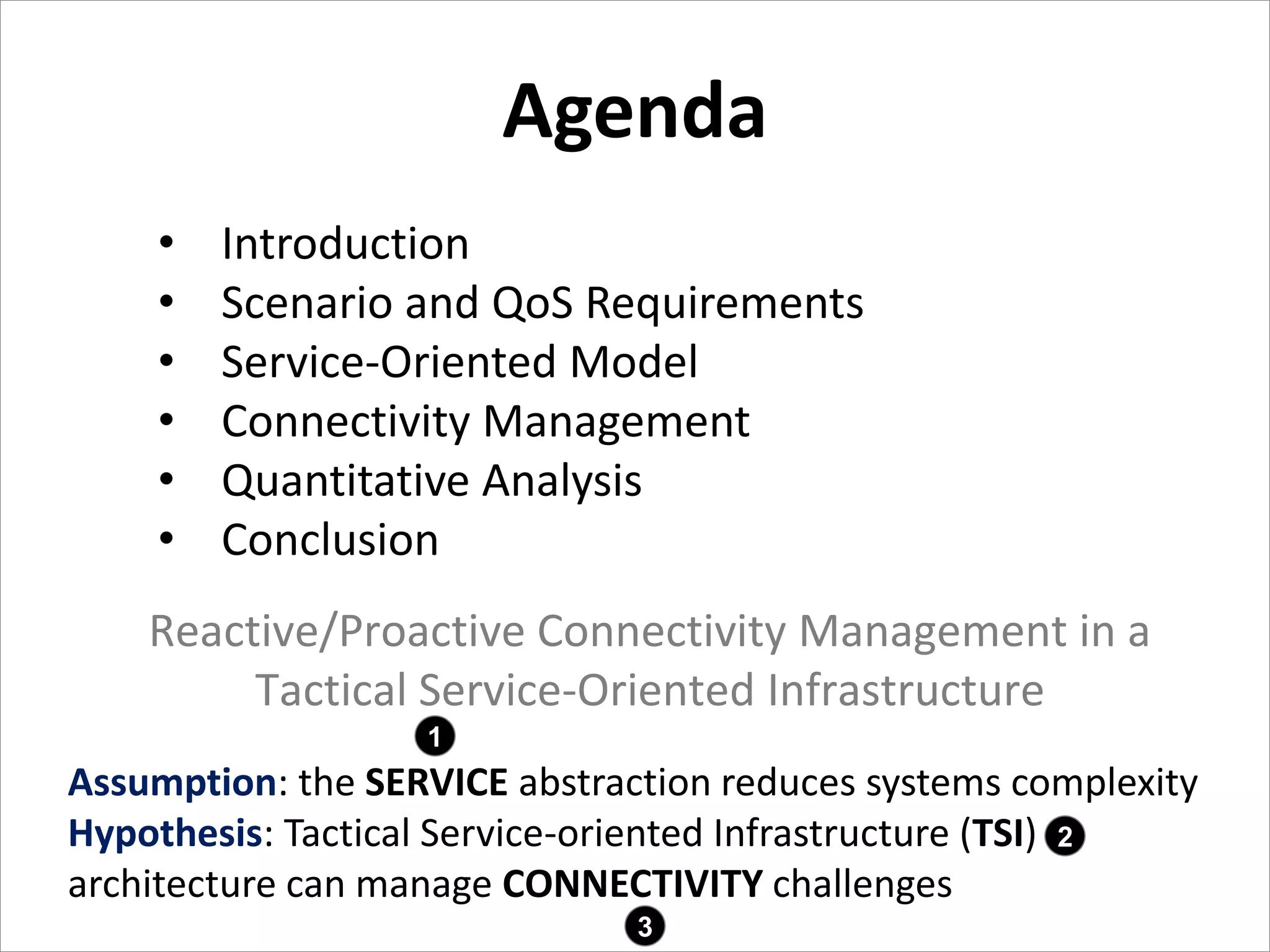
• Introduction
• Scenario and QoS Requirements
• Service-Oriented Model
• Connectivity Management
• Quantitative Analysis
• Conclusion
Assumption: the SERVICE abstraction reduces systems complexity
Hypothesis: Tactical Service-oriented Infrastructure (TSI)
architecture can manage CONNECTIVITY challenges
1
2
3
Reactive/Proactive Connectivity Management in a
Tactical Service-Oriented Infrastructure
In Short
Presentation title yyyy-mm-dd
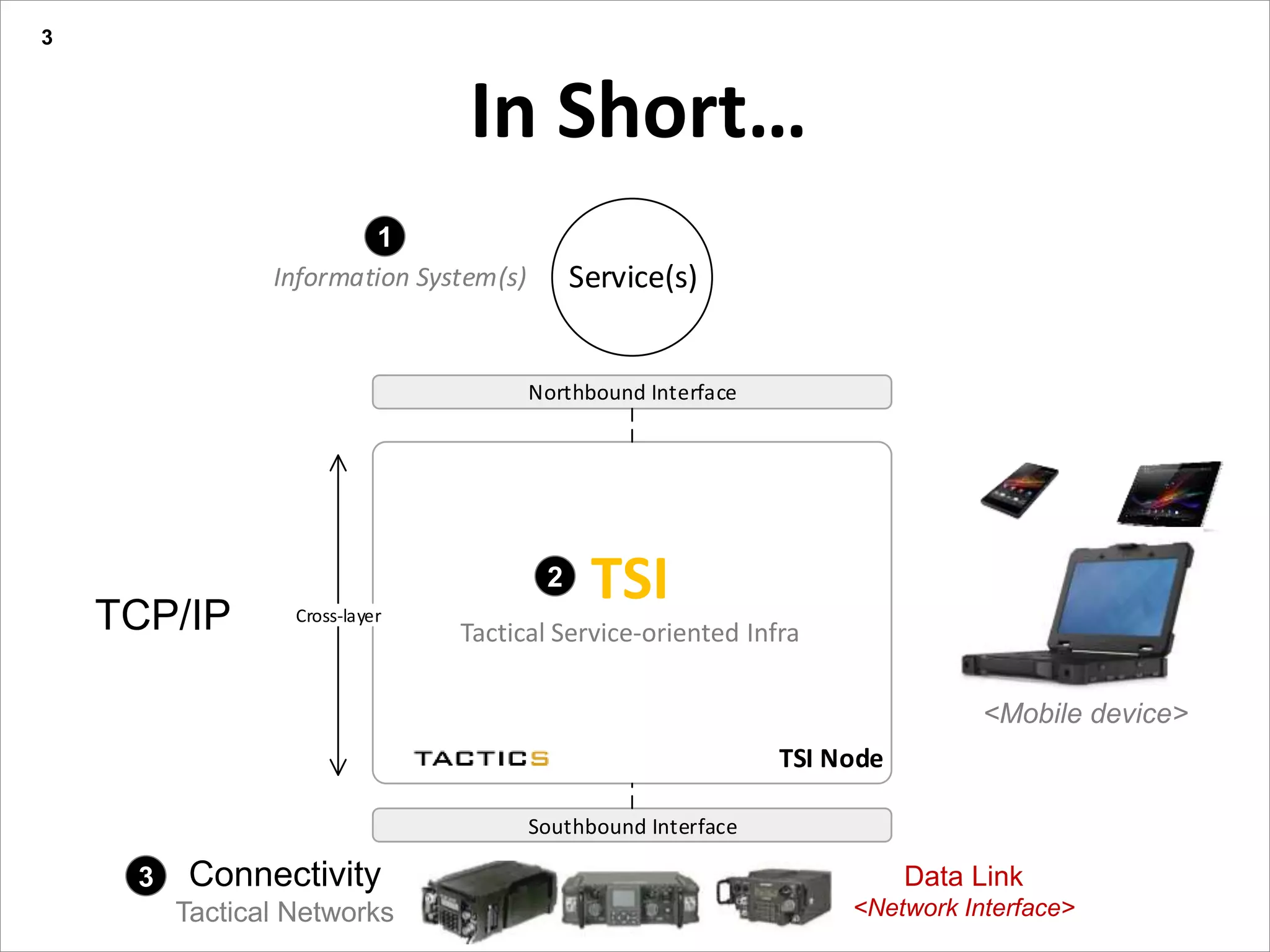
In Short…
3
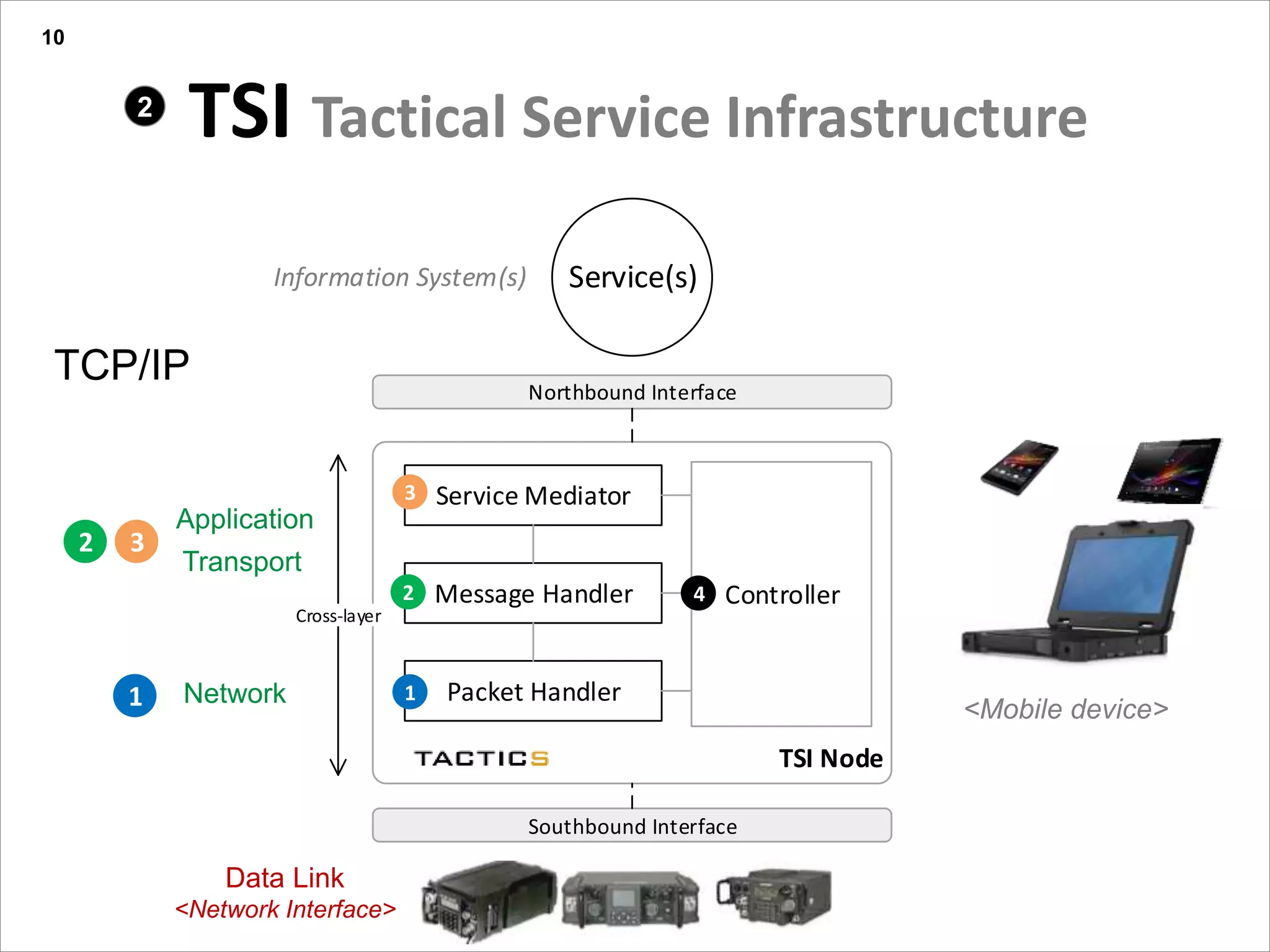
<Mobile device>
Data Link
<Network Interface>
Controller
Service Mediator
Message Handler
Packet Handler
TSI Node
Southbound Interface
Northbound Interface
1
2
3
Cross-layer
4
Service(s)Information System(s)
TCP/IP
1
3
TSI
Tactical Service-oriented Infra
2
Connectivity
Tactical Networks
Agenda
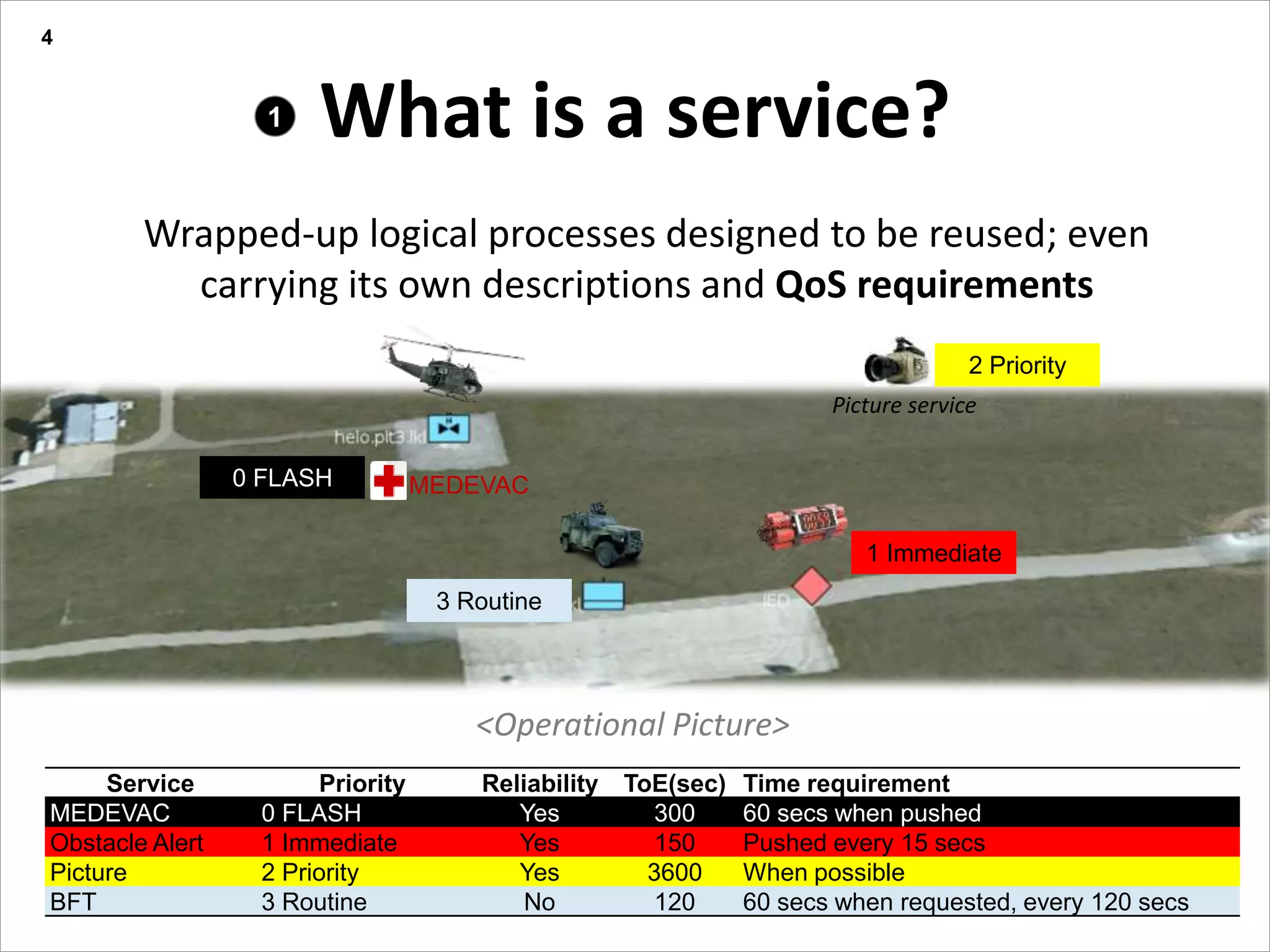
What is a service?
Wrapped-up logical processes designed to be reused; even
carrying its own descriptions and QoS requirements
Service Priority Reliability ToE(sec) Time requirement
MEDEVAC 0 FLASH Yes 300 60 secs when pushed
Obstacle Alert 1 Immediate Yes 150 Pushed every 15 secs
Picture 2 Priority Yes 3600 When possible
BFT 3 Routine No 120 60 secs when requested, every 120 secs
1
<Operational Picture>
4
MEDEVAC0 FLASH
1 Immediate
2 Priority
3 Routine
Picture service
Agenda
Presentation title yyyy-mm-dd
Three things:
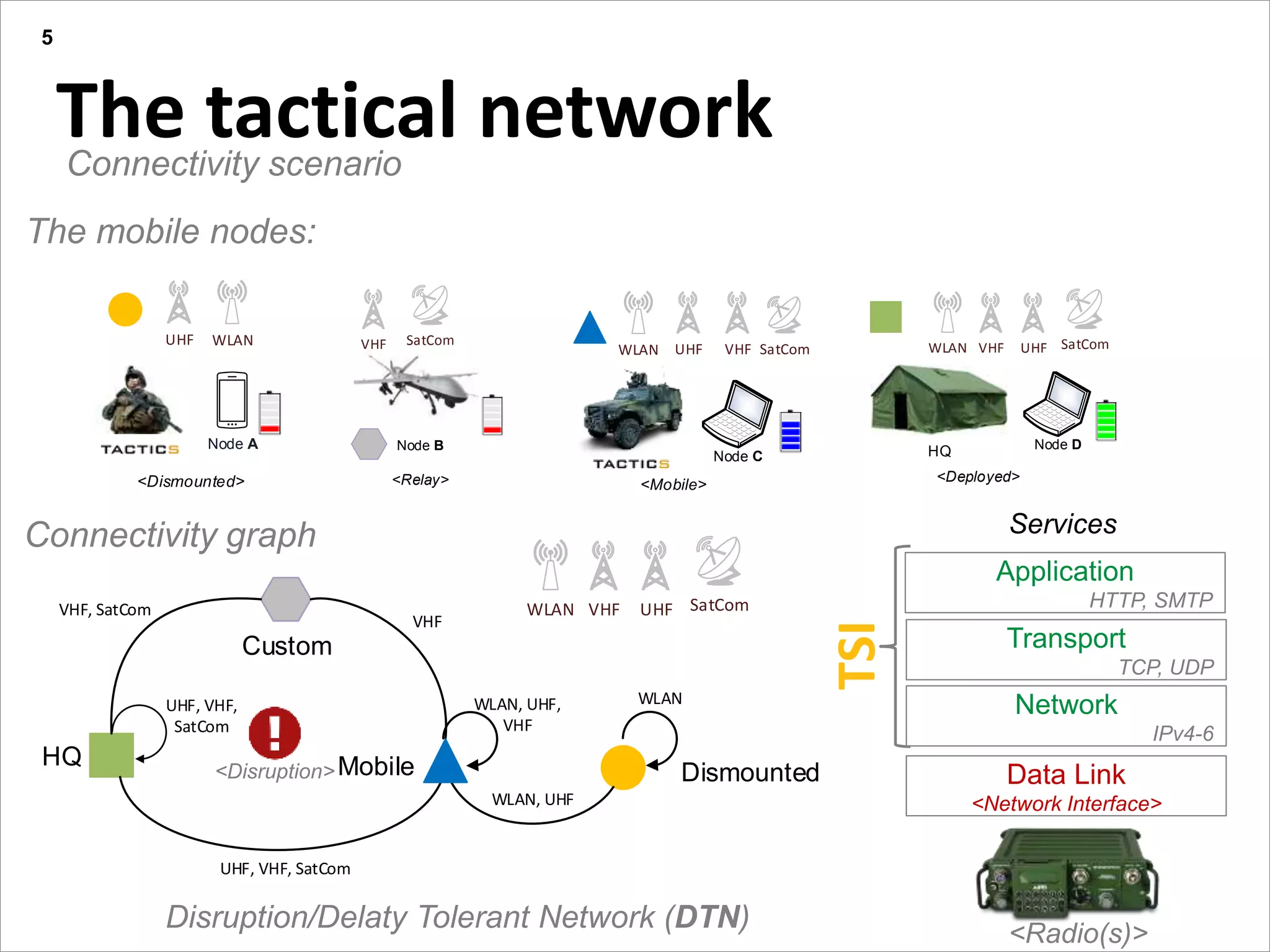
The tactical network
5
Connectivity scenario
ARPANET + Tactical network Data Link
<Network Interface>
Network
IPv4-6
Transport
TCP, UDP
Application
HTTP, SMTP
Services
TSI
<Radio(s)>
HQ
Custom
Mobile
WLAN, UHF
Dismounted
VHF
VHF, SatCom
UHF, VHF, SatCom
WLAN, UHF,
VHF
WLANUHF, VHF,
SatCom
Connectivity graph
SatComVHF UHFWLAN
<Disruption>
Disruption/Delaty Tolerant Network (DTN)
The mobile nodes:
Node A
<Dismounted>
UHF WLAN
Node C
<Mobile>
VHFUHFWLAN SatCom
HQ Node D
<Deployed>
SatComVHF UHFWLAN
Node B
<Relay>
SatComVHF
In Short
Presentation title yyyy-mm-dd
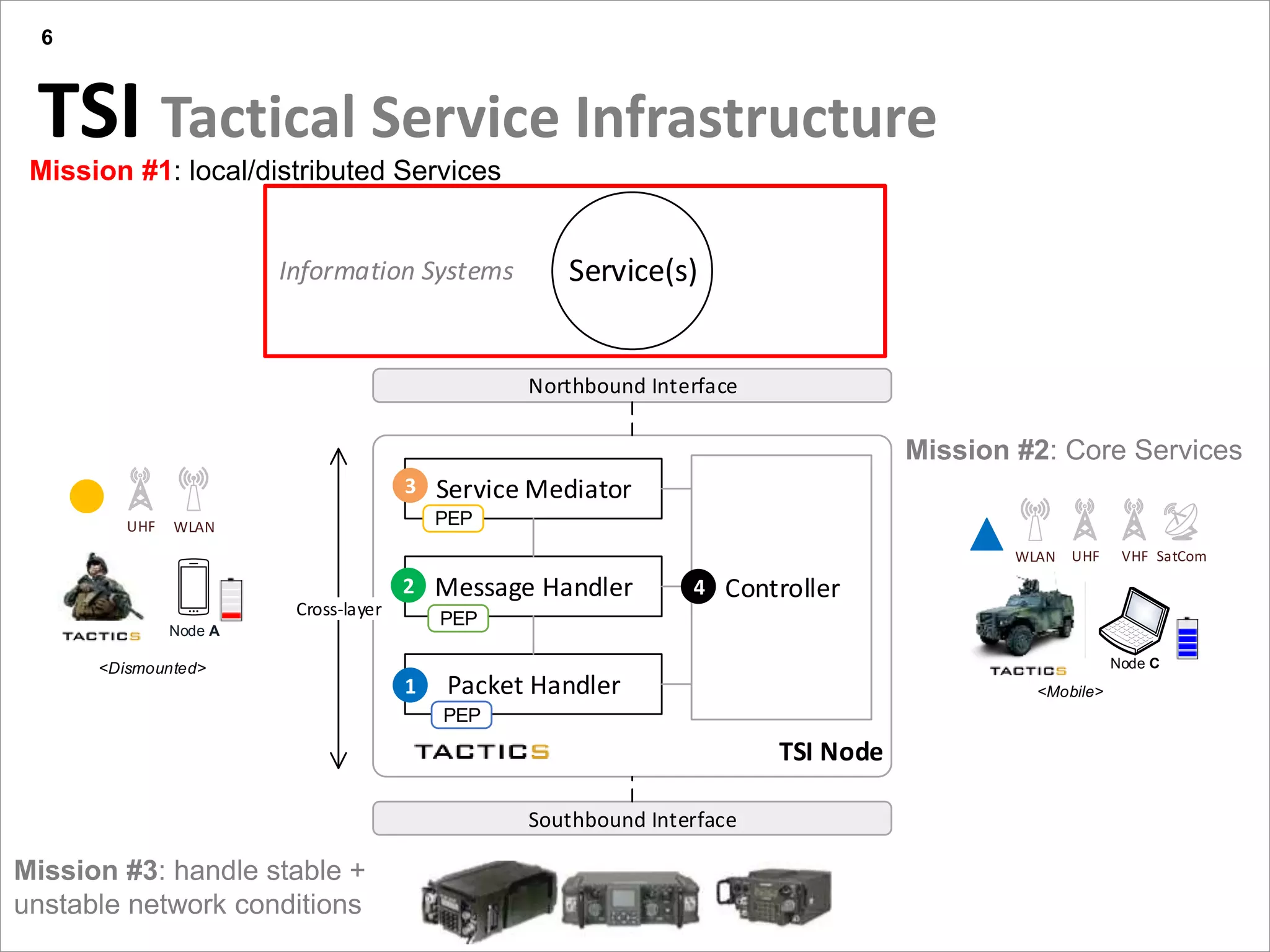
TSI Tactical Service Infrastructure
6
Mission #1: local/distributed Services
Mission #2: Core Services
Mission #3: handle stable +
unstable network conditions
Controller
Service Mediator
Message Handler
Packet Handler
TSI Node
Southbound Interface
Northbound Interface
1
2
3
Cross-layer
PEP
PEP
PEP
4
Service(s)Information Systems
Node A
<Dismounted>
UHF WLAN
Node C
<Mobile>
VHFUHFWLAN SatCom
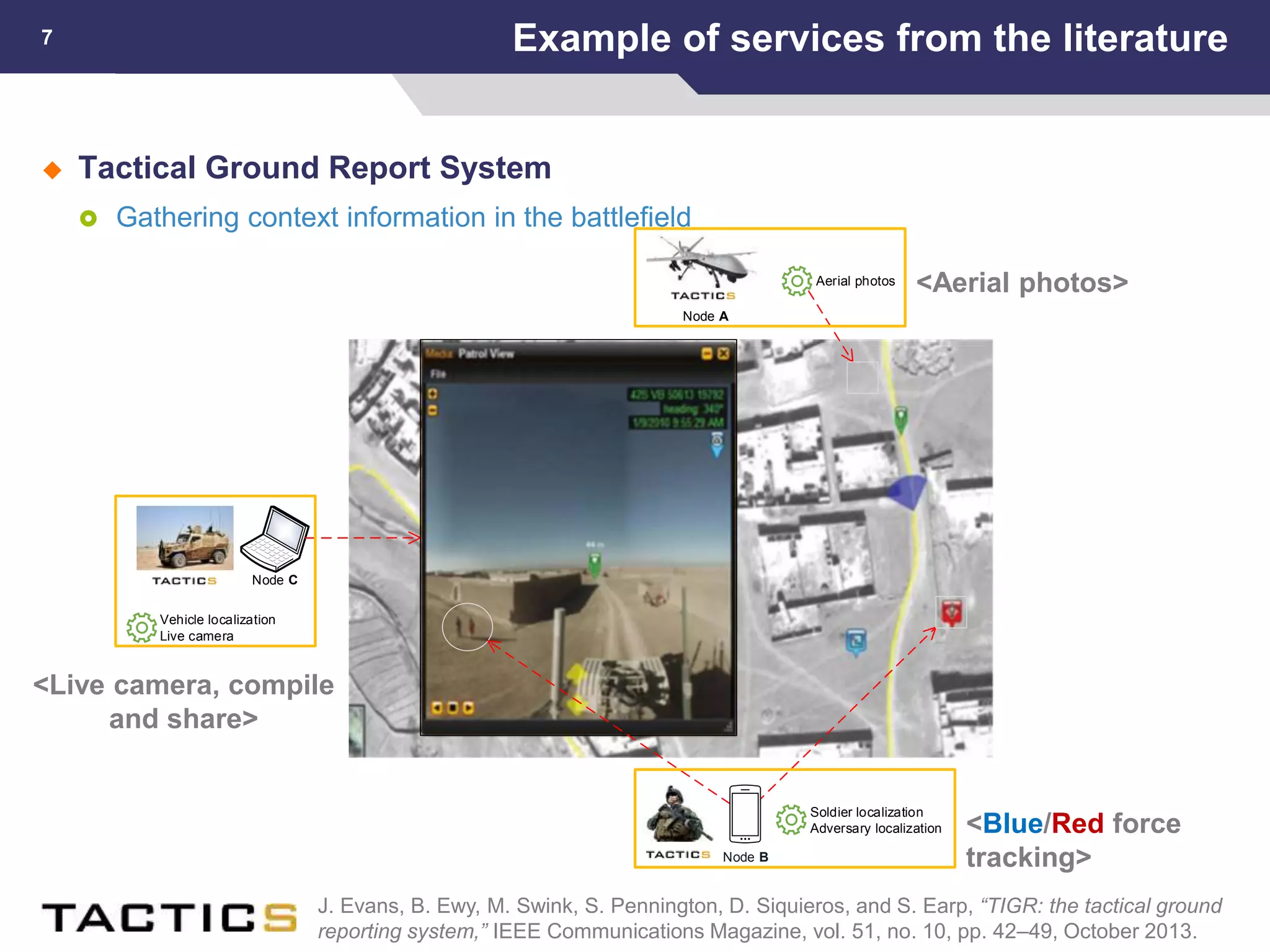
 Tactical Ground Report System
 Gathering context information in the battlefield
Example of services from the literature7
Node C
Node A
Soldier localization
Adversary localization
Vehicle localization
Live camera
Aerial photos
Node B
J. Evans, B. Ewy, M. Swink, S. Pennington, D. Siquieros, and S. Earp, “TIGR: the tactical ground
reporting system,” IEEE Communications Magazine, vol. 51, no. 10, pp. 42–49, October 2013.
<Aerial photos>
<Blue/Red force
tracking>
<Live camera, compile
and share>
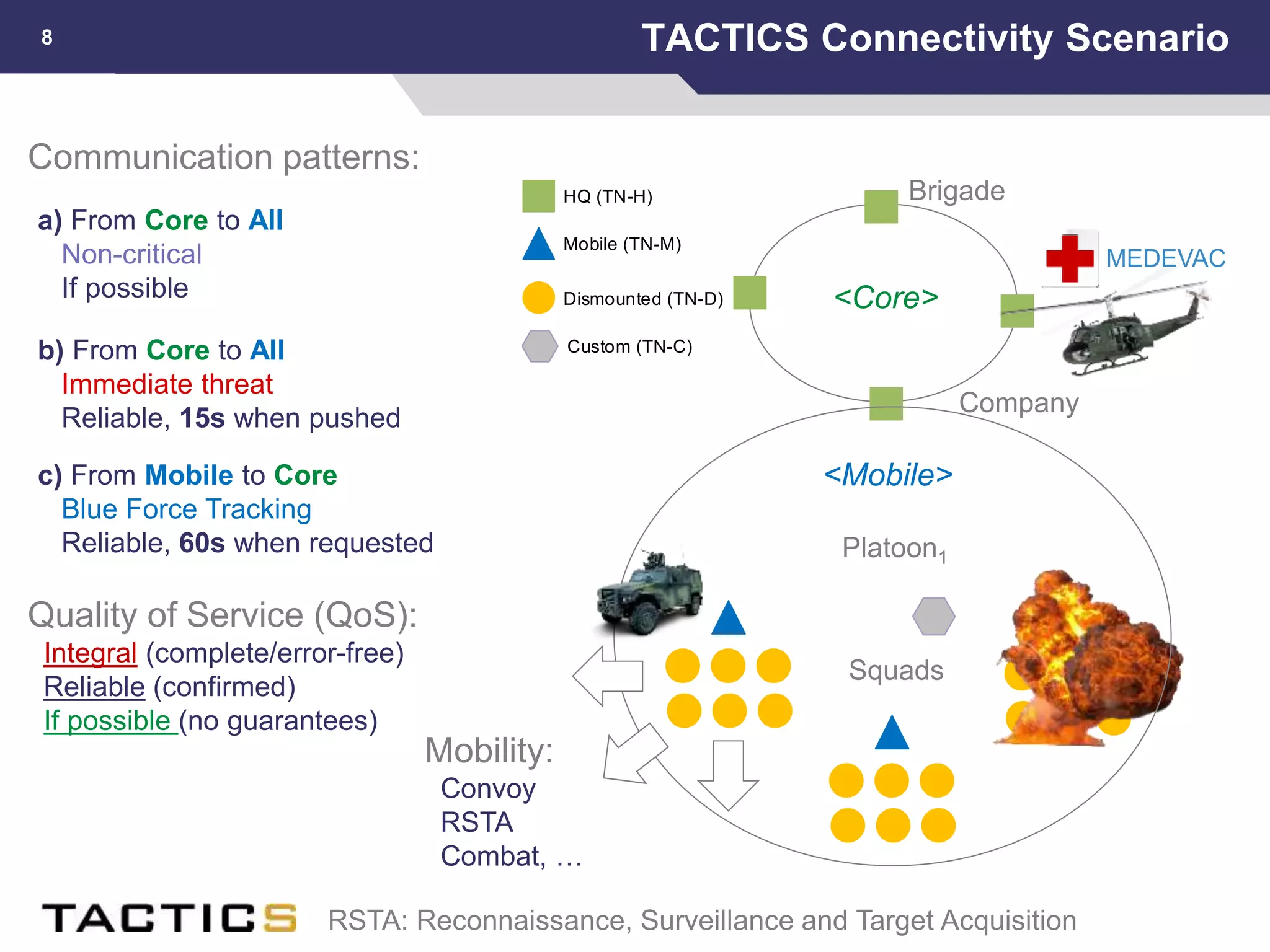
TACTICS Connectivity Scenario8
<Mobile>
<Core>
HQ (TN-H)
Dismounted (TN-D)
Mobile (TN-M)
Custom (TN-C)
Company
Brigade
Squads
Platoon1
MEDEVAC
Communication patterns:
Mobility:
Convoy
RSTA
Combat, …
a) From Core to All
Non-critical
If possible
b) From Core to All
Immediate threat
Reliable, 15s when pushed
c) From Mobile to Core
Blue Force Tracking
Reliable, 60s when requested
Quality of Service (QoS):
Integral (complete/error-free)
Reliable (confirmed)
If possible (no guarantees)
RSTA: Reconnaissance, Surveillance and Target Acquisition
In Short
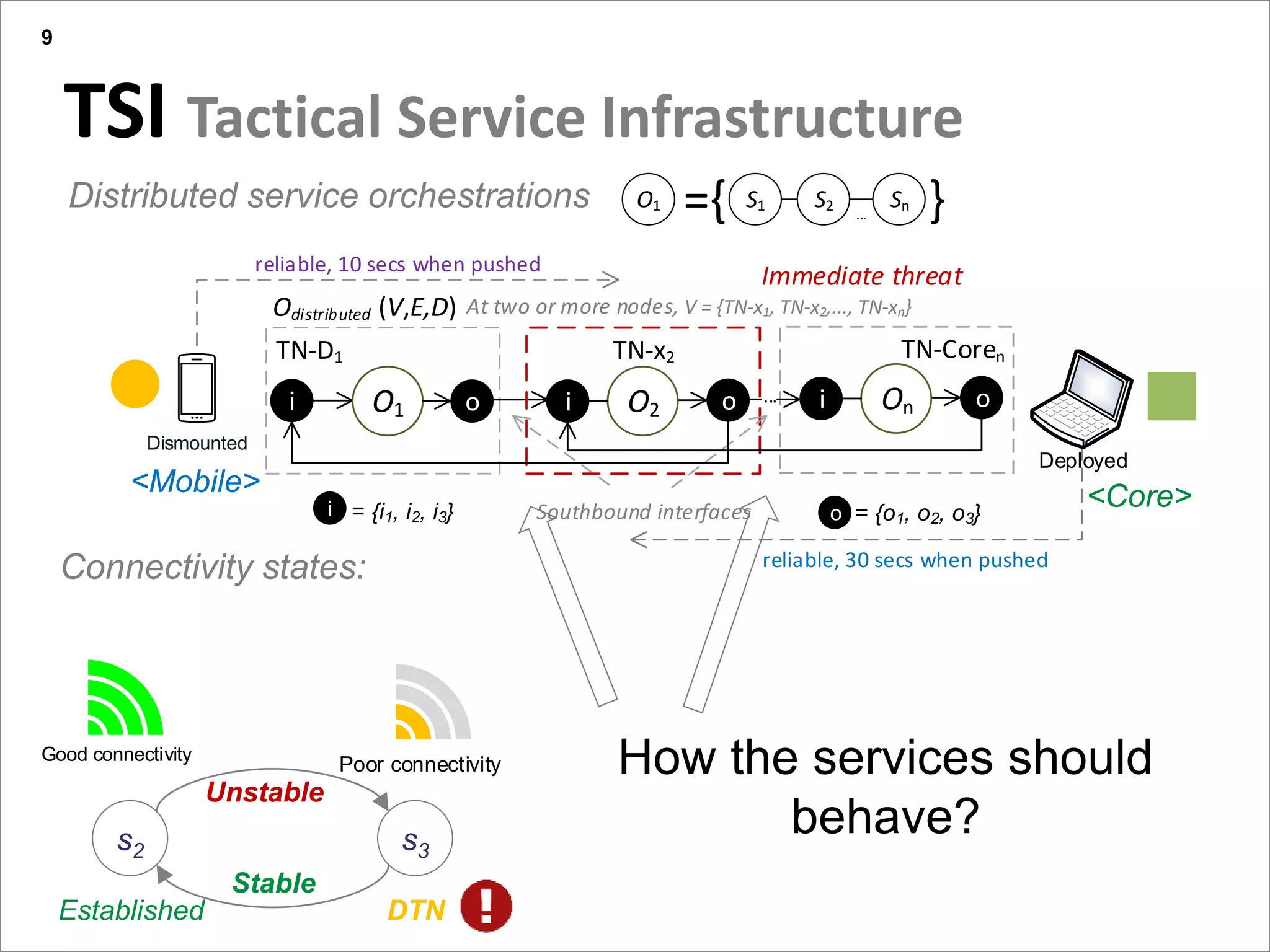
TSI Tactical Service Infrastructure
9
Connectivity states:
i
At two or more nodes, V = {TN-x1, TN-x2,..., TN-xn}
i o
TN-D1
O1 O2o i
Odistributed (V,E,D)
TN-x2
oOni
TN-Coren
...
i = {i1, i2, i3} o = {o1, o2, o3}Southbound interfaces
reliable, 10 secs when pushed
Dismounted
i
reliable, 30 secs when pushed
Deployed
Immediate threat
Distributed service orchestrations
<Mobile> <Core>
={ }S1 S2 Sn
...
O1
How the services should
behave?s2 s3
Established DTN
Unstable
Stable
Good connectivity
Poor connectivity
In Short
Presentation title yyyy-mm-dd
TSI Tactical Service Infrastructure
10
<Mobile device>
Data Link
<Network Interface>
Transport
Application
Controller
Service Mediator
Message Handler
Packet Handler
TSI Node
Southbound Interface
Northbound Interface
1
2
3
Cross-layer
4
Service(s)Information System(s)
Network1
32
TCP/IP
2
Example of orchestration
 TODO: work on that paper diagram…
State of the art review
yyyy-mm-ddPresentation title
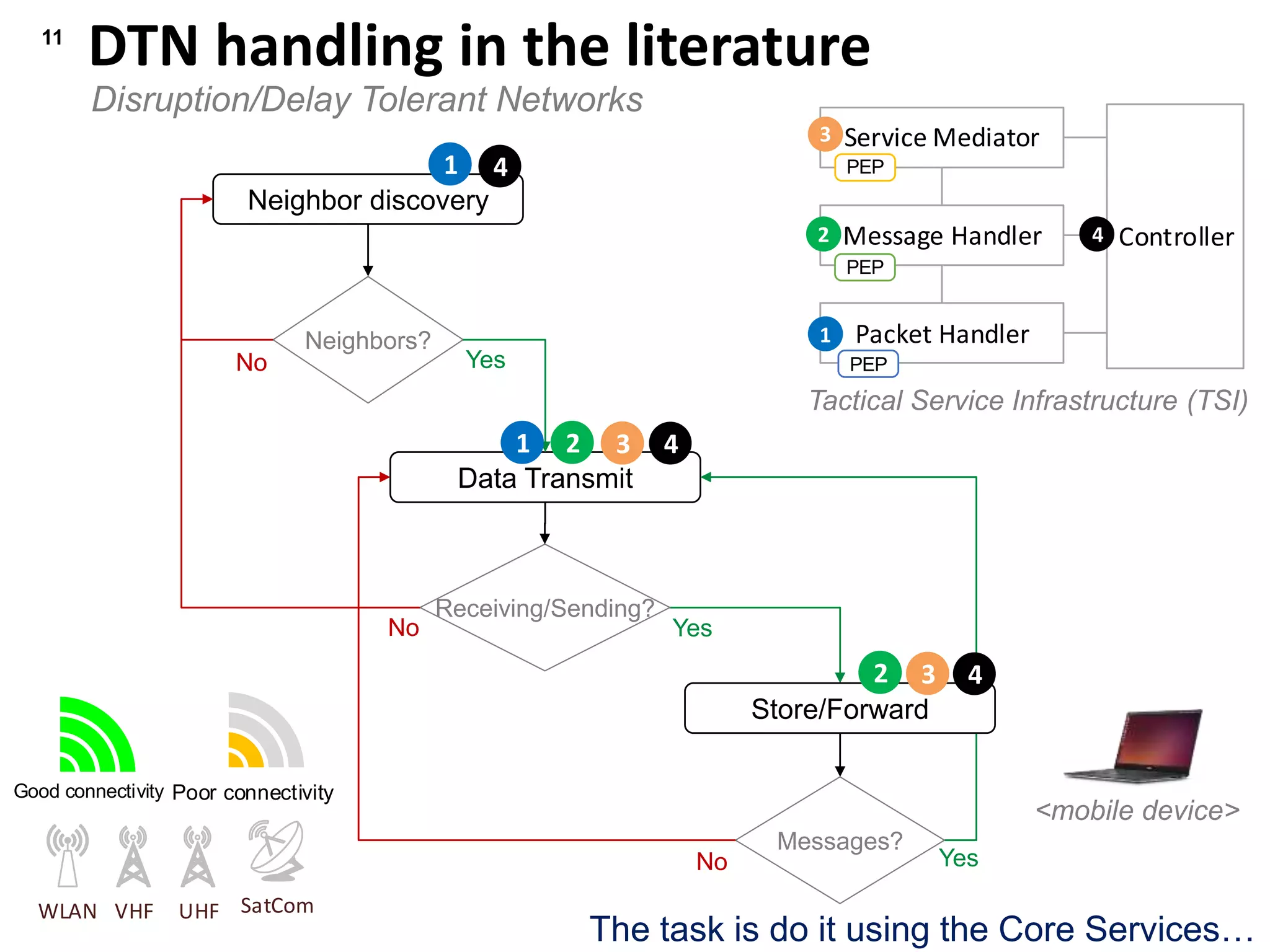
Neighbor discovery
Data Transmit
Neighbors?
Messages?
Receiving/Sending?
11
DTN handling in the literature
No
No
No
Yes
Yes
Yes
Store/Forward
1
2
1
Controller
Service Mediator
Message Handler
Packet Handler1
2
3
4
PEP
PEP
PEP
4
4
4
Disruption/Delay Tolerant Networks
3
3
SatComVHF UHFWLAN
Good connectivity Poor connectivity
The task is do it using the Core Services…
Tactical Service Infrastructure (TSI)
2
<mobile device>
State of the art at TSI12
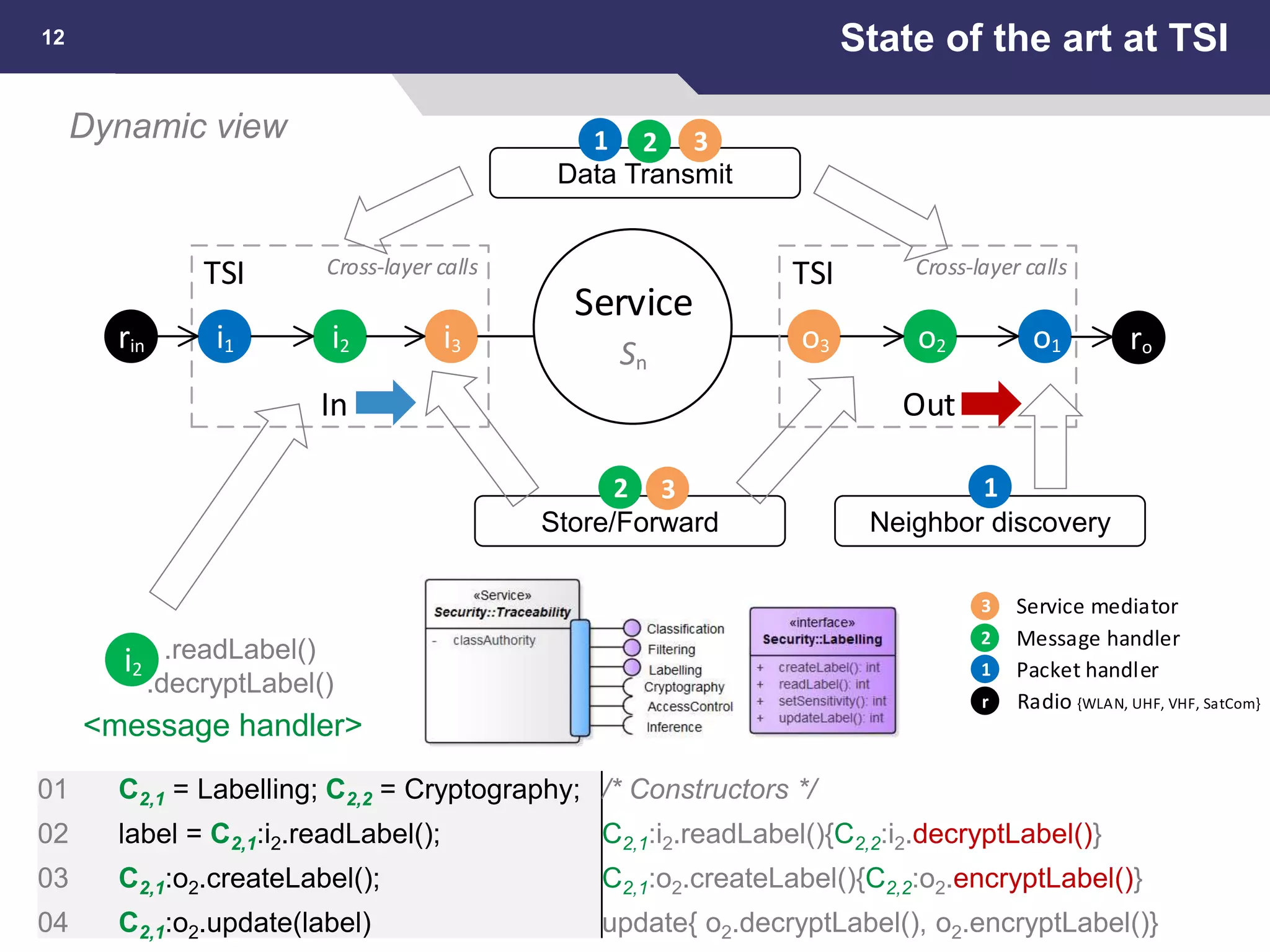
Dynamic view
Service
Sn
i3i2i1 o1o2o3
In Out
TSI TSICross-layer calls
rorin
Cross-layer calls
1 Packet handler
2 Message handler
3 Service mediator
r Radio {WLAN, UHF, VHF, SatCom}
Neighbor discovery
Data Transmit
Store/Forward
1
1 3
2 3
2
01
02
03
04
C2,1 = Labelling; C2,2 = Cryptography;
label = C2,1:i2.readLabel();
C2,1:o2.createLabel();
C2,1:o2.update(label)
/* Constructors */
C2,1:i2.readLabel(){C2,2:i2.decryptLabel()}
C2,1:o2.createLabel(){C2,2:o2.encryptLabel()}
update{ o2.decryptLabel(), o2.encryptLabel()}
i2
.readLabel()
.decryptLabel()
<message handler>
In Short
Presentation title
TSI Tactical Service Infrastructure
13
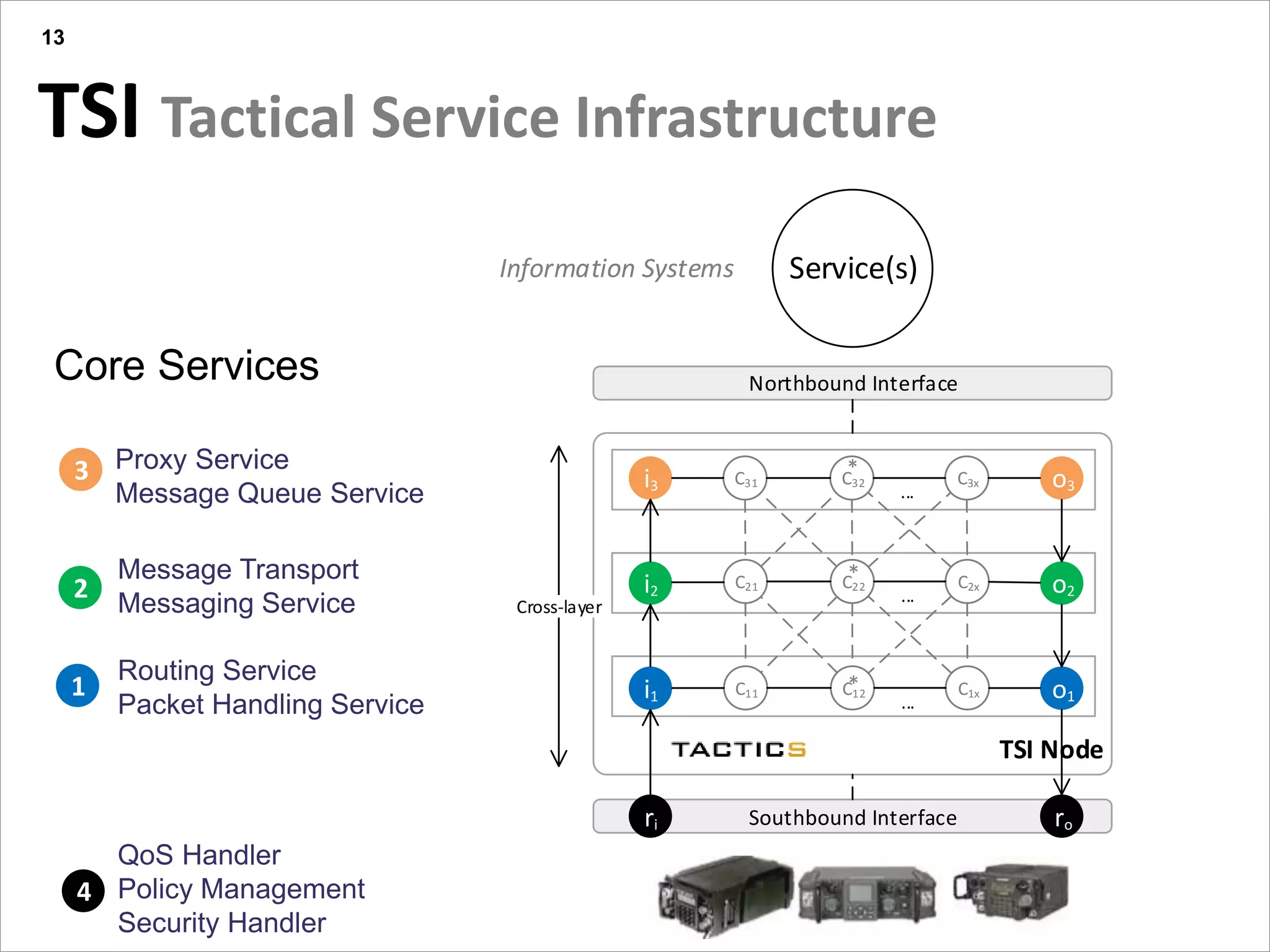
Routing Service
Packet Handling Service
1
Proxy Service
Message Queue Service
3
Message Transport
Messaging Service
2
QoS Handler
Policy Management
Security Handler
4
TSI Node
Southbound Interface
Northbound Interface
Cross-layer
Service(s)Information Systems
ri
i3
i2
i1 o1
o2
o3
ro
C11 C12 C1x
...
C21 C22 C2x
...
C31 C32 C3x
...
*
*
*
Core Services
Agenda
Presentation title
Three things:
14
s1
s2 s3
Disconnected
Established DTN
Unstable
Stable
EMCON EMCON
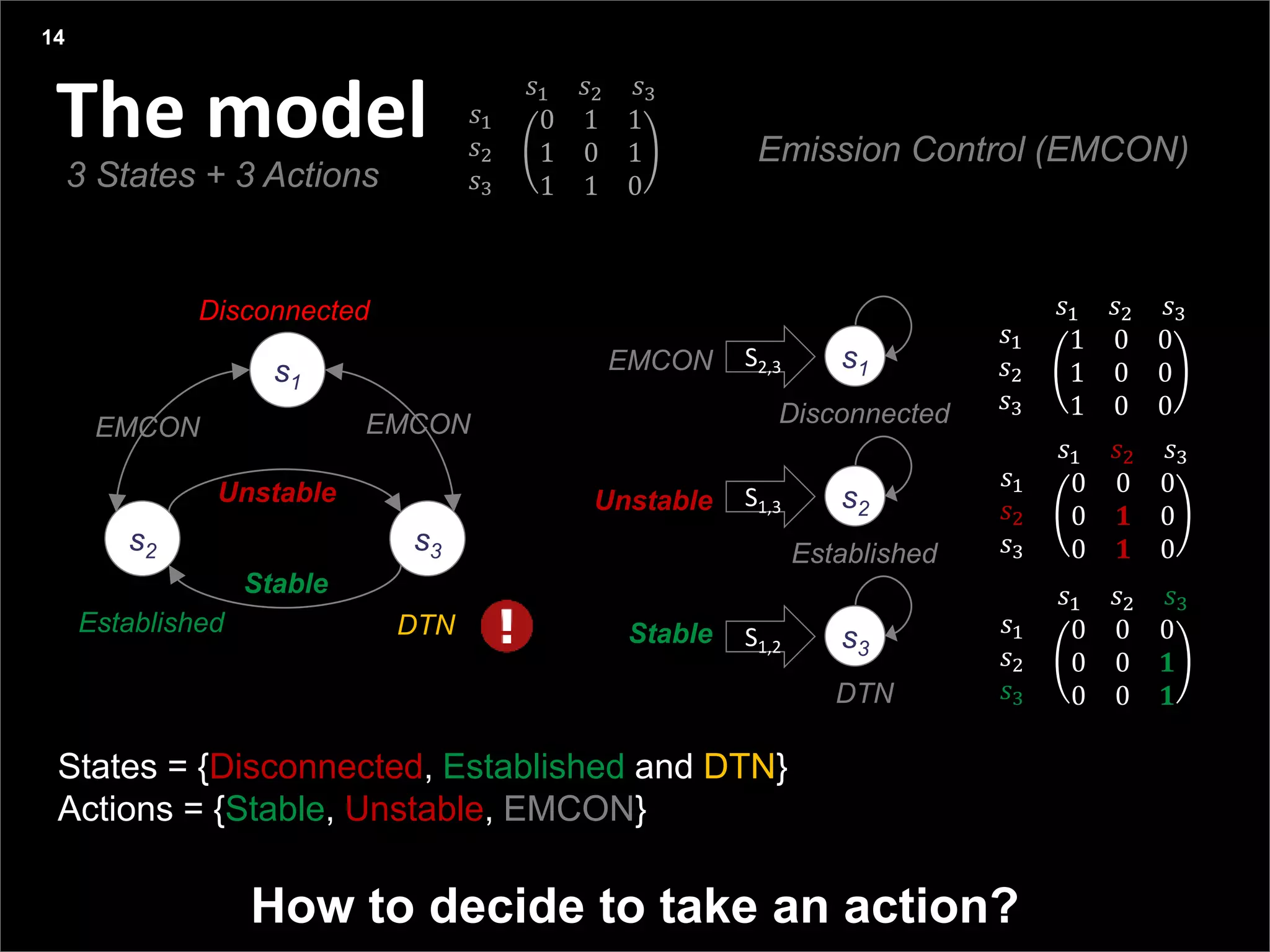
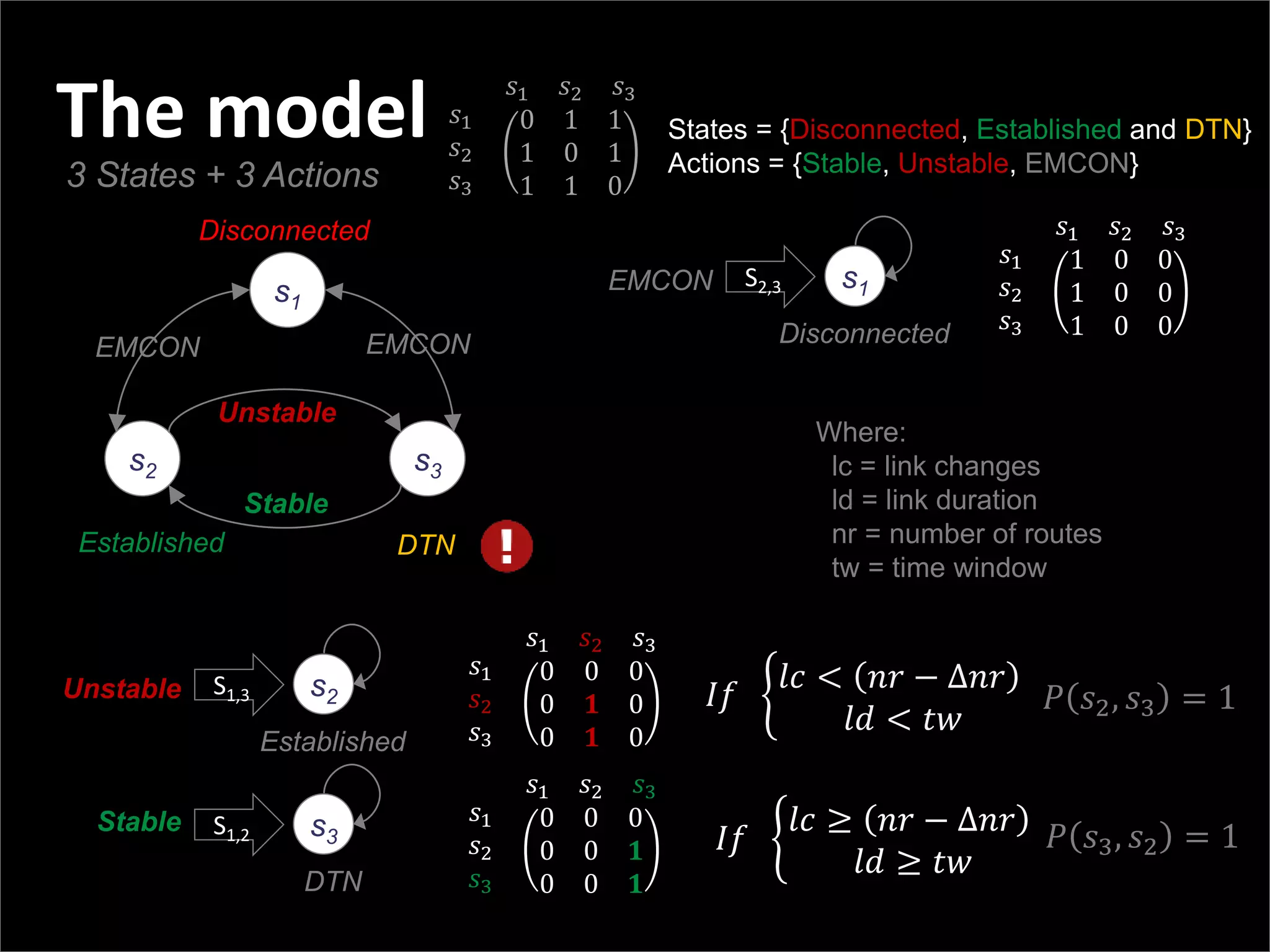
The model
3 States + 3 Actions
Emission Control (EMCON)
States = {Disconnected, Established and DTN}
Actions = {Stable, Unstable, EMCON}
𝑠1 𝑠2 𝑠3
𝑠1
𝑠2
𝑠3
1 0 0
1 0 0
1 0 0
𝑠1 𝑠2 𝑠3
𝑠1
𝑠2
𝑠3
0 0 0
0 𝟏 0
0 𝟏 0
𝑠1 𝑠2 𝑠3
𝑠1
𝑠2
𝑠3
0 0 0
0 0 𝟏
0 0 𝟏
How to decide to take an action?
𝑠1 𝑠2 𝑠3
𝑠1
𝑠2
𝑠3
0 1 1
1 0 1
1 1 0
s1S2,3
Disconnected
EMCON
s2S1,3
Established
s3S1,2
DTN
Unstable
Stable
State of the art review15
Connectivity
Mobility
Resources Requirements
Network setup:
Fully connected
Fragmented
Opportunistic
Mobility pattern
Bandwidth
Storage capacity
Power consumption
QoS
Priority, reliability,
sensitivity
Node A
<Dismounted>
UHF WLAN
Kernel IP routing table
Destination Gateway Metric
10.1.1.2 10.1.1.19 2
10.1.1.3 10.1.1.19 2
10.1.1.4 10.1.1.19 2
10.1.1.5 10.1.1.19 2
10.1.1.6 10.1.1.19 2
a) From Core to All
Non-critical
If possible
b) From Core to All
Immediate threat
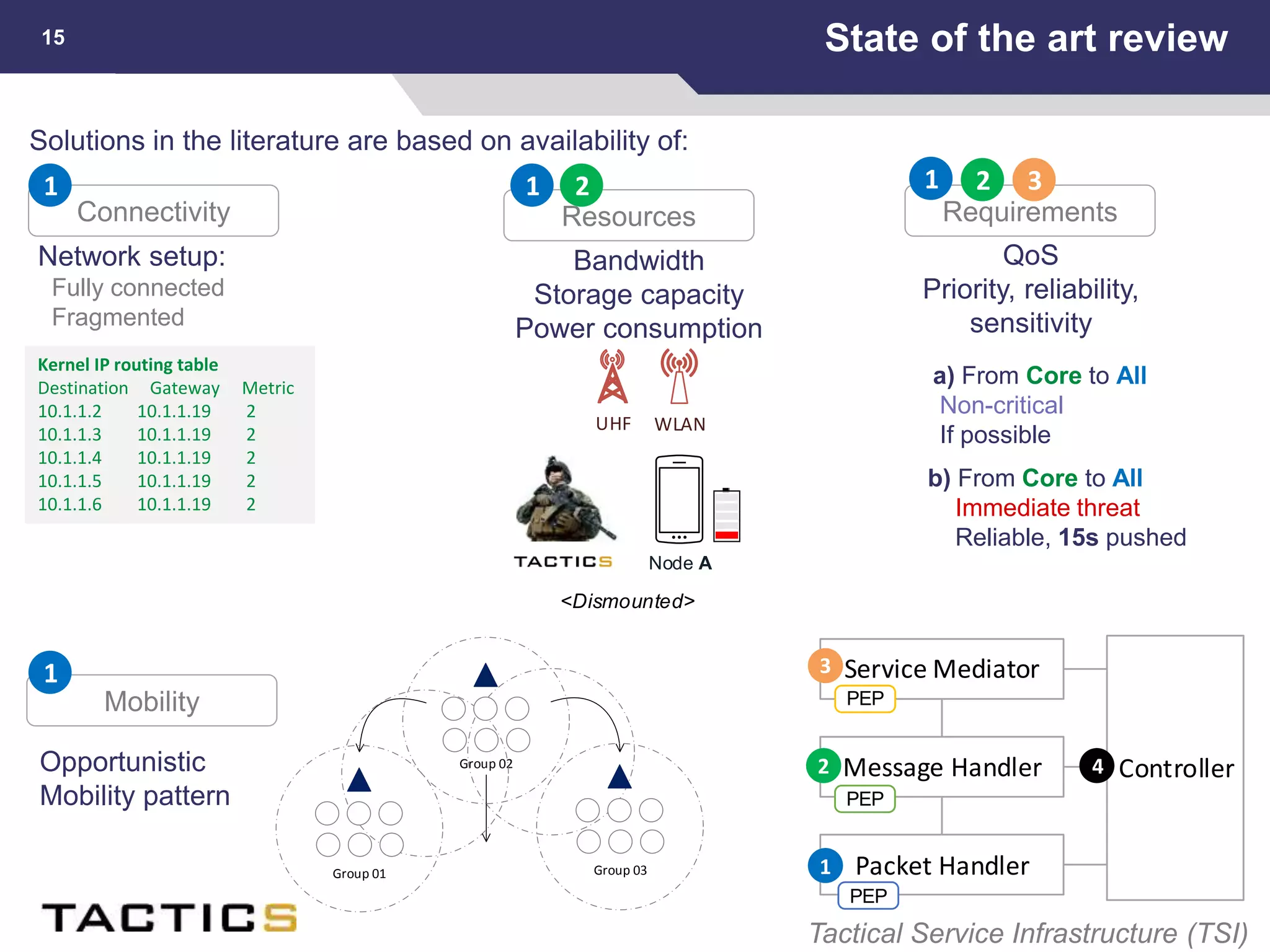
Reliable, 15s pushed
Solutions in the literature are based on availability of:
Controller
Service Mediator
Message Handler
Packet Handler1
2
3
4
PEP
PEP
PEP
Tactical Service Infrastructure (TSI)
Group 02
Group 01 Group 03
1 2 31
1
1 2
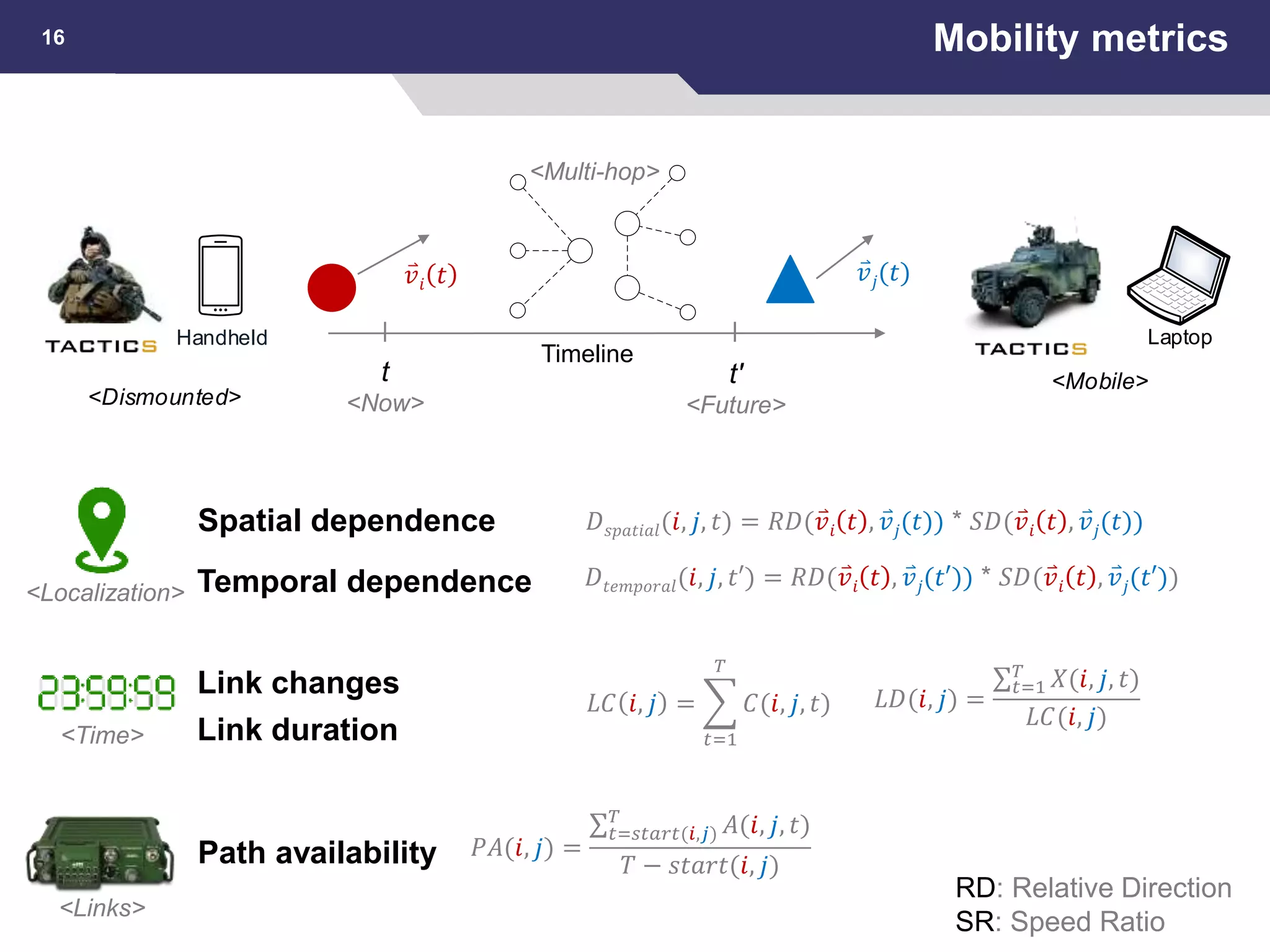
Mobility metrics16
Spatial dependence
Temporal dependence
Link changes
Link duration
Path availability
𝐷 𝑠𝑝𝑎𝑡𝑖𝑎𝑙(𝑖, 𝑗, 𝑡) = 𝑅𝐷( 𝑣𝑖 𝑡 , 𝑣 𝑗(𝑡)) * 𝑆𝐷( 𝑣𝑖 𝑡 , 𝑣 𝑗(𝑡))
𝐷𝑡𝑒𝑚𝑝𝑜𝑟𝑎𝑙(𝑖, 𝑗, 𝑡′) = 𝑅𝐷( 𝑣𝑖 𝑡 , 𝑣 𝑗(𝑡′)) * 𝑆𝐷( 𝑣𝑖 𝑡 , 𝑣 𝑗(𝑡′))
𝐿𝐷(𝑖, 𝑗) =
𝑡=1
𝑇
𝑋(𝑖, 𝑗, 𝑡)
𝐿𝐶(𝑖, 𝑗)
𝐿𝐶 𝑖, 𝑗 =
𝑡=1
𝑇
𝐶(𝑖, 𝑗, 𝑡)
𝑃𝐴(𝑖, 𝑗) =
𝑡=𝑠𝑡𝑎𝑟𝑡(𝑖,𝑗)
𝑇
𝐴(𝑖, 𝑗, 𝑡)
𝑇 − 𝑠𝑡𝑎𝑟𝑡(𝑖, 𝑗)
RD: Relative Direction
SR: Speed Ratio
𝑣𝑖 𝑡 𝑣 𝑗(𝑡)
Timeline
Handheld
<Dismounted>
t
<Now>
t'
<Future>
<Multi-hop>
<Links>
<Localization>
<Time>
Laptop
<Mobile>
Agenda
Presentation title yyyy-mm-dd
Three things:
Hypothesis
17
A feasible guess?
𝐸𝑇𝑇 =
1
𝑙𝑞 ∗ 𝑛𝑙𝑞
∗
𝑠𝑐𝑎𝑙𝑖𝑛𝑔
𝑙𝑖𝑛𝑘𝑠𝑝𝑒𝑒𝑑
𝐷𝐴𝑇 =
1
𝑙𝑞
∗
𝑠𝑐𝑎𝑙𝑖𝑛𝑔
𝑙𝑖𝑛𝑘𝑠𝑝𝑒𝑒𝑑
𝐸𝑇𝑋 =
1
𝑙𝑞 ∗ 𝑛𝑙𝑞
Expected Transmission Count (ETX)
Direction Airtime (DAT)
Expected Transmission Time (ETT)
<Radio(s)>
<Localization>
Path availability 𝑃𝐴(𝑖, 𝑗) =
𝑡=𝑠𝑡𝑎𝑟𝑡(𝑖,𝑗)
𝑇
𝐴(𝑖, 𝑗, 𝑡)
𝑇 − 𝑠𝑡𝑎𝑟𝑡(𝑖, 𝑗)
Link changes
Link duration 𝐿𝐷(𝑖, 𝑗) =
𝑡=1
𝑇
𝑋(𝑖, 𝑗, 𝑡)
𝐿𝐶(𝑖, 𝑗)
𝐿𝐶 𝑖, 𝑗 =
𝑡=1
𝑇
𝐶(𝑖, 𝑗, 𝑡)
<Time>
s1
s2 s3
Disconnected
Established DTN
Unstable
Stable
EMCON EMCON
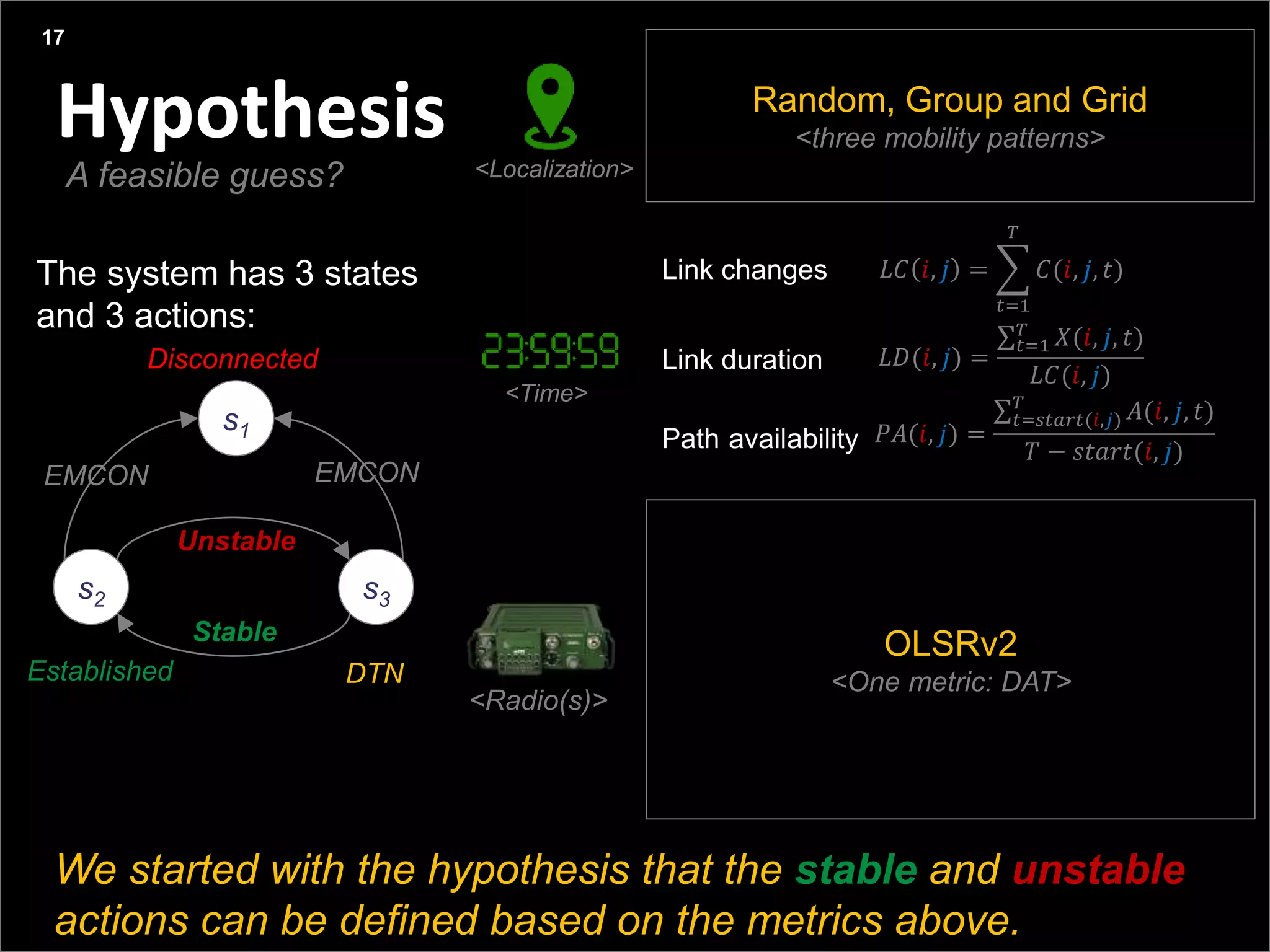
We started with the hypothesis that the stable and unstable
actions can be defined based on the metrics above.
The system has 3 states
and 3 actions:
Spatial dependence
Temporal dependence
𝐷 𝑠𝑝𝑎𝑡𝑖𝑎𝑙(𝑖, 𝑗, 𝑡) = 𝑅𝐷( 𝑣𝑖 𝑡 , 𝑣 𝑗(𝑡)) * 𝑆𝐷( 𝑣𝑖 𝑡 , 𝑣 𝑗(𝑡))
𝐷𝑡𝑒𝑚𝑝𝑜𝑟𝑎𝑙(𝑖, 𝑗, 𝑡′) = 𝑅𝐷( 𝑣𝑖 𝑡 , 𝑣 𝑗(𝑡′)) * 𝑆𝐷( 𝑣𝑖 𝑡 , 𝑣 𝑗(𝑡′))
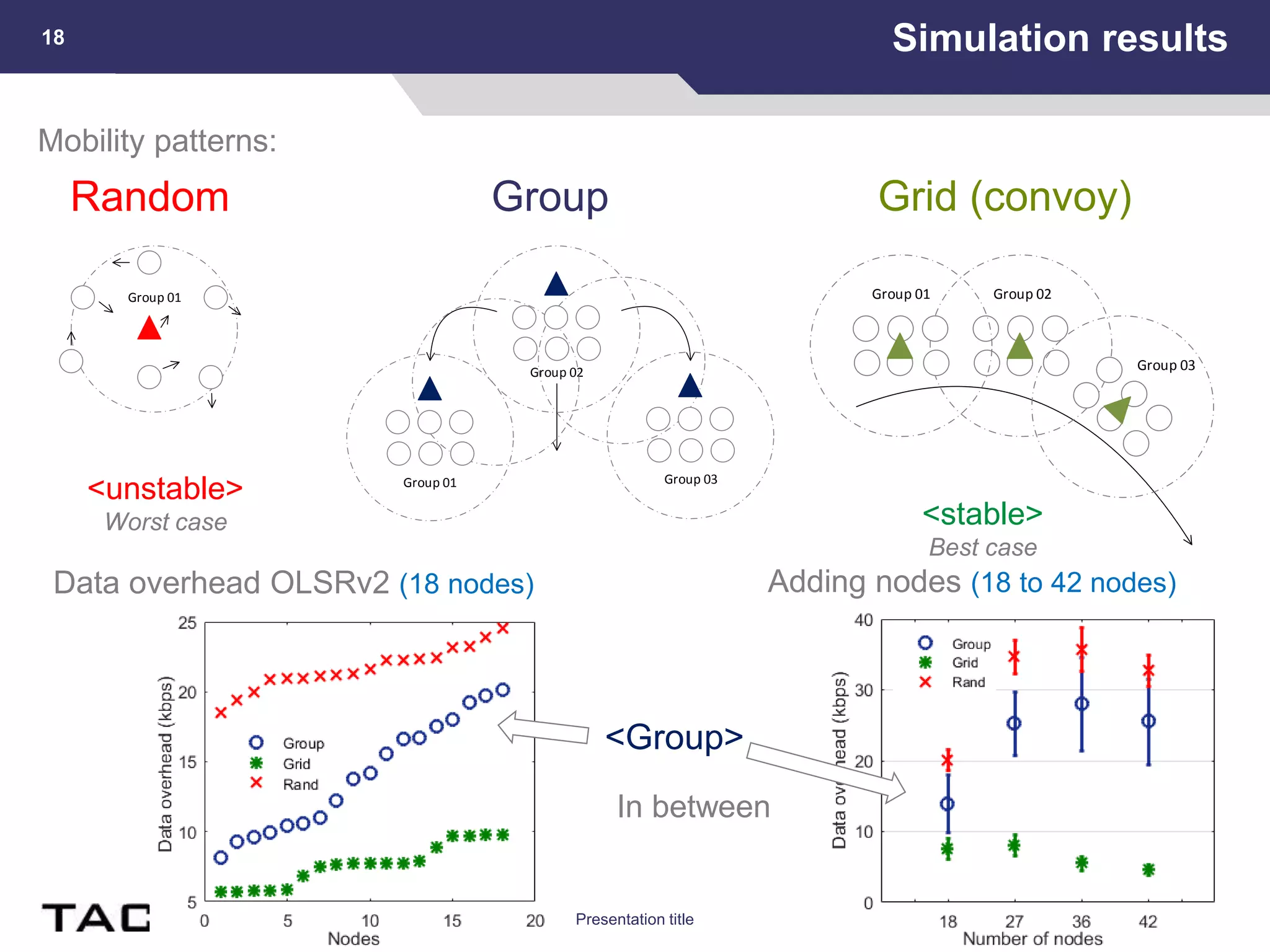
Random, Group and Grid
<three mobility patterns>
OLSRv2
<One metric: DAT>
Simulation results
yyyy-mm-ddPresentation title
18
Random Group
Group 01 Group 02
Group 03Group 02
Group 01 Group 03
Data overhead OLSRv2 (18 nodes) Adding nodes (18 to 42 nodes)
Group 01
Grid (convoy)
Mobility patterns:
<unstable>
Worst case <stable>
Best case
<Group>
In between
In Short
Presentation title yyyy-mm-dd
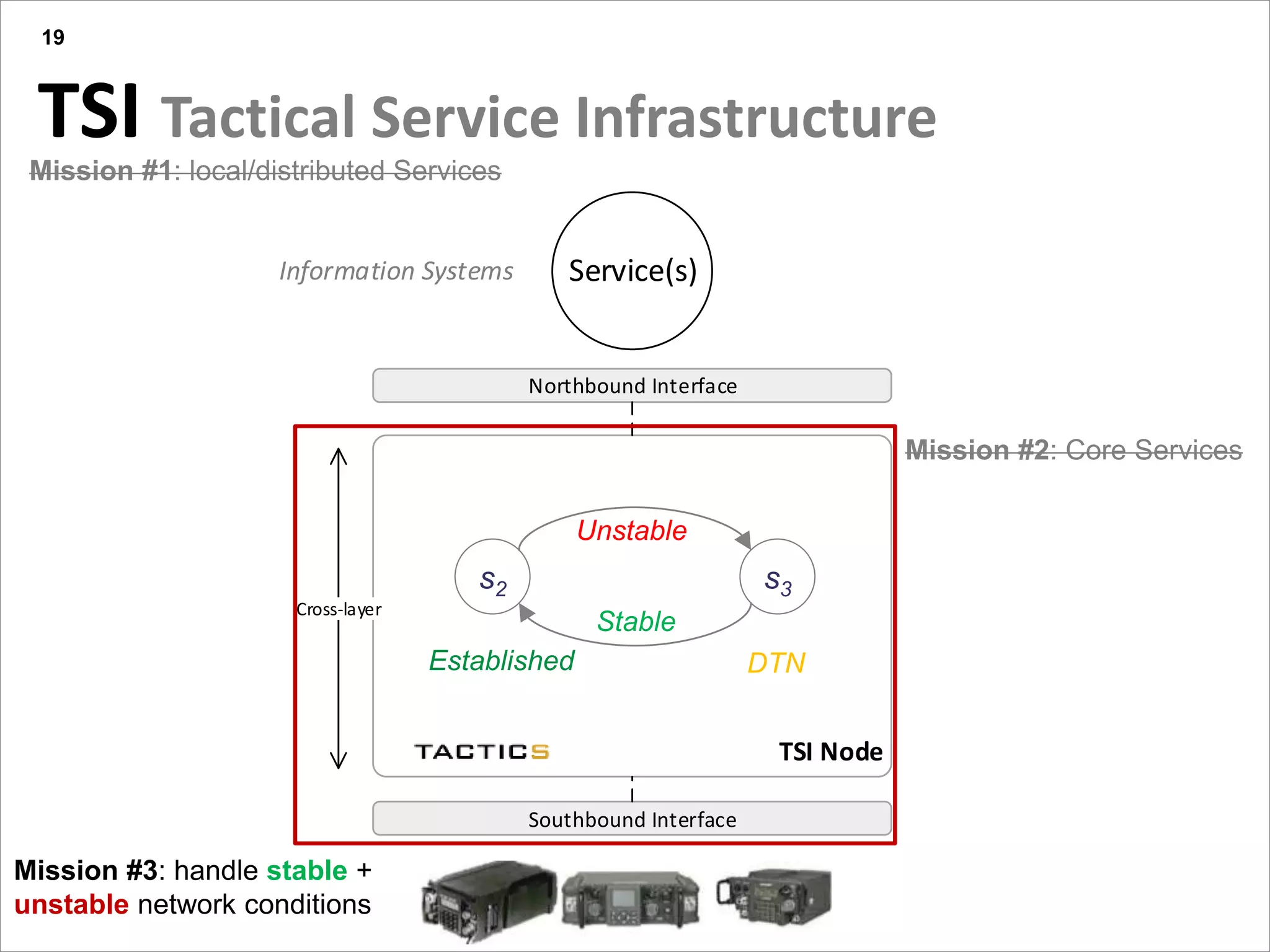
TSI Tactical Service Infrastructure
19
Mission #1: local/distributed Services
Mission #2: Core Services
Mission #3: handle stable +
unstable network conditions
Controller
Service Mediator
Message Handler
Packet Handler
TSI Node
Southbound Interface
Northbound Interface
1
2
3
Cross-layer
PEP
PEP
PEP
4
Service(s)Information Systems
s2 s3
Established DTN
Unstable
Stable
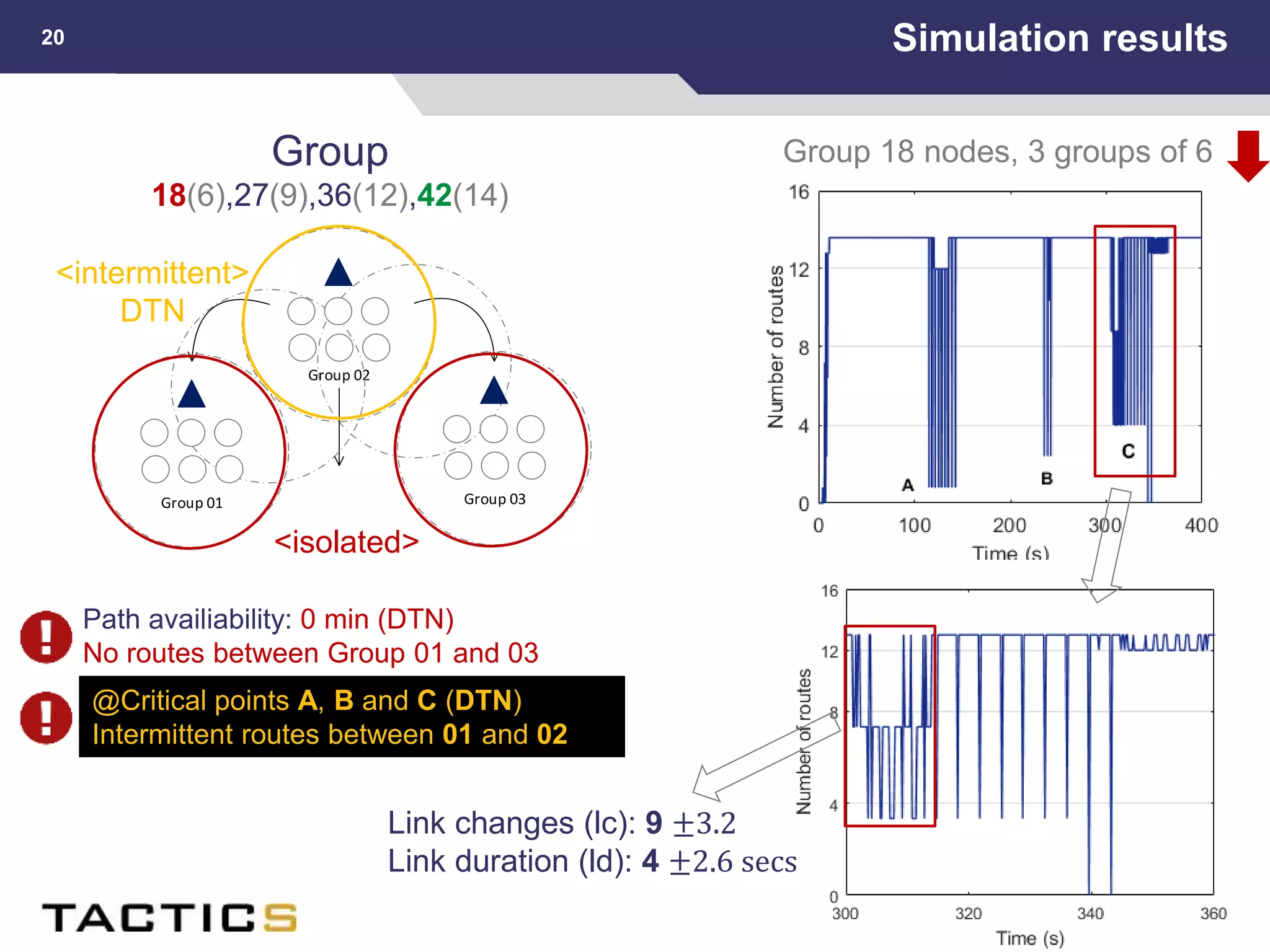
Simulation results20
Group
18(6),27(9),36(12),42(14)
Group 02
Group 01 Group 03
Group 18 nodes, 3 groups of 6
Link changes (lc): 9 ±3.2
Link duration (ld): 4 ±2.6 secs
<isolated>
<intermittent>
DTN
@Critical points A, B and C (DTN)
Intermittent routes between 01 and 02
Path availiability: 0 min (DTN)
No routes between Group 01 and 03
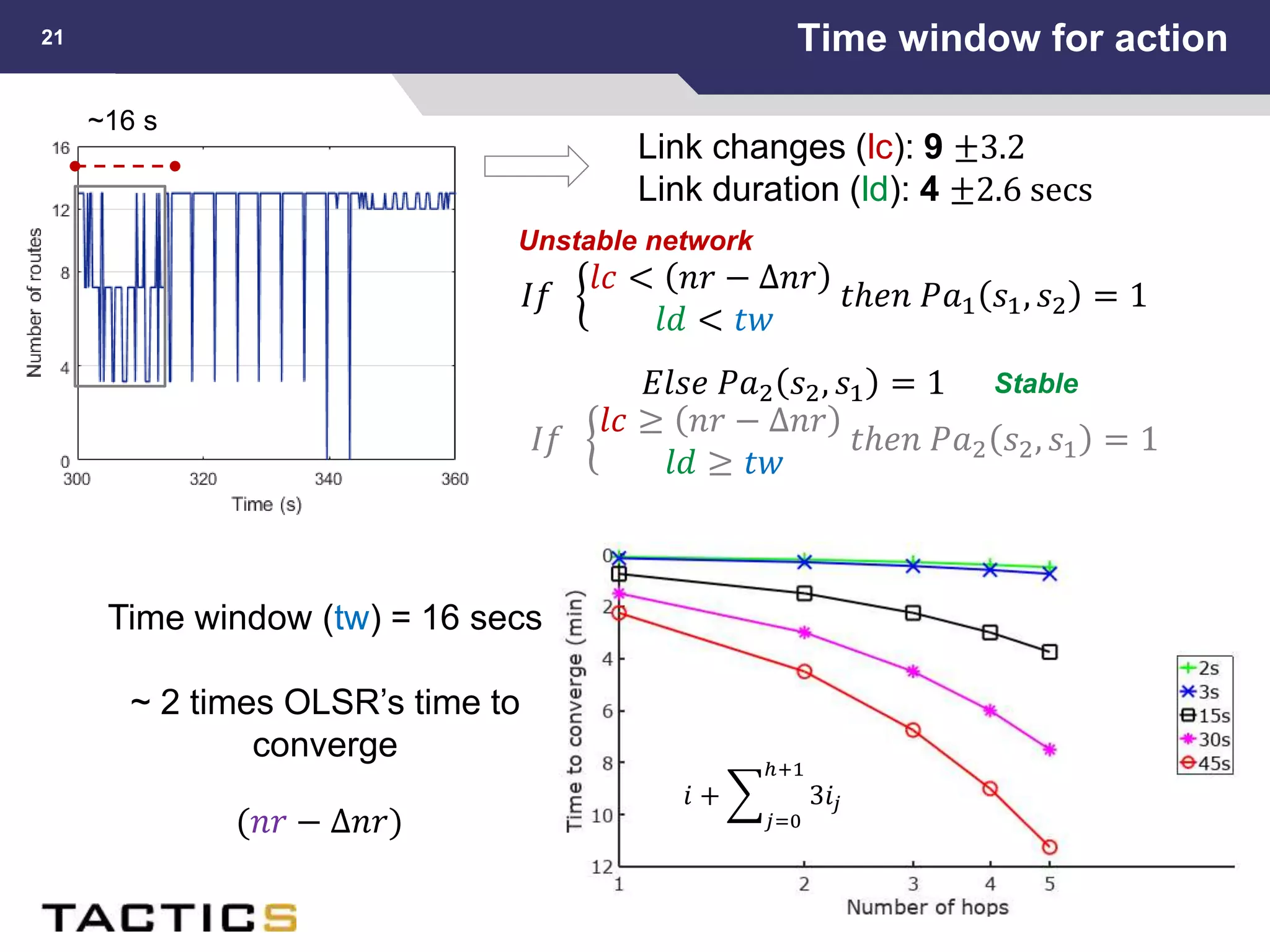
Time window for action21
𝐼𝑓
𝑙𝑐 < 𝑛𝑟 − Δ𝑛𝑟
𝑙𝑑 < 𝑡𝑤
𝑡ℎ𝑒𝑛 𝑃𝑎1 𝑠1, 𝑠2 = 1
𝐼𝑓
𝑙𝑐 ≥ 𝑛𝑟 − Δ𝑛𝑟
𝑙𝑑 ≥ 𝑡𝑤
𝑡ℎ𝑒𝑛 𝑃𝑎2 𝑠2, 𝑠1 = 1
𝐸𝑙𝑠𝑒 𝑃𝑎2 𝑠2, 𝑠1 = 1
Link changes (lc): 9 ±3.2
Link duration (ld): 4 ±2.6 secs
Unstable network
Stable
~16 s
Time window (tw) = 16 secs
~ 2 times OLSR’s time to
converge
(𝑛𝑟 − Δ𝑛𝑟)
𝑖 +
𝑗=0
ℎ+1
3𝑖𝑗
Agenda
Presentatio
n title
Three things:
s1
s2 s3
Disconnected
Established DTN
Unstable
Stable
EMCON EMCON
The model
3 States + 3 Actions
States = {Disconnected, Established and DTN}
Actions = {Stable, Unstable, EMCON}
𝑠1 𝑠2 𝑠3
𝑠1
𝑠2
𝑠3
1 0 0
1 0 0
1 0 0
𝑠1 𝑠2 𝑠3
𝑠1
𝑠2
𝑠3
0 0 0
0 𝟏 0
0 𝟏 0
𝑠1 𝑠2 𝑠3
𝑠1
𝑠2
𝑠3
0 0 0
0 0 𝟏
0 0 𝟏
𝑠1 𝑠2 𝑠3
𝑠1
𝑠2
𝑠3
0 1 1
1 0 1
1 1 0
s1S2,3
Disconnected
EMCON
s2S1,3
Established
s3S1,2
DTN
Unstable
Stable
𝐼𝑓
𝑙𝑐 < 𝑛𝑟 − Δ𝑛𝑟
𝑙𝑑 < 𝑡𝑤
𝐼𝑓
𝑙𝑐 ≥ 𝑛𝑟 − Δ𝑛𝑟
𝑙𝑑 ≥ 𝑡𝑤
𝑃 𝑠2, 𝑠3 = 1
𝑃 𝑠3, 𝑠2 = 1
Where:
lc = link changes
ld = link duration
nr = number of routes
tw = time window
The decision process23
Tactical DTNri
i3
i2
i1 o1
o2
o3
ro
S1,...,Sn
Packet Handler
Olocal
Disruption or EMCON
Cross-layer feedback
In Out
1
2
3
Packet handler
Message handler
Service mediator
1
2
Behaviour
Behaviour
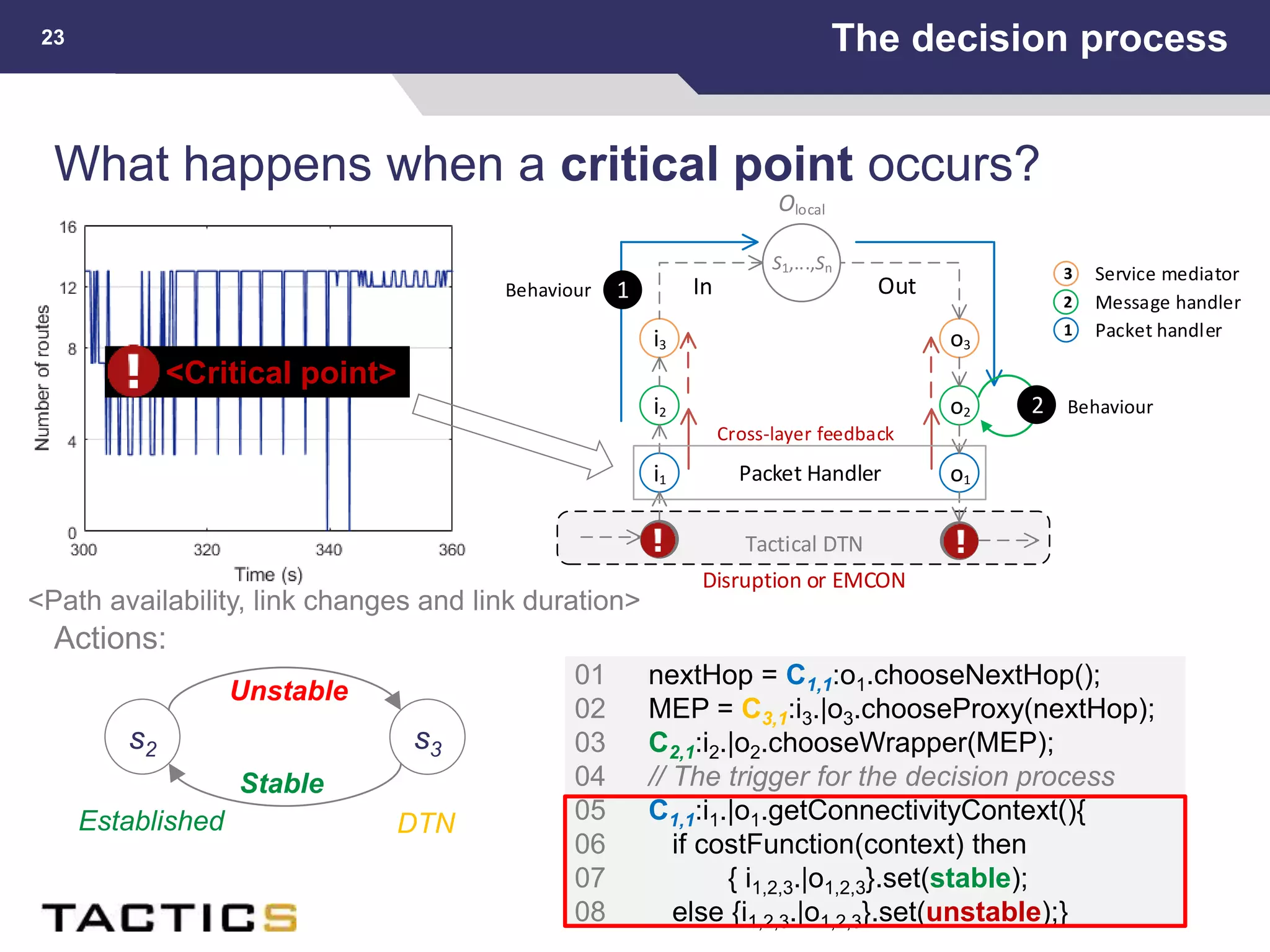
01 nextHop = C1,1:o1.chooseNextHop();
02 MEP = C3,1:i3.|o3.chooseProxy(nextHop);
03 C2,1:i2.|o2.chooseWrapper(MEP);
04 // The trigger for the decision process
05 C1,1:i1.|o1.getConnectivityContext(){
06 if costFunction(context) then
07 { i1,2,3.|o1,2,3}.set(stable);
08 else {i1,2,3.|o1,2,3}.set(unstable);}
What happens when a critical point occurs?
s2 s3
Established DTN
Unstable
Stable
Actions:
<Critical point>
<Path availability, link changes and link duration>
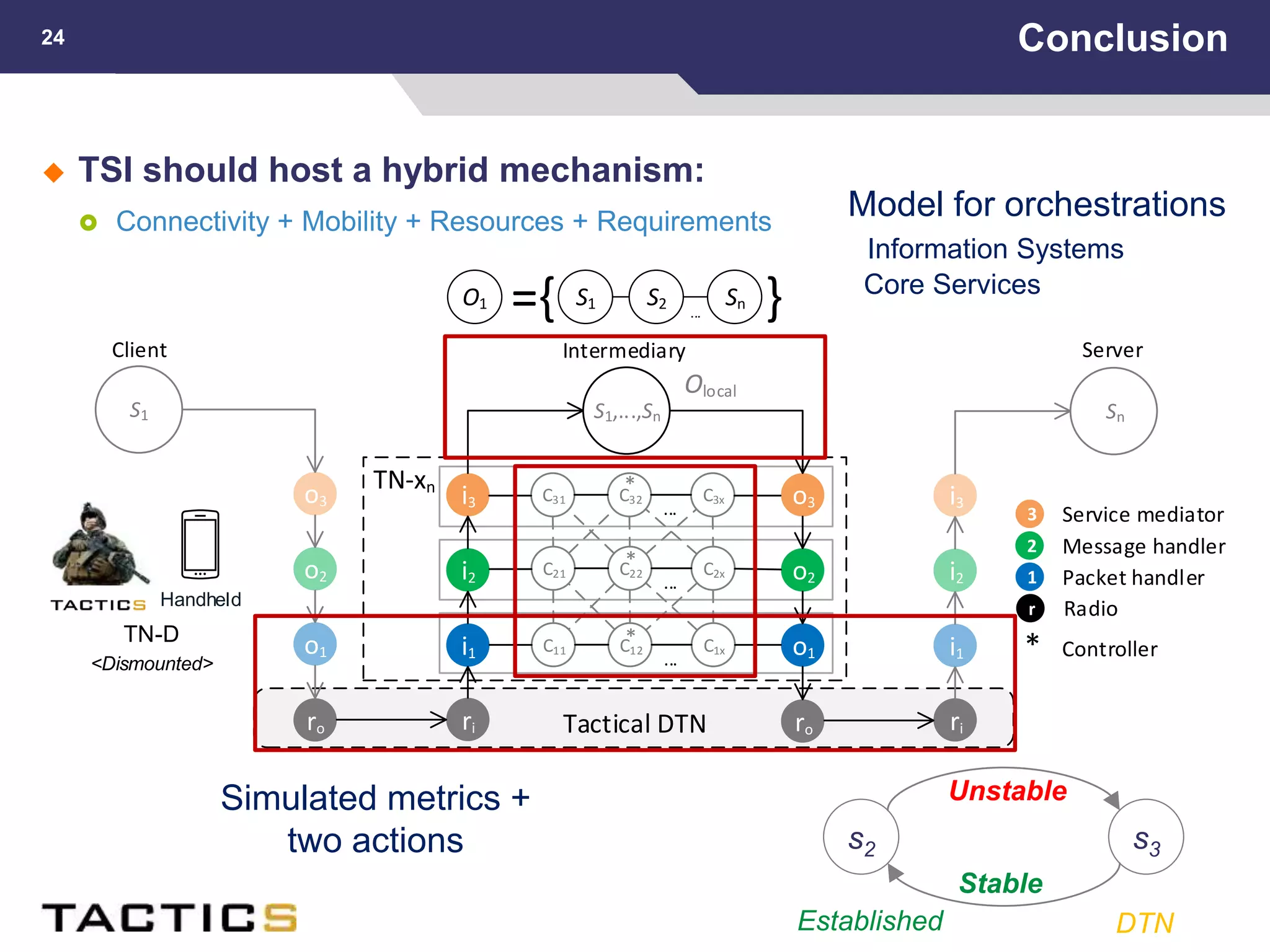
 TSI should host a hybrid mechanism:
 Connectivity + Mobility + Resources + Requirements
Conclusion24
Tactical DTNri
i3
i2
i1 o1
o2
o3
ro
C11 C12 C1x
...
C21 C22 C2x
...
C31 C32 C3x
...
*
*
*
TN-xn
S1,...,Sn
Olocal
1
2
3
Packet handler
Message handler
Service mediator
* Controller
r Radio
o1
o2
o3
ro
S1
Handheld
TN-D
<Dismounted>
ri
i3
i2
i1
Sn
Client ServerIntermediary
Simulated metrics +
two actions
={ }S1 S2 Sn
...
O1
Model for orchestrations
Information Systems
Core Services
s2 s3
Established DTN
Unstable
Stable
Agenda
Presentation title yyyy-mm-dd
Three things:
# ifdown wlan0
Reactive/Proactive Connectivity Management
in a Tactical Service-Oriented Infrastructure
25
Roberto Rigolin F. Lopes, Mikko Nieminen, Antti Viidanoja, Stephen D. Wolthusen
roberto.lopes@fkie.fraunhofer.de , antti.viidanoja@patria.fi
15th May 2017 - Oulu, Finland

Reactive/Proactive Connectivity Management in a Tactical Service-Oriented Infrastructure

  • 1.
    Agenda Presentation title 1 yyyy-mm-dd Three things: Reactive/ProactiveConnectivity Management in a Tactical Service-Oriented Infrastructure Roberto Rigolin F. Lopes, Mikko Nieminen, Antti Viidanoja, Stephen D. Wolthusen roberto.lopes@fkie.fraunhofer.de , antti.viidanoja@patria.fi 15th May 2017 - Oulu, Finland # ICMCIS2017
  • 2.
    Agenda Agenda 2 • Introduction • Scenarioand QoS Requirements • Service-Oriented Model • Connectivity Management • Quantitative Analysis • Conclusion Assumption: the SERVICE abstraction reduces systems complexity Hypothesis: Tactical Service-oriented Infrastructure (TSI) architecture can manage CONNECTIVITY challenges 1 2 3 Reactive/Proactive Connectivity Management in a Tactical Service-Oriented Infrastructure
  • 3.
    In Short Presentation titleyyyy-mm-dd In Short… 3 <Mobile device> Data Link <Network Interface> Controller Service Mediator Message Handler Packet Handler TSI Node Southbound Interface Northbound Interface 1 2 3 Cross-layer 4 Service(s)Information System(s) TCP/IP 1 3 TSI Tactical Service-oriented Infra 2 Connectivity Tactical Networks
  • 4.
    Agenda What is aservice? Wrapped-up logical processes designed to be reused; even carrying its own descriptions and QoS requirements Service Priority Reliability ToE(sec) Time requirement MEDEVAC 0 FLASH Yes 300 60 secs when pushed Obstacle Alert 1 Immediate Yes 150 Pushed every 15 secs Picture 2 Priority Yes 3600 When possible BFT 3 Routine No 120 60 secs when requested, every 120 secs 1 <Operational Picture> 4 MEDEVAC0 FLASH 1 Immediate 2 Priority 3 Routine Picture service
  • 5.
    Agenda Presentation title yyyy-mm-dd Threethings: The tactical network 5 Connectivity scenario ARPANET + Tactical network Data Link <Network Interface> Network IPv4-6 Transport TCP, UDP Application HTTP, SMTP Services TSI <Radio(s)> HQ Custom Mobile WLAN, UHF Dismounted VHF VHF, SatCom UHF, VHF, SatCom WLAN, UHF, VHF WLANUHF, VHF, SatCom Connectivity graph SatComVHF UHFWLAN <Disruption> Disruption/Delaty Tolerant Network (DTN) The mobile nodes: Node A <Dismounted> UHF WLAN Node C <Mobile> VHFUHFWLAN SatCom HQ Node D <Deployed> SatComVHF UHFWLAN Node B <Relay> SatComVHF
  • 6.
    In Short Presentation titleyyyy-mm-dd TSI Tactical Service Infrastructure 6 Mission #1: local/distributed Services Mission #2: Core Services Mission #3: handle stable + unstable network conditions Controller Service Mediator Message Handler Packet Handler TSI Node Southbound Interface Northbound Interface 1 2 3 Cross-layer PEP PEP PEP 4 Service(s)Information Systems Node A <Dismounted> UHF WLAN Node C <Mobile> VHFUHFWLAN SatCom
  • 7.
     Tactical GroundReport System  Gathering context information in the battlefield Example of services from the literature7 Node C Node A Soldier localization Adversary localization Vehicle localization Live camera Aerial photos Node B J. Evans, B. Ewy, M. Swink, S. Pennington, D. Siquieros, and S. Earp, “TIGR: the tactical ground reporting system,” IEEE Communications Magazine, vol. 51, no. 10, pp. 42–49, October 2013. <Aerial photos> <Blue/Red force tracking> <Live camera, compile and share>
  • 8.
    TACTICS Connectivity Scenario8 <Mobile> <Core> HQ(TN-H) Dismounted (TN-D) Mobile (TN-M) Custom (TN-C) Company Brigade Squads Platoon1 MEDEVAC Communication patterns: Mobility: Convoy RSTA Combat, … a) From Core to All Non-critical If possible b) From Core to All Immediate threat Reliable, 15s when pushed c) From Mobile to Core Blue Force Tracking Reliable, 60s when requested Quality of Service (QoS): Integral (complete/error-free) Reliable (confirmed) If possible (no guarantees) RSTA: Reconnaissance, Surveillance and Target Acquisition
  • 9.
    In Short TSI TacticalService Infrastructure 9 Connectivity states: i At two or more nodes, V = {TN-x1, TN-x2,..., TN-xn} i o TN-D1 O1 O2o i Odistributed (V,E,D) TN-x2 oOni TN-Coren ... i = {i1, i2, i3} o = {o1, o2, o3}Southbound interfaces reliable, 10 secs when pushed Dismounted i reliable, 30 secs when pushed Deployed Immediate threat Distributed service orchestrations <Mobile> <Core> ={ }S1 S2 Sn ... O1 How the services should behave?s2 s3 Established DTN Unstable Stable Good connectivity Poor connectivity
  • 10.
    In Short Presentation titleyyyy-mm-dd TSI Tactical Service Infrastructure 10 <Mobile device> Data Link <Network Interface> Transport Application Controller Service Mediator Message Handler Packet Handler TSI Node Southbound Interface Northbound Interface 1 2 3 Cross-layer 4 Service(s)Information System(s) Network1 32 TCP/IP 2
  • 11.
    Example of orchestration TODO: work on that paper diagram… State of the art review yyyy-mm-ddPresentation title Neighbor discovery Data Transmit Neighbors? Messages? Receiving/Sending? 11 DTN handling in the literature No No No Yes Yes Yes Store/Forward 1 2 1 Controller Service Mediator Message Handler Packet Handler1 2 3 4 PEP PEP PEP 4 4 4 Disruption/Delay Tolerant Networks 3 3 SatComVHF UHFWLAN Good connectivity Poor connectivity The task is do it using the Core Services… Tactical Service Infrastructure (TSI) 2 <mobile device>
  • 12.
    State of theart at TSI12 Dynamic view Service Sn i3i2i1 o1o2o3 In Out TSI TSICross-layer calls rorin Cross-layer calls 1 Packet handler 2 Message handler 3 Service mediator r Radio {WLAN, UHF, VHF, SatCom} Neighbor discovery Data Transmit Store/Forward 1 1 3 2 3 2 01 02 03 04 C2,1 = Labelling; C2,2 = Cryptography; label = C2,1:i2.readLabel(); C2,1:o2.createLabel(); C2,1:o2.update(label) /* Constructors */ C2,1:i2.readLabel(){C2,2:i2.decryptLabel()} C2,1:o2.createLabel(){C2,2:o2.encryptLabel()} update{ o2.decryptLabel(), o2.encryptLabel()} i2 .readLabel() .decryptLabel() <message handler>
  • 13.
    In Short Presentation title TSITactical Service Infrastructure 13 Routing Service Packet Handling Service 1 Proxy Service Message Queue Service 3 Message Transport Messaging Service 2 QoS Handler Policy Management Security Handler 4 TSI Node Southbound Interface Northbound Interface Cross-layer Service(s)Information Systems ri i3 i2 i1 o1 o2 o3 ro C11 C12 C1x ... C21 C22 C2x ... C31 C32 C3x ... * * * Core Services
  • 14.
    Agenda Presentation title Three things: 14 s1 s2s3 Disconnected Established DTN Unstable Stable EMCON EMCON The model 3 States + 3 Actions Emission Control (EMCON) States = {Disconnected, Established and DTN} Actions = {Stable, Unstable, EMCON} 𝑠1 𝑠2 𝑠3 𝑠1 𝑠2 𝑠3 1 0 0 1 0 0 1 0 0 𝑠1 𝑠2 𝑠3 𝑠1 𝑠2 𝑠3 0 0 0 0 𝟏 0 0 𝟏 0 𝑠1 𝑠2 𝑠3 𝑠1 𝑠2 𝑠3 0 0 0 0 0 𝟏 0 0 𝟏 How to decide to take an action? 𝑠1 𝑠2 𝑠3 𝑠1 𝑠2 𝑠3 0 1 1 1 0 1 1 1 0 s1S2,3 Disconnected EMCON s2S1,3 Established s3S1,2 DTN Unstable Stable
  • 15.
    State of theart review15 Connectivity Mobility Resources Requirements Network setup: Fully connected Fragmented Opportunistic Mobility pattern Bandwidth Storage capacity Power consumption QoS Priority, reliability, sensitivity Node A <Dismounted> UHF WLAN Kernel IP routing table Destination Gateway Metric 10.1.1.2 10.1.1.19 2 10.1.1.3 10.1.1.19 2 10.1.1.4 10.1.1.19 2 10.1.1.5 10.1.1.19 2 10.1.1.6 10.1.1.19 2 a) From Core to All Non-critical If possible b) From Core to All Immediate threat Reliable, 15s pushed Solutions in the literature are based on availability of: Controller Service Mediator Message Handler Packet Handler1 2 3 4 PEP PEP PEP Tactical Service Infrastructure (TSI) Group 02 Group 01 Group 03 1 2 31 1 1 2
  • 16.
    Mobility metrics16 Spatial dependence Temporaldependence Link changes Link duration Path availability 𝐷 𝑠𝑝𝑎𝑡𝑖𝑎𝑙(𝑖, 𝑗, 𝑡) = 𝑅𝐷( 𝑣𝑖 𝑡 , 𝑣 𝑗(𝑡)) * 𝑆𝐷( 𝑣𝑖 𝑡 , 𝑣 𝑗(𝑡)) 𝐷𝑡𝑒𝑚𝑝𝑜𝑟𝑎𝑙(𝑖, 𝑗, 𝑡′) = 𝑅𝐷( 𝑣𝑖 𝑡 , 𝑣 𝑗(𝑡′)) * 𝑆𝐷( 𝑣𝑖 𝑡 , 𝑣 𝑗(𝑡′)) 𝐿𝐷(𝑖, 𝑗) = 𝑡=1 𝑇 𝑋(𝑖, 𝑗, 𝑡) 𝐿𝐶(𝑖, 𝑗) 𝐿𝐶 𝑖, 𝑗 = 𝑡=1 𝑇 𝐶(𝑖, 𝑗, 𝑡) 𝑃𝐴(𝑖, 𝑗) = 𝑡=𝑠𝑡𝑎𝑟𝑡(𝑖,𝑗) 𝑇 𝐴(𝑖, 𝑗, 𝑡) 𝑇 − 𝑠𝑡𝑎𝑟𝑡(𝑖, 𝑗) RD: Relative Direction SR: Speed Ratio 𝑣𝑖 𝑡 𝑣 𝑗(𝑡) Timeline Handheld <Dismounted> t <Now> t' <Future> <Multi-hop> <Links> <Localization> <Time> Laptop <Mobile>
  • 17.
    Agenda Presentation title yyyy-mm-dd Threethings: Hypothesis 17 A feasible guess? 𝐸𝑇𝑇 = 1 𝑙𝑞 ∗ 𝑛𝑙𝑞 ∗ 𝑠𝑐𝑎𝑙𝑖𝑛𝑔 𝑙𝑖𝑛𝑘𝑠𝑝𝑒𝑒𝑑 𝐷𝐴𝑇 = 1 𝑙𝑞 ∗ 𝑠𝑐𝑎𝑙𝑖𝑛𝑔 𝑙𝑖𝑛𝑘𝑠𝑝𝑒𝑒𝑑 𝐸𝑇𝑋 = 1 𝑙𝑞 ∗ 𝑛𝑙𝑞 Expected Transmission Count (ETX) Direction Airtime (DAT) Expected Transmission Time (ETT) <Radio(s)> <Localization> Path availability 𝑃𝐴(𝑖, 𝑗) = 𝑡=𝑠𝑡𝑎𝑟𝑡(𝑖,𝑗) 𝑇 𝐴(𝑖, 𝑗, 𝑡) 𝑇 − 𝑠𝑡𝑎𝑟𝑡(𝑖, 𝑗) Link changes Link duration 𝐿𝐷(𝑖, 𝑗) = 𝑡=1 𝑇 𝑋(𝑖, 𝑗, 𝑡) 𝐿𝐶(𝑖, 𝑗) 𝐿𝐶 𝑖, 𝑗 = 𝑡=1 𝑇 𝐶(𝑖, 𝑗, 𝑡) <Time> s1 s2 s3 Disconnected Established DTN Unstable Stable EMCON EMCON We started with the hypothesis that the stable and unstable actions can be defined based on the metrics above. The system has 3 states and 3 actions: Spatial dependence Temporal dependence 𝐷 𝑠𝑝𝑎𝑡𝑖𝑎𝑙(𝑖, 𝑗, 𝑡) = 𝑅𝐷( 𝑣𝑖 𝑡 , 𝑣 𝑗(𝑡)) * 𝑆𝐷( 𝑣𝑖 𝑡 , 𝑣 𝑗(𝑡)) 𝐷𝑡𝑒𝑚𝑝𝑜𝑟𝑎𝑙(𝑖, 𝑗, 𝑡′) = 𝑅𝐷( 𝑣𝑖 𝑡 , 𝑣 𝑗(𝑡′)) * 𝑆𝐷( 𝑣𝑖 𝑡 , 𝑣 𝑗(𝑡′)) Random, Group and Grid <three mobility patterns> OLSRv2 <One metric: DAT>
  • 18.
    Simulation results yyyy-mm-ddPresentation title 18 RandomGroup Group 01 Group 02 Group 03Group 02 Group 01 Group 03 Data overhead OLSRv2 (18 nodes) Adding nodes (18 to 42 nodes) Group 01 Grid (convoy) Mobility patterns: <unstable> Worst case <stable> Best case <Group> In between
  • 19.
    In Short Presentation titleyyyy-mm-dd TSI Tactical Service Infrastructure 19 Mission #1: local/distributed Services Mission #2: Core Services Mission #3: handle stable + unstable network conditions Controller Service Mediator Message Handler Packet Handler TSI Node Southbound Interface Northbound Interface 1 2 3 Cross-layer PEP PEP PEP 4 Service(s)Information Systems s2 s3 Established DTN Unstable Stable
  • 20.
    Simulation results20 Group 18(6),27(9),36(12),42(14) Group 02 Group01 Group 03 Group 18 nodes, 3 groups of 6 Link changes (lc): 9 ±3.2 Link duration (ld): 4 ±2.6 secs <isolated> <intermittent> DTN @Critical points A, B and C (DTN) Intermittent routes between 01 and 02 Path availiability: 0 min (DTN) No routes between Group 01 and 03
  • 21.
    Time window foraction21 𝐼𝑓 𝑙𝑐 < 𝑛𝑟 − Δ𝑛𝑟 𝑙𝑑 < 𝑡𝑤 𝑡ℎ𝑒𝑛 𝑃𝑎1 𝑠1, 𝑠2 = 1 𝐼𝑓 𝑙𝑐 ≥ 𝑛𝑟 − Δ𝑛𝑟 𝑙𝑑 ≥ 𝑡𝑤 𝑡ℎ𝑒𝑛 𝑃𝑎2 𝑠2, 𝑠1 = 1 𝐸𝑙𝑠𝑒 𝑃𝑎2 𝑠2, 𝑠1 = 1 Link changes (lc): 9 ±3.2 Link duration (ld): 4 ±2.6 secs Unstable network Stable ~16 s Time window (tw) = 16 secs ~ 2 times OLSR’s time to converge (𝑛𝑟 − Δ𝑛𝑟) 𝑖 + 𝑗=0 ℎ+1 3𝑖𝑗
  • 22.
    Agenda Presentatio n title Three things: s1 s2s3 Disconnected Established DTN Unstable Stable EMCON EMCON The model 3 States + 3 Actions States = {Disconnected, Established and DTN} Actions = {Stable, Unstable, EMCON} 𝑠1 𝑠2 𝑠3 𝑠1 𝑠2 𝑠3 1 0 0 1 0 0 1 0 0 𝑠1 𝑠2 𝑠3 𝑠1 𝑠2 𝑠3 0 0 0 0 𝟏 0 0 𝟏 0 𝑠1 𝑠2 𝑠3 𝑠1 𝑠2 𝑠3 0 0 0 0 0 𝟏 0 0 𝟏 𝑠1 𝑠2 𝑠3 𝑠1 𝑠2 𝑠3 0 1 1 1 0 1 1 1 0 s1S2,3 Disconnected EMCON s2S1,3 Established s3S1,2 DTN Unstable Stable 𝐼𝑓 𝑙𝑐 < 𝑛𝑟 − Δ𝑛𝑟 𝑙𝑑 < 𝑡𝑤 𝐼𝑓 𝑙𝑐 ≥ 𝑛𝑟 − Δ𝑛𝑟 𝑙𝑑 ≥ 𝑡𝑤 𝑃 𝑠2, 𝑠3 = 1 𝑃 𝑠3, 𝑠2 = 1 Where: lc = link changes ld = link duration nr = number of routes tw = time window
  • 23.
    The decision process23 TacticalDTNri i3 i2 i1 o1 o2 o3 ro S1,...,Sn Packet Handler Olocal Disruption or EMCON Cross-layer feedback In Out 1 2 3 Packet handler Message handler Service mediator 1 2 Behaviour Behaviour 01 nextHop = C1,1:o1.chooseNextHop(); 02 MEP = C3,1:i3.|o3.chooseProxy(nextHop); 03 C2,1:i2.|o2.chooseWrapper(MEP); 04 // The trigger for the decision process 05 C1,1:i1.|o1.getConnectivityContext(){ 06 if costFunction(context) then 07 { i1,2,3.|o1,2,3}.set(stable); 08 else {i1,2,3.|o1,2,3}.set(unstable);} What happens when a critical point occurs? s2 s3 Established DTN Unstable Stable Actions: <Critical point> <Path availability, link changes and link duration>
  • 24.
     TSI shouldhost a hybrid mechanism:  Connectivity + Mobility + Resources + Requirements Conclusion24 Tactical DTNri i3 i2 i1 o1 o2 o3 ro C11 C12 C1x ... C21 C22 C2x ... C31 C32 C3x ... * * * TN-xn S1,...,Sn Olocal 1 2 3 Packet handler Message handler Service mediator * Controller r Radio o1 o2 o3 ro S1 Handheld TN-D <Dismounted> ri i3 i2 i1 Sn Client ServerIntermediary Simulated metrics + two actions ={ }S1 S2 Sn ... O1 Model for orchestrations Information Systems Core Services s2 s3 Established DTN Unstable Stable
  • 25.
    Agenda Presentation title yyyy-mm-dd Threethings: # ifdown wlan0 Reactive/Proactive Connectivity Management in a Tactical Service-Oriented Infrastructure 25 Roberto Rigolin F. Lopes, Mikko Nieminen, Antti Viidanoja, Stephen D. Wolthusen roberto.lopes@fkie.fraunhofer.de , antti.viidanoja@patria.fi 15th May 2017 - Oulu, Finland