Resistance and Resistivity
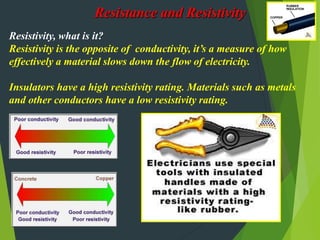
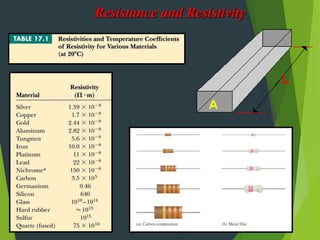
Resistivity, what is it?
Resistivity is the opposite of conductivity, it’s a measure of how
effectively a material slows down the flow of electricity.
Insulators have a high resistivity rating. Materials such as metals
and other conductors have a low resistivity rating.
Resistance and Resistivity
 A conductor’s Resistance is defined as the ratio of the Applied Voltage to
the Current produced.
R = V/I
Scalar
Units: Ohm [Ω] = [V/A]
Resistance and Resistivity
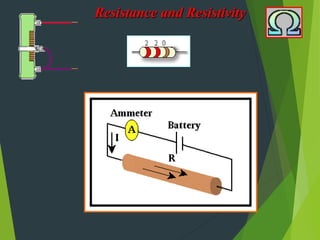
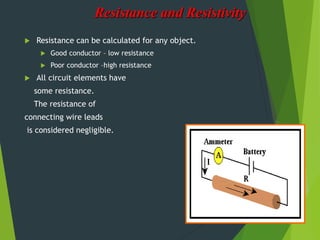
 Resistance can be calculated for any object.
 Good conductor – low resistance
 Poor conductor –high resistance
 All circuit elements have
some resistance.
The resistance of
connecting wire leads
is considered negligible.
Resistance and Resistivity
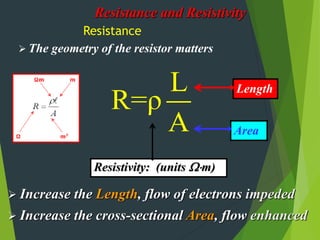
Resistance
 The geometry of the resistor matters
L
R=ρ
A
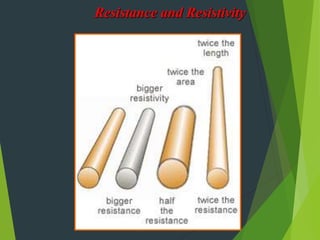
 Increase the Length, flow of electrons impeded
 Increase the cross-sectional Area, flow enhanced
Resistivity: (units m)
Length
Area
Resistance and Resistivity
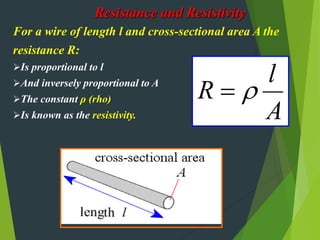
For a wire of length l and cross-sectional area A the
resistance R:
Is proportional to l
And inversely proportional to A
The constant ρ (rho)
Is known as the resistivity.
l
R
A


Resistance and Resistivity
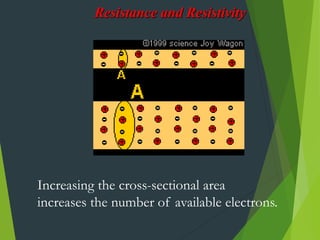
Increasing the cross-sectional area
increases the number of available electrons.
Resistance and Resistivity
Resistivity
2
( )
m
R m Ohms
m
   
l
R
A


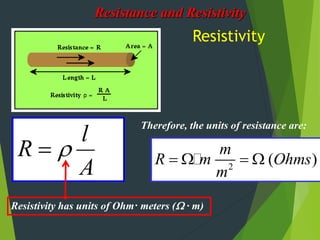
Resistivity has units of Ohm· meters ( · m)
Therefore, the units of resistance are:
Resistance and Resistivity
Resistivity and temperature.
The resistance and resistivity changes with temperature,
therefore resistivity at quoted at a specific temperature
The resistance is proportional to the length l and inversely
proportional to the cross-sectional area A, the material the
conductor is made from, and the temperature.
Resistance and Resistivity
Superconductivity
 Below a certain critical temperature,
Resistance becomes ZERO, allowing current to exist without
energy wasted.
Superconductivity, although predicted and discovered a
century ago has only become useful recently due to the
development of rare-earth conductive ceramics.
Superconductive wires are used in the electromagnets
of MRI machines.
Resistance and Resistivity
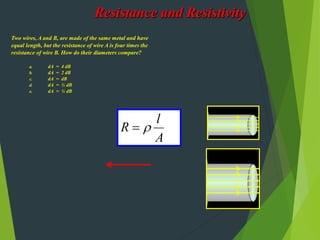
Two wires, A and B, are made of the same metal and have
equal length, but the resistance of wire A is four times the
resistance of wire B. How do their diameters compare?
a. dA = 4 dB
b. dA = 2 dB
c. dA = dB
d. dA = ½ dB
e. dA = ¼ dB
l
R
A


Resistance and Resistivity
A wire of resistance R is stretched uniformly (keeping its volume
constant) until it is twice its original length. What happens to the
resistance?
a. it increases by a factor 4
b. it increases by a factor 2
c. it stays the same
d. it decreases by a factor 2
e. it decreases by a factor 4
Resistance and Resistivity
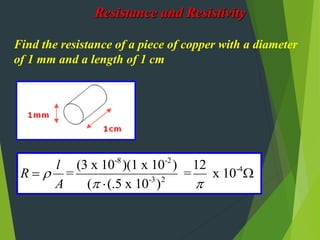
Find the resistance of a piece of copper with a diameter
of 1 mm and a length of 1 cm
-8 -2
-4
-3 2
(3 x 10 )(1 x 10 ) 12
= = x 10
( (.5 x 10 )
l
R
A

 
 

Resistance and Resistivity
Bolbo the gold broker from Baghdad has just received a gold
bullion bar for his birthday from his brother Bob. The face of the
bar is 5 cm on both sides, and the length is 20 cm. The resistance
between faces A and B is measured to be 0.8 micro-ohms. Bolbo
the broker assumes that the bullion is gold if the measured
resistance is within +/- 10% of the theoretical value. Is the material
gold or is it bogus?
B
8 2 2
6
/
(2.4 10 )(.2 ) /.05 )
1.92 10
R L A
x m m m
x




 
 
=1.92 u don’t try to cash it in!
Resistance and Resistivity
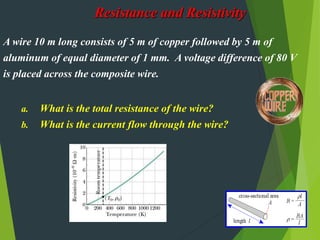
A wire 10 m long consists of 5 m of copper followed by 5 m of
aluminum of equal diameter of 1 mm. A voltage difference of 80 V
is placed across the composite wire.
a. What is the total resistance of the wire?
b. What is the current flow through the wire?
Resistance and Resistivity
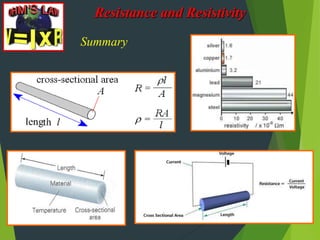
Summary

Resistivity.ppt

  • 1.
  • 2.
    Resistance and Resistivity Resistivity,what is it? Resistivity is the opposite of conductivity, it’s a measure of how effectively a material slows down the flow of electricity. Insulators have a high resistivity rating. Materials such as metals and other conductors have a low resistivity rating.
  • 3.
    Resistance and Resistivity A conductor’s Resistance is defined as the ratio of the Applied Voltage to the Current produced. R = V/I Scalar Units: Ohm [Ω] = [V/A]
  • 4.
    Resistance and Resistivity Resistance can be calculated for any object.  Good conductor – low resistance  Poor conductor –high resistance  All circuit elements have some resistance. The resistance of connecting wire leads is considered negligible.
  • 5.
    Resistance and Resistivity Resistance The geometry of the resistor matters L R=ρ A  Increase the Length, flow of electrons impeded  Increase the cross-sectional Area, flow enhanced Resistivity: (units m) Length Area
  • 6.
    Resistance and Resistivity Fora wire of length l and cross-sectional area A the resistance R: Is proportional to l And inversely proportional to A The constant ρ (rho) Is known as the resistivity. l R A  
  • 7.
    Resistance and Resistivity Increasingthe cross-sectional area increases the number of available electrons.
  • 8.
  • 9.
    Resistance and Resistivity Resistivity 2 () m R m Ohms m     l R A   Resistivity has units of Ohm· meters ( · m) Therefore, the units of resistance are:
  • 10.
  • 11.
  • 12.
    Resistance and Resistivity Resistivityand temperature. The resistance and resistivity changes with temperature, therefore resistivity at quoted at a specific temperature The resistance is proportional to the length l and inversely proportional to the cross-sectional area A, the material the conductor is made from, and the temperature.
  • 13.
    Resistance and Resistivity Superconductivity Below a certain critical temperature, Resistance becomes ZERO, allowing current to exist without energy wasted. Superconductivity, although predicted and discovered a century ago has only become useful recently due to the development of rare-earth conductive ceramics. Superconductive wires are used in the electromagnets of MRI machines.
  • 14.
    Resistance and Resistivity Twowires, A and B, are made of the same metal and have equal length, but the resistance of wire A is four times the resistance of wire B. How do their diameters compare? a. dA = 4 dB b. dA = 2 dB c. dA = dB d. dA = ½ dB e. dA = ¼ dB l R A  
  • 15.
    Resistance and Resistivity Awire of resistance R is stretched uniformly (keeping its volume constant) until it is twice its original length. What happens to the resistance? a. it increases by a factor 4 b. it increases by a factor 2 c. it stays the same d. it decreases by a factor 2 e. it decreases by a factor 4
  • 16.
    Resistance and Resistivity Findthe resistance of a piece of copper with a diameter of 1 mm and a length of 1 cm -8 -2 -4 -3 2 (3 x 10 )(1 x 10 ) 12 = = x 10 ( (.5 x 10 ) l R A      
  • 17.
    Resistance and Resistivity Bolbothe gold broker from Baghdad has just received a gold bullion bar for his birthday from his brother Bob. The face of the bar is 5 cm on both sides, and the length is 20 cm. The resistance between faces A and B is measured to be 0.8 micro-ohms. Bolbo the broker assumes that the bullion is gold if the measured resistance is within +/- 10% of the theoretical value. Is the material gold or is it bogus? B 8 2 2 6 / (2.4 10 )(.2 ) /.05 ) 1.92 10 R L A x m m m x         =1.92 u don’t try to cash it in!
  • 18.
    Resistance and Resistivity Awire 10 m long consists of 5 m of copper followed by 5 m of aluminum of equal diameter of 1 mm. A voltage difference of 80 V is placed across the composite wire. a. What is the total resistance of the wire? b. What is the current flow through the wire?
  • 19.