50
Objectives
Grammar
The present perfect tense
Reading
Reading about heroes
Listening
Listening to a conversation about someone’s
experiences
Speaking
Greeting and introducing someone
Writing
Writing about a famous person
LESSON 1 SB page 23
Outcomes
•	To talk about people you admire
•	To read about heroes and answer questions
•	To carry out an internet search about Dr Rania
Elwani’s life
Before using the book:
•	Write the title of the unit People who we admire
on the board and ask the students to work in small
groups and brainstorm a list of kinds of people
who other people admire, for example, firefighters
or doctors.
•	Ask the groups to share their ideas with the rest
of the class and hold a short discussion about why
people admire them, for example, because they are
brave or very clever.
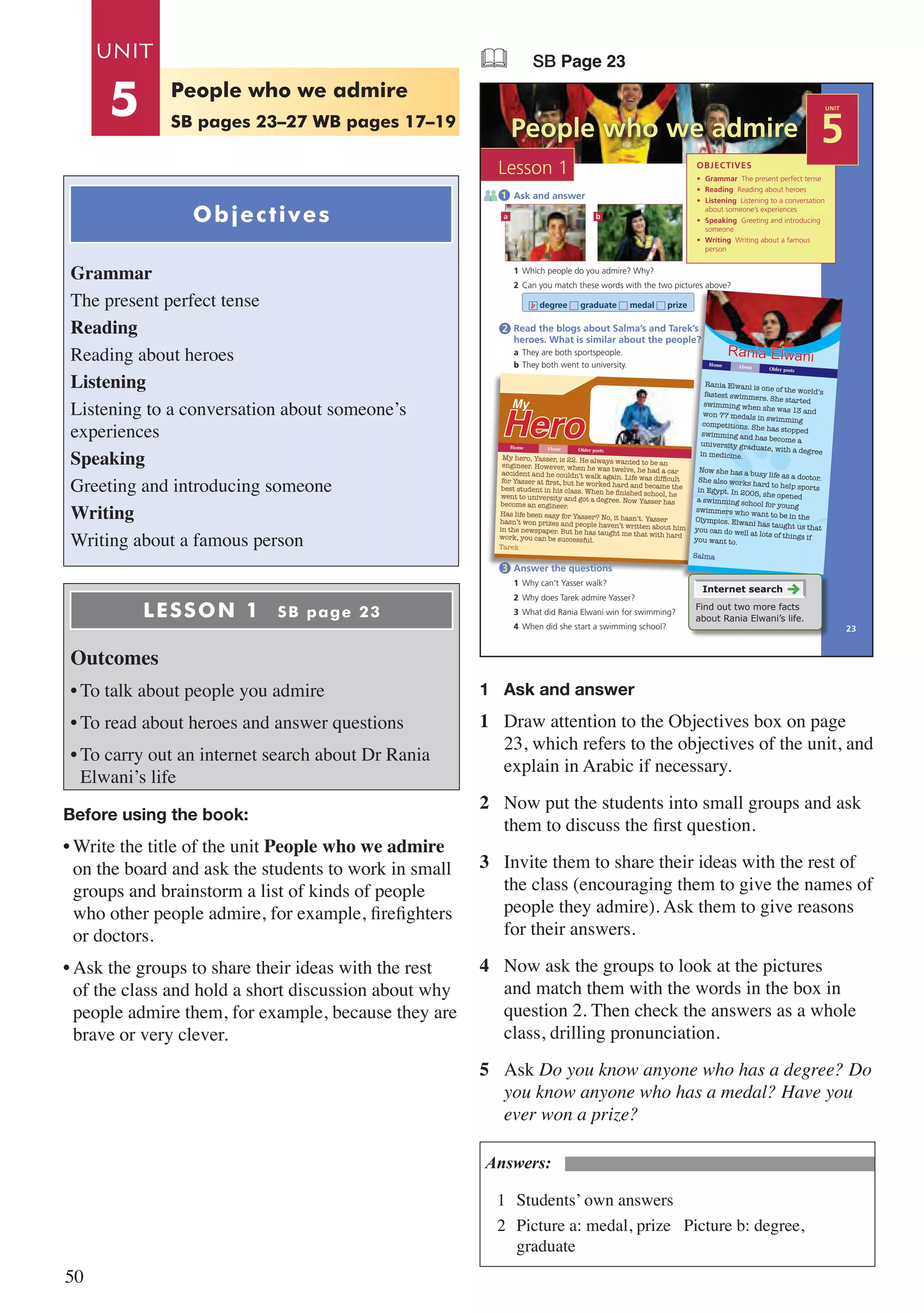
& SB Page 23
My hero, Yasser, is 22. He always wanted to be anengineer. However, when he was twelve, he had a caraccident and he couldn’t walk again. Life was difficultfor Yasser at first, but he worked hard and became thebest student in his class. When he finished school, hewent to university and got a degree. Now Yasser hasbecome an engineer.
Has life been easy for Yasser? No, it hasn’t. Yasserhasn’t won prizes and people haven’t written about himin the newspaper. But he has taught me that with hardwork, you can be successful.
Tarek
My
HeroHome About Older posts
People who we admire
OBJECTIVES
UNIT
5
Lesson 1
23
Ask and answer
1 Which people do you admire? Why?
2 Can you match these words with the two pictures above?
1
• Grammar The present perfect tense
• Reading Reading about heroes
• Listening Listening to a conversation
about someone’s experiences
• Speaking Greeting and introducing
someone
• Writing Writing about a famous
person
Answer the questions
1 Why can’t Yasser walk?
2 Why does Tarek admire Yasser?
3 What did Rania Elwani win for swimming?
4 When did she start a swimming school?
3
2 Read the blogs about Salma’s and Tarek’s
heroes. What is similar about the people?
a They are both sportspeople.
b They both went to university.
a b
degree graduate medal prizeb
Rania ElwaniHome
Older posts
About
Rania Elwani is one of the world’sfastest swimmers. She startedswimming when she was 13 andwon 77 medals in swimmingcompetitions. She has stoppedswimming and has become auniversity graduate, with a degreein medicine.
Now she has a busy life as a doctor.She also works hard to help sportsin Egypt. In 2005, she openeda swimming school for youngswimmers who want to be in theOlympics. Elwani has taught us thatyou can do well at lots of things ifyou want to.
Salma
Internet search
Find out two more facts
about Rania Elwani’s life.
1	 Ask and answer
1	 Draw attention to the Objectives box on page
23, which refers to the objectives of the unit, and
explain in Arabic if necessary.
2	 Now put the students into small groups and ask
them to discuss the first question.
3	 Invite them to share their ideas with the rest of
the class (encouraging them to give the names of
people they admire). Ask them to give reasons
for their answers.
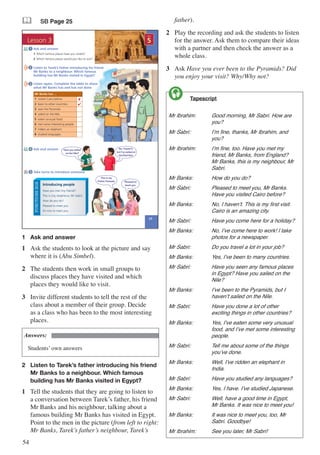
4	 Now ask the groups to look at the pictures
and match them with the words in the box in
question 2. Then check the answers as a whole
class, drilling pronunciation.
5	 Ask Do you know anyone who has a degree? Do
you know anyone who has a medal? Have you
ever won a prize?
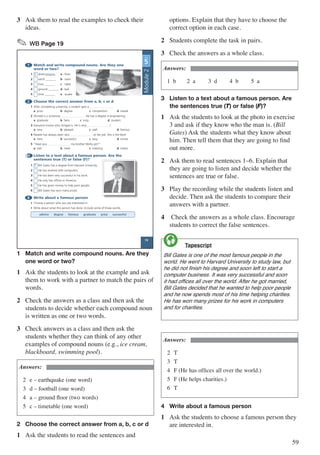
Answers:
1	 Students’ own answers
2	 Picture a: medal, prize Picture b: degree,	
	 graduate
People who we admire
SB pages 23–27 WB pages 17–19
UNIT
5
51
2	 Read the blogs about Salma’s and Tarek’s 		
heroes. What is similar about the people?
1	 Ask the students to read the question in the
rubric and predict what might be similar about
the two heroes.
2	 Then ask the students to read the texts quickly to
find the answer. Tell them not to worry about any
words they don’t know at this point.
3	 Check the answer as a whole class. Ask Have
you heard of Rania Elwani?
Answer:
b
3	 Answer the questions
1	 Ask the students to read the questions and work
in pairs to try to answer them without referring
to the text.
2	 The students then read the text again to check
their ideas. Check the answers as a whole
class and check the meaning of any unknown
vocabulary.
3	 Ask the students which of the heroes they
admire most and why.
Answers:
1	 He had a car accident when he was twelve.
2	 Because he has taught him that, with hard work, 	
	 you can be successful.
3	 She won 77 medals in swimming competitions.
4	 In 2005.
: Internet search
1	 Ask the students what else they know about Dr
Rania Elwani. Tell them that they are going to
find out more about her.
2	 Ask them to look at the Internet search box.
Brainstorm some facts that the students would
like to find out about Rania, for example, where
she’s from, why she started swimming, which
competitions she won.
3	 The students then work in pairs to carry out an
internet search to find out more about Dr Elwani.
4	 Invite different students to report back their
findings to the class.
LESSON 2 SB page 24 WB page 17
Outcomes
•	To use the present perfect
•	To ask and answer questions about events in the
past
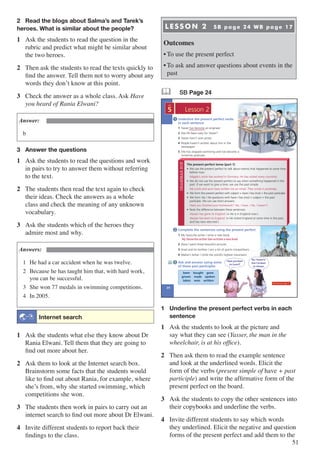
& SB Page 24
Workbook page 17
24
5
UNIT
Lesson 2
Underline the present perfect verbs
in each sentence
1 Yasser has become an engineer.
2 Has life been easy for Yasser?
3 Yasser hasn’t won prizes.
4 People haven’t written about him in the
newspaper.
5 She has stopped swimming and has become a
university graduate.
Ask and answer using some
of these past participles
Complete the sentences using the present perfect
1 My favourite writer / write a new book
…...........................................................................……..
2 Hana / paint these beautiful pictures …..……..
3 Imad and his brother / win a lot of sports competitions …..……..
4 Maher’s father / climb the world’s highest mountains …..……..
1
3
2
The present perfect tense (part 1)
• We use the present perfect to talk about events that happened at some time
before now:
Magda’s uncle has worked in Germany. He has visited many countries.
• We do not use the present perfect to say when something happened in the
past. If we want to give a time, we use the past simple.
My uncle and aunt have written me an email. They wrote it yesterday.
• We form the present perfect with subject + have / has (not) + the past participle.
• We form Yes / No questions with have / has (not) + subject + the past
participle. We can use short answers:
Have you finished your homework? Yes, I have. / No, I haven’t.
• Note the difference between these sentences:
Hassan has gone to England. (= He is in England now.)
Hassan has been to England. (= He visited England at some time in the past,
and has now returned.)
GRAMMARBOX
My favourite writer has written a new book.
been bought gone
grown made spoken
taken won written
No, I haven’t,
but I’ve been
to Aswan.
Have you been
to Luxor?
1	 Underline the present perfect verbs in each 	
	 sentence
1	 Ask the students to look at the picture and
say what they can see (Yasser, the man in the
wheelchair, is at his office).
2	 Then ask them to read the example sentence
and look at the underlined words. Elicit the
form of the verbs (present simple of have + past
participle) and write the affirmative form of the
present perfect on the board.
3	 Ask the students to copy the other sentences into
their copybooks and underline the verbs.
4	 Invite different students to say which words
they underlined. Elicit the negative and question
forms of the present perfect and add them to the
52
board (have/has + not + past participle; have/
has + subject + past participle).
5	 Ask the students to look at the first sentence
again and ask When did this happen? to elicit
that it happened before now, but we don’t know
exactly when. Repeat the question for the rest of
the sentences (they refer to the time before now).
6	 Ask the students to read the first point in the
Grammar box. Ask which of the sentences in
exercise 1 follow this rule (all of them).
7	 Then ask them to read the second point and
elicit some time references to be used with the
past simple (a week ago, last night, yesterday
morning, in 2010, etc.).
8	 The students then read the third and fourth
points and identify the sentences in exercise 1
which match the rules (sentences 3 and 4 are
negative, sentence 2 is a question).
9	 Ask the students to read the final point and invite
them to make two sentences of their own in
pairs. Ask them to read them out for the rest of
the class.
Answers:
1	 Now Yasser has become an engineer.
2	 Has life been easy for Yasser?
3	 Yasser hasn’t won prizes.
4	 People haven’t written about him in the 		
	 newspaper.
5	 She has stopped swimming now and has 		
	 become a university graduate.
2	 Complete the sentences using the present 	
	 perfect
1	 Ask the students to look at the picture and say
where the man is (on top of a mountain).
2	 Ask the students to read the example sentence.
Ask which tense the verbs are in the example
answer (present perfect). Ask why the present
perfect is used (because we know this is a time
before now, but we don’t know exactly when).
3	 The students then construct the rest of the
sentences using the prompts, as in the example.
Go round and monitor while they are working,
helping where necessary.
4	 Invite different students to read out the sentences
for the rest of the class to listen and check that
the present perfect has been used correctly.
Answers:
2	 Hana has painted these beautiful pictures.
3	 Imad and his brother have won a lot of sports 	
	 competitions.
4	 Maher’s father has climbed the world’s 		
	 highest mountains.
3	 Ask and answer using some of these past 		
	 participles
1	 Ask two students to read out the question and
answer shown in the speech bubbles and elicit
the infinitives of the past participle forms in the
box (be – been, buy – bought, go – gone, grow
– grown, make – made, speak – spoken, take –
taken, win – won, write – written).
2	 The students then work in small groups to ask
and answer questions using the past participles
to form the present perfect tense. Go round and
monitor while they are working, helping where
necessary.
3	 Invite pairs of students to ask and answer
questions for the rest of the class to listen.
4	 Play a game of Pairs. The students can prepare
this game themselves in class. Ask them to write
pairs of verbs in the past simple form and past
participle form on small cards (they could use
the verbs in exercise 3 for this, or any from the
list on WB page 40). They should make cards for
no more than ten pairs.
5	 The students work in small groups with one set
of cards per group. They place them face down
on the table and take turns to turn a card over.
They must then say the correct past simple/past
participle form of the verb and then turn over
another card. If the cards match, they keep them.
If they don’t, they must turn them back over and
the next student takes a turn. The winner is the
student with the most pairs of cards at the end of
the game.
Answers:
Students’ own answers
53
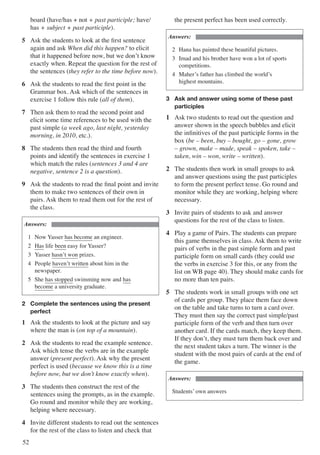
✎ WB Page 17
UNIT
5People
who we
admire
1 Match the words and their meanings
1 d prize a someone who you like because they are very good at something
2 admire b doing very well
3 hero c like and have a good opinion of someone
4 successful d something that you can get for doing well in work, sport, etc.
2 Complete the table of verbs
verb past tense past participle
become became 1 become
2 bought bought
be was 3
go went 4
grow grew 5
speak spoke 6
take took 7
write wrote 8
3 Now complete the sentences with the correct past
participle from exercise 2
1 Ahmed’s cousin was always good at tennis when he was a child and now he has
become a successful tennis player.
2 I’ve just to my father on the phone.
3 Has the thief that man’s phone?
4 The children have a beautiful story.
5 Ali has not to this city before.
6 My grandmother has all the vegetables that we are eating.
7 Mona has to the shops. She will be back soon.
8 How much lamb have they from the supermarket?
Module2
UNIT
5
17
1	 Match the words and their meanings
1	 Ask the students to say any new vocabulary they
have learned related to heroes.
2	 Then ask them to read the example answer in
exercise 1 and explain that they have to match
the words and their meanings.
3	 The students complete the exercise in pairs.
Then check the answers as a whole class.
Answers:
2 c		 3 a		 4 b
2	 Complete the table of verbs
1	 Ask the students to look at the table and tell
them that they have to complete it with the
correct forms of the verbs.
2	 The students work in pairs to complete the table.
While they are working, write the table on the
board.
3	 Check the answers by inviting different students
to come to the board and write the verb forms in
the appropriate place in the table.
Answers:
2 buy		 3 been		 4 gone
5 grown	 6 spoken	 7 taken
8 written
3	 Now complete the sentences with the 		
	 correct past participle from exercise 2
1	 Ask the students to read the example sentence
and explain that they have to complete the
sentences with a suitable verb from the table in
exercise 2.
2	 The students complete the exercise in pairs.
Then invite different students to read out the
sentences.
Answers:
2 spoken	 3 taken		 4 written
5 been		 6 grown		 7 gone
8 bought
L E S S O N 3 S B p a g e 2 5
Outcomes
•	To ask and answer about famous places you
have visited
•	To listen to somebody talking about things they
have or have not done
•	To ask and answer about things you have or have
not done
•	To learn phrases for introducing people
54
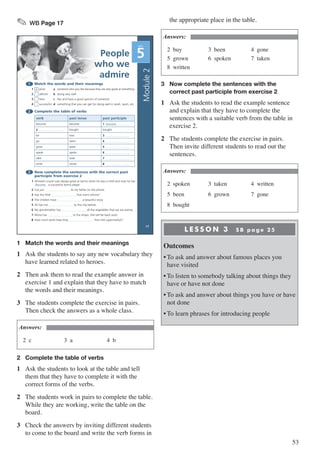
& SB Page 25
Lesson 3
25
5
UNIT
Listen to Tarek’s father introducing his friend
Mr Banks to a neighbour. Which famous
building has Mr Banks visited in Egypt?
2
Ask and answer
Take turns to introduce someone
Listen again. Complete the table to show
what Mr Banks has and has not done
3
4
5
Pleased to
meet you.
FUNCTIONSBOX
Have you met (my friend)?
This is (my neighbour, Mr Sabri).
How do you do?
Pleased to meet you.
It’s nice to meet you.
Introducing people
Mr Banks has ...
1 visited Cairo before. 8
2 been to other countries. 4
3 seen the Pyramids.
4 sailed on the Nile.
5 eaten unusual food.
6 met some interesting people.
7 ridden an elephant.
8 studied languages.
Ask and answer
1 Which famous places have you visited?
2 Which famous places would you like to visit?
1
No, I haven’t,
but I’ve sailed on
the Red Sea.
Have you sailed
on the Nile?
This is my
friend, Fareeda.
1	 Ask and answer
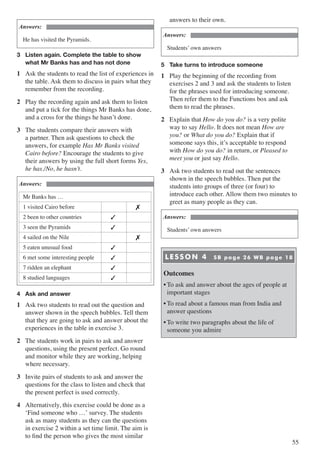
1	 Ask the students to look at the picture and say
where it is (Abu Simbel).
2	 The students then work in small groups to
discuss places they have visited and which
places they would like to visit.
3	 Invite different students to tell the rest of the
class about a member of their group. Decide
as a class who has been to the most interesting
places.
Answers:
Students’ own answers
2	 Listen to Tarek’s father introducing his friend	
	 Mr Banks to a neighbour. Which famous 		
	 building has Mr Banks visited in Egypt?
1	 Tell the students that they are going to listen to
a conversation between Tarek’s father, his friend
Mr Banks and his neighbour, talking about a
famous building Mr Banks has visited in Egypt.
Point to the men in the picture (from left to right:
Mr Banks, Tarek’s father’s neighbour, Tarek’s
father).
2	 Play the recording and ask the students to listen
for the answer. Ask them to compare their ideas
with a partner and then check the answer as a
whole class.
3	 Ask Have you ever been to the Pyramids? Did
you enjoy your visit? Why/Why not?
	 Tapescript
Mr Ibrahim:	 Good morning, Mr Sabri. How are 	
		you?
Mr Sabri:	 	 I’m fine, thanks, Mr Ibrahim, and 	
		you?
Mr Ibrahim:	 I’m fine, too. Have you met my 	
		 friend, Mr Banks, from England? 	
		 Mr Banks, this is my neighbour, Mr 	
		Sabri.
Mr Banks:		 How do you do?
Mr Sabri:		 Pleased to meet you, Mr Banks. 	
		 Have you visited Cairo before?
Mr Banks:		 No, I haven’t. This is my first visit. 	
		 Cairo is an amazing city.
Mr Sabri:		 Have you come here for a holiday?
Mr Banks:		 No, I’ve come here to work! I take 	
		 photos for a newspaper.
Mr Sabri:		 Do you travel a lot in your job?
Mr Banks:		 Yes, I’ve been to many countries.
Mr Sabri:		 Have you seen any famous places 	
		 in Egypt? Have you sailed on the 	
		Nile?
Mr Banks:		 I’ve been to the Pyramids, but I 	
		 haven’t sailed on the Nile.
Mr Sabri:		 Have you done a lot of other 	
		 exciting things in other countries?
Mr Banks:		 Yes, I’ve eaten some very unusual 	
		 food, and I’ve met some interesting 	
		people.
Mr Sabri:		 Tell me about some of the things 	
		 you’ve done.
Mr Banks:		 Well, I’ve ridden an elephant in 	
		India.
Mr Sabri:		 Have you studied any languages?
Mr Banks:		 Yes, I have. I’ve studied Japanese.
Mr Sabri:	 	 Well, have a good time in Egypt, 	
		 Mr Banks. It was nice to meet you!
Mr Banks:		 It was nice to meet you, too, Mr 	
		 Sabri. Goodbye!
Mr Ibrahim:	 See you later, Mr Sabri!

55
Answers:
He has visited the Pyramids.
3	 Listen again. Complete the table to show 		
	 what Mr Banks has and has not done
1	 Ask the students to read the list of experiences in
the table. Ask them to discuss in pairs what they
remember from the recording.
2	 Play the recording again and ask them to listen
and put a tick for the things Mr Banks has done,
and a cross for the things he hasn’t done.
3	 The students compare their answers with
a partner. Then ask questions to check the
answers, for example Has Mr Banks visited
Cairo before? Encourage the students to give
their answers by using the full short forms Yes,
he has./No, he hasn’t.
Answers:
Mr Banks has …
1 visited Cairo before �
2 been to other countries �
3 seen the Pyramids �
4 sailed on the Nile �
5 eaten unusual food �
6 met some interesting people �
7 ridden an elephant �
8 studied languages �
4	 Ask and answer
1	 Ask two students to read out the question and
answer shown in the speech bubbles. Tell them
that they are going to ask and answer about the
experiences in the table in exercise 3.
2	 The students work in pairs to ask and answer
questions, using the present perfect. Go round
and monitor while they are working, helping
where necessary.
3	 Invite pairs of students to ask and answer the
questions for the class to listen and check that
the present perfect is used correctly.
4	 Alternatively, this exercise could be done as a
ʻFind someone who …ʼ survey. The students
ask as many students as they can the questions
in exercise 2 within a set time limit. The aim is
to find the person who gives the most similar
answers to their own.
Answers:
Students’ own answers
5	 Take turns to introduce someone
1	 Play the beginning of the recording from
exercises 2 and 3 and ask the students to listen
for the phrases used for introducing someone.
Then refer them to the Functions box and ask
them to read the phrases.
2	 Explain that How do you do? is a very polite
way to say Hello. It does not mean How are
you? or What do you do? Explain that if
someone says this, it’s acceptable to respond
with How do you do? in return, or Pleased to
meet you or just say Hello.
3	 Ask two students to read out the sentences
shown in the speech bubbles. Then put the
students into groups of three (or four) to
introduce each other. Allow them two minutes to
greet as many people as they can.
Answers:
Students’ own answers
LESSON 4 SB page 26 WB page 18
Outcomes
•	To ask and answer about the ages of people at
important stages
•	To read about a famous man from India and
answer questions
•	To write two paragraphs about the life of
someone you admire
56
& SB Page 26
26
5
UNIT
PROJECT
Read about a famous man from India and
answer the questions
1 When was Tathagat Avatar Tulsi born? …................................……..
2 Where did he live when he was a child? …..……..
3 Where did he go to university? …..……..
4 Which subject did he get his degree in? …..……..
5 Has he got any prizes for his studies? …..……..
2
3
1 Find out about the life of someone
you admire.
2 Find information and make notes
about the person’s
• date and place of birth
• school life
• interests
• university degree
• prizes and medals
• important work
• any other interesting information
3 Then write two paragraphs about
the person.
My grandfather is my hero. He
was born in a village to a poor
family in January 1952. But
he worked hard at school and
he went to university. He was
always interested in helping
people and he became a doctor.
I admire him because he has
stopped working as a doctor,
but he hasn’t stopped helping
people. He teaches science
in the village school. He has
taught science to children who
are now at university.
Name: Tathagat Avatar Tulsi
Date of birth: 9 September 1987
Place of birth: Patna, India
At the age of 10: Science degree (Patna University, India)
At the age of 23: Professor (Mumbai, India)
Prizes: Many from India and other countries
He was born in 1987.
Ask and answer
1 How old are people usually when they finish school?
2 How old are people usually when they get a degree?
3 Why is it usually difficult to get a degree when you are
young?
1
Lesson 4
Workbook page 18
1	 Ask and answer
1	 Ask the students to read the questions and
discuss them in small groups.
2	 Invite the groups to share their ideas with the
rest of the class.
Answers:
1	 They are 17 or older.
2	 They are usually about 21.
3	 Because you do not know enough.
2	 Read about a famous man from India and 		
	 answer the questions
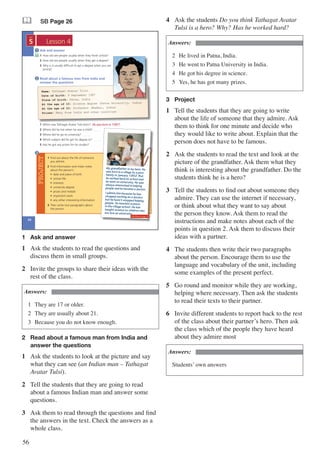
1	 Ask the students to look at the picture and say
what they can see (an Indian man – Tathagat
Avatar Tulsi).
2	 Tell the students that they are going to read
about a famous Indian man and answer some
questions.
3	 Ask them to read through the questions and find
the answers in the text. Check the answers as a
whole class.
4	 Ask the students Do you think Tathagat Avatar
Tulsi is a hero? Why? Has he worked hard?
Answers:
2	 He lived in Patna, India.
3	 He went to Patna University in India.
4	 He got his degree in science.
5	 Yes, he has got many prizes.
3	 Project
1	 Tell the students that they are going to write
about the life of someone that they admire. Ask
them to think for one minute and decide who
they would like to write about. Explain that the
person does not have to be famous.
2	 Ask the students to read the text and look at the
picture of the grandfather. Ask them what they
think is interesting about the grandfather. Do the
students think he is a hero?
3	 Tell the students to find out about someone they
admire. They can use the internet if necessary,
or think about what they want to say about
the person they know. Ask them to read the
instructions and make notes about each of the
points in question 2. Ask them to discuss their
ideas with a partner.
4	 The students then write their two paragraphs
about the person. Encourage them to use the
language and vocabulary of the unit, including
some examples of the present perfect.
5	 Go round and monitor while they are working,
helping where necessary. Then ask the students
to read their texts to their partner.
6	 Invite different students to report back to the rest
of the class about their partner’s hero. Then ask
the class which of the people they have heard
about they admire most
Answers:
Students’ own answers
57
✎ WB Page 18
1 Complete the mini-dialogue
Dina: Hello, Riham and Leila. 1 Have you met my cousin, Nadia?
Riham: 2 to meet you, Nadia.
Dina: Nadia, 3 my good friends, Riham and Leila.
Nadia: How 4 ? It’s nice to meet Dina’s friends.
2 Read and correct the underlined words
1 John has been to England. He is coming back tomorrow. gone
2 My mother has a prize in medicine.
3 Salma has just won a gold graduate in her swimming competition!
4 I want to be like my teacher one day. He is my successful.
3 Complete the table. Put a tick (3) for the things you have
done or a cross (7) for the things you haven’t done
Have you …
eaten Chinese food?
been on a plane?
met a famous person?
visited Alexandria?
ridden a camel?
ridden a horse?
won a prize?
4 Now write sentences about what you have and haven’t
done, as in the example
I have been on a plane, but I haven’t met a famous person.
UNIT
5
18
Module2
1	 Complete the mini-dialogue
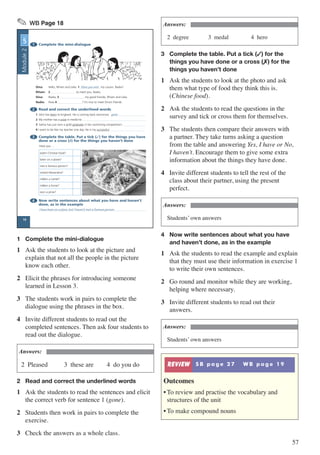
1	 Ask the students to look at the picture and
explain that not all the people in the picture
know each other.
2	 Elicit the phrases for introducing someone
learned in Lesson 3.
3	 The students work in pairs to complete the
dialogue using the phrases in the box.
4	 Invite different students to read out the
completed sentences. Then ask four students to
read out the dialogue.
Answers:
2 Pleased	 3 these are	 4 do you do
2	 Read and correct the underlined words
1	 Ask the students to read the sentences and elicit
the correct verb for sentence 1 (gone).
2	 Students then work in pairs to complete the
exercise.
3	 Check the answers as a whole class.
Answers:
2 degree	 3 medal		 4 hero
3	 Complete the table. Put a tick (�) for the 		
	 things you have done or a cross (�) for the 	
	 things you haven’t done
1	 Ask the students to look at the photo and ask
them what type of food they think this is.
(Chinese food).
2	 Ask the students to read the questions in the
survey and tick or cross them for themselves.
3	 The students then compare their answers with
a partner. They take turns asking a question
from the table and answering Yes, I have or No,
I haven’t. Encourage them to give some extra
information about the things they have done.
4	 Invite different students to tell the rest of the
class about their partner, using the present
perfect.
Answers:
Students’ own answers
4	 Now write sentences about what you have 	
	 and haven’t done, as in the example
1	 Ask the students to read the example and explain
that they must use their information in exercise 1
to write their own sentences.
2	 Go round and monitor while they are working,
helping where necessary.
3	 Invite different students to read out their
answers.
Answers:
Students’ own answers
REVIEW S B p a g e 2 7 W B p a g e 1 9
Outcomes
•	To review and practise the vocabulary and
structures of the unit
•	To make compound nouns
58
Before using the book:
•	Write People who we admire on the board and
ask the students what they have learned in this
unit. Brainstorm a list of topics, vocabulary and
grammar points.
•	Tell the students that they are now going to
complete the review section for this unit, to see
what they can remember.
& SB Page 27
27
5
UNIT
Review
Now you can …
• use words to describe people you admire
• introduce people
Complete the mini-dialogue
Read and match
3
1
Have you met
How do
Pleased
this is
Lamia: Good evening, Miss Dina. 1 …...................…… my sister,
Nabila? Nabila, 2 …..…….. my teacher, Miss Dina.
Nabila: 3 …..…….. you do?
Miss Dina: 4 …..…….. to meet you, Nabila.
• use the present perfect tense
Complete these sentences with the correct present perfect form of the
verb in brackets
1 Hamdi …..…..............….. (not be) to the UAE, but his father is there now. His father …..……..
(go) there to work.
2 …..…….. (you meet) our new English teacher? Her name’s Miss Sara.
3 Miss Sara …..…….. (teach) us many new words in English.
4 My brother …..…….. (finish) school and he …..…….. (start) studying maths at university.
5 “…..…….. (Huda buy) her mother some flowers?” “Yes, she …..…….. (have).”
2
has not been
1 A student gets this after completing university a successful
2 A person who has got a degree from a university b medal
3 Someone who you admire c degree
4 A prize for doing something well d hero
5 A person who many people know e graduate
6 Someone who has done very well f famous
c
Have you met
Word building skills
Workbook page 19
We make compound
nouns from two
nouns, or an adjective/
verb and a noun.
Some are one word,
some are two.
noun
news
verb
post
noun
office
adjective
mobile
noun
phone
noun
paper
newspaper
mobile phone
post office
+
+
+
=
=
=
1	 Read and match
1	 Elicit words related to describing people you
admire. Ask the students to read the words on
the right and say what they mean.
2	 The students then match the words with the
definitions.
3	 Check the answers as a whole class.
Answers:
2 e	 3 d	 4 b	 5 f	 6 a
2	 Complete these sentences with the correct 	
	 present perfect form of the verb in brackets
1	 Elicit the affirmative, negative and question
forms of the present perfect (have/has + past
participle; have/has + not + past participle;
have/has + subject + past participle). Ask the
students to explain when the present perfect is
used (to talk about a time before now).
2	 Ask the students what the difference is between
been and gone (been = went to a place sometime
in the past and returned, gone = went to a place
now and not yet returned). Remind the students
that questions in the present perfect are answered
with a short form.
3	 The students then complete the sentences in
pairs, using the present perfect form of the verbs
in brackets, as in the example.
4	 Invite different students to read out the
completed sentences.
Answers:
1 has gone		 2 Have you met
3 has taught		 4 has finished, has started
5 Has Huda bought, has
3	 Complete the mini-dialogue
1	 Ask What do you say when you introduce
someone? and elicit the phrases for
introductions.
2	 The students then work in pairs to complete the
sentences, using the words and phrases in the
box.
3	 Invite students to read out the different
sentences, then ask three students to read out the
dialogue.
Answers:
2 this is	 3 How do	 4 Pleased
Word building skills
1	 Write newspaper, mobile phone and post
office on the board. Elicit the meanings. Ask Are
they one word or two? Explain that these are
compound nouns, which can be made with two
words joined together, but which only have one
meaning.
2	 Ask Which two words make newspaper? (news
and paper). Ask the students to look at the
individual words (news, paper, mobile, phone,
post, office) and decide whether they are nouns,
adjectives or verbs.
59
3	 Ask them to read the examples to check their
ideas.
✎ WB Page 19
1 Match and write compound nouns. Are they one
word or two?
1 b down_______ a floor
2 earth _______ b stairs
3 foot _______ c table
4 ground _______ d ball
5 time _______ e quake
2 	Choose the correct answer from a, b, c or d
1 After completing university, a student gets a .
a prize b degree c competition d medal
2 Ahmed is a university . He has a degree in engineering.
a graduate b hero c king d student
3 Everyone knows who Amgad is. He is very !
a new b pleased c well d famous
4 Natalie has always been very at her job. She is the best!
a hero b successful c easy d similar
5 “Have you my brother Mohy yet?”
a met b meet c meeting d meets
3 Listen to a text about a famous person. Are the
sentences true (T) or false (F)?
1 F Bill Gates has a degree from Harvard University.
2 He has worked with computers.
3 He has been very successful in his work.
4 He only has offices in America.
5 He has given money to help poor people.
6 Bill Gates has won many prizes.
4 Write about a famous person
• Choose a person who you are interested in.
• Write about what this person has done. Include some of these words:
admire degree famous graduate prize successful
UNIT
5
stairs
19
Module2
1	 Match and write compound nouns. Are they 	
	 one word or two?
1	 Ask the students to look at the example and ask
them to work with a partner to match the pairs of
words.
2	 Check the answers as a class and then ask the
students to decide whether each compound noun
is written as one or two words.
3	 Check answers as a class and then ask the
students whether they can think of any other
examples of compound nouns (e.g., ice cream,
blackboard, swimming pool).
Answers:
2	 e – earthquake (one word)
3	 d – football (one word)
4	 a – ground floor (two words)
5	 c – timetable (one word)
2	 Choose the correct answer from a, b, c or d
1	 Ask the students to read the sentences and
options. Explain that they have to choose the
correct option in each case.
2	 Students complete the task in pairs.
3	 Check the answers as a whole class.
Answers:
1 b	 2 a	 3 d	 4 b	 5 a
3	 Listen to a text about a famous person. Are 	
	 the sentences true (T) or false (F)?
1	 Ask the students to look at the photo in exercise
3 and ask if they know who the man is. (Bill
Gates) Ask the students what they know about
him. Then tell them that they are going to find
out more.
2	 Ask them to read sentences 1–6. Explain that
they are going to listen and decide whether the
sentences are true or false.
3	 Play the recording while the students listen and
decide. Then ask the students to compare their
answers with a partner.
4	 Check the answers as a whole class. Encourage
students to correct the false sentences.
	 Tapescript
Bill Gates is one of the most famous people in the
world. He went to Harvard University to study law, but
he did not finish his degree and soon left to start a
computer business. It was very successful and soon
it had offices all over the world. After he got married,
Bill Gates decided that he wanted to help poor people
and he now spends most of his time helping charities.
He has won many prizes for his work in computers
and for charities.

Answers:
2	 T
3	 T
4	 F (He has offices all over the world.)
5	 F (He helps charities.)
6	 T
4	 Write about a famous person
1	 Ask the students to choose a famous person they
are interested in.
60
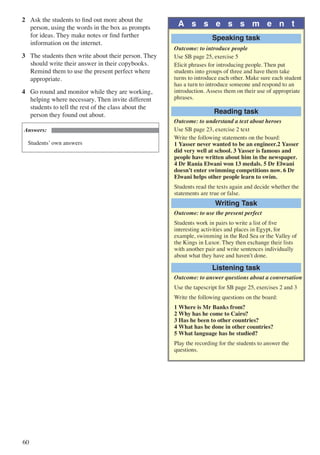
2	 Ask the students to find out more about the
person, using the words in the box as prompts
for ideas. They make notes or find further
information on the internet.
3	 The students then write about their person. They
should write their answer in their copybooks.
Remind them to use the present perfect where
appropriate.
4	 Go round and monitor while they are working,
helping where necessary. Then invite different
students to tell the rest of the class about the
person they found out about.
Answers:
Students’ own answers
A s s e s s m e n t
Speaking task
Outcome: to introduce people
Use SB page 25, exercise 5
Elicit phrases for introducing people. Then put
students into groups of three and have them take
turns to introduce each other. Make sure each student
has a turn to introduce someone and respond to an
introduction. Assess them on their use of appropriate
phrases.
Reading task
Outcome: to understand a text about heroes
Use SB page 23, exercise 2 text
Write the following statements on the board:
1 Yasser never wanted to be an engineer.2 Yasser
did very well at school. 3 Yasser is famous and
people have written about him in the newspaper.
4 Dr Rania Elwani won 13 medals. 5 Dr Elwani
doesn’t enter swimming competitions now. 6 Dr
Elwani helps other people learn to swim.
Students read the texts again and decide whether the
statements are true or false.
Writing Task
Outcome: to use the present perfect
Students work in pairs to write a list of five
interesting activities and places in Egypt, for
example, swimming in the Red Sea or the Valley of
the Kings in Luxor. They then exchange their lists
with another pair and write sentences individually
about what they have and haven’t done.
Listening task
Outcome: to answer questions about a conversation
Use the tapescript for SB page 25, exercises 2 and 3
Write the following questions on the board:
1 Where is Mr Banks from?
2 Why has he come to Cairo?
3 Has he been to other countries?
4 What has he done in other countries?
5 What language has he studied?
Play the recording for the students to answer the
questions.

Prep 2 tg-unit-5

  • 1.
    50 Objectives Grammar The present perfecttense Reading Reading about heroes Listening Listening to a conversation about someone’s experiences Speaking Greeting and introducing someone Writing Writing about a famous person LESSON 1 SB page 23 Outcomes • To talk about people you admire • To read about heroes and answer questions • To carry out an internet search about Dr Rania Elwani’s life Before using the book: • Write the title of the unit People who we admire on the board and ask the students to work in small groups and brainstorm a list of kinds of people who other people admire, for example, firefighters or doctors. • Ask the groups to share their ideas with the rest of the class and hold a short discussion about why people admire them, for example, because they are brave or very clever. & SB Page 23 My hero, Yasser, is 22. He always wanted to be anengineer. However, when he was twelve, he had a caraccident and he couldn’t walk again. Life was difficultfor Yasser at first, but he worked hard and became thebest student in his class. When he finished school, hewent to university and got a degree. Now Yasser hasbecome an engineer. Has life been easy for Yasser? No, it hasn’t. Yasserhasn’t won prizes and people haven’t written about himin the newspaper. But he has taught me that with hardwork, you can be successful. Tarek My HeroHome About Older posts People who we admire OBJECTIVES UNIT 5 Lesson 1 23 Ask and answer 1 Which people do you admire? Why? 2 Can you match these words with the two pictures above? 1 • Grammar The present perfect tense • Reading Reading about heroes • Listening Listening to a conversation about someone’s experiences • Speaking Greeting and introducing someone • Writing Writing about a famous person Answer the questions 1 Why can’t Yasser walk? 2 Why does Tarek admire Yasser? 3 What did Rania Elwani win for swimming? 4 When did she start a swimming school? 3 2 Read the blogs about Salma’s and Tarek’s heroes. What is similar about the people? a They are both sportspeople. b They both went to university. a b degree graduate medal prizeb Rania ElwaniHome Older posts About Rania Elwani is one of the world’sfastest swimmers. She startedswimming when she was 13 andwon 77 medals in swimmingcompetitions. She has stoppedswimming and has become auniversity graduate, with a degreein medicine. Now she has a busy life as a doctor.She also works hard to help sportsin Egypt. In 2005, she openeda swimming school for youngswimmers who want to be in theOlympics. Elwani has taught us thatyou can do well at lots of things ifyou want to. Salma Internet search Find out two more facts about Rania Elwani’s life. 1 Ask and answer 1 Draw attention to the Objectives box on page 23, which refers to the objectives of the unit, and explain in Arabic if necessary. 2 Now put the students into small groups and ask them to discuss the first question. 3 Invite them to share their ideas with the rest of the class (encouraging them to give the names of people they admire). Ask them to give reasons for their answers. 4 Now ask the groups to look at the pictures and match them with the words in the box in question 2. Then check the answers as a whole class, drilling pronunciation. 5 Ask Do you know anyone who has a degree? Do you know anyone who has a medal? Have you ever won a prize? Answers: 1 Students’ own answers 2 Picture a: medal, prize Picture b: degree, graduate People who we admire SB pages 23–27 WB pages 17–19 UNIT 5
  • 2.
    51 2 Read theblogs about Salma’s and Tarek’s heroes. What is similar about the people? 1 Ask the students to read the question in the rubric and predict what might be similar about the two heroes. 2 Then ask the students to read the texts quickly to find the answer. Tell them not to worry about any words they don’t know at this point. 3 Check the answer as a whole class. Ask Have you heard of Rania Elwani? Answer: b 3 Answer the questions 1 Ask the students to read the questions and work in pairs to try to answer them without referring to the text. 2 The students then read the text again to check their ideas. Check the answers as a whole class and check the meaning of any unknown vocabulary. 3 Ask the students which of the heroes they admire most and why. Answers: 1 He had a car accident when he was twelve. 2 Because he has taught him that, with hard work, you can be successful. 3 She won 77 medals in swimming competitions. 4 In 2005. : Internet search 1 Ask the students what else they know about Dr Rania Elwani. Tell them that they are going to find out more about her. 2 Ask them to look at the Internet search box. Brainstorm some facts that the students would like to find out about Rania, for example, where she’s from, why she started swimming, which competitions she won. 3 The students then work in pairs to carry out an internet search to find out more about Dr Elwani. 4 Invite different students to report back their findings to the class. LESSON 2 SB page 24 WB page 17 Outcomes • To use the present perfect • To ask and answer questions about events in the past & SB Page 24 Workbook page 17 24 5 UNIT Lesson 2 Underline the present perfect verbs in each sentence 1 Yasser has become an engineer. 2 Has life been easy for Yasser? 3 Yasser hasn’t won prizes. 4 People haven’t written about him in the newspaper. 5 She has stopped swimming and has become a university graduate. Ask and answer using some of these past participles Complete the sentences using the present perfect 1 My favourite writer / write a new book …...........................................................................…….. 2 Hana / paint these beautiful pictures …..…….. 3 Imad and his brother / win a lot of sports competitions …..…….. 4 Maher’s father / climb the world’s highest mountains …..…….. 1 3 2 The present perfect tense (part 1) • We use the present perfect to talk about events that happened at some time before now: Magda’s uncle has worked in Germany. He has visited many countries. • We do not use the present perfect to say when something happened in the past. If we want to give a time, we use the past simple. My uncle and aunt have written me an email. They wrote it yesterday. • We form the present perfect with subject + have / has (not) + the past participle. • We form Yes / No questions with have / has (not) + subject + the past participle. We can use short answers: Have you finished your homework? Yes, I have. / No, I haven’t. • Note the difference between these sentences: Hassan has gone to England. (= He is in England now.) Hassan has been to England. (= He visited England at some time in the past, and has now returned.) GRAMMARBOX My favourite writer has written a new book. been bought gone grown made spoken taken won written No, I haven’t, but I’ve been to Aswan. Have you been to Luxor? 1 Underline the present perfect verbs in each sentence 1 Ask the students to look at the picture and say what they can see (Yasser, the man in the wheelchair, is at his office). 2 Then ask them to read the example sentence and look at the underlined words. Elicit the form of the verbs (present simple of have + past participle) and write the affirmative form of the present perfect on the board. 3 Ask the students to copy the other sentences into their copybooks and underline the verbs. 4 Invite different students to say which words they underlined. Elicit the negative and question forms of the present perfect and add them to the
  • 3.
    52 board (have/has +not + past participle; have/ has + subject + past participle). 5 Ask the students to look at the first sentence again and ask When did this happen? to elicit that it happened before now, but we don’t know exactly when. Repeat the question for the rest of the sentences (they refer to the time before now). 6 Ask the students to read the first point in the Grammar box. Ask which of the sentences in exercise 1 follow this rule (all of them). 7 Then ask them to read the second point and elicit some time references to be used with the past simple (a week ago, last night, yesterday morning, in 2010, etc.). 8 The students then read the third and fourth points and identify the sentences in exercise 1 which match the rules (sentences 3 and 4 are negative, sentence 2 is a question). 9 Ask the students to read the final point and invite them to make two sentences of their own in pairs. Ask them to read them out for the rest of the class. Answers: 1 Now Yasser has become an engineer. 2 Has life been easy for Yasser? 3 Yasser hasn’t won prizes. 4 People haven’t written about him in the newspaper. 5 She has stopped swimming now and has become a university graduate. 2 Complete the sentences using the present perfect 1 Ask the students to look at the picture and say where the man is (on top of a mountain). 2 Ask the students to read the example sentence. Ask which tense the verbs are in the example answer (present perfect). Ask why the present perfect is used (because we know this is a time before now, but we don’t know exactly when). 3 The students then construct the rest of the sentences using the prompts, as in the example. Go round and monitor while they are working, helping where necessary. 4 Invite different students to read out the sentences for the rest of the class to listen and check that the present perfect has been used correctly. Answers: 2 Hana has painted these beautiful pictures. 3 Imad and his brother have won a lot of sports competitions. 4 Maher’s father has climbed the world’s highest mountains. 3 Ask and answer using some of these past participles 1 Ask two students to read out the question and answer shown in the speech bubbles and elicit the infinitives of the past participle forms in the box (be – been, buy – bought, go – gone, grow – grown, make – made, speak – spoken, take – taken, win – won, write – written). 2 The students then work in small groups to ask and answer questions using the past participles to form the present perfect tense. Go round and monitor while they are working, helping where necessary. 3 Invite pairs of students to ask and answer questions for the rest of the class to listen. 4 Play a game of Pairs. The students can prepare this game themselves in class. Ask them to write pairs of verbs in the past simple form and past participle form on small cards (they could use the verbs in exercise 3 for this, or any from the list on WB page 40). They should make cards for no more than ten pairs. 5 The students work in small groups with one set of cards per group. They place them face down on the table and take turns to turn a card over. They must then say the correct past simple/past participle form of the verb and then turn over another card. If the cards match, they keep them. If they don’t, they must turn them back over and the next student takes a turn. The winner is the student with the most pairs of cards at the end of the game. Answers: Students’ own answers
  • 4.
    53 ✎ WB Page17 UNIT 5People who we admire 1 Match the words and their meanings 1 d prize a someone who you like because they are very good at something 2 admire b doing very well 3 hero c like and have a good opinion of someone 4 successful d something that you can get for doing well in work, sport, etc. 2 Complete the table of verbs verb past tense past participle become became 1 become 2 bought bought be was 3 go went 4 grow grew 5 speak spoke 6 take took 7 write wrote 8 3 Now complete the sentences with the correct past participle from exercise 2 1 Ahmed’s cousin was always good at tennis when he was a child and now he has become a successful tennis player. 2 I’ve just to my father on the phone. 3 Has the thief that man’s phone? 4 The children have a beautiful story. 5 Ali has not to this city before. 6 My grandmother has all the vegetables that we are eating. 7 Mona has to the shops. She will be back soon. 8 How much lamb have they from the supermarket? Module2 UNIT 5 17 1 Match the words and their meanings 1 Ask the students to say any new vocabulary they have learned related to heroes. 2 Then ask them to read the example answer in exercise 1 and explain that they have to match the words and their meanings. 3 The students complete the exercise in pairs. Then check the answers as a whole class. Answers: 2 c 3 a 4 b 2 Complete the table of verbs 1 Ask the students to look at the table and tell them that they have to complete it with the correct forms of the verbs. 2 The students work in pairs to complete the table. While they are working, write the table on the board. 3 Check the answers by inviting different students to come to the board and write the verb forms in the appropriate place in the table. Answers: 2 buy 3 been 4 gone 5 grown 6 spoken 7 taken 8 written 3 Now complete the sentences with the correct past participle from exercise 2 1 Ask the students to read the example sentence and explain that they have to complete the sentences with a suitable verb from the table in exercise 2. 2 The students complete the exercise in pairs. Then invite different students to read out the sentences. Answers: 2 spoken 3 taken 4 written 5 been 6 grown 7 gone 8 bought L E S S O N 3 S B p a g e 2 5 Outcomes • To ask and answer about famous places you have visited • To listen to somebody talking about things they have or have not done • To ask and answer about things you have or have not done • To learn phrases for introducing people
  • 5.
    54 & SB Page25 Lesson 3 25 5 UNIT Listen to Tarek’s father introducing his friend Mr Banks to a neighbour. Which famous building has Mr Banks visited in Egypt? 2 Ask and answer Take turns to introduce someone Listen again. Complete the table to show what Mr Banks has and has not done 3 4 5 Pleased to meet you. FUNCTIONSBOX Have you met (my friend)? This is (my neighbour, Mr Sabri). How do you do? Pleased to meet you. It’s nice to meet you. Introducing people Mr Banks has ... 1 visited Cairo before. 8 2 been to other countries. 4 3 seen the Pyramids. 4 sailed on the Nile. 5 eaten unusual food. 6 met some interesting people. 7 ridden an elephant. 8 studied languages. Ask and answer 1 Which famous places have you visited? 2 Which famous places would you like to visit? 1 No, I haven’t, but I’ve sailed on the Red Sea. Have you sailed on the Nile? This is my friend, Fareeda. 1 Ask and answer 1 Ask the students to look at the picture and say where it is (Abu Simbel). 2 The students then work in small groups to discuss places they have visited and which places they would like to visit. 3 Invite different students to tell the rest of the class about a member of their group. Decide as a class who has been to the most interesting places. Answers: Students’ own answers 2 Listen to Tarek’s father introducing his friend Mr Banks to a neighbour. Which famous building has Mr Banks visited in Egypt? 1 Tell the students that they are going to listen to a conversation between Tarek’s father, his friend Mr Banks and his neighbour, talking about a famous building Mr Banks has visited in Egypt. Point to the men in the picture (from left to right: Mr Banks, Tarek’s father’s neighbour, Tarek’s father). 2 Play the recording and ask the students to listen for the answer. Ask them to compare their ideas with a partner and then check the answer as a whole class. 3 Ask Have you ever been to the Pyramids? Did you enjoy your visit? Why/Why not? Tapescript Mr Ibrahim: Good morning, Mr Sabri. How are you? Mr Sabri: I’m fine, thanks, Mr Ibrahim, and you? Mr Ibrahim: I’m fine, too. Have you met my friend, Mr Banks, from England? Mr Banks, this is my neighbour, Mr Sabri. Mr Banks: How do you do? Mr Sabri: Pleased to meet you, Mr Banks. Have you visited Cairo before? Mr Banks: No, I haven’t. This is my first visit. Cairo is an amazing city. Mr Sabri: Have you come here for a holiday? Mr Banks: No, I’ve come here to work! I take photos for a newspaper. Mr Sabri: Do you travel a lot in your job? Mr Banks: Yes, I’ve been to many countries. Mr Sabri: Have you seen any famous places in Egypt? Have you sailed on the Nile? Mr Banks: I’ve been to the Pyramids, but I haven’t sailed on the Nile. Mr Sabri: Have you done a lot of other exciting things in other countries? Mr Banks: Yes, I’ve eaten some very unusual food, and I’ve met some interesting people. Mr Sabri: Tell me about some of the things you’ve done. Mr Banks: Well, I’ve ridden an elephant in India. Mr Sabri: Have you studied any languages? Mr Banks: Yes, I have. I’ve studied Japanese. Mr Sabri: Well, have a good time in Egypt, Mr Banks. It was nice to meet you! Mr Banks: It was nice to meet you, too, Mr Sabri. Goodbye! Mr Ibrahim: See you later, Mr Sabri! 
  • 6.
    55 Answers: He has visitedthe Pyramids. 3 Listen again. Complete the table to show what Mr Banks has and has not done 1 Ask the students to read the list of experiences in the table. Ask them to discuss in pairs what they remember from the recording. 2 Play the recording again and ask them to listen and put a tick for the things Mr Banks has done, and a cross for the things he hasn’t done. 3 The students compare their answers with a partner. Then ask questions to check the answers, for example Has Mr Banks visited Cairo before? Encourage the students to give their answers by using the full short forms Yes, he has./No, he hasn’t. Answers: Mr Banks has … 1 visited Cairo before � 2 been to other countries � 3 seen the Pyramids � 4 sailed on the Nile � 5 eaten unusual food � 6 met some interesting people � 7 ridden an elephant � 8 studied languages � 4 Ask and answer 1 Ask two students to read out the question and answer shown in the speech bubbles. Tell them that they are going to ask and answer about the experiences in the table in exercise 3. 2 The students work in pairs to ask and answer questions, using the present perfect. Go round and monitor while they are working, helping where necessary. 3 Invite pairs of students to ask and answer the questions for the class to listen and check that the present perfect is used correctly. 4 Alternatively, this exercise could be done as a ʻFind someone who …ʼ survey. The students ask as many students as they can the questions in exercise 2 within a set time limit. The aim is to find the person who gives the most similar answers to their own. Answers: Students’ own answers 5 Take turns to introduce someone 1 Play the beginning of the recording from exercises 2 and 3 and ask the students to listen for the phrases used for introducing someone. Then refer them to the Functions box and ask them to read the phrases. 2 Explain that How do you do? is a very polite way to say Hello. It does not mean How are you? or What do you do? Explain that if someone says this, it’s acceptable to respond with How do you do? in return, or Pleased to meet you or just say Hello. 3 Ask two students to read out the sentences shown in the speech bubbles. Then put the students into groups of three (or four) to introduce each other. Allow them two minutes to greet as many people as they can. Answers: Students’ own answers LESSON 4 SB page 26 WB page 18 Outcomes • To ask and answer about the ages of people at important stages • To read about a famous man from India and answer questions • To write two paragraphs about the life of someone you admire
  • 7.
    56 & SB Page26 26 5 UNIT PROJECT Read about a famous man from India and answer the questions 1 When was Tathagat Avatar Tulsi born? …................................…….. 2 Where did he live when he was a child? …..…….. 3 Where did he go to university? …..…….. 4 Which subject did he get his degree in? …..…….. 5 Has he got any prizes for his studies? …..…….. 2 3 1 Find out about the life of someone you admire. 2 Find information and make notes about the person’s • date and place of birth • school life • interests • university degree • prizes and medals • important work • any other interesting information 3 Then write two paragraphs about the person. My grandfather is my hero. He was born in a village to a poor family in January 1952. But he worked hard at school and he went to university. He was always interested in helping people and he became a doctor. I admire him because he has stopped working as a doctor, but he hasn’t stopped helping people. He teaches science in the village school. He has taught science to children who are now at university. Name: Tathagat Avatar Tulsi Date of birth: 9 September 1987 Place of birth: Patna, India At the age of 10: Science degree (Patna University, India) At the age of 23: Professor (Mumbai, India) Prizes: Many from India and other countries He was born in 1987. Ask and answer 1 How old are people usually when they finish school? 2 How old are people usually when they get a degree? 3 Why is it usually difficult to get a degree when you are young? 1 Lesson 4 Workbook page 18 1 Ask and answer 1 Ask the students to read the questions and discuss them in small groups. 2 Invite the groups to share their ideas with the rest of the class. Answers: 1 They are 17 or older. 2 They are usually about 21. 3 Because you do not know enough. 2 Read about a famous man from India and answer the questions 1 Ask the students to look at the picture and say what they can see (an Indian man – Tathagat Avatar Tulsi). 2 Tell the students that they are going to read about a famous Indian man and answer some questions. 3 Ask them to read through the questions and find the answers in the text. Check the answers as a whole class. 4 Ask the students Do you think Tathagat Avatar Tulsi is a hero? Why? Has he worked hard? Answers: 2 He lived in Patna, India. 3 He went to Patna University in India. 4 He got his degree in science. 5 Yes, he has got many prizes. 3 Project 1 Tell the students that they are going to write about the life of someone that they admire. Ask them to think for one minute and decide who they would like to write about. Explain that the person does not have to be famous. 2 Ask the students to read the text and look at the picture of the grandfather. Ask them what they think is interesting about the grandfather. Do the students think he is a hero? 3 Tell the students to find out about someone they admire. They can use the internet if necessary, or think about what they want to say about the person they know. Ask them to read the instructions and make notes about each of the points in question 2. Ask them to discuss their ideas with a partner. 4 The students then write their two paragraphs about the person. Encourage them to use the language and vocabulary of the unit, including some examples of the present perfect. 5 Go round and monitor while they are working, helping where necessary. Then ask the students to read their texts to their partner. 6 Invite different students to report back to the rest of the class about their partner’s hero. Then ask the class which of the people they have heard about they admire most Answers: Students’ own answers
  • 8.
    57 ✎ WB Page18 1 Complete the mini-dialogue Dina: Hello, Riham and Leila. 1 Have you met my cousin, Nadia? Riham: 2 to meet you, Nadia. Dina: Nadia, 3 my good friends, Riham and Leila. Nadia: How 4 ? It’s nice to meet Dina’s friends. 2 Read and correct the underlined words 1 John has been to England. He is coming back tomorrow. gone 2 My mother has a prize in medicine. 3 Salma has just won a gold graduate in her swimming competition! 4 I want to be like my teacher one day. He is my successful. 3 Complete the table. Put a tick (3) for the things you have done or a cross (7) for the things you haven’t done Have you … eaten Chinese food? been on a plane? met a famous person? visited Alexandria? ridden a camel? ridden a horse? won a prize? 4 Now write sentences about what you have and haven’t done, as in the example I have been on a plane, but I haven’t met a famous person. UNIT 5 18 Module2 1 Complete the mini-dialogue 1 Ask the students to look at the picture and explain that not all the people in the picture know each other. 2 Elicit the phrases for introducing someone learned in Lesson 3. 3 The students work in pairs to complete the dialogue using the phrases in the box. 4 Invite different students to read out the completed sentences. Then ask four students to read out the dialogue. Answers: 2 Pleased 3 these are 4 do you do 2 Read and correct the underlined words 1 Ask the students to read the sentences and elicit the correct verb for sentence 1 (gone). 2 Students then work in pairs to complete the exercise. 3 Check the answers as a whole class. Answers: 2 degree 3 medal 4 hero 3 Complete the table. Put a tick (�) for the things you have done or a cross (�) for the things you haven’t done 1 Ask the students to look at the photo and ask them what type of food they think this is. (Chinese food). 2 Ask the students to read the questions in the survey and tick or cross them for themselves. 3 The students then compare their answers with a partner. They take turns asking a question from the table and answering Yes, I have or No, I haven’t. Encourage them to give some extra information about the things they have done. 4 Invite different students to tell the rest of the class about their partner, using the present perfect. Answers: Students’ own answers 4 Now write sentences about what you have and haven’t done, as in the example 1 Ask the students to read the example and explain that they must use their information in exercise 1 to write their own sentences. 2 Go round and monitor while they are working, helping where necessary. 3 Invite different students to read out their answers. Answers: Students’ own answers REVIEW S B p a g e 2 7 W B p a g e 1 9 Outcomes • To review and practise the vocabulary and structures of the unit • To make compound nouns
  • 9.
    58 Before using thebook: • Write People who we admire on the board and ask the students what they have learned in this unit. Brainstorm a list of topics, vocabulary and grammar points. • Tell the students that they are now going to complete the review section for this unit, to see what they can remember. & SB Page 27 27 5 UNIT Review Now you can … • use words to describe people you admire • introduce people Complete the mini-dialogue Read and match 3 1 Have you met How do Pleased this is Lamia: Good evening, Miss Dina. 1 …...................…… my sister, Nabila? Nabila, 2 …..…….. my teacher, Miss Dina. Nabila: 3 …..…….. you do? Miss Dina: 4 …..…….. to meet you, Nabila. • use the present perfect tense Complete these sentences with the correct present perfect form of the verb in brackets 1 Hamdi …..…..............….. (not be) to the UAE, but his father is there now. His father …..…….. (go) there to work. 2 …..…….. (you meet) our new English teacher? Her name’s Miss Sara. 3 Miss Sara …..…….. (teach) us many new words in English. 4 My brother …..…….. (finish) school and he …..…….. (start) studying maths at university. 5 “…..…….. (Huda buy) her mother some flowers?” “Yes, she …..…….. (have).” 2 has not been 1 A student gets this after completing university a successful 2 A person who has got a degree from a university b medal 3 Someone who you admire c degree 4 A prize for doing something well d hero 5 A person who many people know e graduate 6 Someone who has done very well f famous c Have you met Word building skills Workbook page 19 We make compound nouns from two nouns, or an adjective/ verb and a noun. Some are one word, some are two. noun news verb post noun office adjective mobile noun phone noun paper newspaper mobile phone post office + + + = = = 1 Read and match 1 Elicit words related to describing people you admire. Ask the students to read the words on the right and say what they mean. 2 The students then match the words with the definitions. 3 Check the answers as a whole class. Answers: 2 e 3 d 4 b 5 f 6 a 2 Complete these sentences with the correct present perfect form of the verb in brackets 1 Elicit the affirmative, negative and question forms of the present perfect (have/has + past participle; have/has + not + past participle; have/has + subject + past participle). Ask the students to explain when the present perfect is used (to talk about a time before now). 2 Ask the students what the difference is between been and gone (been = went to a place sometime in the past and returned, gone = went to a place now and not yet returned). Remind the students that questions in the present perfect are answered with a short form. 3 The students then complete the sentences in pairs, using the present perfect form of the verbs in brackets, as in the example. 4 Invite different students to read out the completed sentences. Answers: 1 has gone 2 Have you met 3 has taught 4 has finished, has started 5 Has Huda bought, has 3 Complete the mini-dialogue 1 Ask What do you say when you introduce someone? and elicit the phrases for introductions. 2 The students then work in pairs to complete the sentences, using the words and phrases in the box. 3 Invite students to read out the different sentences, then ask three students to read out the dialogue. Answers: 2 this is 3 How do 4 Pleased Word building skills 1 Write newspaper, mobile phone and post office on the board. Elicit the meanings. Ask Are they one word or two? Explain that these are compound nouns, which can be made with two words joined together, but which only have one meaning. 2 Ask Which two words make newspaper? (news and paper). Ask the students to look at the individual words (news, paper, mobile, phone, post, office) and decide whether they are nouns, adjectives or verbs.
  • 10.
    59 3 Ask themto read the examples to check their ideas. ✎ WB Page 19 1 Match and write compound nouns. Are they one word or two? 1 b down_______ a floor 2 earth _______ b stairs 3 foot _______ c table 4 ground _______ d ball 5 time _______ e quake 2 Choose the correct answer from a, b, c or d 1 After completing university, a student gets a . a prize b degree c competition d medal 2 Ahmed is a university . He has a degree in engineering. a graduate b hero c king d student 3 Everyone knows who Amgad is. He is very ! a new b pleased c well d famous 4 Natalie has always been very at her job. She is the best! a hero b successful c easy d similar 5 “Have you my brother Mohy yet?” a met b meet c meeting d meets 3 Listen to a text about a famous person. Are the sentences true (T) or false (F)? 1 F Bill Gates has a degree from Harvard University. 2 He has worked with computers. 3 He has been very successful in his work. 4 He only has offices in America. 5 He has given money to help poor people. 6 Bill Gates has won many prizes. 4 Write about a famous person • Choose a person who you are interested in. • Write about what this person has done. Include some of these words: admire degree famous graduate prize successful UNIT 5 stairs 19 Module2 1 Match and write compound nouns. Are they one word or two? 1 Ask the students to look at the example and ask them to work with a partner to match the pairs of words. 2 Check the answers as a class and then ask the students to decide whether each compound noun is written as one or two words. 3 Check answers as a class and then ask the students whether they can think of any other examples of compound nouns (e.g., ice cream, blackboard, swimming pool). Answers: 2 e – earthquake (one word) 3 d – football (one word) 4 a – ground floor (two words) 5 c – timetable (one word) 2 Choose the correct answer from a, b, c or d 1 Ask the students to read the sentences and options. Explain that they have to choose the correct option in each case. 2 Students complete the task in pairs. 3 Check the answers as a whole class. Answers: 1 b 2 a 3 d 4 b 5 a 3 Listen to a text about a famous person. Are the sentences true (T) or false (F)? 1 Ask the students to look at the photo in exercise 3 and ask if they know who the man is. (Bill Gates) Ask the students what they know about him. Then tell them that they are going to find out more. 2 Ask them to read sentences 1–6. Explain that they are going to listen and decide whether the sentences are true or false. 3 Play the recording while the students listen and decide. Then ask the students to compare their answers with a partner. 4 Check the answers as a whole class. Encourage students to correct the false sentences. Tapescript Bill Gates is one of the most famous people in the world. He went to Harvard University to study law, but he did not finish his degree and soon left to start a computer business. It was very successful and soon it had offices all over the world. After he got married, Bill Gates decided that he wanted to help poor people and he now spends most of his time helping charities. He has won many prizes for his work in computers and for charities.  Answers: 2 T 3 T 4 F (He has offices all over the world.) 5 F (He helps charities.) 6 T 4 Write about a famous person 1 Ask the students to choose a famous person they are interested in.
  • 11.
    60 2 Ask thestudents to find out more about the person, using the words in the box as prompts for ideas. They make notes or find further information on the internet. 3 The students then write about their person. They should write their answer in their copybooks. Remind them to use the present perfect where appropriate. 4 Go round and monitor while they are working, helping where necessary. Then invite different students to tell the rest of the class about the person they found out about. Answers: Students’ own answers A s s e s s m e n t Speaking task Outcome: to introduce people Use SB page 25, exercise 5 Elicit phrases for introducing people. Then put students into groups of three and have them take turns to introduce each other. Make sure each student has a turn to introduce someone and respond to an introduction. Assess them on their use of appropriate phrases. Reading task Outcome: to understand a text about heroes Use SB page 23, exercise 2 text Write the following statements on the board: 1 Yasser never wanted to be an engineer.2 Yasser did very well at school. 3 Yasser is famous and people have written about him in the newspaper. 4 Dr Rania Elwani won 13 medals. 5 Dr Elwani doesn’t enter swimming competitions now. 6 Dr Elwani helps other people learn to swim. Students read the texts again and decide whether the statements are true or false. Writing Task Outcome: to use the present perfect Students work in pairs to write a list of five interesting activities and places in Egypt, for example, swimming in the Red Sea or the Valley of the Kings in Luxor. They then exchange their lists with another pair and write sentences individually about what they have and haven’t done. Listening task Outcome: to answer questions about a conversation Use the tapescript for SB page 25, exercises 2 and 3 Write the following questions on the board: 1 Where is Mr Banks from? 2 Why has he come to Cairo? 3 Has he been to other countries? 4 What has he done in other countries? 5 What language has he studied? Play the recording for the students to answer the questions.