Since its start in 1998, Google has
become one of the most popular
search engines. It has grown from a
research project in the dormitory room
of two college students to a business
that now employs approximately
20,000 people.
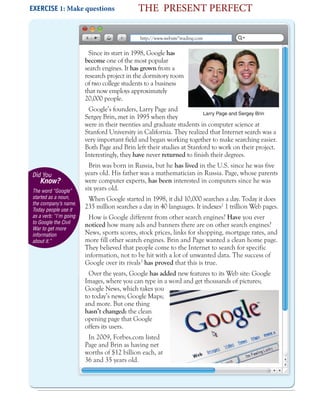
Google’s founders, Larry Page and
Sergey Brin, met in 1995 when they
were in their twenties and graduate students in computer science at
Stanford University in California. They realized that Internet search was a
very important field and began working together to make searching easier.
Both Page and Brin left their studies at Stanford to work on their project.
Interestingly, they have never returned to finish their degrees.
Brin was born in Russia, but he has lived in the U.S. since he was five
years old. His father was a mathematician in Russia. Page, whose parents
were computer experts, has been interested in computers since he was
six years old.
When Google started in 1998, it did 10,000 searches a day. Today it does
235 million searches a day in 40 languages. It indexes2
1 trillion Web pages.
How is Google different from other search engines? Have you ever
noticed how many ads and banners there are on other search engines?
News, sports scores, stock prices, links for shopping, mortgage rates, and
more fill other search engines. Brin and Page wanted a clean home page.
They believed that people come to the Internet to search for specific
information, not to be hit with a lot of unwanted data. The success of
Google over its rivals3
has proved that this is true.
Over the years, Google has added new features to its Web site: Google
Images, where you can type in a word and get thousands of pictures;
Google News, which takes you
to today’s news; Google Maps;
and more. But one thing
hasn’t changed: the clean
opening page that Google
offers its users.
In 2009, Forbes.com listed
Page and Brin as having net
worths of $12 billion each, at
36 and 35 years old.
http://www.website*reading.com
Larry Page and Sergey Brin
Did You
Know?
The word “Google”
started as a noun,
the company’s name.
Today people use it
as a verb: “I’m going
to Google the Civil
War to get more
information
about it.”
THE PRESENT PERFECTEXERCISE 1: Make questions
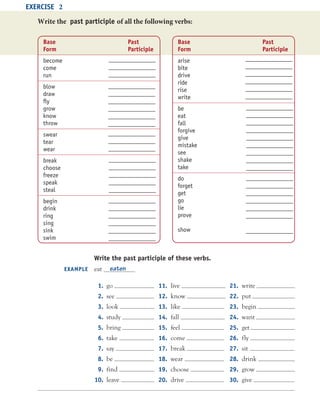
Write the past participle of these verbs.
eat eaten
1. go 11. live 21. write
2. see 12. know 22. put
3. look 13. like 23. begin
4. study 14. fall 24. want
5. bring 15. feel 25. get
6. take 16. come 26. fly
7. say 17. break 27. sit
8. be 18. wear 28. drink
9. find 19. choose 29. grow
10. leave 20. drive 30. give
EXAMPLE
Write the past participle of all the following verbs:
Base Past
Form Participle
become _______________
_______________
_______________
come
run
blow
draw
fly
grow
know
throw
swear
tear
wear
break
choose
freeze
speak
steal
begin
drink
ring
sing
sink
swim
Base Past
Form Participle
arise
bite
drive
ride
rise
write
be
eat
fall
forgive
give
mistake
see
shake
take
do
forget
get
go
lie
prove
show
_______________
_______________
_______________
_______________
_______________
_______________
_______________
_______________
_______________
_______________
_______________
_______________
_______________
_______________
_______________
_______________
_______________
_______________
_______________
_______________
_______________
_______________
_______________
_______________
_______________
_______________
_______________
_______________
_______________
_______________
_______________
_______________
_______________
_______________
_______________
_______________
_______________
_______________
_______________
_______________
_______________
_______________
EXERCISE 2
Add the word in parentheses ( ) to the sentence.
You have gotten an e-mail account. (probably)
You have probably gotten an e-mail account.
1. The teacher has given a test on Lesson 8. (already)
2. We have heard of Page and Brin. (never)
3. My parents have been interested in search technology. (always)
4. You have used Google. (probably)
5. Jack hasn’t finished his degree. (even)
6. Lola and Rose have become billionaires. (already)
EXERCISE 3
Adding an Adverb
7. Lisa has gotten pregnant this month. (probably)
_________________________________________________________
8. Albert and Josheph have gone to Paris. (never)
________________________________________________________
9. I have a siesta after my lunch every day. (always)
________________________________________________________
10. Sandy has gone to see the doctor today. (probably)
________________________________________________________
11. You have done your homework today. (even)
________________________________________________________
My older brother has finished his medicine degree. (already)
________________________________________________________
12.
13. Sonia hasn't spoken more than one language. (even)
________________________________________________________
Lucia and her parents have gone on vacation together. (never)
________________________________________________________
14.
The Present Perfect—Statements and Questions
Change the statement to a question, using the word(s) in
parentheses.
Google has changed the way people search. (how)
How has Google changed the way people search?
1. I have used several search engines. (which ones)
2. Larry and Sergey haven’t finished their degrees. (why)
3. They have made a lot of money. (how much)
4. Sergey has been in the U.S. for many years. (how long)
5. Larry and Sergey have hired many people to work for Google.
(how many)
6. We have used the computer lab several times this semester. (how many times)
EXERCISE 4
EXAMPLE
7. The memory and speed of computers have increased. (why)
8. Computers have become part of our daily lives. (how)
Fill in the blanks with the missing words.
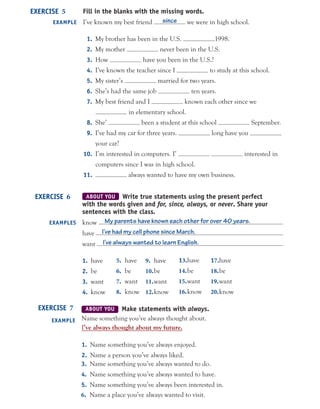
I’ve known my best friend since we were in high school.
1. My brother has been in the U.S. 1998.
2. My mother never been in the U.S.
3. How have you been in the U.S.?
4. I’ve known the teacher since I to study at this school.
5. My sister’s married for two years.
6. She’s had the same job ten years.
7. My best friend and I known each other since we
in elementary school.
8. She’ been a student at this school September.
9. I’ve had my car for three years. long have you
your car?
10. I’m interested in computers. I’ interested in
computers since I was in high school.
11. always wanted to have my own business.
EXERCISE 5
EXAMPLE
ABOUT YOU Write true statements using the present perfect
with the words given and for, since, always, or never. Share your
sentences with the class.
know My parents have known each other for over 40 years.
have I’ve had my cell phone since March.
want I’ve always wanted to learn English.
1. have
2. be
3. want
4. know
EXERCISE 6
EXAMPLES
ABOUT YOU Make statements with always.
Name something you’ve always thought about.
I’ve always thought about my future.
1. Name something you’ve always enjoyed.
2. Name a person you’ve always liked.
EXERCISE 7
EXAMPLE
5. have
6. be
7. want
8. know
9. have
10.be
11.want
12.know
13.have
14.be
15.want
16.know
17.have
18.be
19.want
20.know
3. Name something you’ve always wanted to do.
4. Name something you’ve always wanted to have.
5. Name something you’ve always been interested in.
6. Name a place you’ve always wanted to visit.
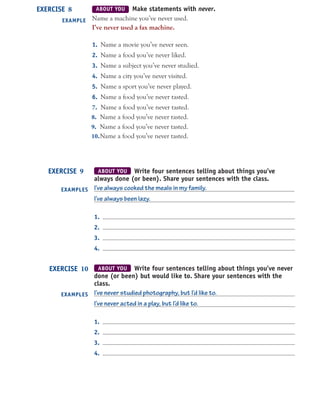
ABOUT YOU Make statements with never.
Name a machine you’ve never used.
I’ve never used a fax machine.
1. Name a movie you’ve never seen.
2. Name a food you’ve never liked.
3. Name a subject you’ve never studied.
4. Name a city you’ve never visited.
5. Name a sport you’ve never played.
6. Name a food you’ve never tasted.
EXERCISE 8
EXAMPLE
ABOUT YOU Write four sentences telling about things you’ve
always done (or been). Share your sentences with the class.
I’ve always cooked the meals in my family.
I’ve always been lazy.
1.
2.
3.
4.
EXERCISE 9
EXAMPLES
ABOUT YOU Write four sentences telling about things you’ve never
done (or been) but would like to. Share your sentences with the
class.
I’ve never studied photography, but I’d like to.
I’ve never acted in a play, but I’d like to.
1.
2.
3.
4.
EXERCISE 10
EXAMPLES
7. Name a food you’ve never tasted.
8. Name a food you’ve never tasted.
9. Name a food you’ve never tasted.
10.Name a food you’ve never tasted.
The Simple Present vs. the Present Perfect
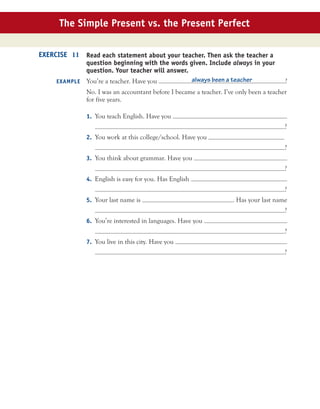
Read each statement about your teacher. Then ask the teacher a
question beginning with the words given. Include always in your
question. Your teacher will answer.
You’re a teacher. Have you always been a teacher ?
No. I was an accountant before I became a teacher. I’ve only been a teacher
for five years.
1. You teach English. Have you
?
2. You work at this college/school. Have you
?
3. You think about grammar. Have you
?
4. English is easy for you. Has English
?
5. Your last name is . Has your last name
?
6. You’re interested in languages. Have you
?
7. You live in this city. Have you
?
EXERCISE 11
EXAMPLE
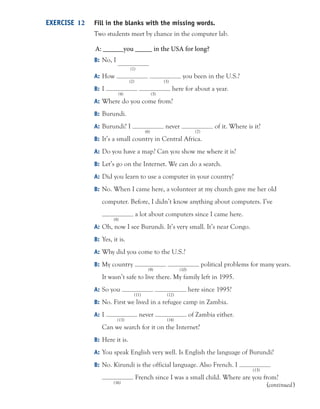
Fill in the blanks with the missing words.
Two students meet by chance in the computer lab.
B: No, I
(1)
A: How you been in the U.S.?
(2) (3)
B: I here for about a year.
(4) (5)
A: Where do you come from?
B: Burundi.
A: Burundi? I never of it. Where is it?
(6) (7)
B: It’s a small country in Central Africa.
A: Do you have a map? Can you show me where it is?
B: Let’s go on the Internet. We can do a search.
A: Did you learn to use a computer in your country?
B: No. When I came here, a volunteer at my church gave me her old
computer. Before, I didn’t know anything about computers. I’ve
a lot about computers since I came here.
(8)
A: Oh, now I see Burundi. It’s very small. It’s near Congo.
B: Yes, it is.
A: Why did you come to the U.S.?
B: My country political problems for many years.
(9) (10)
It wasn’t safe to live there. My family left in 1995.
A: So you here since 1995?
(11) (12)
B: No. First we lived in a refugee camp in Zambia.
A: I never of Zambia either.
(13) (14)
Can we search for it on the Internet?
B: Here it is.
A: You speak English very well. Is English the language of Burundi?
B: No. Kirundi is the official language. Also French. I
(15)
French since I was a small child. Where are you from?
(16)
EXERCISE 12
(continued)
A: ______you _____ in the USA for long?
1. Do you read a lot? What kind of books do you like to read?
2. Have you ever shopped for books on the Internet?
Before
You Read
Read the following conversation. Pay special attention to
the present perfect tens and translate it.
A:A:A:
B:B:B:
A:A:A:
B:B:B:
A:A:A:
B:B:B:
A:A:A:
B:B:B:
A:A:A:
B:B:B:
A:A:A:
B:B:B:
A:A:A:
B:B:B:
A:A:A:
B:B:B:B:B:B:
A:A:A:
E-Books EXERCISE 13
ABOUT YOU Answer the following questions with: Yes, I have;
No, I haven’t; or No, I never have.
Have you ever studied programming? No, I never have.
1. Have you ever “Googled” your own name?
2. Have you ever researched your family history?
3. Have you ever made a family tree?
4. Have you ever used the Web to look for a person you haven’t seen in
a long time?
5. Have you ever added hardware to your computer?
6. Have you ever downloaded music from the Internet?
7. Have you ever used a search engine in your native language?
8. Have you ever sent photos by e-mail?
9. Have you ever received a photo by e-mail?
10. Have you ever bought something online?
11. Have you ever built a computer?
ABOUT YOU Answer the questions.
Have we had a test on the present perfect yet? No, not yet.
1. Have you eaten lunch yet?
2. Have we finished Lesson 8 yet?
3. Have you done today’s homework yet?
4. Have we written any compositions yet?
5. Have you learned the names of all the other students yet?
6. Have you visited the teacher’s office yet?
7. Have we done Exercise 22 yet?
8. Have you learned the present perfect yet?
9. Have you learned all the past participles yet?
EXERCISE 14
EXAMPLE
EXERCISE 15
EXAMPLE
ABOUT YOU Ask a question with “Have you ever . . . ?” and
the present perfect tense of the verb in parentheses ( ). Another
student will answer. To answer with a specific time, use the past
tense. To answer with a frequency response, use the present perfect
tense. You may work with a partner.
(go) to the zoo
A: Have you ever gone to the zoo?
B: Yes. I’ve gone there many times.
(go) to Disneyland
A: Have you ever gone to Disneyland?
B: Yes. I went there last summer.
EXERCISE 16
EXAMPLES
1. (work) in a factory
2. (lose) a glove
3. (see) an e-book
4. (fall) out of bed
5. (make) a mistake in English
grammar
6. (tell) a lie
7. (eat) raw7
fish
8. (study) calculus
9. (meet) a famous person
10. (go) to an art museum
11. (download) a book
12. (break) a window
13. (buy) a book online
We can answer a present perfect question with the simple past tense when a
specific time is introduced in the answer. If a specific time is not known or
necessary, we answer with the present perfect.
Answering a Present Perfect Question
14. (download) music
15. (go) to Las Vegas
16. (travel) by ship
17. (be) in love
18. (write) a poem
19. (send) a text message
ABOUT YOU Write five questions with ever to ask your teacher.
Your teacher will answer.
Have you ever gotten a parking ticket?
Have you ever visited Poland?
1.
2.
3.
4.
5.
ABOUT YOU Ask a student from another country questions using
the words given. The other student will answer.
your country / have a woman president
A: Has your country ever had a woman president?
B: Yes, it has. We had a woman president from 1975 to 1979.
1. your country / have a civil war
2. your country’s leader / visit the U.S.
3. an American president / visit your country
4. your country / have a woman president
5. you / go back to visit your country
6. there / be an earthquake in your hometown
ABOUT YOU Ask a student who has recently arrived in this country
if he or she has done these things yet. The other student will answer.
buy a car
A: Have you bought a car yet?
B: Yes, I have. OR No, I haven’t. OR I bought a car last month.
1. find a doctor 6. write to your family
2. make any new friends 7. get a credit card
3. open a bank account 8. buy a computer
4. save any money 9. get a telephone
5. think about your future 10. get a Social Security card
EXERCISE 17
EXAMPLES
EXERCISE 18
EXAMPLE
EXERCISE 19
EXAMPLE
Fill in the blanks with the correct tense of the verb in parentheses ( ).
Also fill in other missing words.
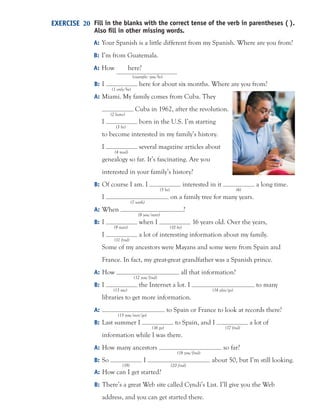
A: Your Spanish is a little different from my Spanish. Where are you from?
B: I’m from Guatemala.
A: How here?
(example: you/be)
B: I here for about six months. Where are you from?
(1 only/be)
A: Miami. My family comes from Cuba. They
Cuba in 1962, after the revolution.
(2 leave)
I born in the U.S. I’m starting
(3 be)
to become interested in my family’s history.
I several magazine articles about
(4 read)
genealogy so far. It’s fascinating. Are you
interested in your family’s history?
B: Of course I am. I interested in it a long time.
(5 be) (6)
I on a family tree for many years.
(7 work)
A: When ?
(8 you/start)
B: I when I 16 years old. Over the years,
(9 start) (10 be)
I a lot of interesting information about my family.
(11 find)
Some of my ancestors were Mayans and some were from Spain and
France. In fact, my great-great grandfather was a Spanish prince.
A: How all that information?
(12 you/find)
B: I the Internet a lot. I to many
(13 use) (14 also/go)
libraries to get more information.
A: to Spain or France to look at records there?
(15 you/ever/go)
B: Last summer I to Spain, and I a lot of
(16 go) (17 find)
information while I was there.
A: How many ancestors so far?
(18 you/find)
B: So I about 50, but I’m still looking.
(19) (20 find)
EXERCISE 20
A: How can I get started?
B: There’s a great Web site called Cyndi’s List. I’ll give you the Web
address, and you can get started there.
Some of the shaded words and phrases have mistakes. Find the
mistakes and correct them. If the shaded words are correct, write C.
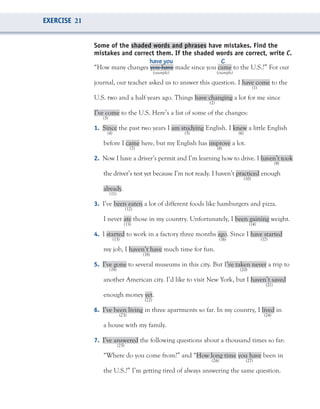
“How many changes you have made since you came to the U.S.?” For our
(example) (example)
journal, our teacher asked us to answer this question. I have come to the
(1)
U.S. two and a half years ago. Things have changing a lot for me since
(2)
I’ve come to the U.S. Here’s a list of some of the changes:
(3)
1. Since the past two years I am studying English. I knew a little English
(4) (5) (6)
before I came here, but my English has improve a lot.
(7) (8)
2. Now I have a driver’s permit and I’m learning how to drive. I haven’t took
(9)
the driver’s test yet because I’m not ready. I haven’t practiced enough
(10)
already.
(11)
3. I’ve been eaten a lot of different foods like hamburgers and pizza.
(12)
I never ate those in my country. Unfortunately, I been gaining weight.
(13) (14)
4. I started to work in a factory three months ago. Since I have started
(15) (16) (17)
my job, I haven’t have much time for fun.
(18)
5. I’ve gone to several museums in this city. But I’ve taken never a trip to
(19) (20)
another American city. I’d like to visit New York, but I haven’t saved
(21)
enough money yet.
(22)
6. I’ve been living in three apartments so far. In my country, I lived in
(23) (24)
a house with my family.
7. I’ve answered the following questions about a thousand times so far:
(25)
“Where do you come from?” and “How long time you have been in
(26) (27)
the U.S.?” I’m getting tired of always answering the same question.
have you C
EXERCISE 21
Test
Fill in the blanks with the simple past, the present perfect, or the
present perfect continuous form by using the words in parentheses ( ).
In some cases, more than one answer is possible.
Conversation 1
A: Have you ever studied computer programming?
(example: study)
B: Yes. I it in college. And I as a programmer
(1 study) (2 work)
for five years. But my job is boring.
A: you ever about changing jobs?
(3 think)
B: Yes. Since I a child, I to be an
(4 be) (5 always/want)
actor. When I was in college, I in a few plays, but
(6 be)
since I , I time to act.
(7 graduate) (8 not/have)
Conversation 2
A: How long in the U.S.?
(1 you/be)
B: For about two years.
A: a lot since you to the U.S.?
(2 your life/change) (3 come)
B: Oh, yes. Before I here, I with my family.
(4 come) (5 live)
Since I came here, I alone.
(6 live)
A: in the same apartment in this city?
(7 always/live)
B: No. I three times so far. And I plan to move again at
(8 move)
the end of the year.
A: Do you plan to have a roommate?
B: Yes, but I one yet.
(9 not/find)
PART 111
Fill in the blanks with the simple present, the simple past,
the present perfect, or the present perfect continuous form
of the verb in parentheses ( ). In some cases, more than one
answer is possible.
Paragraph 1
I the Internet every day. I it for many years.
(1 use) (2 use)
I to use it when I interested in genealogy.
(3 start) (4 become)
I on my family tree for three years. Last month,
(5 work)
I information about my father’s ancestors. My grandfather
(6 find)
with us now and likes to tell us about his past. He
(7 live) (8 be)
born in Italy, but he here when he was very young, so he
(9 come)
here most of his life. He doesn’t remember much about Italy.
(10 live)
I any information about my mother’s ancestors yet.
(11 not/find)
Paragraph 2
I to the U.S. when a war out in my country.
(1 come) (2 break)
I in the U.S. for five years. At first, everything
(3 live)
very hard for me. I any English when
(4 be) (5 not/know)
I . But I English for the past five years,
(6 arrive) (7 study)
and now I it pretty well. I my college
(8 speak) ( 9 not/start)
education yet, but I plan to next semester.
PART 222
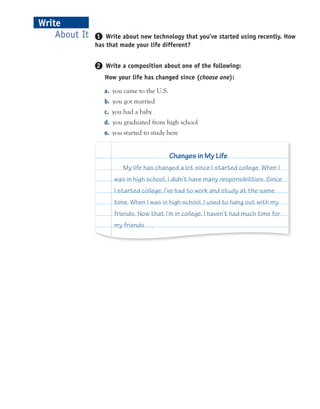
About It
Write
1 Write about new technology that you’ve started using recently. How
has that made your life different?
2 Write a composition about one of the following:
How your life has changed since (choose one):
a. you came to the U.S.
b. you got married
c. you had a baby
d. you graduated from high school
e. you started to study here
My life has changed a lot since I started college. When I
was in high school, I didn’t have many responsibilities. Since
I started college, I’ve had to work and study at the same
time. When I was in high school, I used to hang out with my
friends. Now that I’m in college, I haven’t had much time for
my friends . . .
Changes in My Life

Present perfect 1

  • 1.
    Since its startin 1998, Google has become one of the most popular search engines. It has grown from a research project in the dormitory room of two college students to a business that now employs approximately 20,000 people. Google’s founders, Larry Page and Sergey Brin, met in 1995 when they were in their twenties and graduate students in computer science at Stanford University in California. They realized that Internet search was a very important field and began working together to make searching easier. Both Page and Brin left their studies at Stanford to work on their project. Interestingly, they have never returned to finish their degrees. Brin was born in Russia, but he has lived in the U.S. since he was five years old. His father was a mathematician in Russia. Page, whose parents were computer experts, has been interested in computers since he was six years old. When Google started in 1998, it did 10,000 searches a day. Today it does 235 million searches a day in 40 languages. It indexes2 1 trillion Web pages. How is Google different from other search engines? Have you ever noticed how many ads and banners there are on other search engines? News, sports scores, stock prices, links for shopping, mortgage rates, and more fill other search engines. Brin and Page wanted a clean home page. They believed that people come to the Internet to search for specific information, not to be hit with a lot of unwanted data. The success of Google over its rivals3 has proved that this is true. Over the years, Google has added new features to its Web site: Google Images, where you can type in a word and get thousands of pictures; Google News, which takes you to today’s news; Google Maps; and more. But one thing hasn’t changed: the clean opening page that Google offers its users. In 2009, Forbes.com listed Page and Brin as having net worths of $12 billion each, at 36 and 35 years old. http://www.website*reading.com Larry Page and Sergey Brin Did You Know? The word “Google” started as a noun, the company’s name. Today people use it as a verb: “I’m going to Google the Civil War to get more information about it.” THE PRESENT PERFECTEXERCISE 1: Make questions
  • 2.
    Write the pastparticiple of these verbs. eat eaten 1. go 11. live 21. write 2. see 12. know 22. put 3. look 13. like 23. begin 4. study 14. fall 24. want 5. bring 15. feel 25. get 6. take 16. come 26. fly 7. say 17. break 27. sit 8. be 18. wear 28. drink 9. find 19. choose 29. grow 10. leave 20. drive 30. give EXAMPLE Write the past participle of all the following verbs: Base Past Form Participle become _______________ _______________ _______________ come run blow draw fly grow know throw swear tear wear break choose freeze speak steal begin drink ring sing sink swim Base Past Form Participle arise bite drive ride rise write be eat fall forgive give mistake see shake take do forget get go lie prove show _______________ _______________ _______________ _______________ _______________ _______________ _______________ _______________ _______________ _______________ _______________ _______________ _______________ _______________ _______________ _______________ _______________ _______________ _______________ _______________ _______________ _______________ _______________ _______________ _______________ _______________ _______________ _______________ _______________ _______________ _______________ _______________ _______________ _______________ _______________ _______________ _______________ _______________ _______________ _______________ _______________ _______________ EXERCISE 2
  • 3.
    Add the wordin parentheses ( ) to the sentence. You have gotten an e-mail account. (probably) You have probably gotten an e-mail account. 1. The teacher has given a test on Lesson 8. (already) 2. We have heard of Page and Brin. (never) 3. My parents have been interested in search technology. (always) 4. You have used Google. (probably) 5. Jack hasn’t finished his degree. (even) 6. Lola and Rose have become billionaires. (already) EXERCISE 3 Adding an Adverb 7. Lisa has gotten pregnant this month. (probably) _________________________________________________________ 8. Albert and Josheph have gone to Paris. (never) ________________________________________________________ 9. I have a siesta after my lunch every day. (always) ________________________________________________________ 10. Sandy has gone to see the doctor today. (probably) ________________________________________________________ 11. You have done your homework today. (even) ________________________________________________________ My older brother has finished his medicine degree. (already) ________________________________________________________ 12. 13. Sonia hasn't spoken more than one language. (even) ________________________________________________________ Lucia and her parents have gone on vacation together. (never) ________________________________________________________ 14.
  • 4.
    The Present Perfect—Statementsand Questions Change the statement to a question, using the word(s) in parentheses. Google has changed the way people search. (how) How has Google changed the way people search? 1. I have used several search engines. (which ones) 2. Larry and Sergey haven’t finished their degrees. (why) 3. They have made a lot of money. (how much) 4. Sergey has been in the U.S. for many years. (how long) 5. Larry and Sergey have hired many people to work for Google. (how many) 6. We have used the computer lab several times this semester. (how many times) EXERCISE 4 EXAMPLE 7. The memory and speed of computers have increased. (why) 8. Computers have become part of our daily lives. (how)
  • 5.
    Fill in theblanks with the missing words. I’ve known my best friend since we were in high school. 1. My brother has been in the U.S. 1998. 2. My mother never been in the U.S. 3. How have you been in the U.S.? 4. I’ve known the teacher since I to study at this school. 5. My sister’s married for two years. 6. She’s had the same job ten years. 7. My best friend and I known each other since we in elementary school. 8. She’ been a student at this school September. 9. I’ve had my car for three years. long have you your car? 10. I’m interested in computers. I’ interested in computers since I was in high school. 11. always wanted to have my own business. EXERCISE 5 EXAMPLE ABOUT YOU Write true statements using the present perfect with the words given and for, since, always, or never. Share your sentences with the class. know My parents have known each other for over 40 years. have I’ve had my cell phone since March. want I’ve always wanted to learn English. 1. have 2. be 3. want 4. know EXERCISE 6 EXAMPLES ABOUT YOU Make statements with always. Name something you’ve always thought about. I’ve always thought about my future. 1. Name something you’ve always enjoyed. 2. Name a person you’ve always liked. EXERCISE 7 EXAMPLE 5. have 6. be 7. want 8. know 9. have 10.be 11.want 12.know 13.have 14.be 15.want 16.know 17.have 18.be 19.want 20.know 3. Name something you’ve always wanted to do. 4. Name something you’ve always wanted to have. 5. Name something you’ve always been interested in. 6. Name a place you’ve always wanted to visit.
  • 6.
    ABOUT YOU Makestatements with never. Name a machine you’ve never used. I’ve never used a fax machine. 1. Name a movie you’ve never seen. 2. Name a food you’ve never liked. 3. Name a subject you’ve never studied. 4. Name a city you’ve never visited. 5. Name a sport you’ve never played. 6. Name a food you’ve never tasted. EXERCISE 8 EXAMPLE ABOUT YOU Write four sentences telling about things you’ve always done (or been). Share your sentences with the class. I’ve always cooked the meals in my family. I’ve always been lazy. 1. 2. 3. 4. EXERCISE 9 EXAMPLES ABOUT YOU Write four sentences telling about things you’ve never done (or been) but would like to. Share your sentences with the class. I’ve never studied photography, but I’d like to. I’ve never acted in a play, but I’d like to. 1. 2. 3. 4. EXERCISE 10 EXAMPLES 7. Name a food you’ve never tasted. 8. Name a food you’ve never tasted. 9. Name a food you’ve never tasted. 10.Name a food you’ve never tasted.
  • 7.
    The Simple Presentvs. the Present Perfect Read each statement about your teacher. Then ask the teacher a question beginning with the words given. Include always in your question. Your teacher will answer. You’re a teacher. Have you always been a teacher ? No. I was an accountant before I became a teacher. I’ve only been a teacher for five years. 1. You teach English. Have you ? 2. You work at this college/school. Have you ? 3. You think about grammar. Have you ? 4. English is easy for you. Has English ? 5. Your last name is . Has your last name ? 6. You’re interested in languages. Have you ? 7. You live in this city. Have you ? EXERCISE 11 EXAMPLE
  • 8.
    Fill in theblanks with the missing words. Two students meet by chance in the computer lab. B: No, I (1) A: How you been in the U.S.? (2) (3) B: I here for about a year. (4) (5) A: Where do you come from? B: Burundi. A: Burundi? I never of it. Where is it? (6) (7) B: It’s a small country in Central Africa. A: Do you have a map? Can you show me where it is? B: Let’s go on the Internet. We can do a search. A: Did you learn to use a computer in your country? B: No. When I came here, a volunteer at my church gave me her old computer. Before, I didn’t know anything about computers. I’ve a lot about computers since I came here. (8) A: Oh, now I see Burundi. It’s very small. It’s near Congo. B: Yes, it is. A: Why did you come to the U.S.? B: My country political problems for many years. (9) (10) It wasn’t safe to live there. My family left in 1995. A: So you here since 1995? (11) (12) B: No. First we lived in a refugee camp in Zambia. A: I never of Zambia either. (13) (14) Can we search for it on the Internet? B: Here it is. A: You speak English very well. Is English the language of Burundi? B: No. Kirundi is the official language. Also French. I (15) French since I was a small child. Where are you from? (16) EXERCISE 12 (continued) A: ______you _____ in the USA for long?
  • 9.
    1. Do youread a lot? What kind of books do you like to read? 2. Have you ever shopped for books on the Internet? Before You Read Read the following conversation. Pay special attention to the present perfect tens and translate it. A:A:A: B:B:B: A:A:A: B:B:B: A:A:A: B:B:B: A:A:A: B:B:B: A:A:A: B:B:B: A:A:A: B:B:B: A:A:A: B:B:B: A:A:A: B:B:B:B:B:B: A:A:A: E-Books EXERCISE 13
  • 10.
    ABOUT YOU Answerthe following questions with: Yes, I have; No, I haven’t; or No, I never have. Have you ever studied programming? No, I never have. 1. Have you ever “Googled” your own name? 2. Have you ever researched your family history? 3. Have you ever made a family tree? 4. Have you ever used the Web to look for a person you haven’t seen in a long time? 5. Have you ever added hardware to your computer? 6. Have you ever downloaded music from the Internet? 7. Have you ever used a search engine in your native language? 8. Have you ever sent photos by e-mail? 9. Have you ever received a photo by e-mail? 10. Have you ever bought something online? 11. Have you ever built a computer? ABOUT YOU Answer the questions. Have we had a test on the present perfect yet? No, not yet. 1. Have you eaten lunch yet? 2. Have we finished Lesson 8 yet? 3. Have you done today’s homework yet? 4. Have we written any compositions yet? 5. Have you learned the names of all the other students yet? 6. Have you visited the teacher’s office yet? 7. Have we done Exercise 22 yet? 8. Have you learned the present perfect yet? 9. Have you learned all the past participles yet? EXERCISE 14 EXAMPLE EXERCISE 15 EXAMPLE
  • 11.
    ABOUT YOU Aska question with “Have you ever . . . ?” and the present perfect tense of the verb in parentheses ( ). Another student will answer. To answer with a specific time, use the past tense. To answer with a frequency response, use the present perfect tense. You may work with a partner. (go) to the zoo A: Have you ever gone to the zoo? B: Yes. I’ve gone there many times. (go) to Disneyland A: Have you ever gone to Disneyland? B: Yes. I went there last summer. EXERCISE 16 EXAMPLES 1. (work) in a factory 2. (lose) a glove 3. (see) an e-book 4. (fall) out of bed 5. (make) a mistake in English grammar 6. (tell) a lie 7. (eat) raw7 fish 8. (study) calculus 9. (meet) a famous person 10. (go) to an art museum 11. (download) a book 12. (break) a window 13. (buy) a book online We can answer a present perfect question with the simple past tense when a specific time is introduced in the answer. If a specific time is not known or necessary, we answer with the present perfect. Answering a Present Perfect Question 14. (download) music 15. (go) to Las Vegas 16. (travel) by ship 17. (be) in love 18. (write) a poem 19. (send) a text message
  • 12.
    ABOUT YOU Writefive questions with ever to ask your teacher. Your teacher will answer. Have you ever gotten a parking ticket? Have you ever visited Poland? 1. 2. 3. 4. 5. ABOUT YOU Ask a student from another country questions using the words given. The other student will answer. your country / have a woman president A: Has your country ever had a woman president? B: Yes, it has. We had a woman president from 1975 to 1979. 1. your country / have a civil war 2. your country’s leader / visit the U.S. 3. an American president / visit your country 4. your country / have a woman president 5. you / go back to visit your country 6. there / be an earthquake in your hometown ABOUT YOU Ask a student who has recently arrived in this country if he or she has done these things yet. The other student will answer. buy a car A: Have you bought a car yet? B: Yes, I have. OR No, I haven’t. OR I bought a car last month. 1. find a doctor 6. write to your family 2. make any new friends 7. get a credit card 3. open a bank account 8. buy a computer 4. save any money 9. get a telephone 5. think about your future 10. get a Social Security card EXERCISE 17 EXAMPLES EXERCISE 18 EXAMPLE EXERCISE 19 EXAMPLE
  • 13.
    Fill in theblanks with the correct tense of the verb in parentheses ( ). Also fill in other missing words. A: Your Spanish is a little different from my Spanish. Where are you from? B: I’m from Guatemala. A: How here? (example: you/be) B: I here for about six months. Where are you from? (1 only/be) A: Miami. My family comes from Cuba. They Cuba in 1962, after the revolution. (2 leave) I born in the U.S. I’m starting (3 be) to become interested in my family’s history. I several magazine articles about (4 read) genealogy so far. It’s fascinating. Are you interested in your family’s history? B: Of course I am. I interested in it a long time. (5 be) (6) I on a family tree for many years. (7 work) A: When ? (8 you/start) B: I when I 16 years old. Over the years, (9 start) (10 be) I a lot of interesting information about my family. (11 find) Some of my ancestors were Mayans and some were from Spain and France. In fact, my great-great grandfather was a Spanish prince. A: How all that information? (12 you/find) B: I the Internet a lot. I to many (13 use) (14 also/go) libraries to get more information. A: to Spain or France to look at records there? (15 you/ever/go) B: Last summer I to Spain, and I a lot of (16 go) (17 find) information while I was there. A: How many ancestors so far? (18 you/find) B: So I about 50, but I’m still looking. (19) (20 find) EXERCISE 20 A: How can I get started? B: There’s a great Web site called Cyndi’s List. I’ll give you the Web address, and you can get started there.
  • 14.
    Some of theshaded words and phrases have mistakes. Find the mistakes and correct them. If the shaded words are correct, write C. “How many changes you have made since you came to the U.S.?” For our (example) (example) journal, our teacher asked us to answer this question. I have come to the (1) U.S. two and a half years ago. Things have changing a lot for me since (2) I’ve come to the U.S. Here’s a list of some of the changes: (3) 1. Since the past two years I am studying English. I knew a little English (4) (5) (6) before I came here, but my English has improve a lot. (7) (8) 2. Now I have a driver’s permit and I’m learning how to drive. I haven’t took (9) the driver’s test yet because I’m not ready. I haven’t practiced enough (10) already. (11) 3. I’ve been eaten a lot of different foods like hamburgers and pizza. (12) I never ate those in my country. Unfortunately, I been gaining weight. (13) (14) 4. I started to work in a factory three months ago. Since I have started (15) (16) (17) my job, I haven’t have much time for fun. (18) 5. I’ve gone to several museums in this city. But I’ve taken never a trip to (19) (20) another American city. I’d like to visit New York, but I haven’t saved (21) enough money yet. (22) 6. I’ve been living in three apartments so far. In my country, I lived in (23) (24) a house with my family. 7. I’ve answered the following questions about a thousand times so far: (25) “Where do you come from?” and “How long time you have been in (26) (27) the U.S.?” I’m getting tired of always answering the same question. have you C EXERCISE 21
  • 15.
    Test Fill in theblanks with the simple past, the present perfect, or the present perfect continuous form by using the words in parentheses ( ). In some cases, more than one answer is possible. Conversation 1 A: Have you ever studied computer programming? (example: study) B: Yes. I it in college. And I as a programmer (1 study) (2 work) for five years. But my job is boring. A: you ever about changing jobs? (3 think) B: Yes. Since I a child, I to be an (4 be) (5 always/want) actor. When I was in college, I in a few plays, but (6 be) since I , I time to act. (7 graduate) (8 not/have) Conversation 2 A: How long in the U.S.? (1 you/be) B: For about two years. A: a lot since you to the U.S.? (2 your life/change) (3 come) B: Oh, yes. Before I here, I with my family. (4 come) (5 live) Since I came here, I alone. (6 live) A: in the same apartment in this city? (7 always/live) B: No. I three times so far. And I plan to move again at (8 move) the end of the year. A: Do you plan to have a roommate? B: Yes, but I one yet. (9 not/find) PART 111
  • 16.
    Fill in theblanks with the simple present, the simple past, the present perfect, or the present perfect continuous form of the verb in parentheses ( ). In some cases, more than one answer is possible. Paragraph 1 I the Internet every day. I it for many years. (1 use) (2 use) I to use it when I interested in genealogy. (3 start) (4 become) I on my family tree for three years. Last month, (5 work) I information about my father’s ancestors. My grandfather (6 find) with us now and likes to tell us about his past. He (7 live) (8 be) born in Italy, but he here when he was very young, so he (9 come) here most of his life. He doesn’t remember much about Italy. (10 live) I any information about my mother’s ancestors yet. (11 not/find) Paragraph 2 I to the U.S. when a war out in my country. (1 come) (2 break) I in the U.S. for five years. At first, everything (3 live) very hard for me. I any English when (4 be) (5 not/know) I . But I English for the past five years, (6 arrive) (7 study) and now I it pretty well. I my college (8 speak) ( 9 not/start) education yet, but I plan to next semester. PART 222
  • 17.
    About It Write 1 Writeabout new technology that you’ve started using recently. How has that made your life different? 2 Write a composition about one of the following: How your life has changed since (choose one): a. you came to the U.S. b. you got married c. you had a baby d. you graduated from high school e. you started to study here My life has changed a lot since I started college. When I was in high school, I didn’t have many responsibilities. Since I started college, I’ve had to work and study at the same time. When I was in high school, I used to hang out with my friends. Now that I’m in college, I haven’t had much time for my friends . . . Changes in My Life