By:- RANVEER
SINGH
M.Tech(ICE) – 3rd
Sem.1
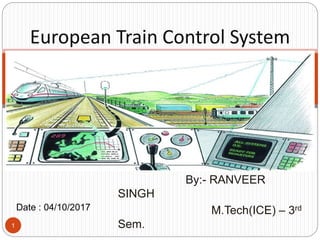
European Train Control System
Date : 04/10/2017
Contents
2
 Introduction
 History
 Indian Railways System
 Major functions of control system
 Components Used
 About ETCS levels
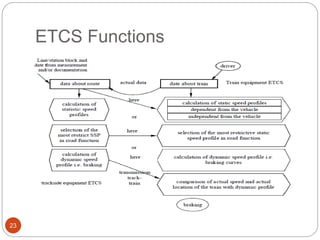
 ETCS functions
 ETCS in India
 ETCS Deployment and Applications
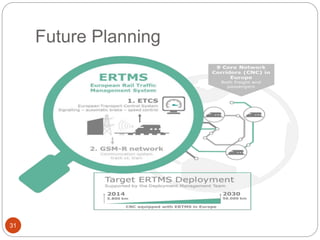
 Future Planning
 Conclusion
 References
Introduction
3
 Train control is the process by which the movement of
rail rapid transit vehicles is regulated for the purposes
of safety and efficiency.
 The train control system is analogous to the sensory
organs and central nervous system of the human
body. It senses and processes information, makes
decisions, and transmits commands.
 ETCS based is on digital track-car transmission. This
transmission may be made by balises, short, average
or long loops, digital radio channel or specialized
transmission modules.
Cont…
4
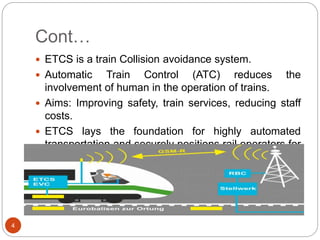
 ETCS is a train Collision avoidance system.
 Automatic Train Control (ATC) reduces the
involvement of human in the operation of trains.
 Aims: Improving safety, train services, reducing staff
costs.
 ETCS lays the foundation for highly automated
transportation and securely positions rail operators for
the future.
History
5
 By the end of the 1980s, the advent of high-speed trains
showed that signaling based on line side signals is
insufficient.
 On 4 and 5 December 1989, a working group including
Transport Ministers resolved a master plan for a trans-
European high-speed rail network, the first time that ETCS
was suggested.
 Eurobalise developed after a crash in 1985 and it was
deployed in the early 1990s on French lines.
 About the same time the idea came up to develop a
common train protection system for Europe leading to the
91/440/EEC as of 29 July 1991. Since 1993 the
organizational framework was in place to publish TSI
standards.
Cont…
6
 Then, at the end of 1993, the EU council issued an
Interoperability Directive and a decision was made to
create a group of railway expert called ERTMS Group,
 This allowed for the first drafts of the new technology and
since 1996 the elements were tested by six railway
operators which had joined the ERTMS user group.
 In the summer of 1998, the UNISIG (Union of Signaling
Industry) comprising the European Signaling companies
Alstom, Ansaldo Signal, Bombardier, Invensys Rail ,
Siemens and Thales was formed to finalize the TSI of the
ERTMS project.
 Siemens has been heavily involved in the specification of
the system, and in 2006, jointly with Thales, equipped the
first ETCS line in regular service – Juterborg-Halle-Leipzig.
Cont…
7
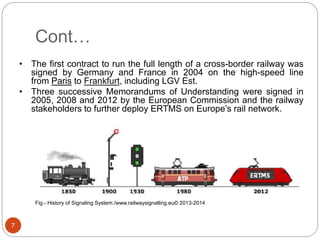
Fig.- History of Signaling System./www.railwaysignalling.eu© 2013-2014
• The first contract to run the full length of a cross-border railway was
signed by Germany and France in 2004 on the high-speed line
from Paris to Frankfurt, including LGV Est.
• Three successive Memorandums of Understanding were signed in
2005, 2008 and 2012 by the European Commission and the railway
stakeholders to further deploy ERTMS on Europe’s rail network.
Indian Railways
8
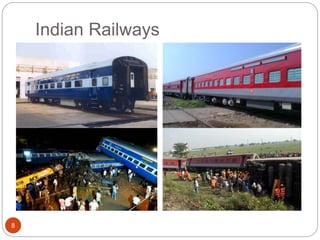
Indian Train Control System
9
ICF Coaches
 1955 till now used.
 Max. speed 110km/hr.
 Weight per 10m is 39.5
tones.
 Length : 23.5 m.
 The coaches climb over
each in accidents causing
serious casuality.
LHB Coaches
• 1999 from Germany.
• Max. speed 200km/hr.
• Lighter weight (17.8
tones), more comfortable
than ICF, low
maintenance cost.
• Material - Al Stainless
Steel.
• Pneumatic Disc Brake,
Fiat Bogie.
• 1LHB Coach Cost: 1.5 to
Major Functions of Control
System
10
 Train Protection:-
 Prevention of collision and derailments.
 Train Operation:-
 Control of train movement and stopping at stations.
 Train Supervision:-
 Direction of train movement in relation to schedule.
 Communication:-
 Interchange of information among the elements of
the system.
Components Used
11
 Eurobalise
 GSM-R
 Lineside Electronic Unit (LEU)
 Interlocking (IXL)
 Radio Block Center (RBC)
 Euro vital computer (EVC)
 Driver Machine Interface (DMI)
 Odometer Sensors
 Signal Encoder
Eurobalise
12
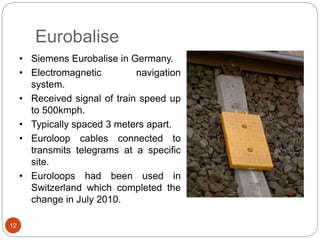
• Siemens Eurobalise in Germany.
• Electromagnetic navigation
system.
• Received signal of train speed up
to 500kmph.
• Typically spaced 3 meters apart.
• Euroloop cables connected to
transmits telegrams at a specific
site.
• Euroloops had been used in
Switzerland which completed the
change in July 2010.
Cont…
13
 Basic Transmission Module (BTM) mounted under a
passing train.
 The downlink uses an amplitude modulation on the
27.095 MHz frequency.
 The uplink uses FSK with 3.951 MHz (0) and
4.516 MHz (1). The data rate of 564.48 kbps is
enough to transmit 3 copies of a telegram to a train
passing at 500 km/h.
 In a practical setup the BTM requires 65 Watt to
power the Eurobalises and to receive the telegrams
with the BTM mounted 21 cm (8 1⁄4 in) above top of
rail on a bogie.
Size of Eurobalise
14
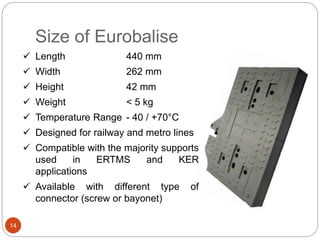
 Length 440 mm
 Width 262 mm
 Height 42 mm
 Weight < 5 kg
 Temperature Range - 40 / +70°C
 Designed for railway and metro lines
 Compatible with the majority supports
used in ERTMS and KER
applications
 Available with different type of
connector (screw or bayonet)
AlTrac 6413 TSS
15
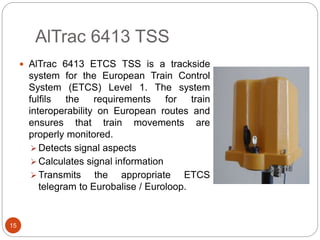
 AlTrac 6413 ETCS TSS is a trackside
system for the European Train Control
System (ETCS) Level 1. The system
fulfils the requirements for train
interoperability on European routes and
ensures that train movements are
properly monitored.
 Detects signal aspects
 Calculates signal information
 Transmits the appropriate ETCS
telegram to Eurobalise / Euroloop.
GSM-R
16
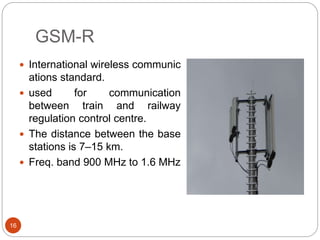
 International wireless communic
ations standard.
 used for communication
between train and railway
regulation control centre.
 The distance between the base
stations is 7–15 km.
 Freq. band 900 MHz to 1.6 MHz
RBC
17
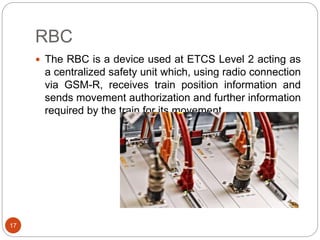
 The RBC is a device used at ETCS Level 2 acting as
a centralized safety unit which, using radio connection
via GSM-R, receives train position information and
sends movement authorization and further information
required by the train for its movement.
ETCS Levels
18
 An ETCS level, which specifies the required
equipment components, such as balises installed in
the track, an RBC and an LEU.
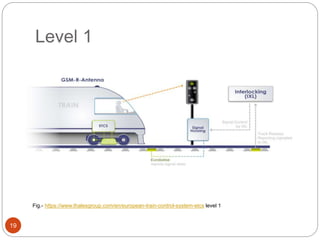
 Level 1: ETCS is installed on line side and on board;
spot transmission of data from track to train (and
versa) via Eurobalises or Euroloops.
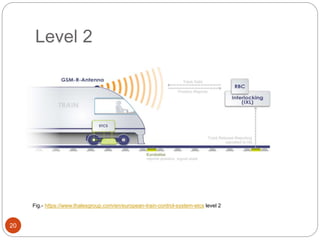
 Level 2: As level 1, but eurobalises are only used for
the exact train position detection. The continuous data
transmission via GSM-R with the Radio Block
Center (RBC) give the required signaling Information
to the drivers display. There is further line side
equipment needed, i.e. for train integrity detection.
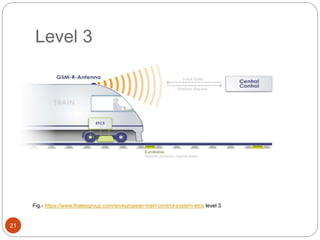
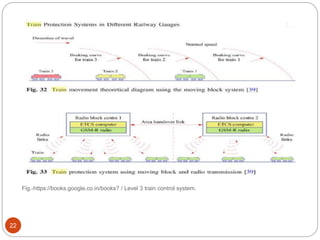
 Level 3: As level 2, but train location and train integrity
supervision no longer rely on trackside equipment
such as track circuits or axle counters.
Level 1
19
Fig.- https://www.thalesgroup.com/en/european-train-control-system-etcs level 1
Level 2
20
Fig.- https://www.thalesgroup.com/en/european-train-control-system-etcs level 2
Level 3
21
Fig.- https://www.thalesgroup.com/en/european-train-control-system-etcs level 3
Fig.-https://books.google.co.in/books? / Level 3 train control system.
22
ETCS Functions
23
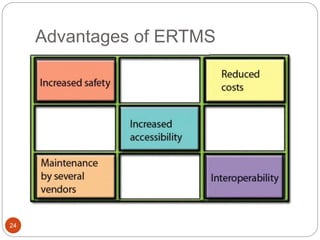
Advantages of ERTMS
24
Cont…
25
 a new and superior model for braking curves,
 a cold movement optimization and
 additional track description options.
 Improve the system's efficiency on long cross-
border distances.

 Increasing Safety and Security
 Higher performance, improved track utilization
and greater passenger service frequency
ETCS in India
26
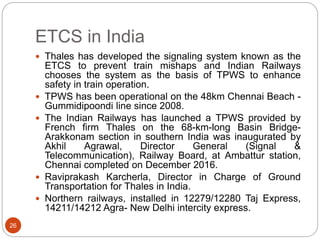
 Thales has developed the signaling system known as the
ETCS to prevent train mishaps and Indian Railways
chooses the system as the basis of TPWS to enhance
safety in train operation.
 TPWS has been operational on the 48km Chennai Beach -
Gummidipoondi line since 2008.
 The Indian Railways has launched a TPWS provided by
French firm Thales on the 68-km-long Basin Bridge-
Arakkonam section in southern India was inaugurated by
Akhil Agrawal, Director General (Signal &
Telecommunication), Railway Board, at Ambattur station,
Chennai completed on December 2016.
 Raviprakash Karcherla, Director in Charge of Ground
Transportation for Thales in India.
 Northern railways, installed in 12279/12280 Taj Express,
14211/14212 Agra- New Delhi intercity express.
Cont…
27
 Indian Railways intends to implement Train Protection
Warning System (TPWS) on a total of approximately 7,900
km of main lines across the country out of which 3,300 km
has already been budgeted.
 As per plan, a total of approximately, 2600 ETCS on board
systems shall be installed on locomotives. Currently two
projects are on tender and both are in Kolkata region.
 While the 128-km long line, 30 stations, 62 electric multiple
unit (EMU) trains to be equipped in the Eastern Railway,
another 121-km long rail line, 27 stations, 70 EMUs to be
equipped with the modern signaling system as accident
prevention measure.
 Deployments are also planned on the Chennai Beach -
Tambaram - Chengalpattu line, where a tender is
underway, and on the Arakkonam - Jolarpettai sections.
Cont…
28
 Northern Indian Railways:
 Supplier (for the Lev.1 system) of:
» BTM and Antennas (35)
» Compact LEU (290)
» Eurobalises (520)
» EVC (35)
 Southern Indian Railways:
 Supplier (for the Lev.1 system) of:
» BTM and Antennas (84)
» Compact LEU (108)
» Eurobalises (520)
» EVC (84)
ETCS Deployments
29
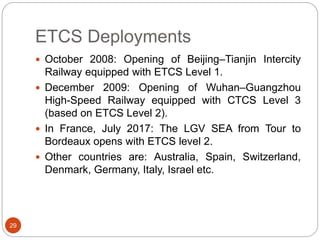
 October 2008: Opening of Beijing–Tianjin Intercity
Railway equipped with ETCS Level 1.
 December 2009: Opening of Wuhan–Guangzhou
High-Speed Railway equipped with CTCS Level 3
(based on ETCS Level 2).
 In France, July 2017: The LGV SEA from Tour to
Bordeaux opens with ETCS level 2.
 Other countries are: Australia, Spain, Switzerland,
Denmark, Germany, Italy, Israel etc.
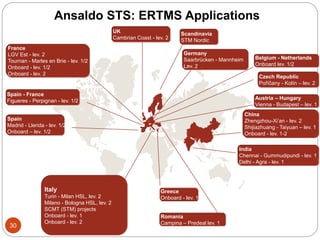
Greece
Onboard - lev. 1
Scandinavia
STM Nordic
UK
Cambrian Coast - lev. 2
Romania
Campina – Predeal lev. 1
India
Chennai - Gummudipundi - lev. 1
Delhi - Agra - lev. 1
China
Zhengzhou-Xi’an - lev. 2
Shijiazhuang - Taiyuan – lev. 1
Onboard - lev. 1-2
Czech Republic
Poříčany - Kolín – lev. 2
Belgium - Netherlands
Onboard lev. 1/2
Spain - France
Figueres - Perpignan - lev. 1/2
Spain
Madrid - Llerida - lev. 1/2
Onboard – lev. 1/2
France
LGV Est - lev. 2
Tournan - Marles en Brie - lev. 1/2
Onboard - lev. 1/2
Onboard - lev. 2
Austria – Hungary
Vienna - Budapest – lev. 1
Italy
Turin - Milan HSL, lev. 2
Milano - Bologna HSL, lev. 2
SCMT (STM) projects
Onboard - lev. 1
Onboard - lev. 2
Germany
Saarbrücken - Mannheim
Lev. 2
Ansaldo STS: ERTMS Applications
30
Future Planning
31
Conclusion
32
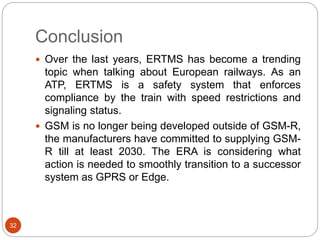
 Over the last years, ERTMS has become a trending
topic when talking about European railways. As an
ATP, ERTMS is a safety system that enforces
compliance by the train with speed restrictions and
signaling status.
 GSM is no longer being developed outside of GSM-R,
the manufacturers have committed to supplying GSM-
R till at least 2030. The ERA is considering what
action is needed to smoothly transition to a successor
system as GPRS or Edge.
References
33
 https://ec.europa.eu/transport/modes/rail/ertms_en.
 https://books.google.co.in/books?
 https://en.wikipedia.org/wiki/European_Train_Control_System
 www.railwaysignalling.eu© 2013-2014/History of Signaling
System.
 https://www.thalesgroup.com/en/european-train-control-system-
etcs
 https://www.mobility.siemens.com/mobility/global/SiteCollectionD
ocuments/en/rail-solutions/rail-automation / train- control-
systems/ trainguard- 200 -rbc-en.pdf
 https://mumbaimirror.indiatimes.com/mumbai/cover-
story/Nov,2016.
 Http://www.raillynews.com/2012/ertms-in-spain-worldwide/etcs-
2-2/
 "ETCS Level 2 for Entire Danish Network". Railway Gazette
34

ETCS

  • 1.
    By:- RANVEER SINGH M.Tech(ICE) –3rd Sem.1 European Train Control System Date : 04/10/2017
  • 2.
    Contents 2  Introduction  History Indian Railways System  Major functions of control system  Components Used  About ETCS levels  ETCS functions  ETCS in India  ETCS Deployment and Applications  Future Planning  Conclusion  References
  • 3.
    Introduction 3  Train controlis the process by which the movement of rail rapid transit vehicles is regulated for the purposes of safety and efficiency.  The train control system is analogous to the sensory organs and central nervous system of the human body. It senses and processes information, makes decisions, and transmits commands.  ETCS based is on digital track-car transmission. This transmission may be made by balises, short, average or long loops, digital radio channel or specialized transmission modules.
  • 4.
    Cont… 4  ETCS isa train Collision avoidance system.  Automatic Train Control (ATC) reduces the involvement of human in the operation of trains.  Aims: Improving safety, train services, reducing staff costs.  ETCS lays the foundation for highly automated transportation and securely positions rail operators for the future.
  • 5.
    History 5  By theend of the 1980s, the advent of high-speed trains showed that signaling based on line side signals is insufficient.  On 4 and 5 December 1989, a working group including Transport Ministers resolved a master plan for a trans- European high-speed rail network, the first time that ETCS was suggested.  Eurobalise developed after a crash in 1985 and it was deployed in the early 1990s on French lines.  About the same time the idea came up to develop a common train protection system for Europe leading to the 91/440/EEC as of 29 July 1991. Since 1993 the organizational framework was in place to publish TSI standards.
  • 6.
    Cont… 6  Then, atthe end of 1993, the EU council issued an Interoperability Directive and a decision was made to create a group of railway expert called ERTMS Group,  This allowed for the first drafts of the new technology and since 1996 the elements were tested by six railway operators which had joined the ERTMS user group.  In the summer of 1998, the UNISIG (Union of Signaling Industry) comprising the European Signaling companies Alstom, Ansaldo Signal, Bombardier, Invensys Rail , Siemens and Thales was formed to finalize the TSI of the ERTMS project.  Siemens has been heavily involved in the specification of the system, and in 2006, jointly with Thales, equipped the first ETCS line in regular service – Juterborg-Halle-Leipzig.
  • 7.
    Cont… 7 Fig.- History ofSignaling System./www.railwaysignalling.eu© 2013-2014 • The first contract to run the full length of a cross-border railway was signed by Germany and France in 2004 on the high-speed line from Paris to Frankfurt, including LGV Est. • Three successive Memorandums of Understanding were signed in 2005, 2008 and 2012 by the European Commission and the railway stakeholders to further deploy ERTMS on Europe’s rail network.
  • 8.
  • 9.
    Indian Train ControlSystem 9 ICF Coaches  1955 till now used.  Max. speed 110km/hr.  Weight per 10m is 39.5 tones.  Length : 23.5 m.  The coaches climb over each in accidents causing serious casuality. LHB Coaches • 1999 from Germany. • Max. speed 200km/hr. • Lighter weight (17.8 tones), more comfortable than ICF, low maintenance cost. • Material - Al Stainless Steel. • Pneumatic Disc Brake, Fiat Bogie. • 1LHB Coach Cost: 1.5 to
  • 10.
    Major Functions ofControl System 10  Train Protection:-  Prevention of collision and derailments.  Train Operation:-  Control of train movement and stopping at stations.  Train Supervision:-  Direction of train movement in relation to schedule.  Communication:-  Interchange of information among the elements of the system.
  • 11.
    Components Used 11  Eurobalise GSM-R  Lineside Electronic Unit (LEU)  Interlocking (IXL)  Radio Block Center (RBC)  Euro vital computer (EVC)  Driver Machine Interface (DMI)  Odometer Sensors  Signal Encoder
  • 12.
    Eurobalise 12 • Siemens Eurobalisein Germany. • Electromagnetic navigation system. • Received signal of train speed up to 500kmph. • Typically spaced 3 meters apart. • Euroloop cables connected to transmits telegrams at a specific site. • Euroloops had been used in Switzerland which completed the change in July 2010.
  • 13.
    Cont… 13  Basic TransmissionModule (BTM) mounted under a passing train.  The downlink uses an amplitude modulation on the 27.095 MHz frequency.  The uplink uses FSK with 3.951 MHz (0) and 4.516 MHz (1). The data rate of 564.48 kbps is enough to transmit 3 copies of a telegram to a train passing at 500 km/h.  In a practical setup the BTM requires 65 Watt to power the Eurobalises and to receive the telegrams with the BTM mounted 21 cm (8 1⁄4 in) above top of rail on a bogie.
  • 14.
    Size of Eurobalise 14 Length 440 mm  Width 262 mm  Height 42 mm  Weight < 5 kg  Temperature Range - 40 / +70°C  Designed for railway and metro lines  Compatible with the majority supports used in ERTMS and KER applications  Available with different type of connector (screw or bayonet)
  • 15.
    AlTrac 6413 TSS 15 AlTrac 6413 ETCS TSS is a trackside system for the European Train Control System (ETCS) Level 1. The system fulfils the requirements for train interoperability on European routes and ensures that train movements are properly monitored.  Detects signal aspects  Calculates signal information  Transmits the appropriate ETCS telegram to Eurobalise / Euroloop.
  • 16.
    GSM-R 16  International wirelesscommunic ations standard.  used for communication between train and railway regulation control centre.  The distance between the base stations is 7–15 km.  Freq. band 900 MHz to 1.6 MHz
  • 17.
    RBC 17  The RBCis a device used at ETCS Level 2 acting as a centralized safety unit which, using radio connection via GSM-R, receives train position information and sends movement authorization and further information required by the train for its movement.
  • 18.
    ETCS Levels 18  AnETCS level, which specifies the required equipment components, such as balises installed in the track, an RBC and an LEU.  Level 1: ETCS is installed on line side and on board; spot transmission of data from track to train (and versa) via Eurobalises or Euroloops.  Level 2: As level 1, but eurobalises are only used for the exact train position detection. The continuous data transmission via GSM-R with the Radio Block Center (RBC) give the required signaling Information to the drivers display. There is further line side equipment needed, i.e. for train integrity detection.  Level 3: As level 2, but train location and train integrity supervision no longer rely on trackside equipment such as track circuits or axle counters.
  • 19.
  • 20.
  • 21.
  • 22.
  • 23.
  • 24.
  • 25.
    Cont… 25  a newand superior model for braking curves,  a cold movement optimization and  additional track description options.  Improve the system's efficiency on long cross- border distances.  Increasing Safety and Security  Higher performance, improved track utilization and greater passenger service frequency
  • 26.
    ETCS in India 26 Thales has developed the signaling system known as the ETCS to prevent train mishaps and Indian Railways chooses the system as the basis of TPWS to enhance safety in train operation.  TPWS has been operational on the 48km Chennai Beach - Gummidipoondi line since 2008.  The Indian Railways has launched a TPWS provided by French firm Thales on the 68-km-long Basin Bridge- Arakkonam section in southern India was inaugurated by Akhil Agrawal, Director General (Signal & Telecommunication), Railway Board, at Ambattur station, Chennai completed on December 2016.  Raviprakash Karcherla, Director in Charge of Ground Transportation for Thales in India.  Northern railways, installed in 12279/12280 Taj Express, 14211/14212 Agra- New Delhi intercity express.
  • 27.
    Cont… 27  Indian Railwaysintends to implement Train Protection Warning System (TPWS) on a total of approximately 7,900 km of main lines across the country out of which 3,300 km has already been budgeted.  As per plan, a total of approximately, 2600 ETCS on board systems shall be installed on locomotives. Currently two projects are on tender and both are in Kolkata region.  While the 128-km long line, 30 stations, 62 electric multiple unit (EMU) trains to be equipped in the Eastern Railway, another 121-km long rail line, 27 stations, 70 EMUs to be equipped with the modern signaling system as accident prevention measure.  Deployments are also planned on the Chennai Beach - Tambaram - Chengalpattu line, where a tender is underway, and on the Arakkonam - Jolarpettai sections.
  • 28.
    Cont… 28  Northern IndianRailways:  Supplier (for the Lev.1 system) of: » BTM and Antennas (35) » Compact LEU (290) » Eurobalises (520) » EVC (35)  Southern Indian Railways:  Supplier (for the Lev.1 system) of: » BTM and Antennas (84) » Compact LEU (108) » Eurobalises (520) » EVC (84)
  • 29.
    ETCS Deployments 29  October2008: Opening of Beijing–Tianjin Intercity Railway equipped with ETCS Level 1.  December 2009: Opening of Wuhan–Guangzhou High-Speed Railway equipped with CTCS Level 3 (based on ETCS Level 2).  In France, July 2017: The LGV SEA from Tour to Bordeaux opens with ETCS level 2.  Other countries are: Australia, Spain, Switzerland, Denmark, Germany, Italy, Israel etc.
  • 30.
    Greece Onboard - lev.1 Scandinavia STM Nordic UK Cambrian Coast - lev. 2 Romania Campina – Predeal lev. 1 India Chennai - Gummudipundi - lev. 1 Delhi - Agra - lev. 1 China Zhengzhou-Xi’an - lev. 2 Shijiazhuang - Taiyuan – lev. 1 Onboard - lev. 1-2 Czech Republic Poříčany - Kolín – lev. 2 Belgium - Netherlands Onboard lev. 1/2 Spain - France Figueres - Perpignan - lev. 1/2 Spain Madrid - Llerida - lev. 1/2 Onboard – lev. 1/2 France LGV Est - lev. 2 Tournan - Marles en Brie - lev. 1/2 Onboard - lev. 1/2 Onboard - lev. 2 Austria – Hungary Vienna - Budapest – lev. 1 Italy Turin - Milan HSL, lev. 2 Milano - Bologna HSL, lev. 2 SCMT (STM) projects Onboard - lev. 1 Onboard - lev. 2 Germany Saarbrücken - Mannheim Lev. 2 Ansaldo STS: ERTMS Applications 30
  • 31.
  • 32.
    Conclusion 32  Over thelast years, ERTMS has become a trending topic when talking about European railways. As an ATP, ERTMS is a safety system that enforces compliance by the train with speed restrictions and signaling status.  GSM is no longer being developed outside of GSM-R, the manufacturers have committed to supplying GSM- R till at least 2030. The ERA is considering what action is needed to smoothly transition to a successor system as GPRS or Edge.
  • 33.
    References 33  https://ec.europa.eu/transport/modes/rail/ertms_en.  https://books.google.co.in/books? https://en.wikipedia.org/wiki/European_Train_Control_System  www.railwaysignalling.eu© 2013-2014/History of Signaling System.  https://www.thalesgroup.com/en/european-train-control-system- etcs  https://www.mobility.siemens.com/mobility/global/SiteCollectionD ocuments/en/rail-solutions/rail-automation / train- control- systems/ trainguard- 200 -rbc-en.pdf  https://mumbaimirror.indiatimes.com/mumbai/cover- story/Nov,2016.  Http://www.raillynews.com/2012/ertms-in-spain-worldwide/etcs- 2-2/  "ETCS Level 2 for Entire Danish Network". Railway Gazette
  • 34.