Infrastructure Planning - II
Capacity Building
Submitted To:
Ms. Hima Bindhu
Dept. of Urban & Regional Planning
Introduction
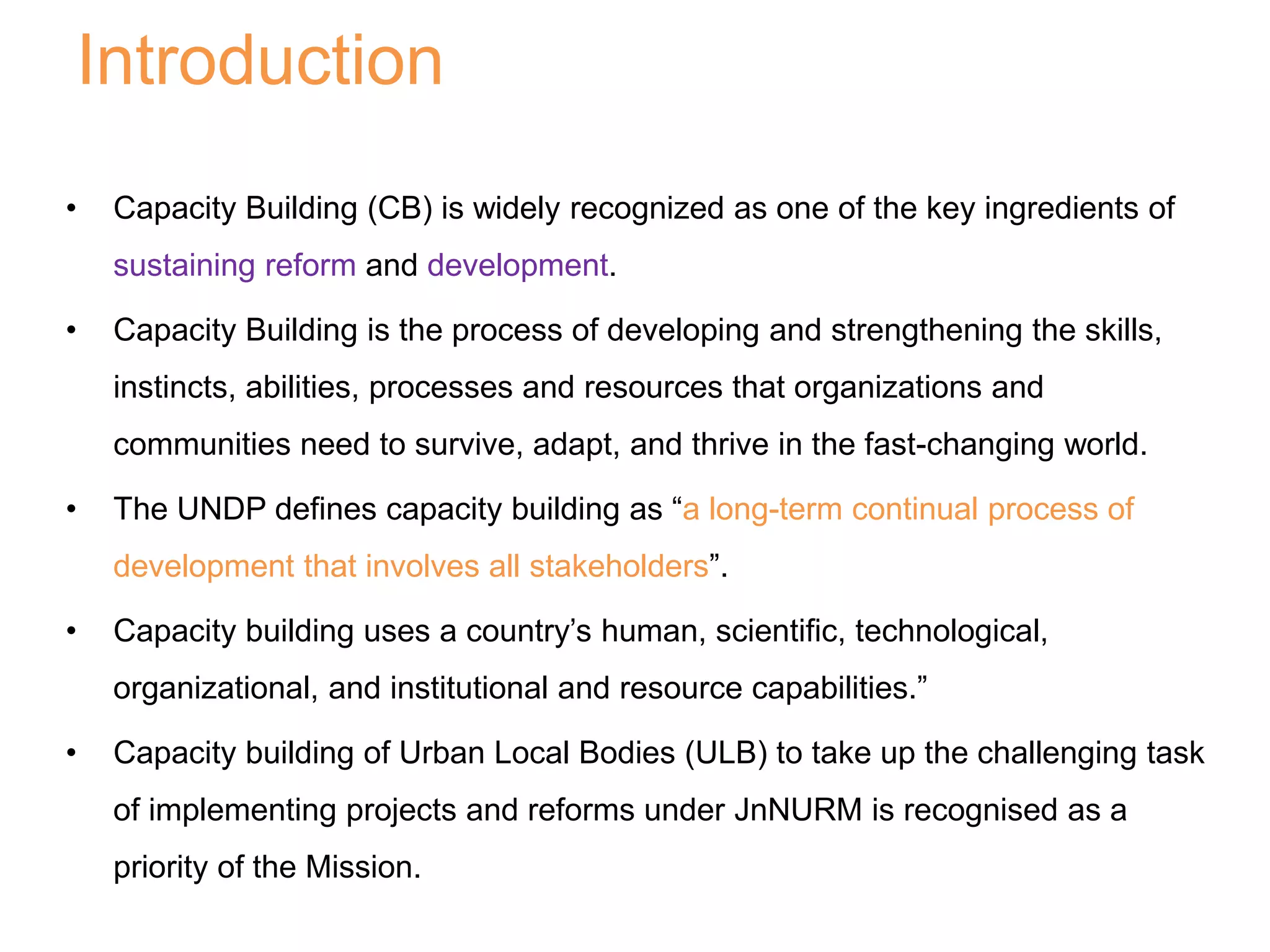
• Capacity Building (CB) is widely recognized as one of the key ingredients of
sustaining reform and development.
• Capacity Building is the process of developing and strengthening the skills,
instincts, abilities, processes and resources that organizations and
communities need to survive, adapt, and thrive in the fast-changing world.
• The UNDP defines capacity building as “a long-term continual process of
development that involves all stakeholders”.
• Capacity building uses a country’s human, scientific, technological,
organizational, and institutional and resource capabilities.”
• Capacity building of Urban Local Bodies (ULB) to take up the challenging task
of implementing projects and reforms under JnNURM is recognised as a
priority of the Mission.
Need for Capacity Building
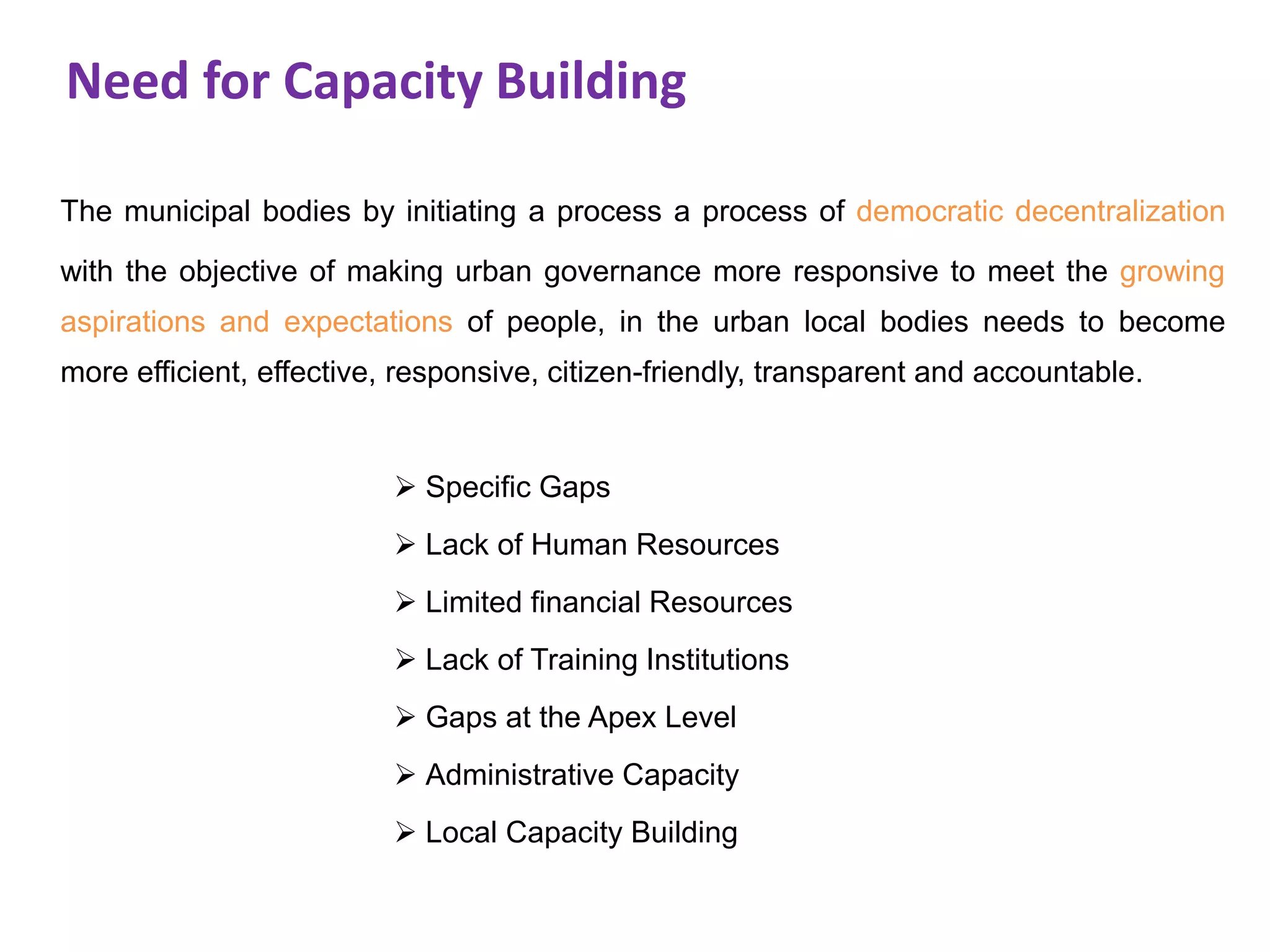
The municipal bodies by initiating a process a process of democratic decentralization
with the objective of making urban governance more responsive to meet the growing
aspirations and expectations of people, in the urban local bodies needs to become
more efficient, effective, responsive, citizen-friendly, transparent and accountable.
 Specific Gaps
 Lack of Human Resources
 Limited financial Resources
 Lack of Training Institutions
 Gaps at the Apex Level
 Administrative Capacity
 Local Capacity Building
Institutions for Capacity Building in India
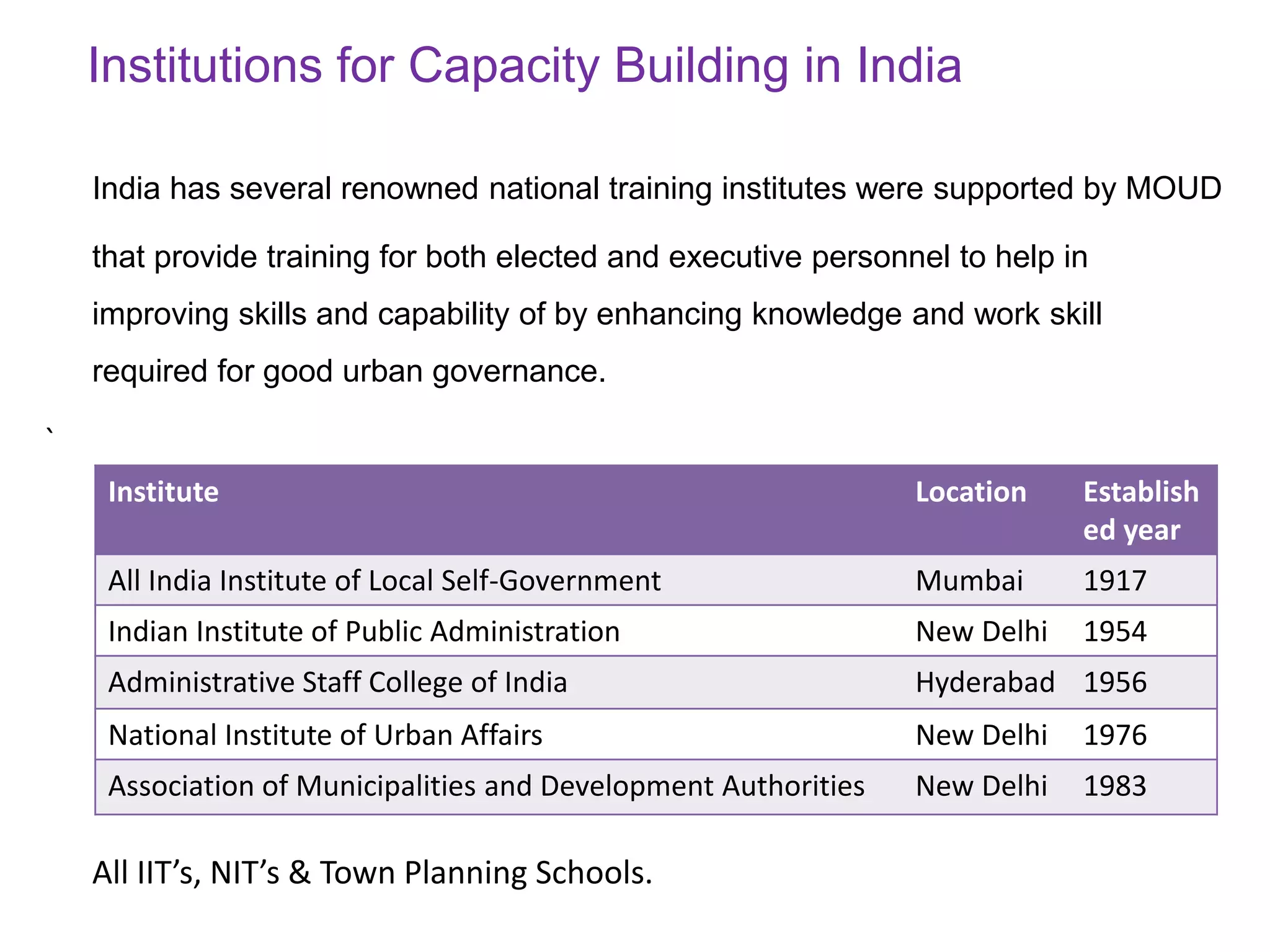
India has several renowned national training institutes were supported by MOUD
that provide training for both elected and executive personnel to help in
improving skills and capability of by enhancing knowledge and work skill
required for good urban governance.
`
All IIT’s, NIT’s & Town Planning Schools.
Institute Location Establish
ed year
All India Institute of Local Self-Government Mumbai 1917
Indian Institute of Public Administration New Delhi 1954
Administrative Staff College of India Hyderabad 1956
National Institute of Urban Affairs New Delhi 1976
Association of Municipalities and Development Authorities New Delhi 1983
Recommendations
To develop a system within the government at Center, state & ULBs levels.
Develop the infrastructure at all levels and recruit the retired persons from IAS or
State Administrative services or there could be persons on deputation from
various government departments.
Ministry should also give the work to some semi-government bodies, when Govt.
these agencies should be given work by dividing states into zones or it could be
at ULB level.
Center Level
 There should be adequate provision of budget in every government paining
policy/ programmes for capacity building and training at all levels of services.
 Promote think tank initiatives in urban policy through centers of excellence/
Innovation in existing nstitutions.
 Train officers from the IAS & other central services annually as urban
specialists and place them systematically through deputation in cities and
towns.
 Encouraging private sector participation in the context of the wide gap in the
requirement and availability of quality human resources;
 Need to give more emphasis to smaller urban areas in all central government
schemes.
State Level
 There should be a capacity building and training cell at district level which will be
responsible for organizing capacity building and training programmes headed by
an IAS.
 Government should engage more Institutes in capacity building and training
programmes of ULBs.
Private player could be appointed for the tasks on contract basis.
 Lateral hiring of professionals into the municipal cadre for fostering
professionalism.
 Build/reform municipal cadre in all states with recruitment into the cadre at entry
level through a competitive examination.
 Provide flexibility in lateral hiring of professionals with special skills into the
cadre.
Urban Local Bodies Level
• A pool of experts and specialists (engineers, planners etc.) could be mantaines
by a federation/consortium of local bodies. This common pool could be then
accessed by the local bodies whenever required for specific tasks.
• Bottoms-up approach will be followed in assessing training and capacity building
needs at the state and city levels for formulating capacity building programmes
and activities;
• Capacity building of functionaries at lower levels including multitasking building
will be given emphasis;
• Hands-on learning and exposure visits shall be integrated into programmes and
activities.
• Municipal bodies should organize at least two seminars/training programmes for
their staff with the help of state/central government or paraststal agencies.
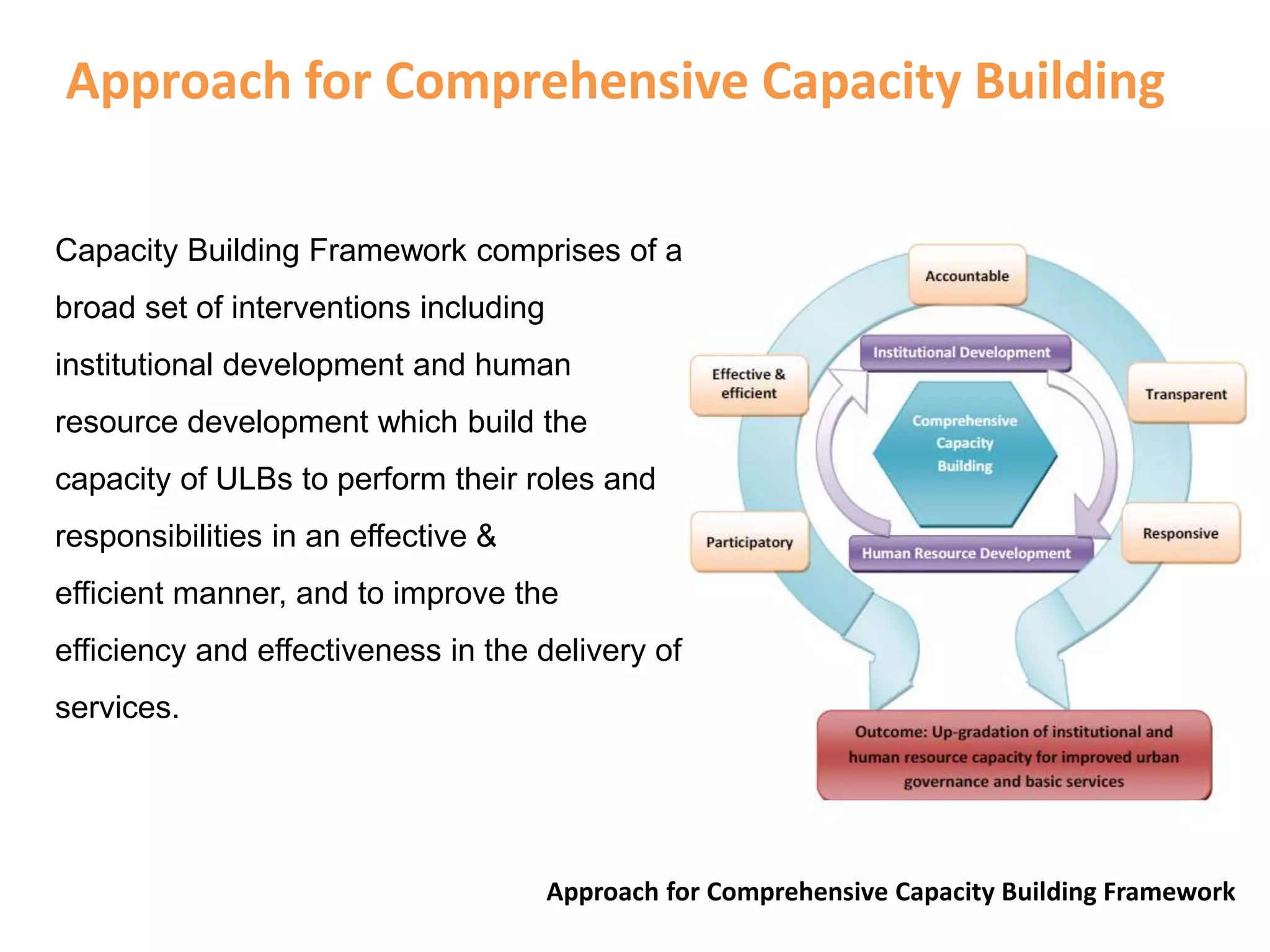
Approach for Comprehensive Capacity Building
Capacity Building Framework comprises of a
broad set of interventions including
institutional development and human
resource development which build the
capacity of ULBs to perform their roles and
responsibilities in an effective &
efficient manner, and to improve the
efficiency and effectiveness in the delivery of
services.
Approach for Comprehensive Capacity Building Framework
Objectives of Comprehensive Capacity Building
Programme
i. Develop institutional capacity for urban governance at State and ULB levels to
promote urban planning and inclusive city development.
ii. Improve human resource capacity to enhance efficiency in civic administration
for planned and inclusive spatial and socio-economic development of cities
iii. Create financially improved and self-sustaining Urban Local Bodies
iv. Implement effectively projects and reforms under JnNURM
v. Facilitate institutional arrangements and networking of training and research
institutions
vi. Develop improved procedures and systems to enhance service delivery
Challenges in Capacity Building
The capacity building challenges can be divided into institutional and human
resource challenges.
a. Institutional challenges can be tackled by
i. Accelerated Business Process Re-engineering efforts
ii. Consolidation of data on ULBs, parastatals, and their services
iii. Strengthening monitoring and evaluation systems
iv. Clear demarcation of responsibilities between ULBs and parastatals
Challenges in Capacity Building
b. Human resource challenges can be addressed by
i. By estimating and putting in place optimal manpower at all levels of Government
(Central, State and City).
ii. Enhancing professional expertise:
Limited professional expertise / subject specialists and lack of technical know-
how to implement various components under the program have resulted in
delays in addressing the challenges. This is critical to success of such a
Mission-mode time bound program.
iii. Enhancing capacity of the training institutions to scale up and deliver research,
conduct training and capacity building programmes across cities.
Rajiv Gandhi Foundation
RGF has constituted a Taskforce on Panchayat Raj which has organized a
series of National, Regional and Sub regional level workshops and brought
out several publications such as “Revitalisation of Panchyat Raj in India”,
“Voices from Below”, “Proceedings of a National Seminar on Panchayats”
and the “Road Blocks to the Institutions of Self Government”.
Some States have trained elected representatives on these lines including
Andhra Pradesh, Gujarat, Rajasthan, Kerala and Karnataka.
UNEP – Capacity Building
UNEP has implemented a series of capacity building activities in its programmes and
projects that are directly related to the goals of the MEF task force and their methods,
results and experiences could be valuable for the MEF process.
Potential for Cooperation/Synergies
• UNEP have experience in identifying capacity needs in the wind and solar sector of
specific countries (e.g. Brazil, China and South Africa) and preparing CB responses, like
e.g. trainings for government officials of energy government agencies on topics such as
resource mapping, potential applications of different technologies, energy pricing
schemes, etc.
• UNEP has an overview over experts/consultants in the area of CB for wind and solar
technologies, which could be involved in MEF activities as required
• UNEP has done a solar resource mapping and assessment for South Africa. The MEF
working group dealing with the mapping of wind and solar resources.
References:
Toolkit for comprehensive capacity building
Nagarlok

Capacity building

  • 1.
    Infrastructure Planning -II Capacity Building Submitted To: Ms. Hima Bindhu Dept. of Urban & Regional Planning
  • 2.
    Introduction • Capacity Building(CB) is widely recognized as one of the key ingredients of sustaining reform and development. • Capacity Building is the process of developing and strengthening the skills, instincts, abilities, processes and resources that organizations and communities need to survive, adapt, and thrive in the fast-changing world. • The UNDP defines capacity building as “a long-term continual process of development that involves all stakeholders”. • Capacity building uses a country’s human, scientific, technological, organizational, and institutional and resource capabilities.” • Capacity building of Urban Local Bodies (ULB) to take up the challenging task of implementing projects and reforms under JnNURM is recognised as a priority of the Mission.
  • 3.
    Need for CapacityBuilding The municipal bodies by initiating a process a process of democratic decentralization with the objective of making urban governance more responsive to meet the growing aspirations and expectations of people, in the urban local bodies needs to become more efficient, effective, responsive, citizen-friendly, transparent and accountable.  Specific Gaps  Lack of Human Resources  Limited financial Resources  Lack of Training Institutions  Gaps at the Apex Level  Administrative Capacity  Local Capacity Building
  • 4.
    Institutions for CapacityBuilding in India India has several renowned national training institutes were supported by MOUD that provide training for both elected and executive personnel to help in improving skills and capability of by enhancing knowledge and work skill required for good urban governance. ` All IIT’s, NIT’s & Town Planning Schools. Institute Location Establish ed year All India Institute of Local Self-Government Mumbai 1917 Indian Institute of Public Administration New Delhi 1954 Administrative Staff College of India Hyderabad 1956 National Institute of Urban Affairs New Delhi 1976 Association of Municipalities and Development Authorities New Delhi 1983
  • 5.
    Recommendations To develop asystem within the government at Center, state & ULBs levels. Develop the infrastructure at all levels and recruit the retired persons from IAS or State Administrative services or there could be persons on deputation from various government departments. Ministry should also give the work to some semi-government bodies, when Govt. these agencies should be given work by dividing states into zones or it could be at ULB level.
  • 6.
    Center Level  Thereshould be adequate provision of budget in every government paining policy/ programmes for capacity building and training at all levels of services.  Promote think tank initiatives in urban policy through centers of excellence/ Innovation in existing nstitutions.  Train officers from the IAS & other central services annually as urban specialists and place them systematically through deputation in cities and towns.  Encouraging private sector participation in the context of the wide gap in the requirement and availability of quality human resources;  Need to give more emphasis to smaller urban areas in all central government schemes.
  • 7.
    State Level  Thereshould be a capacity building and training cell at district level which will be responsible for organizing capacity building and training programmes headed by an IAS.  Government should engage more Institutes in capacity building and training programmes of ULBs. Private player could be appointed for the tasks on contract basis.  Lateral hiring of professionals into the municipal cadre for fostering professionalism.  Build/reform municipal cadre in all states with recruitment into the cadre at entry level through a competitive examination.  Provide flexibility in lateral hiring of professionals with special skills into the cadre.
  • 8.
    Urban Local BodiesLevel • A pool of experts and specialists (engineers, planners etc.) could be mantaines by a federation/consortium of local bodies. This common pool could be then accessed by the local bodies whenever required for specific tasks. • Bottoms-up approach will be followed in assessing training and capacity building needs at the state and city levels for formulating capacity building programmes and activities; • Capacity building of functionaries at lower levels including multitasking building will be given emphasis; • Hands-on learning and exposure visits shall be integrated into programmes and activities. • Municipal bodies should organize at least two seminars/training programmes for their staff with the help of state/central government or paraststal agencies.
  • 9.
    Approach for ComprehensiveCapacity Building Capacity Building Framework comprises of a broad set of interventions including institutional development and human resource development which build the capacity of ULBs to perform their roles and responsibilities in an effective & efficient manner, and to improve the efficiency and effectiveness in the delivery of services. Approach for Comprehensive Capacity Building Framework
  • 10.
    Objectives of ComprehensiveCapacity Building Programme i. Develop institutional capacity for urban governance at State and ULB levels to promote urban planning and inclusive city development. ii. Improve human resource capacity to enhance efficiency in civic administration for planned and inclusive spatial and socio-economic development of cities iii. Create financially improved and self-sustaining Urban Local Bodies iv. Implement effectively projects and reforms under JnNURM v. Facilitate institutional arrangements and networking of training and research institutions vi. Develop improved procedures and systems to enhance service delivery
  • 11.
    Challenges in CapacityBuilding The capacity building challenges can be divided into institutional and human resource challenges. a. Institutional challenges can be tackled by i. Accelerated Business Process Re-engineering efforts ii. Consolidation of data on ULBs, parastatals, and their services iii. Strengthening monitoring and evaluation systems iv. Clear demarcation of responsibilities between ULBs and parastatals
  • 12.
    Challenges in CapacityBuilding b. Human resource challenges can be addressed by i. By estimating and putting in place optimal manpower at all levels of Government (Central, State and City). ii. Enhancing professional expertise: Limited professional expertise / subject specialists and lack of technical know- how to implement various components under the program have resulted in delays in addressing the challenges. This is critical to success of such a Mission-mode time bound program. iii. Enhancing capacity of the training institutions to scale up and deliver research, conduct training and capacity building programmes across cities.
  • 14.
    Rajiv Gandhi Foundation RGFhas constituted a Taskforce on Panchayat Raj which has organized a series of National, Regional and Sub regional level workshops and brought out several publications such as “Revitalisation of Panchyat Raj in India”, “Voices from Below”, “Proceedings of a National Seminar on Panchayats” and the “Road Blocks to the Institutions of Self Government”. Some States have trained elected representatives on these lines including Andhra Pradesh, Gujarat, Rajasthan, Kerala and Karnataka.
  • 15.
    UNEP – CapacityBuilding UNEP has implemented a series of capacity building activities in its programmes and projects that are directly related to the goals of the MEF task force and their methods, results and experiences could be valuable for the MEF process. Potential for Cooperation/Synergies • UNEP have experience in identifying capacity needs in the wind and solar sector of specific countries (e.g. Brazil, China and South Africa) and preparing CB responses, like e.g. trainings for government officials of energy government agencies on topics such as resource mapping, potential applications of different technologies, energy pricing schemes, etc. • UNEP has an overview over experts/consultants in the area of CB for wind and solar technologies, which could be involved in MEF activities as required • UNEP has done a solar resource mapping and assessment for South Africa. The MEF working group dealing with the mapping of wind and solar resources.
  • 16.
    References: Toolkit for comprehensivecapacity building Nagarlok

Editor's Notes

  • #4 A process of acquiring new ideas and knowledge to strengthen an organization’s vision structure direction and talent and enable it to contribute to common goals.