Introduction
The term Biodiversity was first coined by Walter G. Rosen in
1986.
The biosphere comprises of a complex collections of innumerable
organisms, known as the Biodiversity, which constitute the
vital life support for survival of human race.
Biological diversity, abbreviated as biodiversity, represent the sum
total of various life forms such as unicellular fungi, protozoa,
bacteria, and multi cellular organisms such as plants, fishes,
and mammals at various biological levels including gens,
habitats, and ecosystem .
Concept of Biodiversity & its Types
• Biodiversity is the variety of life on Earth.
• For any kind of animal or plant – each
individual is not exactly the same as any other;
nor are species or ecosystems.
• Biodiversity is generally described at three
levels: genetic diversity, species diversity and
ecosystem diversity.
Types of Biodiversity
• There are three types of biodiversity:-
– Genetic Biodiversity
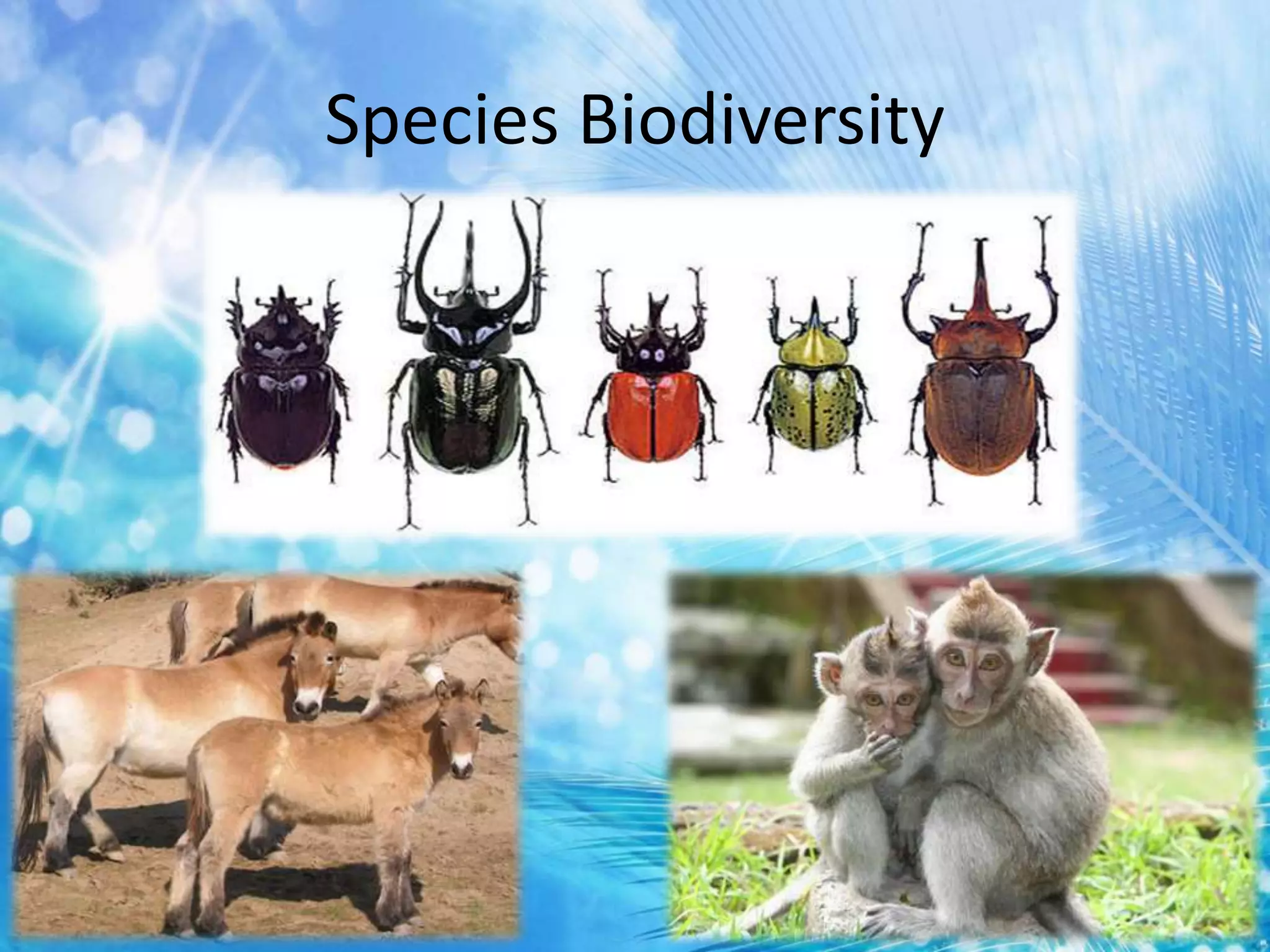
– Species Biodiversity
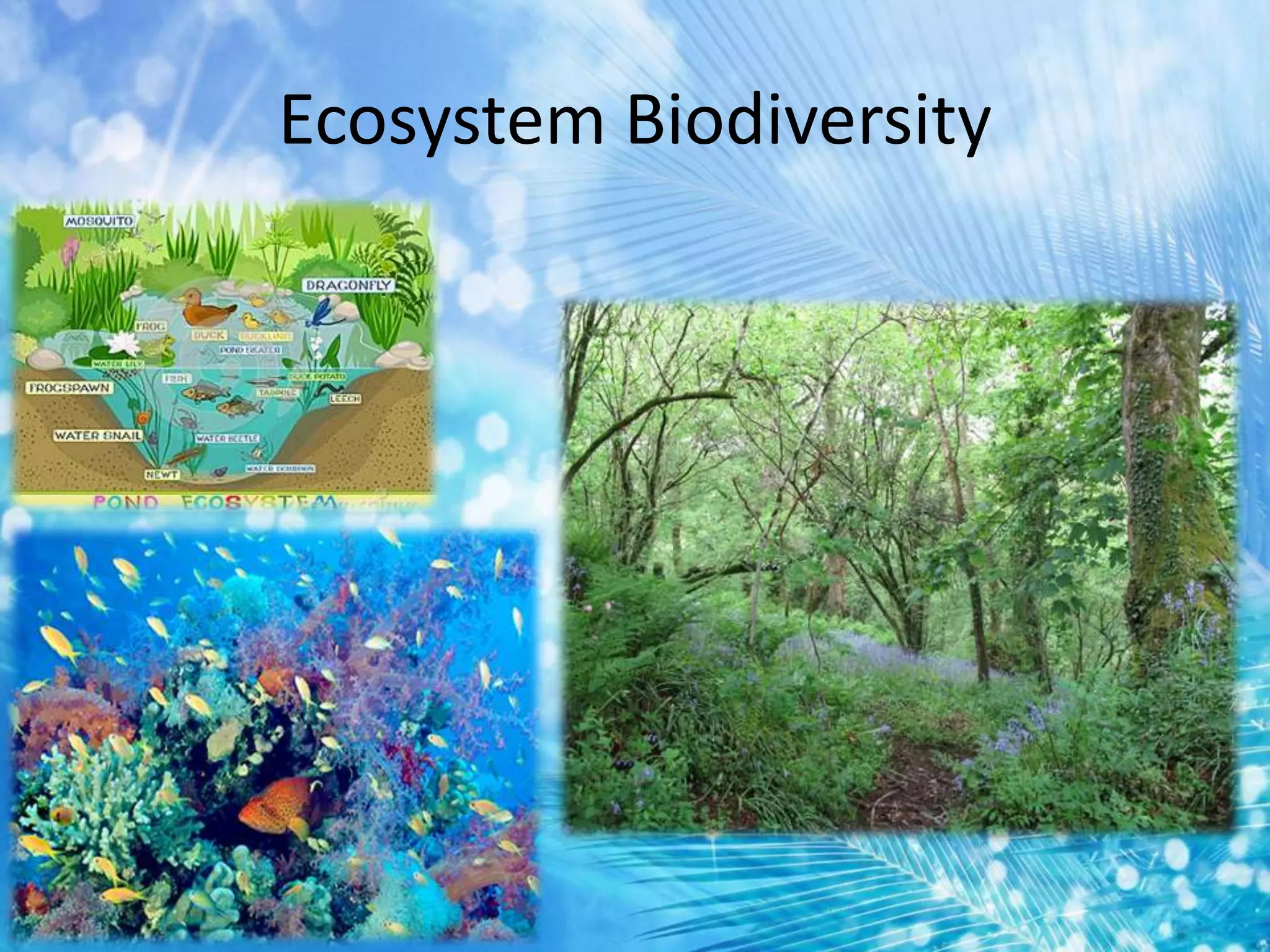
– Ecosystem Biodiversity
Genetic Biodiversity
Species Biodiversity
Ecosystem Biodiversity
Ecosystem or Habitat Biodiversity
• Ecosystem is the structural and the functional
unit of the biosphere.
• Ecosystem diversity is defined as,“ the
aggregation of various habitats, community types
and abiotic environment in a given area.”
• India has one of the biggest ecosystem diversity,
ranging from the deserts, plains, hills, mangroves,
rainforests to cold Himalayas.
Distribution of Biodiversity
• Biodiversity is not evenly distributed, rather it
varies greatly across the globe as well as
within regions.
• Terrestrial biodiversity is thought to be up to
25 times greater than ocean biodiversity.
• The study of the spatial distribution
of organisms, species and ecosystem, is the
science of biogeography.
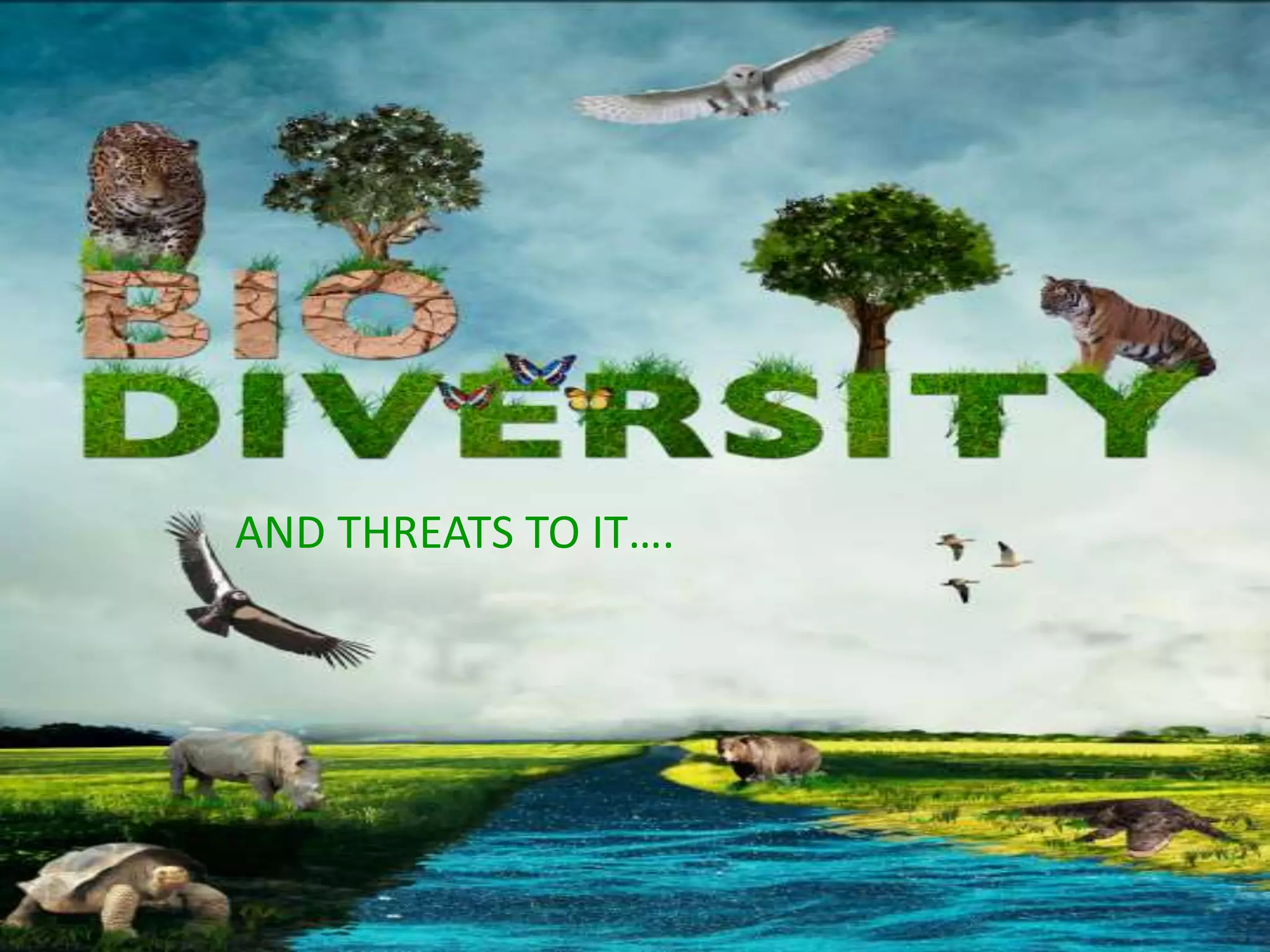
AND THREATS TO IT….
Threats to Biodiversity
• Habitat Destruction- Important to protect habitat in order to
protect biodiversity within it. Huge pressure from the World’s rapidly
increasing population.
• Global Climate Change- Change in a biotic elements of ecosystems
leading to biotic change.
• Habitat Fragmentation- From human activity. Reduces ability of
habitat to support species.
• Pollution- Introduction of pollutants such as nutrient overloading with
nitrate fertilizer as well as more immediately harmful chemicals.
• Over-Exploitation- This includes the illegal wildlife trade as well as
overfishing, logging of tropical hardwoods etc.
• Alien Species- Introduced by humans to regions where there are no
natural predators.
• Disease- Reduction in habitat causing high population densities,
encourages spread of diseases.
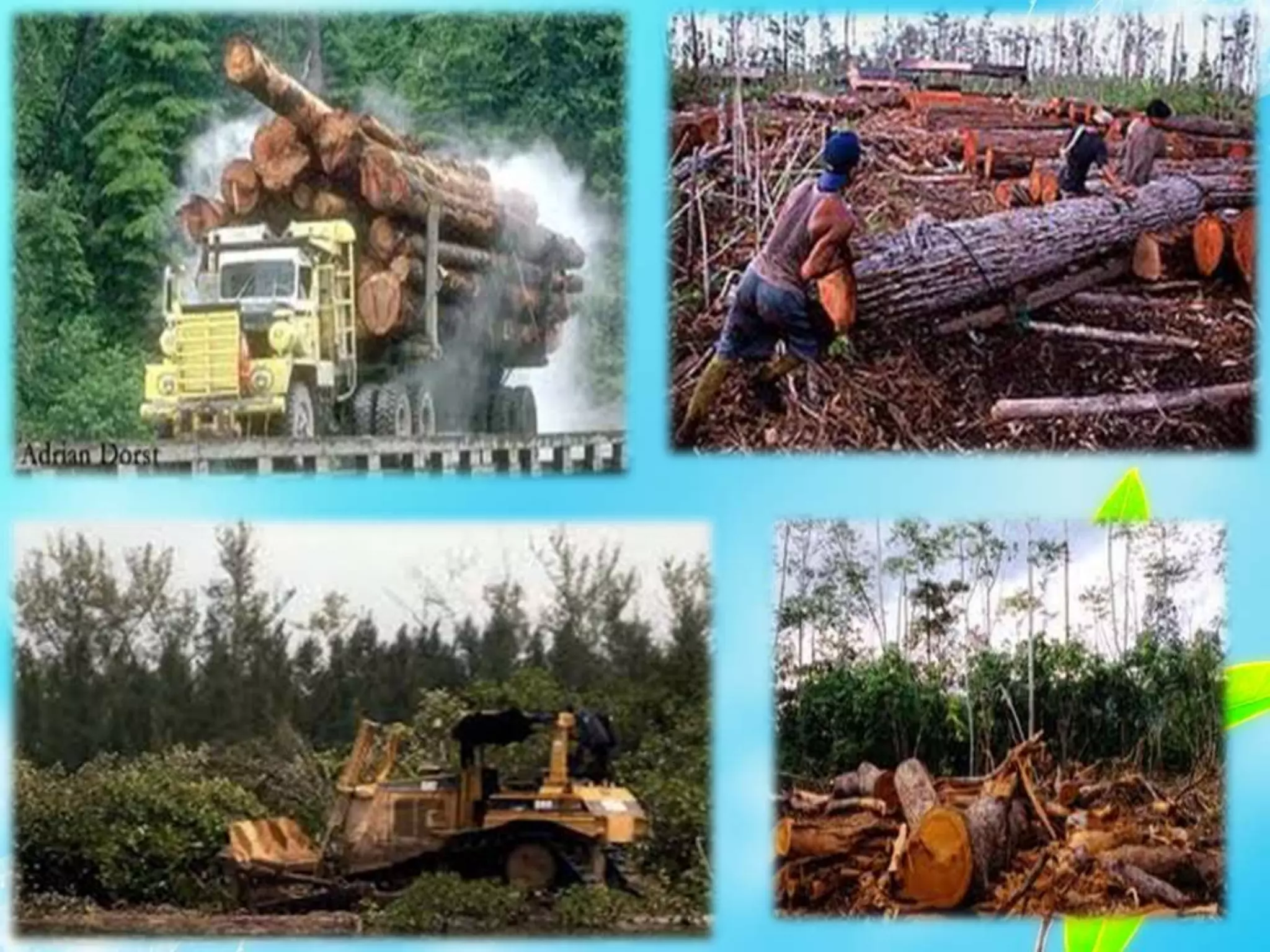
Habitat loss
Habitat loss:-
Habitat loss can be described when an animal loses their
home. Every animal in the animal kingdom has a niche, a
their in their animal community and without their habitat
they no longer have a niche.
Reasons of habitat loss by humans:
~ agriculture, farming
~ harvesting natural resources for personal use
~ for industrial and urbanization development
Habitat destruction is currently ranked as the primary
causes of species extinction world wide…!!!
Example :
The impact upon china’s panda, ones found across
the nation. Now it’s only found in fragmented and
isolated regions in the south west of the country
as a result of wide spread deforestation in the
20th century.
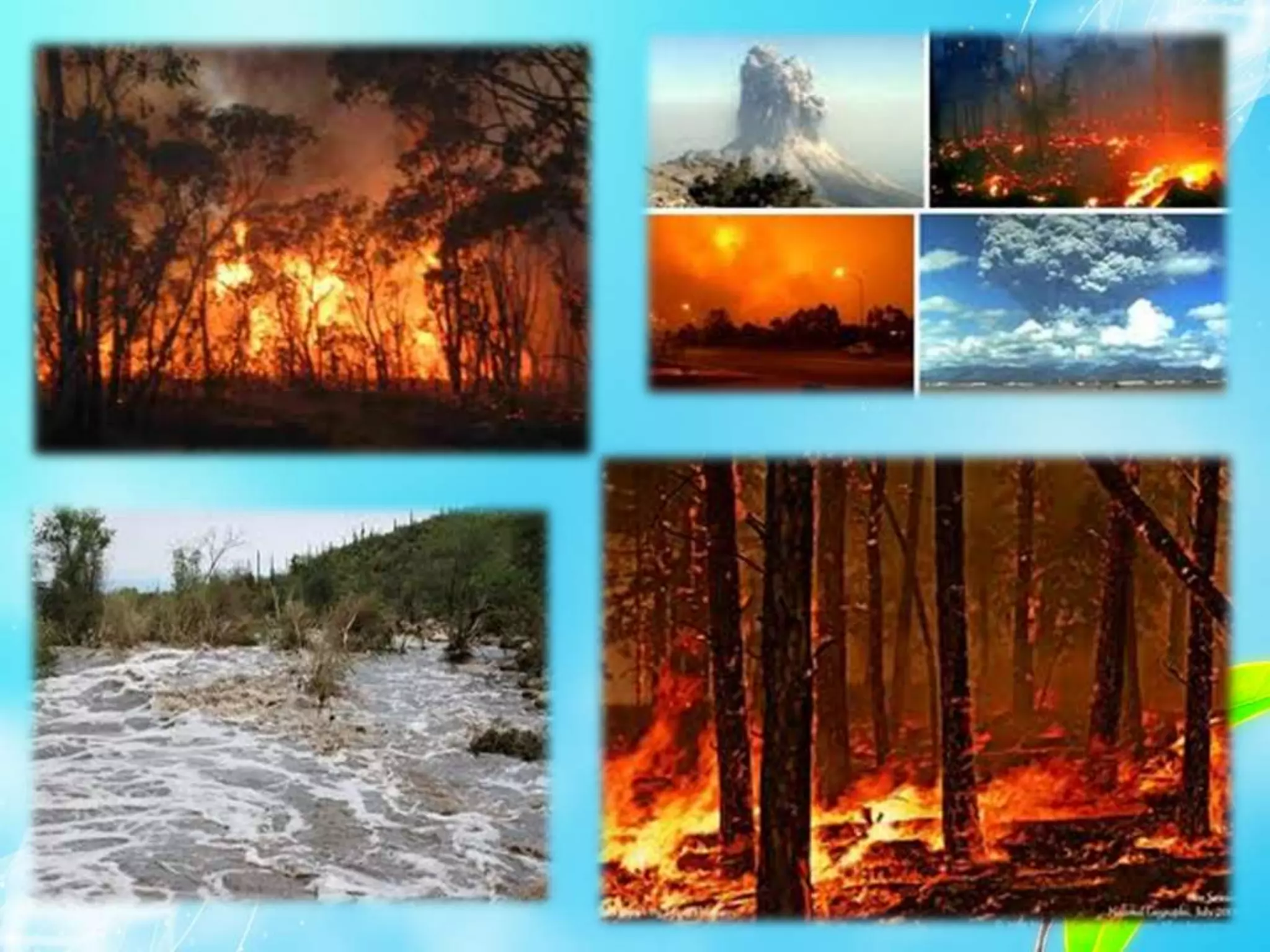
There are natural causes too..
Habitat destruction through natural processes
such as volcanism, fire and climate change is
well documented in the fossil record. One
study shows that fragmentation of tropical
rainforest in euro 3000 million years ago lead
to a great loss of amphibian diversity.
Solutions on for this..
~ Protecting remaining intact section of natural habitat.
~ Reduce human population and expansion of urbanisation
and industries.
~ Educating the public about the importance of natural
habitat and bio diversity.
~Solutions to habitat loss can include planting trees, planting
home gardens so as to reduce need for man to need large lands
for agricultural farms which lead to habitat loss.
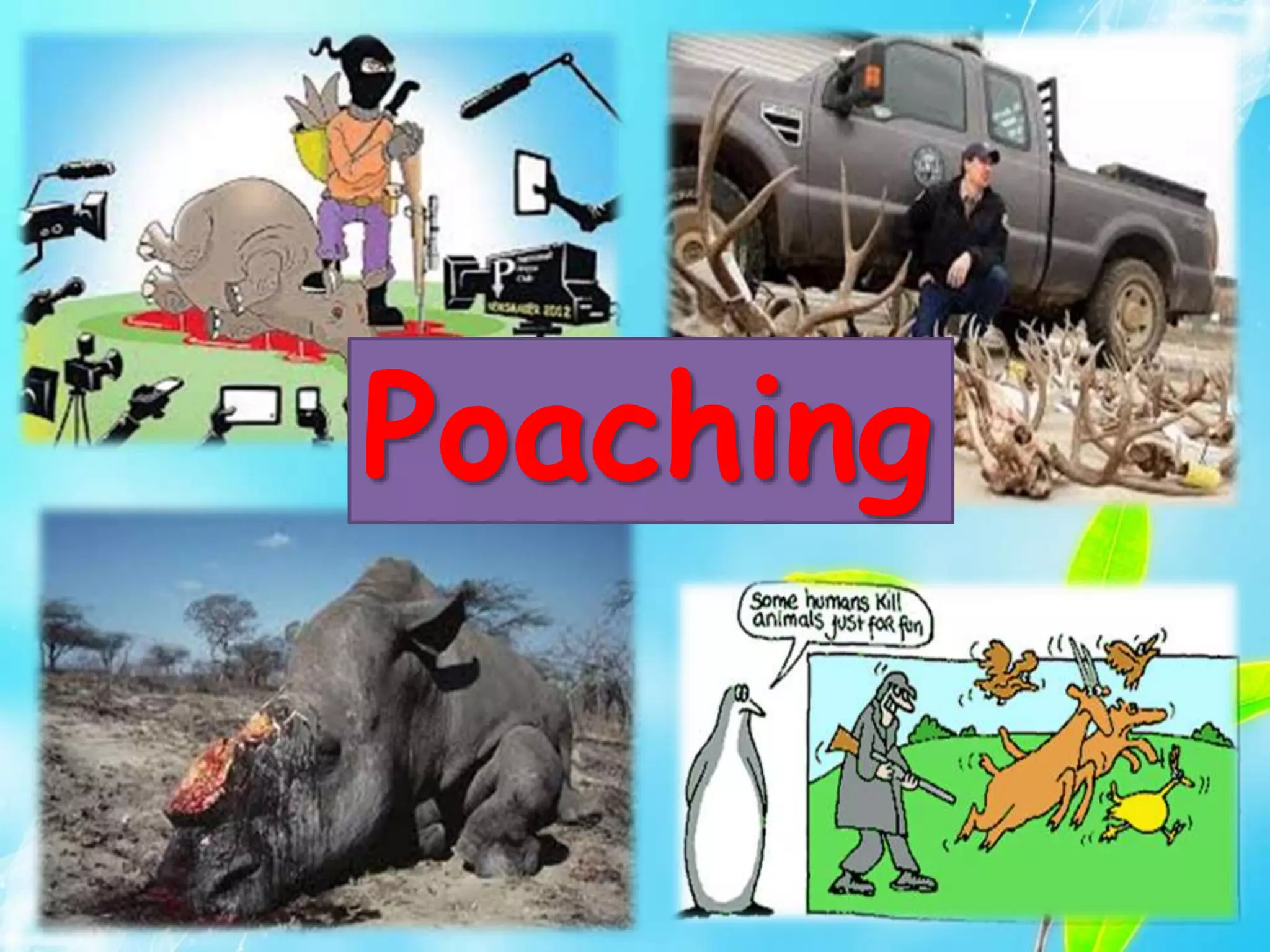
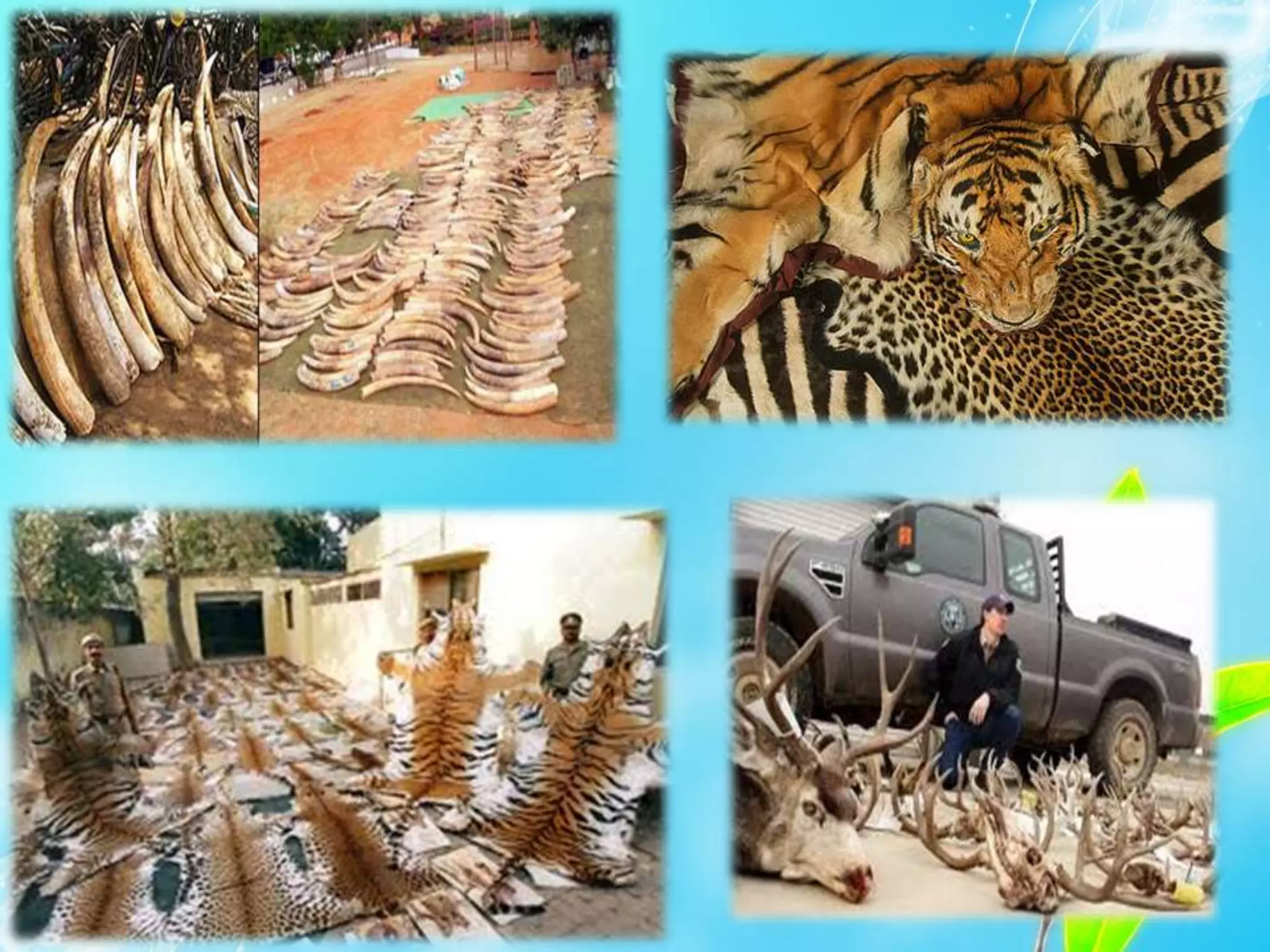
Poaching
• Poaching:-
• Poaching is the hunting and harvesting taking of
wild plants or animals, such as
through hunting, harvesting, fishing,
or trapping.
• History of poaching
• ~ Millions of years ago, in the Stone Age
• ~Followed through the ages, to even the
tribal natives
• ~but it was during the Late Middle Ages that
poaching became a punishable offense
• Why Poaching is done???
• ~ Poaching is done for large profits gained by
the illegal sale or trade of animal parts,
meat and pelts.
• ~ Exists because there is a demand for
these products, caused by a lack of
education or disregard for the law amongst
the buyers.
• ~ Many cultures believe that certain animal
parts have medicinal value.
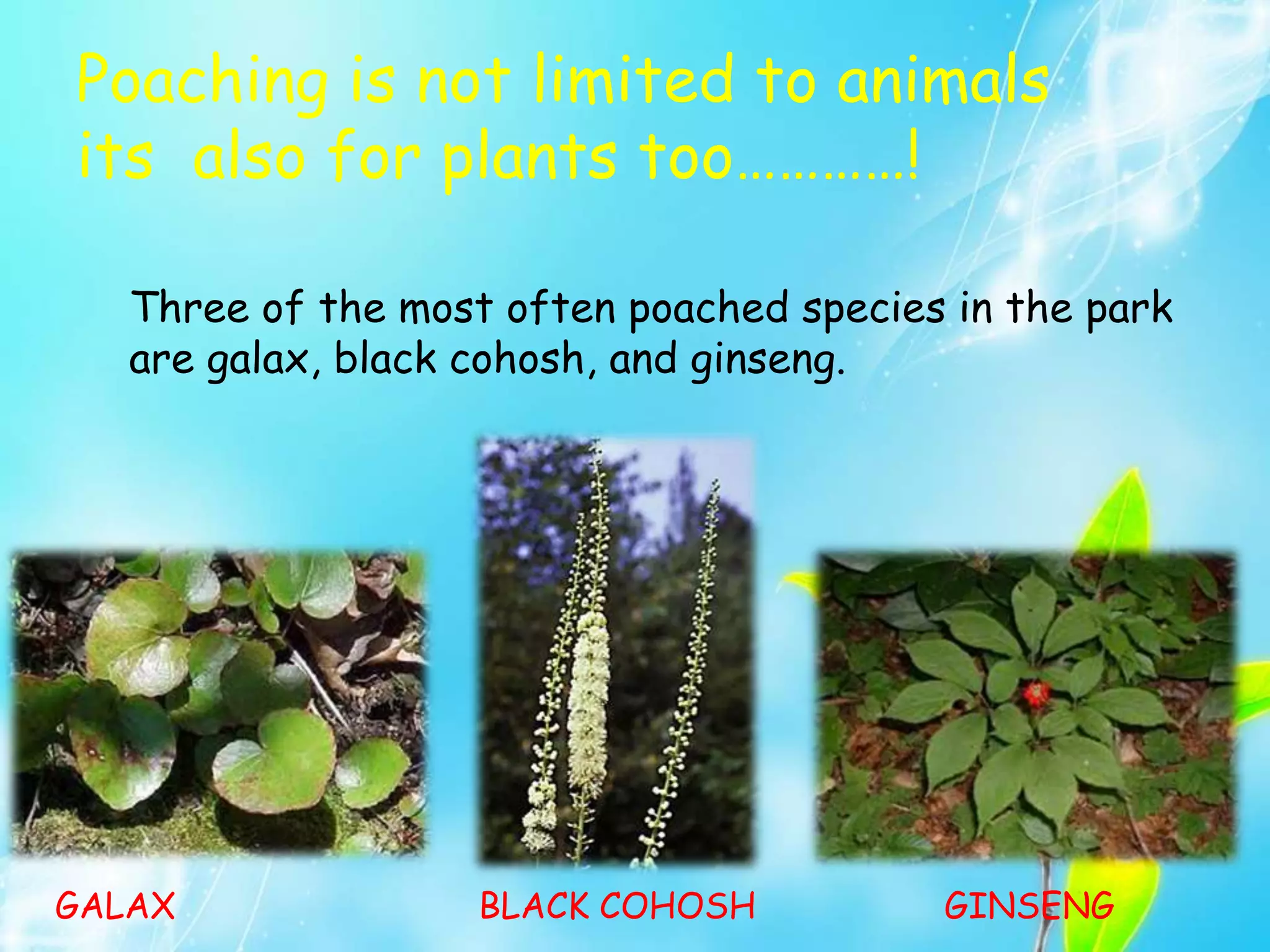
Poaching is not limited to animals
its also for plants too…………!
Three of the most often poached species in the park
are galax, black cohosh, and ginseng.
GALAX BLACK COHOSH GINSENG
• How does poaching affect the
environment?
• ~Poaching or illegal hunting causes animals
endangered of being extinct. If more
animals becomes extinct there's
a disruption in the food chain, and that will
cause major problems in our ecosystem,
resulting eventually in new adaptations of
animals, and or species beyond human
control.
• ~Poaching results in animals being hunted
too soon for them to have time to
reproduce and repopulate.
Recent Issue on Biodiversity
• Some 75% of the genetic diversity of crop plants been
lost in the past century.
• Some scientists estimate that as many as 3 species per
hour are going extinct and 20,000 extinctions occur
each year.
• Roughly one-third of the world’s coral reef systems
have been destroyed or highly degraded.
• About 24% of mammals and 12% of bird species are
currently considered to be globally threatened.
• More than 50%of the world’s wetlands have been
drained, and populations of inland water and wetland
species have declined by 50% between 1970 and 1999.
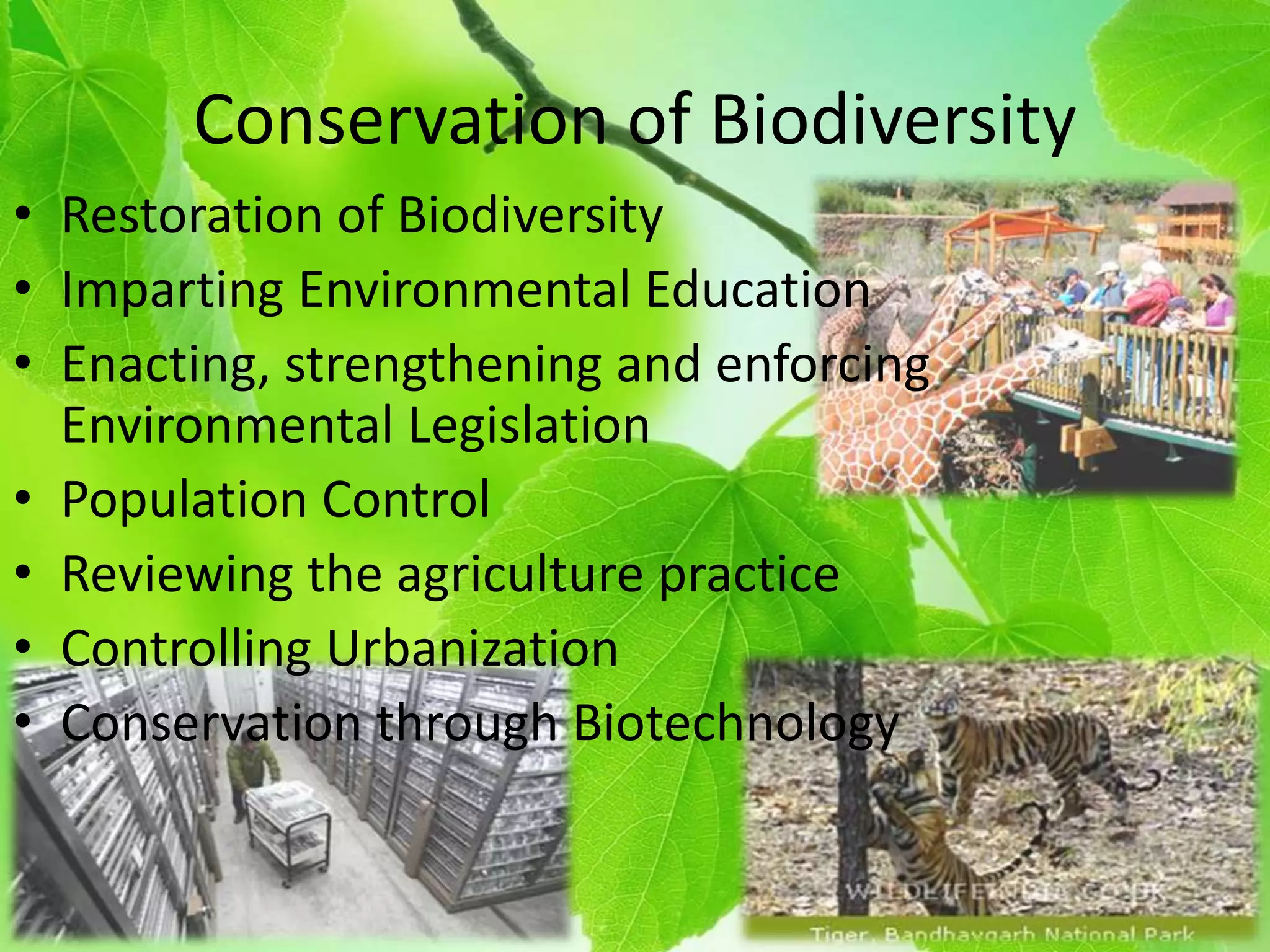
Conservation of Biodiversity
• Restoration of Biodiversity
• Imparting Environmental Education
• Enacting, strengthening and enforcing
Environmental Legislation
• Population Control
• Reviewing the agriculture practice
• Controlling Urbanization
• Conservation through Biotechnology
Biodiversity in India
Categories No. of Indian
Species
% of Indian Species
Evaluated
Species Threatened
in India
Mammals 386 59 41%
Birds 1219 - 7%
Reptiles 495 73 46%
Amphibians 207 79 57%
Freshwater Fish 700 46 70%
The Ten Biography Regions of India
• The Trans-Himalayan
• The Himalayan
• The Indian Desert
• Semi-arid Zone
• Western Ghats
• Deccan Peninsula
• The Gangetic Plain
• North East India
• The Islands
• The Coasts
• India figured with two hotspots- The Western
Ghats & The Eastern Himalayas in an
identification of 25 of the world’s biological
richest and most threatened ecosystem
• These two hotspots that extends to India are
– The western Ghats/Sri Lanka
– The Indo-Burma region ( covering the Eastern
Himalayas)
• And they are included amongst the top eight
most important hotspots.
• The are the areas with higher concentration of
endemic species and which usually experience
rapid rate of habitat modification and loss.
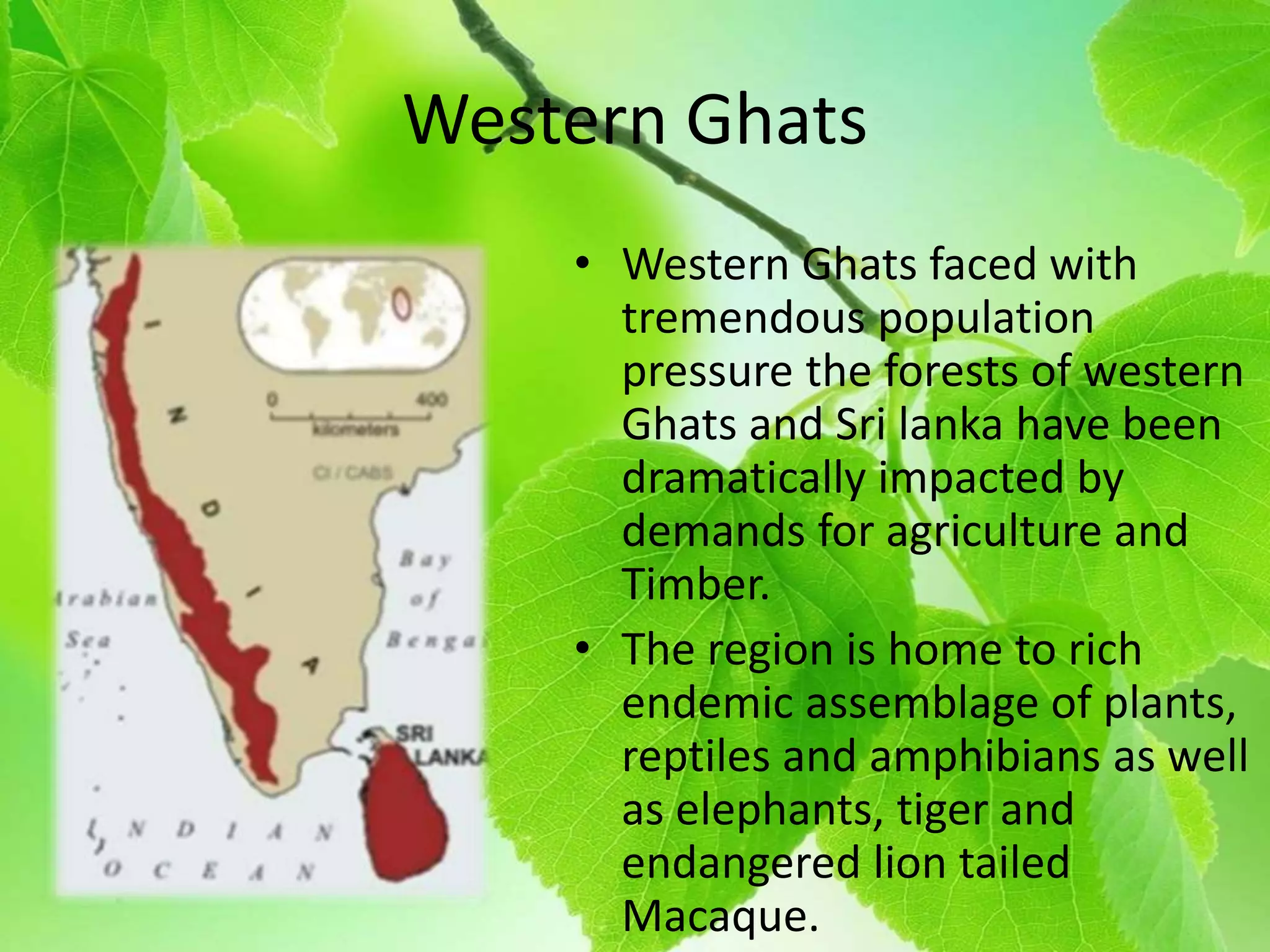
Western Ghats
• Western Ghats faced with
tremendous population
pressure the forests of western
Ghats and Sri lanka have been
dramatically impacted by
demands for agriculture and
Timber.
• The region is home to rich
endemic assemblage of plants,
reptiles and amphibians as well
as elephants, tiger and
endangered lion tailed
Macaque.
The Eastern Himalayas
• Himalayas is the home to world’s highest mountains,
including Mt. Everest. Abrupt rise in rise of mountains
results in diversity of ecosystems that range from
alluvial grasslands and subtropical broad leaved forests
to alpine meadows above the tree line. It’s a home to
variety of large birds, mammals including tiger,
elephants, rhinos and wild water buffaloes.
Biodiversity in Maharashtra
• Flora of Maharashtra is heterogeneous in
composition.
• In 2012 the recorded thick forest area in the state
was 61,939 km2(23,915 sq mi) which was about
20.13% of the state's geographical area.
• There are three main Public Forestry Institutions
(PFIs) in the Maharashtra state: the Maharashtra
Forest Department (MFD), the Forest
Development Corporation of Maharashtra
(FDCM) and the Directorate of Social Forestry
(SFD).
Convention on biodiversity
• The Convention on Biological Diversity (CBD),
known informally as the Biodiversity Convention, is
a multilateral treaty. The Convention has three main
goals:
– conservation of biological diversity
(or biodiversity);
– sustainable use of its components; and
– fair and equitable sharing of benefits arising
from genetic resources
Conclusion
• Biodiversity is a concept that has no general
definition. Usually it is used in a context that
stresses the need for attention on our living
environment and the sustainable use of
natural resources.
• Biodiversity can be divided in different types
such as habitat, species and genetic diversity.
• The integrated approach used in coastal zone
management is an adequate method in
dealing with the matter of biodiversity.
Presentation of biodiversity

Presentation of biodiversity

  • 2.
    Introduction The term Biodiversitywas first coined by Walter G. Rosen in 1986. The biosphere comprises of a complex collections of innumerable organisms, known as the Biodiversity, which constitute the vital life support for survival of human race. Biological diversity, abbreviated as biodiversity, represent the sum total of various life forms such as unicellular fungi, protozoa, bacteria, and multi cellular organisms such as plants, fishes, and mammals at various biological levels including gens, habitats, and ecosystem .
  • 3.
    Concept of Biodiversity& its Types • Biodiversity is the variety of life on Earth. • For any kind of animal or plant – each individual is not exactly the same as any other; nor are species or ecosystems. • Biodiversity is generally described at three levels: genetic diversity, species diversity and ecosystem diversity.
  • 4.
    Types of Biodiversity •There are three types of biodiversity:- – Genetic Biodiversity – Species Biodiversity – Ecosystem Biodiversity
  • 5.
  • 6.
  • 7.
  • 8.
    Ecosystem or HabitatBiodiversity • Ecosystem is the structural and the functional unit of the biosphere. • Ecosystem diversity is defined as,“ the aggregation of various habitats, community types and abiotic environment in a given area.” • India has one of the biggest ecosystem diversity, ranging from the deserts, plains, hills, mangroves, rainforests to cold Himalayas.
  • 9.
    Distribution of Biodiversity •Biodiversity is not evenly distributed, rather it varies greatly across the globe as well as within regions. • Terrestrial biodiversity is thought to be up to 25 times greater than ocean biodiversity. • The study of the spatial distribution of organisms, species and ecosystem, is the science of biogeography.
  • 10.
  • 11.
    Threats to Biodiversity •Habitat Destruction- Important to protect habitat in order to protect biodiversity within it. Huge pressure from the World’s rapidly increasing population. • Global Climate Change- Change in a biotic elements of ecosystems leading to biotic change. • Habitat Fragmentation- From human activity. Reduces ability of habitat to support species. • Pollution- Introduction of pollutants such as nutrient overloading with nitrate fertilizer as well as more immediately harmful chemicals. • Over-Exploitation- This includes the illegal wildlife trade as well as overfishing, logging of tropical hardwoods etc. • Alien Species- Introduced by humans to regions where there are no natural predators. • Disease- Reduction in habitat causing high population densities, encourages spread of diseases.
  • 12.
  • 14.
    Habitat loss:- Habitat losscan be described when an animal loses their home. Every animal in the animal kingdom has a niche, a their in their animal community and without their habitat they no longer have a niche. Reasons of habitat loss by humans: ~ agriculture, farming ~ harvesting natural resources for personal use ~ for industrial and urbanization development Habitat destruction is currently ranked as the primary causes of species extinction world wide…!!!
  • 15.
    Example : The impactupon china’s panda, ones found across the nation. Now it’s only found in fragmented and isolated regions in the south west of the country as a result of wide spread deforestation in the 20th century. There are natural causes too.. Habitat destruction through natural processes such as volcanism, fire and climate change is well documented in the fossil record. One study shows that fragmentation of tropical rainforest in euro 3000 million years ago lead to a great loss of amphibian diversity.
  • 17.
    Solutions on forthis.. ~ Protecting remaining intact section of natural habitat. ~ Reduce human population and expansion of urbanisation and industries. ~ Educating the public about the importance of natural habitat and bio diversity. ~Solutions to habitat loss can include planting trees, planting home gardens so as to reduce need for man to need large lands for agricultural farms which lead to habitat loss.
  • 18.
  • 19.
    • Poaching:- • Poachingis the hunting and harvesting taking of wild plants or animals, such as through hunting, harvesting, fishing, or trapping. • History of poaching • ~ Millions of years ago, in the Stone Age • ~Followed through the ages, to even the tribal natives • ~but it was during the Late Middle Ages that poaching became a punishable offense
  • 21.
    • Why Poachingis done??? • ~ Poaching is done for large profits gained by the illegal sale or trade of animal parts, meat and pelts. • ~ Exists because there is a demand for these products, caused by a lack of education or disregard for the law amongst the buyers. • ~ Many cultures believe that certain animal parts have medicinal value.
  • 22.
    Poaching is notlimited to animals its also for plants too…………! Three of the most often poached species in the park are galax, black cohosh, and ginseng. GALAX BLACK COHOSH GINSENG
  • 23.
    • How doespoaching affect the environment? • ~Poaching or illegal hunting causes animals endangered of being extinct. If more animals becomes extinct there's a disruption in the food chain, and that will cause major problems in our ecosystem, resulting eventually in new adaptations of animals, and or species beyond human control. • ~Poaching results in animals being hunted too soon for them to have time to reproduce and repopulate.
  • 24.
    Recent Issue onBiodiversity • Some 75% of the genetic diversity of crop plants been lost in the past century. • Some scientists estimate that as many as 3 species per hour are going extinct and 20,000 extinctions occur each year. • Roughly one-third of the world’s coral reef systems have been destroyed or highly degraded. • About 24% of mammals and 12% of bird species are currently considered to be globally threatened. • More than 50%of the world’s wetlands have been drained, and populations of inland water and wetland species have declined by 50% between 1970 and 1999.
  • 25.
    Conservation of Biodiversity •Restoration of Biodiversity • Imparting Environmental Education • Enacting, strengthening and enforcing Environmental Legislation • Population Control • Reviewing the agriculture practice • Controlling Urbanization • Conservation through Biotechnology
  • 26.
    Biodiversity in India CategoriesNo. of Indian Species % of Indian Species Evaluated Species Threatened in India Mammals 386 59 41% Birds 1219 - 7% Reptiles 495 73 46% Amphibians 207 79 57% Freshwater Fish 700 46 70%
  • 27.
    The Ten BiographyRegions of India • The Trans-Himalayan • The Himalayan • The Indian Desert • Semi-arid Zone • Western Ghats • Deccan Peninsula • The Gangetic Plain • North East India • The Islands • The Coasts
  • 28.
    • India figuredwith two hotspots- The Western Ghats & The Eastern Himalayas in an identification of 25 of the world’s biological richest and most threatened ecosystem • These two hotspots that extends to India are – The western Ghats/Sri Lanka – The Indo-Burma region ( covering the Eastern Himalayas) • And they are included amongst the top eight most important hotspots. • The are the areas with higher concentration of endemic species and which usually experience rapid rate of habitat modification and loss.
  • 29.
    Western Ghats • WesternGhats faced with tremendous population pressure the forests of western Ghats and Sri lanka have been dramatically impacted by demands for agriculture and Timber. • The region is home to rich endemic assemblage of plants, reptiles and amphibians as well as elephants, tiger and endangered lion tailed Macaque.
  • 30.
    The Eastern Himalayas •Himalayas is the home to world’s highest mountains, including Mt. Everest. Abrupt rise in rise of mountains results in diversity of ecosystems that range from alluvial grasslands and subtropical broad leaved forests to alpine meadows above the tree line. It’s a home to variety of large birds, mammals including tiger, elephants, rhinos and wild water buffaloes.
  • 31.
    Biodiversity in Maharashtra •Flora of Maharashtra is heterogeneous in composition. • In 2012 the recorded thick forest area in the state was 61,939 km2(23,915 sq mi) which was about 20.13% of the state's geographical area. • There are three main Public Forestry Institutions (PFIs) in the Maharashtra state: the Maharashtra Forest Department (MFD), the Forest Development Corporation of Maharashtra (FDCM) and the Directorate of Social Forestry (SFD).
  • 32.
    Convention on biodiversity •The Convention on Biological Diversity (CBD), known informally as the Biodiversity Convention, is a multilateral treaty. The Convention has three main goals: – conservation of biological diversity (or biodiversity); – sustainable use of its components; and – fair and equitable sharing of benefits arising from genetic resources
  • 33.
    Conclusion • Biodiversity isa concept that has no general definition. Usually it is used in a context that stresses the need for attention on our living environment and the sustainable use of natural resources. • Biodiversity can be divided in different types such as habitat, species and genetic diversity. • The integrated approach used in coastal zone management is an adequate method in dealing with the matter of biodiversity.