General Chemistry
Principles and Modern Applications
   Petrucci • Harwood • Herring
             8th Edition


Chapter 10: The Periodic Table
 and Some Atomic Properties
                   Philip Dutton
          University of Windsor, Canada

              Prentice-Hall © 2002
Contents
10-1 Classifying the Elements: The Periodic Law
     and the Periodic Table
10-2 Metals and Nonmetals and Their Ions
10-3 The Sizes of Atoms and Ions
10-4 Ionization Energy
10-5 Electron Affinity
10-6 Magnetic Properties
10-7 Periodic Properties of the Elements
     Focus on The Periodic Law and Mercury

Prentice-Hall   General Chemistry: ChapterSlide 2 of 35
                                           10
10-1 Classifying the Elements: The
   Periodic Law and the Periodic Table


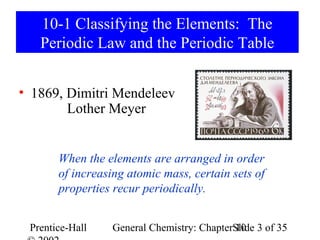
• 1869, Dimitri Mendeleev
        Lother Meyer


       When the elements are arranged in order
       of increasing atomic mass, certain sets of
       properties recur periodically.


 Prentice-Hall   General Chemistry: ChapterSlide 3 of 35
                                            10
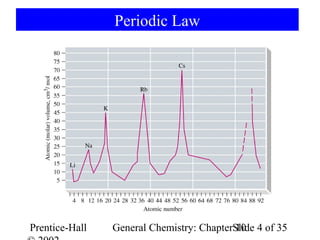
Periodic Law


Prentice-Hall   General Chemistry: ChapterSlide 4 of 35
                                           10
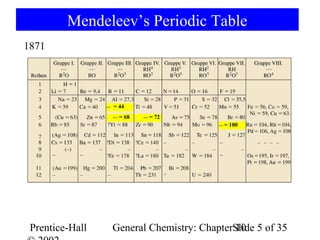
Mendeleev’s Periodic Table
1871


                 —   = 44
                     —   = 68   —   = 72
                                            —=   100


 Prentice-Hall       General Chemistry: ChapterSlide 5 of 35
                                                10
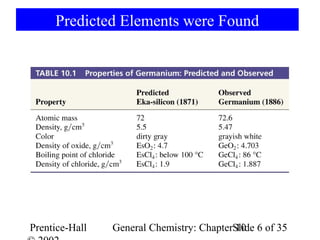
Predicted Elements were Found


Prentice-Hall   General Chemistry: ChapterSlide 6 of 35
                                           10
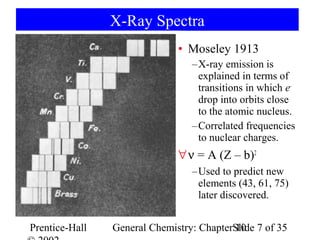
X-Ray Spectra
                              • Moseley 1913
                                 –X-ray emission is
                                  explained in terms of
                                  transitions in which e-
                                  drop into orbits close
                                  to the atomic nucleus.
                                 –Correlated frequencies
                                  to nuclear charges.
                              ∀ν = A (Z – b)2
                                 –Used to predict new
                                  elements (43, 61, 75)
                                  later discovered.


Prentice-Hall   General Chemistry: ChapterSlide 7 of 35
                                           10
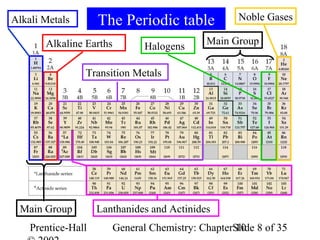
Alkali Metals       The Periodic table               Noble Gases

       Alkaline Earths                       Main Group
                                Halogens

                Transition Metals


 Main Group         Lanthanides and Actinides
    Prentice-Hall        General Chemistry: ChapterSlide 8 of 35
                                                    10
10-2 Metals and Nonmetals and Their Ions

 • Metals
    – Good conductors of heat and electricity.
    – Malleable and ductile.
    – Moderate to high melting points.
 • Nonmetals
    – Nonconductors of heat and electricity.
    – Brittle solids.
    – Some are gases at room temperature.


 Prentice-Hall   General Chemistry: ChapterSlide 9 of 35
                                            10
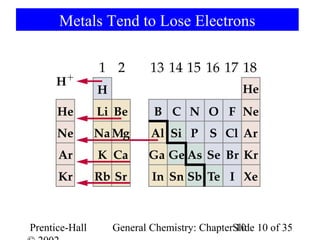
Metals Tend to Lose Electrons


Prentice-Hall   General Chemistry: ChapterSlide 10 of 35
                                           10
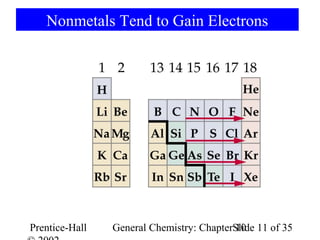
Nonmetals Tend to Gain Electrons


Prentice-Hall   General Chemistry: ChapterSlide 11 of 35
                                           10
Electron Configuration of Some Ions


Prentice-Hall   General Chemistry: ChapterSlide 12 of 35
                                           10
10-3 The Sizes of Atoms and Ions


Prentice-Hall   General Chemistry: ChapterSlide 13 of 35
                                           10
Atomic Radius


Prentice-Hall   General Chemistry: ChapterSlide 14 of 35
                                           10
Screening and Penetration


                                     Zeff = Z – S


                                              Zeff2
                                     En = - RH n2


Prentice-Hall   General Chemistry: ChapterSlide 15 of 35
                                           10
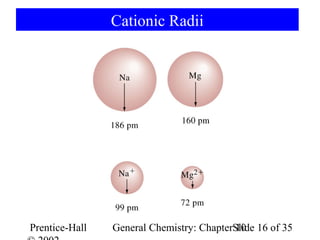
Cationic Radii


Prentice-Hall   General Chemistry: ChapterSlide 16 of 35
                                           10
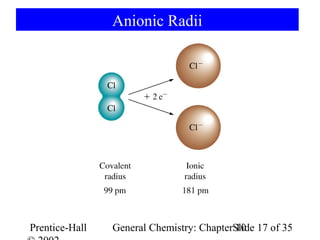
Anionic Radii


Prentice-Hall   General Chemistry: ChapterSlide 17 of 35
                                           10
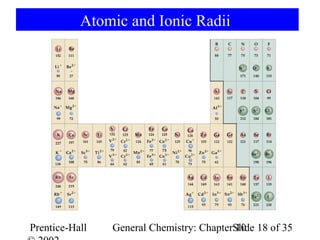
Atomic and Ionic Radii


Prentice-Hall   General Chemistry: ChapterSlide 18 of 35
                                           10
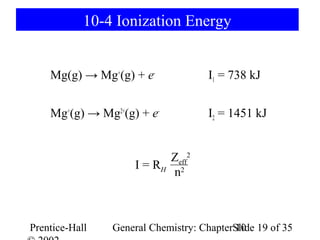
10-4 Ionization Energy


    Mg(g) → Mg+(g) + e-              I1 = 738 kJ


    Mg+(g) → Mg2+(g) + e-            I2 = 1451 kJ


                           Zeff2
                     I = RH 2
                            n


Prentice-Hall   General Chemistry: ChapterSlide 19 of 35
                                           10
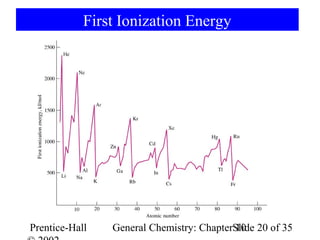
First Ionization Energy


Prentice-Hall   General Chemistry: ChapterSlide 20 of 35
                                           10
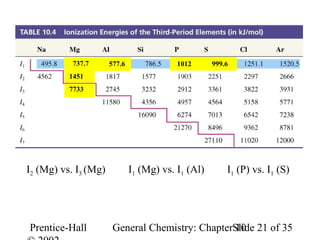
Table 10.4 Ionization Energies of the
   Third-Period Elements (in kJ/mol)
           737.7      577.6               1012      999.6
          1451
          7733


I2 (Mg) vs. I3 (Mg)           I1 (Mg) vs. I1 (Al)       I1 (P) vs. I1 (S)


Prentice-Hall          General Chemistry: ChapterSlide 21 of 35
                                                  10
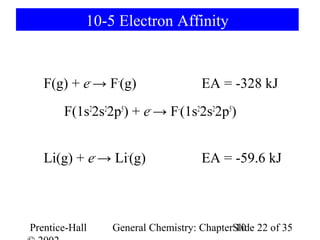
10-5 Electron Affinity


   F(g) + e- → F-(g)               EA = -328 kJ
       F(1s22s22p5) + e- → F-(1s22s22p5)


   Li(g) + e- → Li-(g)             EA = -59.6 kJ


Prentice-Hall   General Chemistry: ChapterSlide 22 of 35
                                           10
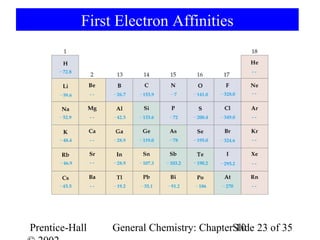
First Electron Affinities


Prentice-Hall   General Chemistry: ChapterSlide 23 of 35
                                           10
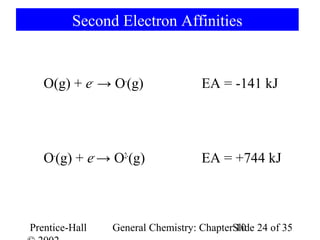
Second Electron Affinities


   O(g) + e- → O-(g)               EA = -141 kJ


   O-(g) + e- → O2-(g)             EA = +744 kJ


Prentice-Hall   General Chemistry: ChapterSlide 24 of 35
                                           10
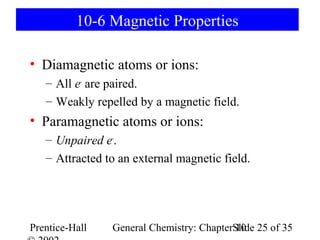
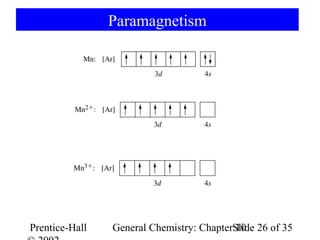
10-6 Magnetic Properties

• Diamagnetic atoms or ions:
   – All e- are paired.
   – Weakly repelled by a magnetic field.
• Paramagnetic atoms or ions:
   – Unpaired e-.
   – Attracted to an external magnetic field.


Prentice-Hall   General Chemistry: ChapterSlide 25 of 35
                                           10
Paramagnetism


Prentice-Hall   General Chemistry: ChapterSlide 26 of 35
                                           10
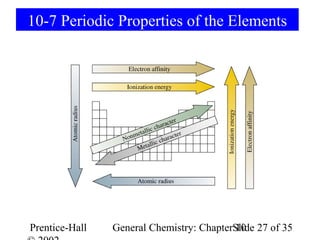
10-7 Periodic Properties of the Elements


Prentice-Hall   General Chemistry: ChapterSlide 27 of 35
                                           10
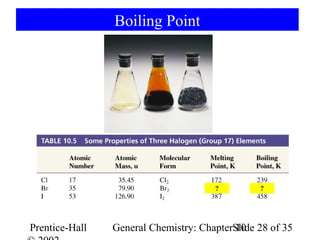
Boiling Point


                                       ?
                                      266        ?
                                                332


Prentice-Hall   General Chemistry: ChapterSlide 28 of 35
                                           10
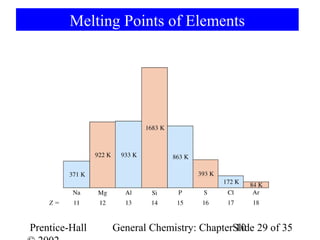
Melting Points of Elements


Prentice-Hall   General Chemistry: ChapterSlide 29 of 35
                                           10
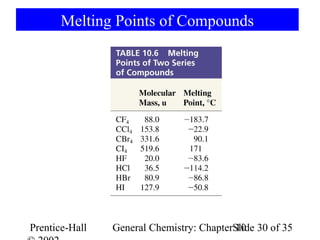
Melting Points of Compounds


Prentice-Hall   General Chemistry: ChapterSlide 30 of 35
                                           10
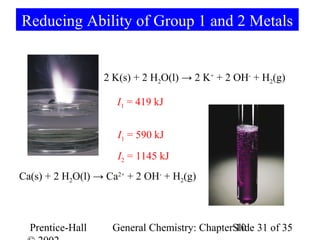
Reducing Ability of Group 1 and 2 Metals


                  2 K(s) + 2 H2O(l) → 2 K+ + 2 OH- + H2(g)

                     I1 = 419 kJ


                     I1 = 590 kJ
                     I2 = 1145 kJ
Ca(s) + 2 H2O(l) → Ca2+ + 2 OH- + H2(g)


  Prentice-Hall     General Chemistry: ChapterSlide 31 of 35
                                               10
Oxidizing Abilities of the Halogens


                2 Na + Cl2 → 2 NaCl


                Cl2 + 2 I- → 2 Cl- + I2


Prentice-Hall   General Chemistry: ChapterSlide 32 of 35
                                           10
Acid Base Nature of Element Oxides
• Basic oxides or base anhydrides:
      Li2O(s) + H2O(l) → 2 Li+(aq) + 2 OH-(aq)


• Acidic oxides or acid anhyhydrides:
      SO2 (g) + H2O(l) → H2SO3(aq)


• Na2O and MgO yield basic solutions
• Cl2O, SO2 and P4O10 yield acidic solutions
• SiO2 dissolves in strong base, acidic oxide.

Prentice-Hall     General Chemistry: ChapterSlide 33 of 35
                                             10
Focus on The Periodic Law and Mercury


• Should be a solid.

• Relativistic shrinking
  of s-orbitals affects all
  heavy metals but is
  maximum with Hg.


Prentice-Hall     General Chemistry: ChapterSlide 34 of 35
                                             10
Chapter 10 Questions


                1, 2, 18, 21, 27,
                33, 39, 43, 51,
                55


Prentice-Hall      General Chemistry: ChapterSlide 35 of 35
                                              10

Ch10

  • 1.
    General Chemistry Principles andModern Applications Petrucci • Harwood • Herring 8th Edition Chapter 10: The Periodic Table and Some Atomic Properties Philip Dutton University of Windsor, Canada Prentice-Hall © 2002
  • 2.
    Contents 10-1 Classifying theElements: The Periodic Law and the Periodic Table 10-2 Metals and Nonmetals and Their Ions 10-3 The Sizes of Atoms and Ions 10-4 Ionization Energy 10-5 Electron Affinity 10-6 Magnetic Properties 10-7 Periodic Properties of the Elements Focus on The Periodic Law and Mercury Prentice-Hall General Chemistry: ChapterSlide 2 of 35 10
  • 3.
    10-1 Classifying theElements: The Periodic Law and the Periodic Table • 1869, Dimitri Mendeleev Lother Meyer When the elements are arranged in order of increasing atomic mass, certain sets of properties recur periodically. Prentice-Hall General Chemistry: ChapterSlide 3 of 35 10
  • 4.
    Periodic Law Prentice-Hall General Chemistry: ChapterSlide 4 of 35 10
  • 5.
    Mendeleev’s Periodic Table 1871 — = 44 — = 68 — = 72 —= 100 Prentice-Hall General Chemistry: ChapterSlide 5 of 35 10
  • 6.
    Predicted Elements wereFound Prentice-Hall General Chemistry: ChapterSlide 6 of 35 10
  • 7.
    X-Ray Spectra • Moseley 1913 –X-ray emission is explained in terms of transitions in which e- drop into orbits close to the atomic nucleus. –Correlated frequencies to nuclear charges. ∀ν = A (Z – b)2 –Used to predict new elements (43, 61, 75) later discovered. Prentice-Hall General Chemistry: ChapterSlide 7 of 35 10
  • 8.
    Alkali Metals The Periodic table Noble Gases Alkaline Earths Main Group Halogens Transition Metals Main Group Lanthanides and Actinides Prentice-Hall General Chemistry: ChapterSlide 8 of 35 10
  • 9.
    10-2 Metals andNonmetals and Their Ions • Metals – Good conductors of heat and electricity. – Malleable and ductile. – Moderate to high melting points. • Nonmetals – Nonconductors of heat and electricity. – Brittle solids. – Some are gases at room temperature. Prentice-Hall General Chemistry: ChapterSlide 9 of 35 10
  • 10.
    Metals Tend toLose Electrons Prentice-Hall General Chemistry: ChapterSlide 10 of 35 10
  • 11.
    Nonmetals Tend toGain Electrons Prentice-Hall General Chemistry: ChapterSlide 11 of 35 10
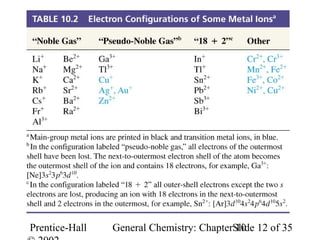
  • 12.
    Electron Configuration ofSome Ions Prentice-Hall General Chemistry: ChapterSlide 12 of 35 10
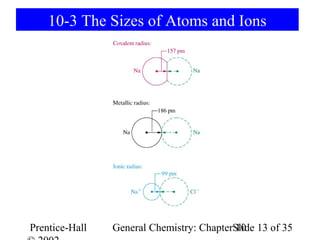
  • 13.
    10-3 The Sizesof Atoms and Ions Prentice-Hall General Chemistry: ChapterSlide 13 of 35 10
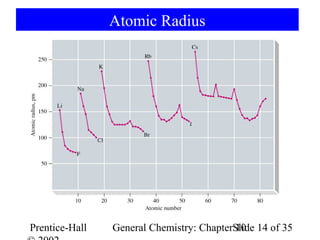
  • 14.
    Atomic Radius Prentice-Hall General Chemistry: ChapterSlide 14 of 35 10
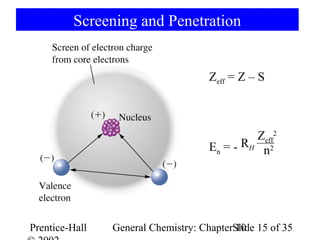
  • 15.
    Screening and Penetration Zeff = Z – S Zeff2 En = - RH n2 Prentice-Hall General Chemistry: ChapterSlide 15 of 35 10
  • 16.
    Cationic Radii Prentice-Hall General Chemistry: ChapterSlide 16 of 35 10
  • 17.
    Anionic Radii Prentice-Hall General Chemistry: ChapterSlide 17 of 35 10
  • 18.
    Atomic and IonicRadii Prentice-Hall General Chemistry: ChapterSlide 18 of 35 10
  • 19.
    10-4 Ionization Energy Mg(g) → Mg+(g) + e- I1 = 738 kJ Mg+(g) → Mg2+(g) + e- I2 = 1451 kJ Zeff2 I = RH 2 n Prentice-Hall General Chemistry: ChapterSlide 19 of 35 10
  • 20.
    First Ionization Energy Prentice-Hall General Chemistry: ChapterSlide 20 of 35 10
  • 21.
    Table 10.4 IonizationEnergies of the Third-Period Elements (in kJ/mol) 737.7 577.6 1012 999.6 1451 7733 I2 (Mg) vs. I3 (Mg) I1 (Mg) vs. I1 (Al) I1 (P) vs. I1 (S) Prentice-Hall General Chemistry: ChapterSlide 21 of 35 10
  • 22.
    10-5 Electron Affinity F(g) + e- → F-(g) EA = -328 kJ F(1s22s22p5) + e- → F-(1s22s22p5) Li(g) + e- → Li-(g) EA = -59.6 kJ Prentice-Hall General Chemistry: ChapterSlide 22 of 35 10
  • 23.
    First Electron Affinities Prentice-Hall General Chemistry: ChapterSlide 23 of 35 10
  • 24.
    Second Electron Affinities O(g) + e- → O-(g) EA = -141 kJ O-(g) + e- → O2-(g) EA = +744 kJ Prentice-Hall General Chemistry: ChapterSlide 24 of 35 10
  • 25.
    10-6 Magnetic Properties •Diamagnetic atoms or ions: – All e- are paired. – Weakly repelled by a magnetic field. • Paramagnetic atoms or ions: – Unpaired e-. – Attracted to an external magnetic field. Prentice-Hall General Chemistry: ChapterSlide 25 of 35 10
  • 26.
    Paramagnetism Prentice-Hall General Chemistry: ChapterSlide 26 of 35 10
  • 27.
    10-7 Periodic Propertiesof the Elements Prentice-Hall General Chemistry: ChapterSlide 27 of 35 10
  • 28.
    Boiling Point ? 266 ? 332 Prentice-Hall General Chemistry: ChapterSlide 28 of 35 10
  • 29.
    Melting Points ofElements Prentice-Hall General Chemistry: ChapterSlide 29 of 35 10
  • 30.
    Melting Points ofCompounds Prentice-Hall General Chemistry: ChapterSlide 30 of 35 10
  • 31.
    Reducing Ability ofGroup 1 and 2 Metals 2 K(s) + 2 H2O(l) → 2 K+ + 2 OH- + H2(g) I1 = 419 kJ I1 = 590 kJ I2 = 1145 kJ Ca(s) + 2 H2O(l) → Ca2+ + 2 OH- + H2(g) Prentice-Hall General Chemistry: ChapterSlide 31 of 35 10
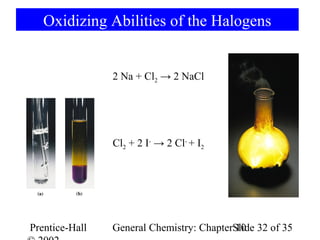
  • 32.
    Oxidizing Abilities ofthe Halogens 2 Na + Cl2 → 2 NaCl Cl2 + 2 I- → 2 Cl- + I2 Prentice-Hall General Chemistry: ChapterSlide 32 of 35 10
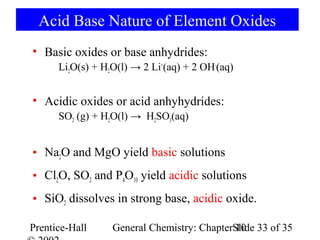
  • 33.
    Acid Base Natureof Element Oxides • Basic oxides or base anhydrides: Li2O(s) + H2O(l) → 2 Li+(aq) + 2 OH-(aq) • Acidic oxides or acid anhyhydrides: SO2 (g) + H2O(l) → H2SO3(aq) • Na2O and MgO yield basic solutions • Cl2O, SO2 and P4O10 yield acidic solutions • SiO2 dissolves in strong base, acidic oxide. Prentice-Hall General Chemistry: ChapterSlide 33 of 35 10
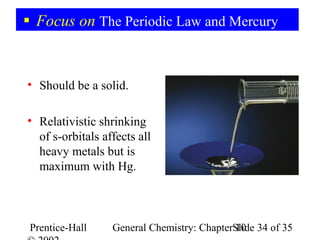
  • 34.
    Focus on ThePeriodic Law and Mercury • Should be a solid. • Relativistic shrinking of s-orbitals affects all heavy metals but is maximum with Hg. Prentice-Hall General Chemistry: ChapterSlide 34 of 35 10
  • 35.
    Chapter 10 Questions 1, 2, 18, 21, 27, 33, 39, 43, 51, 55 Prentice-Hall General Chemistry: ChapterSlide 35 of 35 10

Editor's Notes

  • #2 Thermochemistry branch of chemistry concerned with heat effects accompanying chemical reactions. Direct and indirect measurement of heat. Answer practical questions: why is natural gas a better fuel than coal, and why do fats have higher energy value than carbohydrates and protiens.
  • #5 Meyer based his law on atomic volume , the atomic mass divided by density of solid. He later examined other physical properties such as Hardness Compressibility Boiling point And found these also behaved periodically.
  • #6 Mendeleev’s work attracted more attention He left blank spadces in his table, at 44, 68, 72, and 100, for undiscovered elements (Sc Ga Ge Tc) He corrected some atomic mass values (In, U). Group 1 has high molar volume, low melting points and all form M + ions.
  • #7 Other additions to the table included the Noble gases discoved by William Ramsey. Mendeleev placed certain elements out of order-he assumed that errors had been made in the atomic masses, but it is clear that some elements remain out of order. Moseley changed that with x-ray spectra.
  • #8 43, 61 and 75 were discovered in 1937, 1945 and 1925 respectively. Also proved the periodic law in the region from Z = 13 to 79, and that there could be NO other elements in this region.
  • #15 Radii increase down a group. Radii decrease across a period in the main group (Z eff increases across main group elements). Radii in Transition metals remain fairly constant except for a few spikes. Electrons go into an inner shell, thus participate in shielding the outer shell electrons from the increasing Z eff .
  • #16 Z eff is effective nuclear charge. E n is orbital energy
  • #19 Knowdledge of atomic and ionic radii can be used to varycertain physical porperties. Ex Na + and Ca 2+ ions. Glass is brittle and breaks easily. Replace surface Na + by K + and glass becomes shatter resistant. Cr 3+ in Al 2 O 3 (about 1%) gives beautiful red colour (Ruby).
  • #20 Ionization energy is the quantity of energy a gaseous atom must absorb so that an electron is stripped from it. The electron lost is the one most loosely held.
  • #21 Ionization energies decrease as atomic radii increase. Noble gases are the most difficult to ionize. Alkali metals are the easiest to ionize. Other trends are apparent and can be discussed better using specific examples (next slide)
  • #22 Removing the third electon from Mg causes a large jump in I. I 1 of Al less than Mg because s- electron is removed from Mg and p-electron is removed from Al. I 1 of S is less than that of P. This is due to e - -e - repulsion of the fourth electron.
  • #25 Gaseous O 2- is not likely. It is OK in Na 2 O because of the energetically favorable electrostatic interactions.
  • #28 Metallic character corresponds to conductance of heat and electricity.
  • #29 Average is 349 for mp Average is
  • #30 Melting involves destruction of the orderly arrangement of atoms or molecules in a crystalline solid. Melting point temperature depends on the strength of the attractive forces between atoms of molecules in the solid. Na, Mg, Al Metallic bonds, Si Covalent bonds, strong interatomic forces. P 4 , S 8 , Cl 2 Discrete molecules, forces become weaker as you go across.
  • #32 K is representative of reactivity of Group 1, expect that a lower ionization energy should react more vigerously. Ca is representative of reactivity of Group 2, expect that a higher ionization energy should react more slowly. Ionization energy alone is an oversimlification. If differences in I are small then other factors must be taken into account.
  • #33 Expect compounds with high electron affinity to be good oxidizing agents. So halogens should react vigorously with Na. Cl has higher electron affinity than I, therefore the reaction should lie to the right.