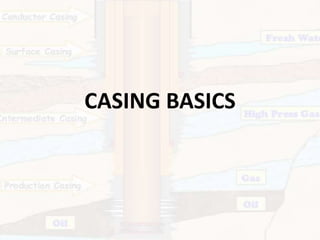
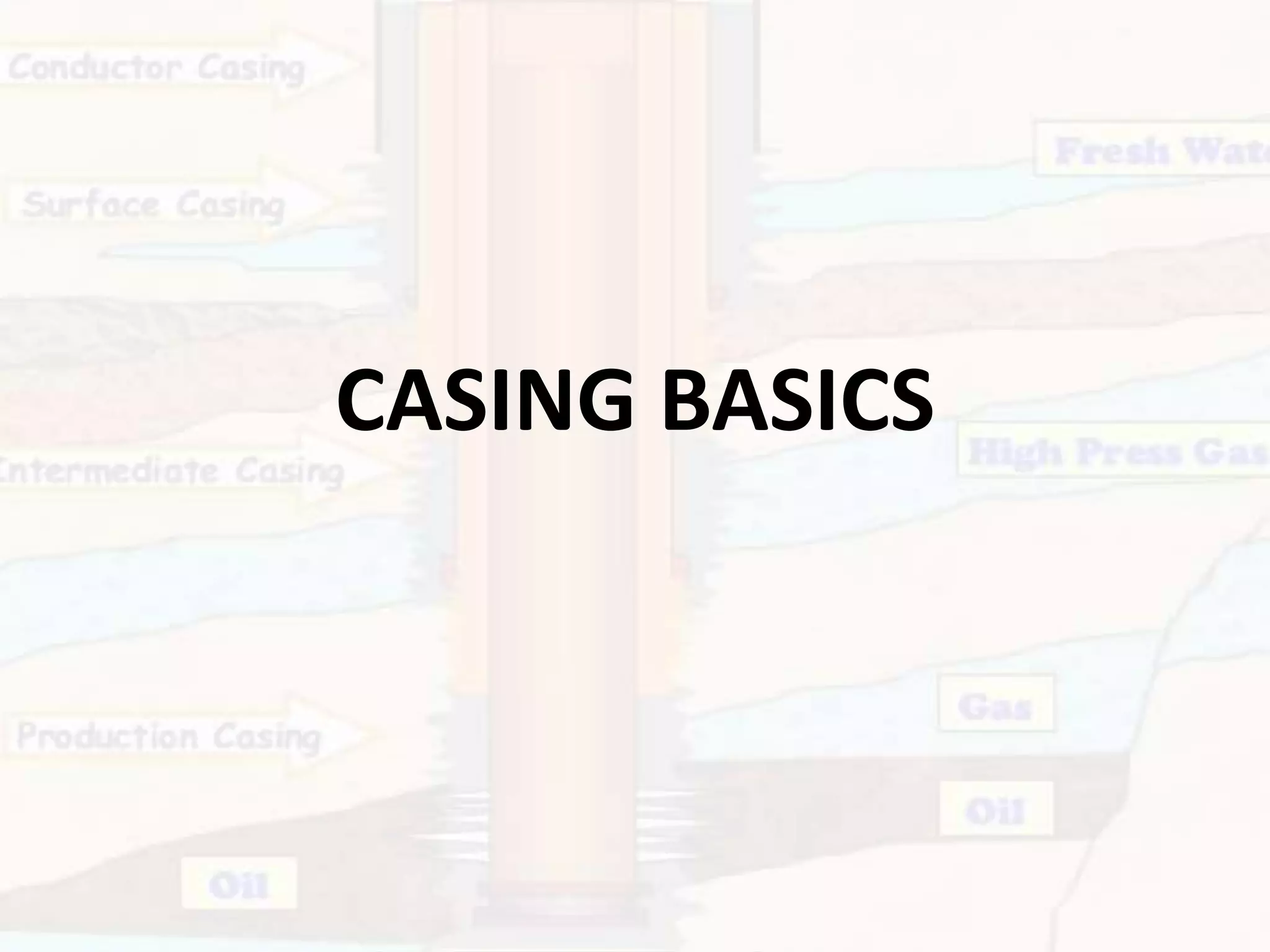
CASING BASICS
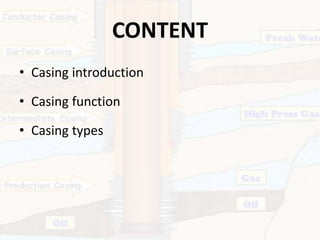
CONTENT
• Casing introduction
• Casing function
• Casing types
CASING INTRODUCTION
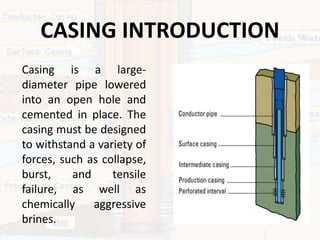
Casing is a large-
diameter pipe lowered
into an open hole and
cemented in place. The
casing must be designed
to withstand a variety of
forces, such as collapse,
burst, and tensile
failure, as well as
chemically aggressive
brines.
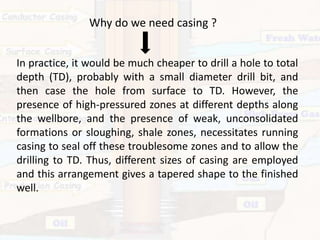
In practice, it would be much cheaper to drill a hole to total
depth (TD), probably with a small diameter drill bit, and
then case the hole from surface to TD. However, the
presence of high-pressured zones at different depths along
the wellbore, and the presence of weak, unconsolidated
formations or sloughing, shale zones, necessitates running
casing to seal off these troublesome zones and to allow the
drilling to TD. Thus, different sizes of casing are employed
and this arrangement gives a tapered shape to the finished
well.
Why do we need casing ?
CASING FUNCTIONS
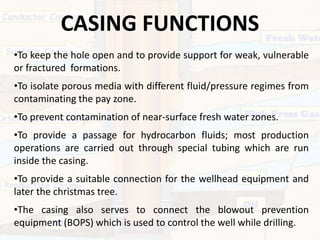
•To keep the hole open and to provide support for weak, vulnerable
or fractured formations.
•To isolate porous media with different fluid/pressure regimes from
contaminating the pay zone.
•To prevent contamination of near-surface fresh water zones.
•To provide a passage for hydrocarbon fluids; most production
operations are carried out through special tubing which are run
inside the casing.
•To provide a suitable connection for the wellhead equipment and
later the christmas tree.
•The casing also serves to connect the blowout prevention
equipment (BOPS) which is used to control the well while drilling.
CASING TYPES
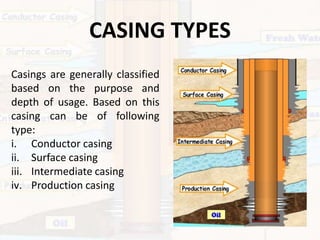
Casings are generally classified
based on the purpose and
depth of usage. Based on this
casing can be of following
type:
i. Conductor casing
ii. Surface casing
iii. Intermediate casing
iv. Production casing
i. Conductor casing
Conductor pipe is run from the surface to a shallow depth, mainly
to protect near surface unconsolidated formations.
It is also used to seal off shallow-water zones, provide protection
against shallow gas flows, provide a conduit for the drilling mud
and to protect the foundation of the platform in offshore
operations. One or more BOPs may be mounted on this casing or
a diverter system if the setting depth of the conductor pipe is
shallow.
In the Middle East, a typical size for a conductor pipe is either 18
5/8 in. (473 mm) or 20 in. (508 mm). In North Sea exploration
wells, the size of the conductor pipe is usually 26 or 30 in.
Conductor pipe is always cemented to surface. It is used to support
subsequent casing strings and wellhead equipment or alternatively
the pipe is cut off at the surface after setting the surface casing.
ii. Surface casing
Surface casing is mainly run to prevent shallow water bearing
formations contamination. One of the important functions of
surface casing is to provide connection point for BOP or well head.
It is also used to prevent caving of weak formations that are
encountered at shallow depths. The surface casing also serves to
provide protection against shallow blowouts.
A typical size of this casing is l3 3/8 in. (240 mm) in the Middle
East and 18 5/8 in. or 20 in. in North Sea operations.
This casing should be set in competent rocks such as hard
limestone. This will ensure that formations at the casing shoe will
not fracture at the high hydrostatic pressures which may be
encountered later.
iii. Intermediate casing
Intermediate casing is usually set in the transition zone below or
above an over-pressured zone, to seal off a severe-loss zone or to
protect against problem formations such as mobile salt zones or
caving shale.
Good cementation of this casing must be ensured to prevent
communication behind the casing between the lower hydrocarbon
zones and upper water formations. Multistage cementing may be
used to cement this string of casing.
The most common size of this casing is 9 5/8 or 10 ¾ in.
iv. Production casing
Production casing is the last casing string. It is run to isolate
producing zones, to provide reservoir fluid control and to permit
selective production in multi zone production.
The usual sizes of this string are 4 1/2, 5 and 7 in.

Anmol bhargava casing basics

  • 1.
  • 2.
    CONTENT • Casing introduction •Casing function • Casing types
  • 3.
    CASING INTRODUCTION Casing isa large- diameter pipe lowered into an open hole and cemented in place. The casing must be designed to withstand a variety of forces, such as collapse, burst, and tensile failure, as well as chemically aggressive brines.
  • 4.
    In practice, itwould be much cheaper to drill a hole to total depth (TD), probably with a small diameter drill bit, and then case the hole from surface to TD. However, the presence of high-pressured zones at different depths along the wellbore, and the presence of weak, unconsolidated formations or sloughing, shale zones, necessitates running casing to seal off these troublesome zones and to allow the drilling to TD. Thus, different sizes of casing are employed and this arrangement gives a tapered shape to the finished well. Why do we need casing ?
  • 5.
    CASING FUNCTIONS •To keepthe hole open and to provide support for weak, vulnerable or fractured formations. •To isolate porous media with different fluid/pressure regimes from contaminating the pay zone. •To prevent contamination of near-surface fresh water zones. •To provide a passage for hydrocarbon fluids; most production operations are carried out through special tubing which are run inside the casing. •To provide a suitable connection for the wellhead equipment and later the christmas tree. •The casing also serves to connect the blowout prevention equipment (BOPS) which is used to control the well while drilling.
  • 6.
    CASING TYPES Casings aregenerally classified based on the purpose and depth of usage. Based on this casing can be of following type: i. Conductor casing ii. Surface casing iii. Intermediate casing iv. Production casing
  • 7.
    i. Conductor casing Conductorpipe is run from the surface to a shallow depth, mainly to protect near surface unconsolidated formations. It is also used to seal off shallow-water zones, provide protection against shallow gas flows, provide a conduit for the drilling mud and to protect the foundation of the platform in offshore operations. One or more BOPs may be mounted on this casing or a diverter system if the setting depth of the conductor pipe is shallow. In the Middle East, a typical size for a conductor pipe is either 18 5/8 in. (473 mm) or 20 in. (508 mm). In North Sea exploration wells, the size of the conductor pipe is usually 26 or 30 in.
  • 8.
    Conductor pipe isalways cemented to surface. It is used to support subsequent casing strings and wellhead equipment or alternatively the pipe is cut off at the surface after setting the surface casing. ii. Surface casing Surface casing is mainly run to prevent shallow water bearing formations contamination. One of the important functions of surface casing is to provide connection point for BOP or well head. It is also used to prevent caving of weak formations that are encountered at shallow depths. The surface casing also serves to provide protection against shallow blowouts. A typical size of this casing is l3 3/8 in. (240 mm) in the Middle East and 18 5/8 in. or 20 in. in North Sea operations.
  • 9.
    This casing shouldbe set in competent rocks such as hard limestone. This will ensure that formations at the casing shoe will not fracture at the high hydrostatic pressures which may be encountered later. iii. Intermediate casing Intermediate casing is usually set in the transition zone below or above an over-pressured zone, to seal off a severe-loss zone or to protect against problem formations such as mobile salt zones or caving shale. Good cementation of this casing must be ensured to prevent communication behind the casing between the lower hydrocarbon zones and upper water formations. Multistage cementing may be used to cement this string of casing. The most common size of this casing is 9 5/8 or 10 ¾ in.
  • 10.
    iv. Production casing Productioncasing is the last casing string. It is run to isolate producing zones, to provide reservoir fluid control and to permit selective production in multi zone production. The usual sizes of this string are 4 1/2, 5 and 7 in.