SUMMER INTERNSHIP PROJECT
REPORT
On
“Plotting Cayley Graph for Dihedral and
Alternating groups”
DEPARTMENT OF
COMPUTER SCIENCE AND
ENGINEERING
INDIAN INSTITUTE OF
TECHNOLOGY GUWAHATI
Under the supervision of:
Prof: PINAKI MITRA
Duration: 17th
May to 16th
May 2016
Submitted by: Anirban Choudhury
Branch: Computer Science and
Engineering
National Institute of Technology Agartala
ACKNOWLEDGEMENT
I would like to extend my sincere and heartfelt gratitude to my guide Prof.
PINAKI MITRA for giving me this opportunity to work under her able
guidance. I would like to thank him for all the effort he took and time he spared
at every step of this internship to guide me. I am truly inspired by him
dedication towards work and I extend my heartfelt thanks for all the motivation
during the project and for making this a fruitful experience.
Lastly, I would like to express my deep sense of gratitude to my parents for all
the support and encouragement, all my friends for making my stay memorable
and to the people at IIT GUWAHATI for all the warmth and kindness.
.
Place: IIT GUWAHATI Anirban Choudhury
Date: 16th June 2016
Index
1. INTRODUCTION
2. CAYLEY GRAPH
3. DIHEDRAL GROUP
4. ALTERNATING GROUP
5. PERMUTATION GROUP
6. Project Details
6.1 Software Requirements
6.2Hardware Requirements
7. TestCase Results
8. References
1.Introduction
2.Cayley graph
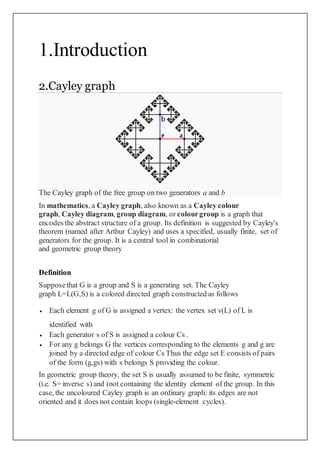
The Cayley graph of the free group on two generators a and b
In mathematics, a Cayley graph, also known as a Cayley colour
graph, Cayley diagram, group diagram, or colourgroup is a graph that
encodes the abstract structure of a group. Its definition is suggested by Cayley's
theorem (named after Arthur Cayley) and uses a specified, usually finite, set of
generators for the group. It is a central tool in combinatorial
and geometric group theory
Definition
Supposethat G is a group and S is a generating set. The Cayley
graph L=L(G,S) is a colored directed graph constructed as follows
 Each element g of G is assigned a vertex: the vertex set v(L) of L is
identified with
 Each generator s of S is assigned a colour Cs .
 For any g belongs G the vertices corresponding to the elements g and g are
joined by a directed edge of colour Cs Thus the edge set E consists of pairs
of the form (g,gs) with s belongs S providing the colour.
In geometric group theory, the set S is usually assumed to be finite, symmetric
(i.e. S= inverse s) and (not containing the identity element of the group. In this
case, the uncoloured Cayley graph is an ordinary graph: its edges are not
oriented and it does not contain loops (single-element cycles).
Examples
 Supposethat G=z is the infinite cyclic group and the set S consists of the
standard generator 1 and its inverse (−1 in the additive notation) then the
Cayley graph is an infinite path.
 Similarly, if G=Zn is the finite cyclic group of order n and the set S consists
of two elements, the standard generator of G and its inverse, then the Cayley
graph is the cycle Cn . More generally, the Cayley graphs of finite cyclic
groups are exactly the circulant graphs.
 The Cayley graph of the direct productof groups (with the cartesian product
of generating sets as a generating set) is the cartesian productof the
corresponding Cayley graphs. Thus the Cayley graph of the abelian group Z
square with the set of generators consisting of four elements .It is the
infinite grid on the plane , while for the direct product with similar
generators the Cayley graph is the finite grid on a torus.
 A different Cayley graph of Dih4 is shown on the below b is still the
horizontal reflection and represented by blue lines; c is a diagonal
reflection and represented by green lines. As both reflections are self-
inverse the Cayley graph on the right is completely undirected. This
graph correspondsto the presentation

On two generators of Dih4, which are both self-inverse
Cayley graph of the dihedral group Dih4 on two generators a and b
 A Cayley graph of the D4 on two generators a and b is depicted to the left.
Red arrows represent left-multiplication by element a. Since element b is
self inverse, the blue lines which represent left-multiplication by
element b are undirected. Therefore the graph is mixed: it has eight vertices,
eight arrows, and four edges. The cayley table of the group D4 can be
derived from the group presentation.
3.Dihedral group
In mathematics, a dihedral group is the group of symmetries of a regular
polygon, which includes rotations and reflections .Dihedral groups are among
the simplest examples of finite groups, and they play an important role in group
theory, geometry, and chemistry.
Notation
The dihedral group with index n has 2n elements. N is the number of vertices
and sides of the underlying polygon while 2n is the number of rotations and
reflections, which make up the symmetries of that polygon.
Definition
Elements
A regular polygon with n sides has 2n different symmetries: n rotational
symmetries and n reflection symmetries. The associate drotations
and reflections make up the dihedral group Dn. If n is odd, each axis of
symmetry connects the midpoint of one side to the oppositevertex. If n is even,
there are n/2 axes of symmetry connecting the midpoints of oppositesides
and n/2 axes of symmetry connecting oppositevertices. In either case, there
are n axes of symmetry and 2n elements in the symmetry group. Reflecting in
one axis of symmetry followed by reflecting in another axis of symmetry
produces a rotation through twice the angle between the axes. The following
picture shows the effect of the sixteen elements of D8 on a stop sign:
The first row shows the effect of the eight rotations, and the second row shows
the effect of the eight reflections, in each caseacting on the stop sign with the
orientation as shown at the top left.
The six axes of reflection of a regular hexagon
Group structure:
As with any geometric object, the composition of two symmetries of a regular
polygon is again a symmetry of this object. With composition of symmetries to
produceanother as the binary operation, this gives the symmetries of a polygon
the algebraic structure of a finite group.
The following Cayley table shows the effect of composition in the group D3 (the
symmetries of an equilateral triangle). r0 denotes the identity; r1 and r2 denote
counter clock wise rotations by 120° and 240° respectively, and s0, s1 and
s2 denote reflections across the three lines shown in the picture to the right.
The composition of these two reflections is a rotation.
r0 r1 r2 s0 s1 s2
r0 r0 r1 r2 s0 s1 s2
r1 r1 r2 r0 s1 s2 s0
r2 r2 r0 r1 s2 s0 s1
s0 s0 s2 s1 r0 r2 r1
s1 s1 s0 s2 r1 r0 r2
s2 s2 s1 s0 r2 r1 r0
For example, s2s1 = r1, because the reflection s1 followed by the reflection
s2 results in a rotation of 120°. The order of elements denoting the is right to
left, reflecting the convention that the element acts on the expression to its right.
The composition operation is not commutative.
In general, the group Dn has elements r0, …, rn−1 and s0, …, sn−1, with
composition given by the following formulae:
In all cases, addition and subtraction of subscripts are to be performed
using modular airthmatic with modulus n.
Dihedral group
FOR D3:
FOR D4: 4:
For D5:
REPRESENTTION OF HOW TO PLOT
CAYLEY GRAPH FOR DIHEDRAL GROUP
CAYLEY GRAPH FOR D3:
CAYLEY GRAPH FOR D4:
CAYLEY GRAPH FOR D5:
4. Alternating group
In mathematics, an alternating group is the group of even permutations of
a finite set. The alternating group on a set of n elements is called
the alternating group of degree n, or the alternating group on n letters and
denoted by An or Alt(n).
Basic properties
For n > 1, the group An is the commutator subgroup of the symmetric group
Sn with inde
x 2 and has therefore n! / 2 elements. It is the kernel of the signature group
homomorphism sgn : Sn → {1, −1} explained under symmetric group.
The group An is abelian if and only if n ≤ 3 and simple if and only if n = 3 or n ≥
5. A5 is the smallest non-abelian simple group , having order 60, and the
smallest non-solvable group .
The group A4 has a Klein four-group V as a proper normal subgroup, namely
the identity and the double transpositions {(), (12)(34), (13)(24), (14)(23) }, and
maps to A3 = C3, from the sequence V → A4 → A3 = C3. In Galois theory, this
map, or rather the corresponding map S4 → S3, correspondsto associating
the Lagrange resolvent cubic to a quartic, which allows the quartic
polynomial to be solved by radicals, as established by Lodovico Ferrari.
Conjugacyclasses
As in the symmetric group the conjugacy classes in An consistof elements with
the same cycle shape. However, if the cycle shape consists only of cycles of odd
length with no two cycles the same length, where cycles of length one are
included in the cycle type, then there are exactly two conjugacy classes for this
cycle shape (Scott 1987, §11.1, p299).
Examples:
 The two permutations (123) and (132) are not conjugates in A3, although
they have the same cycle shape, and are therefore conjugate in S3.
 The permutation (123) (45678) is not conjugate to its inverse (132) (48765)
in A8, although the two permutations have the same cycle shape, so they are
conjugate in S8.
Alternating group for AG3, FOR AG4 AND AG5 are describe below:
5.Permutation Group
In mathematics, a permutation group is a group G whose elements
are permutations of a given set M and whose group operation is the composition
of permutations in G (which are thought of as bijective functions from the
set M to itself). The group of all permutations of a set M is the symmetric group
of M, often written as Sym (M). The term permutation group thus means
a subgroup of the symmetric group. If M = {1,2,...,n} then, Sym (M),
the symmetric group on n letters is usually denoted by Sn.
The way in which the elements of a permutation group permute the elements of
the set is called its group action. Group actions have applications in the study
of symmetries, combinatorics and many other branches of mathematics, physics
and chemistry.
Basic properties
Being a subgroup of a symmetric group, all that is necessary for a set of
permutations to satisfy the group axioms and be a permutation group is that it
contain the identity permutation, the inverse permutation of each permutation it
contains, and be closed under composition of its permutations.A general
property of finite groups implies that a finite nonempty subset of a symmetric
group is again a group if and only if it is closed under the group operation.
The degree ofa group of permutations of a finite set is the number of elements
in the set. The order of a group (of any type) is the number of elements
(cardinality) in the group. By Lagrange's theorem, the order of any finite
permutation group of degree n must divide n! (n-factorial , the order of the
symmetric group Sn).
Compositionof permutations–the group product
The productof two permutations is defined as their composition as functions, in
other words σ·π is the function that maps any element x of the set to σ(π(x)).
Note that the rightmost permutation is applied to the argument
first, [6] [7] because of the way function application is written. Some authors
prefer the leftmost factor acting first, [8] [9] [10] but to that end permutations must
be written to the right of their argument, often as an exponent, so the
permutation σ acting on the element x results in the image xσ. With this
convention, the productis given by xσ·π = (xσ) π. However, this gives
a different rule for multiplying permutations. This convention is commonly used
in the permutation group literature, but this article uses the convention where
the rightmost permutation is applied first.
Since the composition of two bijections always gives another bijection, the
productof two permutations is again a permutation. In two-line notation, the
productof two permutations is obtained by rearranging the columns of the
second (leftmost) permutation so that its first row is identical with the second
row of the first (rightmost) permutation. The productcan then be written as the
first row of the first permutation over the second row of the modified second
permutation.
6.PROJECT DETAILS
6.1 Software Characteristics
Language used for programming
Java is used as the development language, based on jdk 8 and jre 1.8
Integrated development environment used:
The sourcecodeis run on Eclipse luna.
Security
There are no security flaws in the software. AES algorithm is used for
encryption, thus adding security bonus to the software.
Availability
The software can be downloaded from the website and can be used conveniently
for desktop applications.
Packages usedfor graphics
java.awt.Color;
java.awt.EventQueue;
java.awt.Graphics;
java.awt.Graphics2D;
javax.swing.JFrame;
javax.swing.JPanel;
6.2 Software Requirement
The user must have a recent version of Java2 installed on their system. For
desktop use, the user must have a recent version of Java2 installed on the
system.
Operating System Because Java is used, the operating system will be
irrelevant for desktop application. The system will run on any OS that supports
Java2, including, but not limited to, Windows, Linux, and MacOS.
Graphics
A graphical user interface is used to enhance usability and must be able to run
on any display that supports 640x480 resolution or higher.
Web Browser
To utilize all the features of website the system must have any of these
browsers:Internet Explorer 8 or above, Mozilla Firefox, Google Chrome and
UC Browser.
6.3 Hardware
Processor:intel (R) core(TM) i3-4005U CPU@1.70GHZ
INSTALLED MEMORY (RAM): 4 GB
System Type: 64 bit operating system, x64 based processor
The system must run on all systems that supportJava2.
Conclusion
In this PROJECT, we have derived HOW TO PLOT Cayley graph
for DIHEDRAL GROUP AND ALTERNATING GROUPS with the
help of Cayley graph, permutation group, Alternating group, Dihedral
group. In this project we want to plot the graph using tool as
ECLIPSE and using language java.
References:
1. Cayley, Arthur (1878). "Desiderata and suggestions: No. 2. TheTheory of
groups: graphicalrepresentation". Amer. J. Math. 1 (2): 174–6.Doi :
10.2307/2369306. JSTOR2369306.Inhis Collected Mathematical Papers 10:
403–405.
 2. CAYLEY DIAGRAM
http://www.weddslist.com/groups/cayley-plat/index.html
3. WEISTEEN.ERICW., CAYLEY GRAPH, MATHWORLD
https://en.wikipedia.org/wiki/MathWorld
4. Robinson, Derek John Scott (1996), A course in the theory of groups,
Graduatetexts in mathematics 80 (2 ed.), Springer,
5. Scott, W.R. (1987), Group Theory, New York: Dover Publications
6. WEISTEEN .ERIC W., ALTERNATING GROUP, MATHWORLD
 http://mathworld.wolfram.com/AlternatingGroup.html
7. DIHEDRAL GROUP at GROUPPROPS
8. Dixon, John D.; Mortimer, Brian (1996), Permutation Groups, Graduate
Texts in Mathematics163), Springer-Verlag

Anirban_choudhury_summer_internsip_project_report

  • 1.
    SUMMER INTERNSHIP PROJECT REPORT On “PlottingCayley Graph for Dihedral and Alternating groups”
  • 2.
    DEPARTMENT OF COMPUTER SCIENCEAND ENGINEERING INDIAN INSTITUTE OF TECHNOLOGY GUWAHATI Under the supervision of: Prof: PINAKI MITRA Duration: 17th May to 16th May 2016 Submitted by: Anirban Choudhury Branch: Computer Science and Engineering
  • 3.
    National Institute ofTechnology Agartala ACKNOWLEDGEMENT I would like to extend my sincere and heartfelt gratitude to my guide Prof. PINAKI MITRA for giving me this opportunity to work under her able guidance. I would like to thank him for all the effort he took and time he spared at every step of this internship to guide me. I am truly inspired by him dedication towards work and I extend my heartfelt thanks for all the motivation during the project and for making this a fruitful experience. Lastly, I would like to express my deep sense of gratitude to my parents for all the support and encouragement, all my friends for making my stay memorable and to the people at IIT GUWAHATI for all the warmth and kindness. . Place: IIT GUWAHATI Anirban Choudhury Date: 16th June 2016
  • 4.
    Index 1. INTRODUCTION 2. CAYLEYGRAPH 3. DIHEDRAL GROUP 4. ALTERNATING GROUP 5. PERMUTATION GROUP 6. Project Details 6.1 Software Requirements 6.2Hardware Requirements 7. TestCase Results 8. References
  • 5.
    1.Introduction 2.Cayley graph The Cayleygraph of the free group on two generators a and b In mathematics, a Cayley graph, also known as a Cayley colour graph, Cayley diagram, group diagram, or colourgroup is a graph that encodes the abstract structure of a group. Its definition is suggested by Cayley's theorem (named after Arthur Cayley) and uses a specified, usually finite, set of generators for the group. It is a central tool in combinatorial and geometric group theory Definition Supposethat G is a group and S is a generating set. The Cayley graph L=L(G,S) is a colored directed graph constructed as follows  Each element g of G is assigned a vertex: the vertex set v(L) of L is identified with  Each generator s of S is assigned a colour Cs .  For any g belongs G the vertices corresponding to the elements g and g are joined by a directed edge of colour Cs Thus the edge set E consists of pairs of the form (g,gs) with s belongs S providing the colour. In geometric group theory, the set S is usually assumed to be finite, symmetric (i.e. S= inverse s) and (not containing the identity element of the group. In this case, the uncoloured Cayley graph is an ordinary graph: its edges are not oriented and it does not contain loops (single-element cycles).
  • 6.
    Examples  Supposethat G=zis the infinite cyclic group and the set S consists of the standard generator 1 and its inverse (−1 in the additive notation) then the Cayley graph is an infinite path.  Similarly, if G=Zn is the finite cyclic group of order n and the set S consists of two elements, the standard generator of G and its inverse, then the Cayley graph is the cycle Cn . More generally, the Cayley graphs of finite cyclic groups are exactly the circulant graphs.  The Cayley graph of the direct productof groups (with the cartesian product of generating sets as a generating set) is the cartesian productof the corresponding Cayley graphs. Thus the Cayley graph of the abelian group Z square with the set of generators consisting of four elements .It is the infinite grid on the plane , while for the direct product with similar generators the Cayley graph is the finite grid on a torus.  A different Cayley graph of Dih4 is shown on the below b is still the horizontal reflection and represented by blue lines; c is a diagonal reflection and represented by green lines. As both reflections are self- inverse the Cayley graph on the right is completely undirected. This graph correspondsto the presentation  On two generators of Dih4, which are both self-inverse
  • 7.
    Cayley graph ofthe dihedral group Dih4 on two generators a and b  A Cayley graph of the D4 on two generators a and b is depicted to the left. Red arrows represent left-multiplication by element a. Since element b is self inverse, the blue lines which represent left-multiplication by element b are undirected. Therefore the graph is mixed: it has eight vertices, eight arrows, and four edges. The cayley table of the group D4 can be derived from the group presentation.
  • 8.
    3.Dihedral group In mathematics,a dihedral group is the group of symmetries of a regular polygon, which includes rotations and reflections .Dihedral groups are among the simplest examples of finite groups, and they play an important role in group theory, geometry, and chemistry. Notation The dihedral group with index n has 2n elements. N is the number of vertices and sides of the underlying polygon while 2n is the number of rotations and reflections, which make up the symmetries of that polygon. Definition Elements A regular polygon with n sides has 2n different symmetries: n rotational symmetries and n reflection symmetries. The associate drotations and reflections make up the dihedral group Dn. If n is odd, each axis of symmetry connects the midpoint of one side to the oppositevertex. If n is even, there are n/2 axes of symmetry connecting the midpoints of oppositesides and n/2 axes of symmetry connecting oppositevertices. In either case, there are n axes of symmetry and 2n elements in the symmetry group. Reflecting in one axis of symmetry followed by reflecting in another axis of symmetry produces a rotation through twice the angle between the axes. The following picture shows the effect of the sixteen elements of D8 on a stop sign:
  • 9.
    The first rowshows the effect of the eight rotations, and the second row shows the effect of the eight reflections, in each caseacting on the stop sign with the orientation as shown at the top left. The six axes of reflection of a regular hexagon Group structure: As with any geometric object, the composition of two symmetries of a regular polygon is again a symmetry of this object. With composition of symmetries to produceanother as the binary operation, this gives the symmetries of a polygon the algebraic structure of a finite group. The following Cayley table shows the effect of composition in the group D3 (the symmetries of an equilateral triangle). r0 denotes the identity; r1 and r2 denote counter clock wise rotations by 120° and 240° respectively, and s0, s1 and s2 denote reflections across the three lines shown in the picture to the right.
  • 10.
    The composition ofthese two reflections is a rotation. r0 r1 r2 s0 s1 s2 r0 r0 r1 r2 s0 s1 s2 r1 r1 r2 r0 s1 s2 s0 r2 r2 r0 r1 s2 s0 s1 s0 s0 s2 s1 r0 r2 r1 s1 s1 s0 s2 r1 r0 r2 s2 s2 s1 s0 r2 r1 r0 For example, s2s1 = r1, because the reflection s1 followed by the reflection s2 results in a rotation of 120°. The order of elements denoting the is right to left, reflecting the convention that the element acts on the expression to its right. The composition operation is not commutative. In general, the group Dn has elements r0, …, rn−1 and s0, …, sn−1, with composition given by the following formulae: In all cases, addition and subtraction of subscripts are to be performed using modular airthmatic with modulus n.
  • 11.
  • 12.
    For D5: REPRESENTTION OFHOW TO PLOT CAYLEY GRAPH FOR DIHEDRAL GROUP
  • 13.
  • 14.
  • 15.
    CAYLEY GRAPH FORD5: 4. Alternating group In mathematics, an alternating group is the group of even permutations of a finite set. The alternating group on a set of n elements is called the alternating group of degree n, or the alternating group on n letters and denoted by An or Alt(n). Basic properties For n > 1, the group An is the commutator subgroup of the symmetric group Sn with inde
  • 16.
    x 2 andhas therefore n! / 2 elements. It is the kernel of the signature group homomorphism sgn : Sn → {1, −1} explained under symmetric group. The group An is abelian if and only if n ≤ 3 and simple if and only if n = 3 or n ≥ 5. A5 is the smallest non-abelian simple group , having order 60, and the smallest non-solvable group . The group A4 has a Klein four-group V as a proper normal subgroup, namely the identity and the double transpositions {(), (12)(34), (13)(24), (14)(23) }, and maps to A3 = C3, from the sequence V → A4 → A3 = C3. In Galois theory, this map, or rather the corresponding map S4 → S3, correspondsto associating the Lagrange resolvent cubic to a quartic, which allows the quartic polynomial to be solved by radicals, as established by Lodovico Ferrari. Conjugacyclasses As in the symmetric group the conjugacy classes in An consistof elements with the same cycle shape. However, if the cycle shape consists only of cycles of odd length with no two cycles the same length, where cycles of length one are included in the cycle type, then there are exactly two conjugacy classes for this cycle shape (Scott 1987, §11.1, p299). Examples:  The two permutations (123) and (132) are not conjugates in A3, although they have the same cycle shape, and are therefore conjugate in S3.  The permutation (123) (45678) is not conjugate to its inverse (132) (48765) in A8, although the two permutations have the same cycle shape, so they are conjugate in S8. Alternating group for AG3, FOR AG4 AND AG5 are describe below:
  • 20.
    5.Permutation Group In mathematics,a permutation group is a group G whose elements are permutations of a given set M and whose group operation is the composition of permutations in G (which are thought of as bijective functions from the set M to itself). The group of all permutations of a set M is the symmetric group of M, often written as Sym (M). The term permutation group thus means a subgroup of the symmetric group. If M = {1,2,...,n} then, Sym (M), the symmetric group on n letters is usually denoted by Sn. The way in which the elements of a permutation group permute the elements of the set is called its group action. Group actions have applications in the study of symmetries, combinatorics and many other branches of mathematics, physics and chemistry. Basic properties Being a subgroup of a symmetric group, all that is necessary for a set of permutations to satisfy the group axioms and be a permutation group is that it contain the identity permutation, the inverse permutation of each permutation it contains, and be closed under composition of its permutations.A general property of finite groups implies that a finite nonempty subset of a symmetric group is again a group if and only if it is closed under the group operation.
  • 21.
    The degree ofagroup of permutations of a finite set is the number of elements in the set. The order of a group (of any type) is the number of elements (cardinality) in the group. By Lagrange's theorem, the order of any finite permutation group of degree n must divide n! (n-factorial , the order of the symmetric group Sn). Compositionof permutations–the group product The productof two permutations is defined as their composition as functions, in other words σ·π is the function that maps any element x of the set to σ(π(x)). Note that the rightmost permutation is applied to the argument first, [6] [7] because of the way function application is written. Some authors prefer the leftmost factor acting first, [8] [9] [10] but to that end permutations must be written to the right of their argument, often as an exponent, so the permutation σ acting on the element x results in the image xσ. With this convention, the productis given by xσ·π = (xσ) π. However, this gives a different rule for multiplying permutations. This convention is commonly used in the permutation group literature, but this article uses the convention where the rightmost permutation is applied first. Since the composition of two bijections always gives another bijection, the productof two permutations is again a permutation. In two-line notation, the productof two permutations is obtained by rearranging the columns of the second (leftmost) permutation so that its first row is identical with the second row of the first (rightmost) permutation. The productcan then be written as the first row of the first permutation over the second row of the modified second permutation.
  • 22.
    6.PROJECT DETAILS 6.1 SoftwareCharacteristics Language used for programming Java is used as the development language, based on jdk 8 and jre 1.8 Integrated development environment used: The sourcecodeis run on Eclipse luna. Security There are no security flaws in the software. AES algorithm is used for encryption, thus adding security bonus to the software. Availability The software can be downloaded from the website and can be used conveniently for desktop applications. Packages usedfor graphics java.awt.Color; java.awt.EventQueue; java.awt.Graphics; java.awt.Graphics2D; javax.swing.JFrame; javax.swing.JPanel; 6.2 Software Requirement The user must have a recent version of Java2 installed on their system. For desktop use, the user must have a recent version of Java2 installed on the system.
  • 23.
    Operating System BecauseJava is used, the operating system will be irrelevant for desktop application. The system will run on any OS that supports Java2, including, but not limited to, Windows, Linux, and MacOS. Graphics A graphical user interface is used to enhance usability and must be able to run on any display that supports 640x480 resolution or higher. Web Browser To utilize all the features of website the system must have any of these browsers:Internet Explorer 8 or above, Mozilla Firefox, Google Chrome and UC Browser. 6.3 Hardware Processor:intel (R) core(TM) i3-4005U CPU@1.70GHZ INSTALLED MEMORY (RAM): 4 GB System Type: 64 bit operating system, x64 based processor The system must run on all systems that supportJava2.
  • 24.
    Conclusion In this PROJECT,we have derived HOW TO PLOT Cayley graph for DIHEDRAL GROUP AND ALTERNATING GROUPS with the help of Cayley graph, permutation group, Alternating group, Dihedral group. In this project we want to plot the graph using tool as ECLIPSE and using language java.
  • 25.
    References: 1. Cayley, Arthur(1878). "Desiderata and suggestions: No. 2. TheTheory of groups: graphicalrepresentation". Amer. J. Math. 1 (2): 174–6.Doi : 10.2307/2369306. JSTOR2369306.Inhis Collected Mathematical Papers 10: 403–405.  2. CAYLEY DIAGRAM http://www.weddslist.com/groups/cayley-plat/index.html 3. WEISTEEN.ERICW., CAYLEY GRAPH, MATHWORLD https://en.wikipedia.org/wiki/MathWorld 4. Robinson, Derek John Scott (1996), A course in the theory of groups, Graduatetexts in mathematics 80 (2 ed.), Springer, 5. Scott, W.R. (1987), Group Theory, New York: Dover Publications 6. WEISTEEN .ERIC W., ALTERNATING GROUP, MATHWORLD  http://mathworld.wolfram.com/AlternatingGroup.html 7. DIHEDRAL GROUP at GROUPPROPS 8. Dixon, John D.; Mortimer, Brian (1996), Permutation Groups, Graduate Texts in Mathematics163), Springer-Verlag