Infrared Security System
Physics Project
PHYSICS
PROJECT
INFRARED SENSOR
BASED SECURITY
SYSYEM
NAME: Aryan Varshneya
CLASS : XII -A1
ROLL NO. : 04
Infrared Security System
Physics Project
Index
1. Certificate
2. Acknowledgment
3. Introduction
4. Literature Review
5. Aim
6. Materials Required
7. Circuit Diagram
8. Theory
9. Procedure
Infrared Security System
Physics Project
10. Result
11. Precautions
12. Bibliography
Infrared Security System
Physics Project
Introduction
Rapid growth in world population with
incommensurate employment opportunities and
pressures of a more complex society, the incidences of
human intrusion and burglaries and crime in private
and public places are on the increase. Heightened
security concerns at homes, banks, shopping malls,
schools, offices, etc. have led to continued search for
different and improved security gadgets.
Such concerns are apparent in the form of installations
of remote cameras, the presence of security guards and
other monitoring devices and alarm systems which are
in constant use. However, many such devices and
services are relatively costly and usually require a high
and steady power supply for their operation. An
infrared sensor security alarming system which has
been constructed and tested, offers the advantages of
low cost and low power consumption in its operation.
Not so long ago an alarm was a rare sight, however
now almost every house has an alarm of some kind.
One common kind of security system is an infrared
home security system. These are so popular because
they are easy to install without having to drill holes
and lay cables. Infrared radiation is invisible to the
human eye but can be detected by electronic devices
designed for such a purpose.
The sensors are set at the door (entrance point) and/or
some supervised area and an alarm is triggered when
Infrared Security System
Physics Project
an intruder passes within its range of coverage to
notify/alert the people/security personnel.
Infrared science and technology has been, since the
first applications, mainly dedicated to security and
surveillance especially in military field, besides
specialized techniques in thermal imaging for medical
diagnostic and building structures and recently in
energy savings and aerospace context. Till recently the
security applications were mainly based on thermal
imaging as surveillance and warning military systems.
In all these applications the advent of room
temperature, more reliable due to the coolers
avoidance, low cost, and, overall, completely integrable
with Silicon technology FPAs, especially designed and
tailored for specific applications, smart sensors, has
really been impacted with revolutionary and new ideas
and system concepts in all the infrared fields, especially
for security applications. Lastly, the advent of reliable
Infrared Solid-State Laser Sources, operating up to the
Long Infrared Wavelength Band and the new emerging
techniques in Far Infrared Sub-Millimeter Terahertz
Bands, has opened wide and new areas for developing
new, advanced security systems. A review of all the
items with evidence of the weak and the strong points of
each item, especially considering possible future
developments, will be reported and discussed.
Literature Review
Infrared Security System
Physics Project
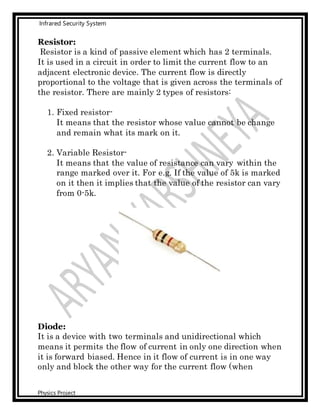
Resistor:
Resistor is a kind of passive element which has 2 terminals.
It is used in a circuit in order to limit the current flow to an
adjacent electronic device. The current flow is directly
proportional to the voltage that is given across the terminals of
the resistor. There are mainly 2 types of resistors:
1. Fixed resistor-
It means that the resistor whose value cannot be change
and remain what its mark on it.
2. Variable Resistor-
It means that the value of resistance can vary within the
range marked over it. For e.g. If the value of 5k is marked
on it then it implies that the value of the resistor can vary
from 0-5k.
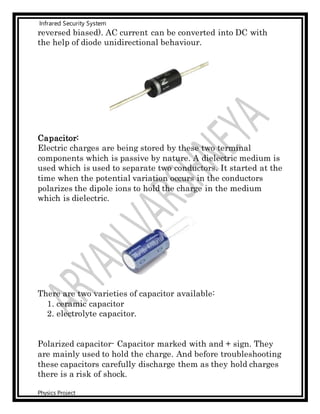
Diode:
It is a device with two terminals and unidirectional which
means it permits the flow of current in only one direction when
it is forward biased. Hence in it flow of current is in one way
only and block the other way for the current flow (when
Infrared Security System
Physics Project
reversed biased). AC current can be converted into DC with
the help of diode unidirectional behaviour.
Capacitor:
Electric charges are being stored by these two terminal
components which is passive by nature. A dielectric medium is
used which is used to separate two conductors. It started at the
time when the potential variation occurs in the conductors
polarizes the dipole ions to hold the charge in the medium
which is dielectric.
There are two varieties of capacitor available:
1. ceramic capacitor
2. electrolyte capacitor.
Polarized capacitor- Capacitor marked with and + sign. They
are mainly used to hold the charge. And before troubleshooting
these capacitors carefully discharge them as they hold charges
there is a risk of shock.
Infrared Security System
Physics Project
Non-polarized capacitor- Capacitors which do not have any
polarity marked over it. They are mainly used to remove the
noises appeared while converting AC into DC.
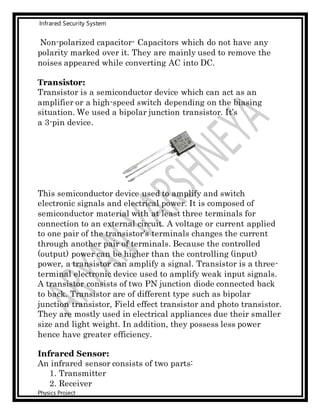
Transistor:
Transistor is a semiconductor device which can act as an
amplifier or a high-speed switch depending on the biasing
situation. We used a bipolar junction transistor. It’s
a 3-pin device.
This semiconductor device used to amplify and switch
electronic signals and electrical power. It is composed of
semiconductor material with at least three terminals for
connection to an external circuit. A voltage or current applied
to one pair of the transistor's terminals changes the current
through another pair of terminals. Because the controlled
(output) power can be higher than the controlling (input)
power, a transistor can amplify a signal. Transistor is a three-
terminal electronic device used to amplify weak input signals.
A transistor consists of two PN junction diode connected back
to back. Transistor are of different type such as bipolar
junction transistor, Field effect transistor and photo transistor.
They are mostly used in electrical appliances due their smaller
size and light weight. In addition, they possess less power
hence have greater efficiency.
Infrared Sensor:
An infrared sensor consists of two parts:
1. Transmitter
2. Receiver
Infrared Security System
Physics Project
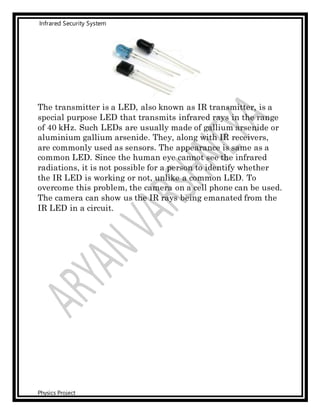
The transmitter is a LED, also known as IR transmitter, is a
special purpose LED that transmits infrared rays in the range
of 40 kHz. Such LEDs are usually made of gallium arsenide or
aluminium gallium arsenide. They, along with IR receivers,
are commonly used as sensors. The appearance is same as a
common LED. Since the human eye cannot see the infrared
radiations, it is not possible for a person to identify whether
the IR LED is working or not, unlike a common LED. To
overcome this problem, the camera on a cell phone can be used.
The camera can show us the IR rays being emanated from the
IR LED in a circuit.
Infrared Security System
Physics Project
Aim
TO MAKE INFRARED SENSOR
BASED SECURITY SYSTEM USING
SOME PRINCIPLES AND
COMPONENTS OF PHYSICS.
Infrared Security System
Physics Project
Requirements
 A 9 V BATTERY
 BATTERY CAP
 Integrated circuits
 PNP TRANSISTOR
 INFRARED TRANSMITTER AND
RECEIVER
 LIGHT EMITTING DIODE
 SMALL RESISTANCE
 BUZZER
 CONNECTING WIRE
Infrared Security System
Physics Project
 electrolytic Capacitor
 DIODES - RECTIFIER AND ZENER
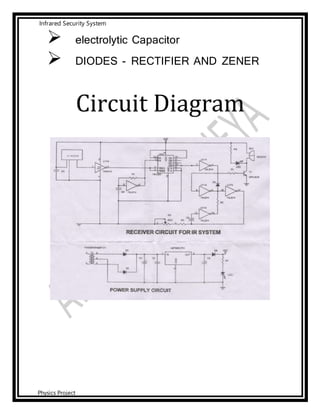
Circuit Diagram
Infrared Security System
Physics Project
Theory
Principle of operation:
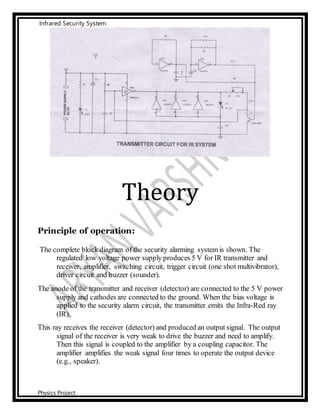
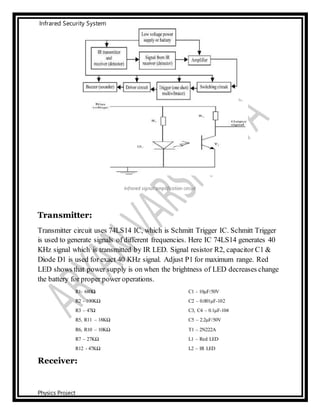
The complete block diagram of the security alarming system is shown. The
regulated low voltage power supply produces 5 V for IR transmitter and
receiver, amplifier, switching circuit, trigger circuit (one shot multivibrator),
driver circuit and buzzer (sounder).
The anode of the transmitter and receiver (detector) are connected to the 5 V power
supply and cathodes are connected to the ground. When the bias voltage is
applied to the security alarm circuit, the transmitter emits the Infra-Red ray
(IR).
This ray receives the receiver (detector) and produced an output signal. The output
signal of the receiver is very weak to drive the buzzer and need to amplify.
Then this signal is coupled to the amplifier by a coupling capacitor. The
amplifier amplifies the weak signal four times to operate the output device
(e.g., speaker).
Infrared Security System
Physics Project
Infrared signal amplification circuit
Transmitter:
Transmitter circuit uses 74LS14 IC, which is Schmitt Trigger IC. Schmitt Trigger
is used to generate signals of different frequencies. Here IC 74LS14 generates 40
KHz signal which is transmitted by IR LED. Signal resistor R2, capacitor C1 &
Diode D1 is used for exact 40 KHz signal. Adjust P1 for maximum range. Red
LED shows that power supply is on when the brightness of LED decreases change
the battery for proper power operations.
R1- 680Ω C1 - 10μF/50V
R2 - 100KΩ C2 – 0.001μF-102
R3 – 47Ω C3, C4 – 0.1μF-104
R5, R11 – 18KΩ C5 – 2.2μF/50V
R6, R10 – 10KΩ T1 – 2N222A
R7 – 27KΩ L1 – Red LED
R12 - 47KΩ L2 – IR LED
Receiver:
Infrared Security System
Physics Project
Receiver circuit operated at 5V D.C. and it derives power supply circuit. Here we
use 9V D.C. battery. IC LM7805 convert 9V D.C. to regulated 5V D.C. Instead of
9V battery, we can use transformer which converts 230V ac to 12V ac is converted
in to dc by diode D1 & D2. Then it is filtered by capacitor C1 and IC3 convert it in
to regulated 5V dc. IR receiver module detect 40 KHz signal that is transmitted
from transmitter circuit. When transmitter is ON IR sensorgets 40 KHz signal and
its output is low, when someone breaks the IR sensordoes not get signal and its
output goes to high level. This output level is fed to Schmitt Trigger IC2 at pin 1.
Output is available at pin 8 of IC2 that is used to drive the transistor. Green LED
shows the ON. Output is available means buzzer is ON for approximately 10
seconds. After 10 second circuit reset automatically and it is ready to detect other
object.
R1 – 220KΩ C1 – 1000μF/25V D1, D2, D3 – IN4007
R2 – 10KΩ C2, C4, C5 – 0.1μf-104 D4 – IN4148
R3 – 100KΩ C3 - 100 μF/25V
R4 – 1KΩ C6 - 10 μF/50V
P1 - 1MΩ IC1 – 74LS93
T1 – CL100 IC2 – 74LS14
L1 – Green LED IC3 - LM7805
Infrared Security System
Physics Project
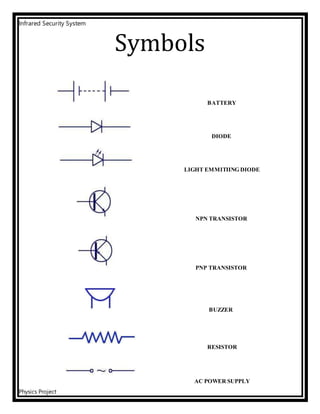
Symbols
BATTERY
DIODE
LIGHT EMMITIING DIODE
NPN TRANSISTOR
PNP TRANSISTOR
BUZZER
RESISTOR
AC POWER SUPPLY
Infrared Security System
Physics Project
Procedure
 ConnecttheBatterytoTheSwitchUsingBatteryCaptoon-off
ThePowerSupplytoTheCircuit.
 ConnecttheSwitchtoASmallResistanceWhichWillStop
UnevenPowerSupply.
 ConnecttheResistancetoInfraredTransmitterinSeries.
 WhenCurrentWillReachtheTransmitter,ItWillSendInfrared
Rays WhichisinvisibletoNakedEyes.
 TheTransmitterIsForwardBiasedandTheReceiverIsReverse
Biased.
 OntheOtherSidetheInfraredReceiverWillReceivetheRays.
 TheReceiverIsConnectedtoaPNPTransistor,Thenthe
TransistorIsConnectedtoTheBuzzerand LedinSeries.
Infrared Security System
Physics Project
 TheCircuitIsCompleteWhenThereIsSendingandReceivingof
IRRays.
 WheneverThereIsInterruptionBetweenIRRaysTransistorand
ReceivertheCurrentStartsFlowingThrough theTransistorThen
theBuzzerStartsBeepingandTheLedStartsGlowing.
Result
Infrared Security System
Physics Project
The result of this circuit depends on the
continuity of the infrared beam. If there is a
continuous beam towards the receiver there
will be no alarm. The interruption of the beam
will result in an intruder alarm.
Precautions
The PCB and the components to besoldered must befree of
dirt or grease.
Infrared Security System
Physics Project
Use 15 to 25 watt soldering iron for general work involving
small joints.
Do not move the components until the molten soldier, at
the joint iscooled.
Mount the components at the appropriate places before
soldering.
Follow the circuit description and component details and
their identification.
Do not sit under afan while soldering.
Power supply should be 9VD.C.
Infrared Security System
Physics Project
Bibliography
http://www.electroschematics.com/6239/invisible-alarm/
http://www.electroschematics.com/5457/entry-alarm/
http://www.academia.edu/5072782/Experiment_1_INVISIBLE_INTRUDER_
ALARM_AIM
http://www.electroschematics.com/9023/infrared-beam-break-
detector/
http://www.electronicshub.org/security-alarm-circuit/
http://www.electronics-tutorials.ws/opamp/opamp_1.html
http://en.wikipedia.org/wiki/Operational_amplifier
http://en.wikipedia.org/wiki/Transistor
http://en.wikipedia.org/wiki/Transistor#Transistor_as_a_switch
http://www.electroschematics.com/6239/invisible-alarm/

Infrared Security System

  • 1.
    Infrared Security System PhysicsProject PHYSICS PROJECT INFRARED SENSOR BASED SECURITY SYSYEM NAME: Aryan Varshneya CLASS : XII -A1 ROLL NO. : 04
  • 2.
    Infrared Security System PhysicsProject Index 1. Certificate 2. Acknowledgment 3. Introduction 4. Literature Review 5. Aim 6. Materials Required 7. Circuit Diagram 8. Theory 9. Procedure
  • 3.
    Infrared Security System PhysicsProject 10. Result 11. Precautions 12. Bibliography
  • 4.
    Infrared Security System PhysicsProject Introduction Rapid growth in world population with incommensurate employment opportunities and pressures of a more complex society, the incidences of human intrusion and burglaries and crime in private and public places are on the increase. Heightened security concerns at homes, banks, shopping malls, schools, offices, etc. have led to continued search for different and improved security gadgets. Such concerns are apparent in the form of installations of remote cameras, the presence of security guards and other monitoring devices and alarm systems which are in constant use. However, many such devices and services are relatively costly and usually require a high and steady power supply for their operation. An infrared sensor security alarming system which has been constructed and tested, offers the advantages of low cost and low power consumption in its operation. Not so long ago an alarm was a rare sight, however now almost every house has an alarm of some kind. One common kind of security system is an infrared home security system. These are so popular because they are easy to install without having to drill holes and lay cables. Infrared radiation is invisible to the human eye but can be detected by electronic devices designed for such a purpose. The sensors are set at the door (entrance point) and/or some supervised area and an alarm is triggered when
  • 5.
    Infrared Security System PhysicsProject an intruder passes within its range of coverage to notify/alert the people/security personnel. Infrared science and technology has been, since the first applications, mainly dedicated to security and surveillance especially in military field, besides specialized techniques in thermal imaging for medical diagnostic and building structures and recently in energy savings and aerospace context. Till recently the security applications were mainly based on thermal imaging as surveillance and warning military systems. In all these applications the advent of room temperature, more reliable due to the coolers avoidance, low cost, and, overall, completely integrable with Silicon technology FPAs, especially designed and tailored for specific applications, smart sensors, has really been impacted with revolutionary and new ideas and system concepts in all the infrared fields, especially for security applications. Lastly, the advent of reliable Infrared Solid-State Laser Sources, operating up to the Long Infrared Wavelength Band and the new emerging techniques in Far Infrared Sub-Millimeter Terahertz Bands, has opened wide and new areas for developing new, advanced security systems. A review of all the items with evidence of the weak and the strong points of each item, especially considering possible future developments, will be reported and discussed. Literature Review
  • 6.
    Infrared Security System PhysicsProject Resistor: Resistor is a kind of passive element which has 2 terminals. It is used in a circuit in order to limit the current flow to an adjacent electronic device. The current flow is directly proportional to the voltage that is given across the terminals of the resistor. There are mainly 2 types of resistors: 1. Fixed resistor- It means that the resistor whose value cannot be change and remain what its mark on it. 2. Variable Resistor- It means that the value of resistance can vary within the range marked over it. For e.g. If the value of 5k is marked on it then it implies that the value of the resistor can vary from 0-5k. Diode: It is a device with two terminals and unidirectional which means it permits the flow of current in only one direction when it is forward biased. Hence in it flow of current is in one way only and block the other way for the current flow (when
  • 7.
    Infrared Security System PhysicsProject reversed biased). AC current can be converted into DC with the help of diode unidirectional behaviour. Capacitor: Electric charges are being stored by these two terminal components which is passive by nature. A dielectric medium is used which is used to separate two conductors. It started at the time when the potential variation occurs in the conductors polarizes the dipole ions to hold the charge in the medium which is dielectric. There are two varieties of capacitor available: 1. ceramic capacitor 2. electrolyte capacitor. Polarized capacitor- Capacitor marked with and + sign. They are mainly used to hold the charge. And before troubleshooting these capacitors carefully discharge them as they hold charges there is a risk of shock.
  • 8.
    Infrared Security System PhysicsProject Non-polarized capacitor- Capacitors which do not have any polarity marked over it. They are mainly used to remove the noises appeared while converting AC into DC. Transistor: Transistor is a semiconductor device which can act as an amplifier or a high-speed switch depending on the biasing situation. We used a bipolar junction transistor. It’s a 3-pin device. This semiconductor device used to amplify and switch electronic signals and electrical power. It is composed of semiconductor material with at least three terminals for connection to an external circuit. A voltage or current applied to one pair of the transistor's terminals changes the current through another pair of terminals. Because the controlled (output) power can be higher than the controlling (input) power, a transistor can amplify a signal. Transistor is a three- terminal electronic device used to amplify weak input signals. A transistor consists of two PN junction diode connected back to back. Transistor are of different type such as bipolar junction transistor, Field effect transistor and photo transistor. They are mostly used in electrical appliances due their smaller size and light weight. In addition, they possess less power hence have greater efficiency. Infrared Sensor: An infrared sensor consists of two parts: 1. Transmitter 2. Receiver
  • 9.
    Infrared Security System PhysicsProject The transmitter is a LED, also known as IR transmitter, is a special purpose LED that transmits infrared rays in the range of 40 kHz. Such LEDs are usually made of gallium arsenide or aluminium gallium arsenide. They, along with IR receivers, are commonly used as sensors. The appearance is same as a common LED. Since the human eye cannot see the infrared radiations, it is not possible for a person to identify whether the IR LED is working or not, unlike a common LED. To overcome this problem, the camera on a cell phone can be used. The camera can show us the IR rays being emanated from the IR LED in a circuit.
  • 10.
    Infrared Security System PhysicsProject Aim TO MAKE INFRARED SENSOR BASED SECURITY SYSTEM USING SOME PRINCIPLES AND COMPONENTS OF PHYSICS.
  • 11.
    Infrared Security System PhysicsProject Requirements  A 9 V BATTERY  BATTERY CAP  Integrated circuits  PNP TRANSISTOR  INFRARED TRANSMITTER AND RECEIVER  LIGHT EMITTING DIODE  SMALL RESISTANCE  BUZZER  CONNECTING WIRE
  • 12.
    Infrared Security System PhysicsProject  electrolytic Capacitor  DIODES - RECTIFIER AND ZENER Circuit Diagram
  • 13.
    Infrared Security System PhysicsProject Theory Principle of operation: The complete block diagram of the security alarming system is shown. The regulated low voltage power supply produces 5 V for IR transmitter and receiver, amplifier, switching circuit, trigger circuit (one shot multivibrator), driver circuit and buzzer (sounder). The anode of the transmitter and receiver (detector) are connected to the 5 V power supply and cathodes are connected to the ground. When the bias voltage is applied to the security alarm circuit, the transmitter emits the Infra-Red ray (IR). This ray receives the receiver (detector) and produced an output signal. The output signal of the receiver is very weak to drive the buzzer and need to amplify. Then this signal is coupled to the amplifier by a coupling capacitor. The amplifier amplifies the weak signal four times to operate the output device (e.g., speaker).
  • 14.
    Infrared Security System PhysicsProject Infrared signal amplification circuit Transmitter: Transmitter circuit uses 74LS14 IC, which is Schmitt Trigger IC. Schmitt Trigger is used to generate signals of different frequencies. Here IC 74LS14 generates 40 KHz signal which is transmitted by IR LED. Signal resistor R2, capacitor C1 & Diode D1 is used for exact 40 KHz signal. Adjust P1 for maximum range. Red LED shows that power supply is on when the brightness of LED decreases change the battery for proper power operations. R1- 680Ω C1 - 10μF/50V R2 - 100KΩ C2 – 0.001μF-102 R3 – 47Ω C3, C4 – 0.1μF-104 R5, R11 – 18KΩ C5 – 2.2μF/50V R6, R10 – 10KΩ T1 – 2N222A R7 – 27KΩ L1 – Red LED R12 - 47KΩ L2 – IR LED Receiver:
  • 15.
    Infrared Security System PhysicsProject Receiver circuit operated at 5V D.C. and it derives power supply circuit. Here we use 9V D.C. battery. IC LM7805 convert 9V D.C. to regulated 5V D.C. Instead of 9V battery, we can use transformer which converts 230V ac to 12V ac is converted in to dc by diode D1 & D2. Then it is filtered by capacitor C1 and IC3 convert it in to regulated 5V dc. IR receiver module detect 40 KHz signal that is transmitted from transmitter circuit. When transmitter is ON IR sensorgets 40 KHz signal and its output is low, when someone breaks the IR sensordoes not get signal and its output goes to high level. This output level is fed to Schmitt Trigger IC2 at pin 1. Output is available at pin 8 of IC2 that is used to drive the transistor. Green LED shows the ON. Output is available means buzzer is ON for approximately 10 seconds. After 10 second circuit reset automatically and it is ready to detect other object. R1 – 220KΩ C1 – 1000μF/25V D1, D2, D3 – IN4007 R2 – 10KΩ C2, C4, C5 – 0.1μf-104 D4 – IN4148 R3 – 100KΩ C3 - 100 μF/25V R4 – 1KΩ C6 - 10 μF/50V P1 - 1MΩ IC1 – 74LS93 T1 – CL100 IC2 – 74LS14 L1 – Green LED IC3 - LM7805
  • 16.
    Infrared Security System PhysicsProject Symbols BATTERY DIODE LIGHT EMMITIING DIODE NPN TRANSISTOR PNP TRANSISTOR BUZZER RESISTOR AC POWER SUPPLY
  • 17.
    Infrared Security System PhysicsProject Procedure  ConnecttheBatterytoTheSwitchUsingBatteryCaptoon-off ThePowerSupplytoTheCircuit.  ConnecttheSwitchtoASmallResistanceWhichWillStop UnevenPowerSupply.  ConnecttheResistancetoInfraredTransmitterinSeries.  WhenCurrentWillReachtheTransmitter,ItWillSendInfrared Rays WhichisinvisibletoNakedEyes.  TheTransmitterIsForwardBiasedandTheReceiverIsReverse Biased.  OntheOtherSidetheInfraredReceiverWillReceivetheRays.  TheReceiverIsConnectedtoaPNPTransistor,Thenthe TransistorIsConnectedtoTheBuzzerand LedinSeries.
  • 18.
    Infrared Security System PhysicsProject  TheCircuitIsCompleteWhenThereIsSendingandReceivingof IRRays.  WheneverThereIsInterruptionBetweenIRRaysTransistorand ReceivertheCurrentStartsFlowingThrough theTransistorThen theBuzzerStartsBeepingandTheLedStartsGlowing. Result
  • 19.
    Infrared Security System PhysicsProject The result of this circuit depends on the continuity of the infrared beam. If there is a continuous beam towards the receiver there will be no alarm. The interruption of the beam will result in an intruder alarm. Precautions The PCB and the components to besoldered must befree of dirt or grease.
  • 20.
    Infrared Security System PhysicsProject Use 15 to 25 watt soldering iron for general work involving small joints. Do not move the components until the molten soldier, at the joint iscooled. Mount the components at the appropriate places before soldering. Follow the circuit description and component details and their identification. Do not sit under afan while soldering. Power supply should be 9VD.C.
  • 21.
    Infrared Security System PhysicsProject Bibliography http://www.electroschematics.com/6239/invisible-alarm/ http://www.electroschematics.com/5457/entry-alarm/ http://www.academia.edu/5072782/Experiment_1_INVISIBLE_INTRUDER_ ALARM_AIM http://www.electroschematics.com/9023/infrared-beam-break- detector/ http://www.electronicshub.org/security-alarm-circuit/ http://www.electronics-tutorials.ws/opamp/opamp_1.html http://en.wikipedia.org/wiki/Operational_amplifier http://en.wikipedia.org/wiki/Transistor http://en.wikipedia.org/wiki/Transistor#Transistor_as_a_switch http://www.electroschematics.com/6239/invisible-alarm/