2016-17
NAME: AKASHDIXITAND YOGESH MALIK
ROLL NO.: 12B31 AND 12B29
PHYSICS INVESTIGATORY
PROJECT
K.V.NO.2 EME BARODA
DEPARTMENT OF PHYSICS
CERTIFICATE
This is to certify that Akash Dixit , student of class
XII-B has successfully completed the research on
the below mentioned project under the guidance of
Mr. S.V. Singh Sir during the year 2016-2017 in
partial fulfilment of Physics practical examination
conducted by AISSCE, New Delhi.
Signature of Signature of
external examiner Physics teacher
K.V.NO.2 EME BARODA
DEPARTMENT OF PHYSICS
CERTIFICATE
This is to certify that Yogesh Malik , student of class
XII-B has successfully completed the research on
the below mentioned project under the guidance of
Mr. S.V. Singh Sir during the year 2016-2017 in
partial fulfilment of Physics practical examination
conducted by AISSCE, New Delhi.
Signature of Signature of
external examiner Physics teacher
ACKNOWLEDGEMENT
In the accomplishment of this project
successfully, many people have best owned
upon me their blessings and the heart
pledged support, this time I am utilizing to
thank all the people who have been concerned
with project.
Primarily I would thank god for being able
to complete this project with success. Then
I would like to thank my principal
and Physics teacher Mr.S.V Singh , whose
valuable guidance has been the ones that
helped me patch this project and make it
full proof success. His suggestions and his
instructions have served as the major
contributor towards the completion of the
project.
Then I would like to thank my parents and
friends who have helped me with their
valuable suggestions and guidance has been
helpful in various phases of the completion
of the project.
Last but not the least I would like to thank
my classmates who have helped me a lot and
also Lab attendant Chandu Sir .
-:CONTENTS:-
1. Certificate
2. Acknowledgement
3. Introduction
4. Theory
5. Activity
 Aim
 Apparatus required
 Procedure
 Result
 Precaution
6. Bibliography
INFRARED SENSOR
BASED SECURITY
. SYSTEM .
The Objective of this project is to study infrared
based security system and its working to catch any
thief .
INTRODUCTION
Rapid growth in world population with incommensurate employment
opportunities and pressures of a more complex society, the incidences of
human intrusion and burglaries and crime in private and public places are on
the increase. Heightened security concerns at homes, banks, shopping malls,
schools, offices, etc. have led to continued search for different and improved
security gadgets.
Such concerns are apparent in the form of installations of remote cameras, the
presence of security guards and other monitoring devices and alarm systems
which are in constant use . However, many such devices and services are
relatively costly and usually require a high and steady power supply for their
operation). An infrared sensor security alarming system which has been
constructed and tested, offers the advantages of low cost and low power
consumption in its operation .
Not so long ago an alarm was a fairly rare sight, however now almost every
house has an alarm of some kind. One common kind of security system is an
infrared home security system. These are so popular because they are easy to
install without having to drill holes and lay cables. Infrared radiation is
invisible to the human eye but can be detected by electronic devices designed
for such a purpose.
The sensors are set at the door (entrance point) and/or some supervised area and an
alarm is triggered when an intruder passes within its range of coverage to notify/alert
the people/security personnel.
Infrared science and technology has been, since the first applications, mainly
dedicated to security and surveillance especially in military field, besides specialized
techniques in thermal imaging for medical diagnostic and building structures and
recently in energy savings and aerospace context. Till recently the security
applications were mainly based on thermal imaging as surveillance and warning
military systems. In all these applications the advent of room temperature, more
reliable due to the coolers avoidance, low cost, and, overall, completely integrable
with Silicon technology FPAs, especially designed and tailored for specific
applications, smart sensors, has really been impacted with revolutionary and new
ideas and system concepts in all the infrared fields, especially for security
applications. Lastly, the advent of reliable Infrared Solid State Laser Sources,
operating up to the Long Infrared Wavelength Band and the new emerging
techniques in Far Infrared Sub- millimetre Terahertz Bands, has opened wide and
new areas for developing new, advanced security systems. A review of all the items
with evidence of the weak and the strong points of each item, especially considering
possible future developments, will be reported and discussed.
Historical introduction:-
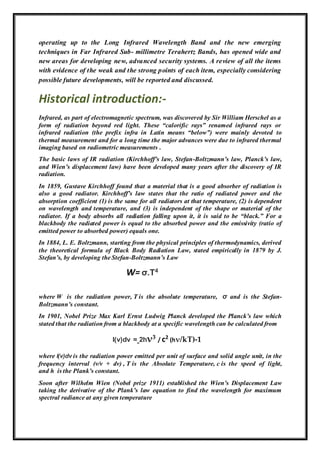
Infrared, as part of electromagnetic spectrum, was discovered by Sir William Herschel as a
form of radiation beyond red light. These “calorific rays” renamed infrared rays or
infrared radiation (the prefix infra in Latin means “below”) were mainly devoted to
thermal measurement and for a long time the major advances were due to infrared thermal
imaging based on radiometric measurements .
The basic laws of IR radiation (Kirchhoff’s law, Stefan-Boltzmann’s law, Planck’s law,
and Wien’s displacement law) have been developed many years after the discovery of IR
radiation.
In 1859, Gustave Kirchhoff found that a material that is a good absorber of radiation is
also a good radiator. Kirchhoff’s law states that the ratio of radiated power and the
absorption coefficient (1) is the same for all radiators at that temperature, (2) is dependent
on wavelength and temperature, and (3) is independent of the shape or material of the
radiator. If a body absorbs all radiation falling upon it, it is said to be “black.” For a
blackbody the radiated power is equal to the absorbed power and the emissivity (ratio of
emitted power to absorbed power) equals one.
In 1884, L. E. Boltzmann, starting from the physical principles of thermodynamics, derived
the theoretical formula of Black Body Radiation Law, stated empirically in 1879 by J.
Stefan’s, by developing the Stefan-Boltzmann’s Law
W= σ.T4
where W is the radiation power, T is the absolute temperature, σ and is the Stefan-
Boltzmann’s constant.
In 1901, Nobel Prize Max Karl Ernst Ludwig Planck developed the Planck’s law which
stated that the radiation from a blackbody at a specific wavelength can be calculated from
I(v)dv = 2hν3 / c2
(hν/kT)-1
where I(v)dv is the radiation power emitted per unit of surface and solid angle unit, in the
frequency interval (v/v + dv) , T is the Absolute Temperature, c is the speed of light,
and h is the Plank’s constant.
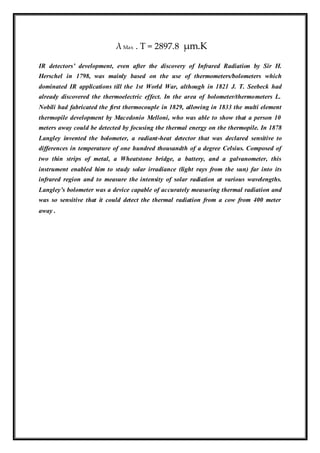
Soon after Wilhelm Wien (Nobel prize 1911) established the Wien’s Displacement Law
taking the derivative of the Plank’s law equation to find the wavelength for maximum
spectral radiance at any given temperature
λ Max . T = 2897.8 μm.K
IR detectors’ development, even after the discovery of Infrared Radiation by Sir H.
Herschel in 1798, was mainly based on the use of thermometers/bolometers which
dominated IR applications till the 1st World War, although in 1821 J. T. Seebeck had
already discovered the thermoelectric effect. In the area of bolometer/thermometers L.
Nobili had fabricated the first thermocouple in 1829, allowing in 1833 the multi element
thermopile development by Macedonio Melloni, who was able to show that a person 10
meters away could be detected by focusing the thermal energy on the thermopile. In 1878
Langley invented the bolometer, a radiant-heat detector that was declared sensitive to
differences in temperature of one hundred thousandth of a degree Celsius. Composed of
two thin strips of metal, a Wheatstone bridge, a battery, and a galvanometer, this
instrument enabled him to study solar irradiance (light rays from the sun) far into its
infrared region and to measure the intensity of solar radiation at various wavelengths.
Langley’s bolometer was a device capable of accurately measuring thermal radiation and
was so sensitive that it could detect the thermal radiation from a cow from 400 meter
away .
THEORY
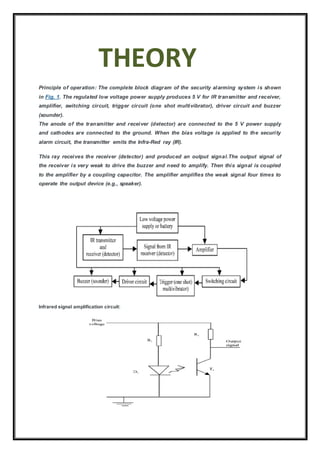
Principle of operation: The complete block diagram of the security alarming system is shown
in Fig. 1. The regulated low voltage power supply produces 5 V for IR transmitter and receiver,
amplifier, switching circuit, trigger circuit (one shot multivibrator), driver circuit and buzzer
(sounder).
The anode of the transmitter and receiver (detector) are connected to the 5 V power supply
and cathodes are connected to the ground. When the bias voltage is applied to the security
alarm circuit, the transmitter emits the Infra-Red ray (IR).
This ray receives the receiver (detector) and produced an output signal.The output signal of
the receiver is very weak to drive the buzzer and need to amplify. Then this signal is coupled
to the amplifier by a coupling capacitor. The amplifier amplifies the weak signal four times to
operate the output device (e.g., speaker).
Infrared signal amplification circuit:
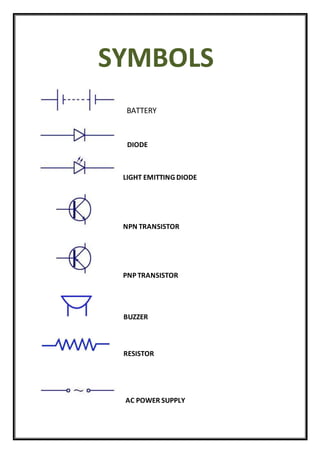
SYMBOLS
BATTERY
DIODE
LIGHT EMITTING DIODE
NPN TRANSISTOR
PNP TRANSISTOR
BUZZER
RESISTOR
AC POWER SUPPLY
ACTIVITY
AIM: TO MAKE A INFRARED SENSOR BASED SECURITY SYSTEM USING
SOME PRINCIPLES AND COMPONENTS OF PHYSICS.
MATERIAL REQUIRED: 1. A 9V BATTERY
2. BATTERY CAP
3. ON-OFF SWITCH
4. PNP TRANSISTOR
5. INFRARED TRANSMITTER AND RECEIVER
6. LIGHT EMITTING DIODE
7. SMALL RESISTANCE
8. BUZZER
9. CONNECTING WIRE
PROCEDURE AND WORKING:-
1. CONNECT THE BATTERY TO THE SWITCH USING BATTERY CAP TO ON-
OFF THE POWER SUPPLYTO THE CIRCUIT.
2. CONNECT THE SWITCH TO A SMALL RESISTANCE WHICH WILL STOP
UNEVEN POWER SUPPLY.
3. THE CONNECT THE RESISTANCE TO INFRARED TRANSMITTER IN SERIES.
4. WHEN CURRENT WILL REACH THE TRANMITTER IT WILL SEND INFRARED
RAYS WHICH WE CANNOT SEE WITH NAKED EYES.
5. THE TRANSMITTER IS FORWARD BIASED AND THE RECEIVER IS
REVERSE BIASED.
6. ON THE OTHER SIDE THE INFRARED RECEIVER WILL RECEIVE THE RAYS.
7. THE RECEIVER IS CONNECTED TO A PNP TRANSISTOR , THEN THE
TRANSISTOR IS CONNECTED TO THE BUZZER AND LED IN SERIES .
8. THE CIRCUIT IS COMPLETE WHEN THEIR IS SENDING AND RECEIVING OF
IR RAYS.
9. WHENEVER THEIR IS INTERRUPTION BETWEEN IR RAYS TRANSISTOR
AND RECEIVER THE CURRENT STARTS FLOWING THROUGH THE
TRANSISTOR THEN THE BUZZER STARTS BEEPING AND THE LED STARTS
GLOWING.
RESULT: FINALLY OUR PYROELECTRIC INFRARED
SENSOR BASED SECURITY IS READY TO USE AND STOP
BURGLAR.
PRECAUTION:-
1. CONNECTIONS SHOULD BE NEAT, CLEAN AND TIGHT.
2. RESISTORS OF SMALL RESISTANCE SHULD BE
TAKEN.
3. WHILE COMPLETING THE CIRCUIT WE SHOULD
REMEMBER OF CATHODE AND ANODE TERMINAL OF
LED , TRANSMITTER AND RECEIVER .
4.ALL THE COMPONENTS MUST BE CHECKED WHETHER
THEY ARE WORKING OR NOT .
5. DISTANCE BETWEEN THE TRANSMITTER AND
RECEIVER SHOULD NOT BE MORE THAN THE RANGE OF
IR RAYS.
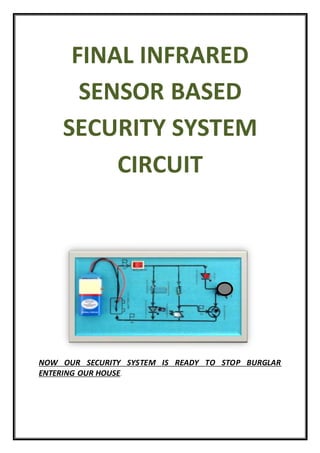
FINAL INFRARED
SENSOR BASED
SECURITY SYSTEM
CIRCUIT
NOW OUR SECURITY SYSTEM IS READY TO STOP BURGLAR
ENTERING OUR HOUSE.
Bibliography
1. Website
 www.google.com
 www.hindawi.com
 en.wikipedia.org
2. BOOKS
 Pradeep’s New Course physics
 Ncert class xii

Physics investigatory project on ir based security system

  • 1.
    2016-17 NAME: AKASHDIXITAND YOGESHMALIK ROLL NO.: 12B31 AND 12B29 PHYSICS INVESTIGATORY PROJECT
  • 2.
    K.V.NO.2 EME BARODA DEPARTMENTOF PHYSICS CERTIFICATE This is to certify that Akash Dixit , student of class XII-B has successfully completed the research on the below mentioned project under the guidance of Mr. S.V. Singh Sir during the year 2016-2017 in partial fulfilment of Physics practical examination conducted by AISSCE, New Delhi. Signature of Signature of external examiner Physics teacher
  • 3.
    K.V.NO.2 EME BARODA DEPARTMENTOF PHYSICS CERTIFICATE This is to certify that Yogesh Malik , student of class XII-B has successfully completed the research on the below mentioned project under the guidance of Mr. S.V. Singh Sir during the year 2016-2017 in partial fulfilment of Physics practical examination conducted by AISSCE, New Delhi. Signature of Signature of external examiner Physics teacher
  • 4.
    ACKNOWLEDGEMENT In the accomplishmentof this project successfully, many people have best owned upon me their blessings and the heart pledged support, this time I am utilizing to thank all the people who have been concerned with project. Primarily I would thank god for being able to complete this project with success. Then I would like to thank my principal and Physics teacher Mr.S.V Singh , whose valuable guidance has been the ones that helped me patch this project and make it full proof success. His suggestions and his instructions have served as the major contributor towards the completion of the project. Then I would like to thank my parents and friends who have helped me with their valuable suggestions and guidance has been helpful in various phases of the completion of the project. Last but not the least I would like to thank my classmates who have helped me a lot and also Lab attendant Chandu Sir .
  • 5.
    -:CONTENTS:- 1. Certificate 2. Acknowledgement 3.Introduction 4. Theory 5. Activity  Aim  Apparatus required  Procedure  Result  Precaution 6. Bibliography
  • 6.
    INFRARED SENSOR BASED SECURITY .SYSTEM . The Objective of this project is to study infrared based security system and its working to catch any thief .
  • 7.
    INTRODUCTION Rapid growth inworld population with incommensurate employment opportunities and pressures of a more complex society, the incidences of human intrusion and burglaries and crime in private and public places are on the increase. Heightened security concerns at homes, banks, shopping malls, schools, offices, etc. have led to continued search for different and improved security gadgets. Such concerns are apparent in the form of installations of remote cameras, the presence of security guards and other monitoring devices and alarm systems which are in constant use . However, many such devices and services are relatively costly and usually require a high and steady power supply for their operation). An infrared sensor security alarming system which has been constructed and tested, offers the advantages of low cost and low power consumption in its operation . Not so long ago an alarm was a fairly rare sight, however now almost every house has an alarm of some kind. One common kind of security system is an infrared home security system. These are so popular because they are easy to install without having to drill holes and lay cables. Infrared radiation is invisible to the human eye but can be detected by electronic devices designed for such a purpose. The sensors are set at the door (entrance point) and/or some supervised area and an alarm is triggered when an intruder passes within its range of coverage to notify/alert the people/security personnel. Infrared science and technology has been, since the first applications, mainly dedicated to security and surveillance especially in military field, besides specialized techniques in thermal imaging for medical diagnostic and building structures and recently in energy savings and aerospace context. Till recently the security applications were mainly based on thermal imaging as surveillance and warning military systems. In all these applications the advent of room temperature, more reliable due to the coolers avoidance, low cost, and, overall, completely integrable with Silicon technology FPAs, especially designed and tailored for specific applications, smart sensors, has really been impacted with revolutionary and new ideas and system concepts in all the infrared fields, especially for security applications. Lastly, the advent of reliable Infrared Solid State Laser Sources,
  • 8.
    operating up tothe Long Infrared Wavelength Band and the new emerging techniques in Far Infrared Sub- millimetre Terahertz Bands, has opened wide and new areas for developing new, advanced security systems. A review of all the items with evidence of the weak and the strong points of each item, especially considering possible future developments, will be reported and discussed. Historical introduction:- Infrared, as part of electromagnetic spectrum, was discovered by Sir William Herschel as a form of radiation beyond red light. These “calorific rays” renamed infrared rays or infrared radiation (the prefix infra in Latin means “below”) were mainly devoted to thermal measurement and for a long time the major advances were due to infrared thermal imaging based on radiometric measurements . The basic laws of IR radiation (Kirchhoff’s law, Stefan-Boltzmann’s law, Planck’s law, and Wien’s displacement law) have been developed many years after the discovery of IR radiation. In 1859, Gustave Kirchhoff found that a material that is a good absorber of radiation is also a good radiator. Kirchhoff’s law states that the ratio of radiated power and the absorption coefficient (1) is the same for all radiators at that temperature, (2) is dependent on wavelength and temperature, and (3) is independent of the shape or material of the radiator. If a body absorbs all radiation falling upon it, it is said to be “black.” For a blackbody the radiated power is equal to the absorbed power and the emissivity (ratio of emitted power to absorbed power) equals one. In 1884, L. E. Boltzmann, starting from the physical principles of thermodynamics, derived the theoretical formula of Black Body Radiation Law, stated empirically in 1879 by J. Stefan’s, by developing the Stefan-Boltzmann’s Law W= σ.T4 where W is the radiation power, T is the absolute temperature, σ and is the Stefan- Boltzmann’s constant. In 1901, Nobel Prize Max Karl Ernst Ludwig Planck developed the Planck’s law which stated that the radiation from a blackbody at a specific wavelength can be calculated from I(v)dv = 2hν3 / c2 (hν/kT)-1 where I(v)dv is the radiation power emitted per unit of surface and solid angle unit, in the frequency interval (v/v + dv) , T is the Absolute Temperature, c is the speed of light, and h is the Plank’s constant. Soon after Wilhelm Wien (Nobel prize 1911) established the Wien’s Displacement Law taking the derivative of the Plank’s law equation to find the wavelength for maximum spectral radiance at any given temperature
  • 9.
    λ Max .T = 2897.8 μm.K IR detectors’ development, even after the discovery of Infrared Radiation by Sir H. Herschel in 1798, was mainly based on the use of thermometers/bolometers which dominated IR applications till the 1st World War, although in 1821 J. T. Seebeck had already discovered the thermoelectric effect. In the area of bolometer/thermometers L. Nobili had fabricated the first thermocouple in 1829, allowing in 1833 the multi element thermopile development by Macedonio Melloni, who was able to show that a person 10 meters away could be detected by focusing the thermal energy on the thermopile. In 1878 Langley invented the bolometer, a radiant-heat detector that was declared sensitive to differences in temperature of one hundred thousandth of a degree Celsius. Composed of two thin strips of metal, a Wheatstone bridge, a battery, and a galvanometer, this instrument enabled him to study solar irradiance (light rays from the sun) far into its infrared region and to measure the intensity of solar radiation at various wavelengths. Langley’s bolometer was a device capable of accurately measuring thermal radiation and was so sensitive that it could detect the thermal radiation from a cow from 400 meter away .
  • 10.
    THEORY Principle of operation:The complete block diagram of the security alarming system is shown in Fig. 1. The regulated low voltage power supply produces 5 V for IR transmitter and receiver, amplifier, switching circuit, trigger circuit (one shot multivibrator), driver circuit and buzzer (sounder). The anode of the transmitter and receiver (detector) are connected to the 5 V power supply and cathodes are connected to the ground. When the bias voltage is applied to the security alarm circuit, the transmitter emits the Infra-Red ray (IR). This ray receives the receiver (detector) and produced an output signal.The output signal of the receiver is very weak to drive the buzzer and need to amplify. Then this signal is coupled to the amplifier by a coupling capacitor. The amplifier amplifies the weak signal four times to operate the output device (e.g., speaker). Infrared signal amplification circuit:
  • 11.
    SYMBOLS BATTERY DIODE LIGHT EMITTING DIODE NPNTRANSISTOR PNP TRANSISTOR BUZZER RESISTOR AC POWER SUPPLY
  • 13.
    ACTIVITY AIM: TO MAKEA INFRARED SENSOR BASED SECURITY SYSTEM USING SOME PRINCIPLES AND COMPONENTS OF PHYSICS. MATERIAL REQUIRED: 1. A 9V BATTERY 2. BATTERY CAP 3. ON-OFF SWITCH 4. PNP TRANSISTOR 5. INFRARED TRANSMITTER AND RECEIVER 6. LIGHT EMITTING DIODE 7. SMALL RESISTANCE 8. BUZZER 9. CONNECTING WIRE PROCEDURE AND WORKING:- 1. CONNECT THE BATTERY TO THE SWITCH USING BATTERY CAP TO ON- OFF THE POWER SUPPLYTO THE CIRCUIT. 2. CONNECT THE SWITCH TO A SMALL RESISTANCE WHICH WILL STOP UNEVEN POWER SUPPLY. 3. THE CONNECT THE RESISTANCE TO INFRARED TRANSMITTER IN SERIES. 4. WHEN CURRENT WILL REACH THE TRANMITTER IT WILL SEND INFRARED RAYS WHICH WE CANNOT SEE WITH NAKED EYES.
  • 14.
    5. THE TRANSMITTERIS FORWARD BIASED AND THE RECEIVER IS REVERSE BIASED. 6. ON THE OTHER SIDE THE INFRARED RECEIVER WILL RECEIVE THE RAYS. 7. THE RECEIVER IS CONNECTED TO A PNP TRANSISTOR , THEN THE TRANSISTOR IS CONNECTED TO THE BUZZER AND LED IN SERIES . 8. THE CIRCUIT IS COMPLETE WHEN THEIR IS SENDING AND RECEIVING OF IR RAYS. 9. WHENEVER THEIR IS INTERRUPTION BETWEEN IR RAYS TRANSISTOR AND RECEIVER THE CURRENT STARTS FLOWING THROUGH THE TRANSISTOR THEN THE BUZZER STARTS BEEPING AND THE LED STARTS GLOWING. RESULT: FINALLY OUR PYROELECTRIC INFRARED SENSOR BASED SECURITY IS READY TO USE AND STOP BURGLAR. PRECAUTION:- 1. CONNECTIONS SHOULD BE NEAT, CLEAN AND TIGHT. 2. RESISTORS OF SMALL RESISTANCE SHULD BE TAKEN. 3. WHILE COMPLETING THE CIRCUIT WE SHOULD REMEMBER OF CATHODE AND ANODE TERMINAL OF LED , TRANSMITTER AND RECEIVER . 4.ALL THE COMPONENTS MUST BE CHECKED WHETHER THEY ARE WORKING OR NOT . 5. DISTANCE BETWEEN THE TRANSMITTER AND RECEIVER SHOULD NOT BE MORE THAN THE RANGE OF IR RAYS.
  • 15.
    FINAL INFRARED SENSOR BASED SECURITYSYSTEM CIRCUIT NOW OUR SECURITY SYSTEM IS READY TO STOP BURGLAR ENTERING OUR HOUSE.
  • 16.
    Bibliography 1. Website  www.google.com www.hindawi.com  en.wikipedia.org 2. BOOKS  Pradeep’s New Course physics  Ncert class xii