POSTNATAL ASSESSMENT
PRANATI PATRA
PHASES OF PUERPERIUM
Taking-In Phase
 It takes 2-3 days, during which time the mother’s first
concern is with her own needs (sleep and food).
 The woman reacts passively, mostly dependent on
others to meet her needs.
 She is quite talkative during this phase about every
detail of her labor and delivery experience.
Taking-Hold Phase (Taking Responsibility
as a Mother)
 It starts the 3rd day postpartum
 She progresses from the passive individual to the
one who is in command of the situation.
This phase lasts about 10 days.
Once the mother has taken control of her physical
being and accepted her role as a mother, she is able
to extend her energies to her mate and other
children.
PHASES OF PUERPERIUM
Letting-go Phase
 This generally occurs when the mother returns home.
In this phase there are two separations that the mother
must accomplish.
 One is to realize and accept physical separation from
the infant. The other is to relinquish her former role as a
childless person and accept the enormous implications
and responsibilities of her new situation.
PHASES OF PUERPERIUM
PHYSICAL ASSESSMENT
• Physical Assessment is necessary to identify
individual needs or potential problems
• Explain to pt purposes of the examination.
• Obtain her consent.
• Record your findings and report results to the
mother.
• Ensure privacy and environment where the mother
can lie on her back with her head supported.
• Ensure bladder is empty & lay patient supine with
legs flexed.
• The midwives hands should be clean and warm
POSTPARTUM MATERNAL
PHYSICAL ASSESSMENT
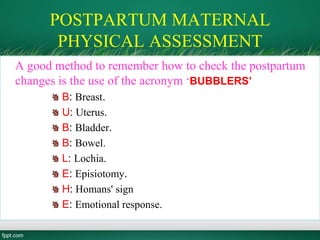
A good method to remember how to check the postpartum
changes is the use of the acronym ‘BUBBLERS’
B: Breast.
U: Uterus.
B: Bladder.
B: Bowel.
L: Lochia.
E: Episiotomy.
H: Homans' sign
E: Emotional response.
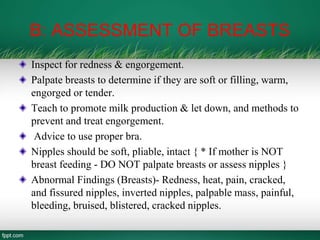
B: ASSESSMENT OF BREASTS
Inspect for redness & engorgement.
Palpate breasts to determine if they are soft or filling, warm,
engorged or tender.
Teach to promote milk production & let down, and methods to
prevent and treat engorgement.
Advice to use proper bra.
Nipples should be soft, pliable, intact { * If mother is NOT
breast feeding - DO NOT palpate breasts or assess nipples }
Abnormal Findings (Breasts)- Redness, heat, pain, cracked,
and fissured nipples, inverted nipples, palpable mass, painful,
bleeding, bruised, blistered, cracked nipples.
U- ASSESSMENT OF THE UTERUS
• Placement and Size (location)
• Tone
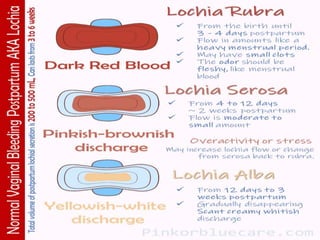
• Lochia
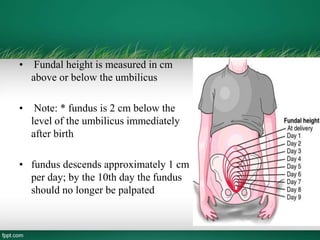
• Fundal height is measured in cm
above or below the umbilicus
• Note: * fundus is 2 cm below the
level of the umbilicus immediately
after birth
• fundus descends approximately 1 cm
per day; by the 10th day the fundus
should no longer be palpated
B: BLADDER
• Marked diuresis is expected for 2-3 days
following delivery: voiding should be
encouraged within 6-8 hrs after labor.
• Ambulate the pt
B: BOWEL
• Bowel: there may be no bowel action for a couple of
days because the bowel has probably been emptied
during labor.
• Glycerin suppository may be used to relieve
constipation
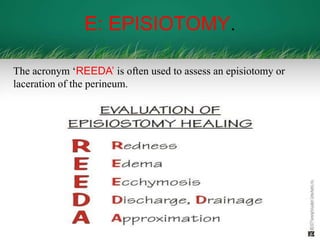
The acronym ‘REEDA’ is often used to assess an episiotomy or
laceration of the perineum.
E: EPISIOTOMY.
• Redness is considered normal with episiotomies and
lacerations
• however, if there is significant pain present, further
assessment is necessary.
• Excessive edema can delay wound healing and the
use of ice packs during the immediate postpartum
period is generally indicated.
• Inspect and observe for presence of episiotomy
lacerations, edema, pain or ulceration.
• Only sterile vaginal pads should be used
• Keep the area clean and dry by employing perineal
care.
• use a sitz bath to aid in perineal healing.To avoid
infection
• Teach the mother principals of selfcare.
H: Homans' sign
• Homan's sign, is indicative of a deep
vein thrombosis (DVT)
• Negative Homan’s Sign is with No
PAIN
• If there is pain then it is positive (+) and
the nurse needs to report this finding
immediately to the health care provider.
• Press down gently on the patient’s knee
(legs extended flat on bed) ask her to
flex her foot (dorsiflex)
E: Emotional response
• sleep deprivation
• ability to rest
• energy level
• comfort level
• anxiety level
• Appetite
• bonding behaviours
• support system (family, husband, self supported)
IMMUNIZATION
• Administration of anti–D–gamma
globulin{RhoGAM} to unimmunized Rh-negative
mother bearing Rh-positive baby.
• Women who are susceptible to rubella can be
vaccinated safely with live attenuated rubella virus.
• The booster dose of tetanus toxoid, HepB,should be
given at the time of discharge, if it is not given during
pregnancy
Postnatal assessment

Postnatal assessment

  • 1.
  • 3.
    PHASES OF PUERPERIUM Taking-InPhase  It takes 2-3 days, during which time the mother’s first concern is with her own needs (sleep and food).  The woman reacts passively, mostly dependent on others to meet her needs.  She is quite talkative during this phase about every detail of her labor and delivery experience.
  • 4.
    Taking-Hold Phase (TakingResponsibility as a Mother)  It starts the 3rd day postpartum  She progresses from the passive individual to the one who is in command of the situation. This phase lasts about 10 days. Once the mother has taken control of her physical being and accepted her role as a mother, she is able to extend her energies to her mate and other children. PHASES OF PUERPERIUM
  • 5.
    Letting-go Phase  Thisgenerally occurs when the mother returns home. In this phase there are two separations that the mother must accomplish.  One is to realize and accept physical separation from the infant. The other is to relinquish her former role as a childless person and accept the enormous implications and responsibilities of her new situation. PHASES OF PUERPERIUM
  • 7.
    PHYSICAL ASSESSMENT • PhysicalAssessment is necessary to identify individual needs or potential problems • Explain to pt purposes of the examination. • Obtain her consent. • Record your findings and report results to the mother.
  • 8.
    • Ensure privacyand environment where the mother can lie on her back with her head supported. • Ensure bladder is empty & lay patient supine with legs flexed. • The midwives hands should be clean and warm
  • 9.
    POSTPARTUM MATERNAL PHYSICAL ASSESSMENT Agood method to remember how to check the postpartum changes is the use of the acronym ‘BUBBLERS’ B: Breast. U: Uterus. B: Bladder. B: Bowel. L: Lochia. E: Episiotomy. H: Homans' sign E: Emotional response.
  • 10.
    B: ASSESSMENT OFBREASTS Inspect for redness & engorgement. Palpate breasts to determine if they are soft or filling, warm, engorged or tender. Teach to promote milk production & let down, and methods to prevent and treat engorgement. Advice to use proper bra. Nipples should be soft, pliable, intact { * If mother is NOT breast feeding - DO NOT palpate breasts or assess nipples } Abnormal Findings (Breasts)- Redness, heat, pain, cracked, and fissured nipples, inverted nipples, palpable mass, painful, bleeding, bruised, blistered, cracked nipples.
  • 11.
    U- ASSESSMENT OFTHE UTERUS • Placement and Size (location) • Tone • Lochia
  • 12.
    • Fundal heightis measured in cm above or below the umbilicus • Note: * fundus is 2 cm below the level of the umbilicus immediately after birth • fundus descends approximately 1 cm per day; by the 10th day the fundus should no longer be palpated
  • 16.
    B: BLADDER • Markeddiuresis is expected for 2-3 days following delivery: voiding should be encouraged within 6-8 hrs after labor. • Ambulate the pt
  • 17.
    B: BOWEL • Bowel:there may be no bowel action for a couple of days because the bowel has probably been emptied during labor. • Glycerin suppository may be used to relieve constipation
  • 18.
    The acronym ‘REEDA’is often used to assess an episiotomy or laceration of the perineum. E: EPISIOTOMY.
  • 19.
    • Redness isconsidered normal with episiotomies and lacerations • however, if there is significant pain present, further assessment is necessary. • Excessive edema can delay wound healing and the use of ice packs during the immediate postpartum period is generally indicated.
  • 20.
    • Inspect andobserve for presence of episiotomy lacerations, edema, pain or ulceration. • Only sterile vaginal pads should be used • Keep the area clean and dry by employing perineal care. • use a sitz bath to aid in perineal healing.To avoid infection • Teach the mother principals of selfcare.
  • 21.
    H: Homans' sign •Homan's sign, is indicative of a deep vein thrombosis (DVT) • Negative Homan’s Sign is with No PAIN • If there is pain then it is positive (+) and the nurse needs to report this finding immediately to the health care provider. • Press down gently on the patient’s knee (legs extended flat on bed) ask her to flex her foot (dorsiflex)
  • 22.
    E: Emotional response •sleep deprivation • ability to rest • energy level • comfort level • anxiety level • Appetite • bonding behaviours • support system (family, husband, self supported)
  • 23.
    IMMUNIZATION • Administration ofanti–D–gamma globulin{RhoGAM} to unimmunized Rh-negative mother bearing Rh-positive baby. • Women who are susceptible to rubella can be vaccinated safely with live attenuated rubella virus. • The booster dose of tetanus toxoid, HepB,should be given at the time of discharge, if it is not given during pregnancy