
VALIDATION
PRESENTED BY :- PRAMOD KUMAR
M.Sc (MBT) 3rd SEM
Maharshi dayanand university rohtak
INTRODUCTION
• validation is a process of establishing documentary evidence demonstrating that
a procedure, process, or activity carried out in production or testing maintains
the desired level of compliance at all stages.
• The concept of validation was first proposed by two Food and Drug
Administration (FDA ) officials, Ted Byers and Bud Loftus, in the mid 1970’s in
order to improve the quality of pharmaceuticals.
• In a guideline, validation is act of demonstrating and documenting that any
procedure, process, and activity will consistently lead to the expected results. It
includes the qualification of systems and equipment.
WHY IS VALIDATION REQUIRED
• It would not be feasible to use the equipments without
knowing whether it will produce the product we wanted or
not.
• The pharmaceutical industry uses expensive materials,
sophisticated facilities & equipments and highly qualified
personnel.
• The efficient use of these resources is necessary for the
continued success of the industry. The cost of product
failures, rejects, reworks, and recalls, complaints are the
significant parts of the total production cost.
• Detailed study and control of the manufacturing process validation
is necessary if failure to be reduced and productivity improved.
The pharmaceutical industries are concerned about validation because
of the following reasons.
• Assurance of quality
• Cost reduction
• Government regulation
Department Responsible
• Site validation committee (SVC): Develop Site master Validation plan,
Prepare/execute/approve validation Studies
• Manufacturing department:Prepares the batches as routin Production
batch
• Quality assurance: Ensure compliance, see that documentations/ procedures are
in place, approves protocols and reports
• Quality control: Perform testing and reviews protocol and report as
needed.
Responsible Authorities For Validation
• Head of quality assurance
• Head of engineering
• Validation manager
• Production manager
• Specialist validation discipline: all areas
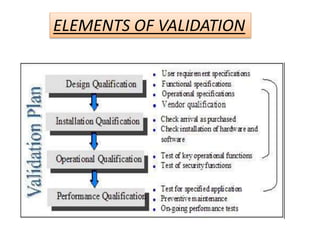
ELEMENTS OF VALIDATION
Elements Of Validation
1. Design Qualification (DQ): -
• Design qualification is the documentation of the planning phase, including
the decision making for the equipment. Design qualification takes place
before the equipment is constructed. The risk analysis is
often part of the design qualification.
• The earlier risks can be recorded and evaluated ,the sooner their
minimization can be taken into consideration in the equipment or facility
construction phase With the design qualification, the conformity of the
equipment or facility planning with certain requirements is reviewed. To this
end, the requirements laid out in the user requirements are compared with
the specifications compiled by the supplier(technical specifications) and
confirmed in writing
DQ Check Items:
• regulatory requirements
• Performance criteria
• Facility air flow, movement flow & pressure regimes
• Reliability & efficiency
• Commissioning requirements
• Construct ability & installation of equipment
• Maintenance & access to critical equipment &
instrumentation
• Safety & environment impact
Installation Qualification (IQ): -
It is documented verification that all aspects of a facility,
utility or equipment that can affect product quality adhere to
approved specifications and are correctly installed. installation qualification process
can be divided into two steps: preinstallation and physical installation.
During preinstallation, all information pertinent to the proper
installation,operation, and maintenance of the instrument is reviewed. Workers
confirm the site requirements and the receipt of all of the parts, pieces,and
manuals necessary to perform the installation.During physical installation, serial
numbers are recorded and all fluidic, electrical, and communication connections
are made for system components.
Documentation describing how the instrument was installed, who performed the
installation, and other miscellaneous details are archived.
• Installation conditions (wiring,utilities, and functionality)
• Calibration, preventative maintenance, cleaning schedules
• Safety features
• Software documentation
• Spare parts list
• Environmental conditions (such as clean room
requirements, temperature and humidity)
• Equipment design features (i.e. materials of construction
cleanability)
Operational Qualification (OQ): -
• Operational Qualification occurs once the instrument has been installed to
demonstrate that the instrument functions according to its operational
specifications.
• For Operational Qualification these should be follow.
• Perform basic instrument control functions from both the instrument’s keyboard
and from the computer (if applicable)
• Perform basic functions of the application software
• Test the equipment hardware for proper functionality
• You will receive an IQ/OQ document with written signature that has all relevant
activities and actions recorded at the time of performance, and a sticker that you
may affix to your instrument. This sticker acts as a reminder to keep your
instrument testing current.
• OQ considerations include:
• Process control limits (time, temperature, pressure, line
speed and setup conditions)
• Software parameters
• Raw material specifications
• Process operating procedures
• Material handling requirements
• Process change control
• Training
• Short term stability and capability of the process, (latitude
Studies or control charts)
• Potential failure modes, action levels and worst-case conditions
• Fault tree analysis
• Performance Qualifications are a collection of test cases used to
verify that a system performs as expected under simulated real-
world conditions. The performance qualification tests requirements
defined in the User Requirements Specification.
• The performance qualification tests requirements that were
defined in the User Requirement Specification (or possibly the
Functional Requirements). Sometimes the performance
qualification is performed by power users as the system is being
released. The performance qualification step verifies system
performance
Performance Qualification (PQ)
• Performance qualification testing is conducted under actual
operating conditions throughout the anticipated working
range.
• Performance Qualifications should be approved before
protocol execution. A copy of the unexecuted protocol should
be kept in the validation package. The unexecuted protocol
should be approved by the System Owner and Quality
Assurance. The executed protocol should be signed by the
tester and reviewed by the system owner and Quality.
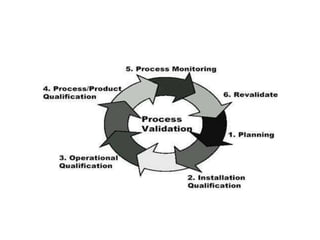
Process Validation: -
• Process validation is defined as the collection and evaluation of data, from the
process design stage throughout production, which establishes scientific
evidence that a process is capable of consistently delivering quality products.
• Process validation is a requirement of current Good Manufacturing Practices
(GMPs) for finished pharmaceuticals and of the GMP regulations for medical
devices and therefore applies to the manufacture of both drug products and
medical devices. Process validation involves a series of activities taking place
over the lifecycle of the product and process.
• The U.S. Food and Drug Administration (FDA) has proposed guidelines with the
following definition for process validation: - “PROCESS VALIDATION” is
establishing documented evidence which provides a high degree of assurance
that a specific process consistently produces a product meeting its
predetermined specifications and quality attributes
The Process validation activities can be described in
three stages.
Stage 1 – Process Design: The commercial process is defined during this stage
based on knowledge gained through development and scale-up activities.
Stage 2 – Process Qualification: During this stage, the process design is
confirmed as being capable of reproducible
commercial manufacturing.
Stage 3 – Continued Process Verification: Ongoing assurance is gained during
routine production that the process remains in a state of control.
Types Of Process Validation: -
The guidelines on general principles of process validation mentions four types of
validation:
A) Prospective validation (or premarket validation)
B) Retrospective validation
C) Concurrent validation
D) Revalidation
A) Prospective validation:
This approach to validationis normally undertaken whenever the process for a
newformula (or within a new facility) must be validated before routine
pharmaceutical production commences. In fact,validation of a process by this
approach often leads to transfer of the manufacturing process from the
development function to production.
Prospective validation is conducted before a new product is released for
distribution or, where the revisions may affect the product's characteristics,
before a product made under a revised manufacturing process is released for
distribution.
B) Retrospective validation:
• Retrospective validation is used for facilities, processes, and
process controls in operation use that have not undergone a
formally documented validation process.
• Validation of these facilities, processes, and process controls is
possible using historical data to provide the necessary
documentary evidence that the process is doing what it is believed
to do.Therefore, this type of validation is only acceptable for well-
established processes and will be inappropriate where there have
been recent changes in the composition of product, operating
processes, or equipment.
• This approach is rarely been used today because it’s very unlikely that any existing
product hasn’t been subjected to the Prospective validation process. It is used only
for the audit of a validated process.
• Retrospective validation involves the examination of past experience of production
on the assumption that composition, procedures, and equipment remain
unchanged; such experience and the results of in-process and final control tests are
then evaluated.
• Recorded difficulties and failures in production are analysed to determine the limits
of process parameters. A trend analysis may be conducted to determine the extent
to which the process parameters are within the permissible range.
• Retrospective validation is obviously not a quality
assurance measure in itself, and should never be
applied to new processes or products
• This type of validation makes use of historical data
and information which may be found in batch
records, production log books, lot records, control
charts, test and inspection results, customer
complaints or lack of complaints, field failure reports,
service reports, and audit reports
• If concurrent validation is being conducted as the initial validation of a
new process or a process which has been modified, product should be
withheld from distribution until all data and results of the validation
study have been reviewed, and it has been determined that the
process has been adequately validated.
• Concurrent validation may be conducted on a previously validated
process to confirm that the process is validated. If there have been no
changes to the process and no indications that the process is not
operating in a state of control, product could be released for
distribution before revalidation of the process is completed. There is
some risk to early release of product in that subsequent analysis of
data may show that the process is not validated.
C) Concurrent validation:
D) Revalidation:
• Revalidation means repeating the original validation effort
or any part of it, and includes investigative review of existing performance
data. This approach is essential to maintain the validated status of the plant,
equipment,manufacturing processes and computer systems
• Revalidation after any change having a bearing on product quality. Periodic
revalidation carried out at scheduled intervals.
• Revalidation after changes. Revalidation must be performed on introduction of
any changes affecting a manufacturing and/or standard procedure having a
bearing on the established product performance characteristics. Such changes
may include those in starting material, packaging material, manufacturing
processes, equipment, in-process controls, manufacturing areas, or support
systems (water, steam, etc)
• Revalidation after changes may be based on the performance of the same tests and
activities as those used during the original validation, including tests on
subprocesses and on the equipment concerned. Some typical changes which
require revalidation include the following:
Possible reasons for starting the revalidation process include:
• The transfer of a product from one plant to another
• Changes to the product, the plant, the manufacturing process, the cleaning
process, or other changes that could affect product quality
• The necessity of periodic checking of the validation results
• Significant (usually order of magnitude) increase or decrease in batch size.
• Sequential batches that fail to meet product and process
specifications.
Phases Of Process Validation
The activities relating to validation studies may be classified
into three phases:
Phase 1:
Pre-Validation Phase or the Qualification Phase,
which covers all activities relating to product research and
development, formulation, pilot batch studies, scale-up
studies, transfer of technology to commercial scale batches,
establishing stability conditions, storage and handling of
in-process and finished dosage forms, equipment
qualification, installation qualification, master production
documents, operational qualification, process capability.
.
Phase 2:
Process Validation Phase (Process Qualification phase) designed to verify
that all established limits of the critical process parameters are valid and
that satisfactory products can be produced even under the “worst
case”conditions
Phase 3:
Validation Maintenance Phase requiring frequent review
of all process related documents, including validation audit reports to
assure that there have been no changes,deviations, failures, modifications
to the production process, including Change Control procedures. At this
stage the validation team also assures that there have been no changes/
deviations that should have resulted in requalification and revalidation.
Validation Protocol: -
• The validation protocol should be numbered, signed and
dated, and should contain as a minimum the following
information:
1. Title
2. Objective & Scope
3. Responsibility
4. Protocol Approval
5. Validation Team
6. Product Composition
7. Process Flow Chart
8. Manufacturing Process
9. Review of Equipments / Utilities
10.Review of Raw Materials and Packing Materials
11. Review of Analytical and Batch Manufacturing Records
12. Review of Batch Quantities for Validation (Raw Materials)
13. Review of Batch Quantities for Validation (Packing
Materials)
14. Requirements
15. Review of Process Parameters
16. Validation Procedure
17. Sampling Location
18. Documentation
19. Acceptance Criteria
20. Summary
21. Conclusion
THANKYOU
References
1. Agalloco J. Validation: an unconventional review and reinvention. PDA J. Pharm. Sci.
Tech. 49:175–179 (1995).
2. Aleem H, Zhao Y, Lord S, McCarthy T and Sharratt P.Pharmaceutical process
validation: an overview. J. Proc.Mech. Eng. 217: 141-151 (2003).
3. Chitlange S. S, Pawar A. S, Pawar H. I, Bhujbal S. S. and Kulkarni A. A. Validation.
http://www.pharmainfo.net/reviews/validation . 4: 318-320 (2006).
4. Dashora K, Singh D and Saraf S. Validation – the Essential Quality Assurance Tool for
Pharma Industries.www.pharminfo.net. 3: 45-47 (2005).
5. Guidance for Industry: Process Validation: General Principles and Practices. U.S.
Department of Health and Human Services, Food and Drug Administration, Center
for Drug Evaluation and Research (CDER), Center for BiologicsEvaluation and
Research (CBER), Center for Veterinary Medicine (CVM), November 2008.

Bioprocess Validation

  • 1.
    VALIDATION PRESENTED BY :-PRAMOD KUMAR M.Sc (MBT) 3rd SEM Maharshi dayanand university rohtak
  • 2.
    INTRODUCTION • validation isa process of establishing documentary evidence demonstrating that a procedure, process, or activity carried out in production or testing maintains the desired level of compliance at all stages. • The concept of validation was first proposed by two Food and Drug Administration (FDA ) officials, Ted Byers and Bud Loftus, in the mid 1970’s in order to improve the quality of pharmaceuticals. • In a guideline, validation is act of demonstrating and documenting that any procedure, process, and activity will consistently lead to the expected results. It includes the qualification of systems and equipment.
  • 3.
    WHY IS VALIDATIONREQUIRED • It would not be feasible to use the equipments without knowing whether it will produce the product we wanted or not. • The pharmaceutical industry uses expensive materials, sophisticated facilities & equipments and highly qualified personnel. • The efficient use of these resources is necessary for the continued success of the industry. The cost of product failures, rejects, reworks, and recalls, complaints are the significant parts of the total production cost.
  • 4.
    • Detailed studyand control of the manufacturing process validation is necessary if failure to be reduced and productivity improved. The pharmaceutical industries are concerned about validation because of the following reasons. • Assurance of quality • Cost reduction • Government regulation Department Responsible • Site validation committee (SVC): Develop Site master Validation plan, Prepare/execute/approve validation Studies • Manufacturing department:Prepares the batches as routin Production batch • Quality assurance: Ensure compliance, see that documentations/ procedures are in place, approves protocols and reports • Quality control: Perform testing and reviews protocol and report as needed.
  • 5.
    Responsible Authorities ForValidation • Head of quality assurance • Head of engineering • Validation manager • Production manager • Specialist validation discipline: all areas
  • 6.
  • 8.
    Elements Of Validation 1.Design Qualification (DQ): - • Design qualification is the documentation of the planning phase, including the decision making for the equipment. Design qualification takes place before the equipment is constructed. The risk analysis is often part of the design qualification. • The earlier risks can be recorded and evaluated ,the sooner their minimization can be taken into consideration in the equipment or facility construction phase With the design qualification, the conformity of the equipment or facility planning with certain requirements is reviewed. To this end, the requirements laid out in the user requirements are compared with the specifications compiled by the supplier(technical specifications) and confirmed in writing
  • 9.
    DQ Check Items: •regulatory requirements • Performance criteria • Facility air flow, movement flow & pressure regimes • Reliability & efficiency • Commissioning requirements • Construct ability & installation of equipment • Maintenance & access to critical equipment & instrumentation • Safety & environment impact
  • 10.
    Installation Qualification (IQ):- It is documented verification that all aspects of a facility, utility or equipment that can affect product quality adhere to approved specifications and are correctly installed. installation qualification process can be divided into two steps: preinstallation and physical installation. During preinstallation, all information pertinent to the proper installation,operation, and maintenance of the instrument is reviewed. Workers confirm the site requirements and the receipt of all of the parts, pieces,and manuals necessary to perform the installation.During physical installation, serial numbers are recorded and all fluidic, electrical, and communication connections are made for system components. Documentation describing how the instrument was installed, who performed the installation, and other miscellaneous details are archived.
  • 11.
    • Installation conditions(wiring,utilities, and functionality) • Calibration, preventative maintenance, cleaning schedules • Safety features • Software documentation • Spare parts list • Environmental conditions (such as clean room requirements, temperature and humidity) • Equipment design features (i.e. materials of construction cleanability)
  • 12.
    Operational Qualification (OQ):- • Operational Qualification occurs once the instrument has been installed to demonstrate that the instrument functions according to its operational specifications. • For Operational Qualification these should be follow. • Perform basic instrument control functions from both the instrument’s keyboard and from the computer (if applicable) • Perform basic functions of the application software • Test the equipment hardware for proper functionality • You will receive an IQ/OQ document with written signature that has all relevant activities and actions recorded at the time of performance, and a sticker that you may affix to your instrument. This sticker acts as a reminder to keep your instrument testing current.
  • 13.
    • OQ considerationsinclude: • Process control limits (time, temperature, pressure, line speed and setup conditions) • Software parameters • Raw material specifications • Process operating procedures • Material handling requirements • Process change control • Training • Short term stability and capability of the process, (latitude Studies or control charts) • Potential failure modes, action levels and worst-case conditions • Fault tree analysis
  • 14.
    • Performance Qualificationsare a collection of test cases used to verify that a system performs as expected under simulated real- world conditions. The performance qualification tests requirements defined in the User Requirements Specification. • The performance qualification tests requirements that were defined in the User Requirement Specification (or possibly the Functional Requirements). Sometimes the performance qualification is performed by power users as the system is being released. The performance qualification step verifies system performance Performance Qualification (PQ)
  • 15.
    • Performance qualificationtesting is conducted under actual operating conditions throughout the anticipated working range. • Performance Qualifications should be approved before protocol execution. A copy of the unexecuted protocol should be kept in the validation package. The unexecuted protocol should be approved by the System Owner and Quality Assurance. The executed protocol should be signed by the tester and reviewed by the system owner and Quality.
  • 16.
    Process Validation: - •Process validation is defined as the collection and evaluation of data, from the process design stage throughout production, which establishes scientific evidence that a process is capable of consistently delivering quality products. • Process validation is a requirement of current Good Manufacturing Practices (GMPs) for finished pharmaceuticals and of the GMP regulations for medical devices and therefore applies to the manufacture of both drug products and medical devices. Process validation involves a series of activities taking place over the lifecycle of the product and process. • The U.S. Food and Drug Administration (FDA) has proposed guidelines with the following definition for process validation: - “PROCESS VALIDATION” is establishing documented evidence which provides a high degree of assurance that a specific process consistently produces a product meeting its predetermined specifications and quality attributes
  • 17.
    The Process validationactivities can be described in three stages. Stage 1 – Process Design: The commercial process is defined during this stage based on knowledge gained through development and scale-up activities. Stage 2 – Process Qualification: During this stage, the process design is confirmed as being capable of reproducible commercial manufacturing. Stage 3 – Continued Process Verification: Ongoing assurance is gained during routine production that the process remains in a state of control.
  • 18.
    Types Of ProcessValidation: - The guidelines on general principles of process validation mentions four types of validation: A) Prospective validation (or premarket validation) B) Retrospective validation C) Concurrent validation D) Revalidation A) Prospective validation: This approach to validationis normally undertaken whenever the process for a newformula (or within a new facility) must be validated before routine pharmaceutical production commences. In fact,validation of a process by this approach often leads to transfer of the manufacturing process from the development function to production. Prospective validation is conducted before a new product is released for distribution or, where the revisions may affect the product's characteristics, before a product made under a revised manufacturing process is released for distribution.
  • 19.
    B) Retrospective validation: •Retrospective validation is used for facilities, processes, and process controls in operation use that have not undergone a formally documented validation process. • Validation of these facilities, processes, and process controls is possible using historical data to provide the necessary documentary evidence that the process is doing what it is believed to do.Therefore, this type of validation is only acceptable for well- established processes and will be inappropriate where there have been recent changes in the composition of product, operating processes, or equipment.
  • 20.
    • This approachis rarely been used today because it’s very unlikely that any existing product hasn’t been subjected to the Prospective validation process. It is used only for the audit of a validated process. • Retrospective validation involves the examination of past experience of production on the assumption that composition, procedures, and equipment remain unchanged; such experience and the results of in-process and final control tests are then evaluated. • Recorded difficulties and failures in production are analysed to determine the limits of process parameters. A trend analysis may be conducted to determine the extent to which the process parameters are within the permissible range.
  • 21.
    • Retrospective validationis obviously not a quality assurance measure in itself, and should never be applied to new processes or products • This type of validation makes use of historical data and information which may be found in batch records, production log books, lot records, control charts, test and inspection results, customer complaints or lack of complaints, field failure reports, service reports, and audit reports
  • 22.
    • If concurrentvalidation is being conducted as the initial validation of a new process or a process which has been modified, product should be withheld from distribution until all data and results of the validation study have been reviewed, and it has been determined that the process has been adequately validated. • Concurrent validation may be conducted on a previously validated process to confirm that the process is validated. If there have been no changes to the process and no indications that the process is not operating in a state of control, product could be released for distribution before revalidation of the process is completed. There is some risk to early release of product in that subsequent analysis of data may show that the process is not validated. C) Concurrent validation:
  • 23.
    D) Revalidation: • Revalidationmeans repeating the original validation effort or any part of it, and includes investigative review of existing performance data. This approach is essential to maintain the validated status of the plant, equipment,manufacturing processes and computer systems • Revalidation after any change having a bearing on product quality. Periodic revalidation carried out at scheduled intervals. • Revalidation after changes. Revalidation must be performed on introduction of any changes affecting a manufacturing and/or standard procedure having a bearing on the established product performance characteristics. Such changes may include those in starting material, packaging material, manufacturing processes, equipment, in-process controls, manufacturing areas, or support systems (water, steam, etc)
  • 24.
    • Revalidation afterchanges may be based on the performance of the same tests and activities as those used during the original validation, including tests on subprocesses and on the equipment concerned. Some typical changes which require revalidation include the following: Possible reasons for starting the revalidation process include: • The transfer of a product from one plant to another • Changes to the product, the plant, the manufacturing process, the cleaning process, or other changes that could affect product quality • The necessity of periodic checking of the validation results • Significant (usually order of magnitude) increase or decrease in batch size. • Sequential batches that fail to meet product and process specifications.
  • 25.
    Phases Of ProcessValidation The activities relating to validation studies may be classified into three phases: Phase 1: Pre-Validation Phase or the Qualification Phase, which covers all activities relating to product research and development, formulation, pilot batch studies, scale-up studies, transfer of technology to commercial scale batches, establishing stability conditions, storage and handling of in-process and finished dosage forms, equipment qualification, installation qualification, master production documents, operational qualification, process capability. .
  • 26.
    Phase 2: Process ValidationPhase (Process Qualification phase) designed to verify that all established limits of the critical process parameters are valid and that satisfactory products can be produced even under the “worst case”conditions Phase 3: Validation Maintenance Phase requiring frequent review of all process related documents, including validation audit reports to assure that there have been no changes,deviations, failures, modifications to the production process, including Change Control procedures. At this stage the validation team also assures that there have been no changes/ deviations that should have resulted in requalification and revalidation.
  • 27.
    Validation Protocol: - •The validation protocol should be numbered, signed and dated, and should contain as a minimum the following information: 1. Title 2. Objective & Scope 3. Responsibility 4. Protocol Approval 5. Validation Team 6. Product Composition 7. Process Flow Chart
  • 28.
    8. Manufacturing Process 9.Review of Equipments / Utilities 10.Review of Raw Materials and Packing Materials 11. Review of Analytical and Batch Manufacturing Records 12. Review of Batch Quantities for Validation (Raw Materials) 13. Review of Batch Quantities for Validation (Packing Materials) 14. Requirements 15. Review of Process Parameters 16. Validation Procedure 17. Sampling Location 18. Documentation
  • 29.
    19. Acceptance Criteria 20.Summary 21. Conclusion
  • 30.
  • 31.
    References 1. Agalloco J.Validation: an unconventional review and reinvention. PDA J. Pharm. Sci. Tech. 49:175–179 (1995). 2. Aleem H, Zhao Y, Lord S, McCarthy T and Sharratt P.Pharmaceutical process validation: an overview. J. Proc.Mech. Eng. 217: 141-151 (2003). 3. Chitlange S. S, Pawar A. S, Pawar H. I, Bhujbal S. S. and Kulkarni A. A. Validation. http://www.pharmainfo.net/reviews/validation . 4: 318-320 (2006). 4. Dashora K, Singh D and Saraf S. Validation – the Essential Quality Assurance Tool for Pharma Industries.www.pharminfo.net. 3: 45-47 (2005). 5. Guidance for Industry: Process Validation: General Principles and Practices. U.S. Department of Health and Human Services, Food and Drug Administration, Center for Drug Evaluation and Research (CDER), Center for BiologicsEvaluation and Research (CBER), Center for Veterinary Medicine (CVM), November 2008.