Perception
Praisy A B
The term ‘perception’ has been
derived from the Latin words
‘percepto’ and ‘percipio’
Perception
Perception refers to the interpretation of what we take in
through our senses.
It is a mental processes by which intellectual, sensory,
and emotional data are organized logically or
meaningfully.
Perception is a process of interpreting what is happening
around us.
Perception
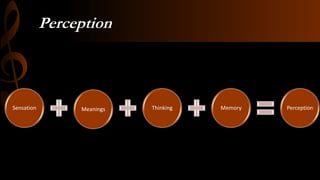
Sensation Meanings Thinking Memory Perception
Definition of Perception
“ Perception is the organizing
process by which we interpret our
sensory input ”
(Edmund Fantino & G S Renolds)
Sensation & Perception
Sensation refers to the process of sensing our
environment through touch, taste, sight, sound, and
smell.
This information is sent to our brain in raw form
where perception comes into play.
Perception is the way we interpret these sensations
and therefore make sense of everything around us.
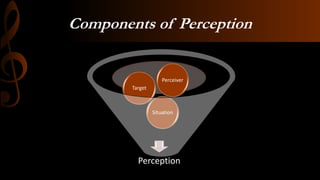
Components of Perception
Perception
Situation
Target
Perceiver
Nature of Perception
 It is the information extractor
 It is a process
 Based on sensation
 Needs observation/experience
 Highly individualized
 Preparation to response
 Provides organization
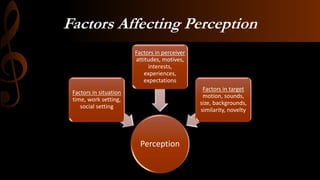
Factors Affecting Perception
Perception
Factors in situation
time, work setting,
social setting
Factors in perceiver
attitudes, motives,
interests,
experiences,
expectations
Factors in target
motion, sounds,
size, backgrounds,
similarity, novelty
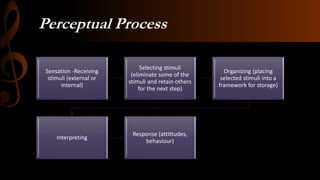
Perceptual Process
Sensation -Receiving
stimuli (external or
internal)
Selecting stimuli
(eliminate some of the
stimuli and retain others
for the next step)
Organizing (placing
selected stimuli into a
framework for storage)
Interpreting
Response (attittudes,
behaviour)
Extra Sensory Perception (ESP)
• Psychologists have named the perception that
occurs without sensory stimulation as ESP.
• Known as Sixth Sense.
• Meeting the souls, precognition, etc. are some of
the common phenomena of ESP.
Errors In Perception
Perception may not be always possible to perceive the
stimulus and perceive it wrongly.
It may due to defect in our sense organs or defective
functioning of the brain or may be due to other factors
influencing perception.
There are 2 kinds of error:
1. Illusion : a false perception – most of the illutions are
vidual or auditory - an individual will be mistake a stimulus
and perceive it wrongly - For example: in the dark, a rape is
mistaken as a snake or vice versa.
Cont.
2. Hallucination: an individual perceives some stimulus,
even when it is not present – this phenomenon is known as
Hallucinations
Thank You

Perception.

  • 1.
  • 2.
    The term ‘perception’has been derived from the Latin words ‘percepto’ and ‘percipio’
  • 3.
    Perception Perception refers tothe interpretation of what we take in through our senses. It is a mental processes by which intellectual, sensory, and emotional data are organized logically or meaningfully. Perception is a process of interpreting what is happening around us.
  • 4.
  • 5.
    Definition of Perception “Perception is the organizing process by which we interpret our sensory input ” (Edmund Fantino & G S Renolds)
  • 6.
    Sensation & Perception Sensationrefers to the process of sensing our environment through touch, taste, sight, sound, and smell. This information is sent to our brain in raw form where perception comes into play. Perception is the way we interpret these sensations and therefore make sense of everything around us.
  • 7.
  • 8.
    Nature of Perception It is the information extractor  It is a process  Based on sensation  Needs observation/experience  Highly individualized  Preparation to response  Provides organization
  • 9.
    Factors Affecting Perception Perception Factorsin situation time, work setting, social setting Factors in perceiver attitudes, motives, interests, experiences, expectations Factors in target motion, sounds, size, backgrounds, similarity, novelty
  • 10.
    Perceptual Process Sensation -Receiving stimuli(external or internal) Selecting stimuli (eliminate some of the stimuli and retain others for the next step) Organizing (placing selected stimuli into a framework for storage) Interpreting Response (attittudes, behaviour)
  • 11.
    Extra Sensory Perception(ESP) • Psychologists have named the perception that occurs without sensory stimulation as ESP. • Known as Sixth Sense. • Meeting the souls, precognition, etc. are some of the common phenomena of ESP.
  • 12.
    Errors In Perception Perceptionmay not be always possible to perceive the stimulus and perceive it wrongly. It may due to defect in our sense organs or defective functioning of the brain or may be due to other factors influencing perception. There are 2 kinds of error: 1. Illusion : a false perception – most of the illutions are vidual or auditory - an individual will be mistake a stimulus and perceive it wrongly - For example: in the dark, a rape is mistaken as a snake or vice versa.
  • 13.
    Cont. 2. Hallucination: anindividual perceives some stimulus, even when it is not present – this phenomenon is known as Hallucinations
  • 14.