
Teens and Libraries

                                           Lee Rainie
                                              Director
Pew Research Center’s Internet & American Life Project


                  Presented to: YALSA Teens and Libraries Summit
                                                January 23, 2013
What is the Pew Internet Project?
A comprehensive and groundbreaking new report
              Number Of Users
released Monday by the Pew Research Center’s
Internet and American Life Project has found that
              Who Actually
only four users of Facebook derive pleasure of any
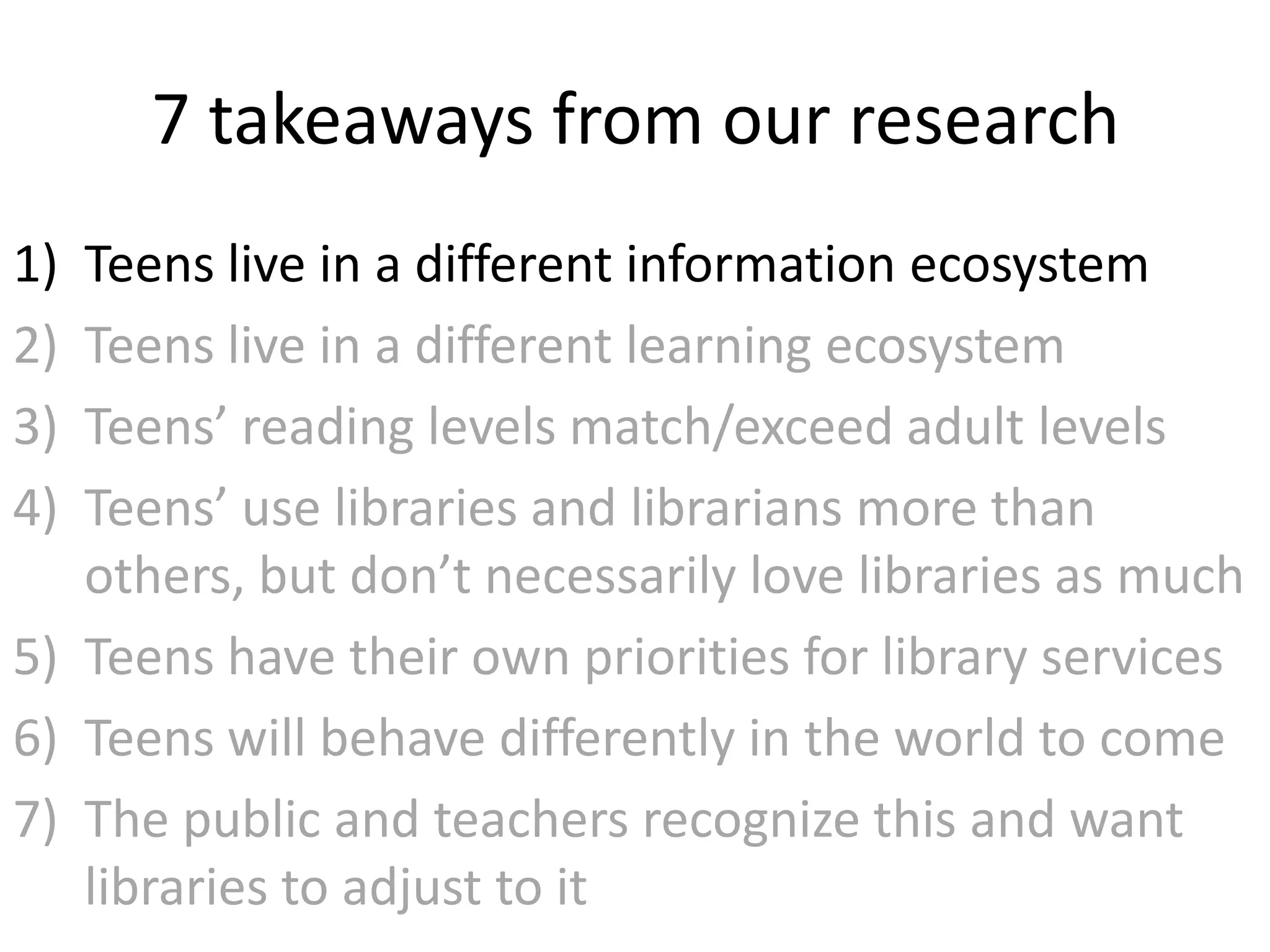
 .... “As it turns out, the vast majority of human
kind from theto become depressed when they
 beings tend popular social networking website.
              Enjoy Facebook
        According to the report, the remainder of
 see the past five years of their life summarized
the 950 million people registered with Facebook,
              Down To 4
 right there in front of them in a sad little
despite using the site on a regular basis, take no
 timeline,” said lead researcher John Elliott.
joy in doing so, and in fact feel a profound sense
of hopelessness and despair immediately upon
logging in…
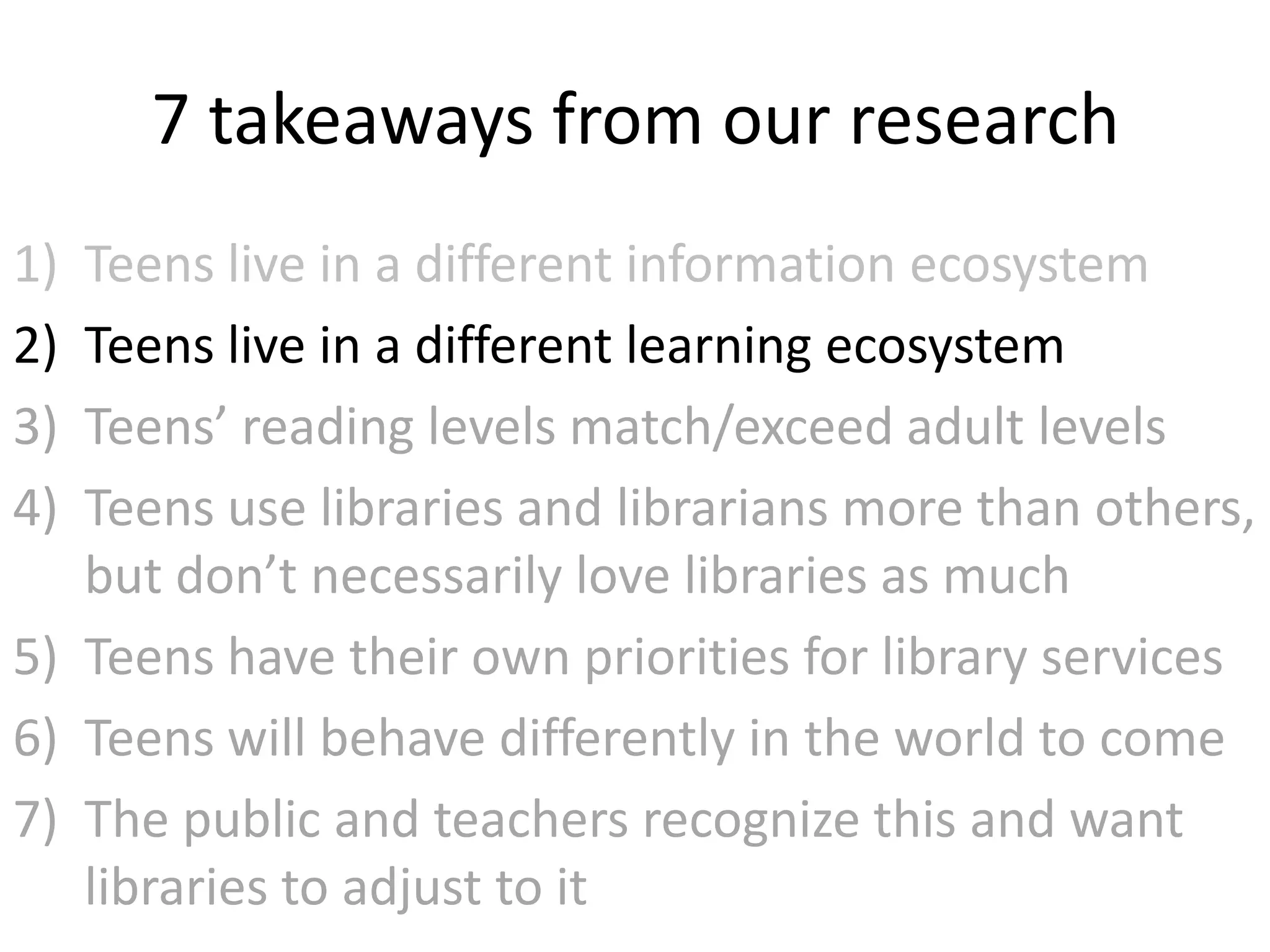
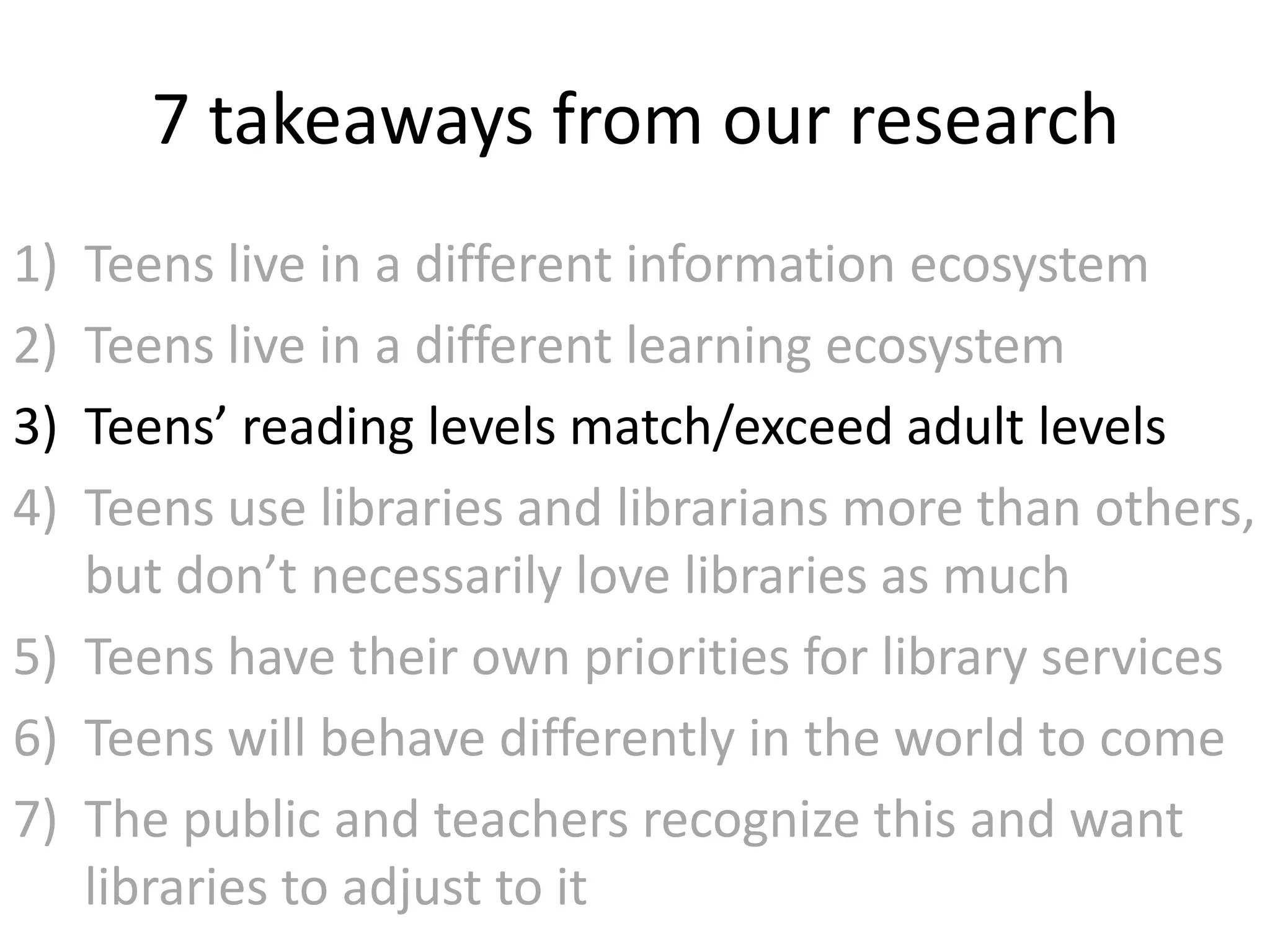
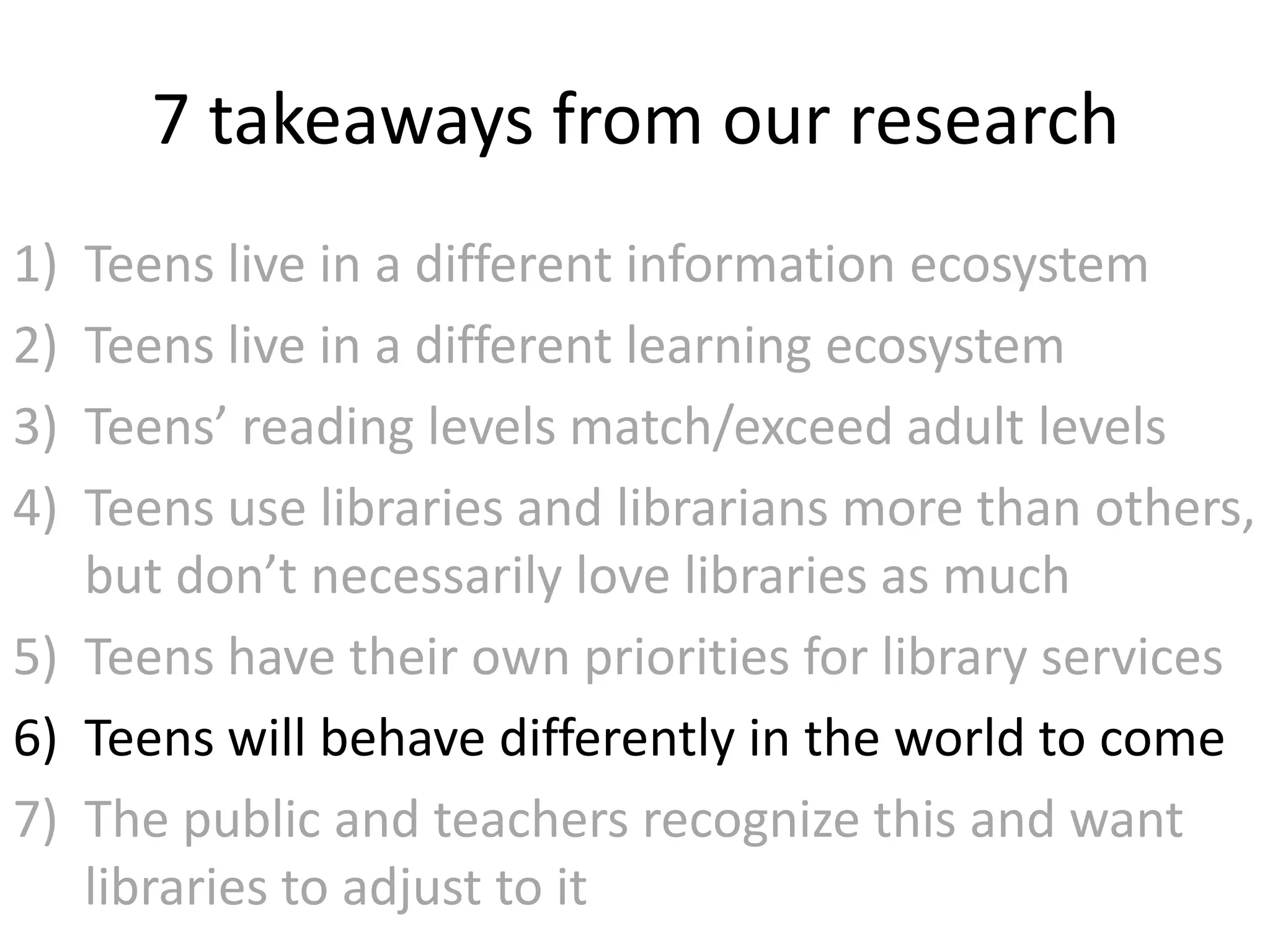
7 takeaways from our research
1) Teens live in a different information ecosystem
2) Teens live in a different learning ecosystem
3) Teens’ reading levels match/exceed adult levels
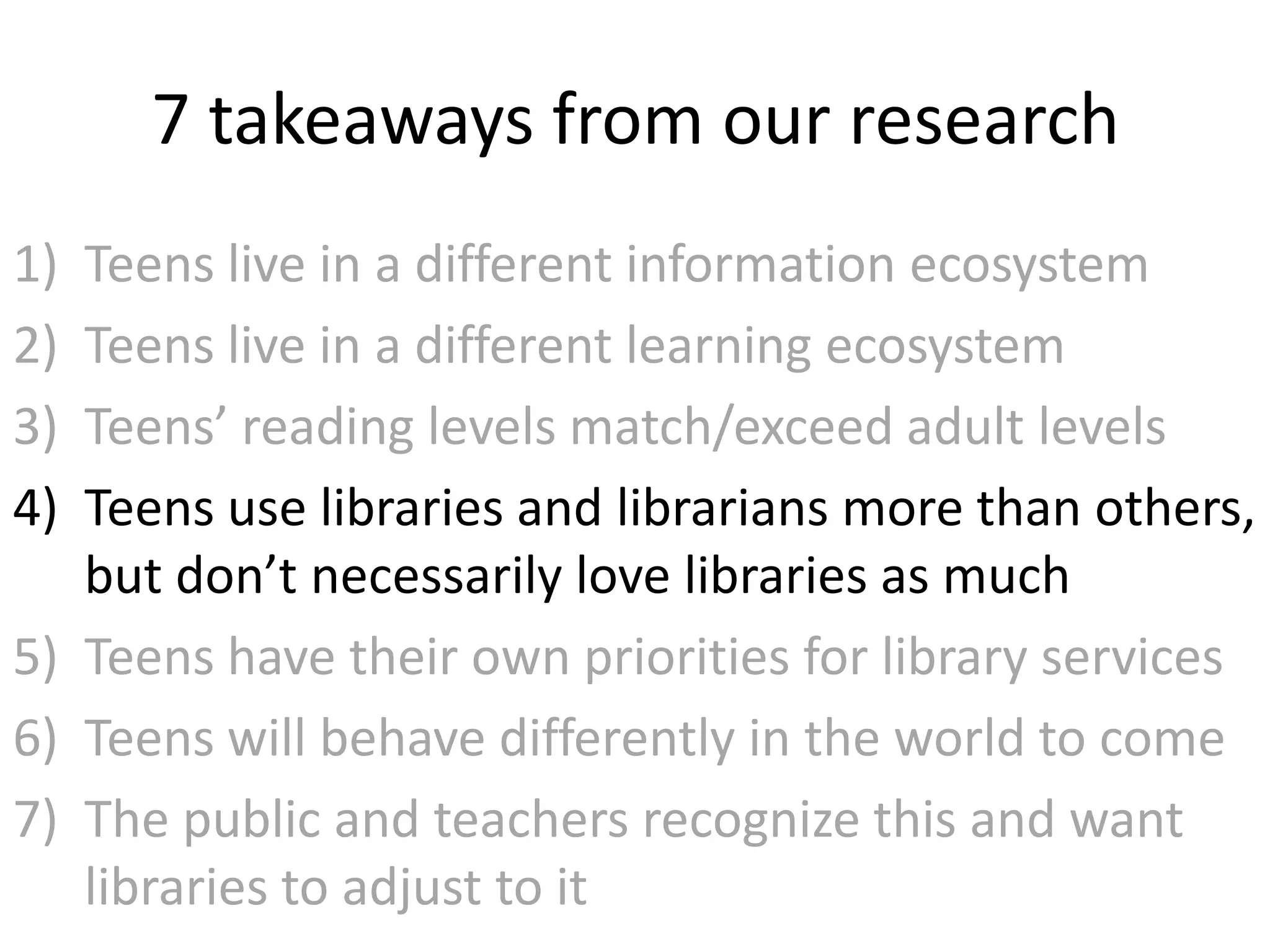
4) Teens use libraries and librarians more than others,
   but don’t necessarily love libraries as much
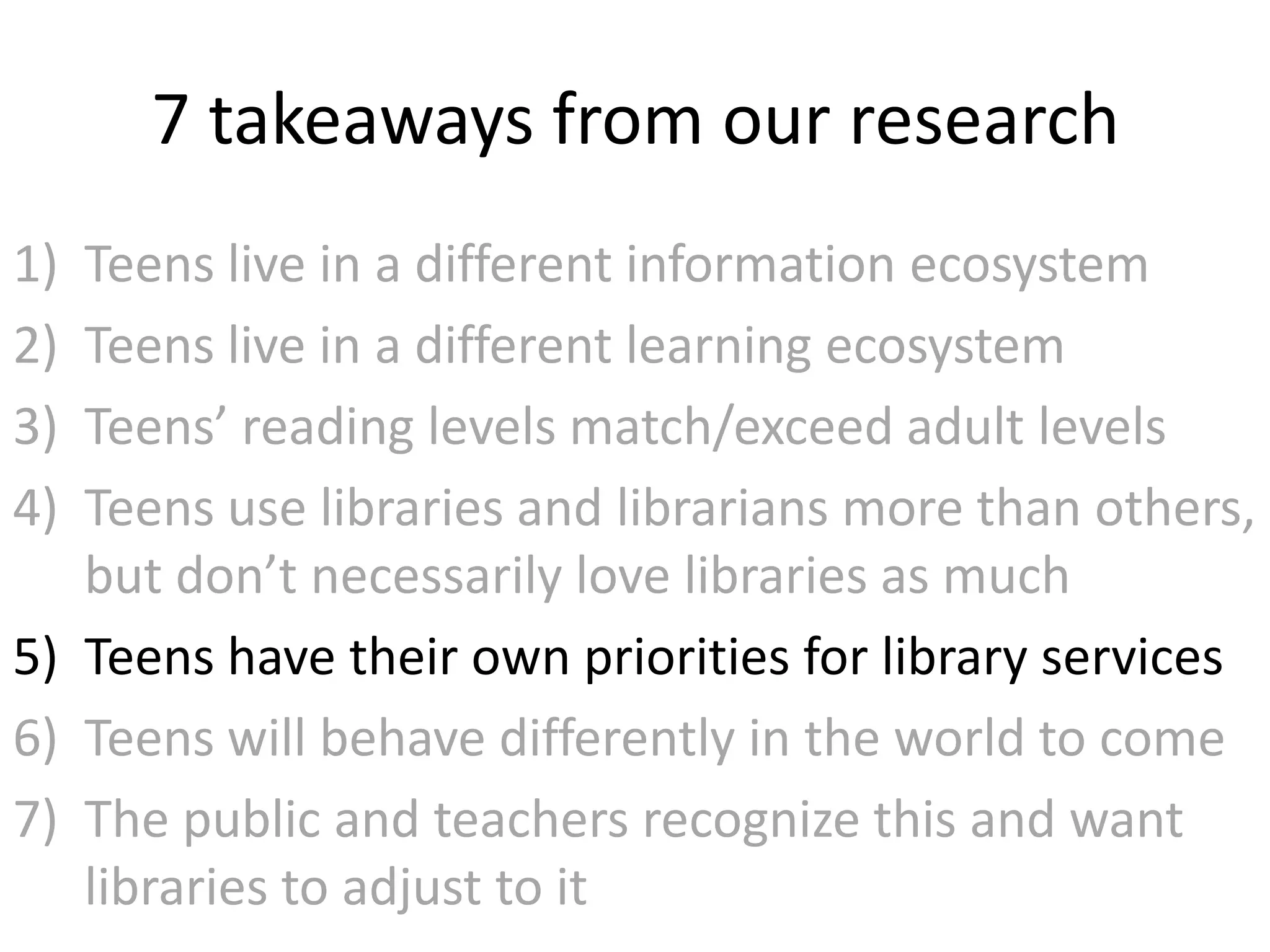
5) Teens have different priorities in library services
6) Teens will behave differently in the world to come
7) The public and teachers recognize this and want
   libraries to adjust to it
7 takeaways from our research
1) Teens live in a different information ecosystem
2) Teens live in a different learning ecosystem
3) Teens’ reading levels match/exceed adult levels
4) Teens’ use libraries and librarians more than
   others, but don’t necessarily love libraries as much
5) Teens have their own priorities for library services
6) Teens will behave differently in the world to come
7) The public and teachers recognize this and want
   libraries to adjust to it
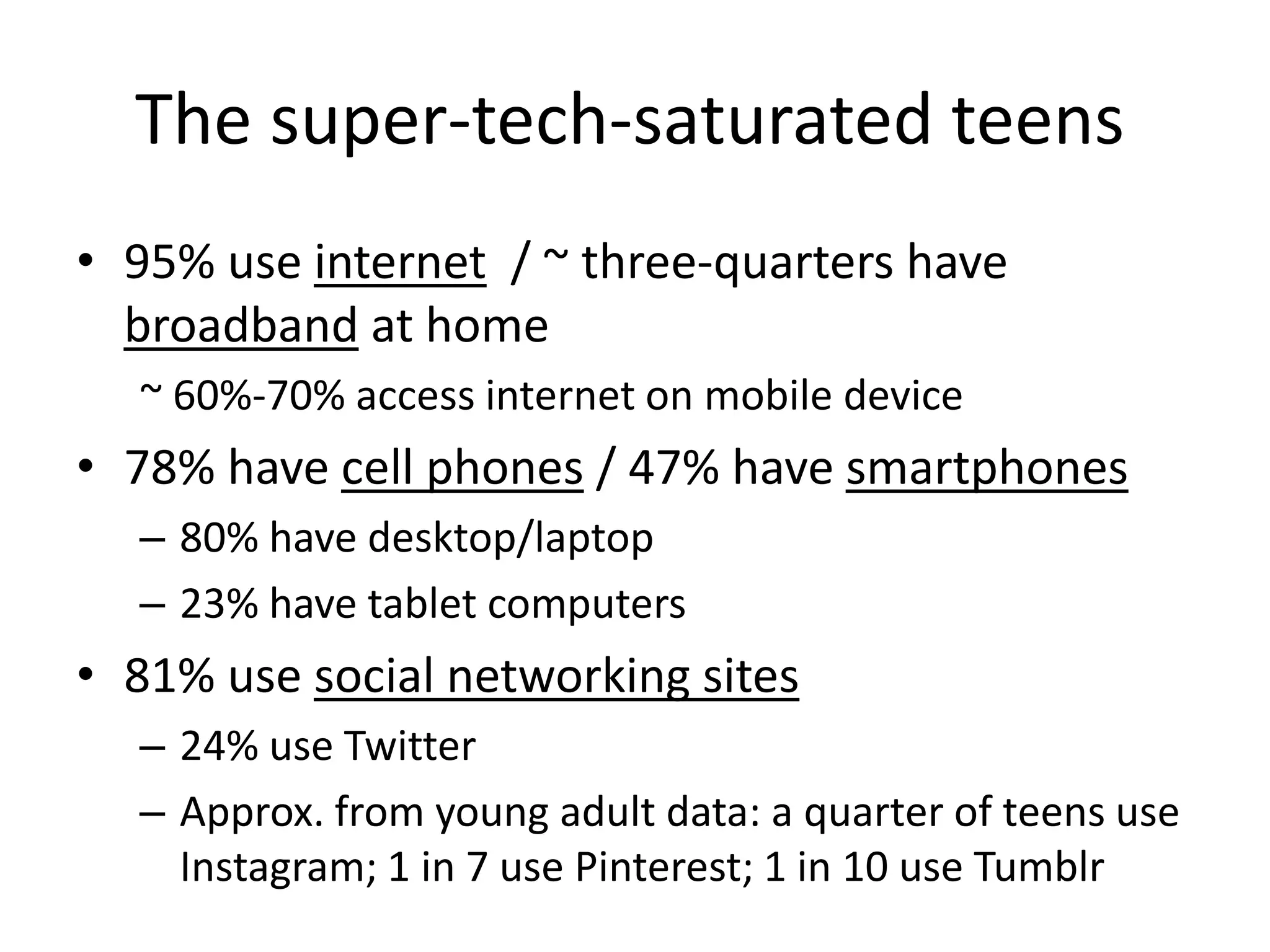
The super-tech-saturated teens
• 95% use internet / ~ three-quarters have
  broadband at home
  ~ 60%-70% access internet on mobile device
• 78% have cell phones / 47% have smartphones
  – 80% have desktop/laptop
  – 23% have tablet computers
• 81% use social networking sites
  – 24% use Twitter
  – Approx. from young adult data: a quarter of teens use
    Instagram; 1 in 7 use Pinterest; 1 in 10 use Tumblr
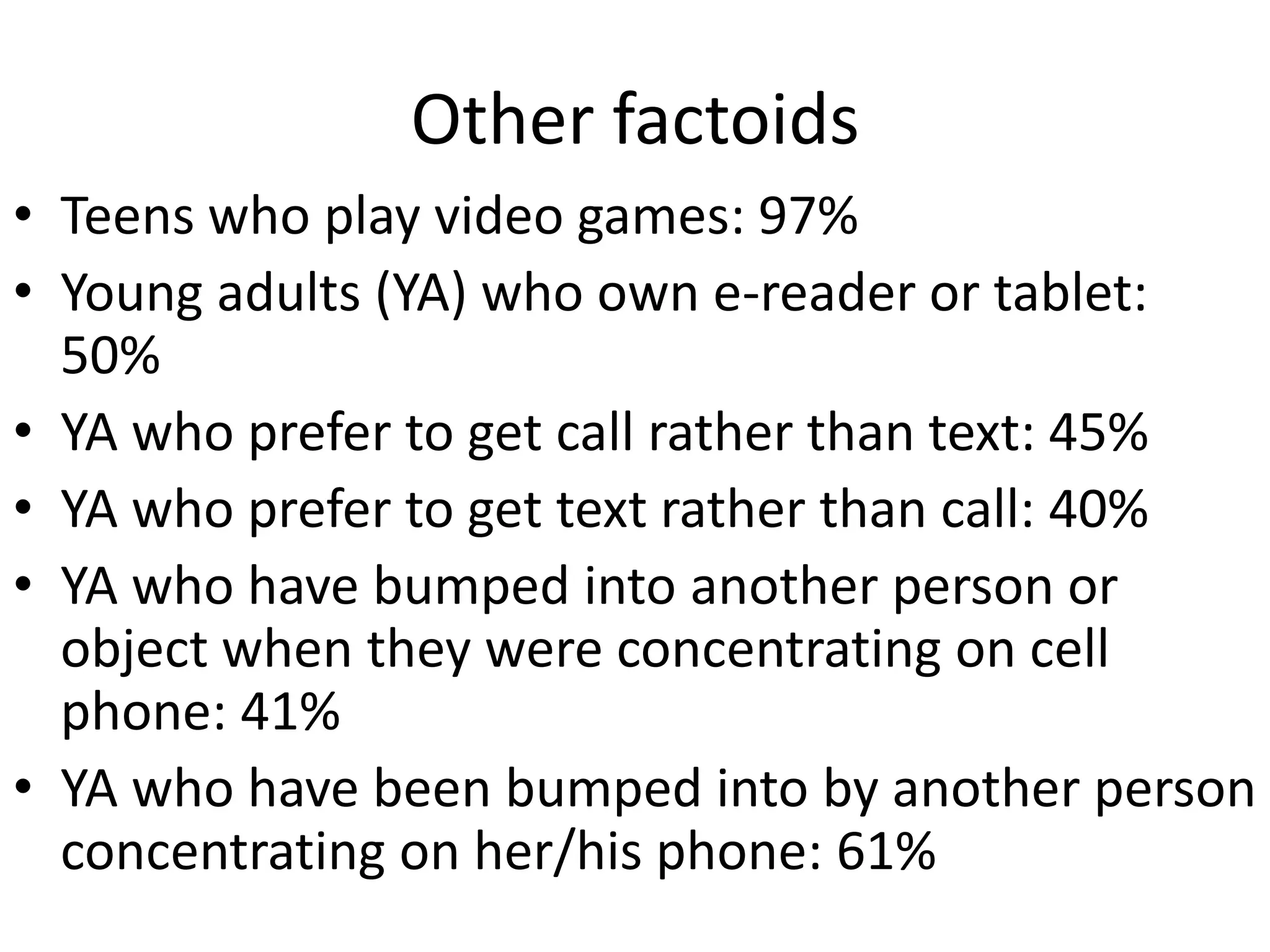
Other factoids
• Teens who play video games: 97%
• Young adults (YA) who own e-reader or tablet:
  50%
• YA who prefer to get call rather than text: 45%
• YA who prefer to get text rather than call: 40%
• YA who have bumped into another person or
  object when they were concentrating on cell
  phone: 41%
• YA who have been bumped into by another person
  concentrating on her/his phone: 61%
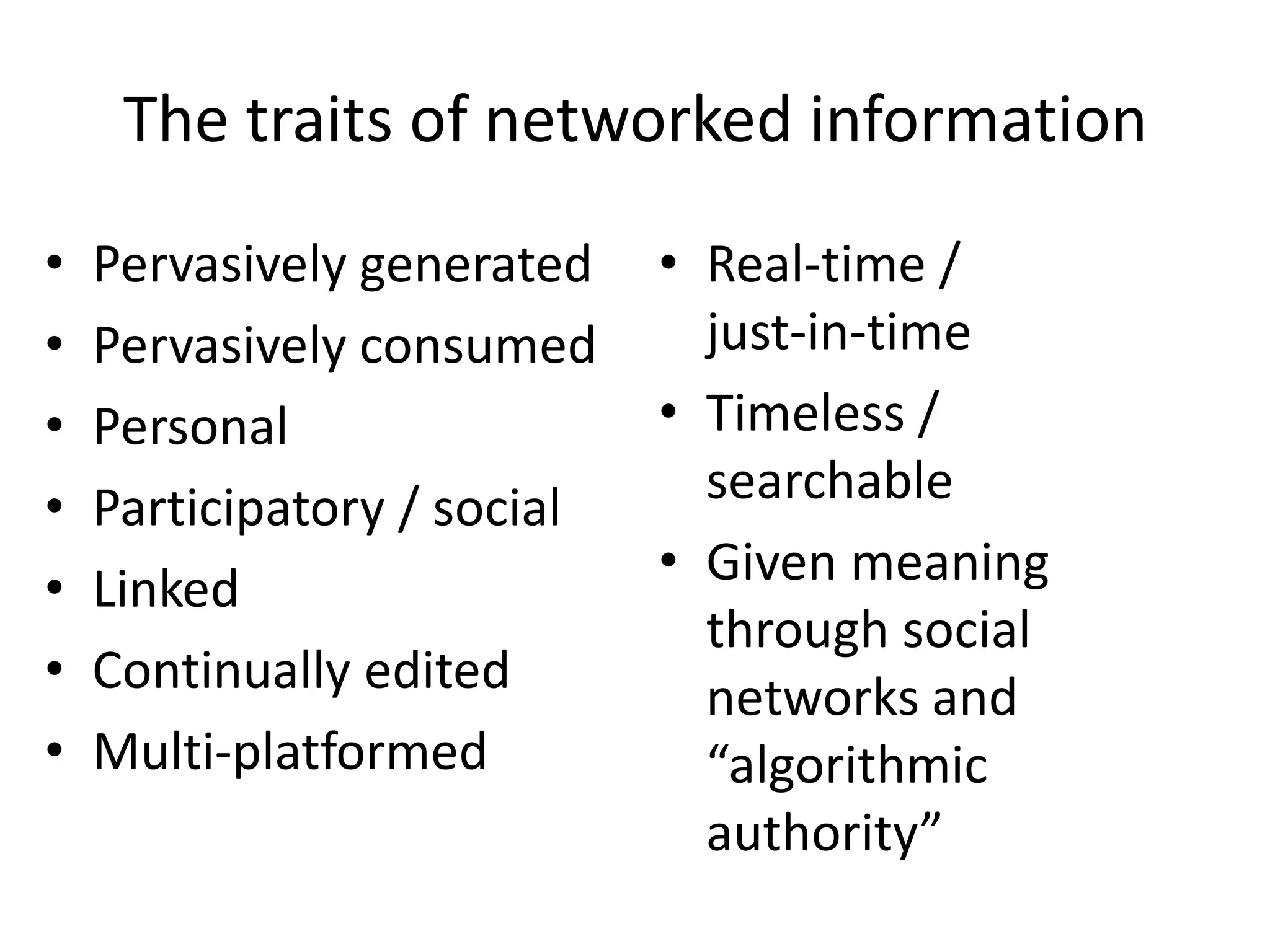
The traits of networked information
•   Pervasively generated    • Real-time /
•   Pervasively consumed       just-in-time
•   Personal                 • Timeless /
•   Participatory / social     searchable
•   Linked                   • Given meaning
                               through social
•   Continually edited         networks and
•   Multi-platformed           “algorithmic
                               authority”
7 takeaways from our research
1) Teens live in a different information ecosystem
2) Teens live in a different learning ecosystem
3) Teens’ reading levels match/exceed adult levels
4) Teens use libraries and librarians more than others,
   but don’t necessarily love libraries as much
5) Teens have their own priorities for library services
6) Teens will behave differently in the world to come
7) The public and teachers recognize this and want
   libraries to adjust to it
Online survey of 2,462 teachers with
College Board and National Writing Project
• 77% of                      • 87% agree
  teachers                      these
  surveyed say                  technologies
  the                           are creating an
  internet and                  “easily
  digital search                distracted
  tools have had                generation with
  a “mostly                     short attention
  positive”                     spans”
  impact on
  their students’
  research work
Online survey of 2,462 teachers with
College Board and National Writing Project
• 76% of the                  • 76% strongly
  teachers in                   agree that
  this study                    internet
  strongly agree                search
  “the internet                 engines have
  enables                       conditioned
  students to                   students to
  access a wider                expect to be
  range of                      able to find
  resources than                information
  would                         quickly and
  otherwise be                  easily
  available”
Online survey of 2,462 teachers with
College Board and National Writing Project
• 65% agree to                83% agree that
  some extent                 the amount of
  that “the                   information
  internet                    available online
  makes today’s               today is
  students                    overwhelming
  more self-                  to most
  sufficient                  students
  researchers”
Online survey of 2,462 teachers with
College Board and National Writing Project
• 90% agree that            • 71% agree that
  the internet                today’s digital
  encourages                  technologies
  learning by                 discourage
  connecting                  students from
  students to                 using a wide
  resources                   range of
  about topics of             sources when
  interest to                 conducting
  them                        research
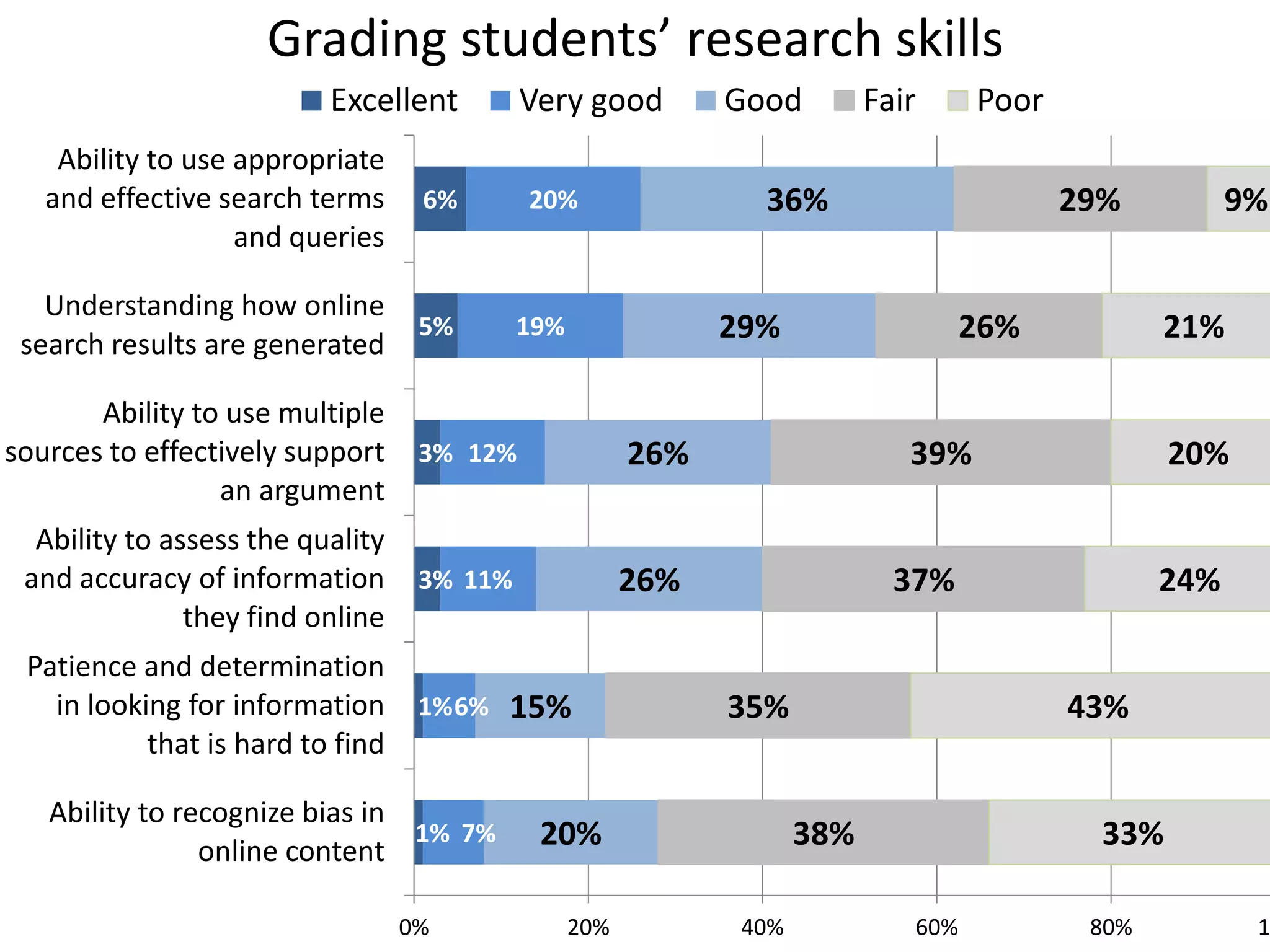
Grading students’ research skills
                          Excellent         Very good         Good         Fair     Poor
    Ability to use appropriate
   and effective search terms      6%       20%                 36%                        29%          9%
                   and queries

   Understanding how online
 search results are generated
                                   5%       19%               29%                   26%           21%

       Ability to use multiple
sources to effectively support     3% 12%               26%                   39%                  20%
                 an argument
  Ability to assess the quality
 and accuracy of information       3% 11%               26%                  37%                  24%
               they find online
 Patience and determination
   in looking for information      1% 6%   15%                35%                          43%
           that is hard to find

   Ability to recognize bias in
                online content
                                1% 7%        20%                     38%                     33%

                                  0%              20%          40%            60%           80%          1
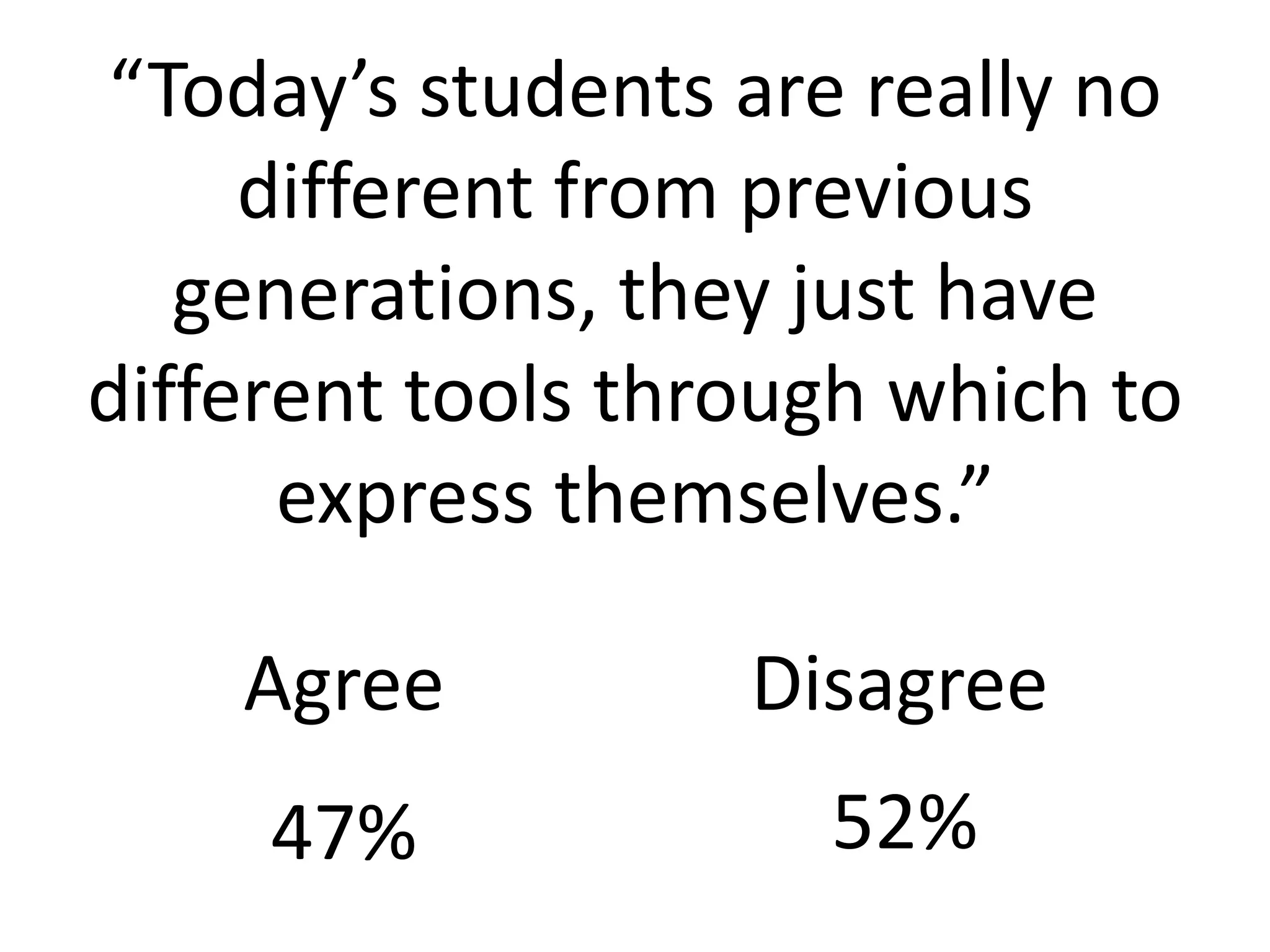
“Today’s students are really no
     different from previous
   generations, they just have
different tools through which to
      express themselves.”

    Agree          Disagree
     47%             52%
7 takeaways from our research
1) Teens live in a different information ecosystem
2) Teens live in a different learning ecosystem
3) Teens’ reading levels match/exceed adult levels
4) Teens use libraries and librarians more than others,
   but don’t necessarily love libraries as much
5) Teens have their own priorities for library services
6) Teens will behave differently in the world to come
7) The public and teachers recognize this and want
   libraries to adjust to it
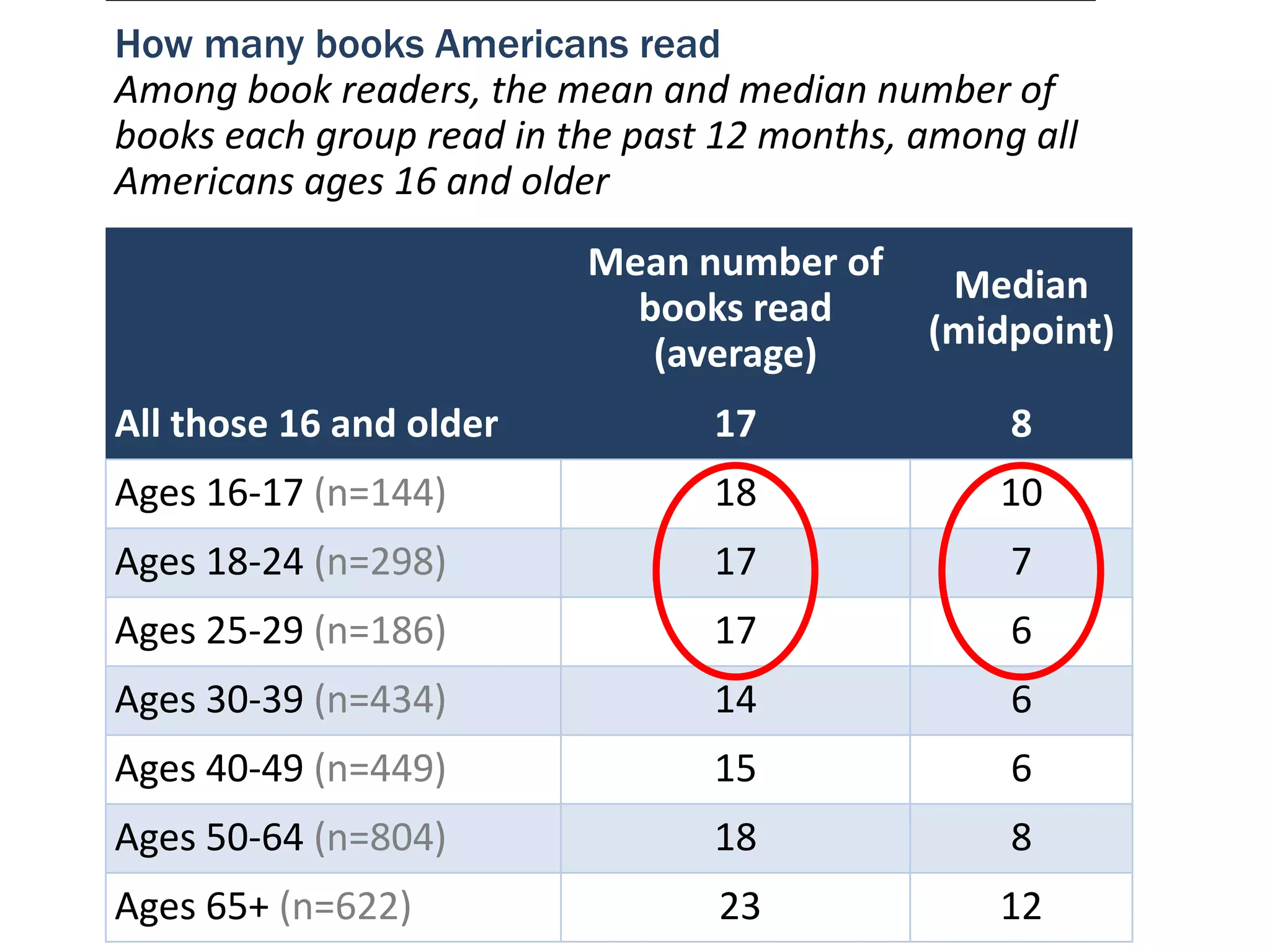
How many books Americans read
Among book readers, the mean and median number of
books each group read in the past 12 months, among all
Americans ages 16 and older
                          Mean number of
                                              Median
                            books read
                                             (midpoint)
                             (average)
All those 16 and older           17               8
Ages 16-17 (n=144)               18              10
Ages 18-24 (n=298)               17               7
Ages 25-29 (n=186)               17               6
Ages 30-39 (n=434)               14               6
Ages 40-49 (n=449)               15               6
Ages 50-64 (n=804)               18               8
Ages 65+ (n=622)                 23              12
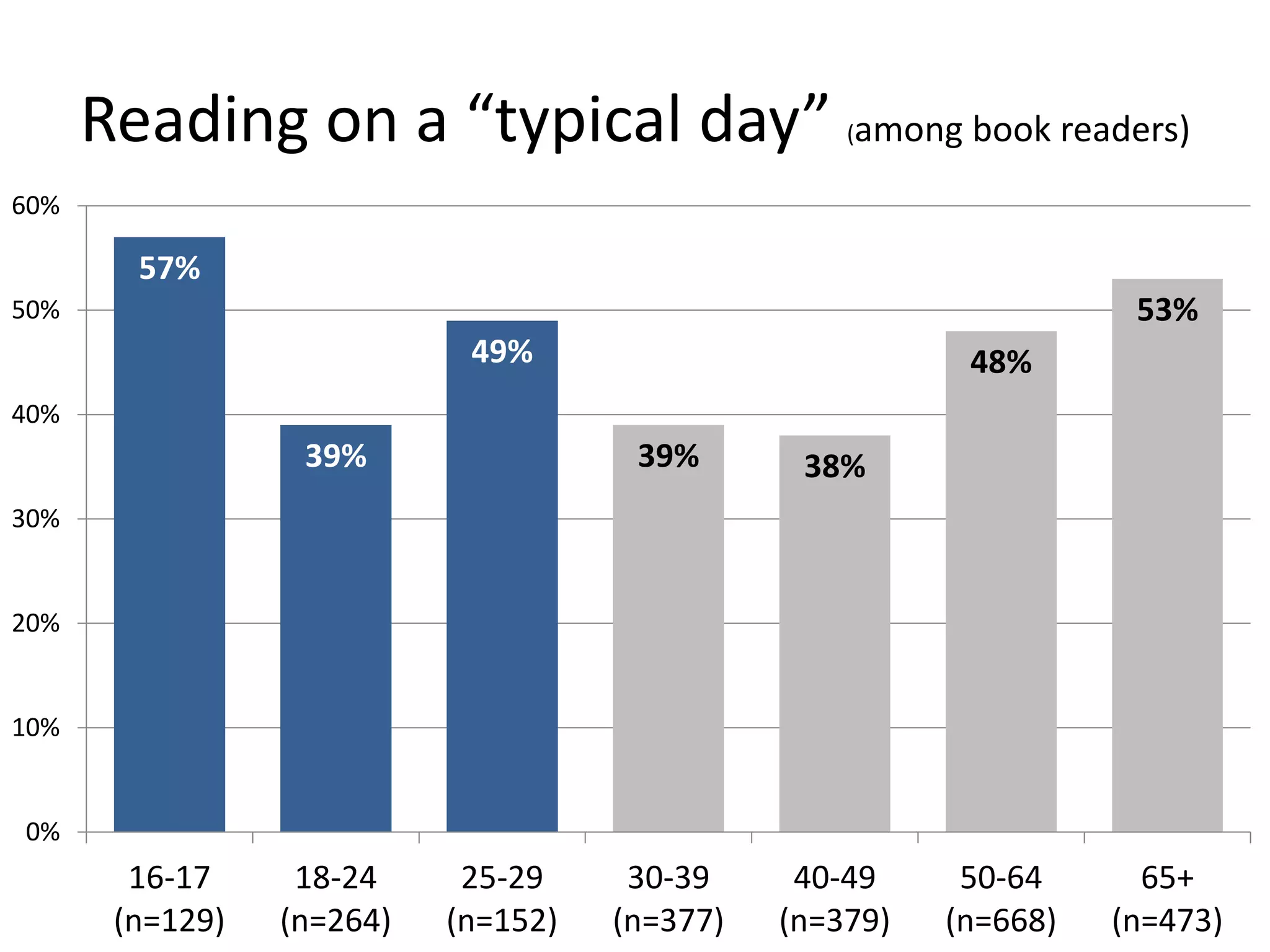
Reading on a “typical day”                   (among   book readers)
60%

        57%
50%                                                                  53%
                            49%                             48%
40%
                  39%                 39%       38%
30%


20%


10%


0%
        16-17     18-24     25-29     30-39     40-49     50-64       65+
       (n=129)   (n=264)   (n=152)   (n=377)   (n=379)   (n=668)    (n=473)
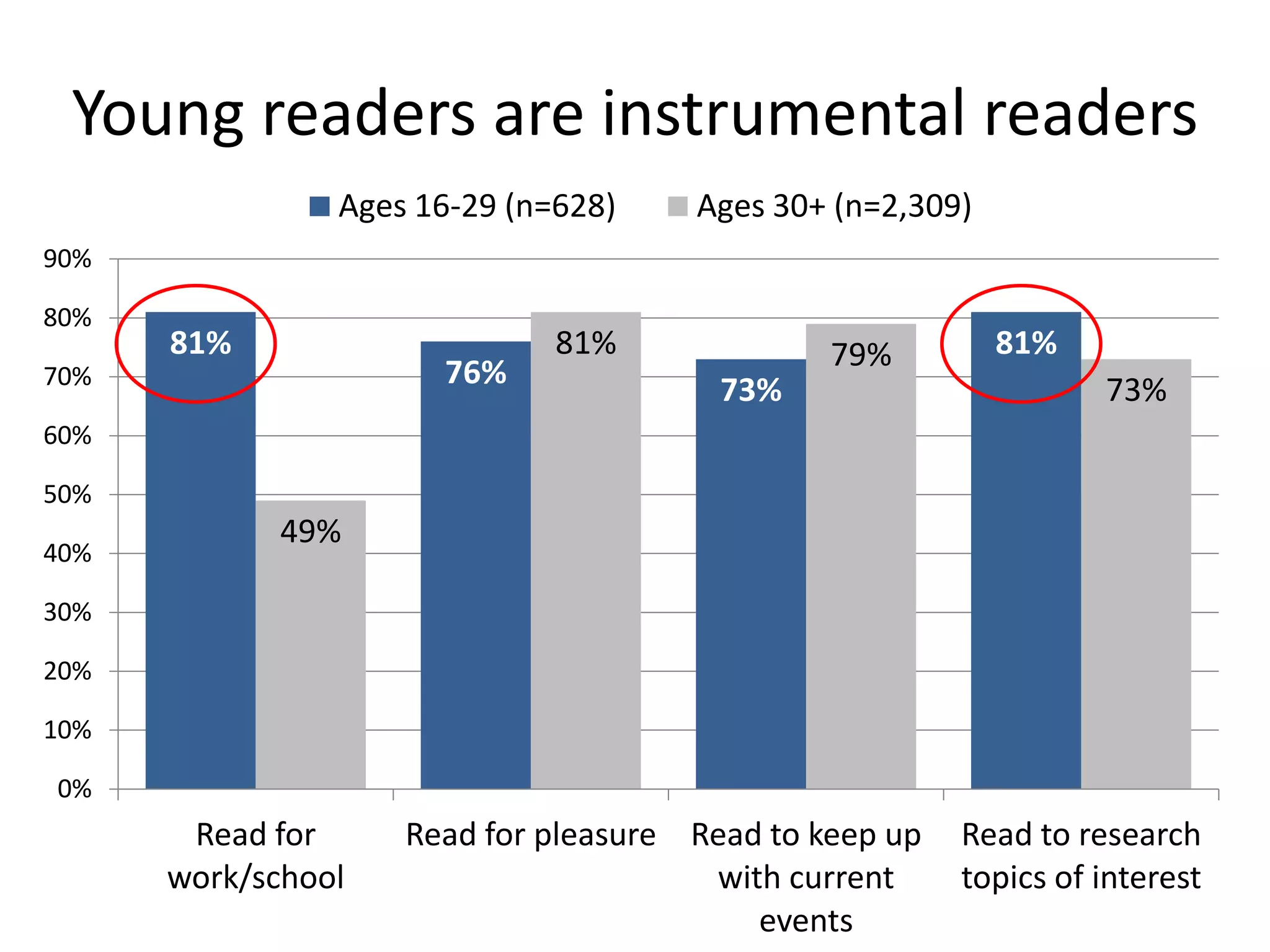
Young readers are instrumental readers
                Ages 16-29 (n=628)    Ages 30+ (n=2,309)
90%

80%
      81%                     81%              79%         81%
70%                   76%               73%                       73%
60%

50%
             49%
40%

30%

20%

10%

0%
       Read for     Read for pleasure Read to keep up   Read to research
      work/school                      with current     topics of interest
                                          events
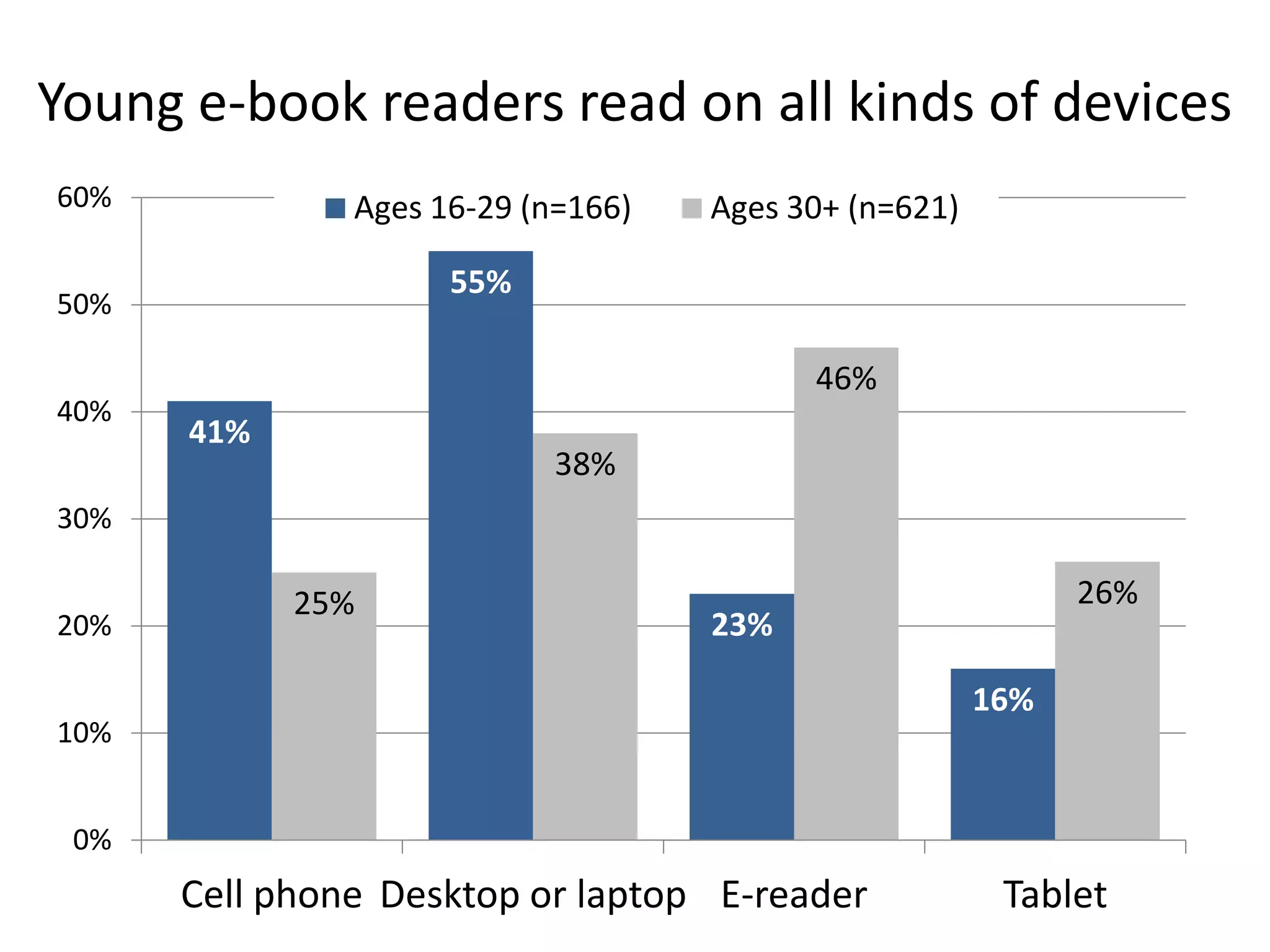
Young e-book readers read on all kinds of devices
60%            Ages 16-29 (n=166)   Ages 30+ (n=621)

                     55%
50%

                                          46%
40%
      41%
                            38%
30%

            25%                                              26%
20%                                 23%

                                                       16%
10%


 0%
      Cell phone Desktop or laptop E-reader             Tablet
7 takeaways from our research
1) Teens live in a different information ecosystem
2) Teens live in a different learning ecosystem
3) Teens’ reading levels match/exceed adult levels
4) Teens use libraries and librarians more than others,
   but don’t necessarily love libraries as much
5) Teens have their own priorities for library services
6) Teens will behave differently in the world to come
7) The public and teachers recognize this and want
   libraries to adjust to it
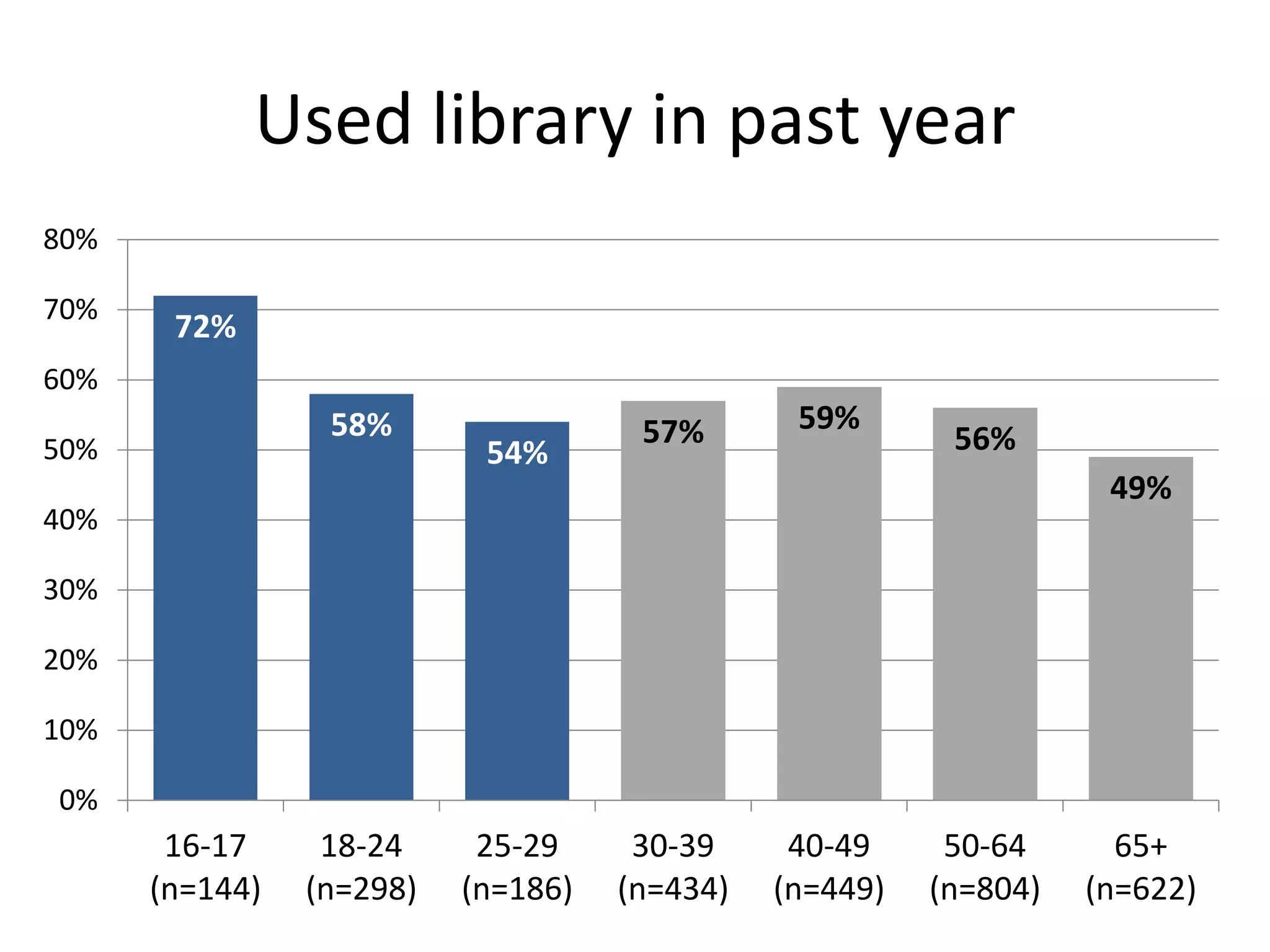
Used library in past year
80%

70%
       72%
60%
                 58%                 57%       59%
50%                        54%                           56%
                                                                   49%
40%

30%

20%

10%

0%
       16-17     18-24     25-29     30-39     40-49     50-64      65+
      (n=144)   (n=298)   (n=186)   (n=434)   (n=449)   (n=804)   (n=622)
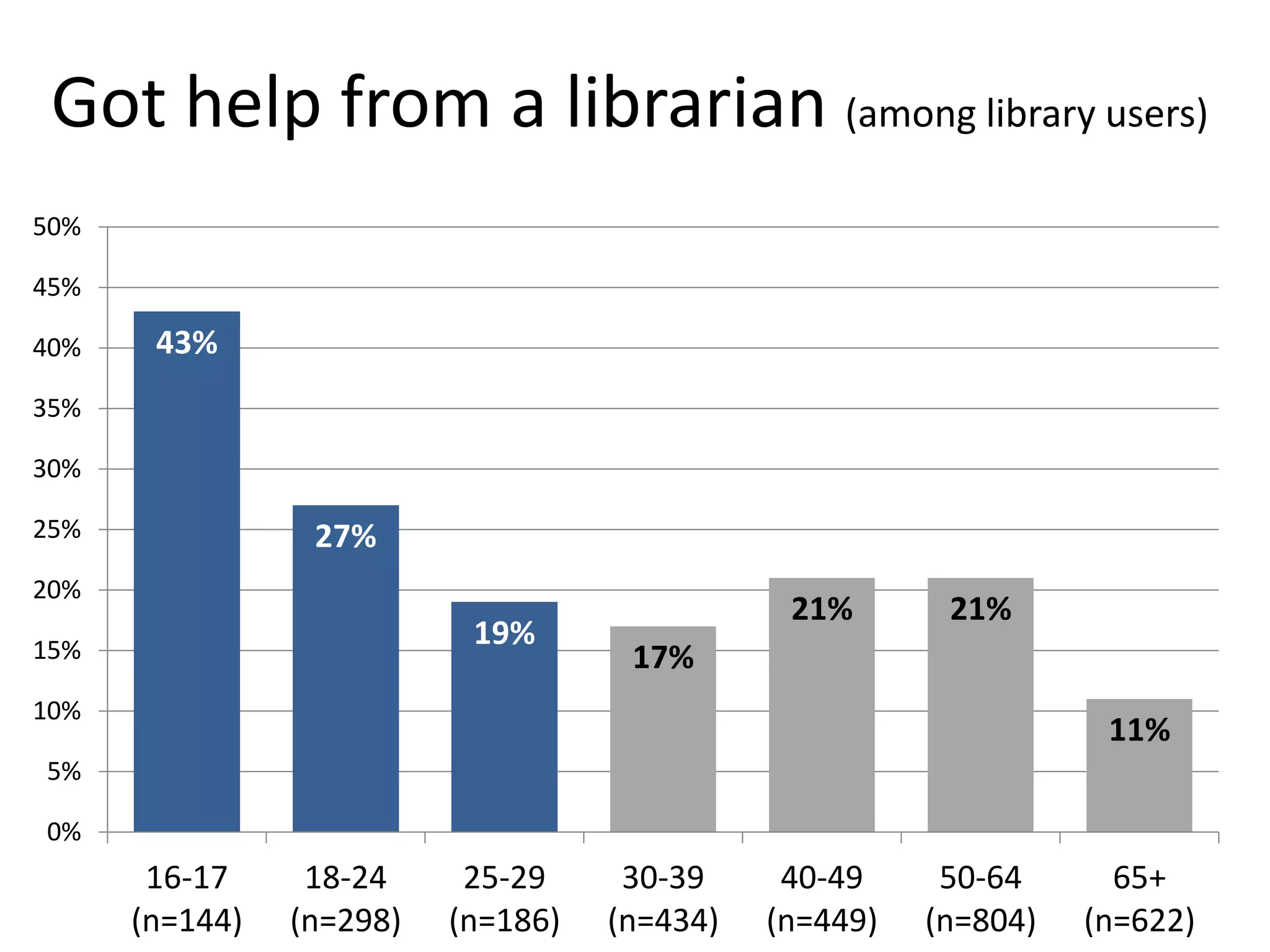
Got help from a librarian (among library users)
50%

45%

40%    43%
35%

30%

25%              27%
20%
                                               21%       21%
15%
                           19%
                                     17%
10%
                                                                   11%
5%

0%
       16-17     18-24     25-29     30-39     40-49     50-64      65+
      (n=144)   (n=298)   (n=186)   (n=434)   (n=449)   (n=804)   (n=622)
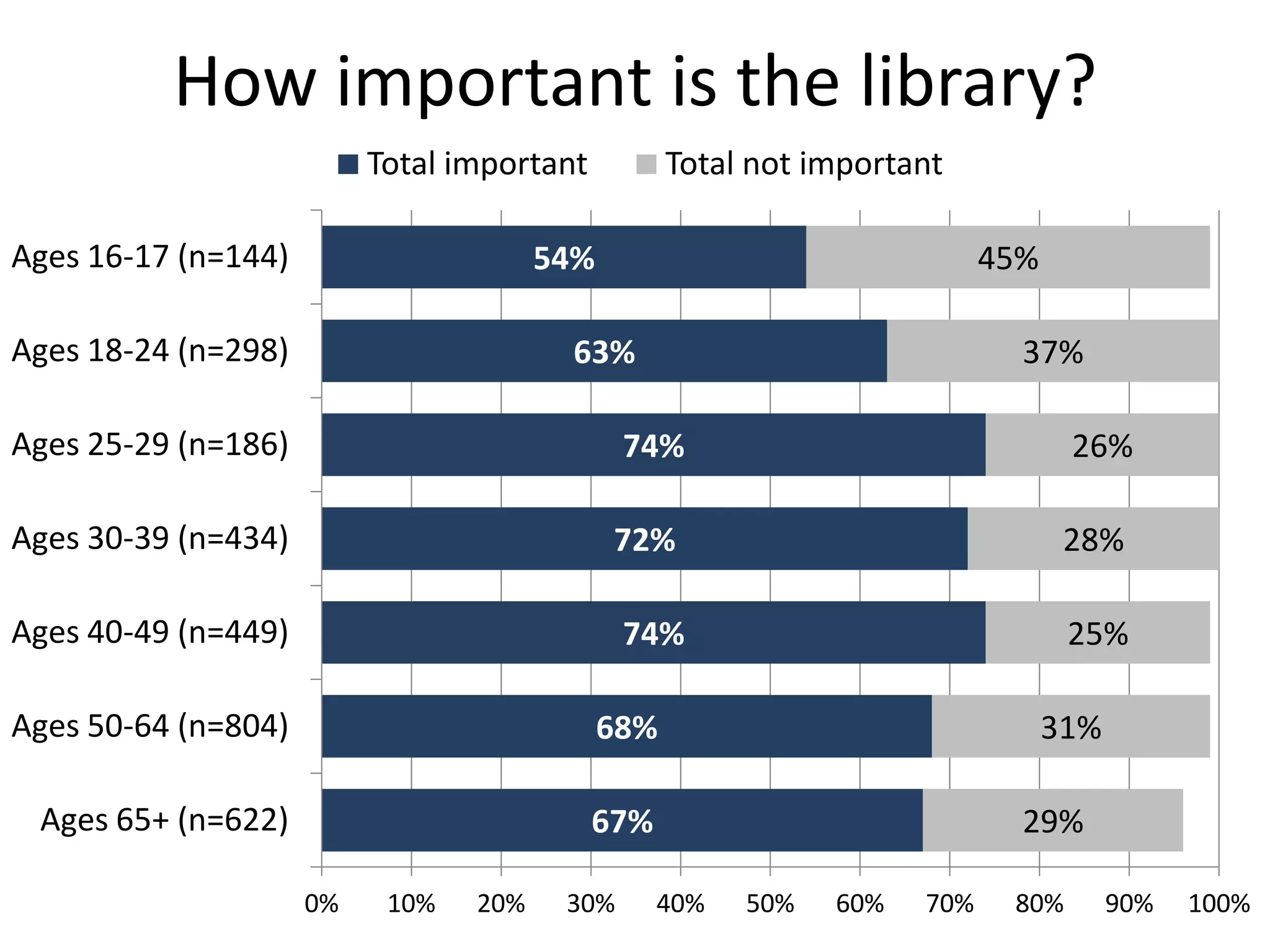
How important is the library?
                          Total important          Total not important

Ages 16-17 (n=144)                     54%                                45%

Ages 18-24 (n=298)                      63%                                 37%

Ages 25-29 (n=186)                            74%                                26%

Ages 30-39 (n=434)                           72%                                 28%

Ages 40-49 (n=449)                            74%                                25%

Ages 50-64 (n=804)                           68%                                31%

 Ages 65+ (n=622)                           67%                             29%

                     0%    10%   20%    30%       40%   50%   60%   70%    80%        90%   100%
7 takeaways from our research
1) Teens live in a different information ecosystem
2) Teens live in a different learning ecosystem
3) Teens’ reading levels match/exceed adult levels
4) Teens use libraries and librarians more than others,
   but don’t necessarily love libraries as much
5) Teens have their own priorities for library services
6) Teens will behave differently in the world to come
7) The public and teachers recognize this and want
   libraries to adjust to it
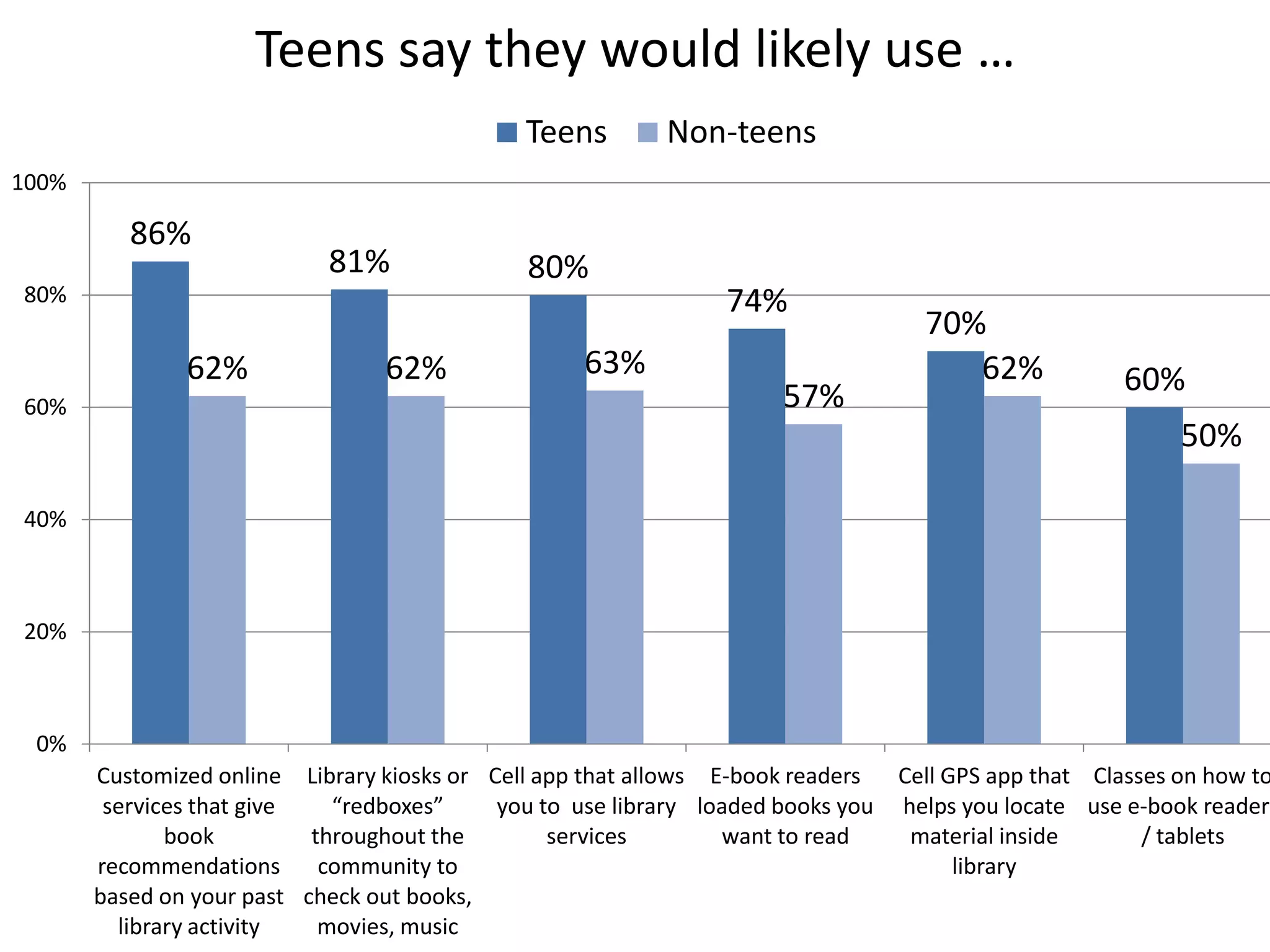
Teens say they would likely use …
                                              Teens        Non-teens
100%

          86%
                            81%               80%
80%                                                             74%
                                                                                  70%
               62%               62%               63%                               62%            60%
60%                                                                  57%
                                                                                                          50%

40%


20%


 0%
       Customized online Library kiosks or Cell app that allows E-book readers  Cell GPS app that Classes on how to
        services that give   “redboxes”     you to use library loaded books you helps you locate use e-book readers
              book         throughout the        services        want to read    material inside       / tablets
       recommendations      community to                                              library
       based on your past check out books,
         library activity   movies, music
7 takeaways from our research
1) Teens live in a different information ecosystem
2) Teens live in a different learning ecosystem
3) Teens’ reading levels match/exceed adult levels
4) Teens use libraries and librarians more than others,
   but don’t necessarily love libraries as much
5) Teens have their own priorities for library services
6) Teens will behave differently in the world to come
7) The public and teachers recognize this and want
   libraries to adjust to it
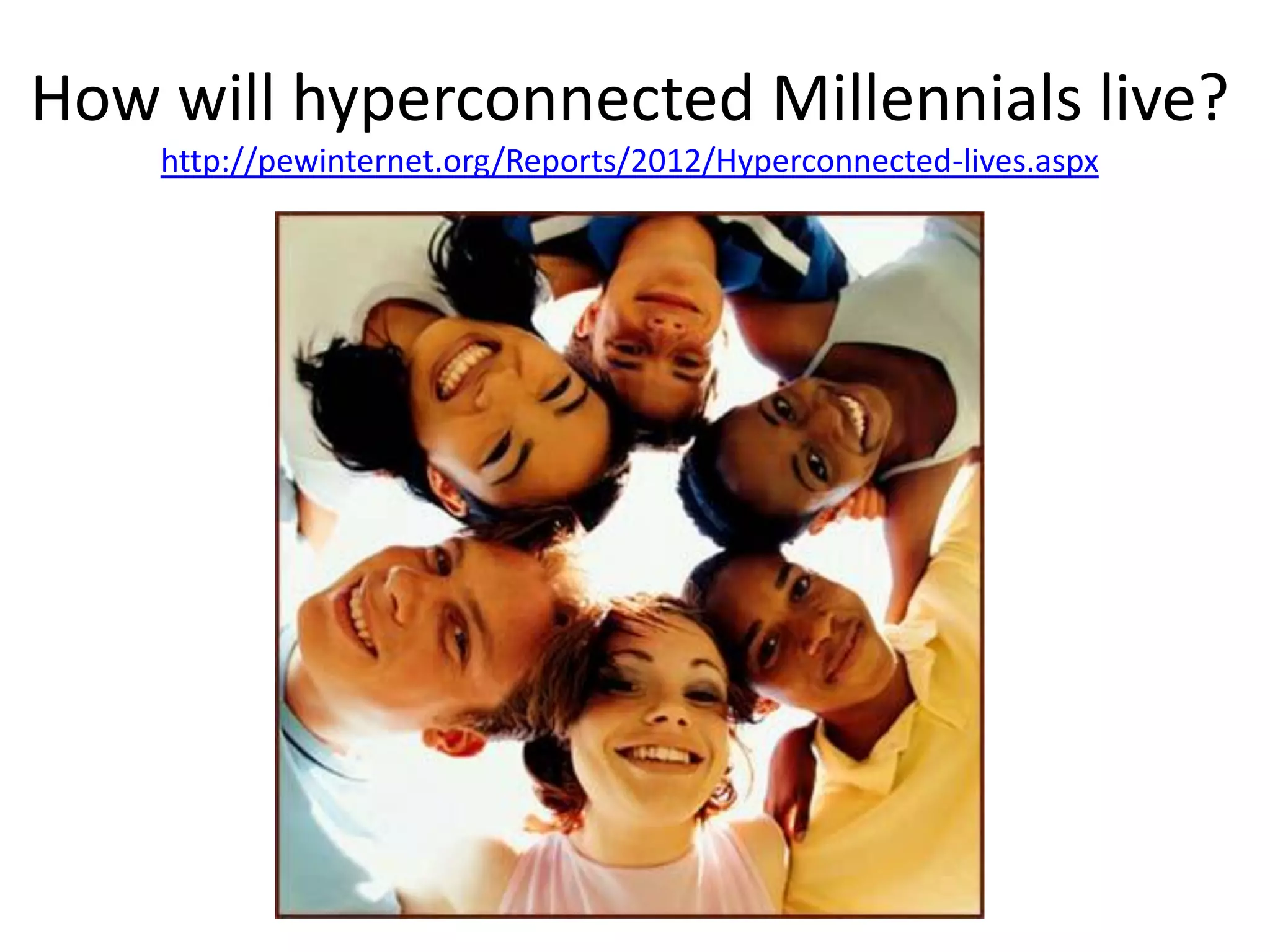
How will hyperconnected Millennials live?
    http://pewinternet.org/Reports/2012/Hyperconnected-lives.aspx
Vote for …
Millennials’ future
• In 2020 the brains of multitasking teens and young
  adults are "wired" differently from those over age 35
  and overall it yields helpful results. They do not suffer
  notable cognitive shortcomings as they multitask and
  cycle quickly through personal- and work-related tasks.
  Rather, they are learning more and they are more
  adept at finding answers to deep questions, in part
  because they can search effectively and access
  collective intelligence via the Internet. In sum, the
  changes in learning behavior and cognition among the
  young generally produce positive outcomes.
… or …
Millennials’ future
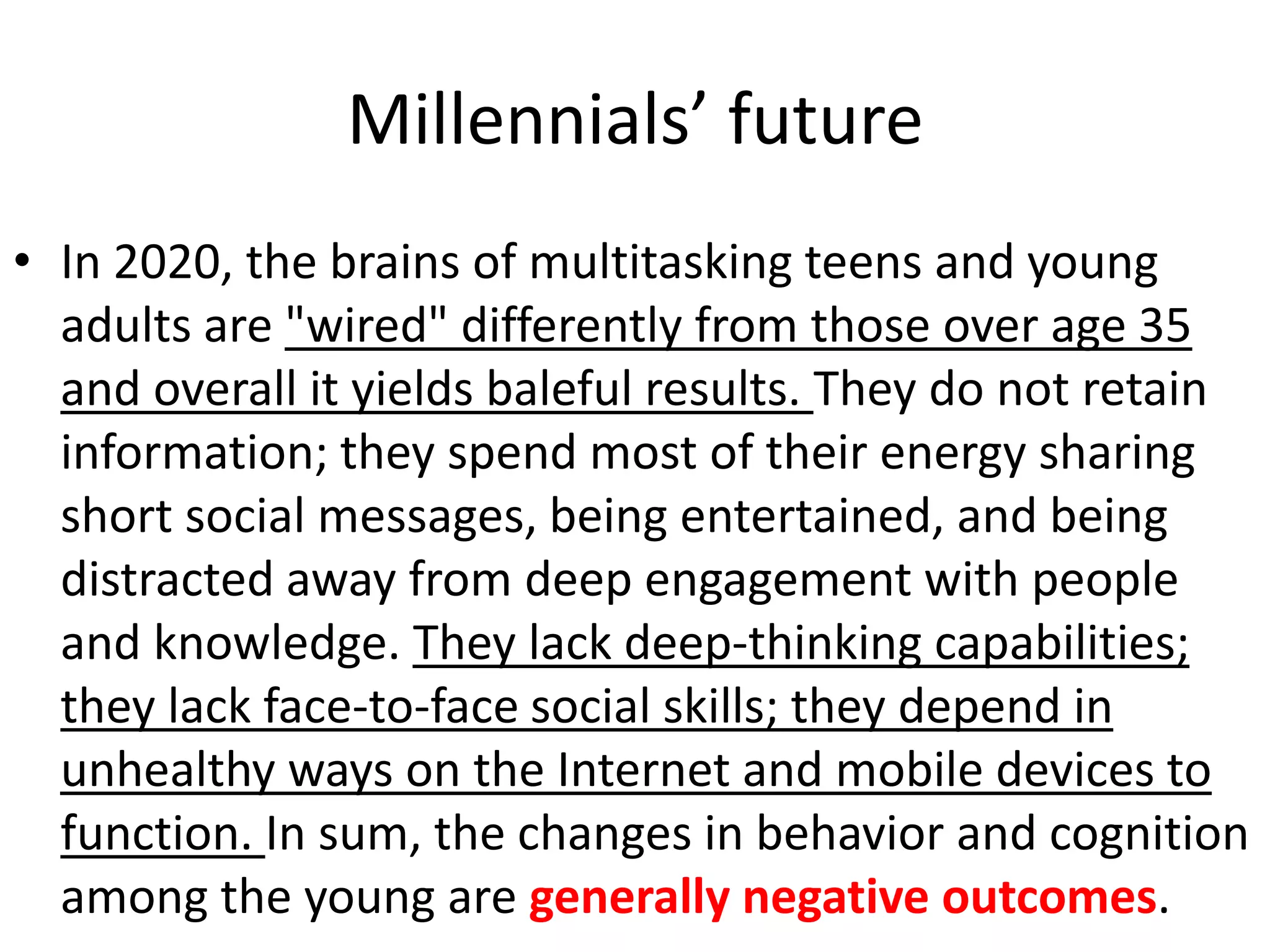
• In 2020, the brains of multitasking teens and young
  adults are "wired" differently from those over age 35
  and overall it yields baleful results. They do not retain
  information; they spend most of their energy sharing
  short social messages, being entertained, and being
  distracted away from deep engagement with people
  and knowledge. They lack deep-thinking capabilities;
  they lack face-to-face social skills; they depend in
  unhealthy ways on the Internet and mobile devices to
  function. In sum, the changes in behavior and cognition
  among the young are generally negative outcomes.
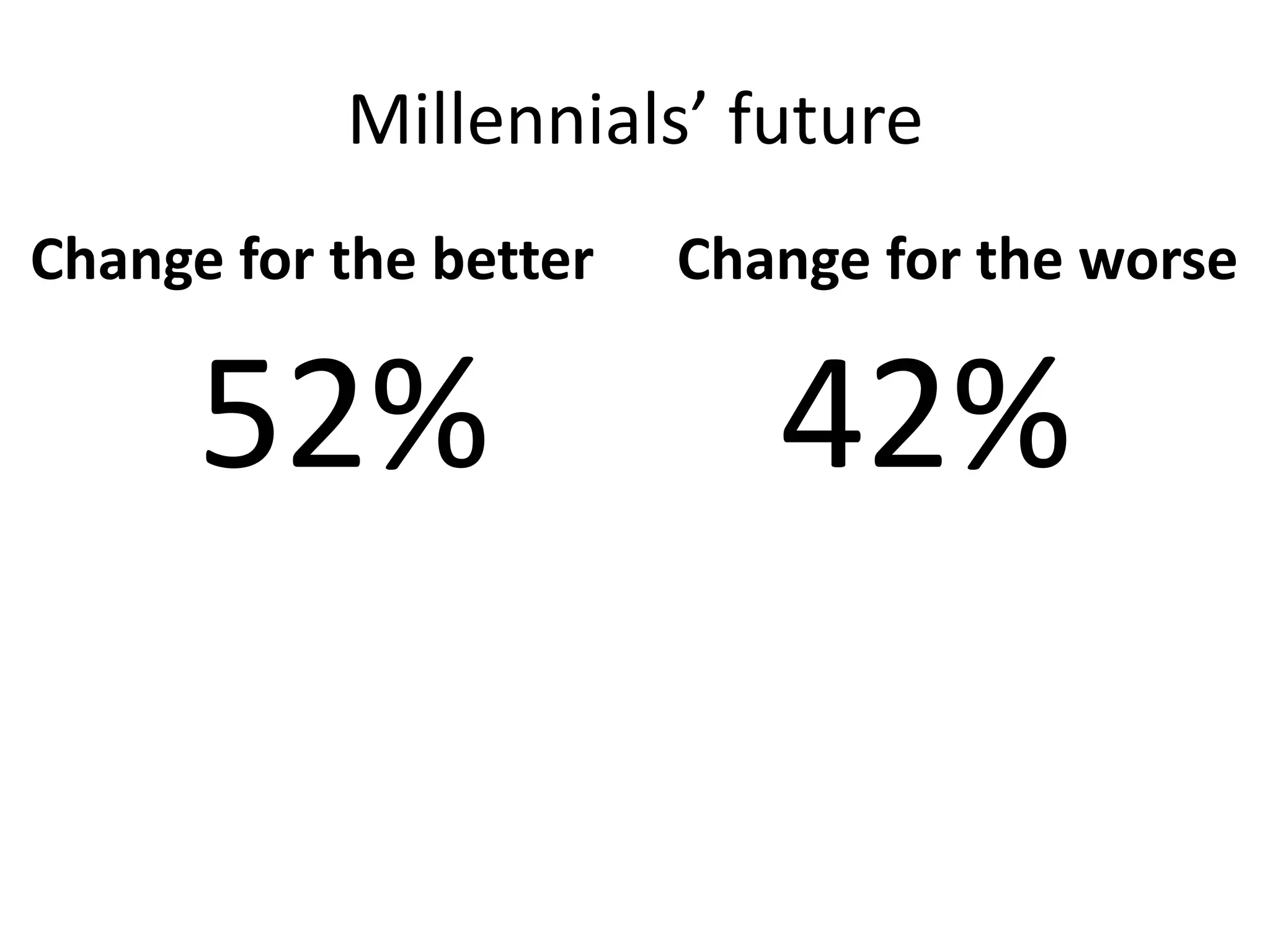
Millennials’ future
Change for the better   Change for the worse

      52%                  42%
Theme - Supertaskers
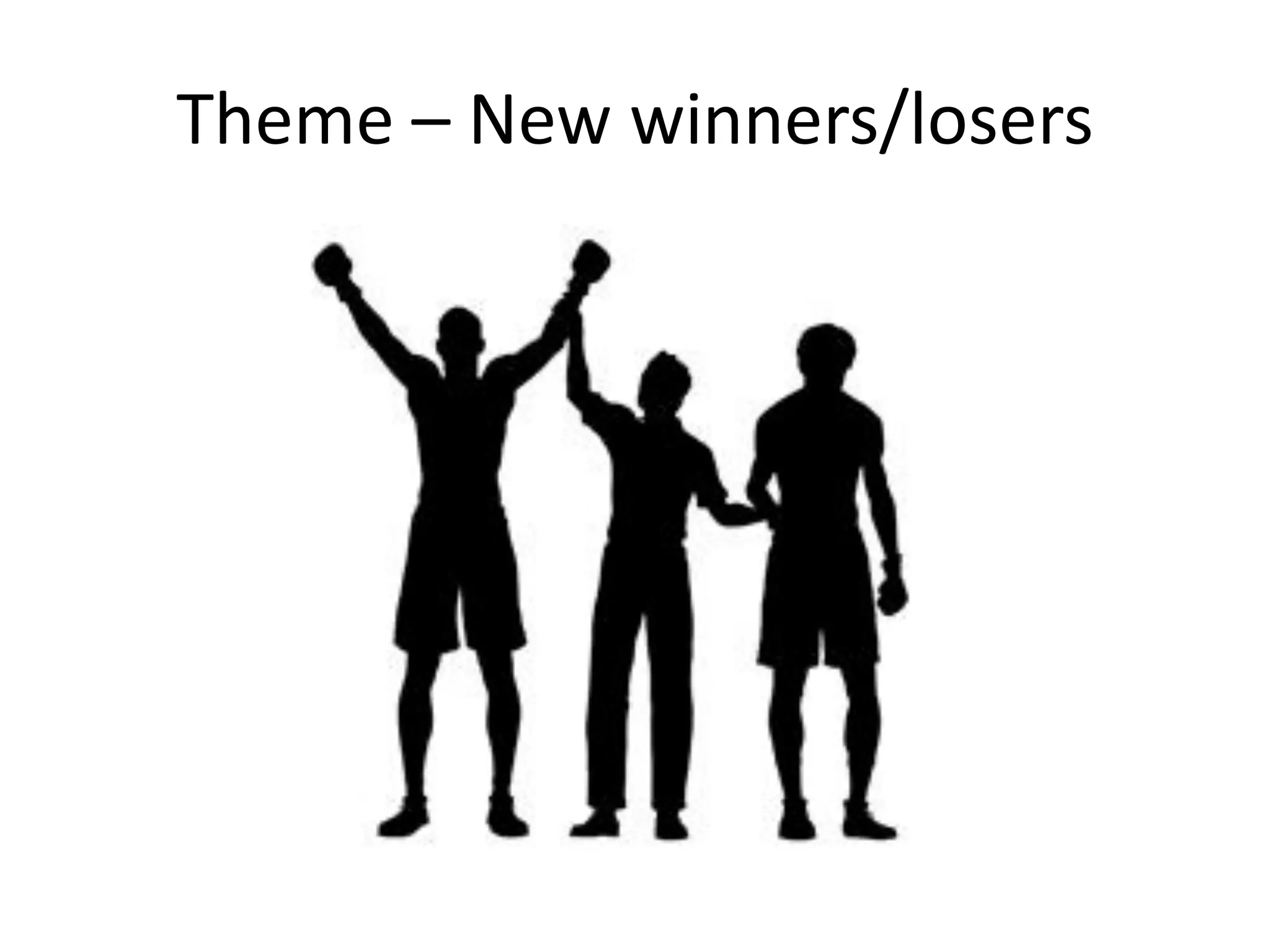
Theme – New winners/losers
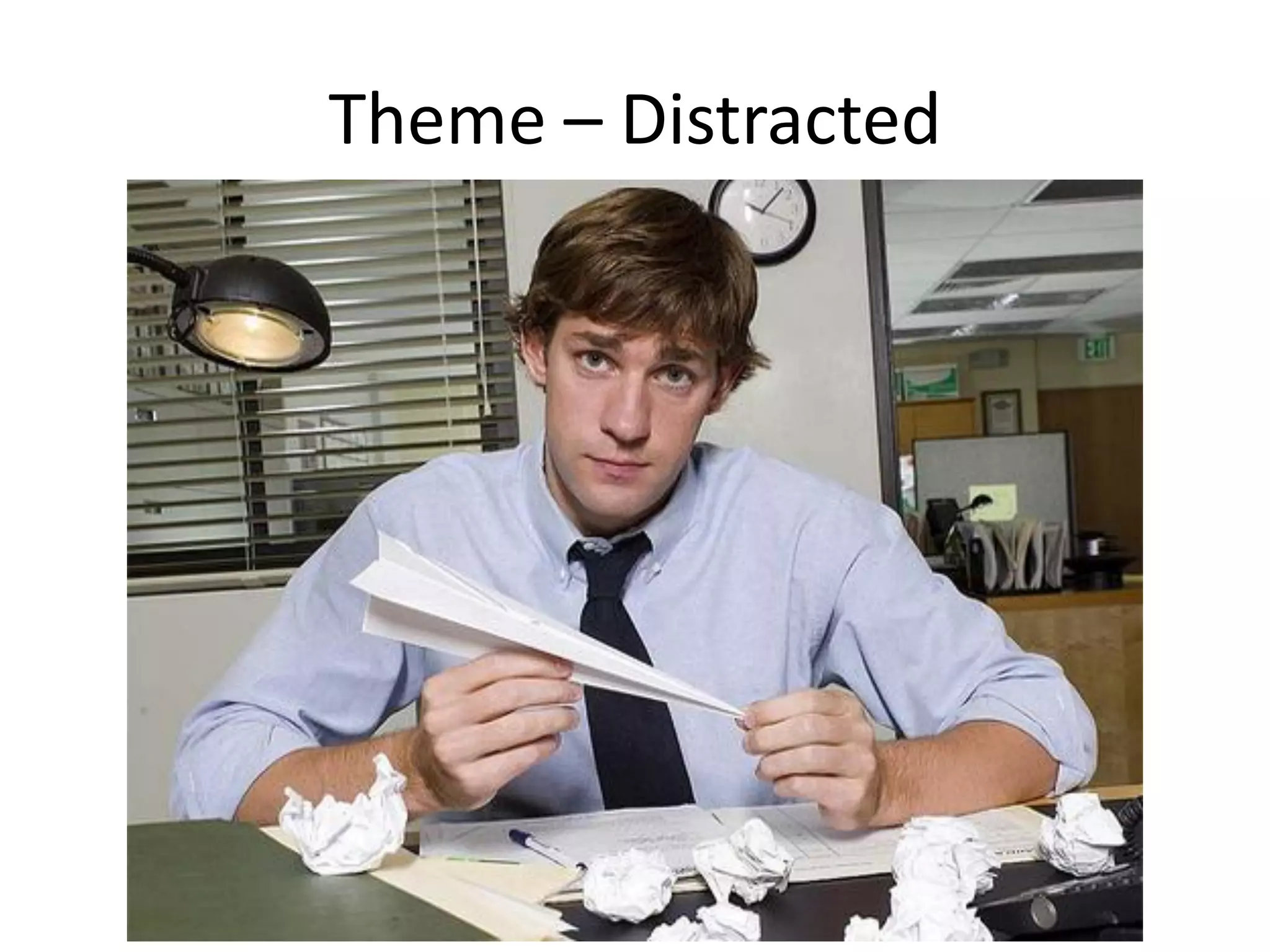
Theme – Distracted
7 takeaways from our research
1) Teens live in a different information ecosystem
2) Teens live in a different learning ecosystem
3) Teens’ reading levels match/exceed adult levels
4) Teens use libraries and librarians more than others,
   but don’t necessarily love libraries as much
5) Teens have their own priorities for library services
6) Teens will behave differently in the world to come
7) The public and teachers recognize this and want
   libraries to adjust to it
Teachers press for literacy
• 57% spend class time helping students improve
  their search skills
• 35% devote class time to helping students
  understand how search engines work and how
  search results are generated
• Asked what curriculum changes might be
  necessary in middle and high schools today, 47%
  “strongly agree” and 44% “somewhat agree” that
  courses or content focusing on digital literacy
  must be incorporated into every school’s
  curriculum.
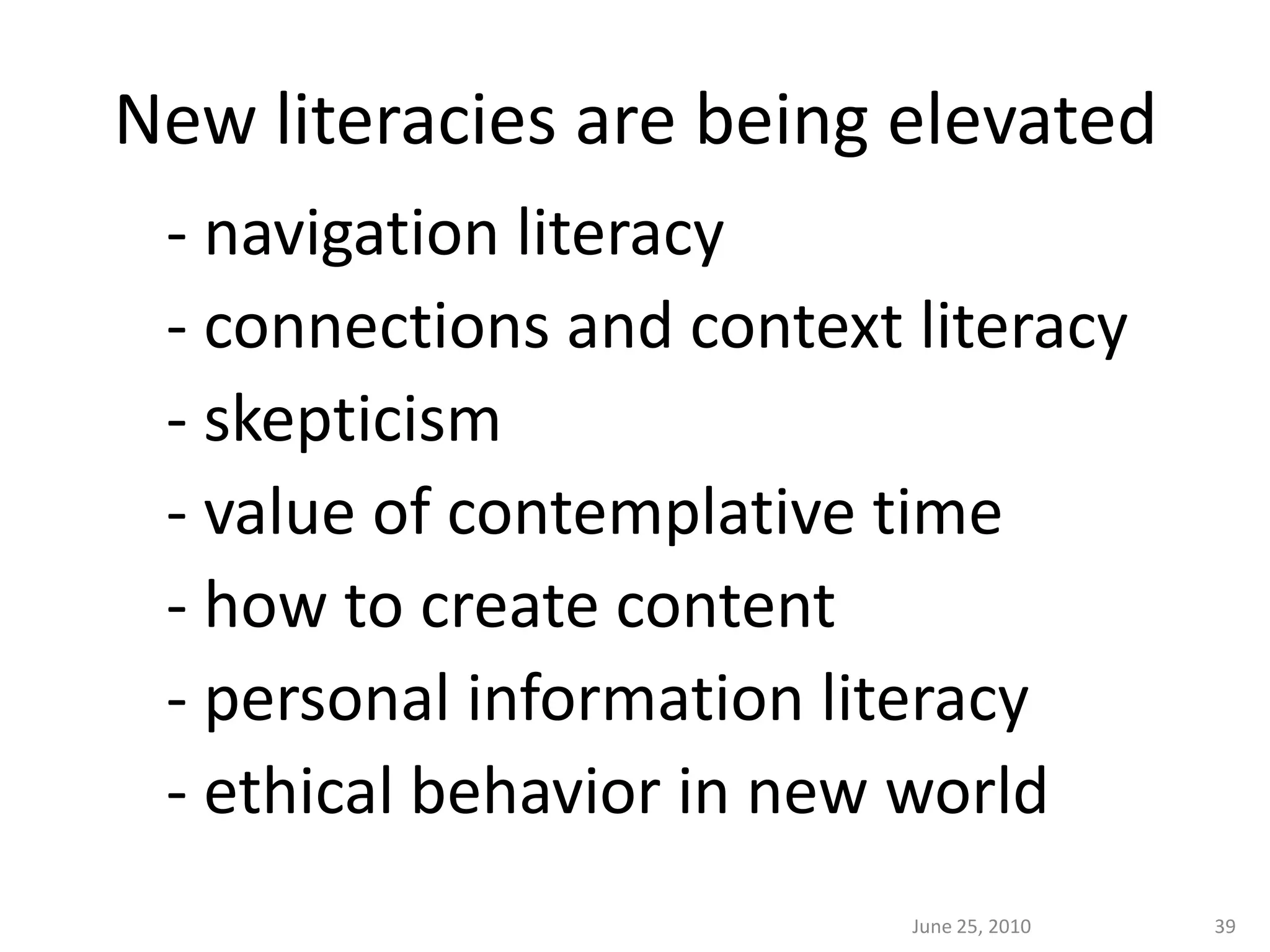
New literacies are being elevated
 - navigation literacy
 - connections and context literacy
 - skepticism
 - value of contemplative time
 - how to create content
 - personal information literacy
 - ethical behavior in new world
                           June 25, 2010   39
Libraries.pewinternet.org
Lee Rainie
Email: lrainie@pewinternet.org
Twitter: @Lrainie

Kathryn Zickuhr
Email: kzickuhr@pewinternet.org
Twitter: @kzickuhr

Kristen Purcell
Email: @kpurcell@pewinternet.org
Twitter: @kristenpurcell

Teens and Libraries

  • 1.
    Teens and Libraries Lee Rainie Director Pew Research Center’s Internet & American Life Project Presented to: YALSA Teens and Libraries Summit January 23, 2013
  • 2.
    What is thePew Internet Project? A comprehensive and groundbreaking new report Number Of Users released Monday by the Pew Research Center’s Internet and American Life Project has found that Who Actually only four users of Facebook derive pleasure of any .... “As it turns out, the vast majority of human kind from theto become depressed when they beings tend popular social networking website. Enjoy Facebook According to the report, the remainder of see the past five years of their life summarized the 950 million people registered with Facebook, Down To 4 right there in front of them in a sad little despite using the site on a regular basis, take no timeline,” said lead researcher John Elliott. joy in doing so, and in fact feel a profound sense of hopelessness and despair immediately upon logging in…
  • 3.
    7 takeaways fromour research 1) Teens live in a different information ecosystem 2) Teens live in a different learning ecosystem 3) Teens’ reading levels match/exceed adult levels 4) Teens use libraries and librarians more than others, but don’t necessarily love libraries as much 5) Teens have different priorities in library services 6) Teens will behave differently in the world to come 7) The public and teachers recognize this and want libraries to adjust to it
  • 4.
    7 takeaways fromour research 1) Teens live in a different information ecosystem 2) Teens live in a different learning ecosystem 3) Teens’ reading levels match/exceed adult levels 4) Teens’ use libraries and librarians more than others, but don’t necessarily love libraries as much 5) Teens have their own priorities for library services 6) Teens will behave differently in the world to come 7) The public and teachers recognize this and want libraries to adjust to it
  • 5.
    The super-tech-saturated teens •95% use internet / ~ three-quarters have broadband at home ~ 60%-70% access internet on mobile device • 78% have cell phones / 47% have smartphones – 80% have desktop/laptop – 23% have tablet computers • 81% use social networking sites – 24% use Twitter – Approx. from young adult data: a quarter of teens use Instagram; 1 in 7 use Pinterest; 1 in 10 use Tumblr
  • 6.
    Other factoids • Teenswho play video games: 97% • Young adults (YA) who own e-reader or tablet: 50% • YA who prefer to get call rather than text: 45% • YA who prefer to get text rather than call: 40% • YA who have bumped into another person or object when they were concentrating on cell phone: 41% • YA who have been bumped into by another person concentrating on her/his phone: 61%
  • 7.
    The traits ofnetworked information • Pervasively generated • Real-time / • Pervasively consumed just-in-time • Personal • Timeless / • Participatory / social searchable • Linked • Given meaning through social • Continually edited networks and • Multi-platformed “algorithmic authority”
  • 8.
    7 takeaways fromour research 1) Teens live in a different information ecosystem 2) Teens live in a different learning ecosystem 3) Teens’ reading levels match/exceed adult levels 4) Teens use libraries and librarians more than others, but don’t necessarily love libraries as much 5) Teens have their own priorities for library services 6) Teens will behave differently in the world to come 7) The public and teachers recognize this and want libraries to adjust to it
  • 9.
    Online survey of2,462 teachers with College Board and National Writing Project • 77% of • 87% agree teachers these surveyed say technologies the are creating an internet and “easily digital search distracted tools have had generation with a “mostly short attention positive” spans” impact on their students’ research work
  • 10.
    Online survey of2,462 teachers with College Board and National Writing Project • 76% of the • 76% strongly teachers in agree that this study internet strongly agree search “the internet engines have enables conditioned students to students to access a wider expect to be range of able to find resources than information would quickly and otherwise be easily available”
  • 11.
    Online survey of2,462 teachers with College Board and National Writing Project • 65% agree to 83% agree that some extent the amount of that “the information internet available online makes today’s today is students overwhelming more self- to most sufficient students researchers”
  • 12.
    Online survey of2,462 teachers with College Board and National Writing Project • 90% agree that • 71% agree that the internet today’s digital encourages technologies learning by discourage connecting students from students to using a wide resources range of about topics of sources when interest to conducting them research
  • 13.
    Grading students’ researchskills Excellent Very good Good Fair Poor Ability to use appropriate and effective search terms 6% 20% 36% 29% 9% and queries Understanding how online search results are generated 5% 19% 29% 26% 21% Ability to use multiple sources to effectively support 3% 12% 26% 39% 20% an argument Ability to assess the quality and accuracy of information 3% 11% 26% 37% 24% they find online Patience and determination in looking for information 1% 6% 15% 35% 43% that is hard to find Ability to recognize bias in online content 1% 7% 20% 38% 33% 0% 20% 40% 60% 80% 1
  • 14.
    “Today’s students arereally no different from previous generations, they just have different tools through which to express themselves.” Agree Disagree 47% 52%
  • 15.
    7 takeaways fromour research 1) Teens live in a different information ecosystem 2) Teens live in a different learning ecosystem 3) Teens’ reading levels match/exceed adult levels 4) Teens use libraries and librarians more than others, but don’t necessarily love libraries as much 5) Teens have their own priorities for library services 6) Teens will behave differently in the world to come 7) The public and teachers recognize this and want libraries to adjust to it
  • 16.
    How many booksAmericans read Among book readers, the mean and median number of books each group read in the past 12 months, among all Americans ages 16 and older Mean number of Median books read (midpoint) (average) All those 16 and older 17 8 Ages 16-17 (n=144) 18 10 Ages 18-24 (n=298) 17 7 Ages 25-29 (n=186) 17 6 Ages 30-39 (n=434) 14 6 Ages 40-49 (n=449) 15 6 Ages 50-64 (n=804) 18 8 Ages 65+ (n=622) 23 12
  • 17.
    Reading on a“typical day” (among book readers) 60% 57% 50% 53% 49% 48% 40% 39% 39% 38% 30% 20% 10% 0% 16-17 18-24 25-29 30-39 40-49 50-64 65+ (n=129) (n=264) (n=152) (n=377) (n=379) (n=668) (n=473)
  • 18.
    Young readers areinstrumental readers Ages 16-29 (n=628) Ages 30+ (n=2,309) 90% 80% 81% 81% 79% 81% 70% 76% 73% 73% 60% 50% 49% 40% 30% 20% 10% 0% Read for Read for pleasure Read to keep up Read to research work/school with current topics of interest events
  • 19.
    Young e-book readersread on all kinds of devices 60% Ages 16-29 (n=166) Ages 30+ (n=621) 55% 50% 46% 40% 41% 38% 30% 25% 26% 20% 23% 16% 10% 0% Cell phone Desktop or laptop E-reader Tablet
  • 20.
    7 takeaways fromour research 1) Teens live in a different information ecosystem 2) Teens live in a different learning ecosystem 3) Teens’ reading levels match/exceed adult levels 4) Teens use libraries and librarians more than others, but don’t necessarily love libraries as much 5) Teens have their own priorities for library services 6) Teens will behave differently in the world to come 7) The public and teachers recognize this and want libraries to adjust to it
  • 21.
    Used library inpast year 80% 70% 72% 60% 58% 57% 59% 50% 54% 56% 49% 40% 30% 20% 10% 0% 16-17 18-24 25-29 30-39 40-49 50-64 65+ (n=144) (n=298) (n=186) (n=434) (n=449) (n=804) (n=622)
  • 22.
    Got help froma librarian (among library users) 50% 45% 40% 43% 35% 30% 25% 27% 20% 21% 21% 15% 19% 17% 10% 11% 5% 0% 16-17 18-24 25-29 30-39 40-49 50-64 65+ (n=144) (n=298) (n=186) (n=434) (n=449) (n=804) (n=622)
  • 23.
    How important isthe library? Total important Total not important Ages 16-17 (n=144) 54% 45% Ages 18-24 (n=298) 63% 37% Ages 25-29 (n=186) 74% 26% Ages 30-39 (n=434) 72% 28% Ages 40-49 (n=449) 74% 25% Ages 50-64 (n=804) 68% 31% Ages 65+ (n=622) 67% 29% 0% 10% 20% 30% 40% 50% 60% 70% 80% 90% 100%
  • 24.
    7 takeaways fromour research 1) Teens live in a different information ecosystem 2) Teens live in a different learning ecosystem 3) Teens’ reading levels match/exceed adult levels 4) Teens use libraries and librarians more than others, but don’t necessarily love libraries as much 5) Teens have their own priorities for library services 6) Teens will behave differently in the world to come 7) The public and teachers recognize this and want libraries to adjust to it
  • 25.
    Teens say theywould likely use … Teens Non-teens 100% 86% 81% 80% 80% 74% 70% 62% 62% 63% 62% 60% 60% 57% 50% 40% 20% 0% Customized online Library kiosks or Cell app that allows E-book readers Cell GPS app that Classes on how to services that give “redboxes” you to use library loaded books you helps you locate use e-book readers book throughout the services want to read material inside / tablets recommendations community to library based on your past check out books, library activity movies, music
  • 26.
    7 takeaways fromour research 1) Teens live in a different information ecosystem 2) Teens live in a different learning ecosystem 3) Teens’ reading levels match/exceed adult levels 4) Teens use libraries and librarians more than others, but don’t necessarily love libraries as much 5) Teens have their own priorities for library services 6) Teens will behave differently in the world to come 7) The public and teachers recognize this and want libraries to adjust to it
  • 27.
    How will hyperconnectedMillennials live? http://pewinternet.org/Reports/2012/Hyperconnected-lives.aspx
  • 28.
  • 29.
    Millennials’ future • In2020 the brains of multitasking teens and young adults are "wired" differently from those over age 35 and overall it yields helpful results. They do not suffer notable cognitive shortcomings as they multitask and cycle quickly through personal- and work-related tasks. Rather, they are learning more and they are more adept at finding answers to deep questions, in part because they can search effectively and access collective intelligence via the Internet. In sum, the changes in learning behavior and cognition among the young generally produce positive outcomes.
  • 30.
  • 31.
    Millennials’ future • In2020, the brains of multitasking teens and young adults are "wired" differently from those over age 35 and overall it yields baleful results. They do not retain information; they spend most of their energy sharing short social messages, being entertained, and being distracted away from deep engagement with people and knowledge. They lack deep-thinking capabilities; they lack face-to-face social skills; they depend in unhealthy ways on the Internet and mobile devices to function. In sum, the changes in behavior and cognition among the young are generally negative outcomes.
  • 32.
    Millennials’ future Change forthe better Change for the worse 52% 42%
  • 33.
  • 34.
    Theme – Newwinners/losers
  • 35.
  • 36.
    7 takeaways fromour research 1) Teens live in a different information ecosystem 2) Teens live in a different learning ecosystem 3) Teens’ reading levels match/exceed adult levels 4) Teens use libraries and librarians more than others, but don’t necessarily love libraries as much 5) Teens have their own priorities for library services 6) Teens will behave differently in the world to come 7) The public and teachers recognize this and want libraries to adjust to it
  • 37.
    Teachers press forliteracy • 57% spend class time helping students improve their search skills • 35% devote class time to helping students understand how search engines work and how search results are generated • Asked what curriculum changes might be necessary in middle and high schools today, 47% “strongly agree” and 44% “somewhat agree” that courses or content focusing on digital literacy must be incorporated into every school’s curriculum.
  • 38.
    New literacies arebeing elevated - navigation literacy - connections and context literacy - skepticism - value of contemplative time - how to create content - personal information literacy - ethical behavior in new world June 25, 2010 39
  • 39.
    Libraries.pewinternet.org Lee Rainie Email: lrainie@pewinternet.org Twitter:@Lrainie Kathryn Zickuhr Email: kzickuhr@pewinternet.org Twitter: @kzickuhr Kristen Purcell Email: @kpurcell@pewinternet.org Twitter: @kristenpurcell