Principles	of	(N)MR	Imaging
Peder Larson,	Ph.D.
University	of	California	– San	Francisco,	Department	of	
Radiology	and	Biomedical	Imaging
Experimental	NMR	Conference,	Educational	Presentation,	
Asilomar,	Pacific	Grove,	CA
March	28,	2017
https://radiology.ucsf.edu/research/labs/larson/educational-materials
(Google:	Peder Larson	Lab,	Educational	Materials	link	on	sidebar)
Overview
1. MRI	Systems
– Magnetic	field	gradients
2. Imaging	Principles
– Slice-selective	RF	Pulses
– Image	Formation
3. MR	spectroscopic	imaging	(MRSI)
– Spectroscopic	image	formation
– Spectral-Spatial	RF	pulses
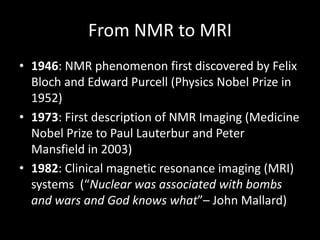
From	NMR	to	MRI
• 1946:	NMR	phenomenon	first	discovered	by	Felix	
Bloch	and	Edward	Purcell	(Physics	Nobel	Prize	in	
1952)
• 1973:	First	description	of	NMR	Imaging	(Medicine	
Nobel	Prize	to	Paul	Lauterbur and	Peter	
Mansfield	in	2003)
• 1982:	Clinical	magnetic	resonance	imaging	(MRI)	
systems		(“Nuclear	was	associated	with	bombs	
and	wars	and	God	knows	what”– John	Mallard)
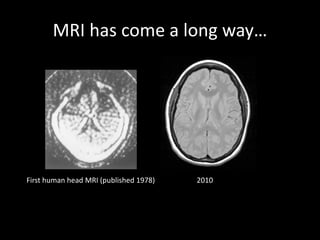
MRI	has	come	a	long	way…
MR: What’s the attraction?
Figure 1.3 First ever human head image using MRI at 0.1 T
from EMI Central Research Laboratories. For this image CT
type “back projection” was used. Courtesy of Ian Young.
The early history of NMR
‘Nuclear induction’, as it was first described, was dis-
covered in 1945, soon after the close of World War II,
by Bloch and independently by Purcell and Pound. It
is said that the development of radio communica-
tions in the war effort, to which Purcell had con-
tributed scientifically, was one of the factors
underpinning this important scientific discovery.
Another important factor, as in the development of
atomic physics, was the expulsion or fleeing of
European physicists from the Nazi regime, an exodus
that included Bloch and Bloembergen. What did
these MR pioneers discover? That you can detect a
signal (a voltage in a coil) when you place a sample in
a magnetic field and irradiate it with radiofrequency
(RF) energy of a certain frequency, the resonant or
Larmor frequency. The signal is produced by the
interaction of the sample nuclei with the magnetic
field. The spin echo was ‘stumbled upon’ by Hahn in
1949. He discovered that you could get a repeat of the
NMR signal at a delayed time by adding a second
burst of RF energy. That’s all you need to know for
now. So what were NMR researchers doing between
the forties and the seventies – that’s a long time in
cultural and scientific terms. The answer: they were
doing chemistry, including Lauterbur, a professor of
chemistry at the same institution as Damadian,
albeit on different campuses. NMR developed into a
laboratory spectroscopic technique capable of
examining the molecular structure of compounds,
until Damadian’s ground-breaking discovery in 1971.
First	human	head	MRI	(published	1978) 2010
Siemens	PET/MRI
Siemens	7T	MRI
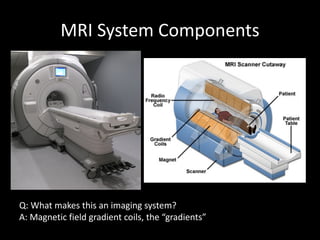
MRI	System	Components
Q:	What	makes	this	an	imaging	system?
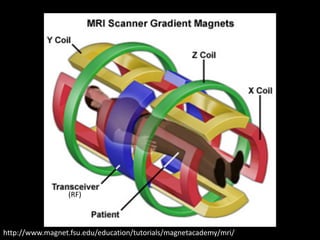
A:	Magnetic	field	gradient	coils,	the	“gradients”
http://www.magnet.fsu.edu/education/tutorials/magnetacademy/mri/
(RF)
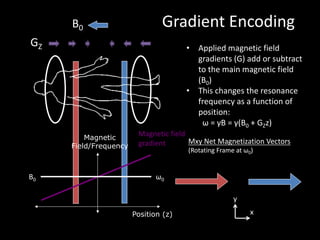
Gradient	Encoding
Position (z)
Magnetic
Field/Frequency
Magnetic	field	
gradient
B0
ω0
GZ • Applied	magnetic	field	
gradients	(G)	add	or	subtract	
to	the	main	magnetic	field	
(B0)
• This	changes	the	resonance	
frequency	as	a	function	of	
position:
ω	=	γB =	γ(B0 +	GZz)
x
y
Mxy Net	Magnetization	Vectors
(Rotating	Frame	at	ω0)
B0
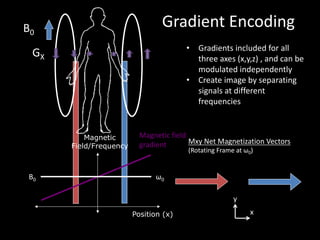
Gradient	Encoding
Position (x)
Magnetic	field	
gradient
B0
GX
Magnetic
Field/Frequency
• Gradients	included	for	all	
three	axes	(x,y,z)	,	and	can	be	
modulated	independently
• Create	image	by	separating	
signals	at	different	
frequencies
ω0B0
Mxy Net	Magnetization	Vectors
(Rotating	Frame	at	ω0)
x
y
Bloch	Equation	– Gradient	Fields
• Gradient	coils	create	changes	in	the	magnetic	field	versus	
position
• Changes	precession	frequency	to	be	a	function	of	position	
(enabling	image	formation):
G(t) = [GX (t), GY (t), GZ(t)]
~B(~r, t) =
2
4
0
0
B0 + ~G(t) · ~r
3
5
!0 = (B0 + ~G(t) · ~r)
d ~M(t)
dt
= ~M(t) ⇥ ~B(t) +
2
4
1/T2 0 0
0 1/T2 0
0 0 1/T1
3
5 ~M(t) +
2
4
0
0
M0/T1
3
5
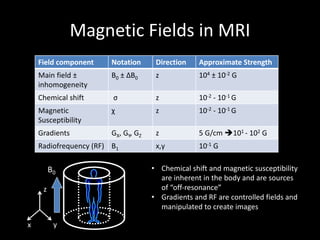
Magnetic	Fields	in	MRI
z
x y
Field	component Notation Direction Approximate	Strength
Main	field	±
inhomogeneity
B0 ± ΔB0 z 104 ± 10-2 G
Chemical	shift σ z 10-2 - 10-1	G
Magnetic	
Susceptibility
χ z 10-2 - 10-1	G
Gradients GX,	GY,	GZ z 5	G/cm	è101	- 102 G
Radiofrequency	(RF) B1 x,y 10-1 G
B0
• Chemical	shift	and	magnetic	susceptibility	
are	inherent	in	the	body	and	are	sources	
of	“off-resonance”
• Gradients	and	RF	are	controlled	fields	and	
manipulated	to	create	images
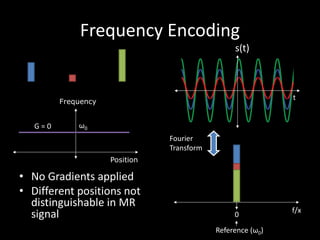
Frequency	Encoding
• No	Gradients	applied
• Different	positions	not	
distinguishable	in	MR	
signal
Position
Frequency
G	=	0
Fourier	
Transform
ω0
t
f/x
Reference	(ω0)
0
s(t)
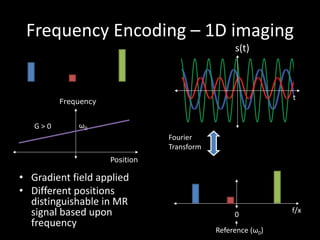
Frequency	Encoding	– 1D	imaging
• Gradient	field	applied
• Different	positions	
distinguishable	in	MR	
signal	based	upon	
frequency
Position
Frequency
G	>	0
Fourier	
Transform
f/x
ω0
t
Reference	(ω0)
0
s(t)
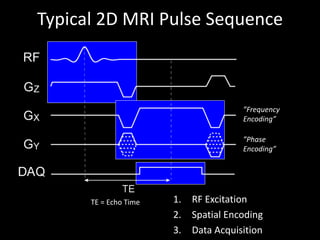
Typical	2D	MRI	Pulse	Sequence
1. RF	Excitation
2. Spatial	Encoding
3. Data	Acquisition
TE	=	Echo	Time
”Frequency	
Encoding”
”Phase	
Encoding”
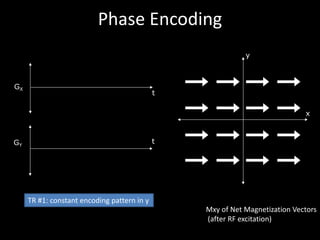
Phase	Encoding
x
y
t
GX
tGY
Mxy of	Net	Magnetization	Vectors
(after	RF	excitation)
TR	#1:	constant	encoding	pattern	in	y
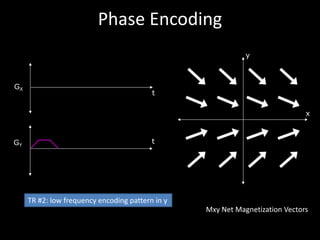
Phase	Encoding
x
y
t
GX
tGY
Mxy Net	Magnetization	Vectors
TR	#2:	low	frequency	encoding	pattern	in	y
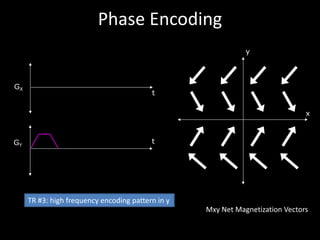
Phase	Encoding
x
y
t
GX
tGY
Mxy Net	Magnetization	Vectors
TR	#3:	high	frequency	encoding	pattern	in	y
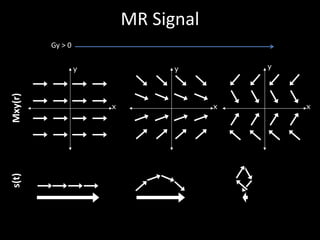
MR	Signal
x
y
Mxy(r)
x
y
x
y
s(t)	
Gy >	0
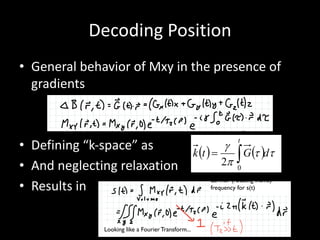
Decoding	Position
• General	behavior	of	Mxy in	the	presence	of	
gradients
• Defining	“k-space”	as
• And	neglecting	relaxation
• Results	in


General case: time varying gradients on x,y,z 


Proportional to phase of Mxy
( ) ( ) tt
p
g
dGtk
t
ò=
0
2


Demodulate received signal at
Larmor (rotating frame)
frequency for s(t)
Looking like a Fourier Transform...
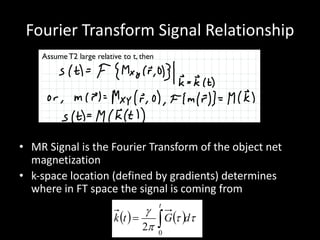
Fourier	Transform	Signal	Relationship
• MR	Signal	is	the	Fourier	Transform	of	the	object	net	
magnetization
• k-space	location	(defined	by	gradients)	determines	
where	in	FT	space	the	signal	is	coming	from
Assume T2 large relative to t, then


Received signal is the spatial Fourier Transform of the transverse (xy) net
magnetization! Evaluated at k-space location that depends on gradients 


Example : consider signal from three locations - x= 0, x1, x2 -
with magnetic field gradient on
( ) ( ) tt
p
g
dGtk
t
ò=
0
2
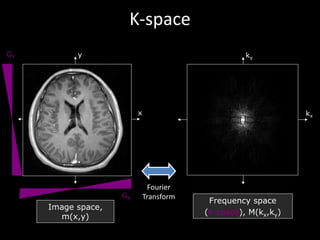
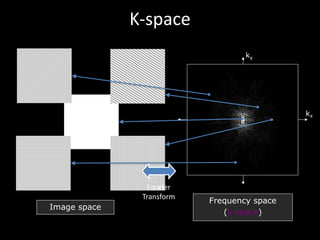
K-space
kx
ky
Frequency space
(k-space), M(kx,ky)
x
y
Fourier	
Transform
Image space,
m(x,y)
GX
GY
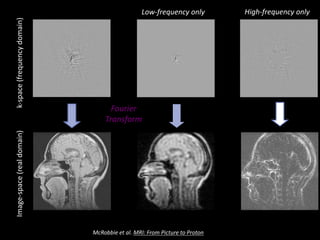
Figure 7.10 Images and their 2D spectra (k-space) showing: (a) reconstruction from all spatial frequencies, (b) low spatial
(a) (b) (c)
k-space	(frequency	domain)Image-space	(real	domain)
Fourier	
Transform
Low-frequency	only High-frequency	only
McRobbie et	al.	MRI:	From	Picture	to	Proton
K-space
kx
ky
Frequency space
(k-space)
Fourier	
Transform
Image space
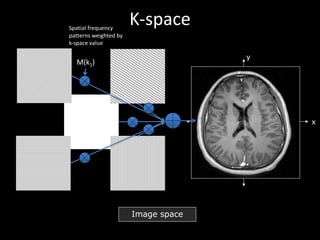
K-space
Image space
x
y
M(k1)
Spatial	frequency	
patterns	weighted	by	
k-space	value
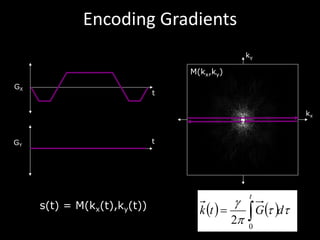
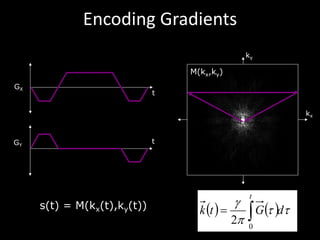
Encoding	Gradients
kx
ky
t
GX
tGY
( ) ( ) tt
p
g
dGtk
t
ò=
0
2
s(t) = M(kx(t),ky(t))
M(kx,ky)
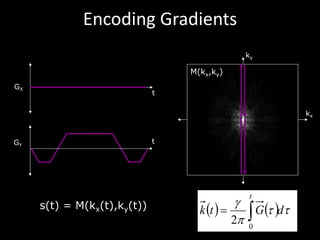
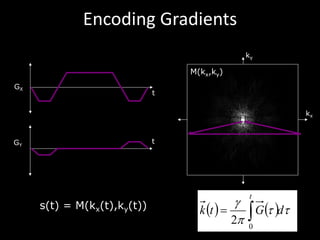
Encoding	Gradients
kx
ky
t
GX
tGY
( ) ( ) tt
p
g
dGtk
t
ò=
0
2
s(t) = M(kx(t),ky(t))
M(kx,ky)
Encoding	Gradients
kx
ky
t
GX
tGY
( ) ( ) tt
p
g
dGtk
t
ò=
0
2
s(t) = M(kx(t),ky(t))
M(kx,ky)
Encoding	Gradients
kx
ky
t
GX
tGY
( ) ( ) tt
p
g
dGtk
t
ò=
0
2
s(t) = M(kx(t),ky(t))
M(kx,ky)
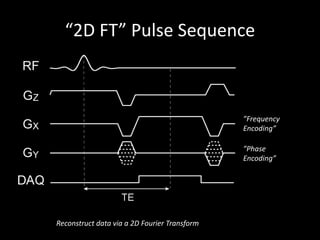
“2D	FT”	Pulse	Sequence
”Frequency	
Encoding”
”Phase	
Encoding”
Reconstruct	data	via	a	2D	Fourier	Transform
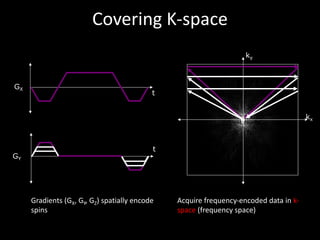
Covering	K-space
kx
ky
t
GX
t
GY
Gradients	(GX,	GY,	GZ)	spatially	encode	
spins
Acquire	frequency-encoded	data	in	k-
space (frequency	space)
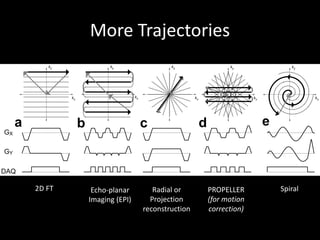
More	Trajectories
GX
DAQ
GY
a b
kx
ky
kx
ky
kx
ky
kx
ky
kx
ky
c d e
2D	FT Echo-planar	
Imaging	(EPI)
Radial	or	
Projection	
reconstruction
PROPELLER	
(for	motion	
correction)
Spiral
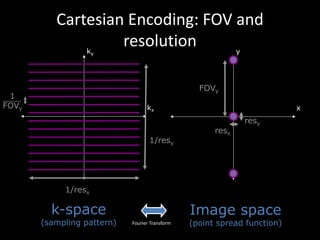
Cartesian	Encoding:	FOV	and	
resolution
kx
ky
1
FOVy
k-space
(sampling pattern)
Image space
(point spread function)Fourier	Transform
x
y
FOVy
1/resx
resx
resy
1/resy
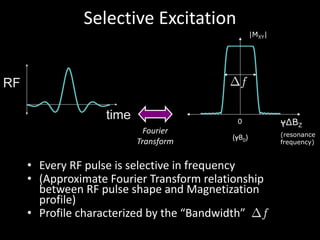
Selective	Excitation
• Every	RF	pulse	is	selective	in	frequency
• (Approximate	Fourier	Transform	relationship	
between	RF	pulse	shape	and	Magnetization	
profile)
• Profile	characterized	by	the	“Bandwidth”
γΔBZ
(resonance
frequency)
|MXY|
Fourier	
Transform
0
(γB0)
f
f
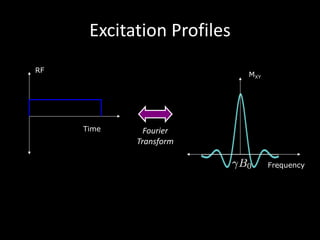
Excitation	Profiles
Frequency
MXY
Fourier	
Transform
Time
RF
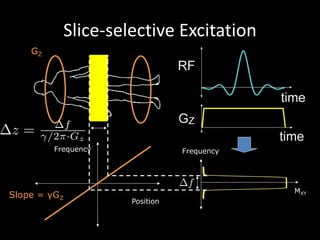
Slice-selective	Excitation
Frequency
Position
GZ
MXY
Slope = γGZ
Frequency
f
z = f
/2⇥·Gz
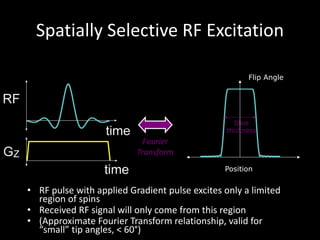
Spatially	Selective	RF	Excitation
Position
Flip Angle
Fourier	
Transform
Slice
thickness
• RF	pulse	with	applied	Gradient	pulse	excites	only	a	limited	
region	of	spins
• Received	RF	signal	will	only	come	from	this	region
• (Approximate	Fourier	Transform	relationship,	valid	for	
“small”	tip	angles,	<	60°)
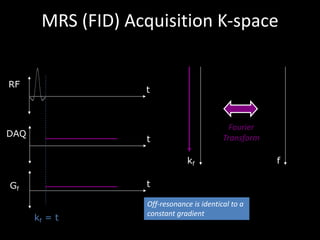
MRS	(FID)	Acquisition	K-space
Gf
t
RF
t
DAQ
t
kf = t
Off-resonance	is	identical	to	a	
constant	gradient
kf f
Fourier	
Transform
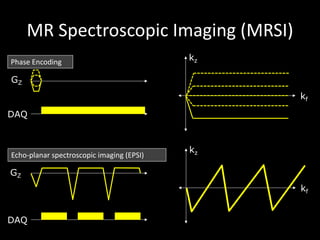
MR	Spectroscopic	Imaging	(MRSI)
GZ
DAQ
GZ
kz
kf
kz
kf
DAQ
Phase	Encoding
Echo-planar	spectroscopic	imaging	(EPSI)
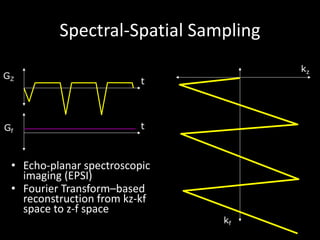
Spectral-Spatial	Sampling
• Echo-planar	spectroscopic	
imaging	(EPSI)
• Fourier	Transform–based	
reconstruction	from	kz-kf
space	to	z-f	space
kz
kf
Gf
t
GZ
t
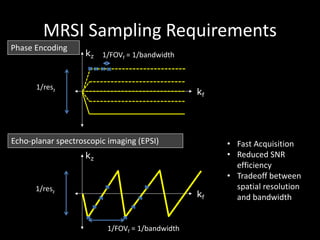
MRSI	Sampling	Requirements
kz
kf
kz
kf
1/resz
1/FOVf =	1/bandwidth
1/resz
1/FOVf =	1/bandwidth
• Fast	Acquisition
• Reduced	SNR	
efficiency
• Tradeoff	between	
spatial	resolution	
and	bandwidth
Phase	Encoding
Echo-planar	spectroscopic	imaging	(EPSI)
0
2
4
6
8
10
-1
-0.5
0
0.5
1
-1
-0.5
0
0.5
1
Ky(cm-1
)
time (ms)
Kx (cm-1
)
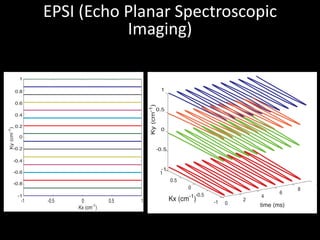
EPSI	(Echo	Planar	Spectroscopic	
Imaging)
-1 -0.5 0 0.5 1
-1
-0.8
-0.6
-0.4
-0.2
0
0.2
0.4
0.6
0.8
1
Kx (cm-1
)
Ky(cm-1
)
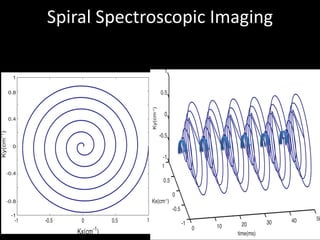
Spiral	Spectroscopic	Imaging
0 10 20 30 40 50
-1
-0.5
0
0.5
1
-1
-0.5
0
0.5
1
time(ms)
Kx(cm-1
)
Ky(cm-1
)
-1 -0.5 0 0.5 1
-1
-0.8
-0.4
0
0.4
0.8
1
Kx(cm-1
)
Ky(cm-1
)
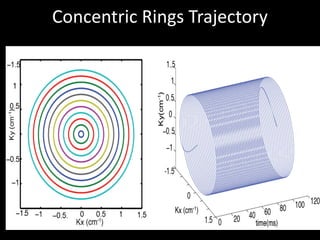
Concentric	Rings	Trajectory
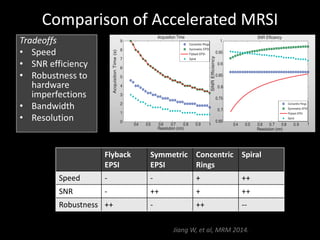
Tradeoffs
• Speed
• SNR	efficiency
• Robustness	to	
hardware	
imperfections
• Bandwidth
• Resolution
Comparison	of	Accelerated	MRSI	
Strategies
0.4 0.5 0.6 0.7 0.8 0.9 1
0
500
1000
1500
2000
2500
3000
Spectral Bandwidth
Resolution (cm)
SBW(Hz)
Concentric Rings
Symmetric EPSI
Flyback EPSI
Spiral
0.4 0.5 0.6 0.7 0.8 0.9 1
0
1
2
3
4
5
6
7
8
9
Acquisition Time
Resolution (cm)
AcquisitonTime(s)
Concentric Rings
Symmetric EPSI
Flyback EPSI
Spiral
0.4 0.5 0.6 0.7 0.8 0.9 1
0
500
1000
1500
2000
2500
3000
Spectral Bandwidth with Interleaves
Resolution (cm)
SBW(Hz)
Concentric Rings
Symmetric EPSI
Flyback EPSI
Spiral
0.4 0.5 0.6 0.7 0.8 0.9 1
0.65
0.7
0.75
0.8
0.85
0.9
0.95
1
SNR Efficiency
Resolution (cm)
SNREfficiency
Concentric Rings
Symmetric EPSI
Flyback EPSI
Spiral
Flyback
EPSI
Symmetric	
EPSI
Concentric	
Rings
Spiral
Speed - - + ++
SNR - ++ + ++
Robustness ++ - ++ --
Jiang	W,	et	al,	MRM	2014.
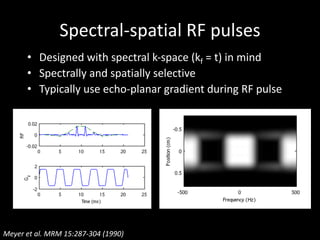
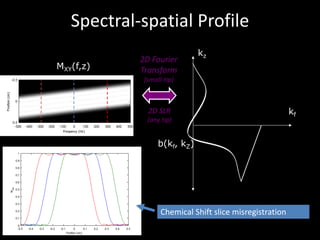
Spectral-spatial	RF	pulses
• Designed	with	spectral	k-space	(kf =	t)	in	mind
• Spectrally	and	spatially	selective
• Typically	use	echo-planar	gradient	during	RF	pulse
Meyer	et	al.	MRM	15:287-304	(1990)
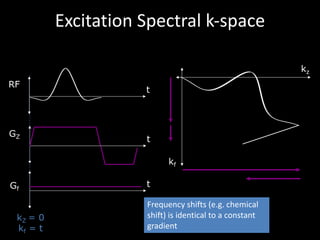
Excitation	Spectral	k-space
Gf
t
RF
t
GZ
t
kZ = 0
kf = t
Frequency	shifts	(e.g.	chemical	
shift)	is	identical	to	a	constant	
gradient
kz
kf
Spectral-spatial	Profile
b(kf, kZ)
MXY(f,z)
kz
kf
2D	Fourier	
Transform
(small-tip)
Chemical	Shift	slice	misregistration
2D	SLR
(any	tip)
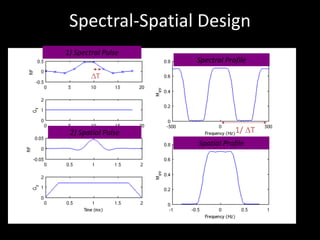
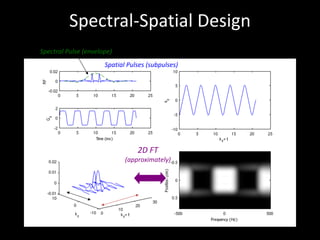
Spectral-Spatial	Design
Spectral	Pulse	(envelope)
Spatial	Pulses	(subpulses)
2D	FT
(approximately)
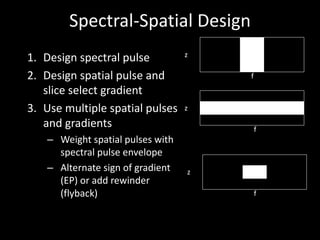
Spectral-Spatial	Design
1. Design	spectral	pulse
2. Design	spatial	pulse	and	
slice	select	gradient	
3. Use	multiple	spatial	pulses	
and	gradients
– Weight	spatial	pulses	with	
spectral pulse	envelope
– Alternate	sign	of	gradient	
(EP)	or	add	rewinder
(flyback)
z
f
z
f
z
f
Spectral-Spatial	Design
Spectral	Profile
Spatial	Profile
1)	Spectral	Pulse
2)	Spatial	Pulse
DT
1/	DT
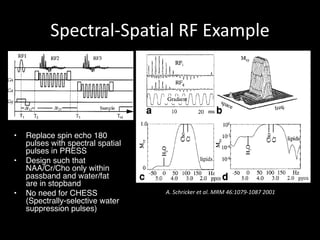
Spectral-Spatial	RF	Example
A.	Schricker et	al.	MRM	46:1079-1087	2001
• Replace spin echo 180
pulses with spectral spatial
pulses in PRESS
• Design such that
NAA/Cr/Cho only within
passband and water/fat
are in stopband
• No need for CHESS
(Spectrally-selective water
suppression pulses)
Recommended	MRI	Resources
• Nishimura.		Principles	of	Magnetic	Resonance	Imaging.		Available	from	lulu.com:	Paperback or	
Hardcover
– Complete	and	coherent	description	of	MRI,	targeted	towards	engineers	and	physicists
• McRobbie,	Moore,	Graves,	and	Prince.			MRI	From	Picture	to	Proton	(2nd edition).		Cambridge	
University	Press.
– Comprehensive	description	of	MRI,	targeted	towards	a	less	technical	audience
– Many	useful	imaging	examples	and	practical	tips
• Schröder,	Faber. In	Vivo	NMR	Imaging.		Spinger.		http://link.springer.com/book/10.1007/978-1-
61779-219-9/page/1
– Useful	chapters	on	image	formation,	special	contrast	in	MRI,	and	applications
– Very	detailed	descriptions
• Bernstein,	King,	Zhou.		Handbook	of	MRI	Pulse	Sequences.		Academic	Press.		
http://www.sciencedirect.com/science/book/9780120928613
– Detailed	descriptions	of	specialized	MRI	topics
– Assumes	introductory	knowledge	of	MRI
– Essential	for	MRI	scientists	
• Danish	Research	Centre	for	Magnetic	Resonance.	Educational	Materials:		
http://www.drcmr.dk/educations/education-material
– Introduction	to	MRI	notes,	targeted	towards	physicists	and	engineers
– Bloch	equation	and	“compassMR”	simulations	for	teaching
– Videos	explaining	simulations

Principles of (N)MR Imaging