Trait theories of personality
Psychology for Everyday Living – PSY 111
30-11-2022
Pavan Mohan N
1
Outline
• Overview of trait theories
• Allport’s Trait Theory
• Hierarchy
• Cattell’s Trait Theory
• Sixteen Personality Factor Questionnaire
• Eysenck’s Trait Theory
• Personality dimensions
• McCrae and Costa’s Theory
• Big-five Factors
• Conclusion
30-11-2022
Pavan Mohan N
2
Overview of trait theories
• Personality, a characteristic way of
thinking, feeling, and behaving
• The entire puzzle is personality
• Each piece in the puzzle can be
considered a trait
• Each piece of puzzle influences
personality
• Personality is a combination of traits that
determine our behaviour
• Traits are viewed as continuous
dimension
Ex: the trait of ‘extroversion-introversion’
• Trait-labels used to identify the
characteristic way of behaving
30-11-2022
Pavan Mohan N
3
Infographic : Which Personality Type
Are You? - AdvertisingRow.com |
Home of Advertising Professionals,
Advertising news, Infographics, Job
offers..
Example of a trait-label and dimensions
30-11-2022
Pavan Mohan N
4
Viewed as
continuous
dimension
Eysenck, H. J. (1952). The scientific study of personality.
Famous trait theorists
• Gordon Allport
• Raymond Cattell
• Hans Eysenck
• Robert McCrae and Paul Costa
30-11-2022
Pavan Mohan N
5
Allport’s Trait Theory
• Examined 4,500 words used in the English language that
could describe people
• According to their theory, three types of traits govern our
personality (in a hierarchy)
30-11-2022
Pavan Mohan N
6
Cardinal
Central
Secondary
Allport’s Trait Theory
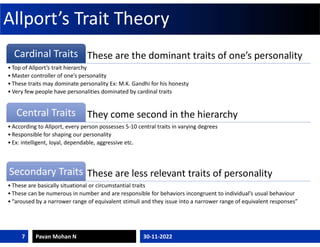
These are the dominant traits of one’s personality
Cardinal Traits
• Top of Allport’s trait hierarchy
• Master controller of one’s personality
• These traits may dominate personality Ex: M.K. Gandhi for his honesty
• Very few people have personalities dominated by cardinal traits
They come second in the hierarchy
Central Traits
• According to Allport, every person possesses 5-10 central traits in varying degrees
• Responsible for shaping our personality
• Ex: intelligent, loyal, dependable, aggressive etc.
These are less relevant traits of personality
Secondary Traits
• These are basically situational or circumstantial traits
• These can be numerous in number and are responsible for behaviors incongruent to individual’s usual behaviour
• “aroused by a narrower range of equivalent stimuli and they issue into a narrower range of equivalent responses”
30-11-2022
Pavan Mohan N
7
Cattell’s Trait Theory
• Using factor analysis-a statistical procedure, Cattell factor
analysed the Allport’s list of 4,500 English adjectives.
• He came up with the following sixteen trait dimensions
of human personality
30-11-2022
Pavan Mohan N
8
Allport’s 4,500 Adjectives/Words
Cattell’s 16 trait dimensions
Cattell’s Trait Theory
30-11-2022
Pavan Mohan N
9
Cattell’s Trait Theory
30-11-2022
Pavan Mohan N
10
Developed a questionnaire known as the Sixteen Personality Factor Questionnaire (16PF)
16PF psychology sheet - Bing..
Eysenck’s Trait Theory
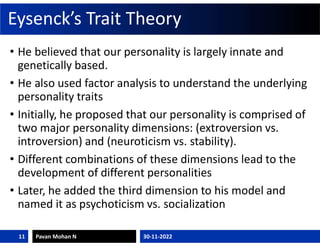
• He believed that our personality is largely innate and
genetically based.
• He also used factor analysis to understand the underlying
personality traits
• Initially, he proposed that our personality is comprised of
two major personality dimensions: (extroversion vs.
introversion) and (neuroticism vs. stability).
• Different combinations of these dimensions lead to the
development of different personalities
• Later, he added the third dimension to his model and
named it as psychoticism vs. socialization
30-11-2022
Pavan Mohan N
11
Eysenck’s Trait Theory
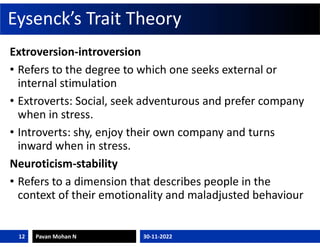
Extroversion-introversion
• Refers to the degree to which one seeks external or
internal stimulation
• Extroverts: Social, seek adventurous and prefer company
when in stress.
• Introverts: shy, enjoy their own company and turns
inward when in stress.
Neuroticism-stability
• Refers to a dimension that describes people in the
context of their emotionality and maladjusted behaviour
30-11-2022
Pavan Mohan N
12
Eysenck’s Trait Theory
• Neuroticism: emotionally unstable, moody and
maladjusted
• Stable: tend to be calm
Psychoticism-socialization
• Psychoticism: aggressive, egocentric, anti-social and
impulsive
• Socialization: empathetic and conventional
30-11-2022
Pavan Mohan N
13
McCrae and Costa’s Big-five Factor Theory
• McCrae and Costa believed that all human personality
traits can be reduced to five factors only (OCEAN):
• Openness to experience
• Conscientiousness
• Extraversion
• Agreeableness
• Neuroticism
30-11-2022
Pavan Mohan N
14
McCrae and Costa’s Big-five Factor Theory
30-11-2022
Pavan Mohan N
15
Openness to experience: such people love novelty and creativity.
They have a curious mind and have an appreciation for art. They are
an independent thinker and prefer to do a variety of things instead of
routine activities.
Conscientiousness: these people are more goal-directed, self-
disciplined, hardworking, honest and competent. They prefer
planned activity instead of spontaneous behaviour.
Extraversion: similar to the description of Eysenck’s theory
Agreeableness: people who score high on agreeableness have a
tendency to be cooperative and compassionate. Such people are
generally helpful and trustworthy.
Neuroticism: these are worried, insecure and self-pitying people.
Whereas, people who score low on neuroticism are self-satisfied and
secure.

Trait Theories.pdf

  • 1.
    Trait theories ofpersonality Psychology for Everyday Living – PSY 111 30-11-2022 Pavan Mohan N 1
  • 2.
    Outline • Overview oftrait theories • Allport’s Trait Theory • Hierarchy • Cattell’s Trait Theory • Sixteen Personality Factor Questionnaire • Eysenck’s Trait Theory • Personality dimensions • McCrae and Costa’s Theory • Big-five Factors • Conclusion 30-11-2022 Pavan Mohan N 2
  • 3.
    Overview of traittheories • Personality, a characteristic way of thinking, feeling, and behaving • The entire puzzle is personality • Each piece in the puzzle can be considered a trait • Each piece of puzzle influences personality • Personality is a combination of traits that determine our behaviour • Traits are viewed as continuous dimension Ex: the trait of ‘extroversion-introversion’ • Trait-labels used to identify the characteristic way of behaving 30-11-2022 Pavan Mohan N 3 Infographic : Which Personality Type Are You? - AdvertisingRow.com | Home of Advertising Professionals, Advertising news, Infographics, Job offers..
  • 4.
    Example of atrait-label and dimensions 30-11-2022 Pavan Mohan N 4 Viewed as continuous dimension Eysenck, H. J. (1952). The scientific study of personality.
  • 5.
    Famous trait theorists •Gordon Allport • Raymond Cattell • Hans Eysenck • Robert McCrae and Paul Costa 30-11-2022 Pavan Mohan N 5
  • 6.
    Allport’s Trait Theory •Examined 4,500 words used in the English language that could describe people • According to their theory, three types of traits govern our personality (in a hierarchy) 30-11-2022 Pavan Mohan N 6 Cardinal Central Secondary
  • 7.
    Allport’s Trait Theory Theseare the dominant traits of one’s personality Cardinal Traits • Top of Allport’s trait hierarchy • Master controller of one’s personality • These traits may dominate personality Ex: M.K. Gandhi for his honesty • Very few people have personalities dominated by cardinal traits They come second in the hierarchy Central Traits • According to Allport, every person possesses 5-10 central traits in varying degrees • Responsible for shaping our personality • Ex: intelligent, loyal, dependable, aggressive etc. These are less relevant traits of personality Secondary Traits • These are basically situational or circumstantial traits • These can be numerous in number and are responsible for behaviors incongruent to individual’s usual behaviour • “aroused by a narrower range of equivalent stimuli and they issue into a narrower range of equivalent responses” 30-11-2022 Pavan Mohan N 7
  • 8.
    Cattell’s Trait Theory •Using factor analysis-a statistical procedure, Cattell factor analysed the Allport’s list of 4,500 English adjectives. • He came up with the following sixteen trait dimensions of human personality 30-11-2022 Pavan Mohan N 8 Allport’s 4,500 Adjectives/Words Cattell’s 16 trait dimensions
  • 9.
  • 10.
    Cattell’s Trait Theory 30-11-2022 PavanMohan N 10 Developed a questionnaire known as the Sixteen Personality Factor Questionnaire (16PF) 16PF psychology sheet - Bing..
  • 11.
    Eysenck’s Trait Theory •He believed that our personality is largely innate and genetically based. • He also used factor analysis to understand the underlying personality traits • Initially, he proposed that our personality is comprised of two major personality dimensions: (extroversion vs. introversion) and (neuroticism vs. stability). • Different combinations of these dimensions lead to the development of different personalities • Later, he added the third dimension to his model and named it as psychoticism vs. socialization 30-11-2022 Pavan Mohan N 11
  • 12.
    Eysenck’s Trait Theory Extroversion-introversion •Refers to the degree to which one seeks external or internal stimulation • Extroverts: Social, seek adventurous and prefer company when in stress. • Introverts: shy, enjoy their own company and turns inward when in stress. Neuroticism-stability • Refers to a dimension that describes people in the context of their emotionality and maladjusted behaviour 30-11-2022 Pavan Mohan N 12
  • 13.
    Eysenck’s Trait Theory •Neuroticism: emotionally unstable, moody and maladjusted • Stable: tend to be calm Psychoticism-socialization • Psychoticism: aggressive, egocentric, anti-social and impulsive • Socialization: empathetic and conventional 30-11-2022 Pavan Mohan N 13
  • 14.
    McCrae and Costa’sBig-five Factor Theory • McCrae and Costa believed that all human personality traits can be reduced to five factors only (OCEAN): • Openness to experience • Conscientiousness • Extraversion • Agreeableness • Neuroticism 30-11-2022 Pavan Mohan N 14
  • 15.
    McCrae and Costa’sBig-five Factor Theory 30-11-2022 Pavan Mohan N 15 Openness to experience: such people love novelty and creativity. They have a curious mind and have an appreciation for art. They are an independent thinker and prefer to do a variety of things instead of routine activities. Conscientiousness: these people are more goal-directed, self- disciplined, hardworking, honest and competent. They prefer planned activity instead of spontaneous behaviour. Extraversion: similar to the description of Eysenck’s theory Agreeableness: people who score high on agreeableness have a tendency to be cooperative and compassionate. Such people are generally helpful and trustworthy. Neuroticism: these are worried, insecure and self-pitying people. Whereas, people who score low on neuroticism are self-satisfied and secure.