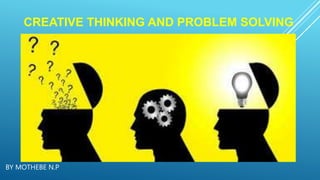

CREATIVE THINKING AND PROBLEM SOLVING
BY MOTHEBE N.P
CREATIVE THINKING
creative means to have the capacity to consider something
new and unique.
creativity in business can help you to:
1. think about a novel business thought
2. enhance a current item in a novel way
3. consider better approaches to serve your clients, attract
new clients take care of issues that your clients may
experience.
DEVELOP YOUR OWN CREATIVITY
1. THINK, THINK, THINK
Develop the habit of thinking about what
is happening around you.
Question everything.
2. WRITE IT DOWN
Write down ideas as they come into
your head.
Revise your ideas.
Compare one thought and another.
Combine one thought with another.
3. ASK QUESTIONS
The answer is not in the solution-it is in
the question. Smart questions define
problems well and lead to a clear vision
of issues involved.
4. BREAK THE RULES
People create habits and fall into a rut.
If you do things differently for only one
day, it can help to stimulate your thought
processes.
5. BANISH FEAR
Do not be afraid of making mistakes.
Support friends if they think of
something new, instead of suggesting
reasons why it would not work.
If you have a business, encourage new
ideas.
PROBLEM SOLVING
A problem happens when things are not going
as they should.
A few problems, for example, natural disasters,
we can not foresee.
Different problems create over some undefined
time frame and are unsurprising.
Checking the performance of business perceives
problems.
PROBLEM-SOLVING VERSUS DECISION-MAKING
Problem-solving is the way toward
investigating a circumstance in an orderly,
well ordered way, and after that coming up
with solutions, actualizing the problem, and
assessing the outcomes.
Decision-making is a piece of the
procedure of critical thinking and happens
at each progression of problem-solving.
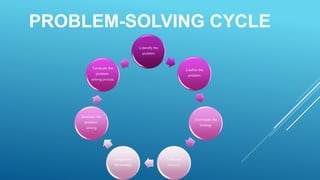
PROBLEM-SOLVING CYCLE
1.identify the
problem
2.define the
problem
3.formulate the
strategy
4.allocate
resource
5.implement
the strategy
6.monitor the
problem-
solving
7.evaluate the
problem-
solving process
PROBLEM SOLVING TECHNIQUES
1. FORCE-FIELD ANALYSIS
Force-field analysis is used to plan a change
in product or service.
Negative forces are identified and steps
taken to limit them. (restraining forces)
Positive forces are identified and
strengthened. (driving forces)
2. CHAIR TECHNIQUE
 Explain the problem aloud to an
imaginary person sitting in a chair. It
encourages clear thinking.
3. EMPTY CHAIR TECHNIQUE
Some people find it easier to talk when
there is 'nobody' to hear them. Somebody
who has a problem can talk to an empty
chair to voice frustrations. Another person
writes down the problems and possible
solutions.
4. DELPHI TECHNIQUE (1)
The Delphi technique involves the use
of a series of confidential
questionnaires to solve a problem.
Experts in a field are asked for their
opinion independently from one
another.
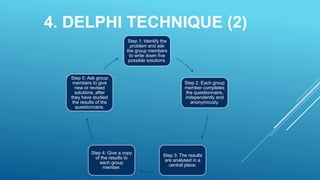
4. DELPHI TECHNIQUE (2)
Step 1: Identify the
problem and ask
the group members
to write down five
possible solutions.
Step 2: Each group
member completes
the questionnaire,
independently and
anonymously.
Step 3: The results
are analysed in a
central place.
Step 4: Give a copy
of the results to
each group
member.
Step 5: Ask group
members to give
new or revised
solutions, after
they have studied
the results of the
questionnaire.
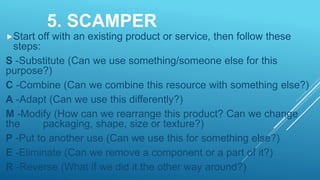
5. SCAMPER
Start off with an existing product or service, then follow these
steps:
S -Substitute (Can we use something/someone else for this
purpose?)
C -Combine (Can we combine this resource with something else?)
A -Adapt (Can we use this differently?)
M -Modify (How can we rearrange this product? Can we change
the packaging, shape, size or texture?)
P -Put to another use (Can we use this for something else?)
E -Eliminate (Can we remove a component or a part of it?)
R -Reverse (What if we did it the other way around?)
REFERENCE
 Alsagoff, Z.(2007) Problem Solving. Available from slideshare at
https://www.slideshare.net/zaid/problem-solving-85723 (accessed 28 August 2018)
 Karoobi, A.(2014) Creative thinking and problem solving. Available from slideshare at
https://www.slideshare.net/asmakaroobi/creative-thinking-problem-solving (accessed 30
August 2018)
 Khurana, V.(2013) Creative problem solving. Available from slideshare at
https://www.slideshare.net/VijayKrKhurana/creative-problem-solving-15904299 (accessed 28
August 2018)
 Shyan, H.(2014) Creative thinking and problem solving. Available from slideshare at
https://www.slideshare.net/khooshyan/creative-thinking-and-problem-solving-34237651
(accessed 29 August 2018)
 Schwartz, A.(2008) Problem solving. Available from slideshare at
https://www.slideshare.net/readysetpresent/problem-solving-power-point-content-
presentation (accessed 29 August 2018)

Creative thinking and problem solving

  • 1.
    CREATIVE THINKING ANDPROBLEM SOLVING BY MOTHEBE N.P
  • 2.
    CREATIVE THINKING creative meansto have the capacity to consider something new and unique. creativity in business can help you to: 1. think about a novel business thought 2. enhance a current item in a novel way 3. consider better approaches to serve your clients, attract new clients take care of issues that your clients may experience.
  • 3.
    DEVELOP YOUR OWNCREATIVITY
  • 4.
    1. THINK, THINK,THINK Develop the habit of thinking about what is happening around you. Question everything.
  • 5.
    2. WRITE ITDOWN Write down ideas as they come into your head. Revise your ideas. Compare one thought and another. Combine one thought with another.
  • 6.
    3. ASK QUESTIONS Theanswer is not in the solution-it is in the question. Smart questions define problems well and lead to a clear vision of issues involved.
  • 7.
    4. BREAK THERULES People create habits and fall into a rut. If you do things differently for only one day, it can help to stimulate your thought processes.
  • 8.
    5. BANISH FEAR Donot be afraid of making mistakes. Support friends if they think of something new, instead of suggesting reasons why it would not work. If you have a business, encourage new ideas.
  • 10.
    PROBLEM SOLVING A problemhappens when things are not going as they should. A few problems, for example, natural disasters, we can not foresee. Different problems create over some undefined time frame and are unsurprising. Checking the performance of business perceives problems.
  • 11.
    PROBLEM-SOLVING VERSUS DECISION-MAKING Problem-solvingis the way toward investigating a circumstance in an orderly, well ordered way, and after that coming up with solutions, actualizing the problem, and assessing the outcomes. Decision-making is a piece of the procedure of critical thinking and happens at each progression of problem-solving.
  • 12.
    PROBLEM-SOLVING CYCLE 1.identify the problem 2.definethe problem 3.formulate the strategy 4.allocate resource 5.implement the strategy 6.monitor the problem- solving 7.evaluate the problem- solving process
  • 13.
  • 14.
    1. FORCE-FIELD ANALYSIS Force-fieldanalysis is used to plan a change in product or service. Negative forces are identified and steps taken to limit them. (restraining forces) Positive forces are identified and strengthened. (driving forces)
  • 15.
    2. CHAIR TECHNIQUE Explain the problem aloud to an imaginary person sitting in a chair. It encourages clear thinking.
  • 16.
    3. EMPTY CHAIRTECHNIQUE Some people find it easier to talk when there is 'nobody' to hear them. Somebody who has a problem can talk to an empty chair to voice frustrations. Another person writes down the problems and possible solutions.
  • 17.
    4. DELPHI TECHNIQUE(1) The Delphi technique involves the use of a series of confidential questionnaires to solve a problem. Experts in a field are asked for their opinion independently from one another.
  • 18.
    4. DELPHI TECHNIQUE(2) Step 1: Identify the problem and ask the group members to write down five possible solutions. Step 2: Each group member completes the questionnaire, independently and anonymously. Step 3: The results are analysed in a central place. Step 4: Give a copy of the results to each group member. Step 5: Ask group members to give new or revised solutions, after they have studied the results of the questionnaire.
  • 19.
    5. SCAMPER Start offwith an existing product or service, then follow these steps: S -Substitute (Can we use something/someone else for this purpose?) C -Combine (Can we combine this resource with something else?) A -Adapt (Can we use this differently?) M -Modify (How can we rearrange this product? Can we change the packaging, shape, size or texture?) P -Put to another use (Can we use this for something else?) E -Eliminate (Can we remove a component or a part of it?) R -Reverse (What if we did it the other way around?)
  • 20.
    REFERENCE  Alsagoff, Z.(2007)Problem Solving. Available from slideshare at https://www.slideshare.net/zaid/problem-solving-85723 (accessed 28 August 2018)  Karoobi, A.(2014) Creative thinking and problem solving. Available from slideshare at https://www.slideshare.net/asmakaroobi/creative-thinking-problem-solving (accessed 30 August 2018)  Khurana, V.(2013) Creative problem solving. Available from slideshare at https://www.slideshare.net/VijayKrKhurana/creative-problem-solving-15904299 (accessed 28 August 2018)  Shyan, H.(2014) Creative thinking and problem solving. Available from slideshare at https://www.slideshare.net/khooshyan/creative-thinking-and-problem-solving-34237651 (accessed 29 August 2018)  Schwartz, A.(2008) Problem solving. Available from slideshare at https://www.slideshare.net/readysetpresent/problem-solving-power-point-content- presentation (accessed 29 August 2018)