Tablet Coating Defects
By:- Rohit Kumar
Pharm.D 3rd yr
Roll No.:07
Submitted to:-
Mrs.Bijal Prajapati
Contents
• Introduction of Tablet coating
• Benefits
• Defects: Sticking & Picking,
• Roughness, Orange - Peel effects,
• Bridging, Filling,
• Blistering, Hazing / Dull film,
• Colour variation, Cracking
2
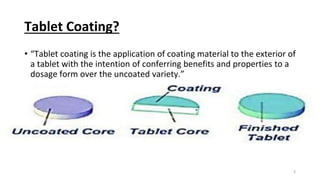
Tablet Coating?
• “Tablet coating is the application of coating material to the exterior of
a tablet with the intention of conferring benefits and properties to a
dosage form over the uncoated variety.”
3
Why Tablets Coating?
• Bitter taste or unpleasant order
• Protecting the drug from surrounding (Stability)
• Handling & easy of ingesting by patients
• Mech. protection from breakage
• Light incompatibility
• Env. oxidation
• Modifying the drug release profile
• Product identity
4
Sticking & Picking:
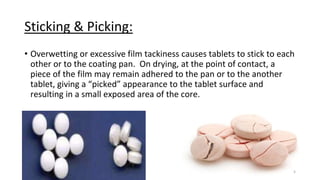
• Overwetting or excessive film tackiness causes tablets to stick to each
other or to the coating pan. On drying, at the point of contact, a
piece of the film may remain adhered to the pan or to the another
tablet, giving a “picked” appearance to the tablet surface and
resulting in a small exposed area of the core.
5
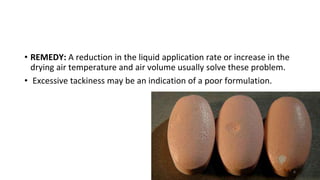
• REMEDY: A reduction in the liquid application rate or increase in the
drying air temperature and air volume usually solve these problem.
• Excessive tackiness may be an indication of a poor formulation.
6
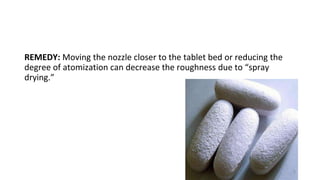
Roughness:
A rough surface is a defect, observed when the coating is applied by a
spray. Some of the droplets may dry too rapidly before reaching the
tablet bed, resulting in deposits on the tablet surface of “spray dried”
particles instead of finely divided droplets of coating solution.
7
REMEDY: Moving the nozzle closer to the tablet bed or reducing the
degree of atomization can decrease the roughness due to “spray
drying.”
8
Orange - Peel effects:
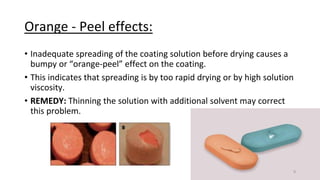
• Inadequate spreading of the coating solution before drying causes a
bumpy or “orange-peel” effect on the coating.
• This indicates that spreading is by too rapid drying or by high solution
viscosity.
• REMEDY: Thinning the solution with additional solvent may correct
this problem.
9
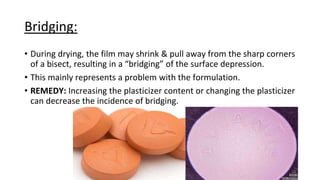
Bridging:
• During drying, the film may shrink & pull away from the sharp corners
of a bisect, resulting in a “bridging” of the surface depression.
• This mainly represents a problem with the formulation.
• REMEDY: Increasing the plasticizer content or changing the plasticizer
can decrease the incidence of bridging.
10
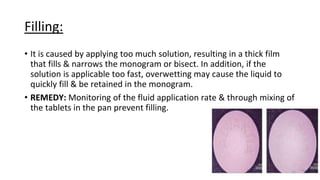
Filling:
• It is caused by applying too much solution, resulting in a thick film
that fills & narrows the monogram or bisect. In addition, if the
solution is applicable too fast, overwetting may cause the liquid to
quickly fill & be retained in the monogram.
• REMEDY: Monitoring of the fluid application rate & through mixing of
the tablets in the pan prevent filling.
11
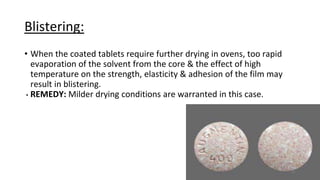
Blistering:
• When the coated tablets require further drying in ovens, too rapid
evaporation of the solvent from the core & the effect of high
temperature on the strength, elasticity & adhesion of the film may
result in blistering.
• REMEDY: Milder drying conditions are warranted in this case.
12
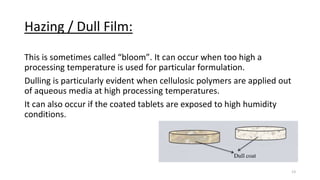
Hazing / Dull Film:
This is sometimes called “bloom”. It can occur when too high a
processing temperature is used for particular formulation.
Dulling is particularly evident when cellulosic polymers are applied out
of aqueous media at high processing temperatures.
It can also occur if the coated tablets are exposed to high humidity
conditions.
13
Colour Variation:
The problem can be caused by processing conditions or the
formulation.
Improper mixing, uneven spray pattern, & insufficient coating may
result in colour variation.
The migration of soluble dyes, plasticizers & other additives during
drying may give the coating a spotted appearance.
14
REMEDY: The use of “lake dyes” eliminates dye migration.
A reformulation with different plasticizers & additives is the best way
to solve film instabilities caused by the ingredient.
15
Cracking:
It occurs if internal stresses in the film exceed the tensile strength of
the film. The tensile strength of the film can be increased by using
higher-molecular-weight polymers.
REMEDY: Internal stresses in the film can be minimized by adjusting
the “plasticizer / pigment” type & concentration.
16
Reference:
The Theory & Practice of Industrial Pharmacy
By:- LEON LACHMAN
3rd EDITION
Page No.: 371
Image Sources:
https://www.pharmapproach.com/common-defects-in-film-coating-process-causes-and-possible-solutions/
http://pharmamanual.com/tablet-coating-defects-twinning-cracking-weight-gain-picking/
www.Slideshare.net
17
18

Tablet coating defects

  • 1.
    Tablet Coating Defects By:-Rohit Kumar Pharm.D 3rd yr Roll No.:07 Submitted to:- Mrs.Bijal Prajapati
  • 2.
    Contents • Introduction ofTablet coating • Benefits • Defects: Sticking & Picking, • Roughness, Orange - Peel effects, • Bridging, Filling, • Blistering, Hazing / Dull film, • Colour variation, Cracking 2
  • 3.
    Tablet Coating? • “Tabletcoating is the application of coating material to the exterior of a tablet with the intention of conferring benefits and properties to a dosage form over the uncoated variety.” 3
  • 4.
    Why Tablets Coating? •Bitter taste or unpleasant order • Protecting the drug from surrounding (Stability) • Handling & easy of ingesting by patients • Mech. protection from breakage • Light incompatibility • Env. oxidation • Modifying the drug release profile • Product identity 4
  • 5.
    Sticking & Picking: •Overwetting or excessive film tackiness causes tablets to stick to each other or to the coating pan. On drying, at the point of contact, a piece of the film may remain adhered to the pan or to the another tablet, giving a “picked” appearance to the tablet surface and resulting in a small exposed area of the core. 5
  • 6.
    • REMEDY: Areduction in the liquid application rate or increase in the drying air temperature and air volume usually solve these problem. • Excessive tackiness may be an indication of a poor formulation. 6
  • 7.
    Roughness: A rough surfaceis a defect, observed when the coating is applied by a spray. Some of the droplets may dry too rapidly before reaching the tablet bed, resulting in deposits on the tablet surface of “spray dried” particles instead of finely divided droplets of coating solution. 7
  • 8.
    REMEDY: Moving thenozzle closer to the tablet bed or reducing the degree of atomization can decrease the roughness due to “spray drying.” 8
  • 9.
    Orange - Peeleffects: • Inadequate spreading of the coating solution before drying causes a bumpy or “orange-peel” effect on the coating. • This indicates that spreading is by too rapid drying or by high solution viscosity. • REMEDY: Thinning the solution with additional solvent may correct this problem. 9
  • 10.
    Bridging: • During drying,the film may shrink & pull away from the sharp corners of a bisect, resulting in a “bridging” of the surface depression. • This mainly represents a problem with the formulation. • REMEDY: Increasing the plasticizer content or changing the plasticizer can decrease the incidence of bridging. 10
  • 11.
    Filling: • It iscaused by applying too much solution, resulting in a thick film that fills & narrows the monogram or bisect. In addition, if the solution is applicable too fast, overwetting may cause the liquid to quickly fill & be retained in the monogram. • REMEDY: Monitoring of the fluid application rate & through mixing of the tablets in the pan prevent filling. 11
  • 12.
    Blistering: • When thecoated tablets require further drying in ovens, too rapid evaporation of the solvent from the core & the effect of high temperature on the strength, elasticity & adhesion of the film may result in blistering. • REMEDY: Milder drying conditions are warranted in this case. 12
  • 13.
    Hazing / DullFilm: This is sometimes called “bloom”. It can occur when too high a processing temperature is used for particular formulation. Dulling is particularly evident when cellulosic polymers are applied out of aqueous media at high processing temperatures. It can also occur if the coated tablets are exposed to high humidity conditions. 13
  • 14.
    Colour Variation: The problemcan be caused by processing conditions or the formulation. Improper mixing, uneven spray pattern, & insufficient coating may result in colour variation. The migration of soluble dyes, plasticizers & other additives during drying may give the coating a spotted appearance. 14
  • 15.
    REMEDY: The useof “lake dyes” eliminates dye migration. A reformulation with different plasticizers & additives is the best way to solve film instabilities caused by the ingredient. 15
  • 16.
    Cracking: It occurs ifinternal stresses in the film exceed the tensile strength of the film. The tensile strength of the film can be increased by using higher-molecular-weight polymers. REMEDY: Internal stresses in the film can be minimized by adjusting the “plasticizer / pigment” type & concentration. 16
  • 17.
    Reference: The Theory &Practice of Industrial Pharmacy By:- LEON LACHMAN 3rd EDITION Page No.: 371 Image Sources: https://www.pharmapproach.com/common-defects-in-film-coating-process-causes-and-possible-solutions/ http://pharmamanual.com/tablet-coating-defects-twinning-cracking-weight-gain-picking/ www.Slideshare.net 17
  • 18.