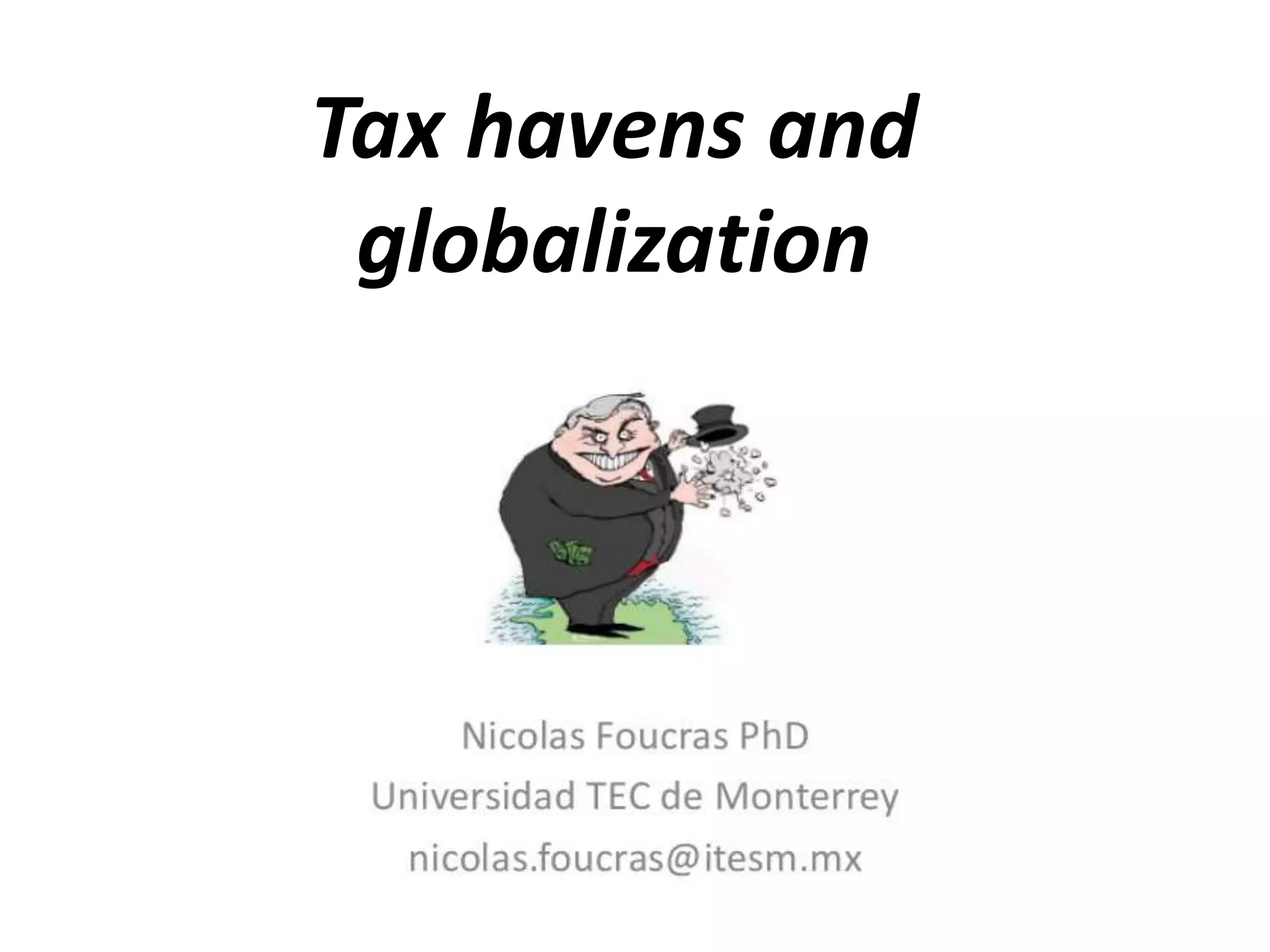
Tax havens and
globalization
There is no consensus over a definition
“A country that offers foreign individuals and businesses
little or no tax liability in a politically and economically
stable environment. Tax havens also provide little or no
financial information to foreign tax authorities.
Individuals and businesses that do not reside a tax haven
can take advantage of these countries' tax regimes to
avoid paying taxes in their home countries. Tax havens
do not require that an individual reside in or a business
operate out of that country in order to benefit from its
tax policies.”
(Investopedia 2015)
Tax haven (TH) characteristics
1. Low/no taxes
2. Flexible normativity => it is possible to create quickly a
bank/subsidiary/company with few requirements; as well
as Holdings* or Hedge Funds**
3. Usually it offers a banking secrecy to the clients =>
Total lack of transparency of financial activities
4. Usually there is a dual regulatory system: residents vs
foreigners
5. It can be a territory within a country (Examples:
Delaware, Hong Kong, San Marino)
6. Many MNFs (from ICs and DCs) use THs to export:
– They export at a very low price from the country
of production to the subsidiary located in a TH
(so they almost do not pay any tax on exports)
– Then they export from the TH to the final market
– Merchandise does not transit physically through
this territory
– It is also used for the transfer of intermediate
products within the global value chain of a MNF
(transfer of auto-parts)
=> It generates competitiveness with the
complicity of the States
*A holding company
• It is a company that owns shares of other companies to
form a corporate group
• This company does not produce goods or services itself
• It allows:
• To hide business transactions for one or more members
(shell corporation)
• To control one or several companies with total secrecy
• To create huge monopolies escaping to the national
legislations like in the agroindustry sector but also the
mass media, pharmaceutical sector… (Hirsh)
**A hedge fund
• This is an investment platform that pools capital
from institutional investors
• It is administered by a professional management
firm; usually it belongs to transnational bank
• Its purpose is to generate high returns on
investment
They make very risky and aggressive investments
out of the national legislations
Ex.: they can lend money without any certainty that
beneficiaries would be able to pay back their credit:
It was the case during the financial crisis in 2008
Crisis of 2008
• During the 2000s, many Banks, using their Hedge funds, lent
money in an irresponsible way to households with a low
purchasing power (with high interest rate)
• They were able to do it, despite the US legislation, because they
were taking these decisions from THs
• In 2008 many Hedge funds faced a situation in which many
households could not make their payment (=> transferred their
liabilities/debts to the banks)
• Actually Hedge funds (or banks) lent because:
(1) They have a very short term vision (high profitability right now)
(2) They knew that they will be beneficiating from a
national/international bank rescue plan due to their “critical mass”
in the international economy (“too big to fail”)
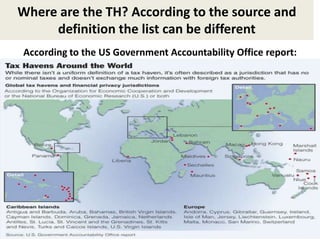
According to the US Government Accountability Office report:
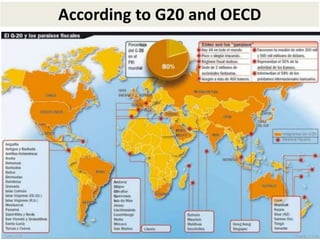
Where are the TH? According to the source and
definition the list can be different
According to G20 and OECD
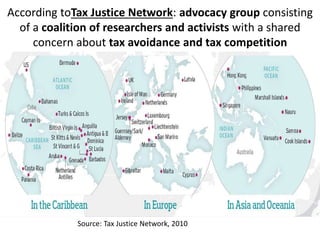
Source: Tax Justice Network, 2010
According toTax Justice Network: advocacy group consisting
of a coalition of researchers and activists with a shared
concern about tax avoidance and tax competition
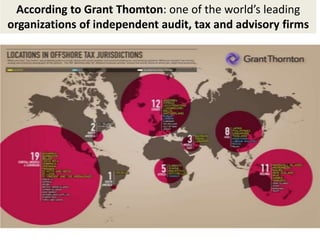
According to Grant Thomton: one of the world’s leading
organizations of independent audit, tax and advisory firms
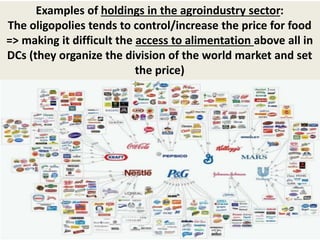
Examples of holdings in the agroindustry sector:
The oligopolies tends to control/increase the price for food
=> making it difficult the access to alimentation above all in
DCs (they organize the division of the world market and set
the price)
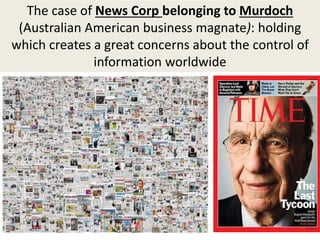
The case of News Corp belonging to Murdoch
(Australian American business magnate): holding
which creates a great concerns about the control of
information worldwide
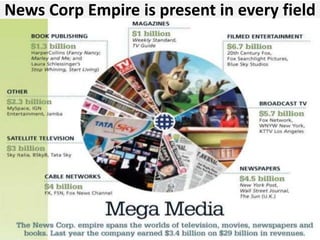
News Corp Empire is present in every field
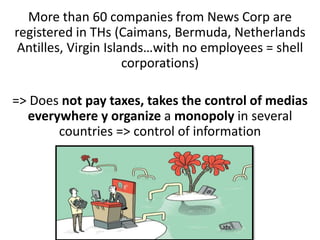
More than 60 companies from News Corp are
registered in THs (Caimans, Bermuda, Netherlands
Antilles, Virgin Islands…with no employees = shell
corporations)
=> Does not pay taxes, takes the control of medias
everywhere y organize a monopoly in several
countries => control of information
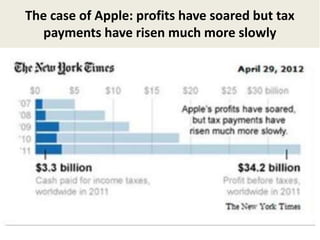
The case of Apple: profits have soared but tax
payments have risen much more slowly
Clients of the THs
• Banks
• Collective investment funds
• Insurance companies
• Individuals (big fortunes)
• MNFs
• Governments
• Transnational Criminal Organizations (TCO; they
deposit dirty capital in THs and then Governments
or MNFs use it to finance investment or public
budget => hypocrisy)….
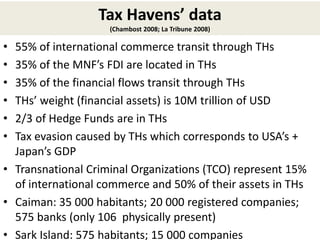
Tax Havens’ data
(Chambost 2008; La Tribune 2008)
• 55% of international commerce transit through THs
• 35% of the MNF’s FDI are located in THs
• 35% of the financial flows transit through THs
• THs’ weight (financial assets) is 10M trillion of USD
• 2/3 of Hedge Funds are in THs
• Tax evasion caused by THs which corresponds to USA’s +
Japan’s GDP
• Transnational Criminal Organizations (TCO) represent 15%
of international commerce and 50% of their assets in THs
• Caiman: 35 000 habitants; 20 000 registered companies;
575 banks (only 106 physically present)
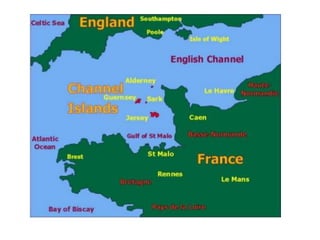
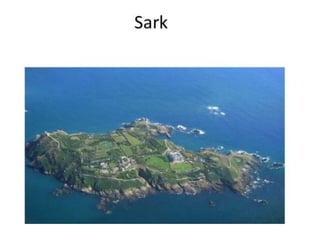
• Sark Island: 575 habitants; 15 000 companies
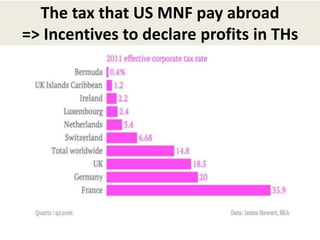
The tax that US MNF pay abroad
=> Incentives to declare profits in THs
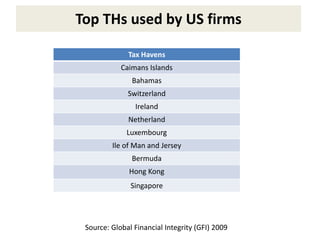
Top THs used by US firms
Tax Havens
Caimans Islands
Bahamas
Switzerland
Ireland
Netherland
Luxembourg
Ile of Man and Jersey
Bermuda
Hong Kong
Singapore
Source: Global Financial Integrity (GFI) 2009
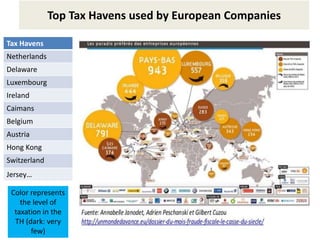
Top Tax Havens used by European Companies
Tax Havens
Netherlands
Delaware
Luxembourg
Ireland
Caimans
Belgium
Austria
Hong Kong
Switzerland
Jersey…
Color represents
the level of
taxation in the
TH (dark: very
few)
Chronology
• After 1929: fiscal pressure rises upon ICs firms (due
to Welfare State as a product of Labor Unions
activism)
fiscal gap started to grow between ICs and
States whose fiscal legislation was low due to
absence of necessities for tax revenues
1920-1930: tax evasion from very wealthy
people (Man Island; Bahamas; Liechtenstein;
Switzerland; Luxembourg; Monaco)
• 1960s: Eurodollars (dollars outside the US economy
and generated by the overseas activities of the first US
MNFs) seek refugee (to avoid USA’s fiscal restrictions)
• 1970s:
– Arabic countries invest the petrodollars in THs (USD earned
through exports of petroleum after the nationalization of oil
production) : they place these USD in TH to avoid national
instability*
– It allows high liquidity for investment Funds/Banks located in
THs
– Big Banks started to invest in THs and to create speculative
mechanisms in THs
– MNFs started to use THs to facilitate commerce between
their subsidiaries and to export
• From 1980s, THs, MNFs, Banks, Transnational Criminal
Organizations complement each other = Financial
globalization
*Large inflows of petrodollars into a country often
has an impact on the value of the national currency
(=Dutch Disease)
Ex.: it was shown in the case of Canada that if the
price of oil increases by 10% => Canadian dollar
value Vs USD by 3% [when the authority or private
sector change the currency: there is a supply of USD
and a Demand of CAD] (The Economist 2012); consequences:
- National firms lose competitiveness
(unemployment)
- Imports increase => Deficit of the Trade balance…
Many countries exporting huge amount of primary
commodities (ICs and DCs) prefer to avoid converting in
their own currency the USD obtained from exports
 They keep this capital in national Fund
established/managed in a TH (= Sovereign Wealth
Funds)
These Funds turned to be important/essential actors in
the Globalization because they orientate/canalize huge
amount of capital to:
• competitive global sectors
• or to specific Gvts depending on the decision they are
taking
=> Political actors
Sovereign wealth funds
• Investment funds held by the State
• It is a Contra-cyclic instruments
• Financed by the revenues from raw materials exports
and obtained by public firms (oil, gas, coper, nickel…)
or all kind of exports (China channels vast sums of USD
into these Funds)
• Mainly in USD; main reason:
To avoid to destabilize the national currency (converting
USD to national currency) (it could affect the
competitiveness of the national economy)
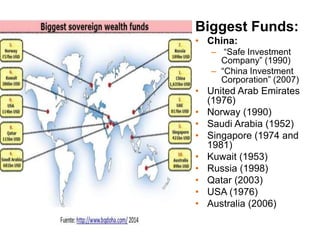
Biggest Funds:
• China:
– “Safe Investment
Company” (1990)
– “China Investment
Corporation” (2007)
• United Arab Emirates
(1976)
• Norway (1990)
• Saudi Arabia (1952)
• Singapore (1974 and
1981)
• Kuwait (1953)
• Russia (1998)
• Qatar (2003)
• USA (1976)
• Australia (2006)
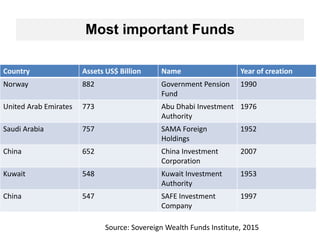
Most important Funds
Country Assets US$ Billion Name Year of creation
Norway 882 Government Pension
Fund
1990
United Arab Emirates 773 Abu Dhabi Investment
Authority
1976
Saudi Arabia 757 SAMA Foreign
Holdings
1952
China 652 China Investment
Corporation
2007
Kuwait 548 Kuwait Investment
Authority
1953
China 547 SAFE Investment
Company
1997
Source: Sovereign Wealth Funds Institute, 2015
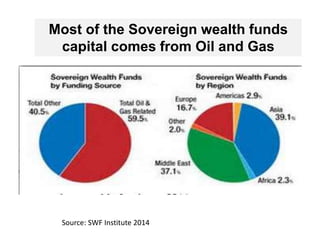
Source: SWF Institute 2014
Most of the Sovereign wealth funds
capital comes from Oil and Gas
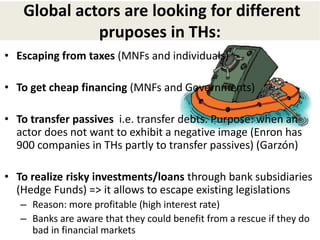
Global actors are looking for different
pruposes in THs:
• Escaping from taxes (MNFs and individuals)
• To get cheap financing (MNFs and Governments)
• To transfer passives i.e. transfer debts. Purpose: when an
actor does not want to exhibit a negative image (Enron has
900 companies in THs partly to transfer passives) (Garzón)
• To realize risky investments/loans through bank subsidiaries
(Hedge Funds) => it allows to escape existing legislations
– Reason: more profitable (high interest rate)
– Banks are aware that they could benefit from a rescue if they do
bad in financial markets
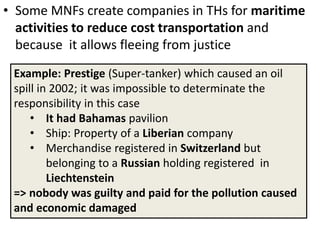
• Some MNFs create companies in THs for maritime
activities to reduce cost transportation and
because it allows fleeing from justice
Example: Prestige (Super-tanker) which caused an oil
spill in 2002; it was impossible to determinate the
responsibility in this case
• It had Bahamas pavilion
• Ship: Property of a Liberian company
• Merchandise registered in Switzerland but
belonging to a Russian holding registered in
Liechtenstein
=> nobody was guilty and paid for the pollution caused
and economic damaged
THs Impacts
• They protect Transnational Criminal Organizations and Terrorist
activities due to the banking secrecy
It allows to launder funds generated by illegal activities
Then, dirty funds obtained from illicit activities (traffics of drugs,
migrants, prostitutes, organs, arms, protected animals, gambling,
etc.) can finance easily (1) MNFs investment or (2) public budgets
with a total discretion (it transforms dirty money into clean money)
 Difficult to combat these activities because :
– Actors operate using THs
– Big international actors (MNFs, Banks and Governments) take
advantage of the huge amounts of money they allow => there
is no interest for the disappearance of these activities (it is
part of the competitiveness => par of the global Balance of
powers)
– There is no real coordination between States
TCO
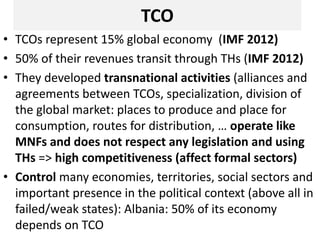
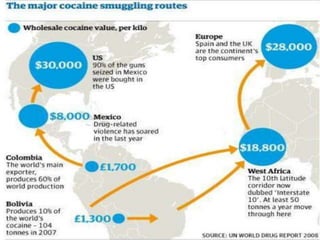
• TCOs represent 15% global economy (IMF 2012)
• 50% of their revenues transit through THs (IMF 2012)
• They developed transnational activities (alliances and
agreements between TCOs, specialization, division of
the global market: places to produce and place for
consumption, routes for distribution, … operate like
MNFs and does not respect any legislation and using
THs => high competitiveness (affect formal sectors)
• Control many economies, territories, social sectors and
important presence in the political context (above all in
failed/weak states): Albania: 50% of its economy
depends on TCO
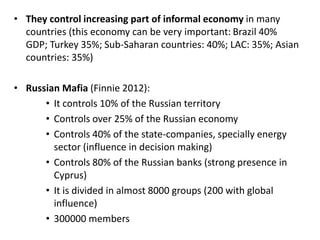
• They control increasing part of informal economy in many
countries (this economy can be very important: Brazil 40%
GDP; Turkey 35%; Sub-Saharan countries: 40%; LAC: 35%; Asian
countries: 35%)
• Russian Mafia (Finnie 2012):
• It controls 10% of the Russian territory
• Controls over 25% of the Russian economy
• Controls 40% of the state-companies, specially energy
sector (influence in decision making)
• Controls 80% of the Russian banks (strong presence in
Cyprus)
• It is divided in almost 8000 groups (200 with global
influence)
• 300000 members
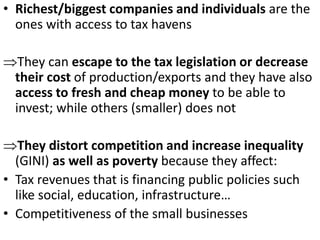
• Richest/biggest companies and individuals are the
ones with access to tax havens
They can escape to the tax legislation or decrease
their cost of production/exports and they have also
access to fresh and cheap money to be able to
invest; while others (smaller) does not
They distort competition and increase inequality
(GINI) as well as poverty because they affect:
• Tax revenues that is financing public policies such
like social, education, infrastructure…
• Competitiveness of the small businesses
• Due to the low/no tax rate
It makes difficult to maintain (or increase) taxes
in ICs and DCs because if they do it then many
actors (biggest contributors) will declare their
profits in TH and States will suffer tax evasion
TH represent high competition for Gvts that
affect tax revenues (fiscal legislation)
Currently, States tend to reduce their tax pressures on high
incomes to slow down tax evasion (it affects the progressive
income taxation => unfair)
Reduces public tax revenues
THs affects the efficiency of Welfare State and the
capacity for the State to operate a redistributive public
policy through progressive taxes and public policies
Increases the level of public debt (to compensate for
the decreasing amount of tax revenues)
DCs are affected because they have few instruments to
monitor tax evasion; for instance: most MNF in DCs do not
pay taxes and informal economy is important
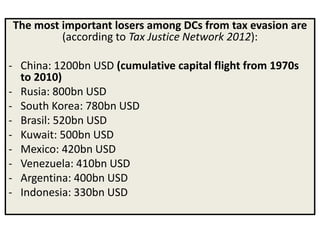
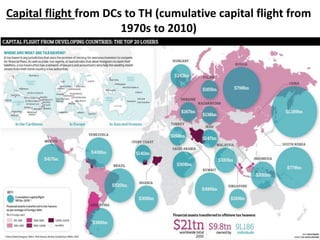
The most important losers among DCs from tax evasion are
(according to Tax Justice Network 2012):
- China: 1200bn USD (cumulative capital flight from 1970s
to 2010)
- Rusia: 800bn USD
- South Korea: 780bn USD
- Brasil: 520bn USD
- Kuwait: 500bn USD
- Mexico: 420bn USD
- Venezuela: 410bn USD
- Argentina: 400bn USD
- Indonesia: 330bn USD
Capital flight from DCs to TH (cumulative capital flight from
1970s to 2010)
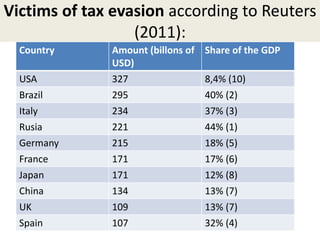
Victims of tax evasion according to Reuters
(2011):
Country Amount (billons of
USD)
Share of the GDP
USA 327 8,4% (10)
Brazil 295 40% (2)
Italy 234 37% (3)
Rusia 221 44% (1)
Germany 215 18% (5)
France 171 17% (6)
Japan 171 12% (8)
China 134 13% (7)
UK 109 13% (7)
Spain 107 32% (4)
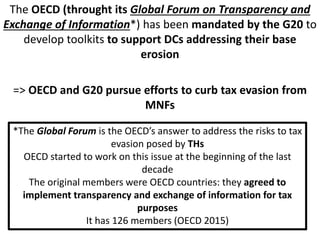
The OECD (throught its Global Forum on Transparency and
Exchange of Information*) has been mandated by the G20 to
develop toolkits to support DCs addressing their base
erosion
=> OECD and G20 pursue efforts to curb tax evasion from
MNFs
*The Global Forum is the OECD’s answer to address the risks to tax
evasion posed by THs
OECD started to work on this issue at the beginning of the last
decade
The original members were OECD countries: they agreed to
implement transparency and exchange of information for tax
purposes
It has 126 members (OECD 2015)
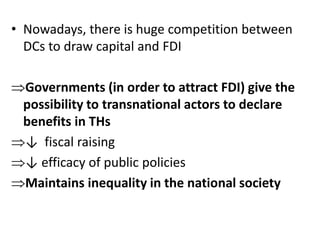
• Nowadays, there is huge competition between
DCs to draw capital and FDI
Governments (in order to attract FDI) give the
possibility to transnational actors to declare
benefits in THs
↓ fiscal raising
↓ efficacy of public policies
Maintains inequality in the national society
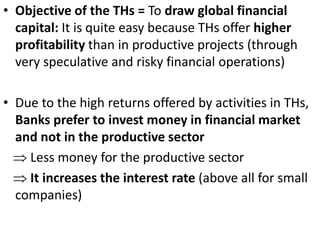
• Objective of the THs = To draw global financial
capital: It is quite easy because THs offer higher
profitability than in productive projects (through
very speculative and risky financial operations)
• Due to the high returns offered by activities in THs,
Banks prefer to invest money in financial market
and not in the productive sector
 Less money for the productive sector
 It increases the interest rate (above all for small
companies)
They participate to the “financialisation of the
economy” (Strange) with important implications for
employment: affects job creation and growth (=>
political instability)
Banks through their subsidiaries decide which sector
has to be supported and which not (using global
indicators); Strange says that the power of the
international system is in hand of those actors who
have control over the credit (and THs give them a huge
power; may be more important than many
gouvernments)
Nowadays, Funds in THs have the capacity to generate
growth or economic crisis (they have an important
political power)
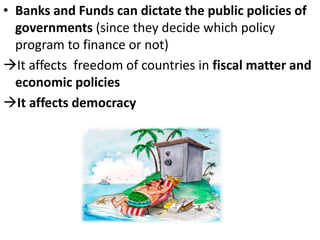
• Banks and Funds can dictate the public policies of
governments (since they decide which policy
program to finance or not)
It affects freedom of countries in fiscal matter and
economic policies
It affects democracy
Some proposals from NGOs and Governments into
G20 and OECD
• To eliminate THs (Garzon 2011)
• To pressure THs to publish information (EU & OCDE)
• To reduce the velocity of money circulation and to reduce
attractiveness of the speculation (make it more difficult for
TH to draw money)  introduction of a financial transaction
tax (Tobin Tax) (advocated by ATTAC or OXFAM)
• Coordination of fiscal policies at a global level (like in the EU)
to avoid competition and to reduce tax evasion for ICs and
DCs with the purpose to favor their development
Activity:
• Form groups of 3
• Answer the questions (15 minutes):
– What is the most important challenge for DCs?
– What is your vision of the future?
• Make your presentation

Tax havens

  • 1.
  • 2.
    There is noconsensus over a definition “A country that offers foreign individuals and businesses little or no tax liability in a politically and economically stable environment. Tax havens also provide little or no financial information to foreign tax authorities. Individuals and businesses that do not reside a tax haven can take advantage of these countries' tax regimes to avoid paying taxes in their home countries. Tax havens do not require that an individual reside in or a business operate out of that country in order to benefit from its tax policies.” (Investopedia 2015)
  • 3.
    Tax haven (TH)characteristics 1. Low/no taxes 2. Flexible normativity => it is possible to create quickly a bank/subsidiary/company with few requirements; as well as Holdings* or Hedge Funds** 3. Usually it offers a banking secrecy to the clients => Total lack of transparency of financial activities 4. Usually there is a dual regulatory system: residents vs foreigners 5. It can be a territory within a country (Examples: Delaware, Hong Kong, San Marino)
  • 4.
    6. Many MNFs(from ICs and DCs) use THs to export: – They export at a very low price from the country of production to the subsidiary located in a TH (so they almost do not pay any tax on exports) – Then they export from the TH to the final market – Merchandise does not transit physically through this territory – It is also used for the transfer of intermediate products within the global value chain of a MNF (transfer of auto-parts) => It generates competitiveness with the complicity of the States
  • 5.
    *A holding company •It is a company that owns shares of other companies to form a corporate group • This company does not produce goods or services itself • It allows: • To hide business transactions for one or more members (shell corporation) • To control one or several companies with total secrecy • To create huge monopolies escaping to the national legislations like in the agroindustry sector but also the mass media, pharmaceutical sector… (Hirsh)
  • 6.
    **A hedge fund •This is an investment platform that pools capital from institutional investors • It is administered by a professional management firm; usually it belongs to transnational bank • Its purpose is to generate high returns on investment They make very risky and aggressive investments out of the national legislations Ex.: they can lend money without any certainty that beneficiaries would be able to pay back their credit: It was the case during the financial crisis in 2008
  • 7.
    Crisis of 2008 •During the 2000s, many Banks, using their Hedge funds, lent money in an irresponsible way to households with a low purchasing power (with high interest rate) • They were able to do it, despite the US legislation, because they were taking these decisions from THs • In 2008 many Hedge funds faced a situation in which many households could not make their payment (=> transferred their liabilities/debts to the banks) • Actually Hedge funds (or banks) lent because: (1) They have a very short term vision (high profitability right now) (2) They knew that they will be beneficiating from a national/international bank rescue plan due to their “critical mass” in the international economy (“too big to fail”)
  • 8.
    According to theUS Government Accountability Office report: Where are the TH? According to the source and definition the list can be different
  • 9.
  • 10.
    Source: Tax JusticeNetwork, 2010 According toTax Justice Network: advocacy group consisting of a coalition of researchers and activists with a shared concern about tax avoidance and tax competition
  • 11.
    According to GrantThomton: one of the world’s leading organizations of independent audit, tax and advisory firms
  • 12.
    Examples of holdingsin the agroindustry sector: The oligopolies tends to control/increase the price for food => making it difficult the access to alimentation above all in DCs (they organize the division of the world market and set the price)
  • 13.
    The case ofNews Corp belonging to Murdoch (Australian American business magnate): holding which creates a great concerns about the control of information worldwide
  • 14.
    News Corp Empireis present in every field
  • 15.
    More than 60companies from News Corp are registered in THs (Caimans, Bermuda, Netherlands Antilles, Virgin Islands…with no employees = shell corporations) => Does not pay taxes, takes the control of medias everywhere y organize a monopoly in several countries => control of information
  • 16.
    The case ofApple: profits have soared but tax payments have risen much more slowly
  • 17.
    Clients of theTHs • Banks • Collective investment funds • Insurance companies • Individuals (big fortunes) • MNFs • Governments • Transnational Criminal Organizations (TCO; they deposit dirty capital in THs and then Governments or MNFs use it to finance investment or public budget => hypocrisy)….
  • 18.
    Tax Havens’ data (Chambost2008; La Tribune 2008) • 55% of international commerce transit through THs • 35% of the MNF’s FDI are located in THs • 35% of the financial flows transit through THs • THs’ weight (financial assets) is 10M trillion of USD • 2/3 of Hedge Funds are in THs • Tax evasion caused by THs which corresponds to USA’s + Japan’s GDP • Transnational Criminal Organizations (TCO) represent 15% of international commerce and 50% of their assets in THs • Caiman: 35 000 habitants; 20 000 registered companies; 575 banks (only 106 physically present) • Sark Island: 575 habitants; 15 000 companies
  • 21.
    The tax thatUS MNF pay abroad => Incentives to declare profits in THs
  • 22.
    Top THs usedby US firms Tax Havens Caimans Islands Bahamas Switzerland Ireland Netherland Luxembourg Ile of Man and Jersey Bermuda Hong Kong Singapore Source: Global Financial Integrity (GFI) 2009
  • 23.
    Top Tax Havensused by European Companies Tax Havens Netherlands Delaware Luxembourg Ireland Caimans Belgium Austria Hong Kong Switzerland Jersey… Color represents the level of taxation in the TH (dark: very few)
  • 24.
    Chronology • After 1929:fiscal pressure rises upon ICs firms (due to Welfare State as a product of Labor Unions activism) fiscal gap started to grow between ICs and States whose fiscal legislation was low due to absence of necessities for tax revenues 1920-1930: tax evasion from very wealthy people (Man Island; Bahamas; Liechtenstein; Switzerland; Luxembourg; Monaco)
  • 25.
    • 1960s: Eurodollars(dollars outside the US economy and generated by the overseas activities of the first US MNFs) seek refugee (to avoid USA’s fiscal restrictions) • 1970s: – Arabic countries invest the petrodollars in THs (USD earned through exports of petroleum after the nationalization of oil production) : they place these USD in TH to avoid national instability* – It allows high liquidity for investment Funds/Banks located in THs – Big Banks started to invest in THs and to create speculative mechanisms in THs – MNFs started to use THs to facilitate commerce between their subsidiaries and to export • From 1980s, THs, MNFs, Banks, Transnational Criminal Organizations complement each other = Financial globalization
  • 26.
    *Large inflows ofpetrodollars into a country often has an impact on the value of the national currency (=Dutch Disease) Ex.: it was shown in the case of Canada that if the price of oil increases by 10% => Canadian dollar value Vs USD by 3% [when the authority or private sector change the currency: there is a supply of USD and a Demand of CAD] (The Economist 2012); consequences: - National firms lose competitiveness (unemployment) - Imports increase => Deficit of the Trade balance…
  • 27.
    Many countries exportinghuge amount of primary commodities (ICs and DCs) prefer to avoid converting in their own currency the USD obtained from exports  They keep this capital in national Fund established/managed in a TH (= Sovereign Wealth Funds) These Funds turned to be important/essential actors in the Globalization because they orientate/canalize huge amount of capital to: • competitive global sectors • or to specific Gvts depending on the decision they are taking => Political actors
  • 28.
    Sovereign wealth funds •Investment funds held by the State • It is a Contra-cyclic instruments • Financed by the revenues from raw materials exports and obtained by public firms (oil, gas, coper, nickel…) or all kind of exports (China channels vast sums of USD into these Funds) • Mainly in USD; main reason: To avoid to destabilize the national currency (converting USD to national currency) (it could affect the competitiveness of the national economy)
  • 29.
    Biggest Funds: • China: –“Safe Investment Company” (1990) – “China Investment Corporation” (2007) • United Arab Emirates (1976) • Norway (1990) • Saudi Arabia (1952) • Singapore (1974 and 1981) • Kuwait (1953) • Russia (1998) • Qatar (2003) • USA (1976) • Australia (2006)
  • 30.
    Most important Funds CountryAssets US$ Billion Name Year of creation Norway 882 Government Pension Fund 1990 United Arab Emirates 773 Abu Dhabi Investment Authority 1976 Saudi Arabia 757 SAMA Foreign Holdings 1952 China 652 China Investment Corporation 2007 Kuwait 548 Kuwait Investment Authority 1953 China 547 SAFE Investment Company 1997 Source: Sovereign Wealth Funds Institute, 2015
  • 31.
    Source: SWF Institute2014 Most of the Sovereign wealth funds capital comes from Oil and Gas
  • 32.
    Global actors arelooking for different pruposes in THs: • Escaping from taxes (MNFs and individuals) • To get cheap financing (MNFs and Governments) • To transfer passives i.e. transfer debts. Purpose: when an actor does not want to exhibit a negative image (Enron has 900 companies in THs partly to transfer passives) (Garzón) • To realize risky investments/loans through bank subsidiaries (Hedge Funds) => it allows to escape existing legislations – Reason: more profitable (high interest rate) – Banks are aware that they could benefit from a rescue if they do bad in financial markets
  • 33.
    • Some MNFscreate companies in THs for maritime activities to reduce cost transportation and because it allows fleeing from justice Example: Prestige (Super-tanker) which caused an oil spill in 2002; it was impossible to determinate the responsibility in this case • It had Bahamas pavilion • Ship: Property of a Liberian company • Merchandise registered in Switzerland but belonging to a Russian holding registered in Liechtenstein => nobody was guilty and paid for the pollution caused and economic damaged
  • 34.
    THs Impacts • Theyprotect Transnational Criminal Organizations and Terrorist activities due to the banking secrecy It allows to launder funds generated by illegal activities Then, dirty funds obtained from illicit activities (traffics of drugs, migrants, prostitutes, organs, arms, protected animals, gambling, etc.) can finance easily (1) MNFs investment or (2) public budgets with a total discretion (it transforms dirty money into clean money)  Difficult to combat these activities because : – Actors operate using THs – Big international actors (MNFs, Banks and Governments) take advantage of the huge amounts of money they allow => there is no interest for the disappearance of these activities (it is part of the competitiveness => par of the global Balance of powers) – There is no real coordination between States
  • 35.
    TCO • TCOs represent15% global economy (IMF 2012) • 50% of their revenues transit through THs (IMF 2012) • They developed transnational activities (alliances and agreements between TCOs, specialization, division of the global market: places to produce and place for consumption, routes for distribution, … operate like MNFs and does not respect any legislation and using THs => high competitiveness (affect formal sectors) • Control many economies, territories, social sectors and important presence in the political context (above all in failed/weak states): Albania: 50% of its economy depends on TCO
  • 36.
    • They controlincreasing part of informal economy in many countries (this economy can be very important: Brazil 40% GDP; Turkey 35%; Sub-Saharan countries: 40%; LAC: 35%; Asian countries: 35%) • Russian Mafia (Finnie 2012): • It controls 10% of the Russian territory • Controls over 25% of the Russian economy • Controls 40% of the state-companies, specially energy sector (influence in decision making) • Controls 80% of the Russian banks (strong presence in Cyprus) • It is divided in almost 8000 groups (200 with global influence) • 300000 members
  • 38.
    • Richest/biggest companiesand individuals are the ones with access to tax havens They can escape to the tax legislation or decrease their cost of production/exports and they have also access to fresh and cheap money to be able to invest; while others (smaller) does not They distort competition and increase inequality (GINI) as well as poverty because they affect: • Tax revenues that is financing public policies such like social, education, infrastructure… • Competitiveness of the small businesses
  • 39.
    • Due tothe low/no tax rate It makes difficult to maintain (or increase) taxes in ICs and DCs because if they do it then many actors (biggest contributors) will declare their profits in TH and States will suffer tax evasion TH represent high competition for Gvts that affect tax revenues (fiscal legislation)
  • 40.
    Currently, States tendto reduce their tax pressures on high incomes to slow down tax evasion (it affects the progressive income taxation => unfair) Reduces public tax revenues THs affects the efficiency of Welfare State and the capacity for the State to operate a redistributive public policy through progressive taxes and public policies Increases the level of public debt (to compensate for the decreasing amount of tax revenues) DCs are affected because they have few instruments to monitor tax evasion; for instance: most MNF in DCs do not pay taxes and informal economy is important
  • 41.
    The most importantlosers among DCs from tax evasion are (according to Tax Justice Network 2012): - China: 1200bn USD (cumulative capital flight from 1970s to 2010) - Rusia: 800bn USD - South Korea: 780bn USD - Brasil: 520bn USD - Kuwait: 500bn USD - Mexico: 420bn USD - Venezuela: 410bn USD - Argentina: 400bn USD - Indonesia: 330bn USD
  • 42.
    Capital flight fromDCs to TH (cumulative capital flight from 1970s to 2010)
  • 43.
    Victims of taxevasion according to Reuters (2011): Country Amount (billons of USD) Share of the GDP USA 327 8,4% (10) Brazil 295 40% (2) Italy 234 37% (3) Rusia 221 44% (1) Germany 215 18% (5) France 171 17% (6) Japan 171 12% (8) China 134 13% (7) UK 109 13% (7) Spain 107 32% (4)
  • 44.
    The OECD (throughtits Global Forum on Transparency and Exchange of Information*) has been mandated by the G20 to develop toolkits to support DCs addressing their base erosion => OECD and G20 pursue efforts to curb tax evasion from MNFs *The Global Forum is the OECD’s answer to address the risks to tax evasion posed by THs OECD started to work on this issue at the beginning of the last decade The original members were OECD countries: they agreed to implement transparency and exchange of information for tax purposes It has 126 members (OECD 2015)
  • 45.
    • Nowadays, thereis huge competition between DCs to draw capital and FDI Governments (in order to attract FDI) give the possibility to transnational actors to declare benefits in THs ↓ fiscal raising ↓ efficacy of public policies Maintains inequality in the national society
  • 46.
    • Objective ofthe THs = To draw global financial capital: It is quite easy because THs offer higher profitability than in productive projects (through very speculative and risky financial operations) • Due to the high returns offered by activities in THs, Banks prefer to invest money in financial market and not in the productive sector  Less money for the productive sector  It increases the interest rate (above all for small companies)
  • 47.
    They participate tothe “financialisation of the economy” (Strange) with important implications for employment: affects job creation and growth (=> political instability) Banks through their subsidiaries decide which sector has to be supported and which not (using global indicators); Strange says that the power of the international system is in hand of those actors who have control over the credit (and THs give them a huge power; may be more important than many gouvernments) Nowadays, Funds in THs have the capacity to generate growth or economic crisis (they have an important political power)
  • 48.
    • Banks andFunds can dictate the public policies of governments (since they decide which policy program to finance or not) It affects freedom of countries in fiscal matter and economic policies It affects democracy
  • 49.
    Some proposals fromNGOs and Governments into G20 and OECD • To eliminate THs (Garzon 2011) • To pressure THs to publish information (EU & OCDE) • To reduce the velocity of money circulation and to reduce attractiveness of the speculation (make it more difficult for TH to draw money)  introduction of a financial transaction tax (Tobin Tax) (advocated by ATTAC or OXFAM) • Coordination of fiscal policies at a global level (like in the EU) to avoid competition and to reduce tax evasion for ICs and DCs with the purpose to favor their development
  • 50.
    Activity: • Form groupsof 3 • Answer the questions (15 minutes): – What is the most important challenge for DCs? – What is your vision of the future? • Make your presentation