Amyotrophic Lateral
Sclerosis
Presented by Nawab
Khatoon
Presented to Sir Kashif
Reg number# 1248136
Bs biscience
What is Amyotrophic Lateral
Sclerosis?
Lou Gehrig's Disease
also called as amyotrophic lateral sclerosis.
But
What is Amyotrophic Lateral
Sclerosis?
"a" for without
"myo" for muscle
"trophic" for nourishment
"lateral" for side (of the spinal cord)
"sclerosis" for hardening or scarring
•It’s a fatal disease of nervous system,
characterized by progressive muscle
weakness resulting in paralysis.
Causes:
What causes ALS isn’t known, but according to some theories
which states that:
•Genetic Factor: 5 to 10% ALS cases are familial meaning that
another person in the family has previously been diagnosed with
the disease.
-- 20% are linked to a mutation in the SOD1 gene
-- Only a small amount is linked with mutant gene
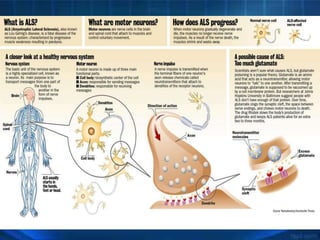
•Glutamate: which is responsible for transmitting many of the
messages between nerve cells in the brain. When glutamate isn't
removed from the spaces between the nerve cells (called
synapses), it builds up and causes an overflow of calcium into
motor neurons. This eventually leads to destruction of nerve
cells.
•environmental factors :such as heavy metal exposure leads to
damage nerve.
•Viral infections: are yet another factor that may play a role in
the development of ALS.
•Free Radicals:
•Active chemical
• can damage motor neuron
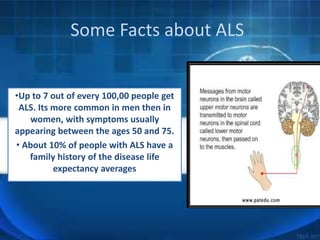
Some Facts about ALS
•Up to 7 out of every 100,00 people get
ALS. Its more common in men then in
women, with symptoms usually
appearing between the ages 50 and 75.
• About 10% of people with ALS have a
family history of the disease life
expectancy averages
Signs and Symptoms
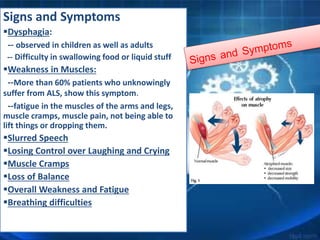
Dysphagia:
-- observed in children as well as adults
-- Difficulty in swallowing food or liquid stuff
Weakness in Muscles:
--More than 60% patients who unknowingly
suffer from ALS, show this symptom.
--fatigue in the muscles of the arms and legs,
muscle cramps, muscle pain, not being able to
lift things or dropping them.
Slurred Speech
Losing Control over Laughing and Crying
Muscle Cramps
Loss of Balance
Overall Weakness and Fatigue
Breathing difficulties
Bulbar Als Onset
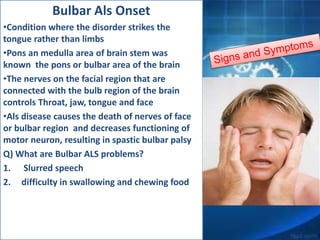
•Condition where the disorder strikes the
tongue rather than limbs
•Pons an medulla area of brain stem was
known the pons or bulbar area of the brain
•The nerves on the facial region that are
connected with the bulb region of the brain
controls Throat, jaw, tongue and face
•Als disease causes the death of nerves of face
or bulbar region and decreases functioning of
motor neuron, resulting in spastic bulbar palsy
Q) What are Bulbar ALS problems?
1. Slurred speech
2. difficulty in swallowing and chewing food
DDiddds
When the muscles get progressively weaker,
especially if a person's sensations aren't at all
impaired, doctors will suspect ALS. A series of
tests may be needed to rule out other potential
causes for symptoms.
 Electromyography(EMG):is used to determine
whether the problem is in muscle or the nerve
cells .This test works by measuring the electrical
activity in the muscle
 Nerve Conduction Velocity (NCV)
 Magnetic Resonance Imaging (MRI): scan of
the head or spine may be used to exclude
other conditions that can damage or
compress nerve cells such as tumors or
degenerative disc disease.
 The physician may order tests on blood and
urine samples to eliminate the possibility of
other diseases as well as routine laboratory
tests
Average Life Expectancy Of Als
Patient after it is Diagnosed??
Although the life expectancy of an ALS
patient averages about two to five years
from the time of diagnosis, this disease
is variable and many people live with
quality for five years and more. More
than half of all patients live more than
three years after diagnosis.
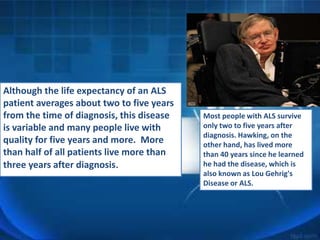
Most people with ALS survive
only two to five years after
diagnosis. Hawking, on the
other hand, has lived more
than 40 years since he learned
he had the disease, which is
also known as Lou Gehrig's
Disease or ALS.
Currently, there's no way to prevent or cure Lou Gehrig's disease, but a number
of treatments are available to people with the disease.
1. Medicines can control symptoms, such as muscle cramping and difficulty
swallowing, and other drugs can slow the development of the disease.
2. Physical therapy can help people with ALS cope with muscle loss and
breathing problems
3. Special equipment is also provided when it becomes necessary. For
instance, a power wheelchair can enable a paralyzed person with ALS to get
around. A machine called a ventilator can help a someone breathe.
4. Riluzole* is a medication that appears to prolong the life of some people
with ALS by at least a few months. Riluzole seems to do two things: slow the
release of glutamate from neurons and block its effects on glutamate
receptors.
5. Vitamins that help to slow down ALS
--- Vitamin B-1
--- Vitamin B-12
--- Vitamin C and Vitamin E
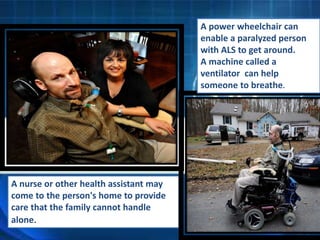
A nurse or other health assistant may
come to the person's home to provide
care that the family cannot handle
alone.
A power wheelchair can
enable a paralyzed person
with ALS to get around.
A machine called a
ventilator can help
someone to breathe.
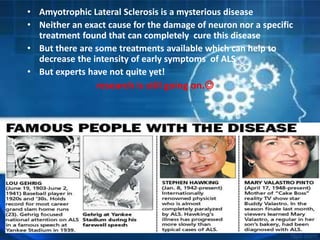
• Amyotrophic Lateral Sclerosis is a mysterious disease
• Neither an exact cause for the damage of neuron nor a specific
treatment found that can completely cure this disease
• But there are some treatments available which can help to
decrease the intensity of early symptoms of ALS
• But experts have not quite yet!
research is still going on.
ALS (Amytropic Lateral Sclerosis)

ALS (Amytropic Lateral Sclerosis)

  • 1.
    Amyotrophic Lateral Sclerosis Presented byNawab Khatoon Presented to Sir Kashif Reg number# 1248136 Bs biscience
  • 2.
    What is AmyotrophicLateral Sclerosis?
  • 3.
    Lou Gehrig's Disease alsocalled as amyotrophic lateral sclerosis. But What is Amyotrophic Lateral Sclerosis? "a" for without "myo" for muscle "trophic" for nourishment "lateral" for side (of the spinal cord) "sclerosis" for hardening or scarring •It’s a fatal disease of nervous system, characterized by progressive muscle weakness resulting in paralysis.
  • 6.
    Causes: What causes ALSisn’t known, but according to some theories which states that: •Genetic Factor: 5 to 10% ALS cases are familial meaning that another person in the family has previously been diagnosed with the disease. -- 20% are linked to a mutation in the SOD1 gene -- Only a small amount is linked with mutant gene •Glutamate: which is responsible for transmitting many of the messages between nerve cells in the brain. When glutamate isn't removed from the spaces between the nerve cells (called synapses), it builds up and causes an overflow of calcium into motor neurons. This eventually leads to destruction of nerve cells. •environmental factors :such as heavy metal exposure leads to damage nerve. •Viral infections: are yet another factor that may play a role in the development of ALS. •Free Radicals: •Active chemical • can damage motor neuron
  • 7.
    Some Facts aboutALS •Up to 7 out of every 100,00 people get ALS. Its more common in men then in women, with symptoms usually appearing between the ages 50 and 75. • About 10% of people with ALS have a family history of the disease life expectancy averages
  • 9.
    Signs and Symptoms Dysphagia: --observed in children as well as adults -- Difficulty in swallowing food or liquid stuff Weakness in Muscles: --More than 60% patients who unknowingly suffer from ALS, show this symptom. --fatigue in the muscles of the arms and legs, muscle cramps, muscle pain, not being able to lift things or dropping them. Slurred Speech Losing Control over Laughing and Crying Muscle Cramps Loss of Balance Overall Weakness and Fatigue Breathing difficulties
  • 10.
    Bulbar Als Onset •Conditionwhere the disorder strikes the tongue rather than limbs •Pons an medulla area of brain stem was known the pons or bulbar area of the brain •The nerves on the facial region that are connected with the bulb region of the brain controls Throat, jaw, tongue and face •Als disease causes the death of nerves of face or bulbar region and decreases functioning of motor neuron, resulting in spastic bulbar palsy Q) What are Bulbar ALS problems? 1. Slurred speech 2. difficulty in swallowing and chewing food
  • 11.
  • 12.
    When the musclesget progressively weaker, especially if a person's sensations aren't at all impaired, doctors will suspect ALS. A series of tests may be needed to rule out other potential causes for symptoms.  Electromyography(EMG):is used to determine whether the problem is in muscle or the nerve cells .This test works by measuring the electrical activity in the muscle  Nerve Conduction Velocity (NCV)  Magnetic Resonance Imaging (MRI): scan of the head or spine may be used to exclude other conditions that can damage or compress nerve cells such as tumors or degenerative disc disease.  The physician may order tests on blood and urine samples to eliminate the possibility of other diseases as well as routine laboratory tests
  • 13.
    Average Life ExpectancyOf Als Patient after it is Diagnosed??
  • 14.
    Although the lifeexpectancy of an ALS patient averages about two to five years from the time of diagnosis, this disease is variable and many people live with quality for five years and more. More than half of all patients live more than three years after diagnosis. Most people with ALS survive only two to five years after diagnosis. Hawking, on the other hand, has lived more than 40 years since he learned he had the disease, which is also known as Lou Gehrig's Disease or ALS.
  • 16.
    Currently, there's noway to prevent or cure Lou Gehrig's disease, but a number of treatments are available to people with the disease. 1. Medicines can control symptoms, such as muscle cramping and difficulty swallowing, and other drugs can slow the development of the disease. 2. Physical therapy can help people with ALS cope with muscle loss and breathing problems 3. Special equipment is also provided when it becomes necessary. For instance, a power wheelchair can enable a paralyzed person with ALS to get around. A machine called a ventilator can help a someone breathe. 4. Riluzole* is a medication that appears to prolong the life of some people with ALS by at least a few months. Riluzole seems to do two things: slow the release of glutamate from neurons and block its effects on glutamate receptors. 5. Vitamins that help to slow down ALS --- Vitamin B-1 --- Vitamin B-12 --- Vitamin C and Vitamin E
  • 17.
    A nurse orother health assistant may come to the person's home to provide care that the family cannot handle alone. A power wheelchair can enable a paralyzed person with ALS to get around. A machine called a ventilator can help someone to breathe.
  • 18.
    • Amyotrophic LateralSclerosis is a mysterious disease • Neither an exact cause for the damage of neuron nor a specific treatment found that can completely cure this disease • But there are some treatments available which can help to decrease the intensity of early symptoms of ALS • But experts have not quite yet! research is still going on.

Editor's Notes

  • #7 SOD1 gene:
  • #10 Weakness in muscles: --fatigue in the muscles of the arms and legs, muscle cramps, muscle pain, not being able to lift things or dropping them. This mainly happens because the sufferer gradually loses control over the voluntary movements of his body. One might also experience difficulty in performing day-to-day activities such as dressing up, washing clothes, etc. Slurred Speech: --Loss over voluntary movements results in difficulty in speaking and often the speech starts becoming slurred. Losing Control over laughing: ---As an early symptom of ALS, it so happens that the person loses control over his muscle movements, and therefore if he starts laughing over something, he keeps on laughing for a long time. He is unable to control his laughter as a result of the loss of control over the facial muscles. Same is the case with crying. Muscle Cramps: --- Muscle cramps and even twitching of the muscles is experienced. This happens mostly to the muscles of the hands and feet. Loss of Balance --There is the tendency to lose some sense of balance, and tripping and falling is a common occurrence. Overall Weakness and Fatigue ---On the whole, an individual always experiences weakness and a sense of fatigue.
  • #13 Because symptoms of ALS can be similar to those of a wide variety of other, more treatable diseases or disorders, appropriate tests must be conducted to exclude the possibility of other conditions. One of these tests iselectromyography (EMG), a special recording technique that detects electrical activity in muscles. Certain EMG findings can support the diagnosis of ALS. Another common test measures nerve conduction velocity (NCV). Specific abnormalities in the NCV results may suggest, for example, that the patient has a form of peripheral neuropathy (damage to peripheral nerves) or myopathy (muscle disease) rather than ALS. The physician may ordermagnetic resonance imaging (MRI), a noninvasive procedure that uses a magnetic field and radio waves to take detailed images of the brain and spinal cord. Although these MRI scans are often normal in patients with ALS, they can reveal evidence of other problems that may be causing the symptoms, such as a spinal cord tumor, multiple sclerosis, a herniated disk in the neck, syringomyelia, or cervical spondylosis