
CHANGES AROUND US
SCIENCE - CLASS-VI
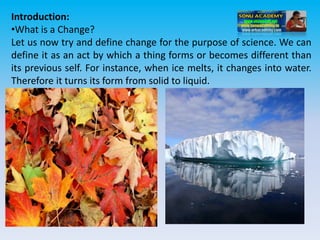
Introduction:
•What is a Change?
Let us now try and define change for the purpose of science. We can
define it as an act by which a thing forms or becomes different than
its previous self. For instance, when ice melts, it changes into water.
Therefore it turns its form from solid to liquid.
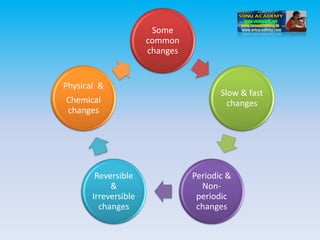
Some
common
changes
Slow & fast
changes
Periodic &
Non-
periodic
changes
Reversible
&
Irreversible
changes
Physical &
Chemical
changes
We change bring a change in a substance by doing one or more
following methods:
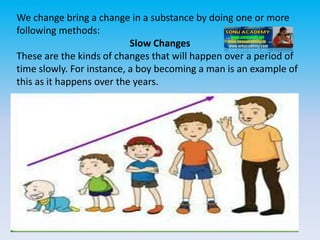
Slow Changes
These are the kinds of changes that will happen over a period of
time slowly. For instance, a boy becoming a man is an example of
this as it happens over the years.
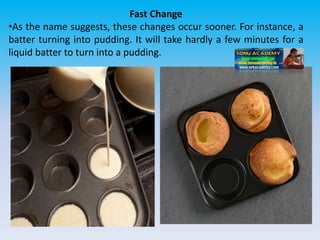
Fast Change
•As the name suggests, these changes occur sooner. For instance, a
batter turning into pudding. It will take hardly a few minutes for a
liquid batter to turn into a pudding.
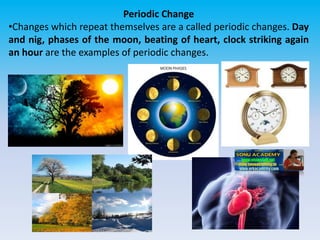
Periodic Change
•Changes which repeat themselves are a called periodic changes. Day
and nig, phases of the moon, beating of heart, clock striking again
an hour are the examples of periodic changes.
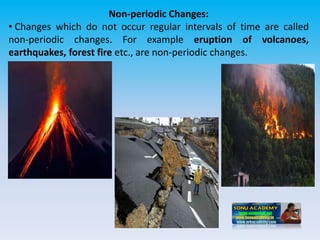
Non-periodic Changes:
• Changes which do not occur regular intervals of time are called
non-periodic changes. For example eruption of volcanoes,
earthquakes, forest fire etc., are non-periodic changes.
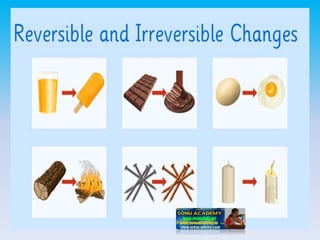
Reversible and Irreversible Changes
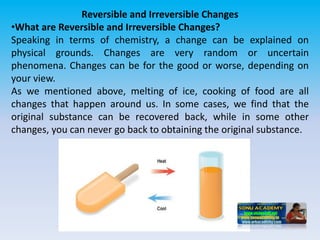
•What are Reversible and Irreversible Changes?
Speaking in terms of chemistry, a change can be explained on
physical grounds. Changes are very random or uncertain
phenomena. Changes can be for the good or worse, depending on
your view.
As we mentioned above, melting of ice, cooking of food are all
changes that happen around us. In some cases, we find that the
original substance can be recovered back, while in some other
changes, you can never go back to obtaining the original substance.
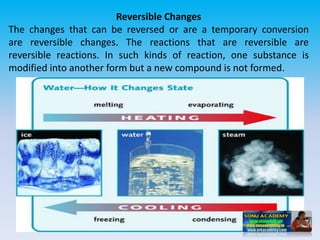
Reversible Changes
The changes that can be reversed or are a temporary conversion
are reversible changes. The reactions that are reversible are
reversible reactions. In such kinds of reaction, one substance is
modified into another form but a new compound is not formed.
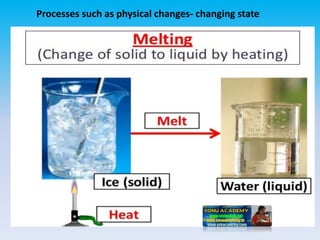
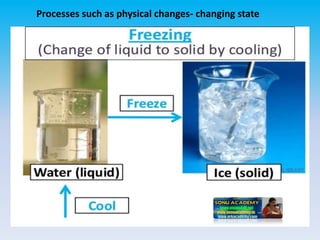
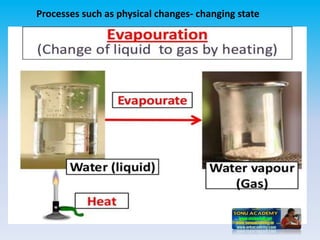
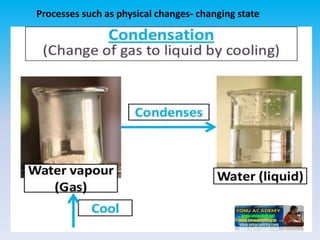
Processes such as physical changes- changing state
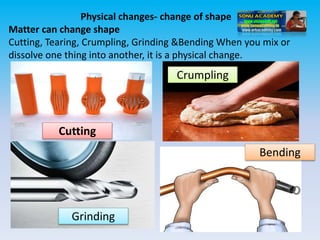
Physical changes- change of shape
Matter can change shape
Cutting, Tearing, Crumpling, Grinding &Bending When you mix or
dissolve one thing into another, it is a physical change.
Cutting
Crumpling
Grinding
Bending
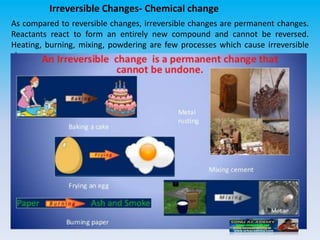
Irreversible Changes- Chemical change
As compared to reversible changes, irreversible changes are permanent changes.
Reactants react to form an entirely new compound and cannot be reversed.
Heating, burning, mixing, powdering are few processes which cause irreversible
changes.
CHANGES AROUND US (SCIENCE CLASS VI)

CHANGES AROUND US (SCIENCE CLASS VI)

  • 1.
  • 2.
    Introduction: •What is aChange? Let us now try and define change for the purpose of science. We can define it as an act by which a thing forms or becomes different than its previous self. For instance, when ice melts, it changes into water. Therefore it turns its form from solid to liquid.
  • 3.
    Some common changes Slow & fast changes Periodic& Non- periodic changes Reversible & Irreversible changes Physical & Chemical changes
  • 4.
    We change bringa change in a substance by doing one or more following methods: Slow Changes These are the kinds of changes that will happen over a period of time slowly. For instance, a boy becoming a man is an example of this as it happens over the years.
  • 5.
    Fast Change •As thename suggests, these changes occur sooner. For instance, a batter turning into pudding. It will take hardly a few minutes for a liquid batter to turn into a pudding.
  • 6.
    Periodic Change •Changes whichrepeat themselves are a called periodic changes. Day and nig, phases of the moon, beating of heart, clock striking again an hour are the examples of periodic changes.
  • 7.
    Non-periodic Changes: • Changeswhich do not occur regular intervals of time are called non-periodic changes. For example eruption of volcanoes, earthquakes, forest fire etc., are non-periodic changes.
  • 9.
    Reversible and IrreversibleChanges •What are Reversible and Irreversible Changes? Speaking in terms of chemistry, a change can be explained on physical grounds. Changes are very random or uncertain phenomena. Changes can be for the good or worse, depending on your view. As we mentioned above, melting of ice, cooking of food are all changes that happen around us. In some cases, we find that the original substance can be recovered back, while in some other changes, you can never go back to obtaining the original substance.
  • 10.
    Reversible Changes The changesthat can be reversed or are a temporary conversion are reversible changes. The reactions that are reversible are reversible reactions. In such kinds of reaction, one substance is modified into another form but a new compound is not formed.
  • 11.
    Processes such asphysical changes- changing state
  • 12.
    Processes such asphysical changes- changing state
  • 13.
    Processes such asphysical changes- changing state
  • 14.
    Processes such asphysical changes- changing state
  • 15.
    Physical changes- changeof shape Matter can change shape Cutting, Tearing, Crumpling, Grinding &Bending When you mix or dissolve one thing into another, it is a physical change. Cutting Crumpling Grinding Bending
  • 16.
    Irreversible Changes- Chemicalchange As compared to reversible changes, irreversible changes are permanent changes. Reactants react to form an entirely new compound and cannot be reversed. Heating, burning, mixing, powdering are few processes which cause irreversible changes.