Principles of Information Systems Chapter 8 Electronic and Mobile Commerce
Principles and Learning Objectives Electronic commerce and mobile commerce are evolving, providing new ways of conducting business that present both opportunities for improvement and potential problems Describe the current status of various forms of e-commerce, including B2B, B2C, and C2C Outline a multistage purchasing model that describes how e-commerce works Define m-commerce and identify some of its unique challenges
Principles and Learning Objectives (continued) E-commerce and m-commerce can be used in many innovative ways to improve the operations of an organization Identify several e-commerce and m-commerce applications Identify several advantages associated with the use of e-commerce and m-commerce
Why Learn About Electronic and Mobile Commerce? Most organizations have an Internet presence Sales/marketing manager involved with e-commerce Customer service employees help develop the Web site Human resource or public relations manager may provide Web content for employees and investors Must learn about e-commerce and m-commerce
An Introduction to Electronic Commerce Electronic commerce:  conducting business activities electronically over computer networks Types of business activities that are strong candidates for conversion to e-commerce Paper based Time-consuming Inconvenient for customers
Business-to-Business (B2B)  E-Commerce Subset of e-commerce All the participants are organizations Useful tool for connecting business partners in a virtual supply chain to cut resupply times and reduce costs
Business-to-Consumer (B2C)  E-Commerce Form of e-commerce in which customers deal directly with an organization and avoid intermediaries Squeezes costs and inefficiencies out of supply chain Can lead to higher profits Can lead to lower prices for consumers E-commerce via the Internet Many goods and services are cheaper online The Internet allows consumers to easily compare prices, features, and value
Consumer-to-Consumer (C2C)  E-Commerce Subset of e-commerce that involves consumers selling directly to other consumers Example: eBay Customers buy and sell items directly to each other through the site 181 million users buy and sell items valued at more than $44 billion Other popular online auction Web sites: Craigslist, uBid, Yahoo! Auctions, Onsale, and WeBidz
E-Government Use of information and communications technology to simplify the sharing of information, speed formerly paper-based processes, and improve the relationship between citizen and government Forms of eGovernment Government-to-consumer (G2C) Government-to-business (G2B) Government-to-government (G2G)
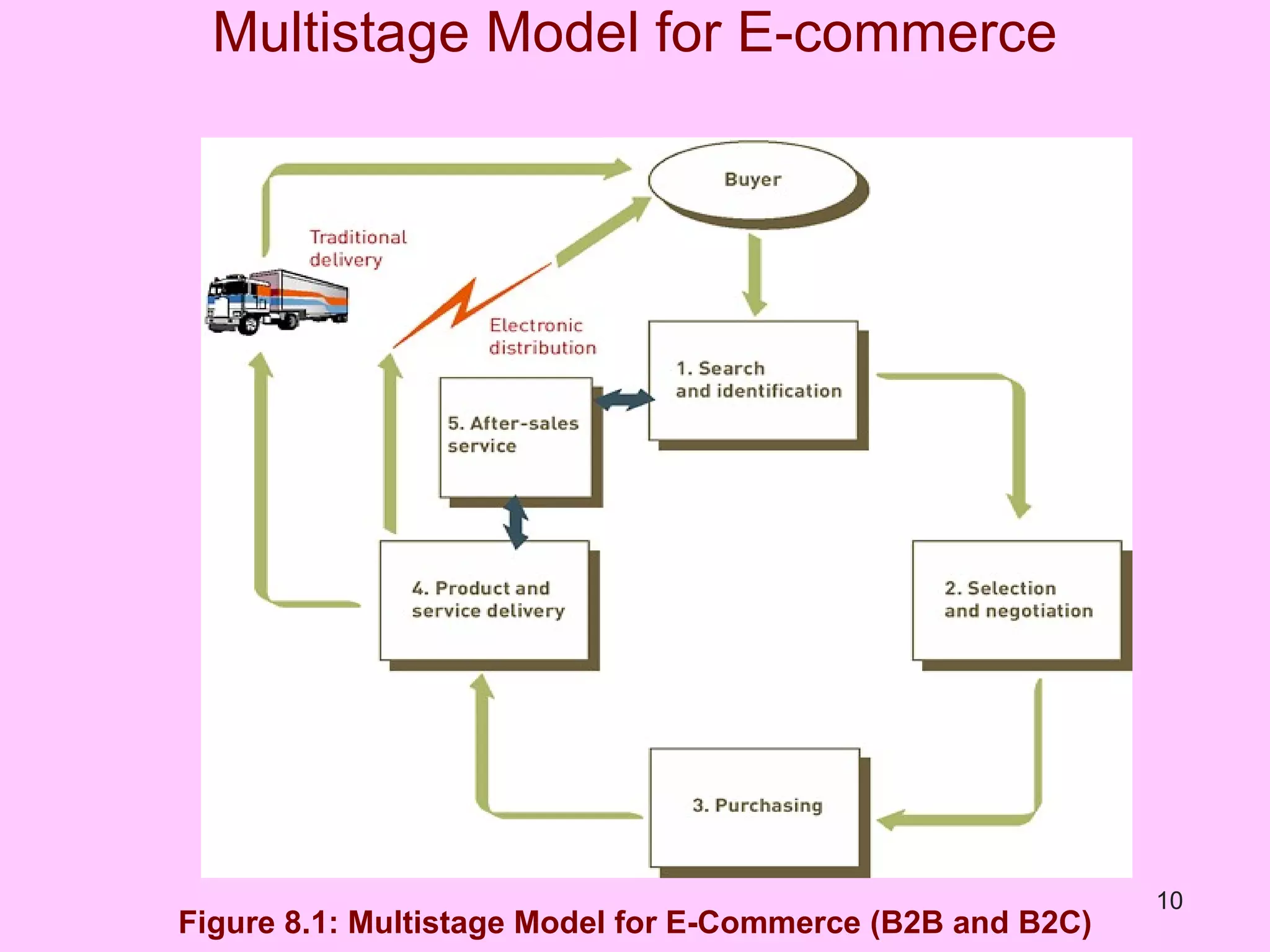
Multistage Model for E-commerce Figure 8.1: Multistage Model for E-Commerce (B2B and B2C)
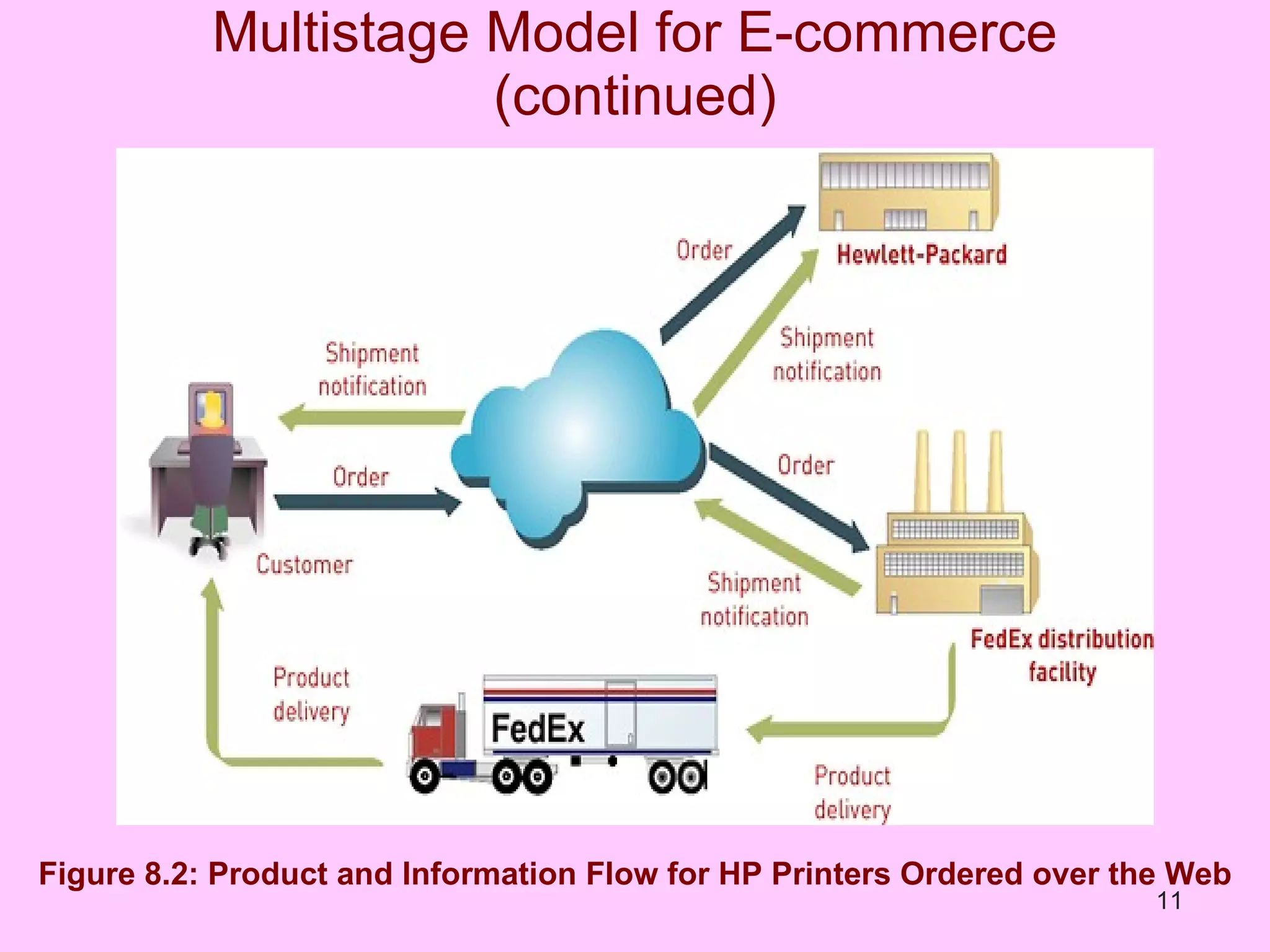
Multistage Model for E-commerce (continued) Figure 8.2: Product and Information Flow for HP Printers Ordered over the Web
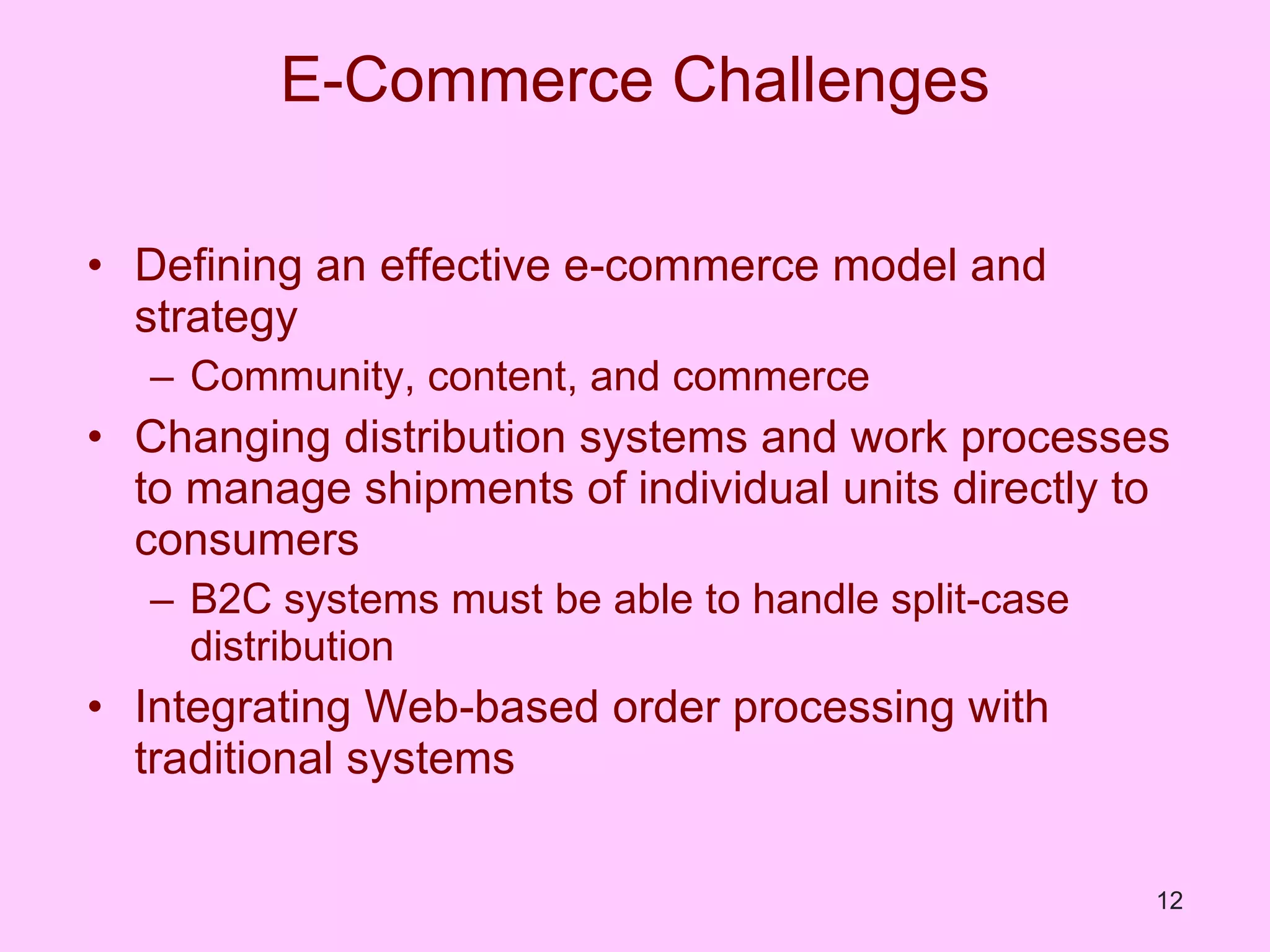
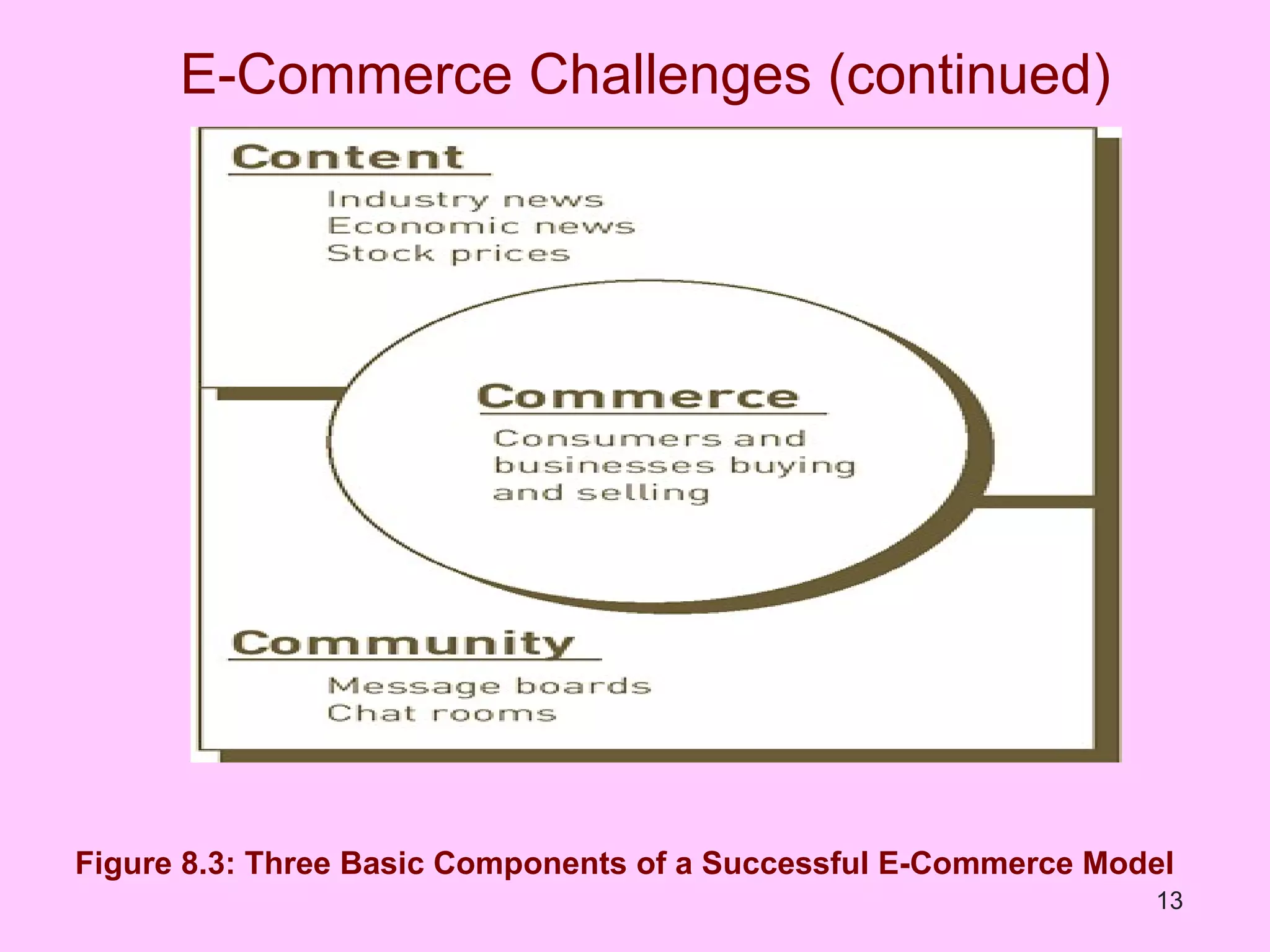
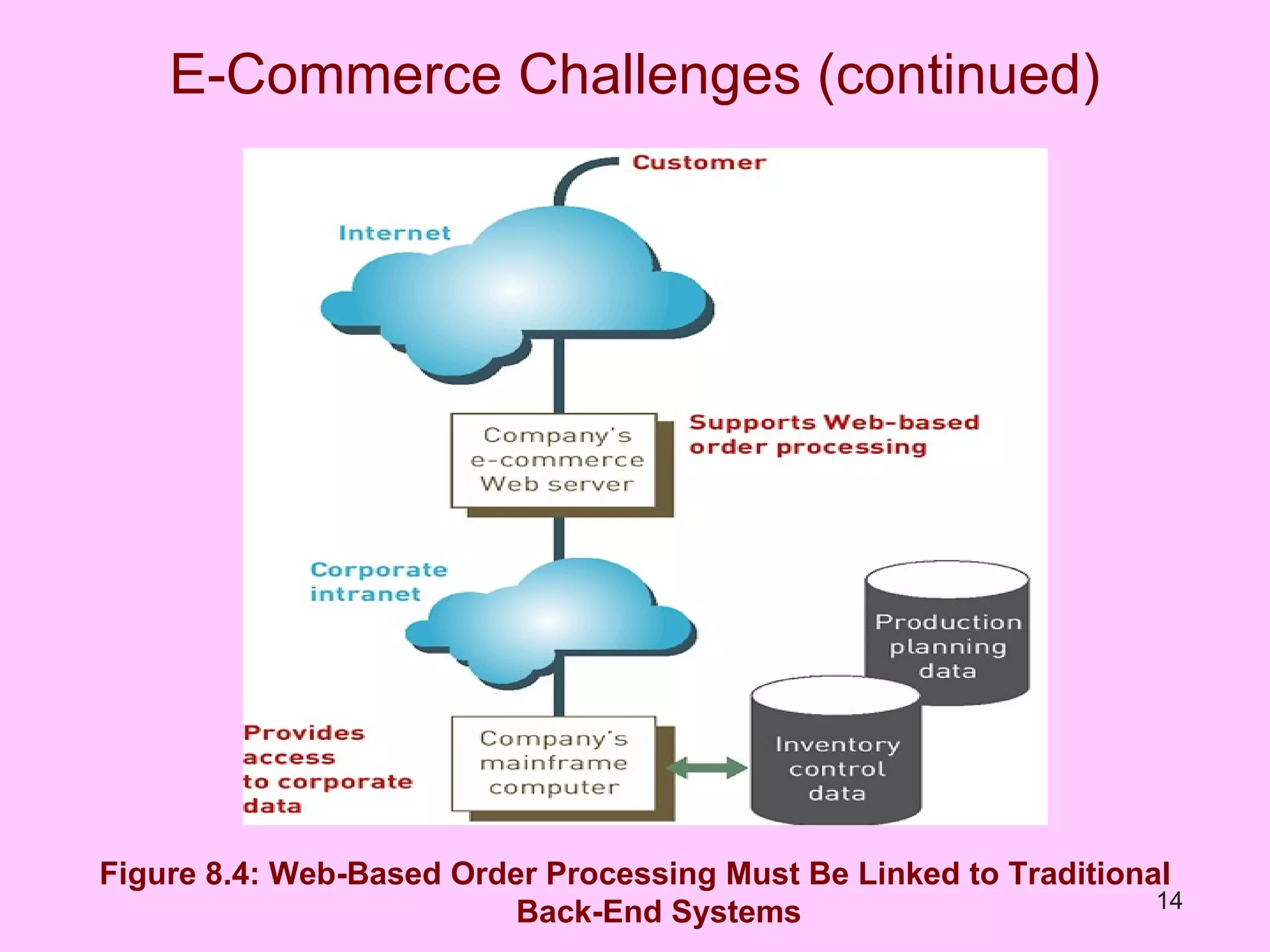
E-Commerce Challenges Defining an effective e-commerce model and strategy Community, content, and commerce Changing distribution systems and work processes to manage shipments of individual units directly to consumers B2C systems must be able to handle split-case distribution Integrating Web-based order processing with traditional systems
E-Commerce Challenges (continued) Figure 8.3: Three Basic Components of a Successful E-Commerce Model
E-Commerce Challenges (continued) Figure 8.4: Web-Based Order Processing Must Be Linked to Traditional Back-End Systems
An Introduction to Mobile Commerce Mobile commerce (m-commerce )  relies on the use of wireless devices, such as personal digital assistants, cell phones, and smart phones, to place orders and conduct business Handset manufacturers are working with communications carriers to develop appropriate wireless devices, related technology, and services Content providers and mobile service providers are working together more closely than ever
Mobile Commerce in Perspective Only 12 to 14 percent of the world’s 1.8 billion mobile phone users have ever used the Web from their phones Internet Corporation for Assigned Names and Numbers (ICANN) created a .mobi domain to help attract mobile users to the Web Market for m-commerce in North America is maturing much later than in Western Europe and Japan
Technology Needed for Mobile Commerce Improved interface between the wireless device and its user Improved network speed Security Encryption, digital certificates Web applications that are accessible for handheld users
Technology Needed for Mobile Commerce (continued) Wireless application protocol (WAP):  standard set of specifications for Internet applications that run on handheld, wireless devices Effectively serves as a Web browser for such devices Uses the Wireless Markup Language (WML), which is designed for effectively displaying information on small devices
Electronic and Mobile Commerce Applications Many B2B, B2C, C2C, and m-commerce applications are being used in: Retail and wholesale Manufacturing Marketing Investment and finance Auction arenas
Retail and Wholesale Electronic retailing (e-tailing):  direct sale from business to consumer through electronic storefronts Electronic storefronts are typically designed around an electronic catalog and shopping cart model Cybermall:  single Web site that offers many products and services at one Internet location Manufacturing, repair, and operations (MRO) goods and services
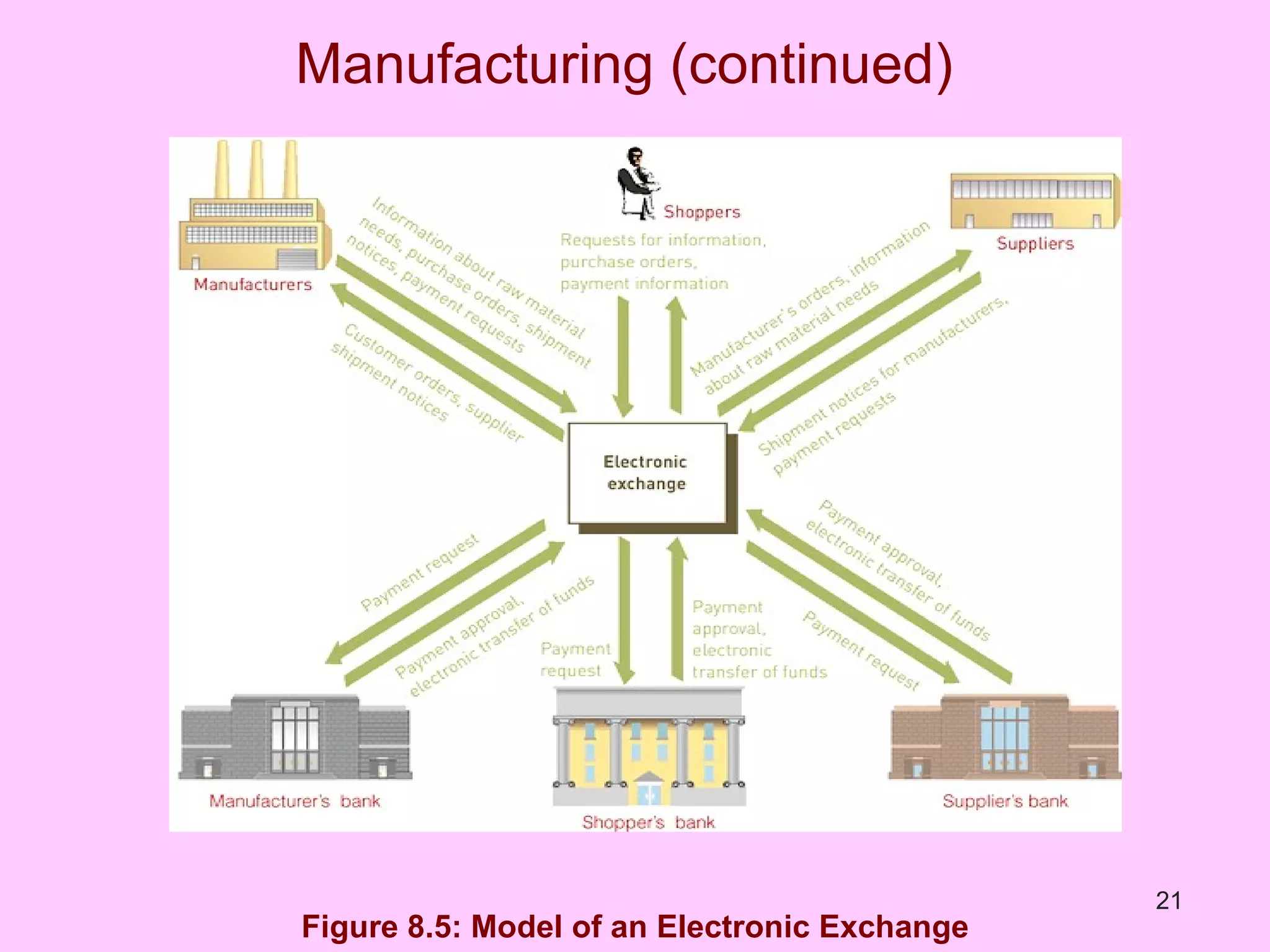
Manufacturing (continued) Figure 8.5: Model of an Electronic Exchange
Investment and Finance Online stock trading Online tools for doing research and analysis Online banking Customers can check account balances, transfer money among accounts, pay bills, etc. Electronic bill presentment
Auctions eBay Has become synonymous with online auctions Customer complaints: increased fees and problems with unscrupulous buyers Constantly trying to expand and improve its services: Skype, Verisign Hundreds of other online auction sites Example: Priceline.com
Anywhere, Anytime Applications of Mobile Commerce M-commerce devices are ideal for accessing personal information and receiving targeted messages for a particular consumer Through m-commerce, companies can establish one-to-one marketing relationships with individual consumers anytime and anywhere The most successful m-commerce applications suit local conditions and people’s habits and preferences Examples: banking, stock trading, information services, retail, advertisements
Advantages of Electronic and Mobile Commerce Global reach: helps reduce gap between rich and poor countries Reduces costs: increases speed and accuracy Speeds the flow of goods and information Increases accuracy: eliminates human data-entry error Improves customer service: information about delivery status and ability to meet customer demand
Threats to Electronic and Mobile Commerce Businesses must ensure that e-commerce and m-commerce transactions are safe and consumers are protected Number of threats to the continued growth of e-commerce and m-commerce Security, theft of intellectual property, fraud, invasion of privacy, lack of Internet access, return on investment, legal jurisdiction, taxation
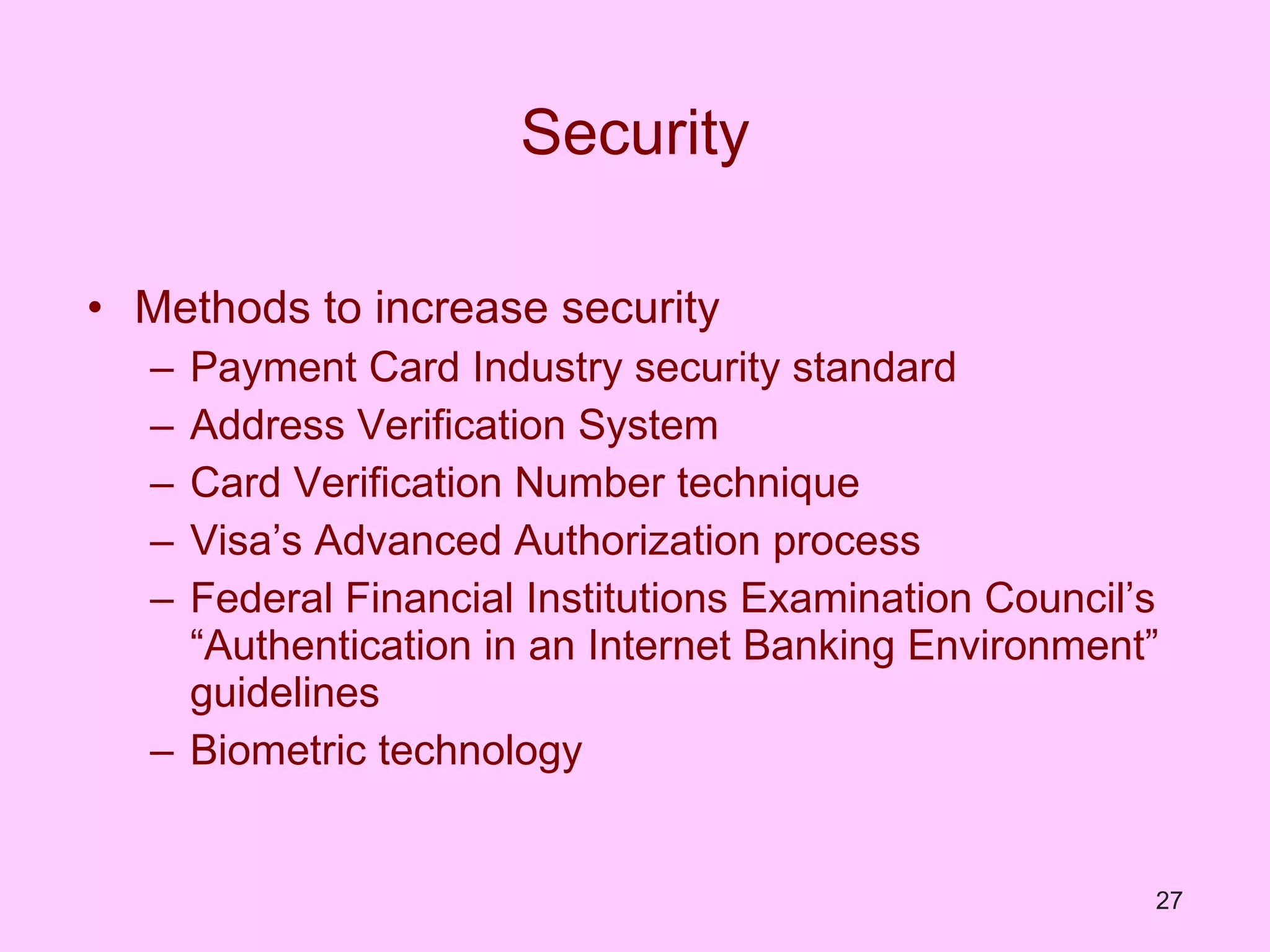
Security Methods to increase security Payment Card Industry security standard Address Verification System Card Verification Number technique Visa’s Advanced Authorization process Federal Financial Institutions Examination Council’s “Authentication in an Internet Banking Environment” guidelines Biometric technology
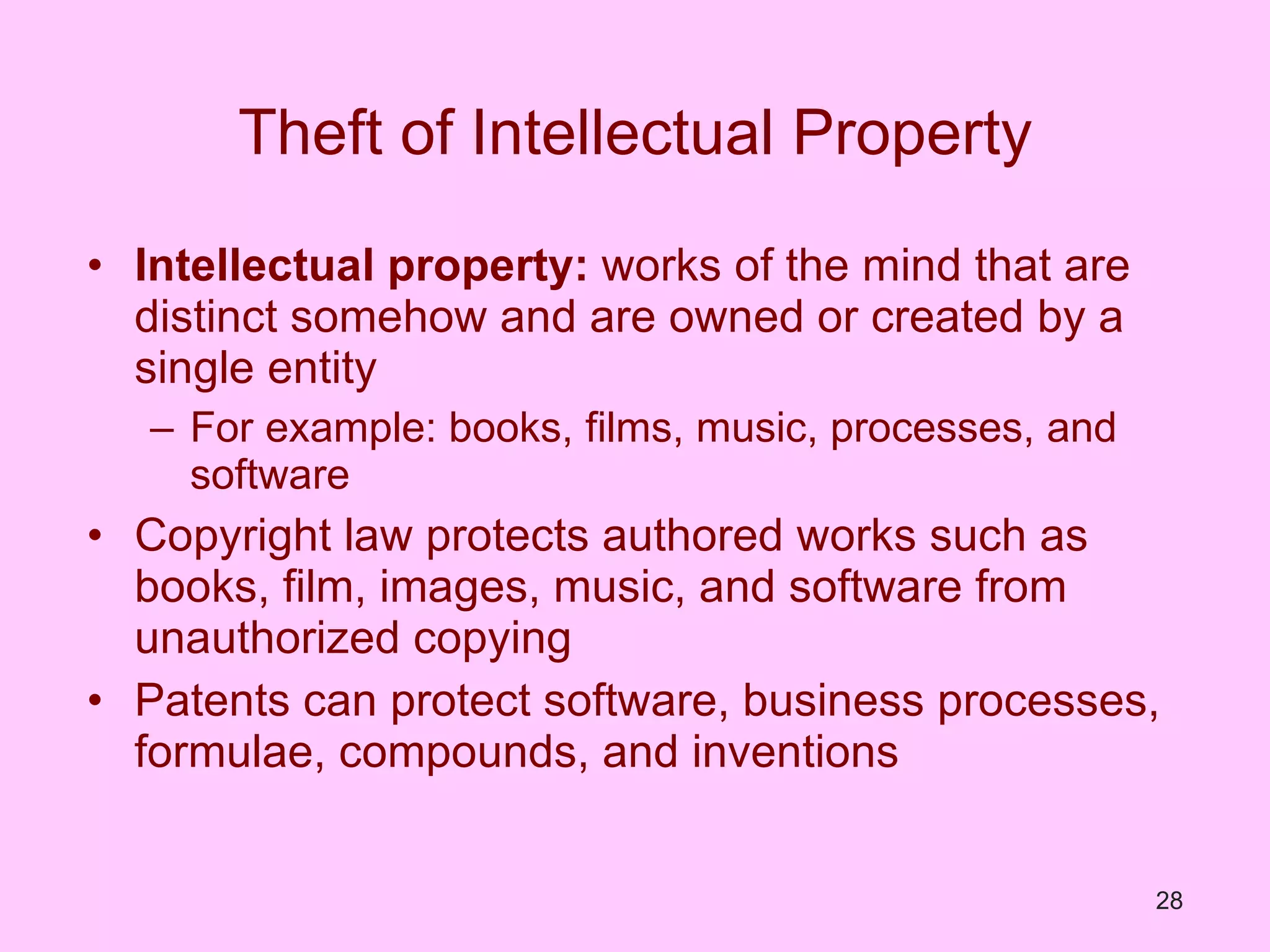
Theft of Intellectual Property Intellectual property:  works of the mind that are distinct somehow and are owned or created by a single entity For example: books, films, music, processes, and software Copyright law protects authored works such as books, film, images, music, and software from unauthorized copying Patents can protect software, business processes, formulae, compounds, and inventions
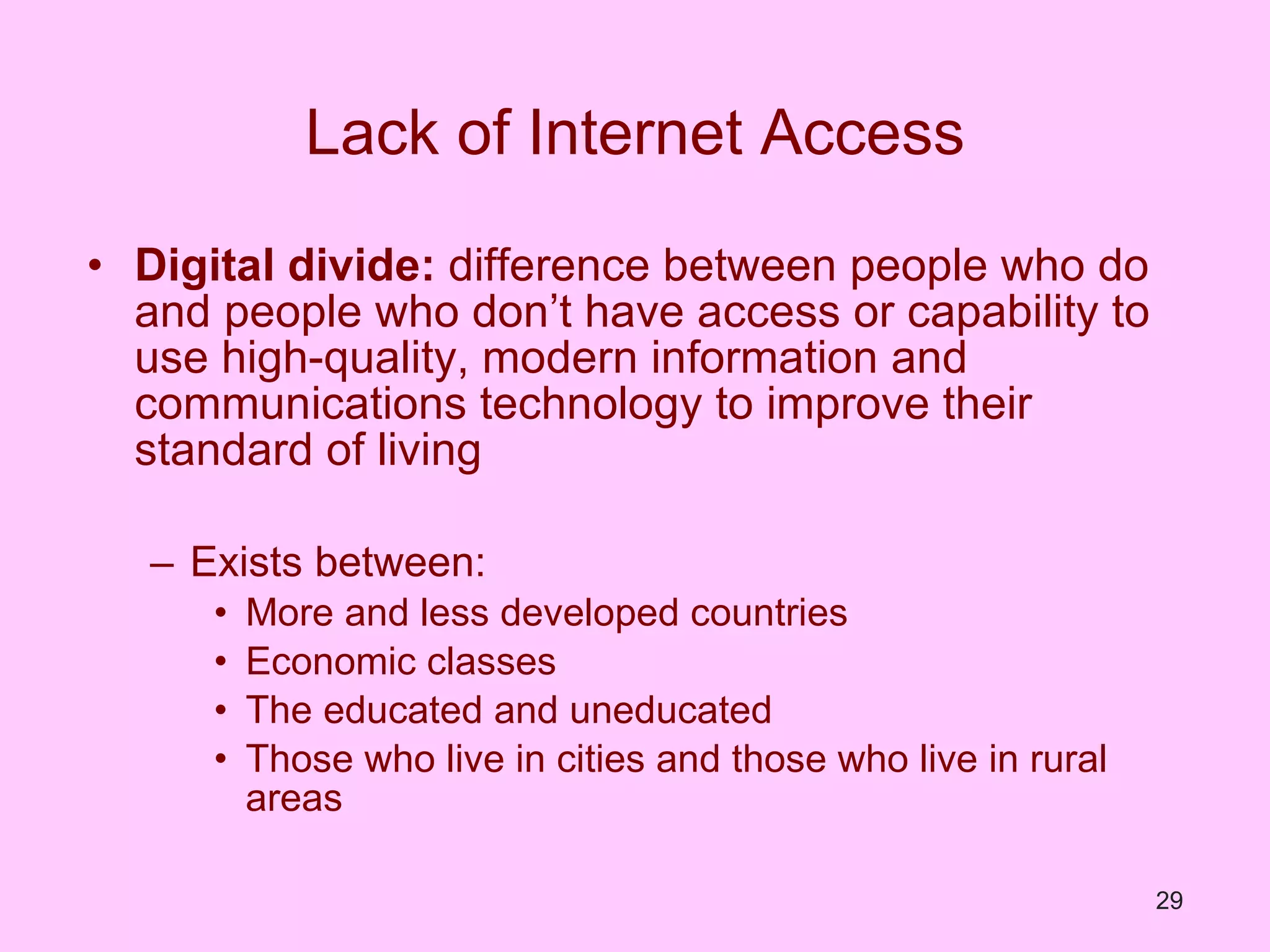
Lack of Internet Access Digital divide:   difference between people who do and people who don’t have access or capability to use high-quality, modern information and communications technology to improve their standard of living Exists between: More and less developed countries Economic classes The educated and uneducated Those who live in cities and those who live in rural areas
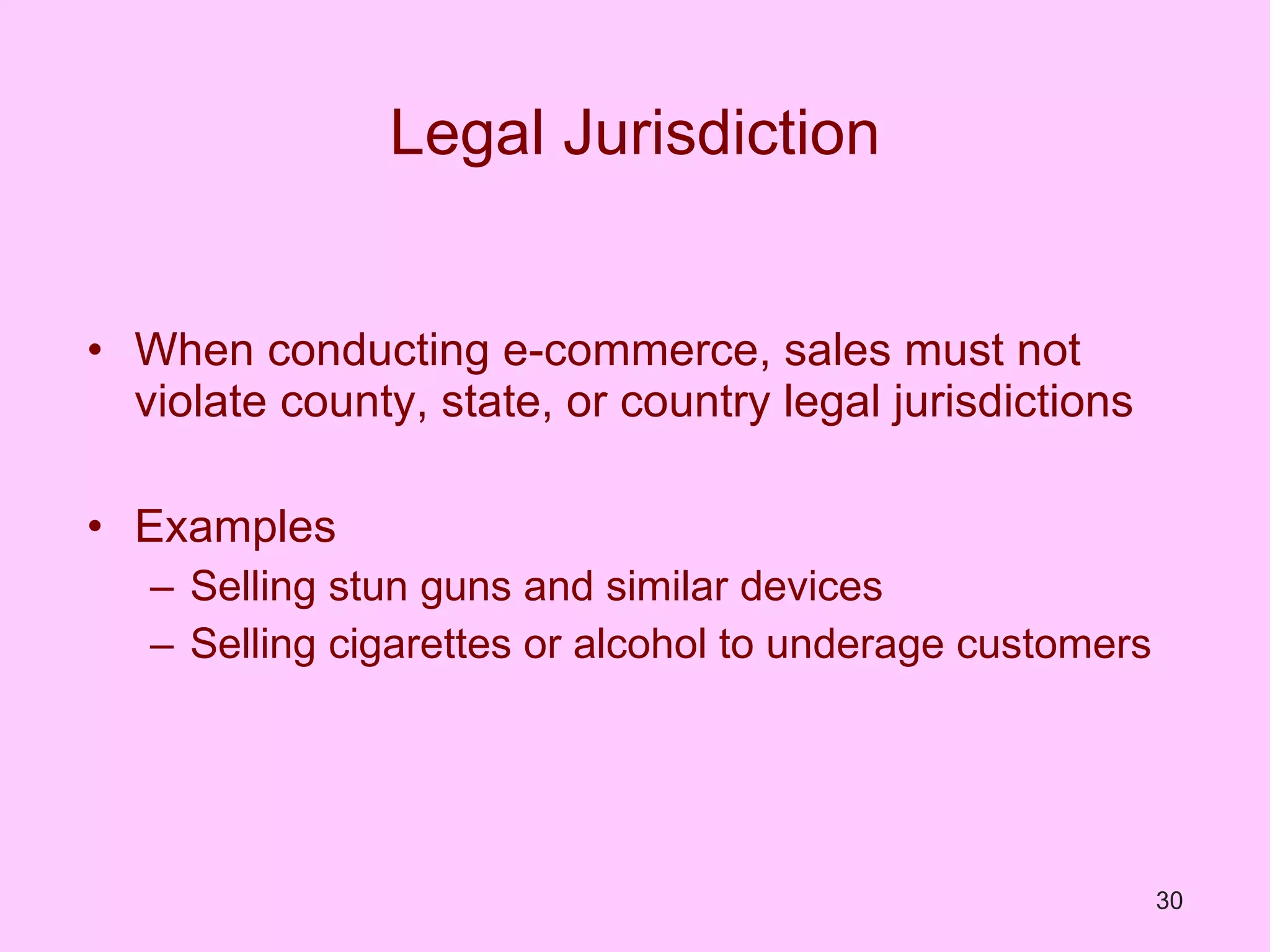
Legal Jurisdiction When conducting e-commerce, sales must not violate county, state, or country legal jurisdictions  Examples Selling stun guns and similar devices Selling cigarettes or alcohol to underage customers
Strategies for Successful  E-Commerce Companies must develop effective Web sites that include the following characteristics: Easy to use Accomplish the goals of the company Safe and secure Affordable to set up and maintain
Establishing a Web Site Web site hosting companies Allow you to set up a Web page and conduct e-commerce within a matter of days Little up-front cost Storefront broker:  companies that act as middlemen between your Web site and online merchants that have the products and retail expertise
Building Traffic to Your Web Site Obtain and register a domain name Make your site search-engine-friendly Meta tag:  special HTML tag that contains keywords representing your site’s content Keywords are used by search engines to build indexes pointing to your Web site Web site traffic data analysis software Adapting Web site design for global consumers
Technology Infrastructure Required To Support E-commerce and  M-commerce Successful implementation of e-business requires significant changes to existing business processes and substantial investment in IS technology Poor Web site performance drives consumers to abandon some e-commerce sites in favor of those with better, more reliable performance
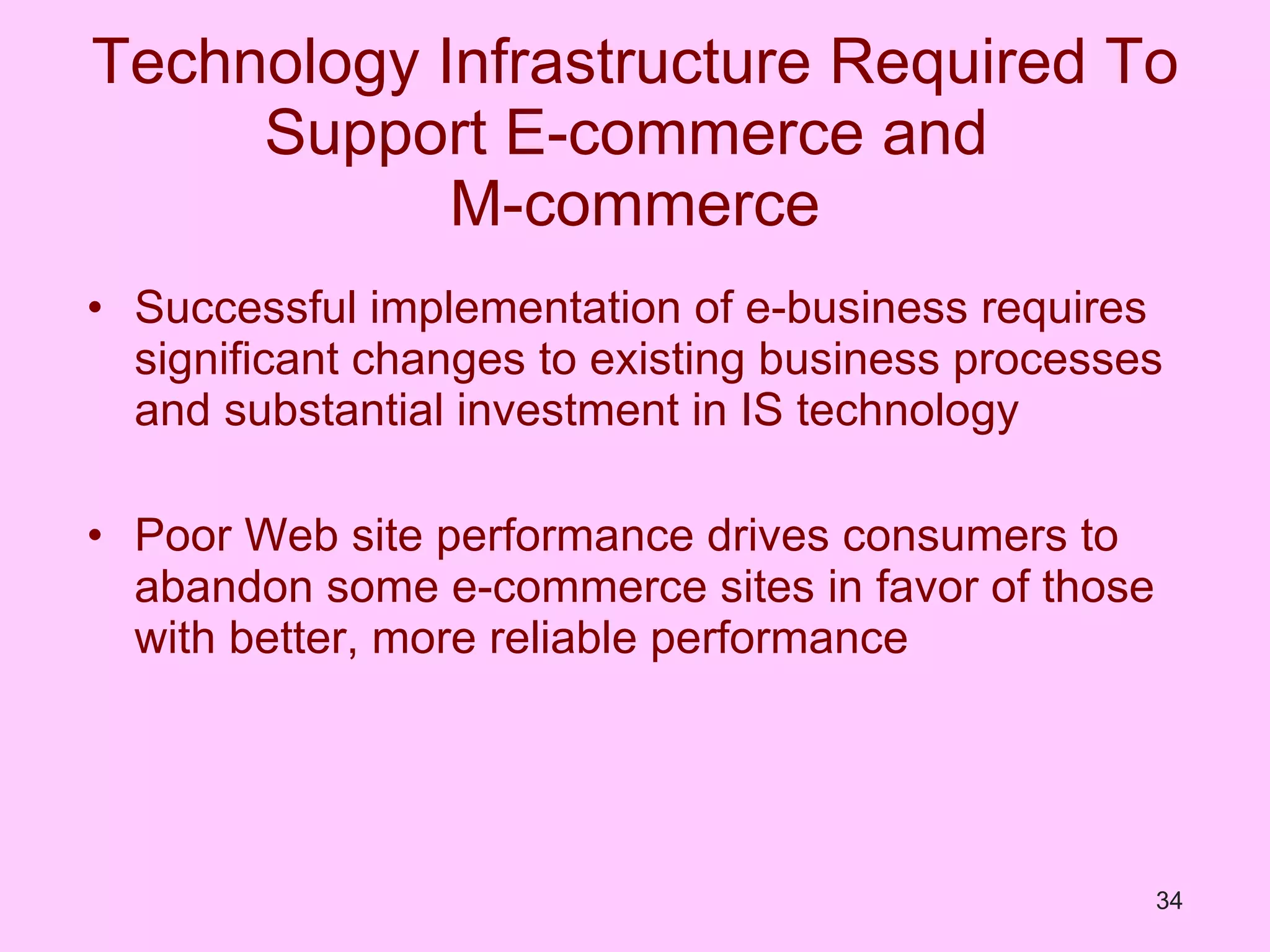
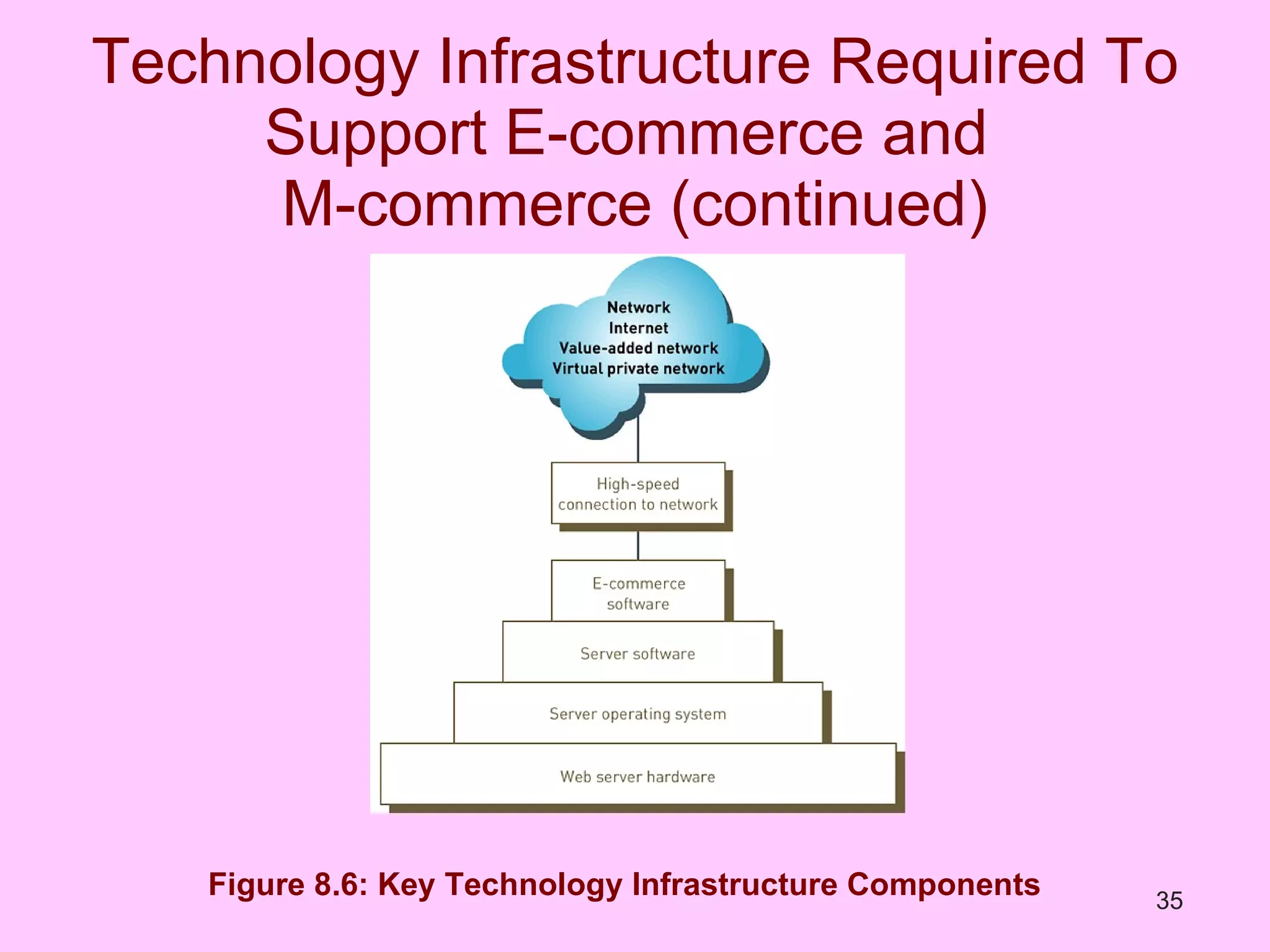
Technology Infrastructure Required To Support E-commerce and  M-commerce (continued) Figure 8.6: Key Technology Infrastructure Components
Hardware Storage capacity and computing power required of the Web server depends on: Software that will run on the server Volume of e-commerce transactions E-commerce solutions should be designed to be highly scalable
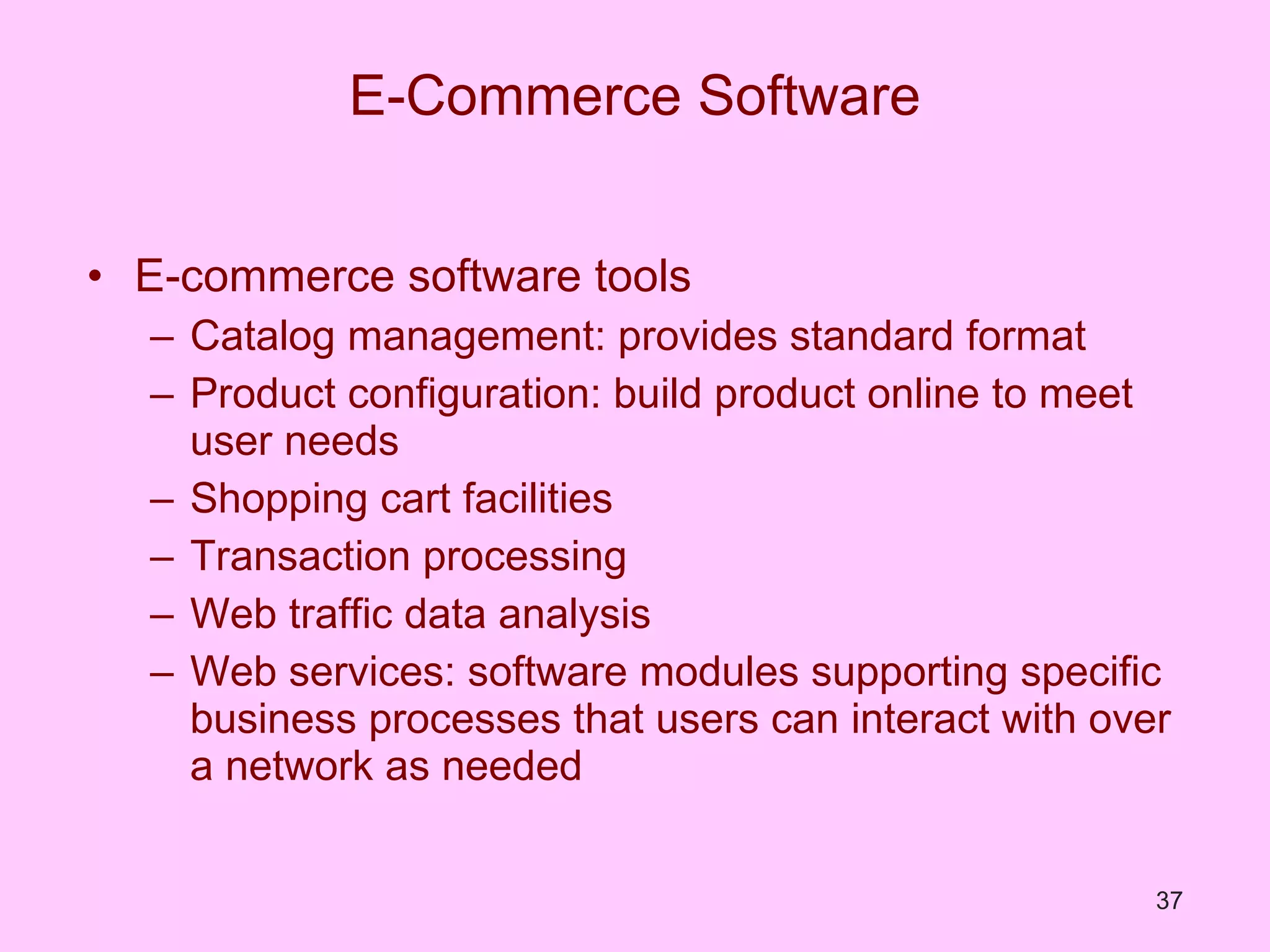
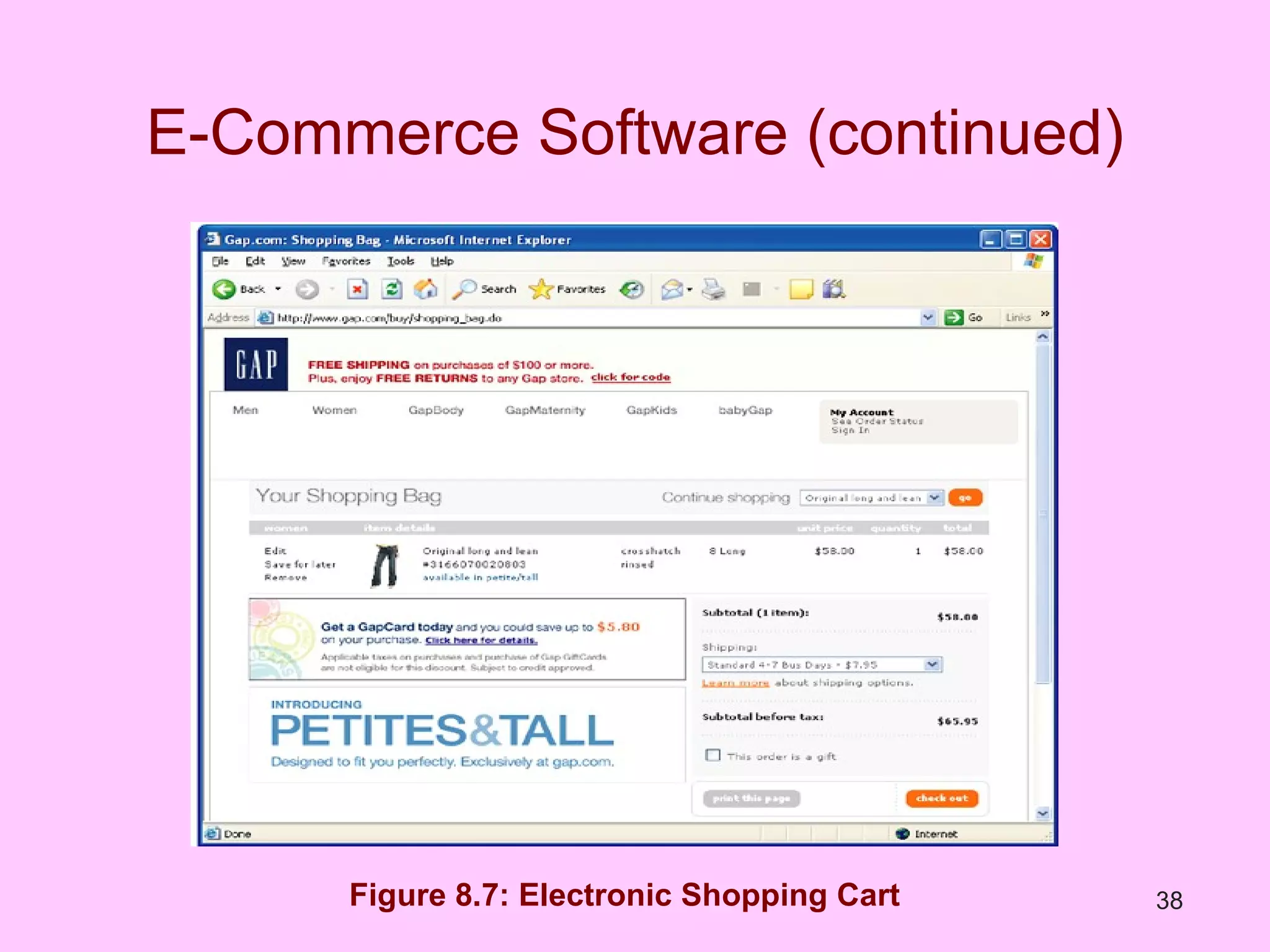
E-Commerce Software E-commerce software tools Catalog management: provides standard format Product configuration: build product online to meet user needs Shopping cart facilities Transaction processing Web traffic data analysis Web services: software modules supporting specific business processes that users can interact with over a network as needed
E-Commerce Software (continued) Figure 8.7: Electronic Shopping Cart
Electronic Payment Systems Digital certificate:  attachment to an e-mail message or data embedded in a Web page that verifies the identity of a sender or a Web site Certificate authority (CA):  trusted third party that issues digital certificates Secure Sockets Layer (SSL):  communications protocol used to secure sensitive data Electronic cash:  amount of money that is computerized, stored, and used as cash for e-commerce transactions
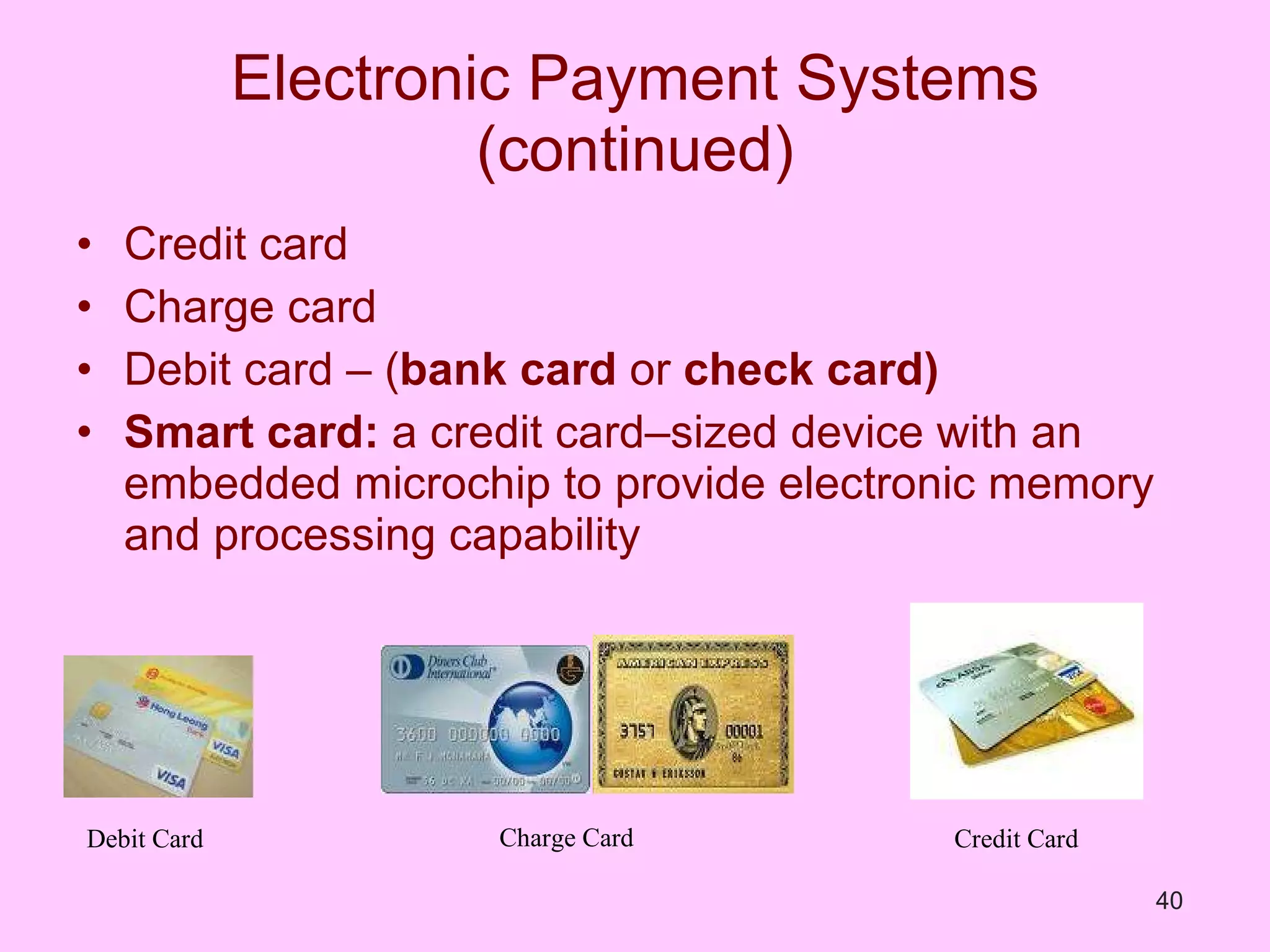
Electronic Payment Systems (continued) Credit card Charge card Debit card – ( bank card  or  check  card)   Smart card:  a credit card–sized device with an embedded microchip to provide electronic memory and processing capability Debit Card Charge Card Credit Card
Summary   Electronic commerce (or e-commerce): conducting business activities electronically over computer networks Types of e-commerce: business-to-consumer (B2C), business-to-business (B2B), and consumer-to-consumer (C2C) E-Government: use of information and communications technology to simplify the sharing of information, speed formerly paper-based processes, and improve the relationship between citizen and government
Summary (continued)   Multistage model for e-commerce: includes search and identification, selection and negotiation, electronic purchasing, delivery, and after-sales service Mobile commerce (m-commerce): uses wireless devices to place orders and conduct business B2B, B2C, C2C, and m-commerce applications are being used in retail and wholesale, manufacturing, marketing, investment and finance, and auction arenas
Summary (continued) Issues affecting growth of e- and m-commerce: security, theft of intellectual property, fraud, invasion of consumer privacy, lack of Internet access, return on investment, legal jurisdiction, and taxation An effective Web site should be easy to use, accomplish the goals of the company, be safe and secure, and be affordable to set up and maintain Successful implementation of e-business requires significant changes to existing business processes and substantial investment in IS technology

Ch08 c electronic and mobile commerce a (2)

  • 1.
    Principles of InformationSystems Chapter 8 Electronic and Mobile Commerce
  • 2.
    Principles and LearningObjectives Electronic commerce and mobile commerce are evolving, providing new ways of conducting business that present both opportunities for improvement and potential problems Describe the current status of various forms of e-commerce, including B2B, B2C, and C2C Outline a multistage purchasing model that describes how e-commerce works Define m-commerce and identify some of its unique challenges
  • 3.
    Principles and LearningObjectives (continued) E-commerce and m-commerce can be used in many innovative ways to improve the operations of an organization Identify several e-commerce and m-commerce applications Identify several advantages associated with the use of e-commerce and m-commerce
  • 4.
    Why Learn AboutElectronic and Mobile Commerce? Most organizations have an Internet presence Sales/marketing manager involved with e-commerce Customer service employees help develop the Web site Human resource or public relations manager may provide Web content for employees and investors Must learn about e-commerce and m-commerce
  • 5.
    An Introduction toElectronic Commerce Electronic commerce: conducting business activities electronically over computer networks Types of business activities that are strong candidates for conversion to e-commerce Paper based Time-consuming Inconvenient for customers
  • 6.
    Business-to-Business (B2B) E-Commerce Subset of e-commerce All the participants are organizations Useful tool for connecting business partners in a virtual supply chain to cut resupply times and reduce costs
  • 7.
    Business-to-Consumer (B2C) E-Commerce Form of e-commerce in which customers deal directly with an organization and avoid intermediaries Squeezes costs and inefficiencies out of supply chain Can lead to higher profits Can lead to lower prices for consumers E-commerce via the Internet Many goods and services are cheaper online The Internet allows consumers to easily compare prices, features, and value
  • 8.
    Consumer-to-Consumer (C2C) E-Commerce Subset of e-commerce that involves consumers selling directly to other consumers Example: eBay Customers buy and sell items directly to each other through the site 181 million users buy and sell items valued at more than $44 billion Other popular online auction Web sites: Craigslist, uBid, Yahoo! Auctions, Onsale, and WeBidz
  • 9.
    E-Government Use ofinformation and communications technology to simplify the sharing of information, speed formerly paper-based processes, and improve the relationship between citizen and government Forms of eGovernment Government-to-consumer (G2C) Government-to-business (G2B) Government-to-government (G2G)
  • 10.
    Multistage Model forE-commerce Figure 8.1: Multistage Model for E-Commerce (B2B and B2C)
  • 11.
    Multistage Model forE-commerce (continued) Figure 8.2: Product and Information Flow for HP Printers Ordered over the Web
  • 12.
    E-Commerce Challenges Definingan effective e-commerce model and strategy Community, content, and commerce Changing distribution systems and work processes to manage shipments of individual units directly to consumers B2C systems must be able to handle split-case distribution Integrating Web-based order processing with traditional systems
  • 13.
    E-Commerce Challenges (continued)Figure 8.3: Three Basic Components of a Successful E-Commerce Model
  • 14.
    E-Commerce Challenges (continued)Figure 8.4: Web-Based Order Processing Must Be Linked to Traditional Back-End Systems
  • 15.
    An Introduction toMobile Commerce Mobile commerce (m-commerce ) relies on the use of wireless devices, such as personal digital assistants, cell phones, and smart phones, to place orders and conduct business Handset manufacturers are working with communications carriers to develop appropriate wireless devices, related technology, and services Content providers and mobile service providers are working together more closely than ever
  • 16.
    Mobile Commerce inPerspective Only 12 to 14 percent of the world’s 1.8 billion mobile phone users have ever used the Web from their phones Internet Corporation for Assigned Names and Numbers (ICANN) created a .mobi domain to help attract mobile users to the Web Market for m-commerce in North America is maturing much later than in Western Europe and Japan
  • 17.
    Technology Needed forMobile Commerce Improved interface between the wireless device and its user Improved network speed Security Encryption, digital certificates Web applications that are accessible for handheld users
  • 18.
    Technology Needed forMobile Commerce (continued) Wireless application protocol (WAP): standard set of specifications for Internet applications that run on handheld, wireless devices Effectively serves as a Web browser for such devices Uses the Wireless Markup Language (WML), which is designed for effectively displaying information on small devices
  • 19.
    Electronic and MobileCommerce Applications Many B2B, B2C, C2C, and m-commerce applications are being used in: Retail and wholesale Manufacturing Marketing Investment and finance Auction arenas
  • 20.
    Retail and WholesaleElectronic retailing (e-tailing): direct sale from business to consumer through electronic storefronts Electronic storefronts are typically designed around an electronic catalog and shopping cart model Cybermall: single Web site that offers many products and services at one Internet location Manufacturing, repair, and operations (MRO) goods and services
  • 21.
    Manufacturing (continued) Figure8.5: Model of an Electronic Exchange
  • 22.
    Investment and FinanceOnline stock trading Online tools for doing research and analysis Online banking Customers can check account balances, transfer money among accounts, pay bills, etc. Electronic bill presentment
  • 23.
    Auctions eBay Hasbecome synonymous with online auctions Customer complaints: increased fees and problems with unscrupulous buyers Constantly trying to expand and improve its services: Skype, Verisign Hundreds of other online auction sites Example: Priceline.com
  • 24.
    Anywhere, Anytime Applicationsof Mobile Commerce M-commerce devices are ideal for accessing personal information and receiving targeted messages for a particular consumer Through m-commerce, companies can establish one-to-one marketing relationships with individual consumers anytime and anywhere The most successful m-commerce applications suit local conditions and people’s habits and preferences Examples: banking, stock trading, information services, retail, advertisements
  • 25.
    Advantages of Electronicand Mobile Commerce Global reach: helps reduce gap between rich and poor countries Reduces costs: increases speed and accuracy Speeds the flow of goods and information Increases accuracy: eliminates human data-entry error Improves customer service: information about delivery status and ability to meet customer demand
  • 26.
    Threats to Electronicand Mobile Commerce Businesses must ensure that e-commerce and m-commerce transactions are safe and consumers are protected Number of threats to the continued growth of e-commerce and m-commerce Security, theft of intellectual property, fraud, invasion of privacy, lack of Internet access, return on investment, legal jurisdiction, taxation
  • 27.
    Security Methods toincrease security Payment Card Industry security standard Address Verification System Card Verification Number technique Visa’s Advanced Authorization process Federal Financial Institutions Examination Council’s “Authentication in an Internet Banking Environment” guidelines Biometric technology
  • 28.
    Theft of IntellectualProperty Intellectual property: works of the mind that are distinct somehow and are owned or created by a single entity For example: books, films, music, processes, and software Copyright law protects authored works such as books, film, images, music, and software from unauthorized copying Patents can protect software, business processes, formulae, compounds, and inventions
  • 29.
    Lack of InternetAccess Digital divide: difference between people who do and people who don’t have access or capability to use high-quality, modern information and communications technology to improve their standard of living Exists between: More and less developed countries Economic classes The educated and uneducated Those who live in cities and those who live in rural areas
  • 30.
    Legal Jurisdiction Whenconducting e-commerce, sales must not violate county, state, or country legal jurisdictions Examples Selling stun guns and similar devices Selling cigarettes or alcohol to underage customers
  • 31.
    Strategies for Successful E-Commerce Companies must develop effective Web sites that include the following characteristics: Easy to use Accomplish the goals of the company Safe and secure Affordable to set up and maintain
  • 32.
    Establishing a WebSite Web site hosting companies Allow you to set up a Web page and conduct e-commerce within a matter of days Little up-front cost Storefront broker: companies that act as middlemen between your Web site and online merchants that have the products and retail expertise
  • 33.
    Building Traffic toYour Web Site Obtain and register a domain name Make your site search-engine-friendly Meta tag: special HTML tag that contains keywords representing your site’s content Keywords are used by search engines to build indexes pointing to your Web site Web site traffic data analysis software Adapting Web site design for global consumers
  • 34.
    Technology Infrastructure RequiredTo Support E-commerce and M-commerce Successful implementation of e-business requires significant changes to existing business processes and substantial investment in IS technology Poor Web site performance drives consumers to abandon some e-commerce sites in favor of those with better, more reliable performance
  • 35.
    Technology Infrastructure RequiredTo Support E-commerce and M-commerce (continued) Figure 8.6: Key Technology Infrastructure Components
  • 36.
    Hardware Storage capacityand computing power required of the Web server depends on: Software that will run on the server Volume of e-commerce transactions E-commerce solutions should be designed to be highly scalable
  • 37.
    E-Commerce Software E-commercesoftware tools Catalog management: provides standard format Product configuration: build product online to meet user needs Shopping cart facilities Transaction processing Web traffic data analysis Web services: software modules supporting specific business processes that users can interact with over a network as needed
  • 38.
    E-Commerce Software (continued)Figure 8.7: Electronic Shopping Cart
  • 39.
    Electronic Payment SystemsDigital certificate: attachment to an e-mail message or data embedded in a Web page that verifies the identity of a sender or a Web site Certificate authority (CA): trusted third party that issues digital certificates Secure Sockets Layer (SSL): communications protocol used to secure sensitive data Electronic cash: amount of money that is computerized, stored, and used as cash for e-commerce transactions
  • 40.
    Electronic Payment Systems(continued) Credit card Charge card Debit card – ( bank card or check card) Smart card: a credit card–sized device with an embedded microchip to provide electronic memory and processing capability Debit Card Charge Card Credit Card
  • 41.
    Summary Electronic commerce (or e-commerce): conducting business activities electronically over computer networks Types of e-commerce: business-to-consumer (B2C), business-to-business (B2B), and consumer-to-consumer (C2C) E-Government: use of information and communications technology to simplify the sharing of information, speed formerly paper-based processes, and improve the relationship between citizen and government
  • 42.
    Summary (continued)  Multistage model for e-commerce: includes search and identification, selection and negotiation, electronic purchasing, delivery, and after-sales service Mobile commerce (m-commerce): uses wireless devices to place orders and conduct business B2B, B2C, C2C, and m-commerce applications are being used in retail and wholesale, manufacturing, marketing, investment and finance, and auction arenas
  • 43.
    Summary (continued) Issuesaffecting growth of e- and m-commerce: security, theft of intellectual property, fraud, invasion of consumer privacy, lack of Internet access, return on investment, legal jurisdiction, and taxation An effective Web site should be easy to use, accomplish the goals of the company, be safe and secure, and be affordable to set up and maintain Successful implementation of e-business requires significant changes to existing business processes and substantial investment in IS technology