Summary Writing Chapter 4
Objectives   Give an appropriate definition for a summary Know the characteristics of a good summary Learn the techniques in summary writing Learn the steps in summary writing Practice
I. What is a summary? A summary is a  shortened  passage, which retains the  essential information  of the original. It is a fairly brief restatement ---  in your own words   ---of the contents of a passage.  Note: you simply  report  back what the writer has said,  without  making value judgments.
II. Characteristics of a good summary Can be understood  without  reference to the original; Is a  faithful   reproduction  of, or contains only the ideas or information of, the original; Is  brief  without any unnecessary detail; Is a readable  unified  whole
III. Techniques in summary writing Paraphrasing To paraphrase means to  completely  and  correctly  express other people’s ideas in one’s own words.
Examples:   1. You’ve cooked us all  a hot potato . (a troublesome person or issue) 2. Prevention is better than cure.  (It is better to prevent something  unpleasant from happening than  try to put it right afterwards.)
★ It helps us understand the original better. ★ It helps us grasp the central idea and the main points.  ★ It helps us write summaries that are brief and to the point, and in our own words. The importance of paraphrasing
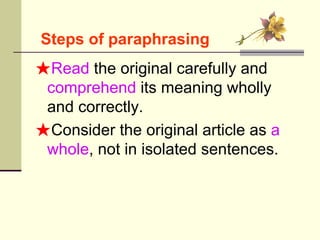
★ Read  the original carefully and  comprehend  its meaning wholly and correctly. ★ Consider the original article as  a whole , not in isolated sentences. Steps of paraphrasing
Grasping the central ideas III. Techniques in summary writing
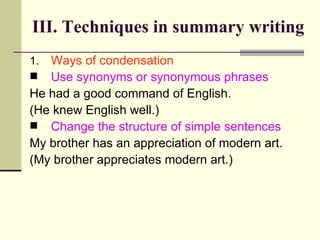
Ways of condensation Use synonyms or synonymous phrases He had a good command of English.  (He knew English well.) Change the structure of simple sentences My brother has an appreciation of modern art. (My brother appreciates modern art.) III. Techniques in summary writing
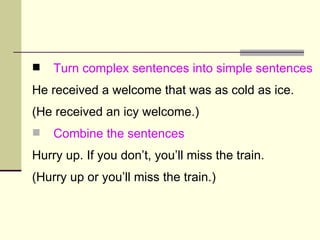
Turn complex sentences into simple sentences He received a welcome that was as cold as ice. (He received an icy welcome.) Combine the sentences Hurry up. If you don’t, you’ll miss the train. (Hurry up or you’ll miss the train.)
Finding the topic sentence and making an outline topic sentence   /   outline
IV. How to write a summary? The importance of summary writing Necessary elements for a good summary Proper citation   title, author, source;  date of publication and the text  (journal articles)
Thesis statement   the topic or general subject matter of the text;  the author’s major assertion, comment, or position on the topic
Supporting ideas   major supporting ideas;  relationships among these ideas no specifics the author’s purpose in writing no personal opinions, ideas, and inferences.
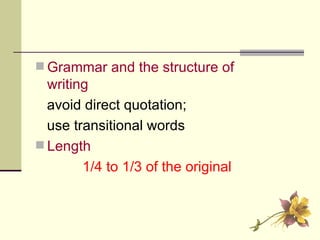
Grammar and the structure of writing avoid direct quotation;  use transitional words Length   1/4 to 1/3 of the original
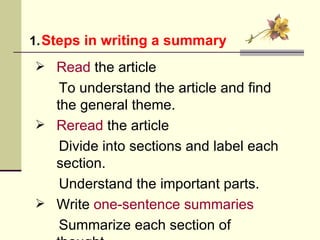
Read  the article To understand the article and find the general theme. Reread  the article Divide into sections and label each section. Understand the important parts. Write  one-sentence summaries Summarize each section of thought. Steps in writing a summary
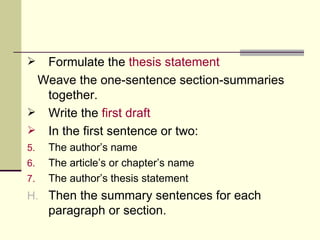
Formulate the  thesis statement Weave the one-sentence section-summaries together. Write the  first draft In   the first sentence or two: The author’s name The article’s or chapter’s name The author’s thesis statement Then the summary sentences for each paragraph or section.
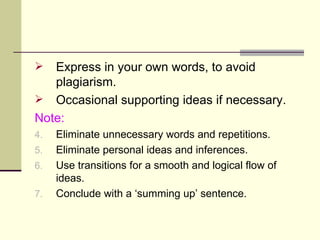
Express in your own words, to avoid plagiarism. Occasional supporting ideas if necessary. Note: Eliminate unnecessary words and repetitions. Eliminate personal ideas and inferences. Use transitions for a smooth and logical flow of ideas. Conclude with a ‘summing up’ sentence.
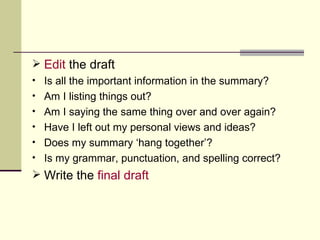
Edit  the draft Is all the important information in the summary? Am I listing things out? Am I saying the same thing over and over again? Have I left out my personal views and ideas? Does my summary ‘hang together’? Is my grammar, punctuation, and spelling correct? Write the  final draft

Summary writing

  • 1.
  • 2.
    Objectives Give an appropriate definition for a summary Know the characteristics of a good summary Learn the techniques in summary writing Learn the steps in summary writing Practice
  • 3.
    I. What isa summary? A summary is a shortened passage, which retains the essential information of the original. It is a fairly brief restatement --- in your own words ---of the contents of a passage. Note: you simply report back what the writer has said, without making value judgments.
  • 4.
    II. Characteristics ofa good summary Can be understood without reference to the original; Is a faithful reproduction of, or contains only the ideas or information of, the original; Is brief without any unnecessary detail; Is a readable unified whole
  • 5.
    III. Techniques insummary writing Paraphrasing To paraphrase means to completely and correctly express other people’s ideas in one’s own words.
  • 6.
    Examples: 1. You’ve cooked us all a hot potato . (a troublesome person or issue) 2. Prevention is better than cure. (It is better to prevent something unpleasant from happening than try to put it right afterwards.)
  • 7.
    ★ It helpsus understand the original better. ★ It helps us grasp the central idea and the main points. ★ It helps us write summaries that are brief and to the point, and in our own words. The importance of paraphrasing
  • 8.
    ★ Read the original carefully and comprehend its meaning wholly and correctly. ★ Consider the original article as a whole , not in isolated sentences. Steps of paraphrasing
  • 9.
    Grasping the centralideas III. Techniques in summary writing
  • 10.
    Ways of condensationUse synonyms or synonymous phrases He had a good command of English. (He knew English well.) Change the structure of simple sentences My brother has an appreciation of modern art. (My brother appreciates modern art.) III. Techniques in summary writing
  • 11.
    Turn complex sentencesinto simple sentences He received a welcome that was as cold as ice. (He received an icy welcome.) Combine the sentences Hurry up. If you don’t, you’ll miss the train. (Hurry up or you’ll miss the train.)
  • 12.
    Finding the topicsentence and making an outline topic sentence / outline
  • 13.
    IV. How towrite a summary? The importance of summary writing Necessary elements for a good summary Proper citation title, author, source; date of publication and the text (journal articles)
  • 14.
    Thesis statement the topic or general subject matter of the text; the author’s major assertion, comment, or position on the topic
  • 15.
    Supporting ideas major supporting ideas; relationships among these ideas no specifics the author’s purpose in writing no personal opinions, ideas, and inferences.
  • 16.
    Grammar and thestructure of writing avoid direct quotation; use transitional words Length 1/4 to 1/3 of the original
  • 17.
    Read thearticle To understand the article and find the general theme. Reread the article Divide into sections and label each section. Understand the important parts. Write one-sentence summaries Summarize each section of thought. Steps in writing a summary
  • 18.
    Formulate the thesis statement Weave the one-sentence section-summaries together. Write the first draft In the first sentence or two: The author’s name The article’s or chapter’s name The author’s thesis statement Then the summary sentences for each paragraph or section.
  • 19.
    Express in yourown words, to avoid plagiarism. Occasional supporting ideas if necessary. Note: Eliminate unnecessary words and repetitions. Eliminate personal ideas and inferences. Use transitions for a smooth and logical flow of ideas. Conclude with a ‘summing up’ sentence.
  • 20.
    Edit thedraft Is all the important information in the summary? Am I listing things out? Am I saying the same thing over and over again? Have I left out my personal views and ideas? Does my summary ‘hang together’? Is my grammar, punctuation, and spelling correct? Write the final draft