Reported by:
Crisanta B. Montejo
IV- General Science
Objectives
At the end of the lesson students are expected
to:
a) describe what is emergent literacy or early literacy
b) distinguish the theories that support early literacy
c) trace the concepts of emergent literacy before and
now
d) explain the parent involvement on early literacy
development
e) cite importance about learning emergent literacy
Definition of Emergent Literacy
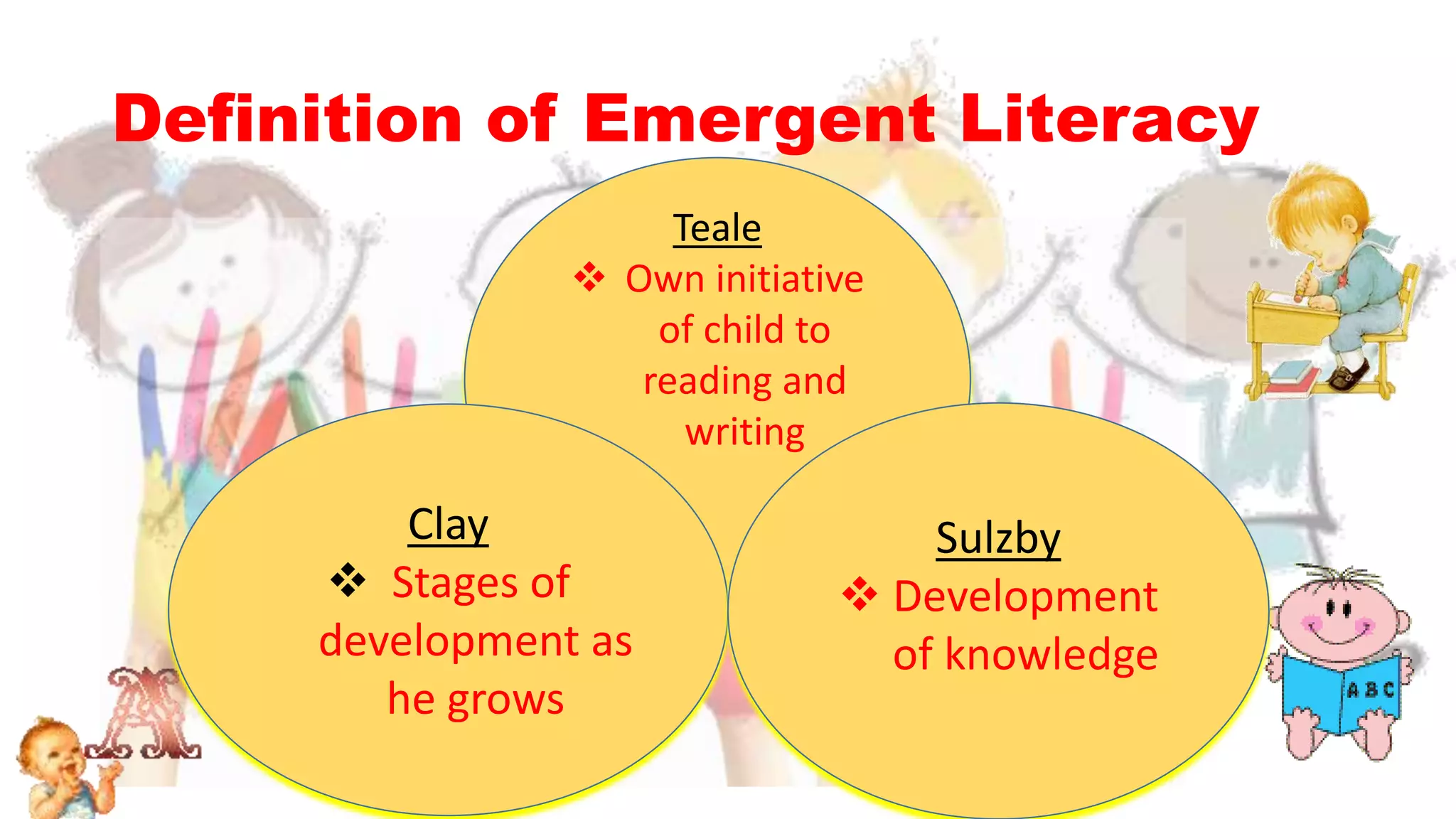
Teale
 Own initiative
of child to
reading and
writing
Clay
 Stages of
development as
he grows
Sulzby
 Development
of knowledge
Definition of Emergent Literacy
Marie Clay (1996) was the first one who
used the term emergent literacy.
Emergent Literacy is based on an
assumption that a child acquires some
knowledge about language, reading and
writing even before attending any formal
education.
She asserted that literacy development
begins early in life and is ongoing.
Definition of Emergent Literacy
Teale (1982) viewed literacy as the result
of children’s involvement in reading
activities facilitated by literate adults.
All children who come to school already
have certain experiences and interests in
learning (Teale, 1987).
Thus, refers to
competencies and literacy skills in early
childhood.
Definition of Emergent Literacy
SULZBY(1991) defines LITERACY as the
reading and writing behaviors of young
children that precede and develop into
conventional literacy.
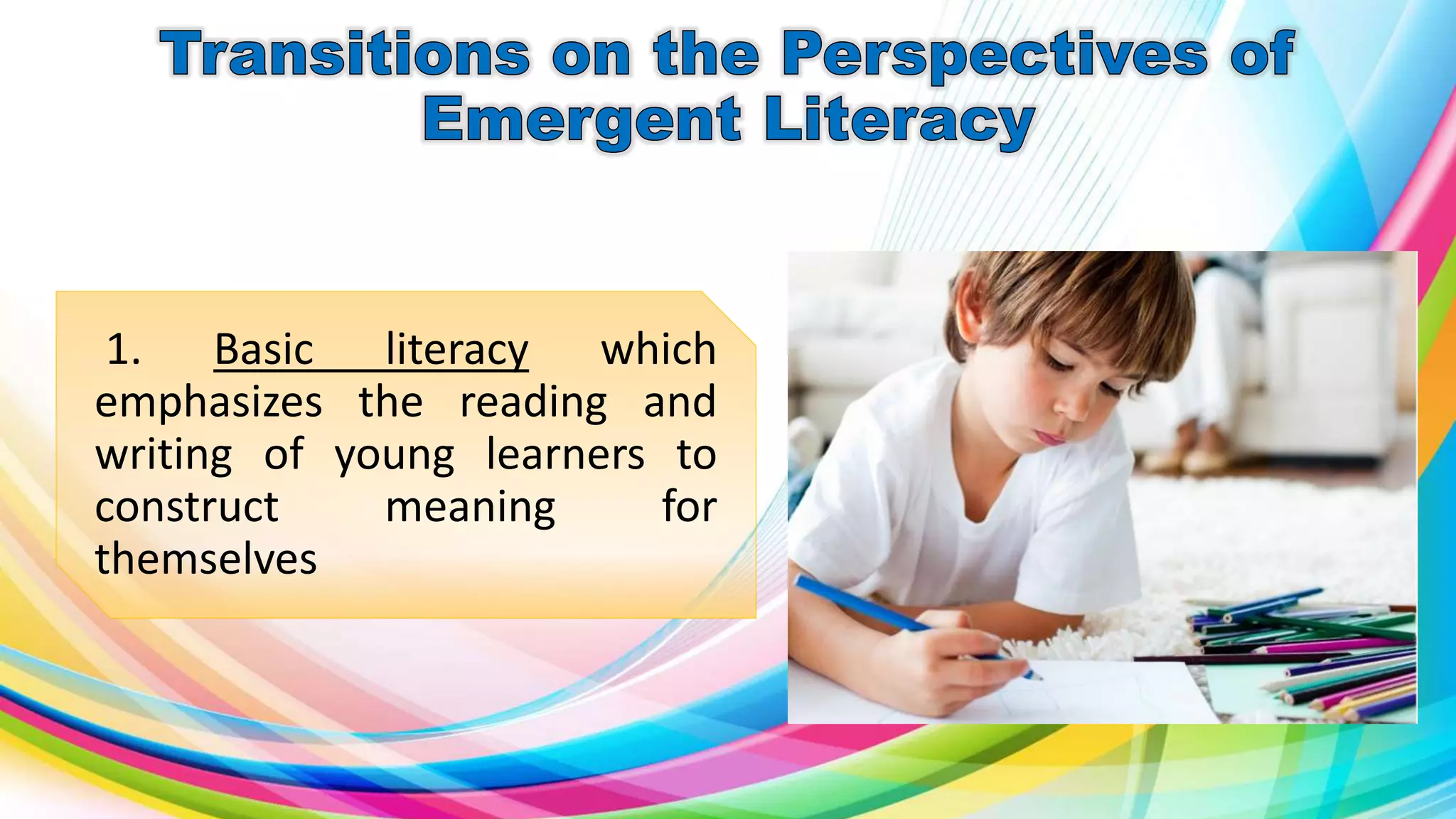
1. Basic literacy which
emphasizes the reading and
writing of young learners to
construct meaning for
themselves
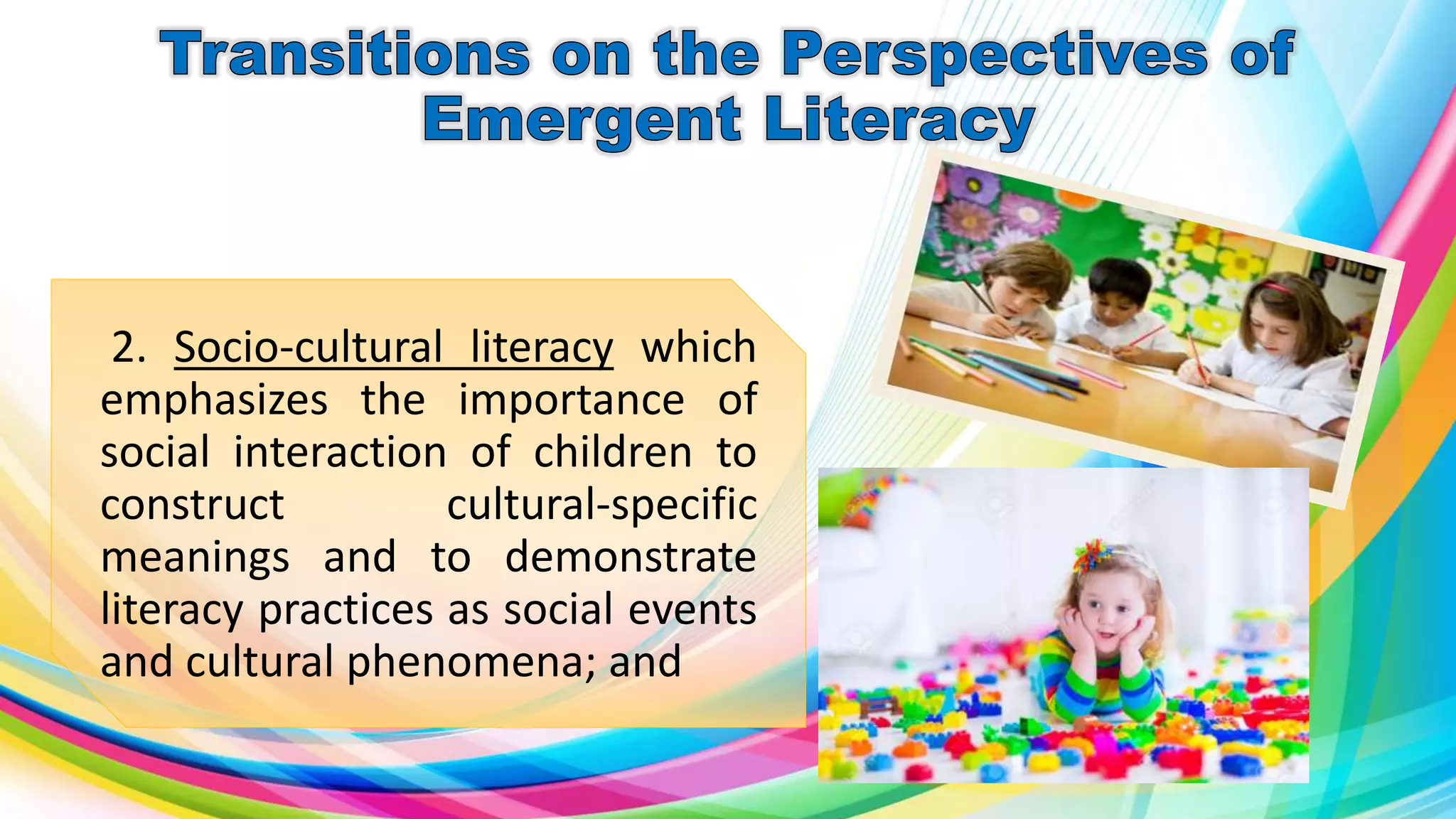
2. Socio-cultural literacy which
emphasizes the importance of
social interaction of children to
construct cultural-specific
meanings and to demonstrate
literacy practices as social events
and cultural phenomena; and
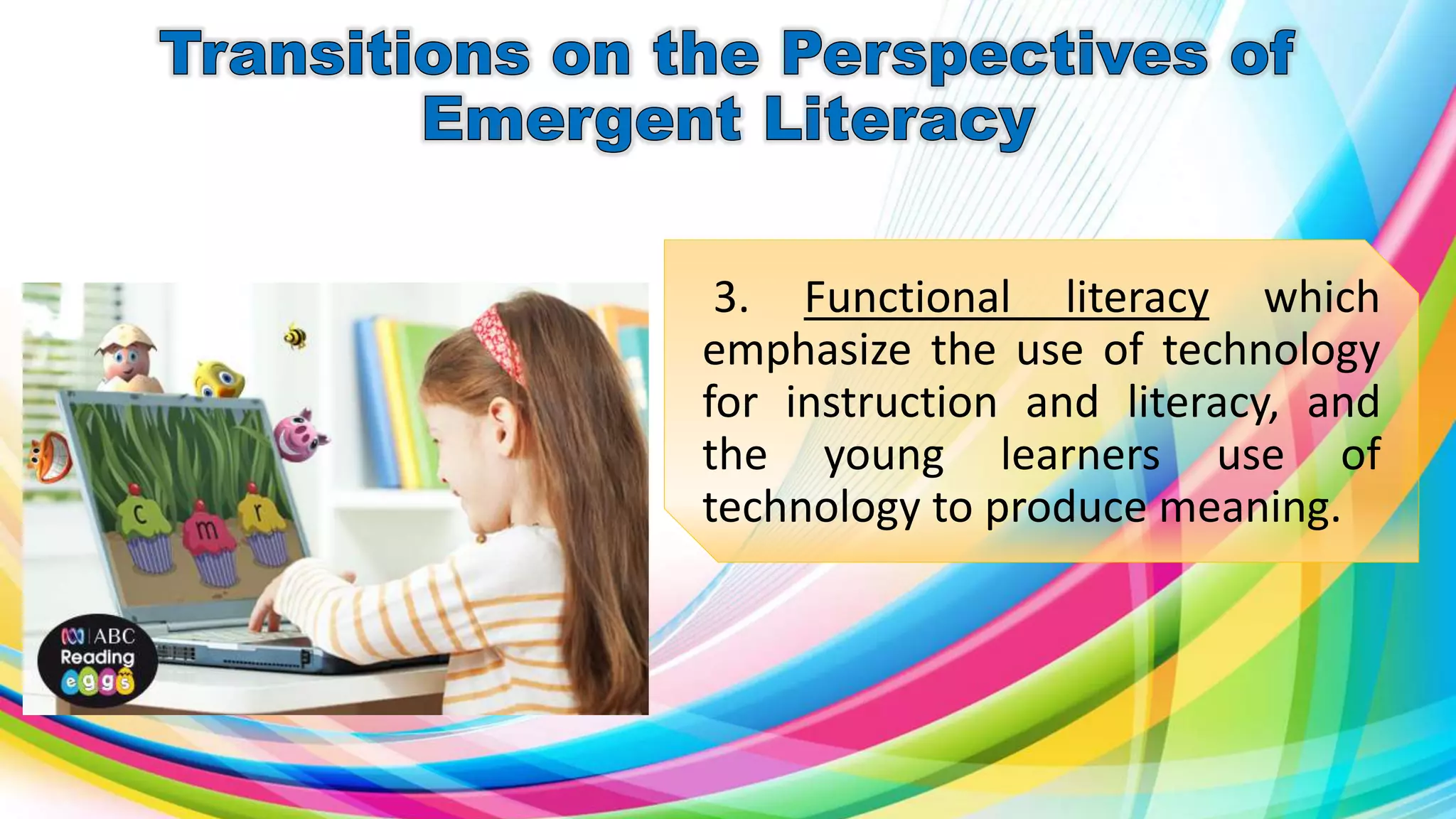
3. Functional literacy which
emphasize the use of technology
for instruction and literacy, and
the young learners use of
technology to produce meaning.
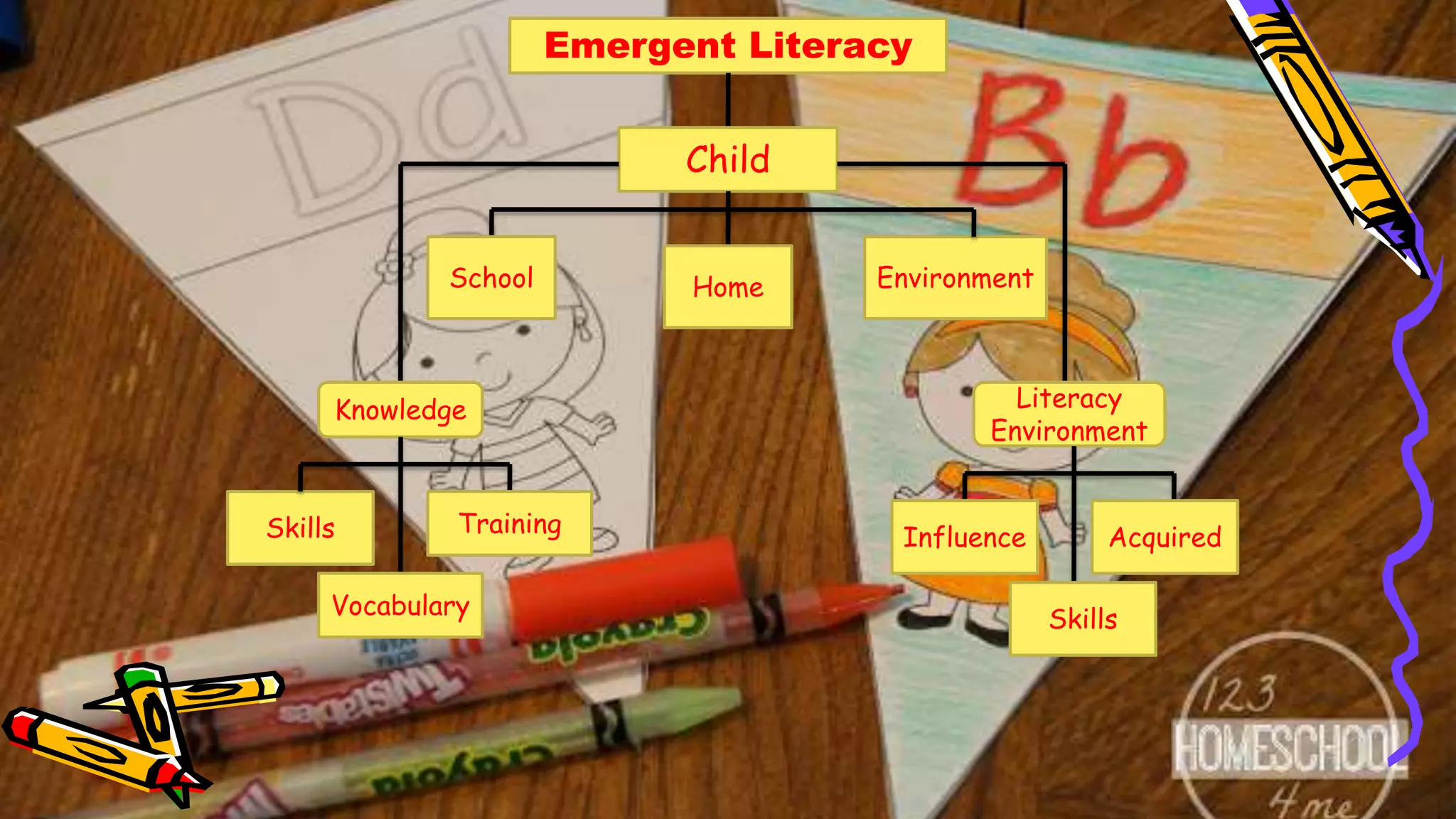
Emergent Literacy
Child
School Home Environment
Knowledge Literacy
Environment
Skills
Vocabulary
Training
Influence
Skills
Acquired
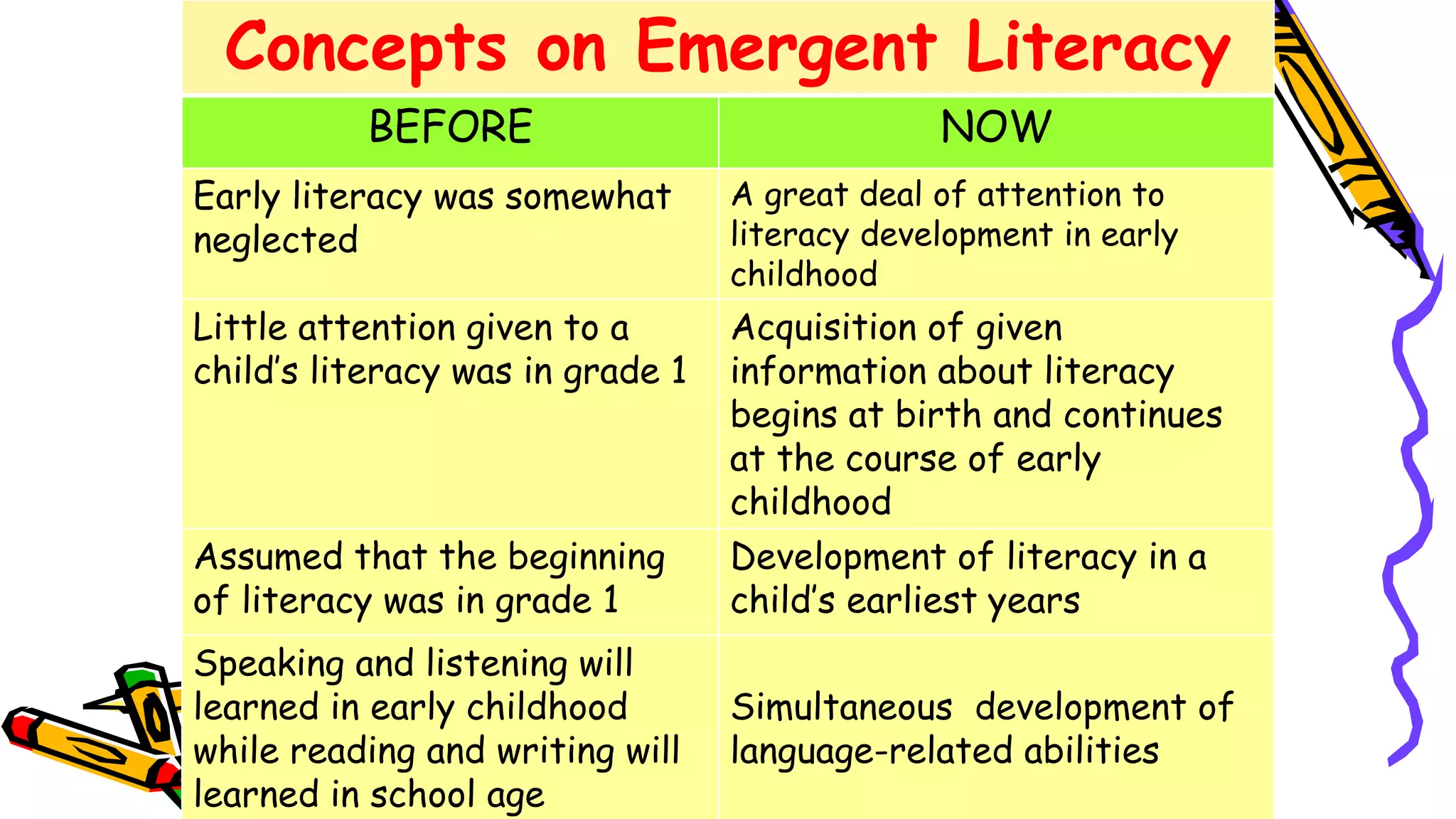
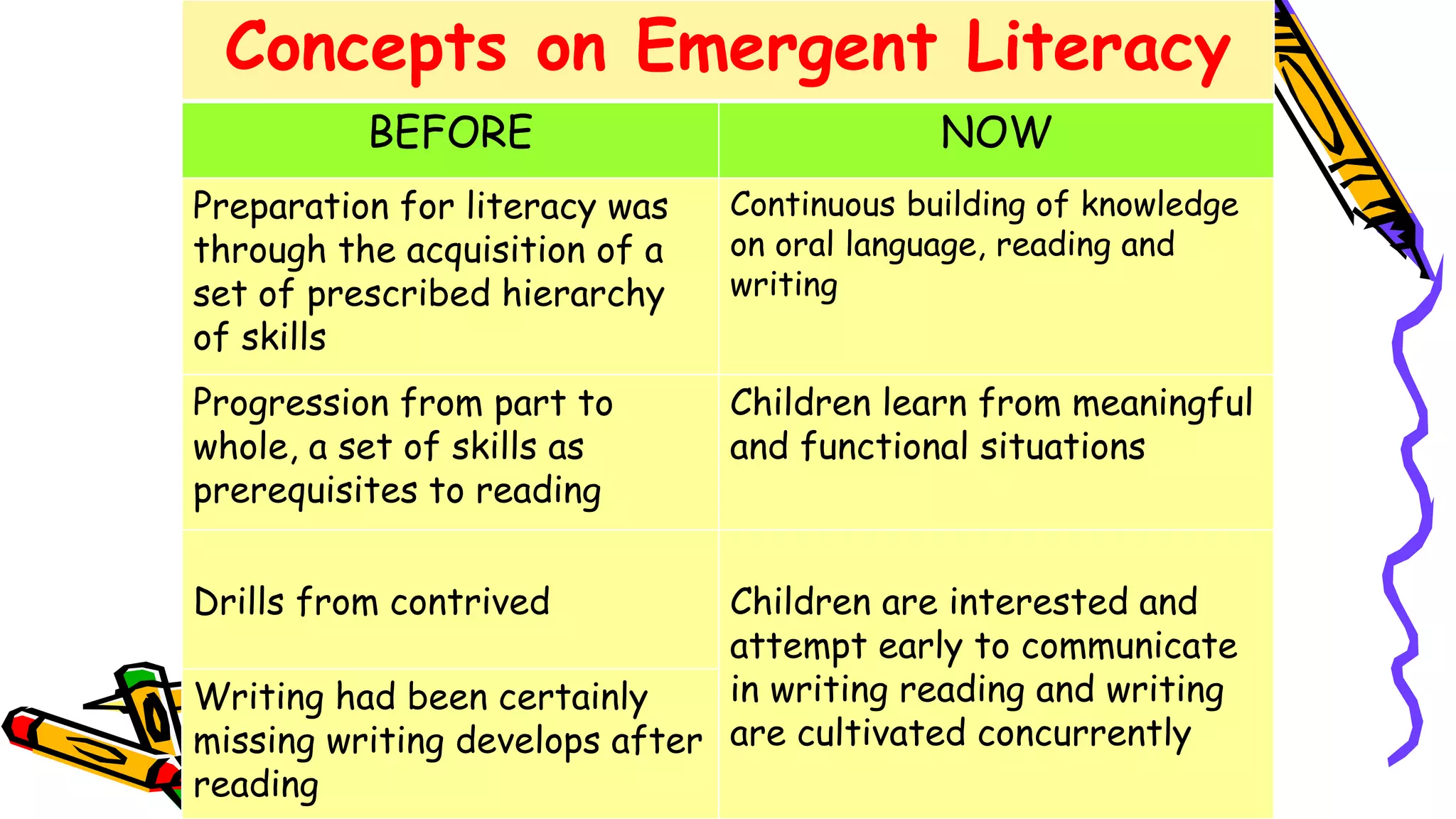
Concepts on Emergent Literacy
BEFORE NOW
Early literacy was somewhat
neglected
A great deal of attention to
literacy development in early
childhood
Little attention given to a
child’s literacy was in grade 1
Acquisition of given
information about literacy
begins at birth and continues
at the course of early
childhood
Assumed that the beginning
of literacy was in grade 1
Development of literacy in a
child’s earliest years
Speaking and listening will
learned in early childhood
while reading and writing will
learned in school age
Simultaneous development of
language-related abilities
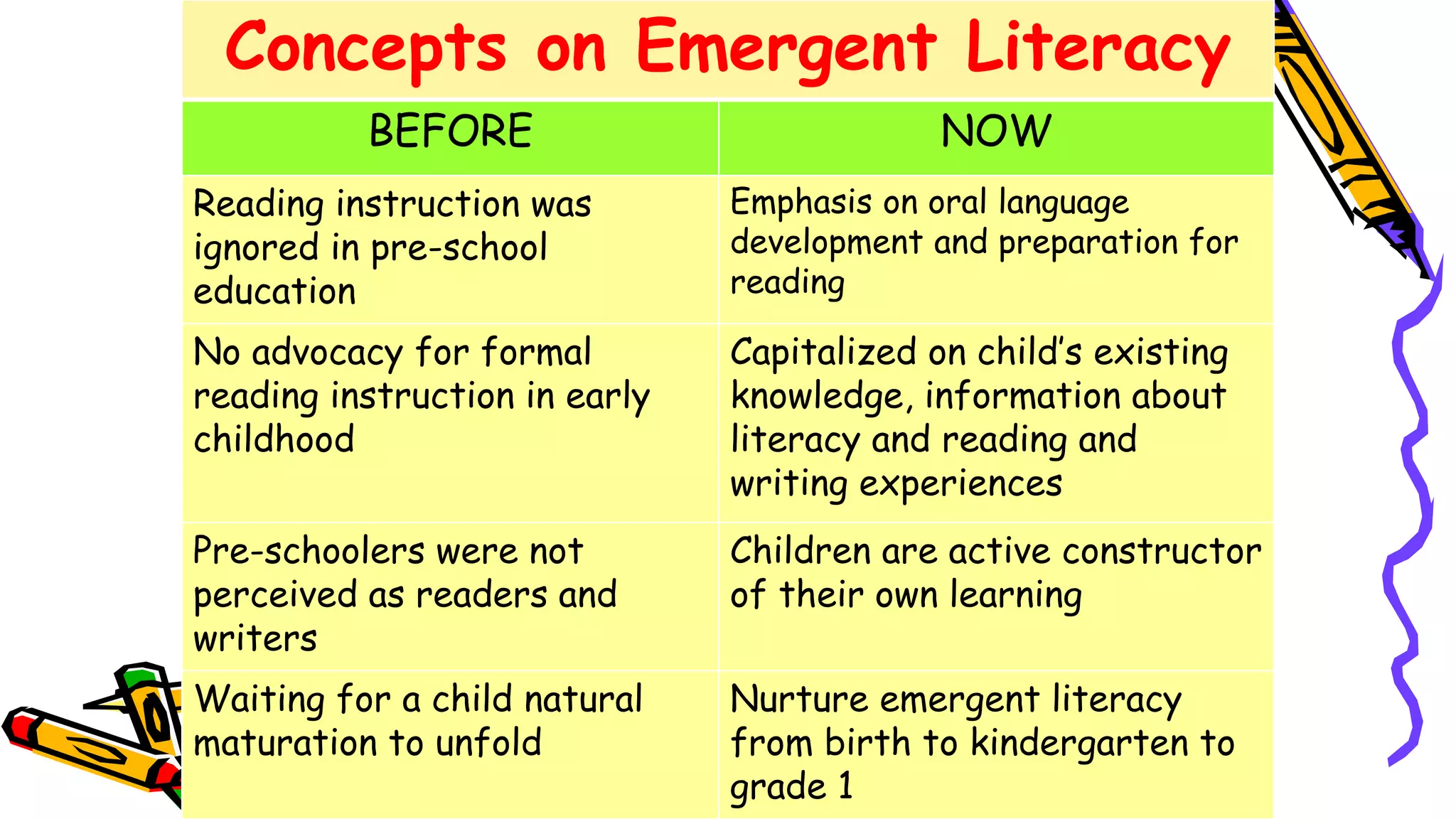
Concepts on Emergent Literacy
BEFORE NOW
Reading instruction was
ignored in pre-school
education
Emphasis on oral language
development and preparation for
reading
No advocacy for formal
reading instruction in early
childhood
Capitalized on child’s existing
knowledge, information about
literacy and reading and
writing experiences
Pre-schoolers were not
perceived as readers and
writers
Children are active constructor
of their own learning
Waiting for a child natural
maturation to unfold
Nurture emergent literacy
from birth to kindergarten to
grade 1
Concepts on Emergent Literacy
BEFORE NOW
Preparation for literacy was
through the acquisition of a
set of prescribed hierarchy
of skills
Continuous building of knowledge
on oral language, reading and
writing
Progression from part to
whole, a set of skills as
prerequisites to reading
Children learn from meaningful
and functional situations
Drills from contrived Children are interested and
attempt early to communicate
in writing reading and writing
are cultivated concurrently
Writing had been certainly
missing writing develops after
reading
Dr. Franklin
Dr. Steward
Dr. Danglars
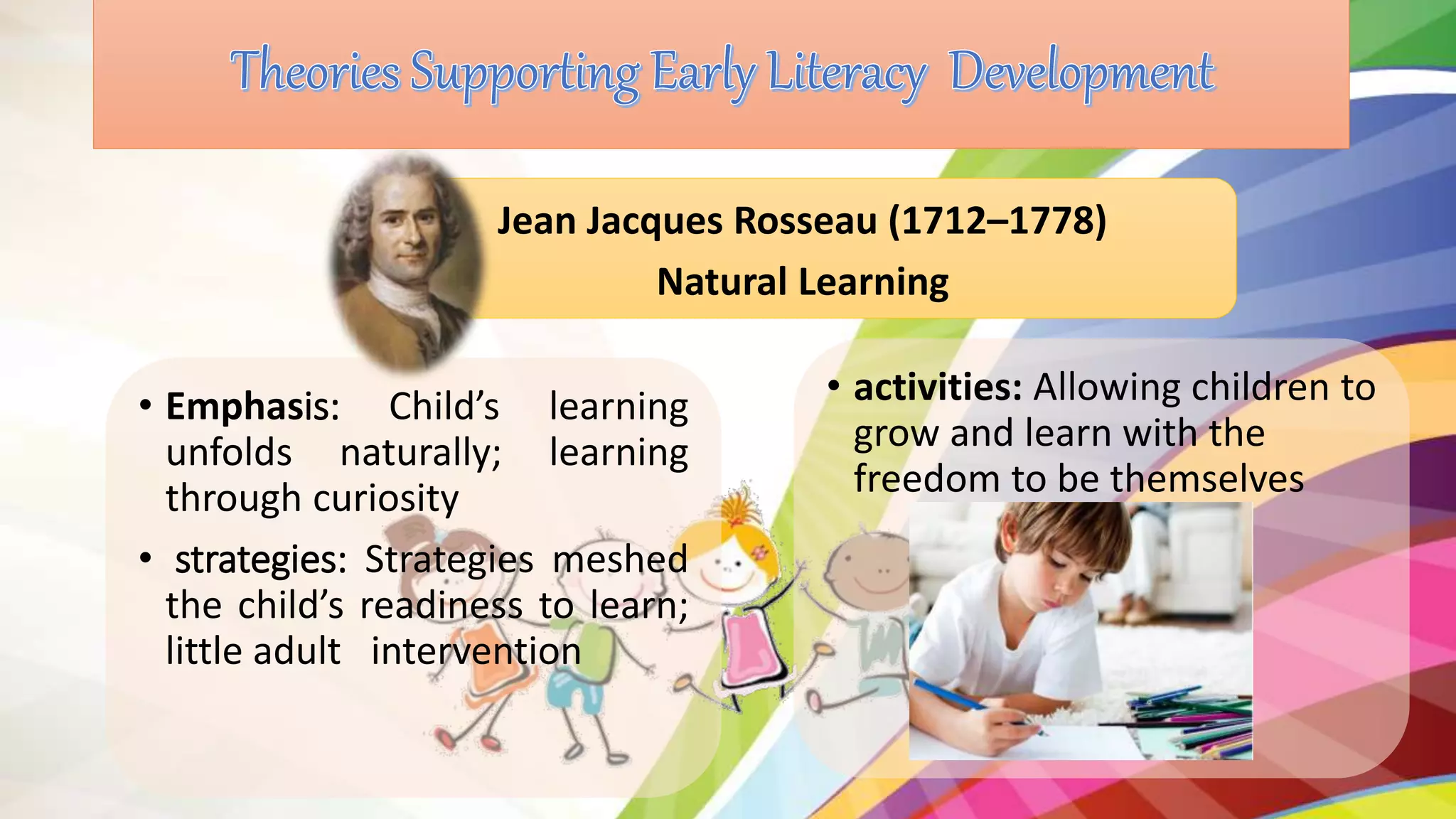
• Emphasis: Child’s learning
unfolds naturally; learning
through curiosity
• strategies: Strategies meshed
the child’s readiness to learn;
little adult intervention
Jean Jacques Rosseau (1712–1778)
Natural Learning
• activities: Allowing children to
grow and learn with the
freedom to be themselves
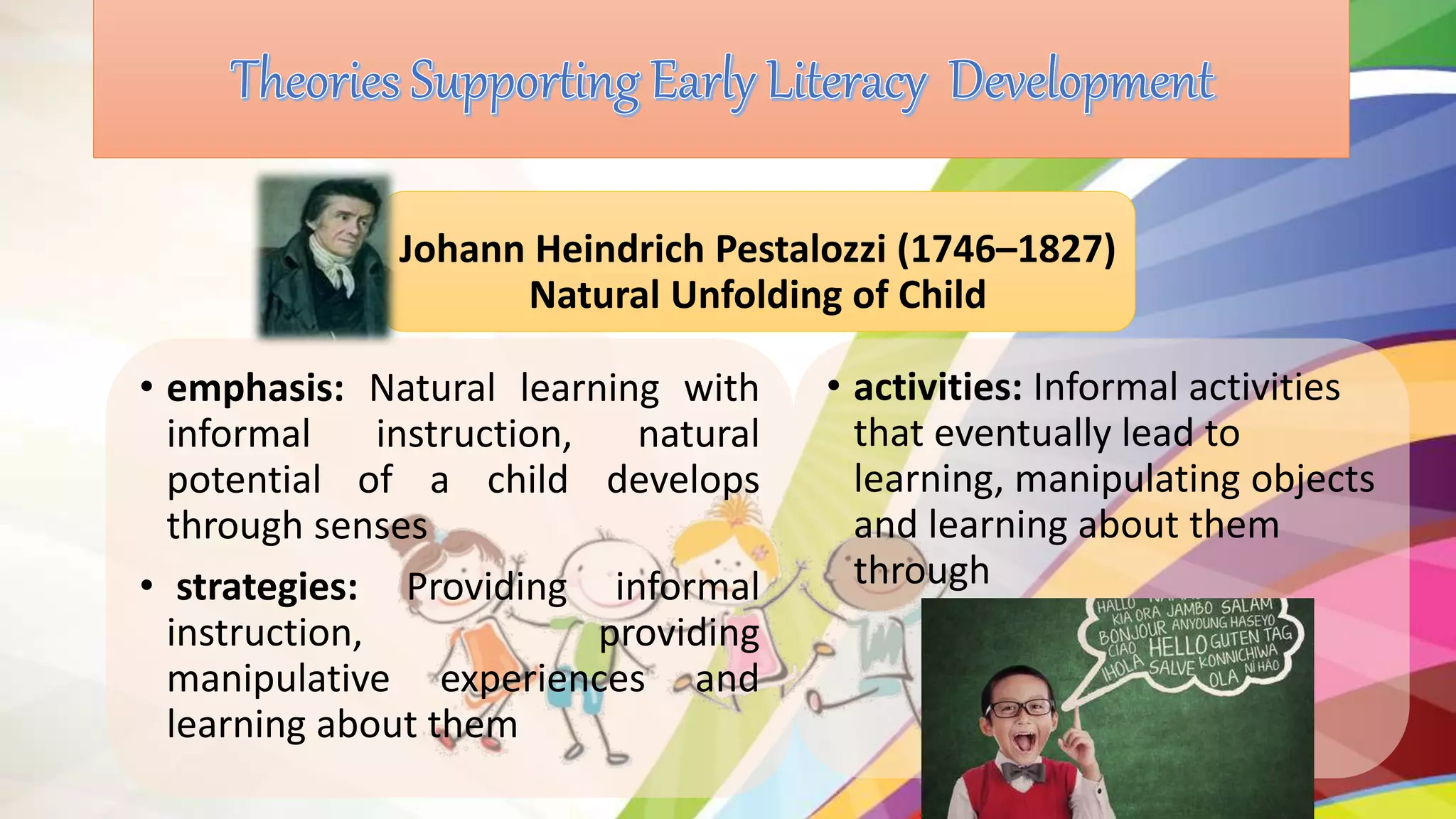
• emphasis: Natural learning with
informal instruction, natural
potential of a child develops
through senses
• strategies: Providing informal
instruction, providing
manipulative experiences and
learning about them
Johann Heindrich Pestalozzi (1746–1827)
Natural Unfolding of Child
• activities: Informal activities
that eventually lead to
learning, manipulating objects
and learning about them
through
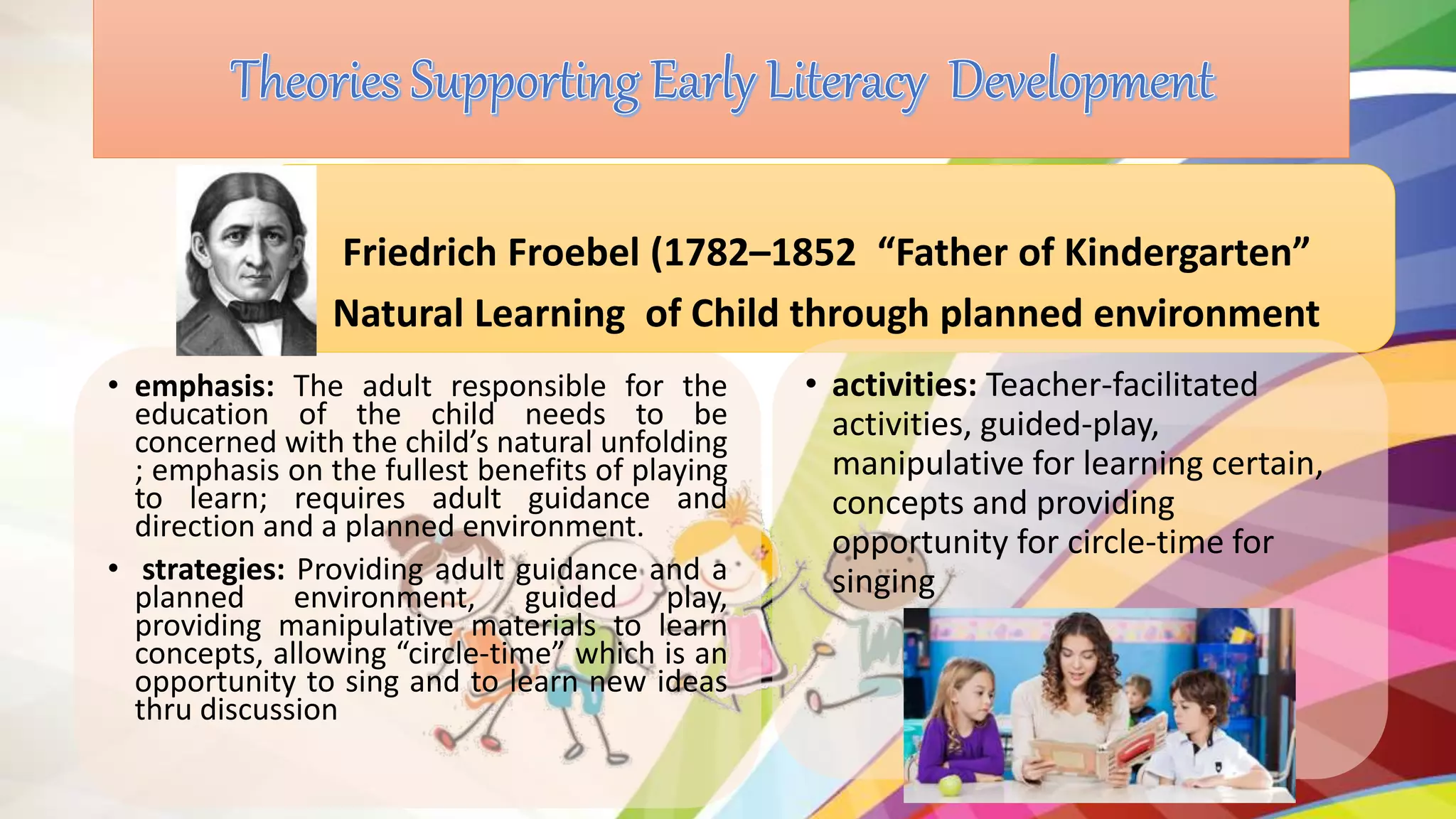
• emphasis: The adult responsible for the
education of the child needs to be
concerned with the child’s natural unfolding
; emphasis on the fullest benefits of playing
to learn; requires adult guidance and
direction and a planned environment.
• strategies: Providing adult guidance and a
planned environment, guided play,
providing manipulative materials to learn
concepts, allowing “circle-time” which is an
opportunity to sing and to learn new ideas
thru discussion
Friedrich Froebel (1782–1852 “Father of Kindergarten”
Natural Learning of Child through planned environment
• activities: Teacher-facilitated
activities, guided-play,
manipulative for learning certain,
concepts and providing
opportunity for circle-time for
singing
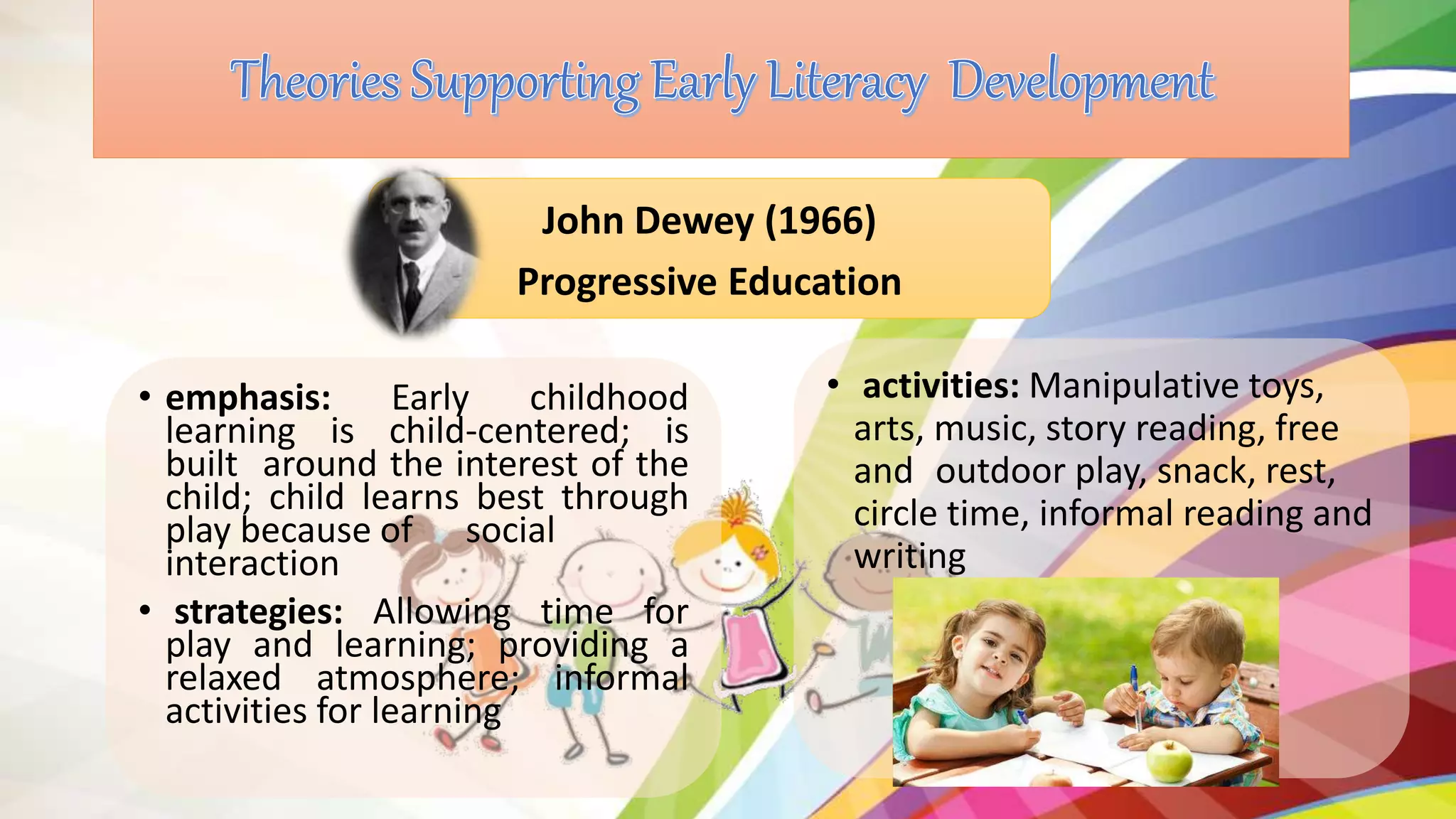
• emphasis: Early childhood
learning is child-centered; is
built around the interest of the
child; child learns best through
play because of social
interaction
• strategies: Allowing time for
play and learning; providing a
relaxed atmosphere; informal
activities for learning
John Dewey (1966)
Progressive Education
• activities: Manipulative toys,
arts, music, story reading, free
and outdoor play, snack, rest,
circle time, informal reading and
writing
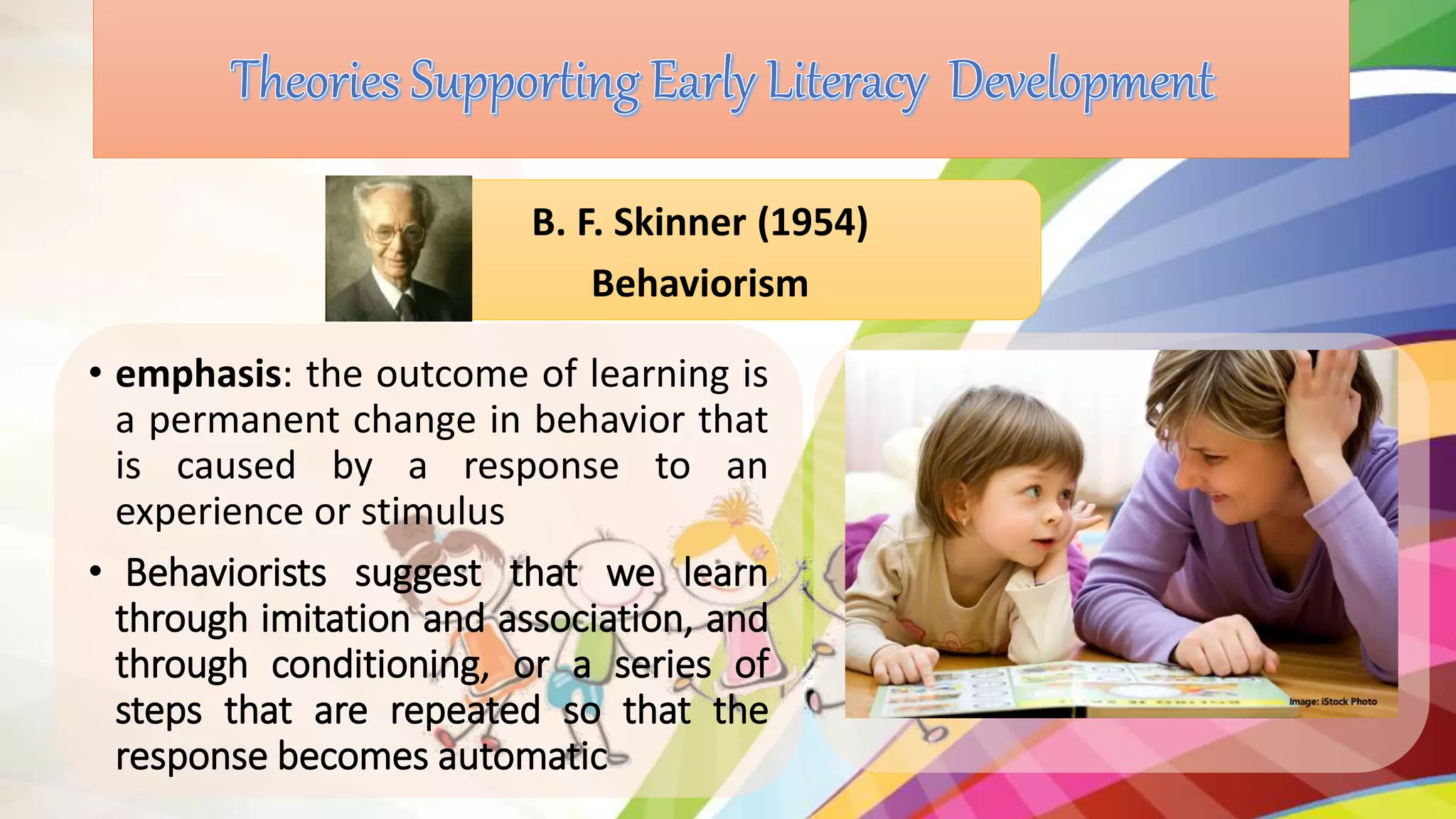
• emphasis: the outcome of learning is
a permanent change in behavior that
is caused by a response to an
experience or stimulus
• Behaviorists suggest that we learn
through imitation and association, and
through conditioning, or a series of
steps that are repeated so that the
response becomes automatic
B. F. Skinner (1954)
Behaviorism
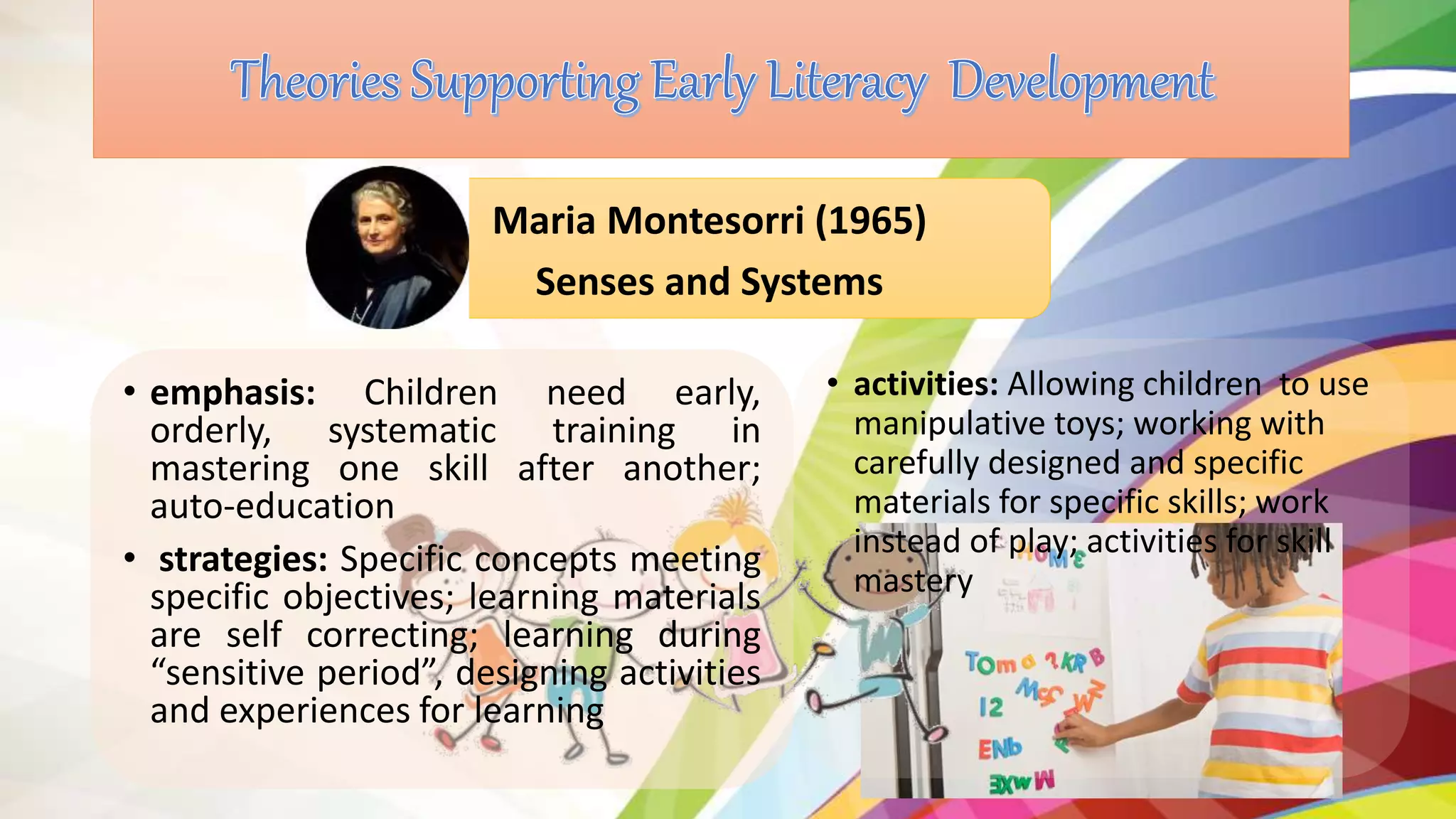
• emphasis: Children need early,
orderly, systematic training in
mastering one skill after another;
auto-education
• strategies: Specific concepts meeting
specific objectives; learning materials
are self correcting; learning during
“sensitive period”, designing activities
and experiences for learning
Maria Montesorri (1965)
Senses and Systems
• activities: Allowing children to use
manipulative toys; working with
carefully designed and specific
materials for specific skills; work
instead of play; activities for skill
mastery
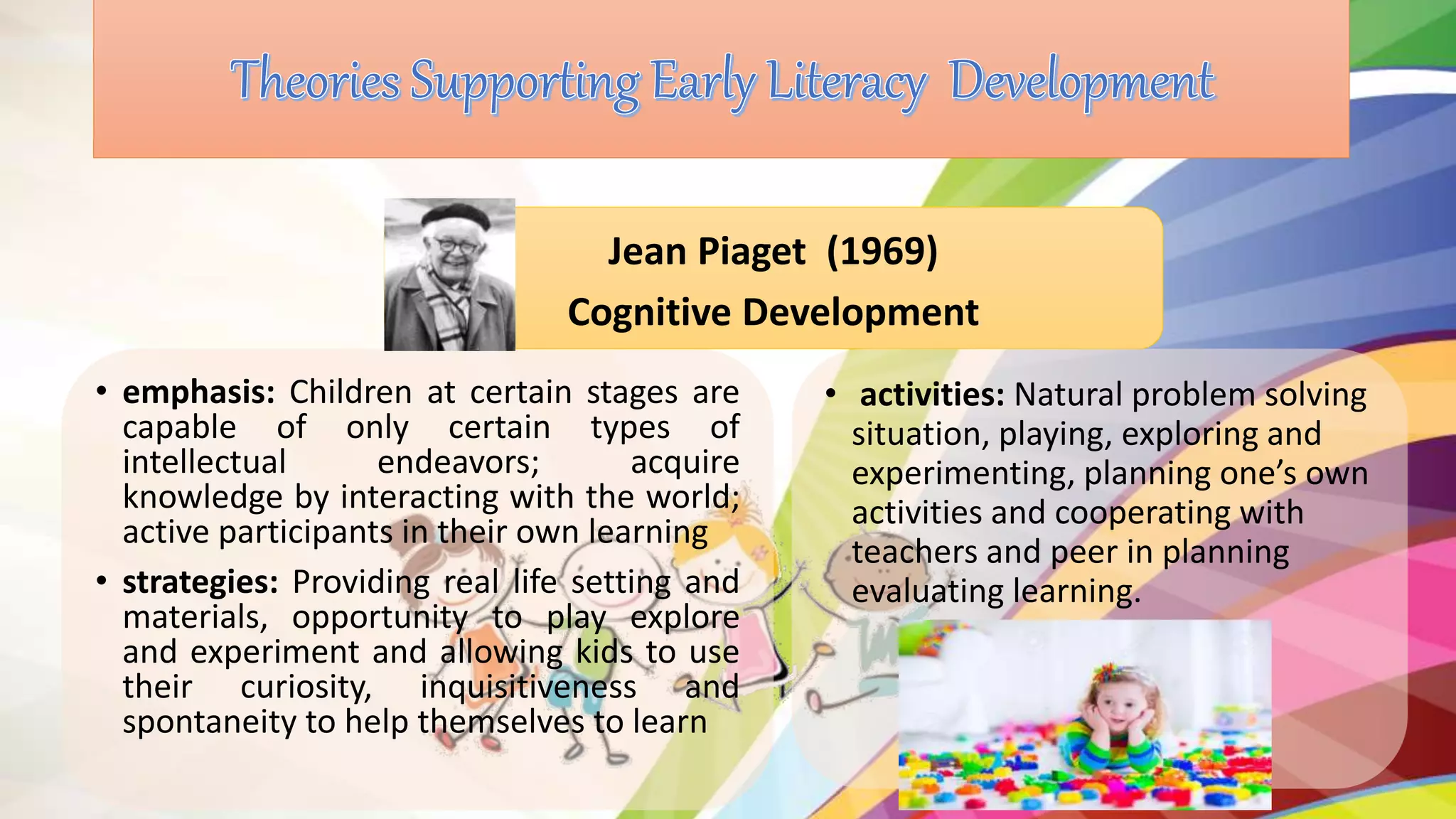
• emphasis: Children at certain stages are
capable of only certain types of
intellectual endeavors; acquire
knowledge by interacting with the world;
active participants in their own learning
• strategies: Providing real life setting and
materials, opportunity to play explore
and experiment and allowing kids to use
their curiosity, inquisitiveness and
spontaneity to help themselves to learn
Jean Piaget (1969)
Cognitive Development
• activities: Natural problem solving
situation, playing, exploring and
experimenting, planning one’s own
activities and cooperating with
teachers and peer in planning
evaluating learning.
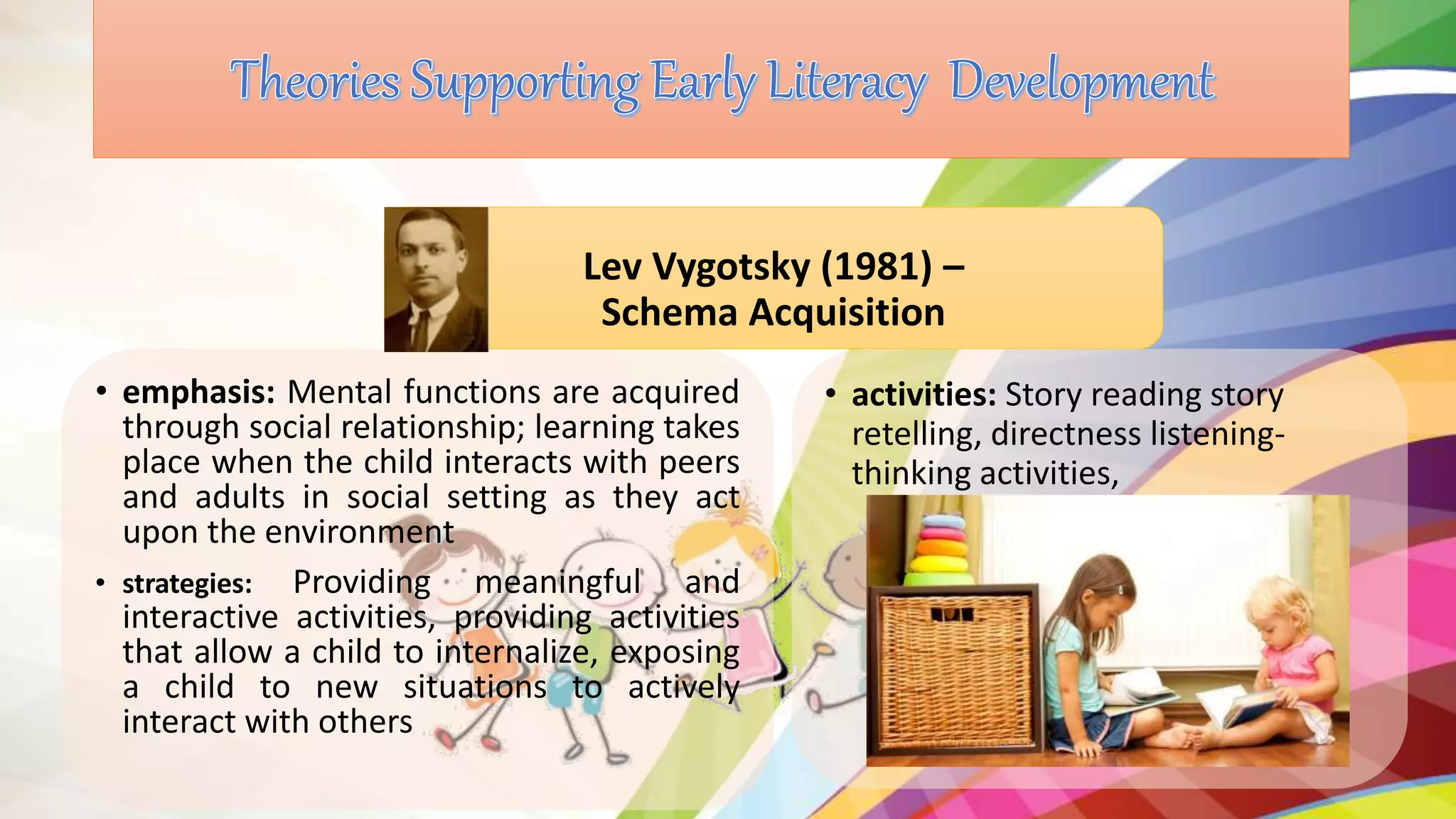
• emphasis: Mental functions are acquired
through social relationship; learning takes
place when the child interacts with peers
and adults in social setting as they act
upon the environment
• strategies: Providing meaningful and
interactive activities, providing activities
that allow a child to internalize, exposing
a child to new situations to actively
interact with others
Lev Vygotsky (1981) –
Schema Acquisition
• activities: Story reading story
retelling, directness listening-
thinking activities,
Lev Vygotsky (1981) –
Schema Acquisition
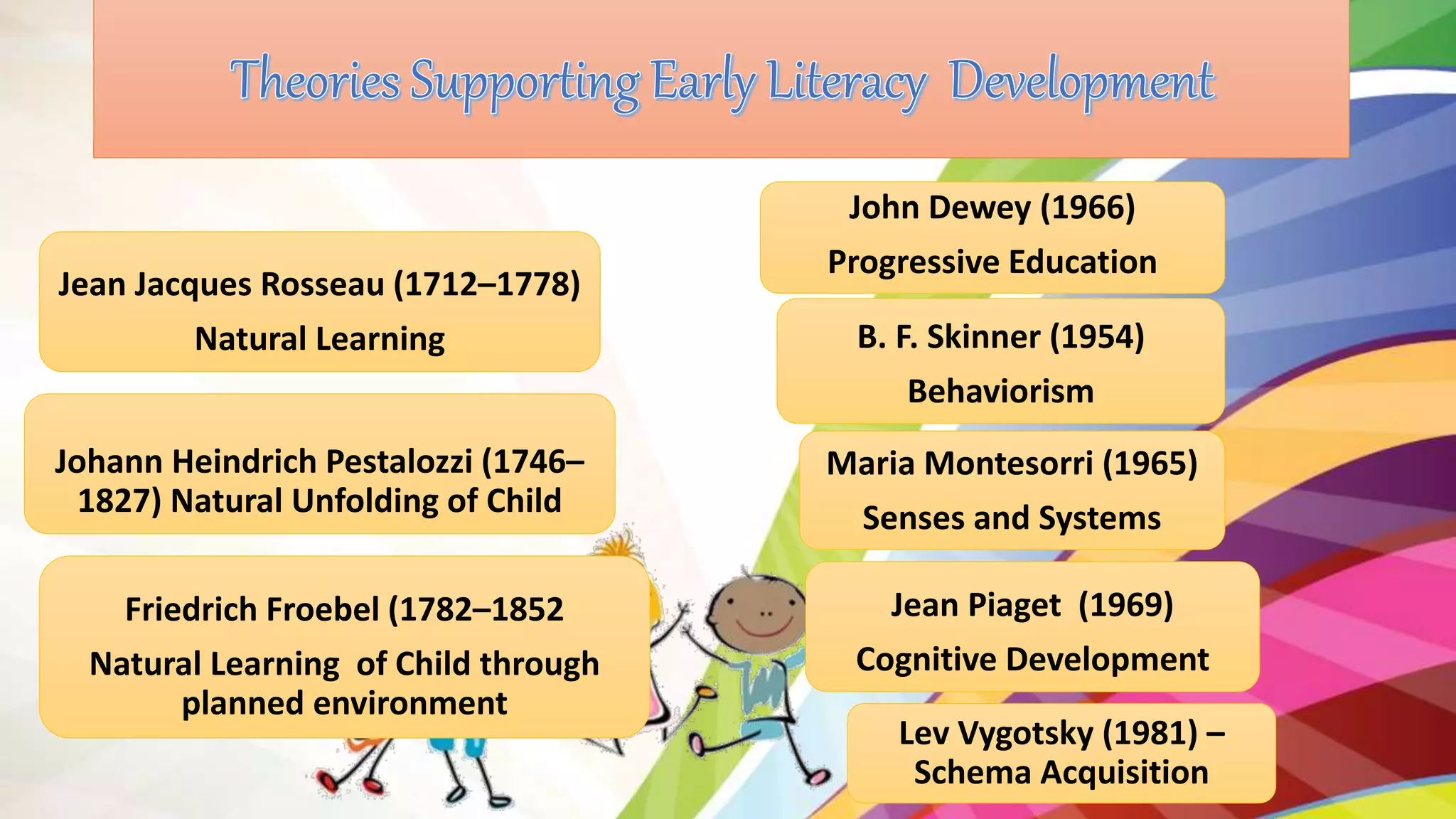
Jean Jacques Rosseau (1712–1778)
Natural Learning
Johann Heindrich Pestalozzi (1746–
1827) Natural Unfolding of Child
Friedrich Froebel (1782–1852
Natural Learning of Child through
planned environment
John Dewey (1966)
Progressive Education
B. F. Skinner (1954)
Behaviorism
Maria Montesorri (1965)
Senses and Systems
Jean Piaget (1969)
Cognitive Development
Lesson
Characteristics of an Emergent Reader
• Emergent reading pertains to the first stage in a
child’s growth toward literacy.
• This stage relates to the beginning experiences or the
child’s first experience with print in the home and
continues through early years of formal schooling.
• Reading behavior does not begin at a particular age
but emerges continually, thus the term called
emergent reading
Emergent reading pertains to the first stage in a child’s growth
toward literacy.
Particularly, this stage relates to the beginning experiences or the
child’s first experience with print in the home and continues through
early years of formal
Stage 1- Emergent Readers
• age from 2 to 7 years old. They begin to familiarize themselves
with the concepts of print related to directionality, one-to-one
correspondence between the spoken and written word, and the
value of picture clues to the meaning of story.
Stage 2-Early Readers
• Picking up from the concepts attained as an emergent reader,
early readers now begin to rely more heavily on the printed text
than on the picture in a book.
• Most often, they begin to develop word recognition strategies
such as monitoring, searching, crosschecking, and self-
correction.
Stage 3- Transitional Readers
• make the leap into fluent reading as they are generally able to
able to read in meaningful phrases with comfortable pace and
pace and appropriate voice intonation
Stage 4 – Self- Extending
• They often read a variety of textual genres and use
reading as a tool for gaining new knowledge
Stage 5- Advance Readers
• those readers who have attained a level of master with
reading. They are generally over the age of 9 and have
become proficient in reading and in comprehending
various text sources
Characteristics of an Emergent Writer
• Their emergent writing is characterized by playful
markings to communicate something, which signals
their knowledge of the uses of written language before
learning the form.
• Writing is always related to reading. Thus, reading is
always connected to writing. The child’s
experimentation with writing allows him to construct
and refine the kind of knowledge about written
language that makes reading possible.
The Role of the Home in Promoting Early Literacy
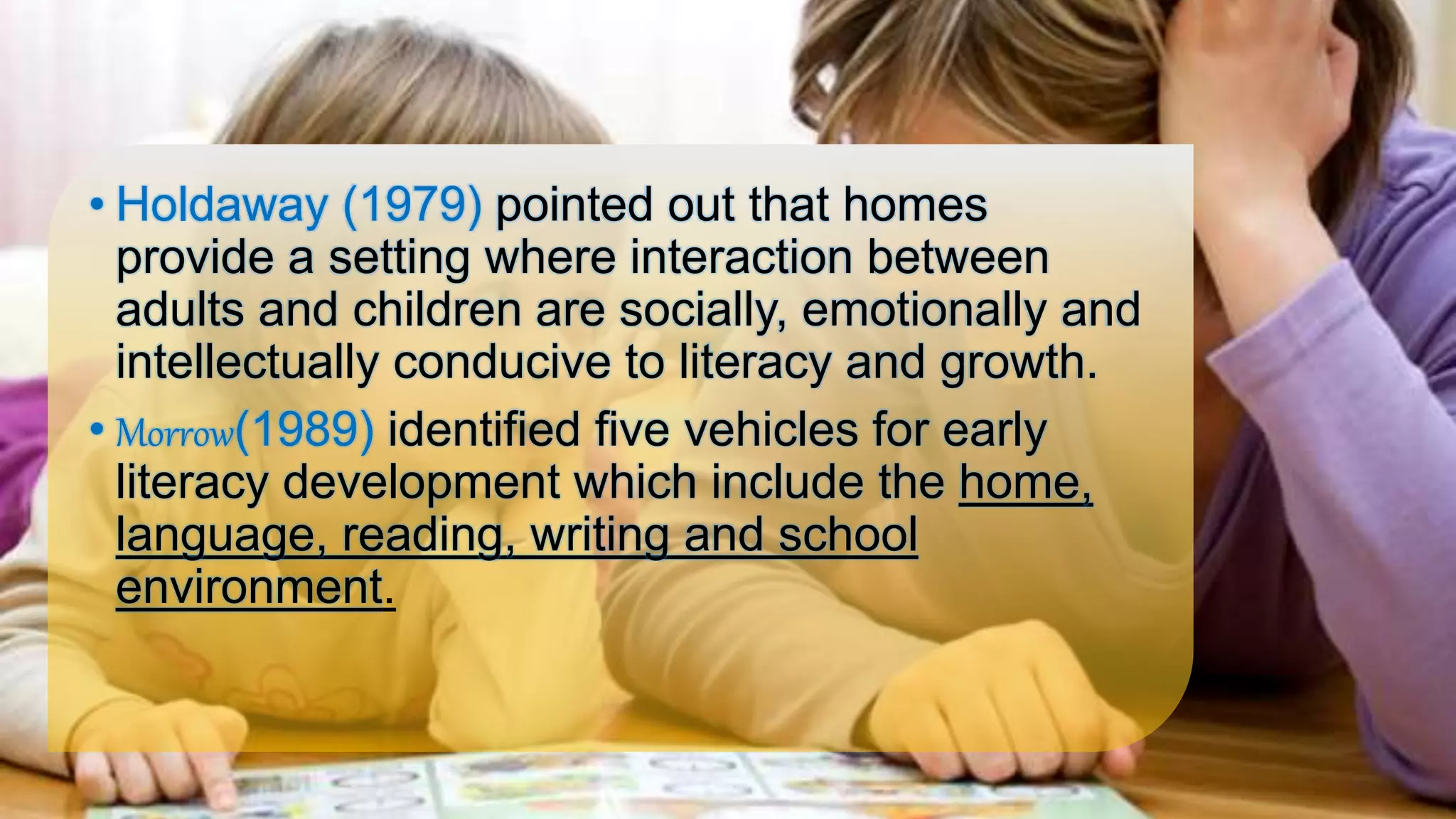
• Holdaway (1979) pointed out that homes
provide a setting where interaction between
adults and children are socially, emotionally and
intellectually conducive to literacy and growth.
• Morrow(1989) identified five vehicles for early
literacy development which include the home,
language, reading, writing and school
environment.
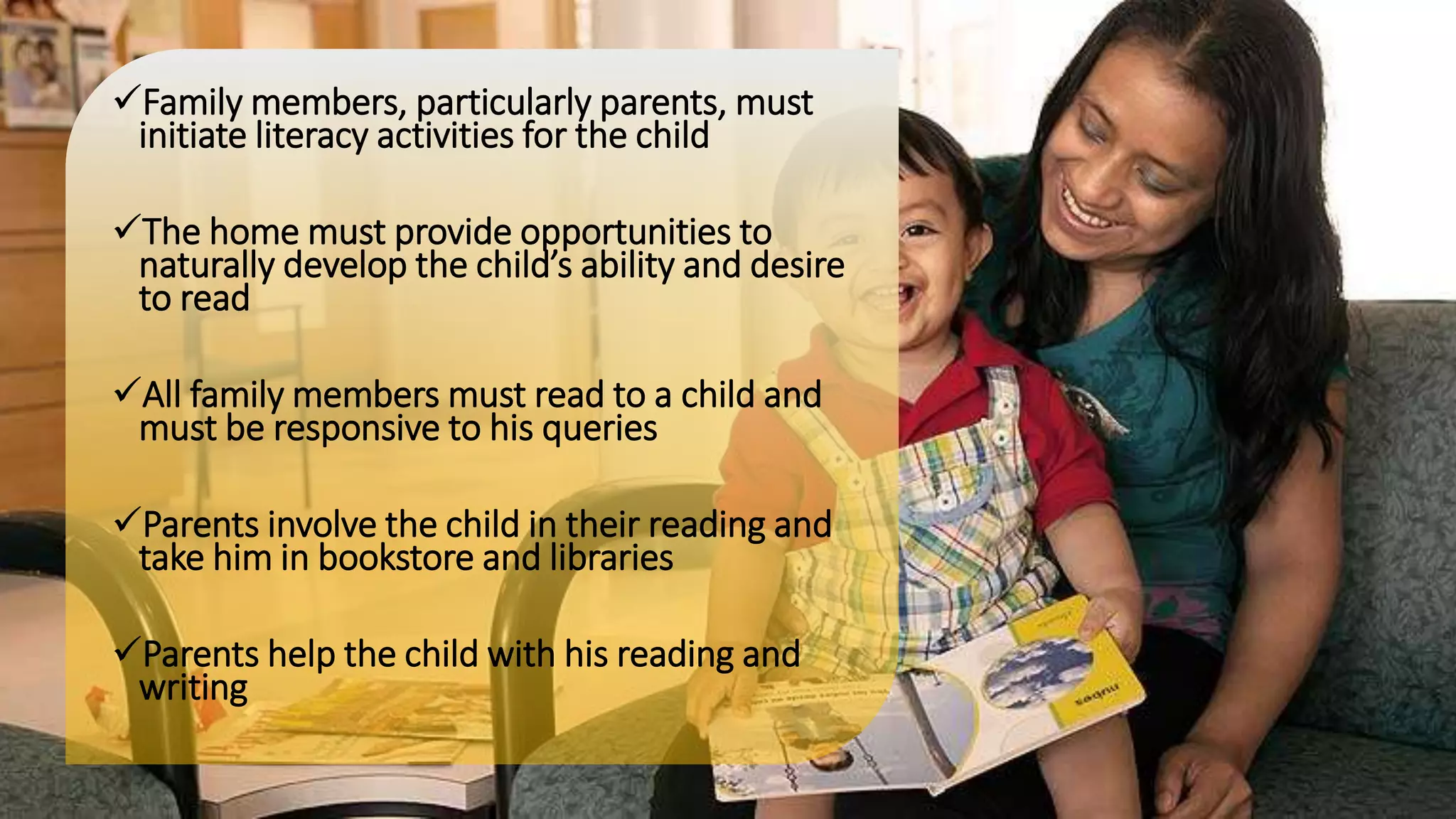
Family members, particularly parents, must
initiate literacy activities for the child
The home must provide opportunities to
naturally develop the child’s ability and desire
to read
All family members must read to a child and
must be responsive to his queries
Parents involve the child in their reading and
take him in bookstore and libraries
Parents help the child with his reading and
writing
Thank you!!!
When we no longer able to change a situation,
we are challenge to change ourselves
–Eleonor Roosevelt

Emergent Literacy and Theories of Learning

  • 1.
    Reported by: Crisanta B.Montejo IV- General Science
  • 2.
    Objectives At the endof the lesson students are expected to: a) describe what is emergent literacy or early literacy b) distinguish the theories that support early literacy c) trace the concepts of emergent literacy before and now d) explain the parent involvement on early literacy development e) cite importance about learning emergent literacy
  • 3.
    Definition of EmergentLiteracy Teale  Own initiative of child to reading and writing Clay  Stages of development as he grows Sulzby  Development of knowledge
  • 4.
    Definition of EmergentLiteracy Marie Clay (1996) was the first one who used the term emergent literacy. Emergent Literacy is based on an assumption that a child acquires some knowledge about language, reading and writing even before attending any formal education. She asserted that literacy development begins early in life and is ongoing.
  • 5.
    Definition of EmergentLiteracy Teale (1982) viewed literacy as the result of children’s involvement in reading activities facilitated by literate adults. All children who come to school already have certain experiences and interests in learning (Teale, 1987). Thus, refers to competencies and literacy skills in early childhood.
  • 6.
    Definition of EmergentLiteracy SULZBY(1991) defines LITERACY as the reading and writing behaviors of young children that precede and develop into conventional literacy.
  • 7.
    1. Basic literacywhich emphasizes the reading and writing of young learners to construct meaning for themselves
  • 8.
    2. Socio-cultural literacywhich emphasizes the importance of social interaction of children to construct cultural-specific meanings and to demonstrate literacy practices as social events and cultural phenomena; and
  • 9.
    3. Functional literacywhich emphasize the use of technology for instruction and literacy, and the young learners use of technology to produce meaning.
  • 10.
    Emergent Literacy Child School HomeEnvironment Knowledge Literacy Environment Skills Vocabulary Training Influence Skills Acquired
  • 11.
    Concepts on EmergentLiteracy BEFORE NOW Early literacy was somewhat neglected A great deal of attention to literacy development in early childhood Little attention given to a child’s literacy was in grade 1 Acquisition of given information about literacy begins at birth and continues at the course of early childhood Assumed that the beginning of literacy was in grade 1 Development of literacy in a child’s earliest years Speaking and listening will learned in early childhood while reading and writing will learned in school age Simultaneous development of language-related abilities
  • 12.
    Concepts on EmergentLiteracy BEFORE NOW Reading instruction was ignored in pre-school education Emphasis on oral language development and preparation for reading No advocacy for formal reading instruction in early childhood Capitalized on child’s existing knowledge, information about literacy and reading and writing experiences Pre-schoolers were not perceived as readers and writers Children are active constructor of their own learning Waiting for a child natural maturation to unfold Nurture emergent literacy from birth to kindergarten to grade 1
  • 13.
    Concepts on EmergentLiteracy BEFORE NOW Preparation for literacy was through the acquisition of a set of prescribed hierarchy of skills Continuous building of knowledge on oral language, reading and writing Progression from part to whole, a set of skills as prerequisites to reading Children learn from meaningful and functional situations Drills from contrived Children are interested and attempt early to communicate in writing reading and writing are cultivated concurrently Writing had been certainly missing writing develops after reading
  • 15.
  • 17.
    • Emphasis: Child’slearning unfolds naturally; learning through curiosity • strategies: Strategies meshed the child’s readiness to learn; little adult intervention Jean Jacques Rosseau (1712–1778) Natural Learning • activities: Allowing children to grow and learn with the freedom to be themselves
  • 18.
    • emphasis: Naturallearning with informal instruction, natural potential of a child develops through senses • strategies: Providing informal instruction, providing manipulative experiences and learning about them Johann Heindrich Pestalozzi (1746–1827) Natural Unfolding of Child • activities: Informal activities that eventually lead to learning, manipulating objects and learning about them through
  • 19.
    • emphasis: Theadult responsible for the education of the child needs to be concerned with the child’s natural unfolding ; emphasis on the fullest benefits of playing to learn; requires adult guidance and direction and a planned environment. • strategies: Providing adult guidance and a planned environment, guided play, providing manipulative materials to learn concepts, allowing “circle-time” which is an opportunity to sing and to learn new ideas thru discussion Friedrich Froebel (1782–1852 “Father of Kindergarten” Natural Learning of Child through planned environment • activities: Teacher-facilitated activities, guided-play, manipulative for learning certain, concepts and providing opportunity for circle-time for singing
  • 20.
    • emphasis: Earlychildhood learning is child-centered; is built around the interest of the child; child learns best through play because of social interaction • strategies: Allowing time for play and learning; providing a relaxed atmosphere; informal activities for learning John Dewey (1966) Progressive Education • activities: Manipulative toys, arts, music, story reading, free and outdoor play, snack, rest, circle time, informal reading and writing
  • 21.
    • emphasis: theoutcome of learning is a permanent change in behavior that is caused by a response to an experience or stimulus • Behaviorists suggest that we learn through imitation and association, and through conditioning, or a series of steps that are repeated so that the response becomes automatic B. F. Skinner (1954) Behaviorism
  • 22.
    • emphasis: Childrenneed early, orderly, systematic training in mastering one skill after another; auto-education • strategies: Specific concepts meeting specific objectives; learning materials are self correcting; learning during “sensitive period”, designing activities and experiences for learning Maria Montesorri (1965) Senses and Systems • activities: Allowing children to use manipulative toys; working with carefully designed and specific materials for specific skills; work instead of play; activities for skill mastery
  • 23.
    • emphasis: Childrenat certain stages are capable of only certain types of intellectual endeavors; acquire knowledge by interacting with the world; active participants in their own learning • strategies: Providing real life setting and materials, opportunity to play explore and experiment and allowing kids to use their curiosity, inquisitiveness and spontaneity to help themselves to learn Jean Piaget (1969) Cognitive Development • activities: Natural problem solving situation, playing, exploring and experimenting, planning one’s own activities and cooperating with teachers and peer in planning evaluating learning.
  • 24.
    • emphasis: Mentalfunctions are acquired through social relationship; learning takes place when the child interacts with peers and adults in social setting as they act upon the environment • strategies: Providing meaningful and interactive activities, providing activities that allow a child to internalize, exposing a child to new situations to actively interact with others Lev Vygotsky (1981) – Schema Acquisition • activities: Story reading story retelling, directness listening- thinking activities,
  • 25.
    Lev Vygotsky (1981)– Schema Acquisition Jean Jacques Rosseau (1712–1778) Natural Learning Johann Heindrich Pestalozzi (1746– 1827) Natural Unfolding of Child Friedrich Froebel (1782–1852 Natural Learning of Child through planned environment John Dewey (1966) Progressive Education B. F. Skinner (1954) Behaviorism Maria Montesorri (1965) Senses and Systems Jean Piaget (1969) Cognitive Development
  • 26.
  • 27.
    Characteristics of anEmergent Reader • Emergent reading pertains to the first stage in a child’s growth toward literacy. • This stage relates to the beginning experiences or the child’s first experience with print in the home and continues through early years of formal schooling. • Reading behavior does not begin at a particular age but emerges continually, thus the term called emergent reading
  • 28.
    Emergent reading pertainsto the first stage in a child’s growth toward literacy. Particularly, this stage relates to the beginning experiences or the child’s first experience with print in the home and continues through early years of formal Stage 1- Emergent Readers • age from 2 to 7 years old. They begin to familiarize themselves with the concepts of print related to directionality, one-to-one correspondence between the spoken and written word, and the value of picture clues to the meaning of story.
  • 29.
    Stage 2-Early Readers •Picking up from the concepts attained as an emergent reader, early readers now begin to rely more heavily on the printed text than on the picture in a book. • Most often, they begin to develop word recognition strategies such as monitoring, searching, crosschecking, and self- correction. Stage 3- Transitional Readers • make the leap into fluent reading as they are generally able to able to read in meaningful phrases with comfortable pace and pace and appropriate voice intonation
  • 30.
    Stage 4 –Self- Extending • They often read a variety of textual genres and use reading as a tool for gaining new knowledge Stage 5- Advance Readers • those readers who have attained a level of master with reading. They are generally over the age of 9 and have become proficient in reading and in comprehending various text sources
  • 31.
    Characteristics of anEmergent Writer • Their emergent writing is characterized by playful markings to communicate something, which signals their knowledge of the uses of written language before learning the form. • Writing is always related to reading. Thus, reading is always connected to writing. The child’s experimentation with writing allows him to construct and refine the kind of knowledge about written language that makes reading possible.
  • 32.
    The Role ofthe Home in Promoting Early Literacy
  • 33.
    • Holdaway (1979)pointed out that homes provide a setting where interaction between adults and children are socially, emotionally and intellectually conducive to literacy and growth. • Morrow(1989) identified five vehicles for early literacy development which include the home, language, reading, writing and school environment.
  • 34.
    Family members, particularlyparents, must initiate literacy activities for the child The home must provide opportunities to naturally develop the child’s ability and desire to read All family members must read to a child and must be responsive to his queries Parents involve the child in their reading and take him in bookstore and libraries Parents help the child with his reading and writing
  • 35.
    Thank you!!! When weno longer able to change a situation, we are challenge to change ourselves –Eleonor Roosevelt