ITIL
What? Why? How?
08-Jan-15 1
ITIL
What? Why? How?
08-Jan-15 2
Definition of ITIL
ITIL stands for Information Technology Infrastructure Library.
ITIL is a framework for IT Service Management and provides a set of
specialized organizational capabilities for providing value to customers
in the form of IT services.
08-Jan-15 3
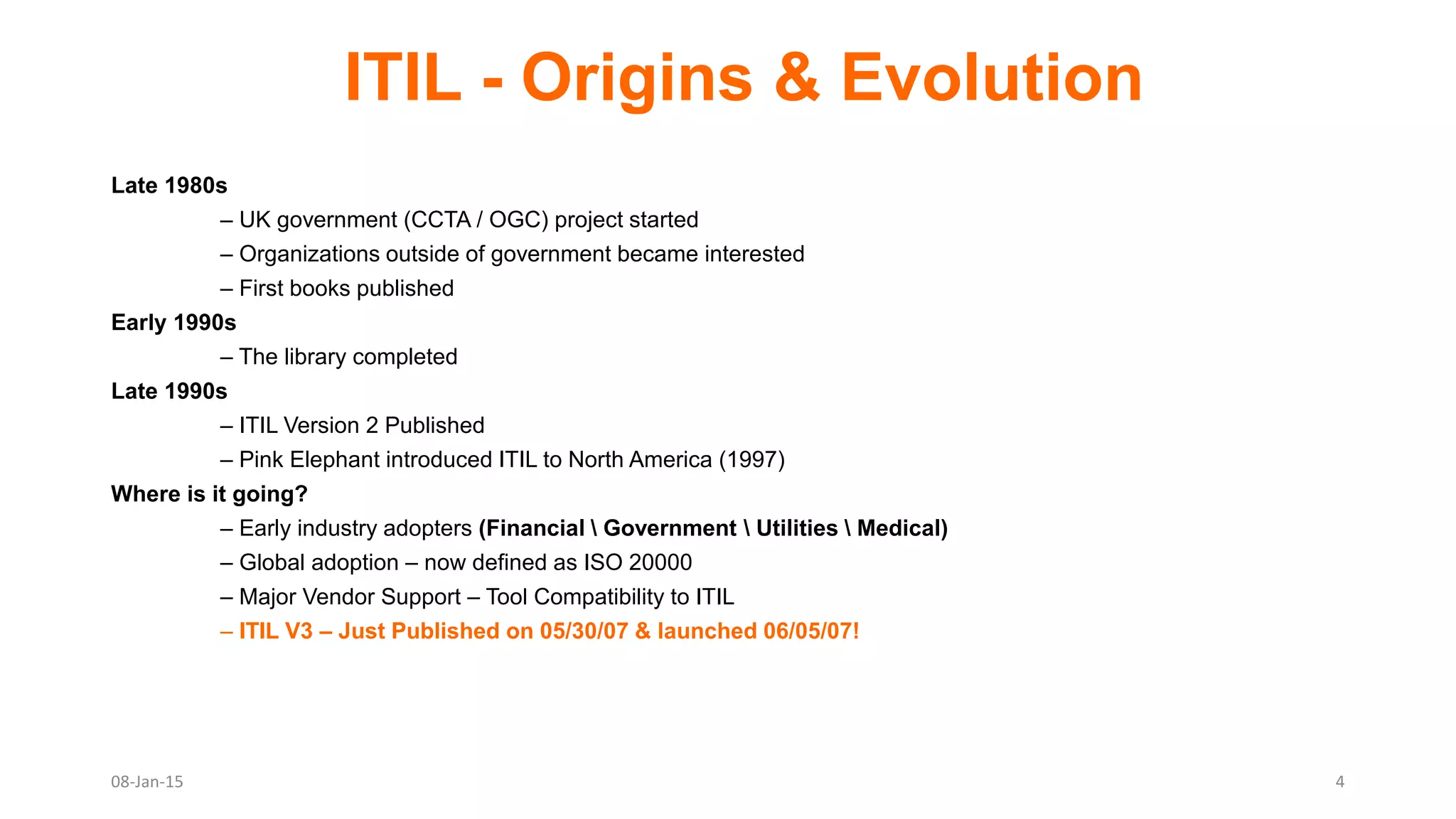
ITIL - Origins & Evolution
Late 1980s
– UK government (CCTA / OGC) project started
– Organizations outside of government became interested
– First books published
Early 1990s
– The library completed
Late 1990s
– ITIL Version 2 Published
– Pink Elephant introduced ITIL to North America (1997)
Where is it going?
– Early industry adopters (Financial  Government  Utilities  Medical)
– Global adoption – now defined as ISO 20000
– Major Vendor Support – Tool Compatibility to ITIL
– ITIL V3 – Just Published on 05/30/07 & launched 06/05/07!
08-Jan-15 4
Processes
Procedures
Tasks
Checklists
ITIL Consist of
08-Jan-15 5
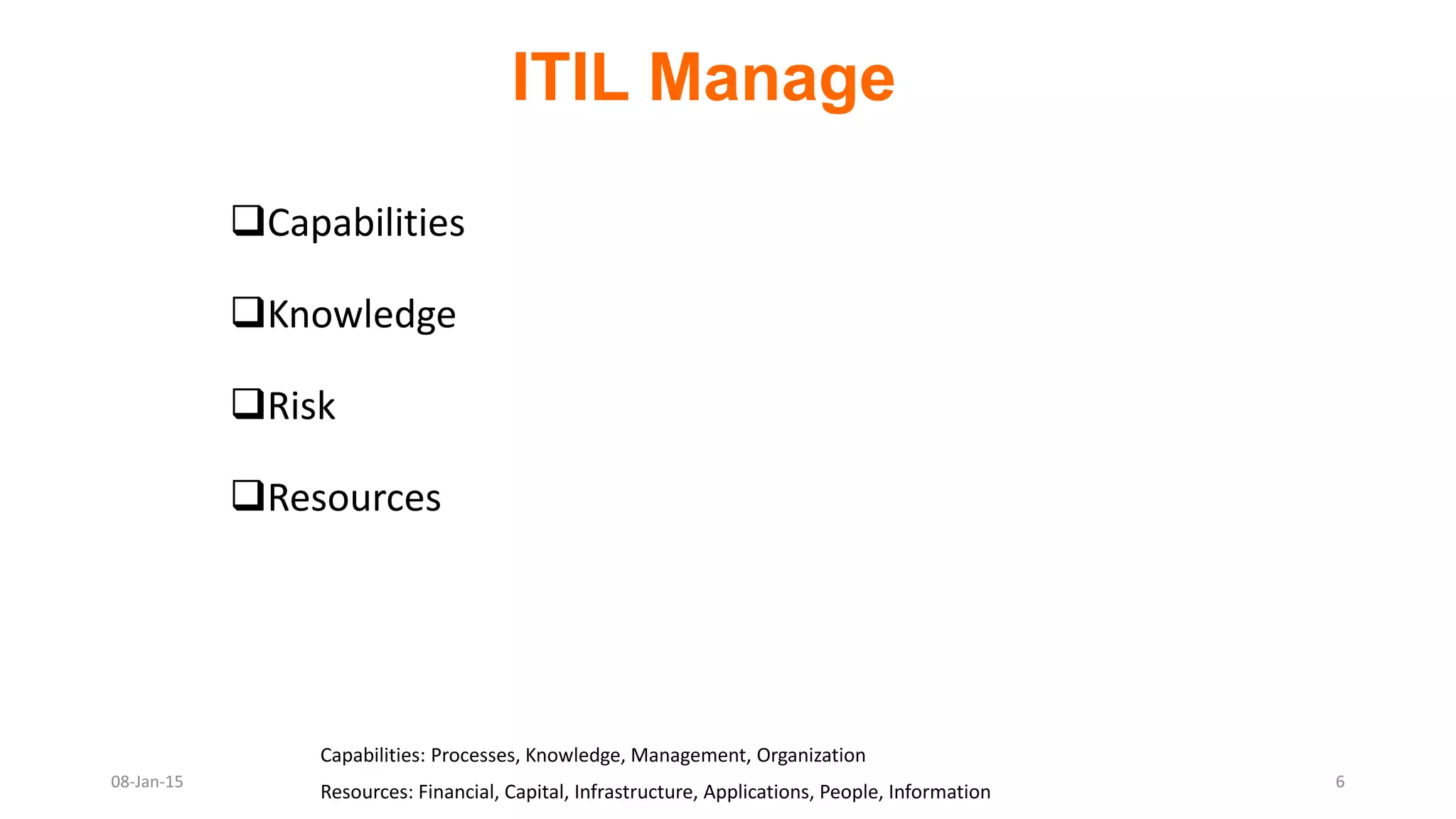
Capabilities
Knowledge
Risk
Resources
Capabilities: Processes, Knowledge, Management, Organization
Resources: Financial, Capital, Infrastructure, Applications, People, Information
ITIL Manage
08-Jan-15 6
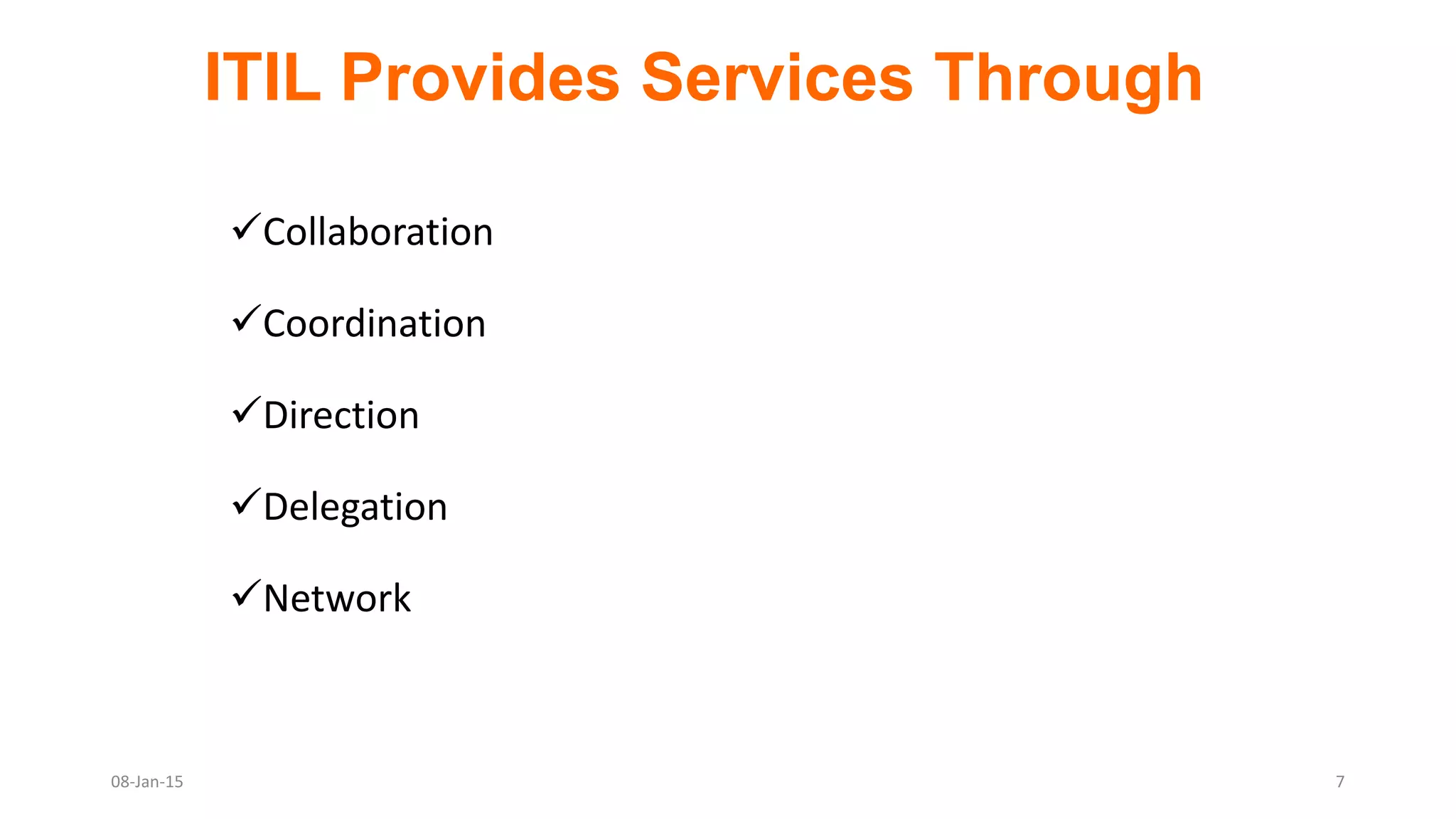
Collaboration
Coordination
Direction
Delegation
Network
ITIL Provides Services Through
08-Jan-15 7
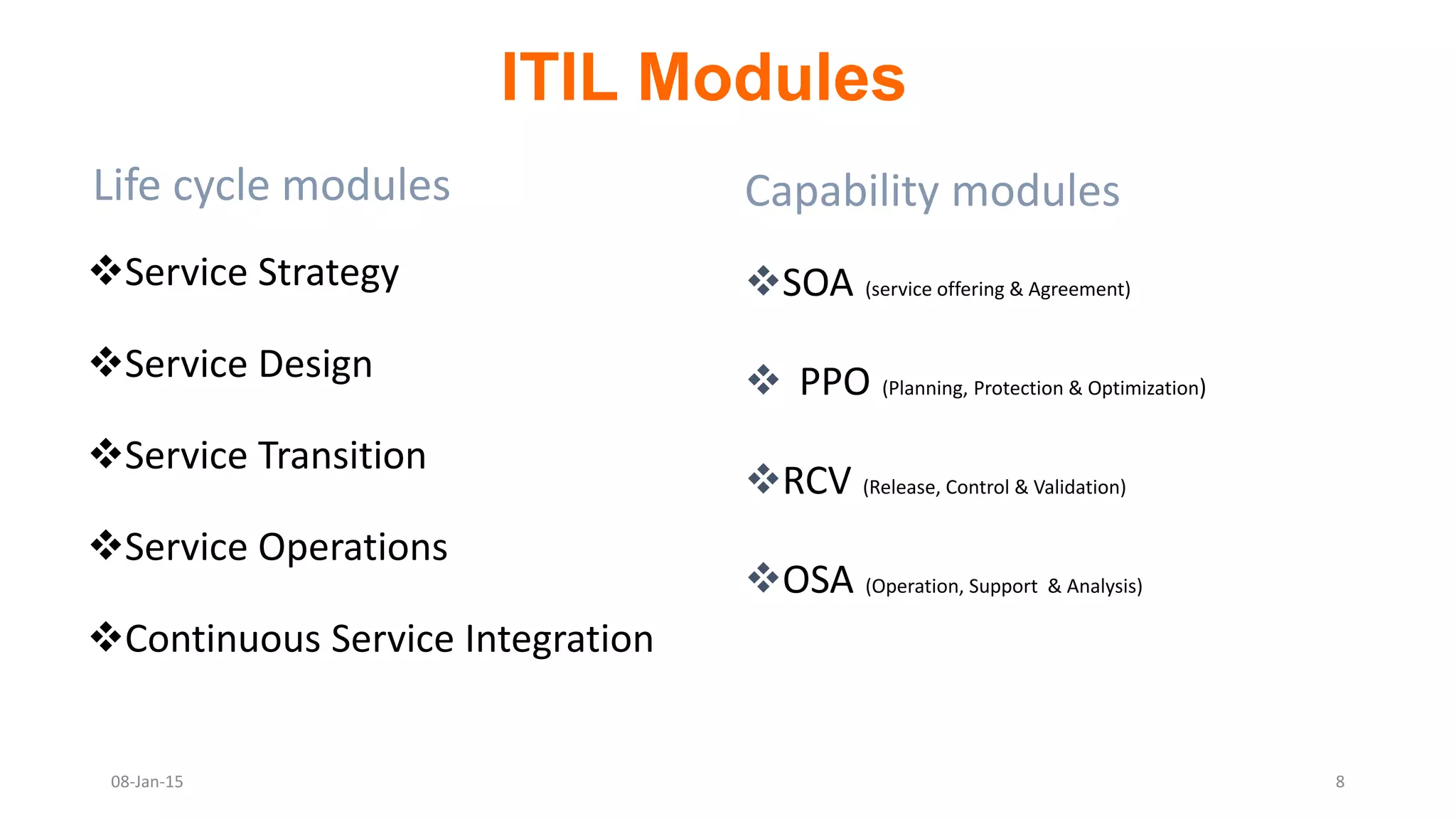
Life cycle modules
Service Strategy
Service Design
Service Transition
Service Operations
Continuous Service Integration
Capability modules
SOA (service offering & Agreement)
 PPO (Planning, Protection & Optimization)
RCV (Release, Control & Validation)
OSA (Operation, Support & Analysis)
ITIL Modules
08-Jan-15 8
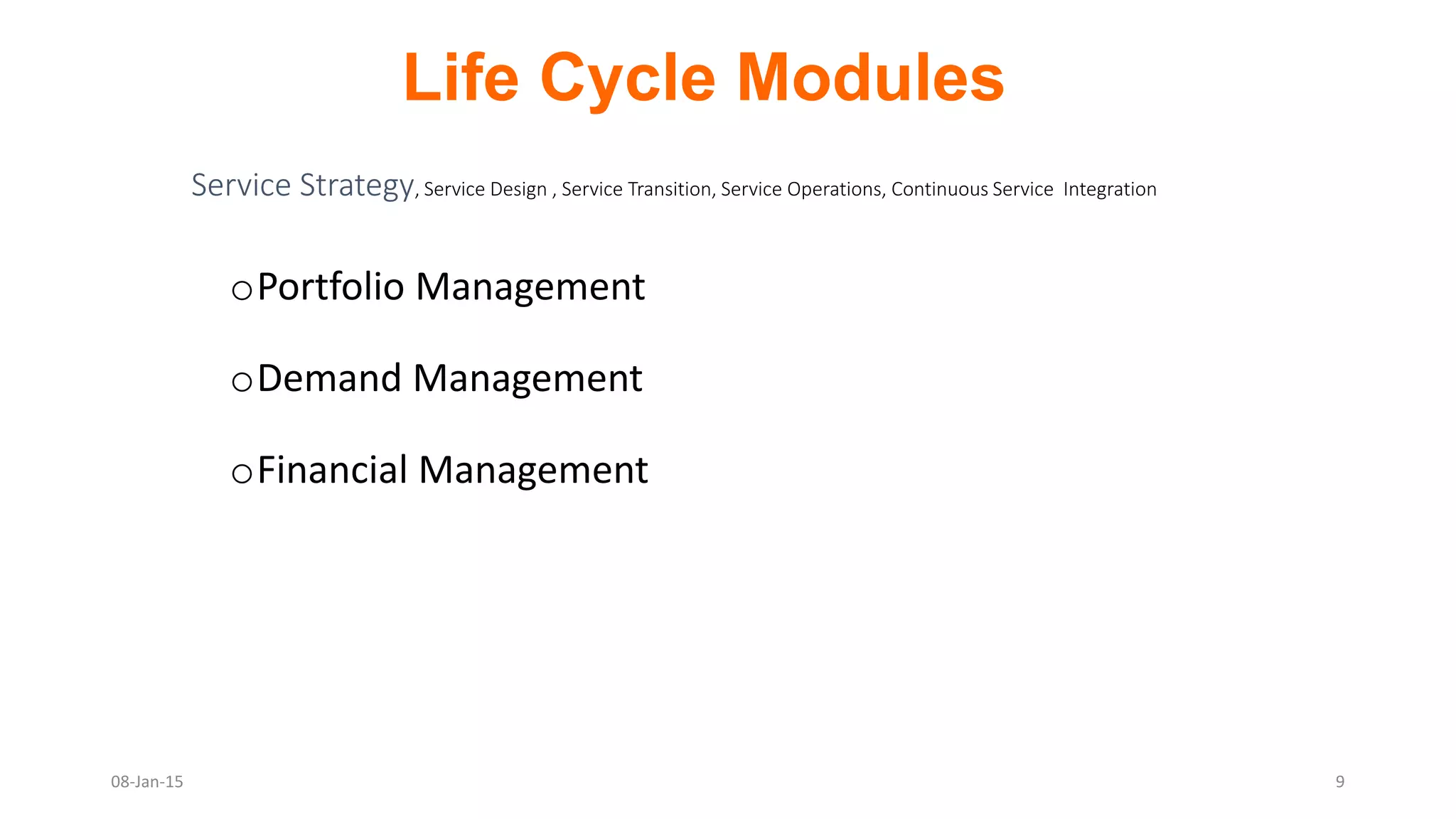
oPortfolio Management
oDemand Management
oFinancial Management
Service Strategy, Service Design , Service Transition, Service Operations, Continuous Service Integration
Life Cycle Modules
08-Jan-15 9
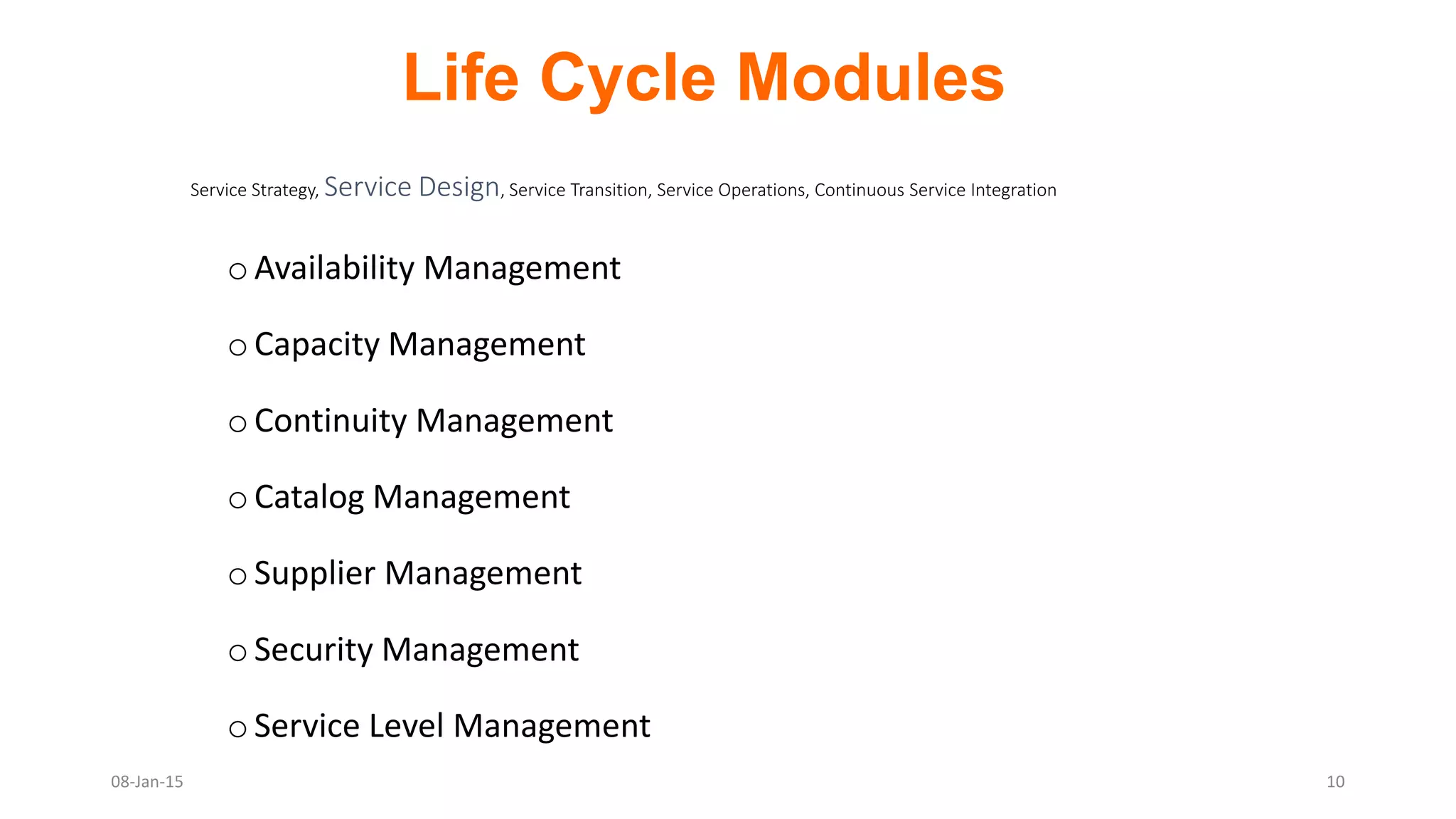
oAvailability Management
oCapacity Management
oContinuity Management
oCatalog Management
oSupplier Management
oSecurity Management
oService Level Management
Service Strategy, Service Design, Service Transition, Service Operations, Continuous Service Integration
Life Cycle Modules
08-Jan-15 10
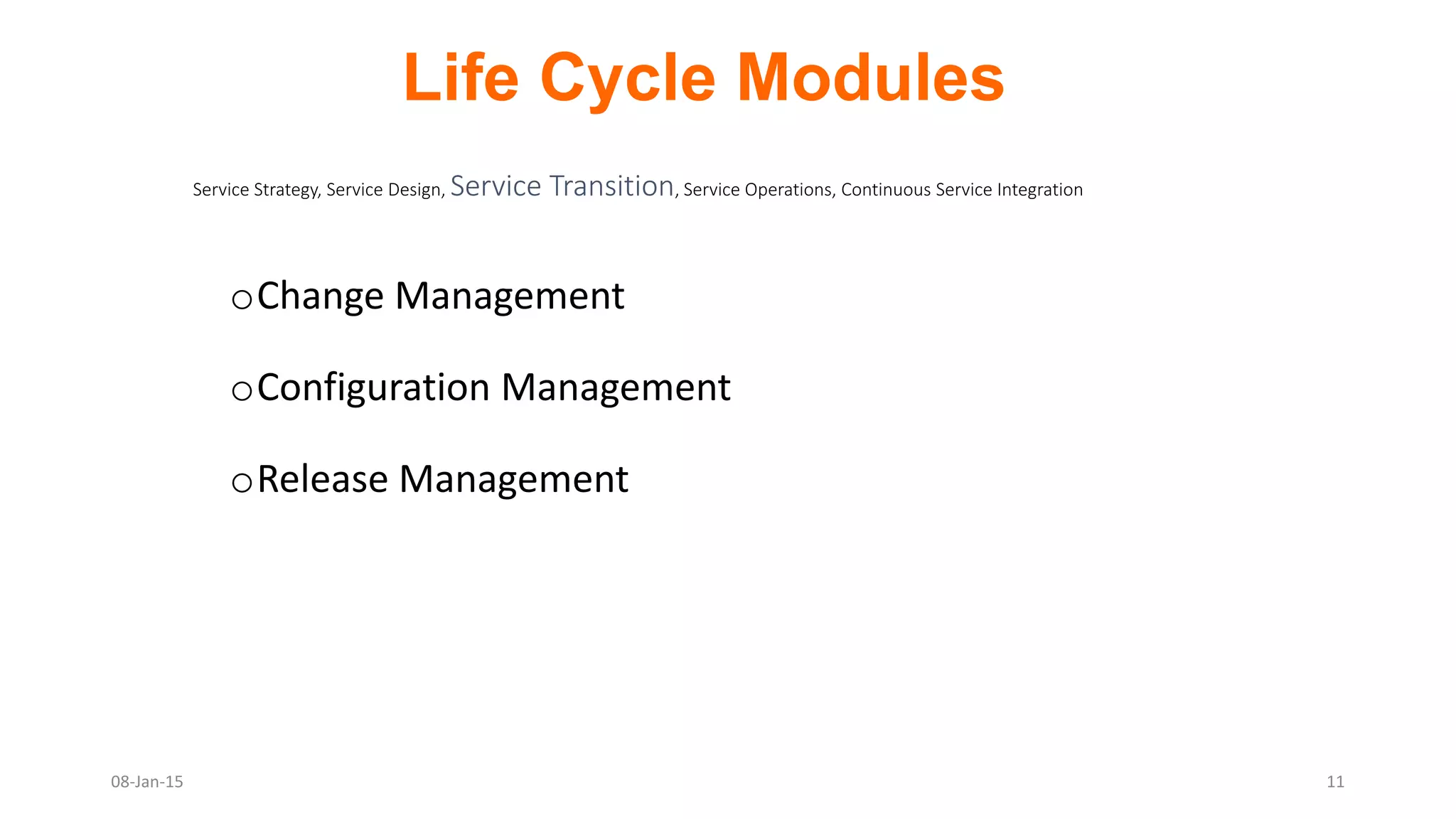
oChange Management
oConfiguration Management
oRelease Management
Service Strategy, Service Design, Service Transition, Service Operations, Continuous Service Integration
Life Cycle Modules
08-Jan-15 11
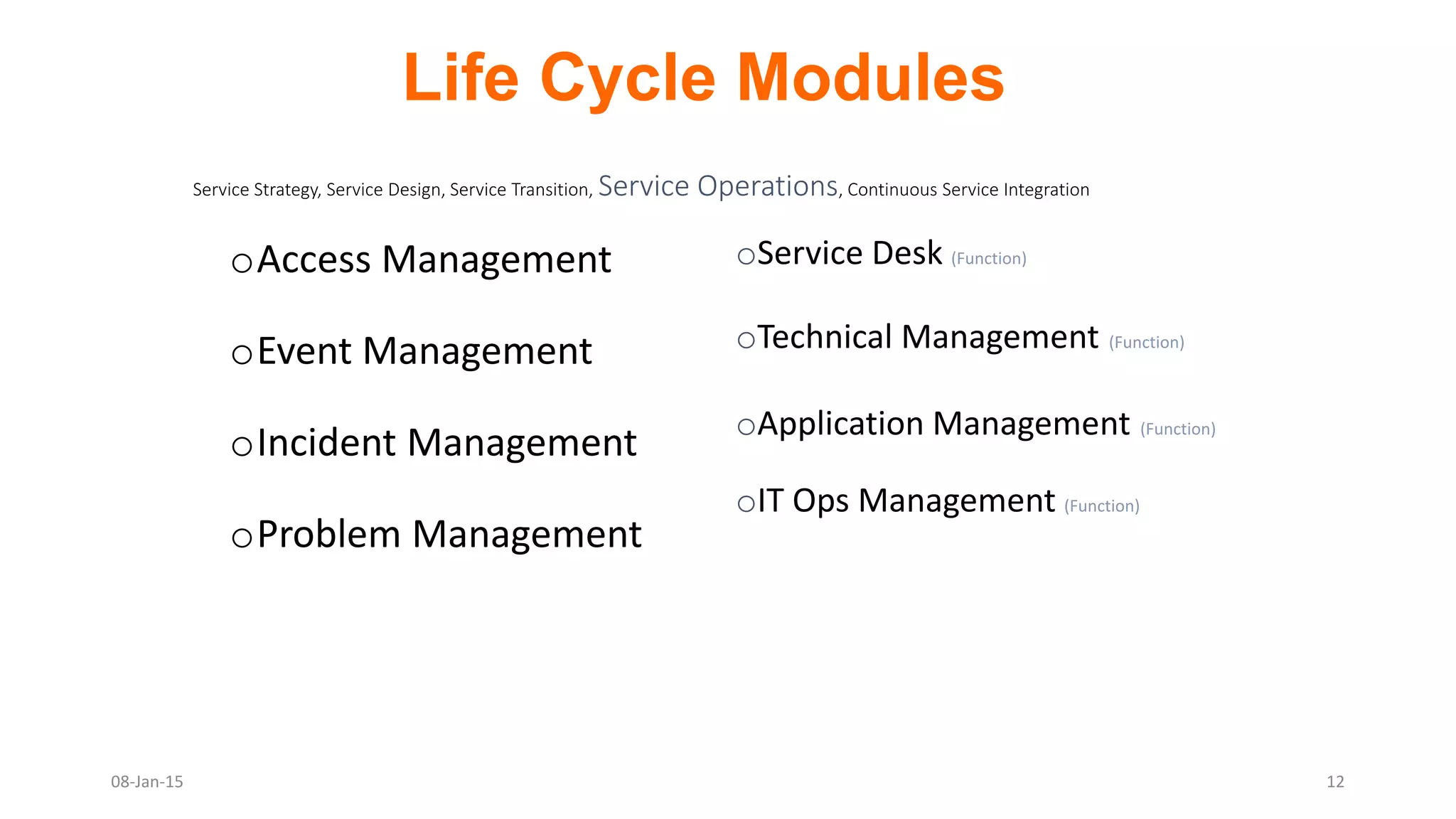
oAccess Management
oEvent Management
oIncident Management
oProblem Management
Service Strategy, Service Design, Service Transition, Service Operations, Continuous Service Integration
oService Desk (Function)
oTechnical Management (Function)
oApplication Management (Function)
oIT Ops Management (Function)
Life Cycle Modules
08-Jan-15 12
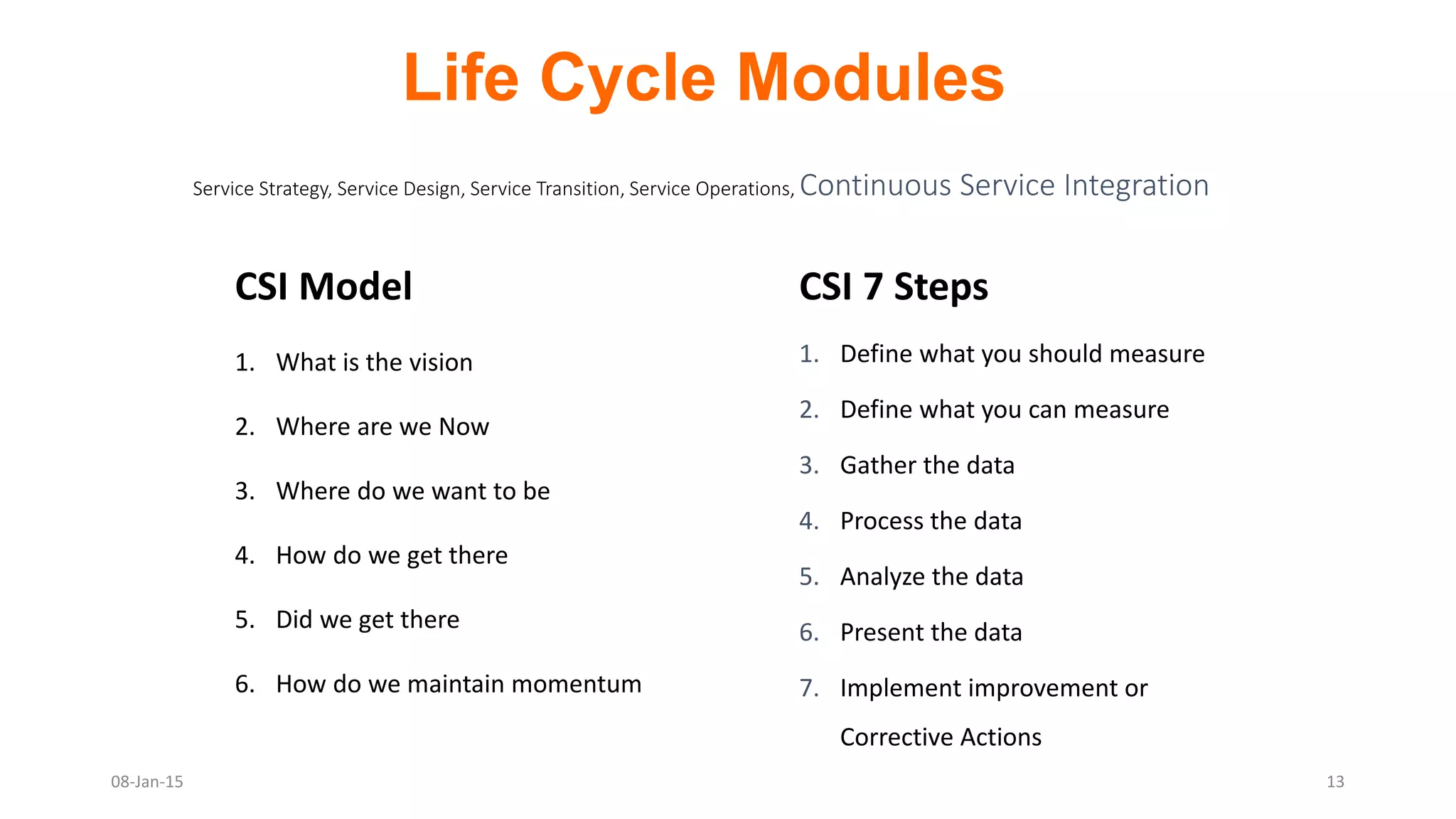
CSI Model
1. What is the vision
2. Where are we Now
3. Where do we want to be
4. How do we get there
5. Did we get there
6. How do we maintain momentum
Service Strategy, Service Design, Service Transition, Service Operations, Continuous Service Integration
CSI 7 Steps
1. Define what you should measure
2. Define what you can measure
3. Gather the data
4. Process the data
5. Analyze the data
6. Present the data
7. Implement improvement or
Corrective Actions
Life Cycle Modules
08-Jan-15 13
Service Manager
Product Manager
Service Owner
Process Owner
ITIL Roles
08-Jan-15 14
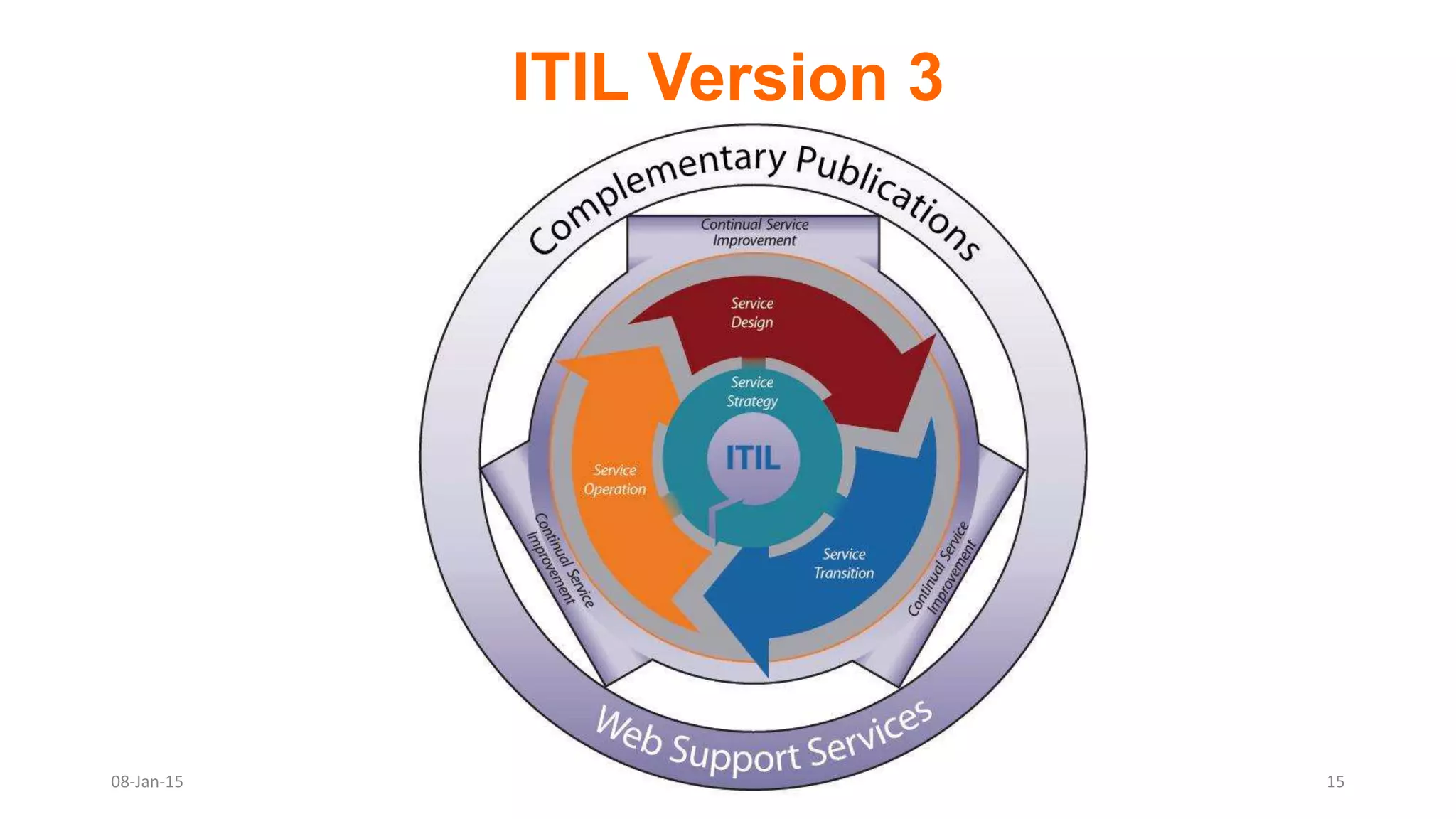
ITIL Version 3
08-Jan-15 15
V3 Overview
 Service management as a practice
 Service lifecycle
 Role of processes in the lifecycle
 Role of functions in the lifecycle
 Practice fundamentals
 Practice principles
 Processes
 Organizational design and structures roles and responsibilities
 Challenges, critical success factors, risks
08-Jan-15 16
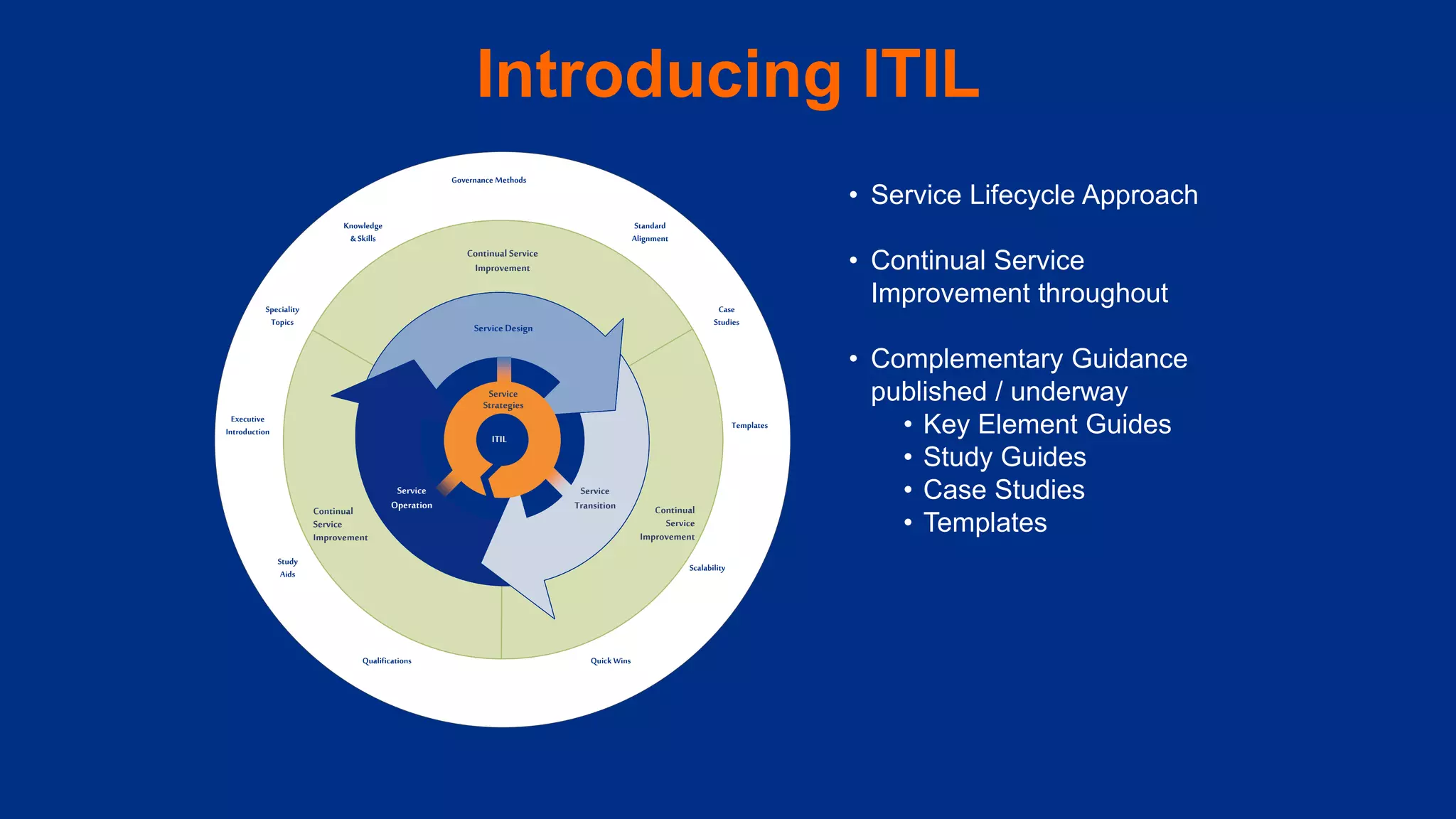
Introducing ITIL
Service Design
ITIL
Service
Strategies
Continual
Service
Improvement
Continual
Service
Improvement
Continual Service
Improvement
Service
Operation
Service
Transition
Governance Methods
Standard
Alignment
Case
Studies
Templates
Scalability
Quick WinsQualifications
Study
Aids
Executive
Introduction
Speciality
Topics
Knowledge
& Skills
• Service Lifecycle Approach
• Continual Service
Improvement throughout
• Complementary Guidance
published / underway
• Key Element Guides
• Study Guides
• Case Studies
• Templates
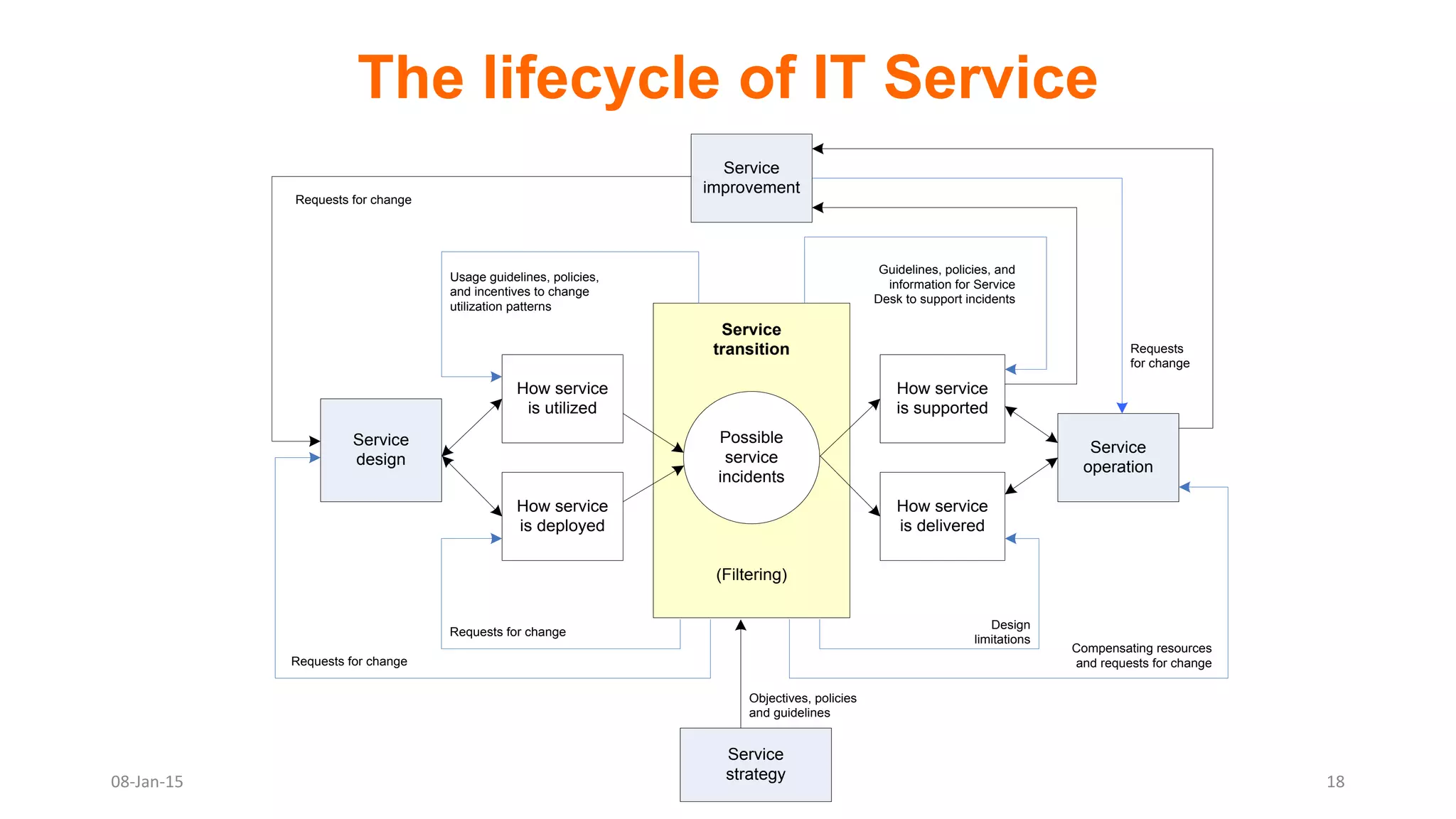
The lifecycle of IT Service
Service
design
How service
is deployed
Possible
service
incidents
How service
is utilized
Requests for change
Requests for change
Usage guidelines, policies,
and incentives to change
utilization patterns
Service
transition
How service
is delivered
How service
is supported
Service
operation
Design
limitations
Guidelines, policies, and
information for Service
Desk to support incidents
(Filtering)
Compensating resources
and requests for change
Requests
for change
Service
improvement
Requests for change
Service
strategy
Objectives, policies
and guidelines
08-Jan-15 18
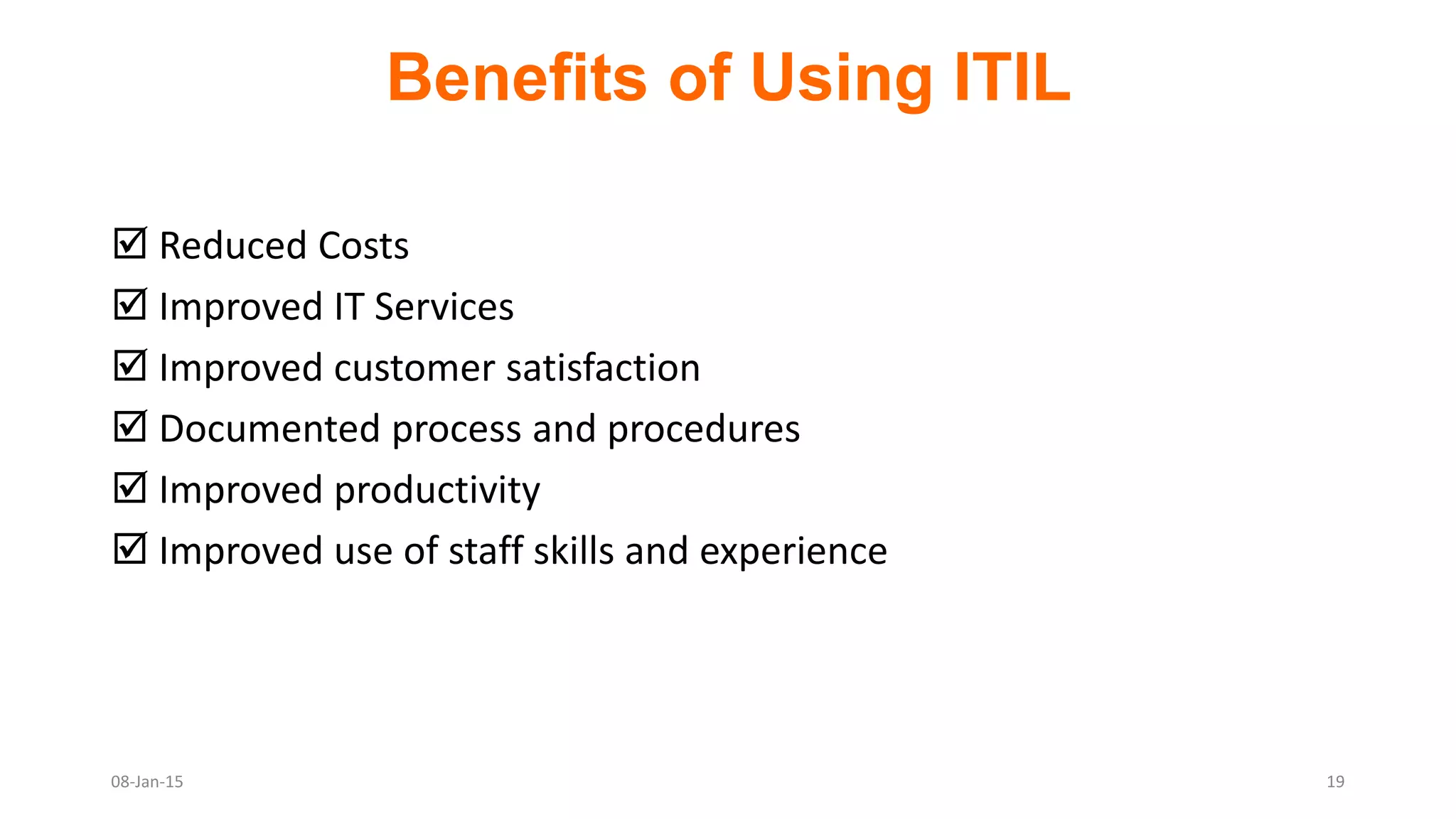
Benefits of Using ITIL
 Reduced Costs
 Improved IT Services
 Improved customer satisfaction
 Documented process and procedures
 Improved productivity
 Improved use of staff skills and experience
08-Jan-15 19
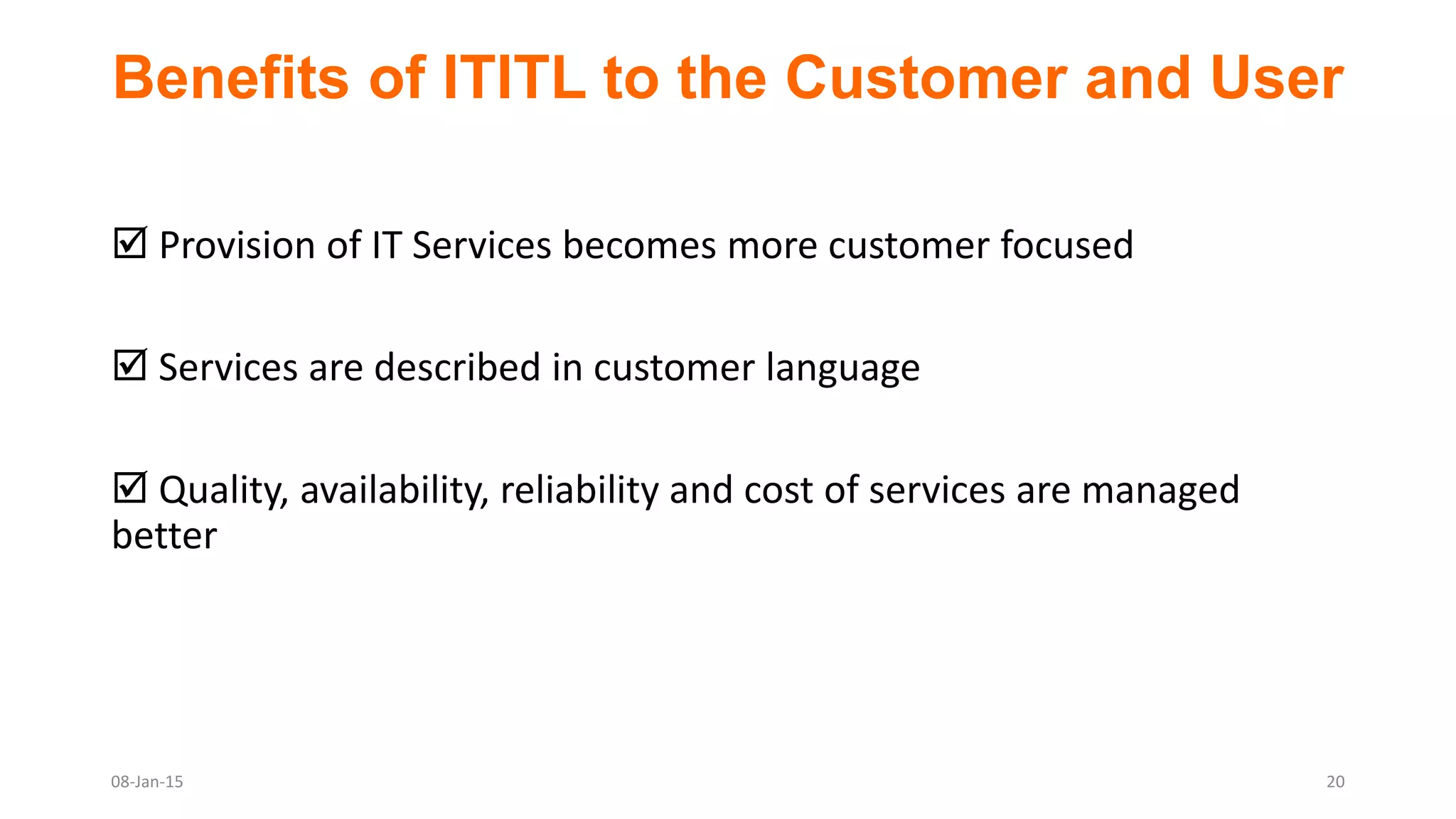
Benefits of ITITL to the Customer and User
 Provision of IT Services becomes more customer focused
 Services are described in customer language
 Quality, availability, reliability and cost of services are managed
better
08-Jan-15 20
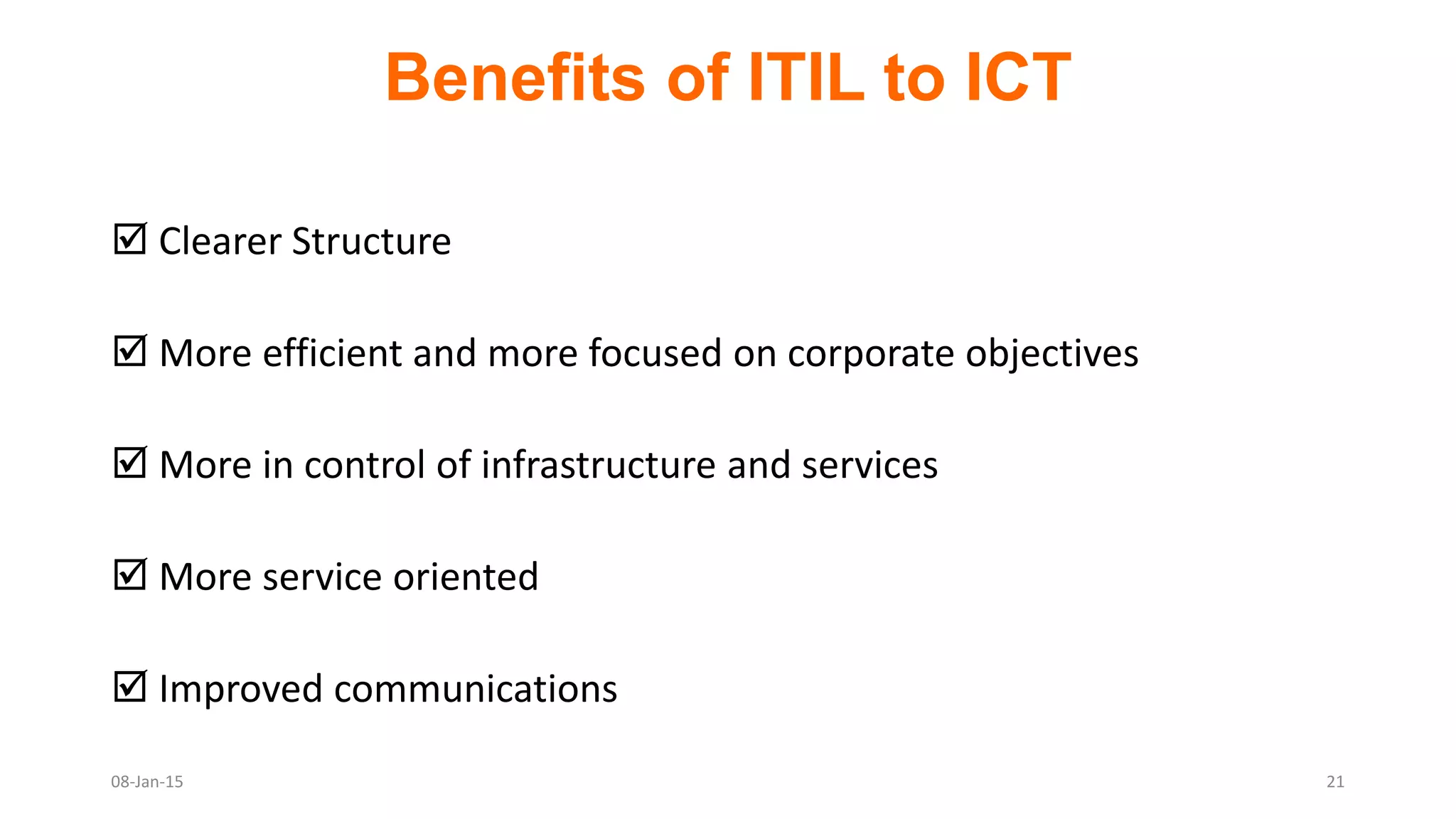
Benefits of ITIL to ICT
 Clearer Structure
 More efficient and more focused on corporate objectives
 More in control of infrastructure and services
 More service oriented
 Improved communications
08-Jan-15 21
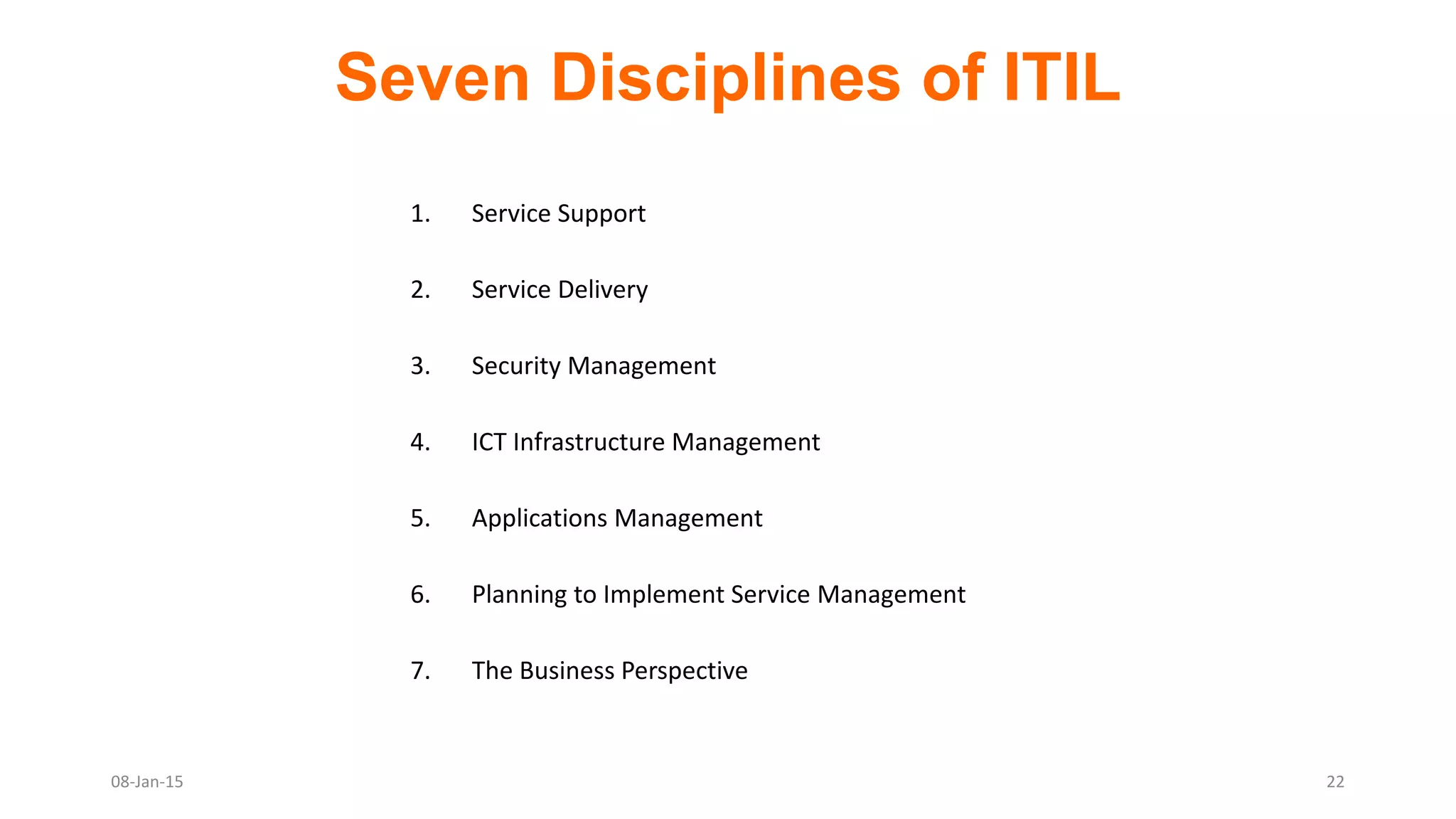
Seven Disciplines of ITIL
1. Service Support
2. Service Delivery
3. Security Management
4. ICT Infrastructure Management
5. Applications Management
6. Planning to Implement Service Management
7. The Business Perspective
08-Jan-15 22
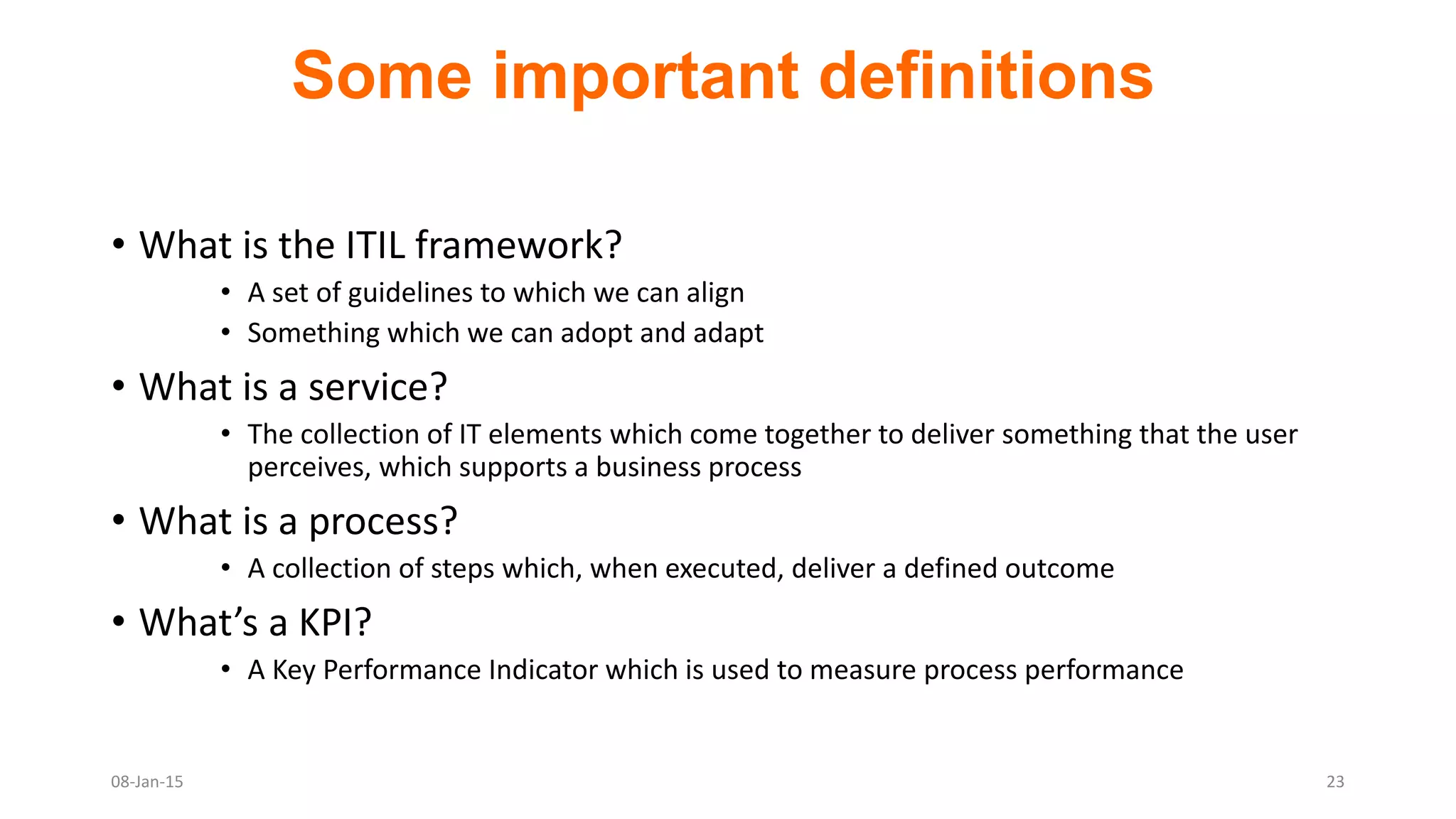
Some important definitions
• What is the ITIL framework?
• A set of guidelines to which we can align
• Something which we can adopt and adapt
• What is a service?
• The collection of IT elements which come together to deliver something that the user
perceives, which supports a business process
• What is a process?
• A collection of steps which, when executed, deliver a defined outcome
• What’s a KPI?
• A Key Performance Indicator which is used to measure process performance
08-Jan-15 23
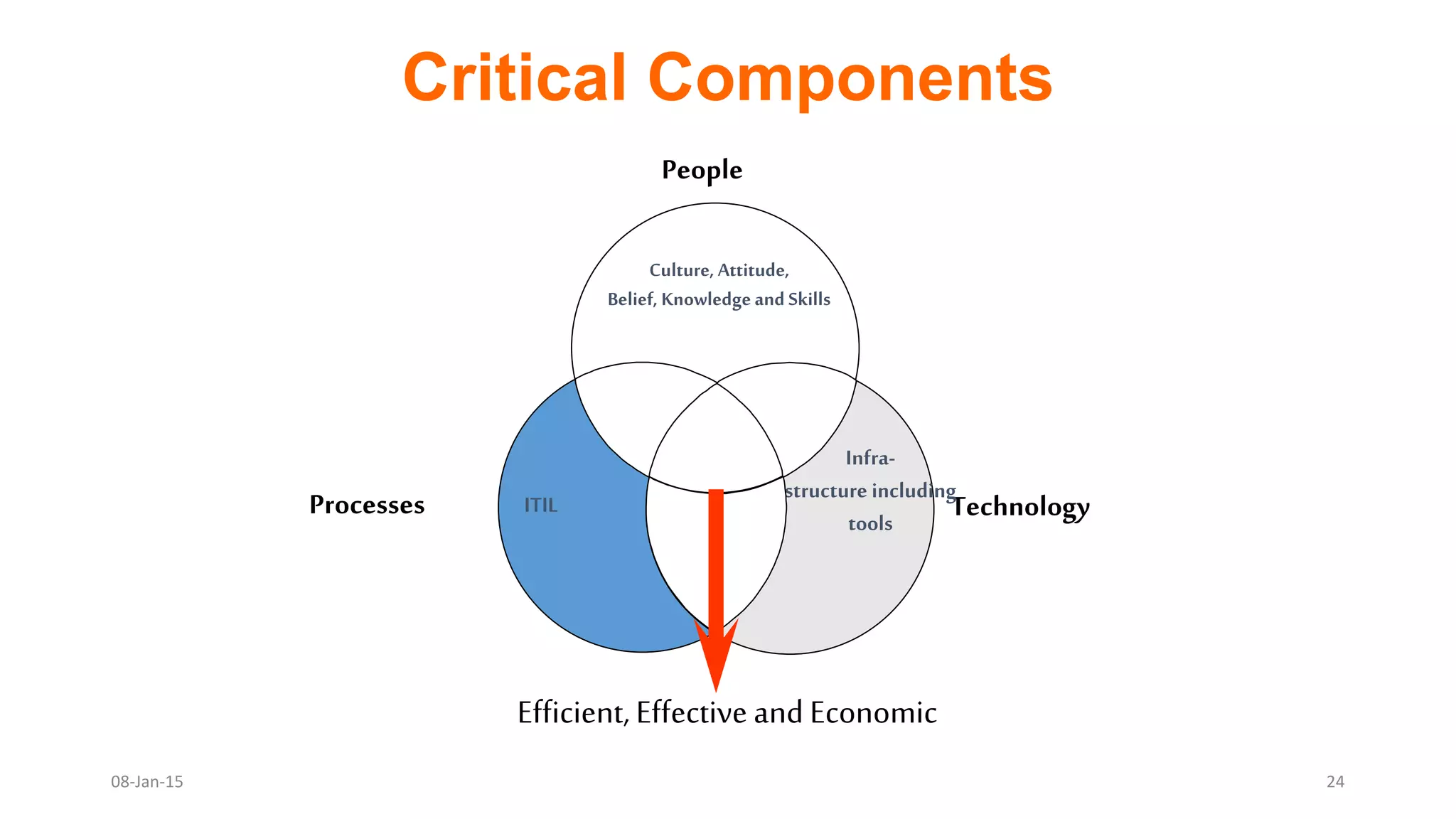
Processes ITIL Technology
Infra-
structure including
tools
Critical Components
Efficient, Effective and Economic
People
Culture, Attitude,
Belief, Knowledgeand Skills
08-Jan-15 24
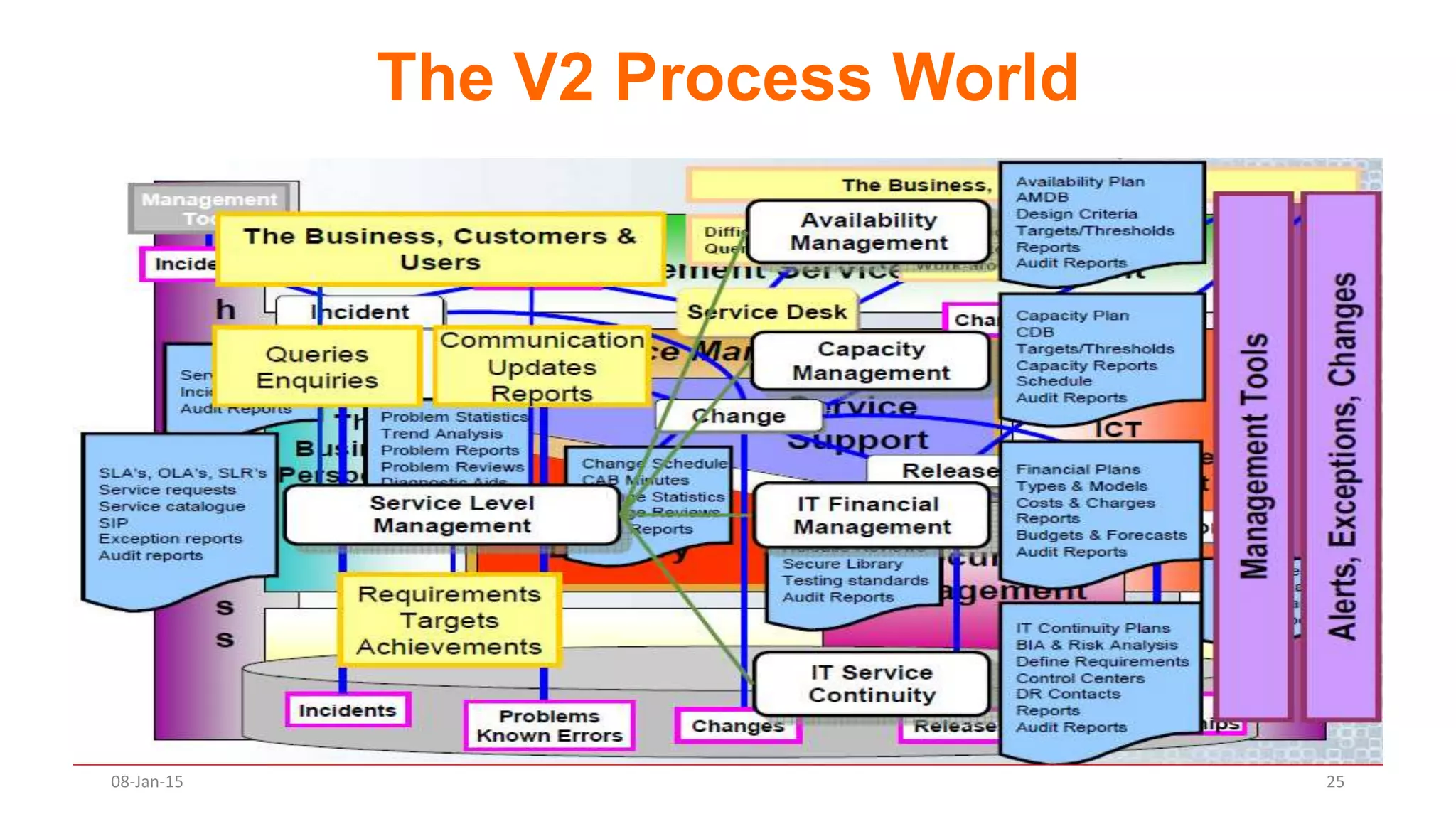
The V2 Process World
08-Jan-15 25
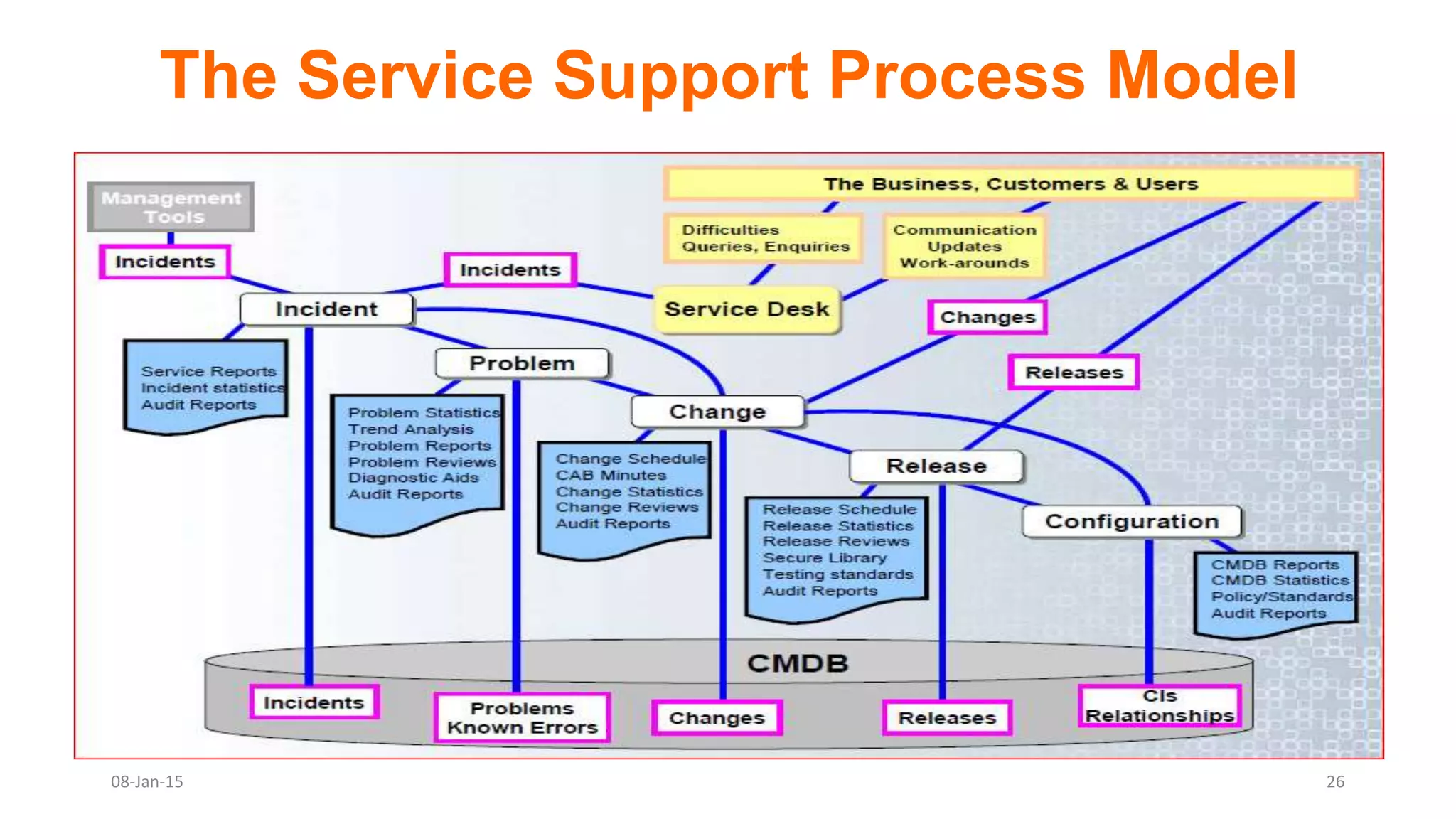
The Service Support Process Model
08-Jan-15 26
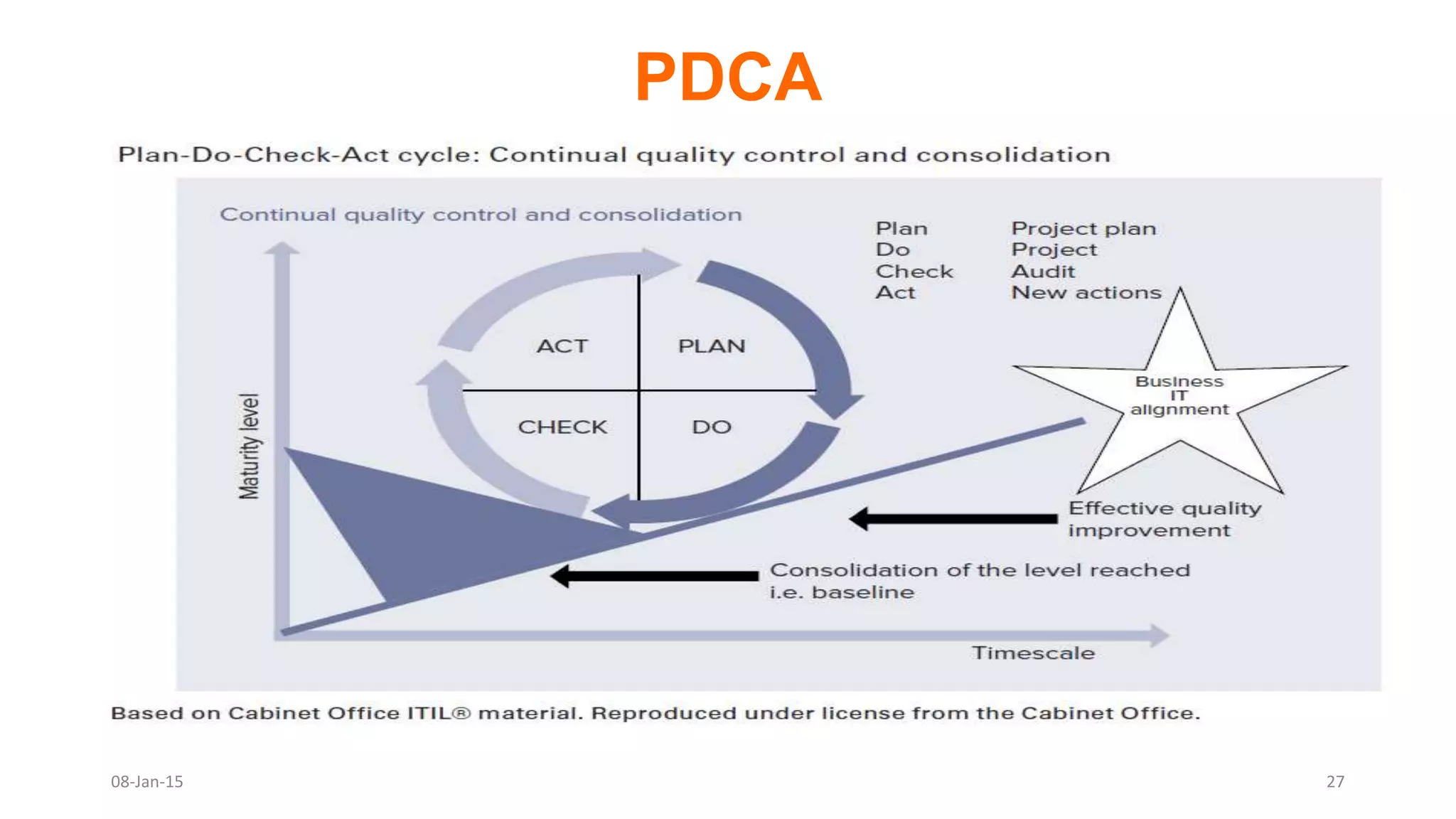
PDCA
08-Jan-15 27
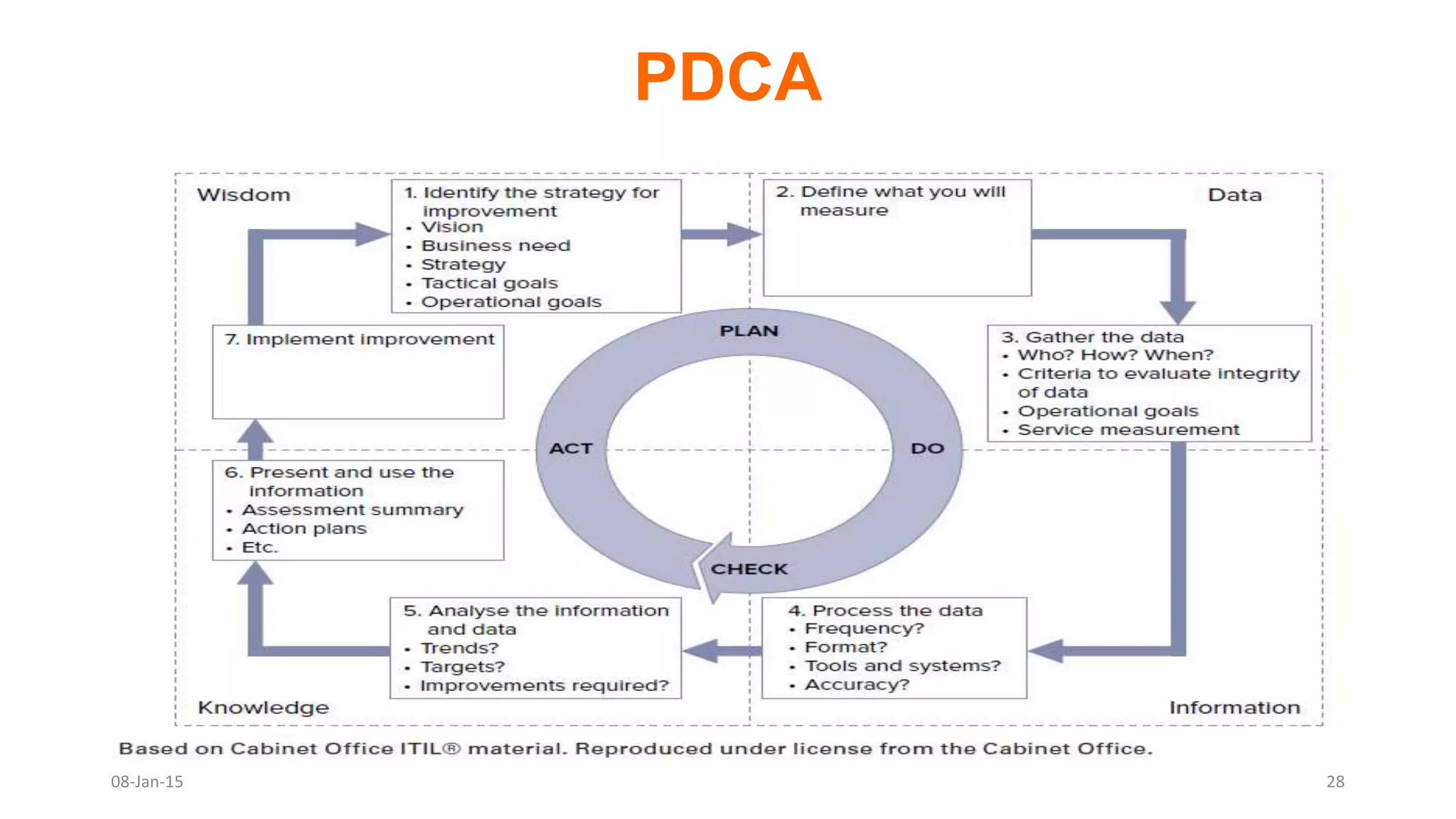
PDCA
08-Jan-15 28
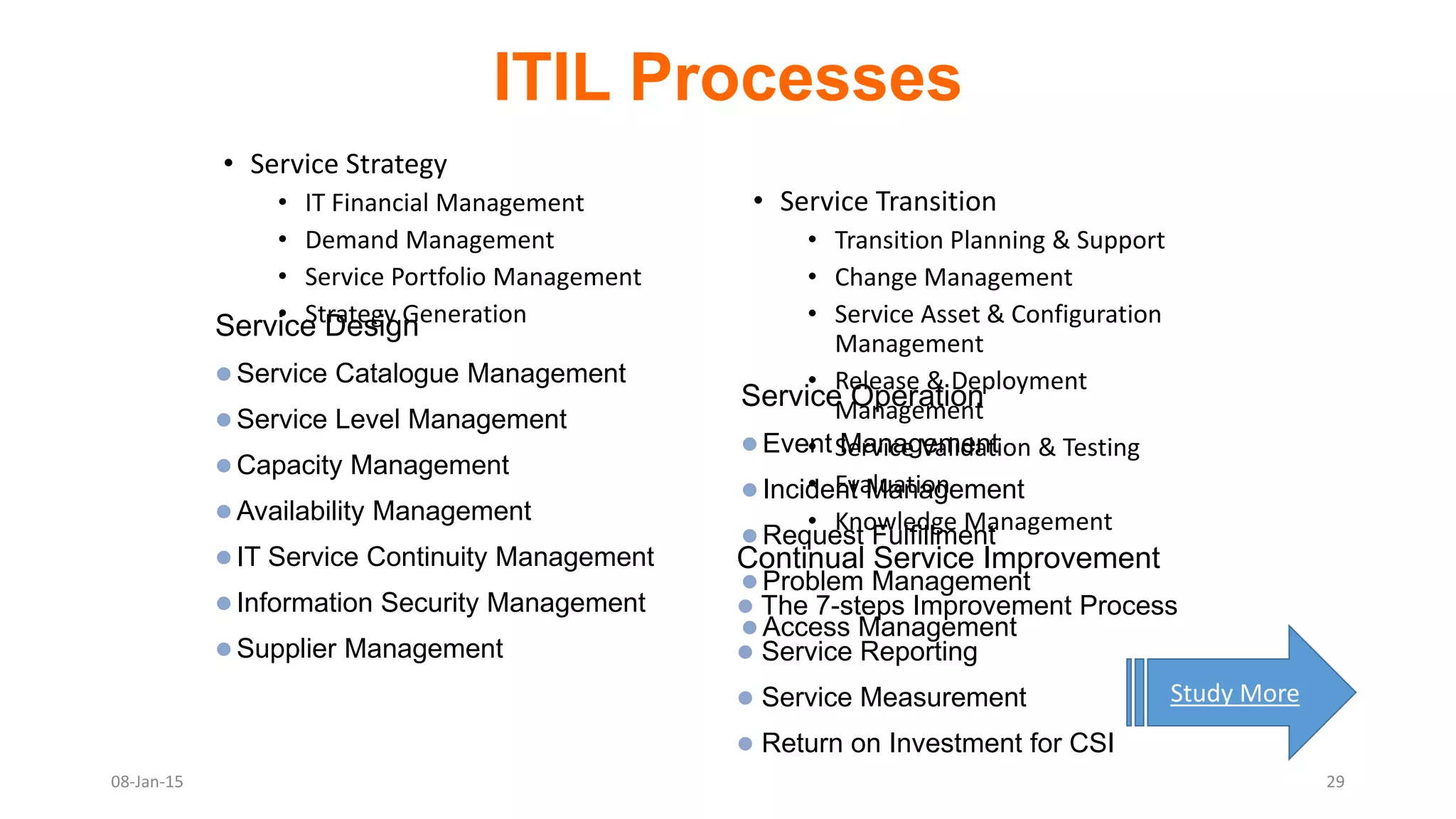
ITIL Processes
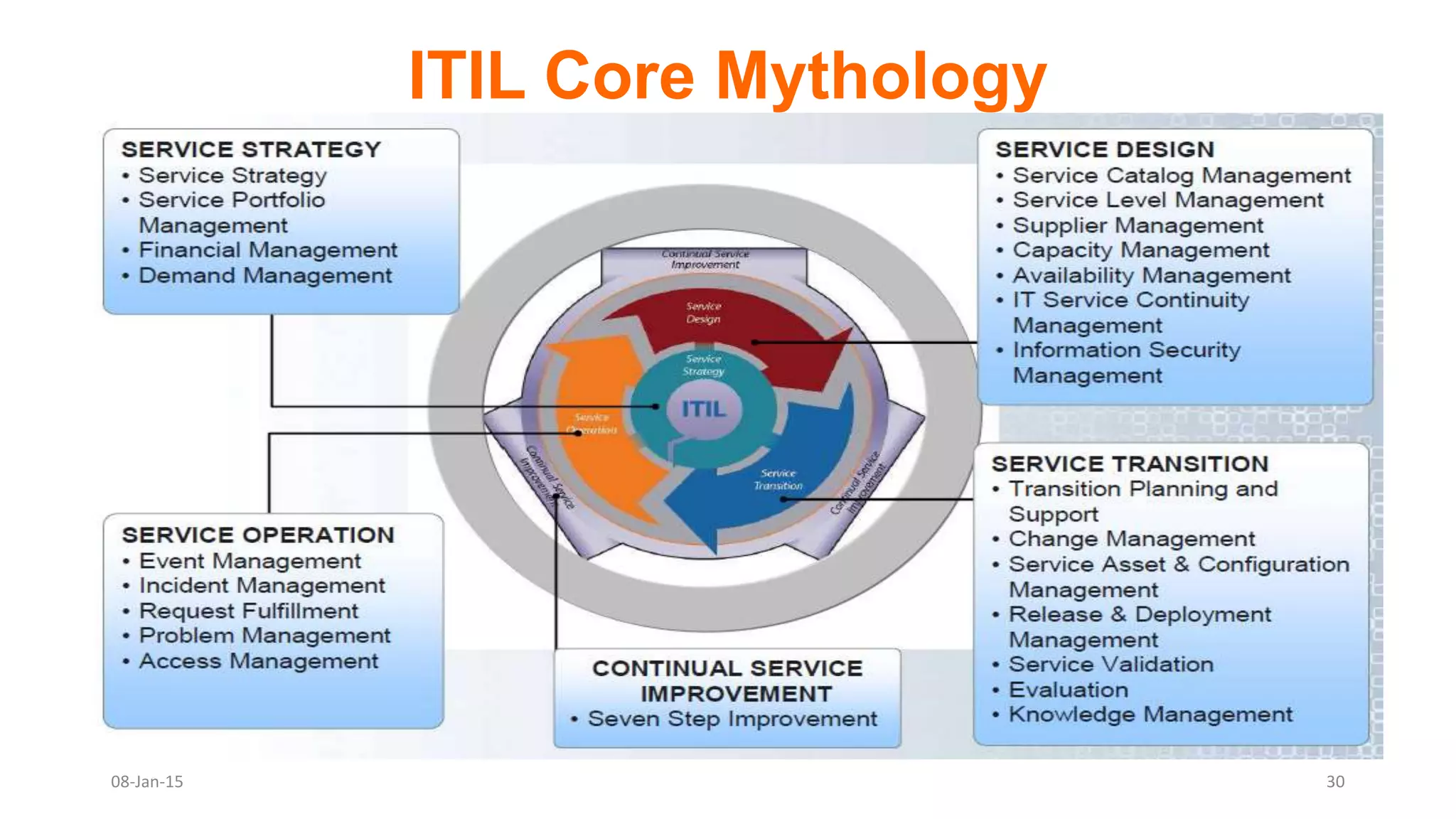
• Service Strategy
• IT Financial Management
• Demand Management
• Service Portfolio Management
• Strategy Generation
• Service Transition
• Transition Planning & Support
• Change Management
• Service Asset & Configuration
Management
• Release & Deployment
Management
• Service Validation & Testing
• Evaluation
• Knowledge Management
Continual Service Improvement
 The 7-steps Improvement Process
 Service Reporting
 Service Measurement
 Return on Investment for CSI
Service Operation
 Event Management
 Incident Management
 Request Fulfillment
 Problem Management
 Access Management
Service Design
 Service Catalogue Management
 Service Level Management
 Capacity Management
 Availability Management
 IT Service Continuity Management
 Information Security Management
 Supplier Management
08-Jan-15 29
Study More
ITIL Core Mythology
08-Jan-15 30
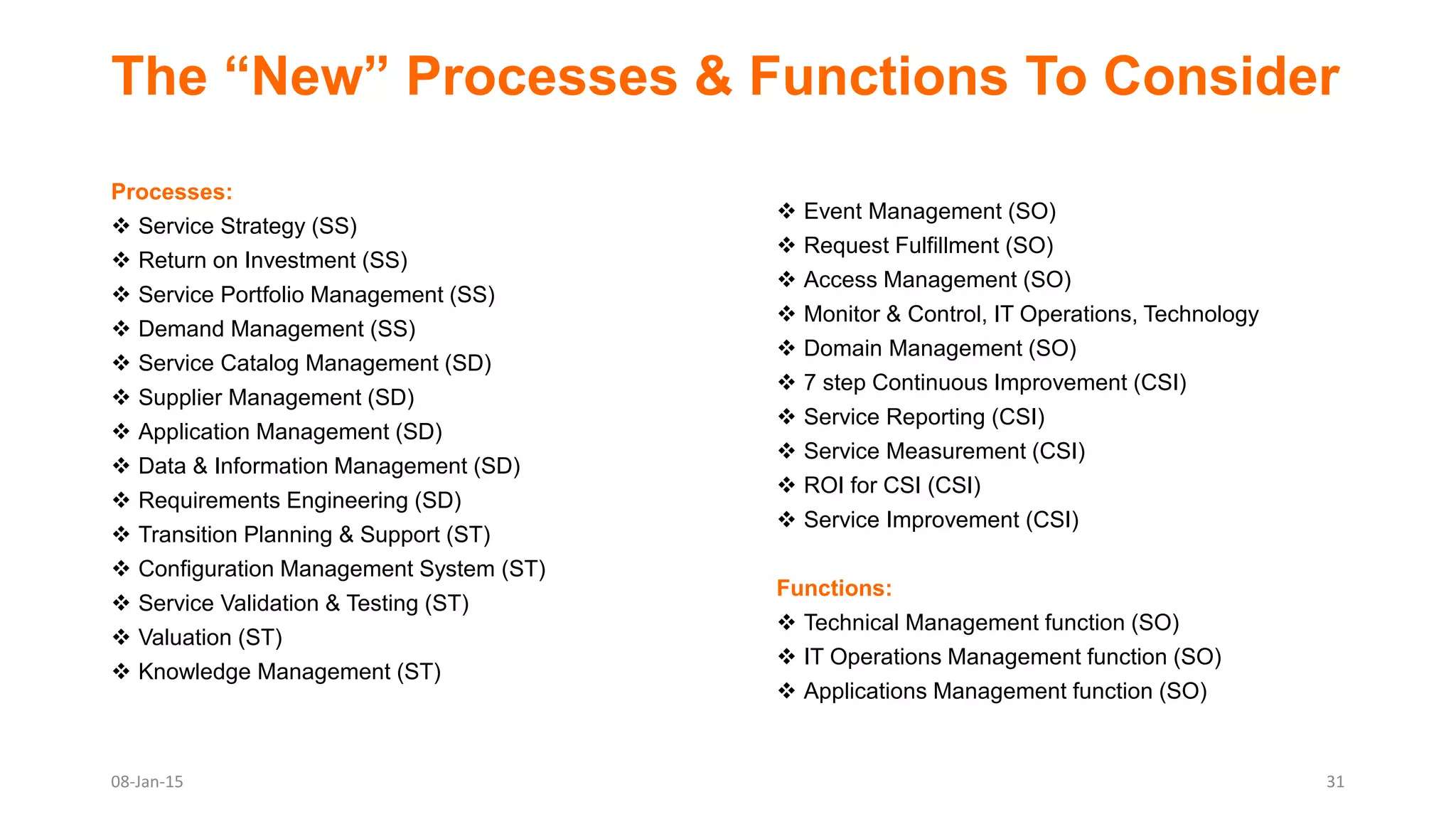
The “New” Processes & Functions To Consider
Processes:
 Service Strategy (SS)
 Return on Investment (SS)
 Service Portfolio Management (SS)
 Demand Management (SS)
 Service Catalog Management (SD)
 Supplier Management (SD)
 Application Management (SD)
 Data & Information Management (SD)
 Requirements Engineering (SD)
 Transition Planning & Support (ST)
 Configuration Management System (ST)
 Service Validation & Testing (ST)
 Valuation (ST)
 Knowledge Management (ST)
 Event Management (SO)
 Request Fulfillment (SO)
 Access Management (SO)
 Monitor & Control, IT Operations, Technology
 Domain Management (SO)
 7 step Continuous Improvement (CSI)
 Service Reporting (CSI)
 Service Measurement (CSI)
 ROI for CSI (CSI)
 Service Improvement (CSI)
Functions:
 Technical Management function (SO)
 IT Operations Management function (SO)
 Applications Management function (SO)
08-Jan-15 31
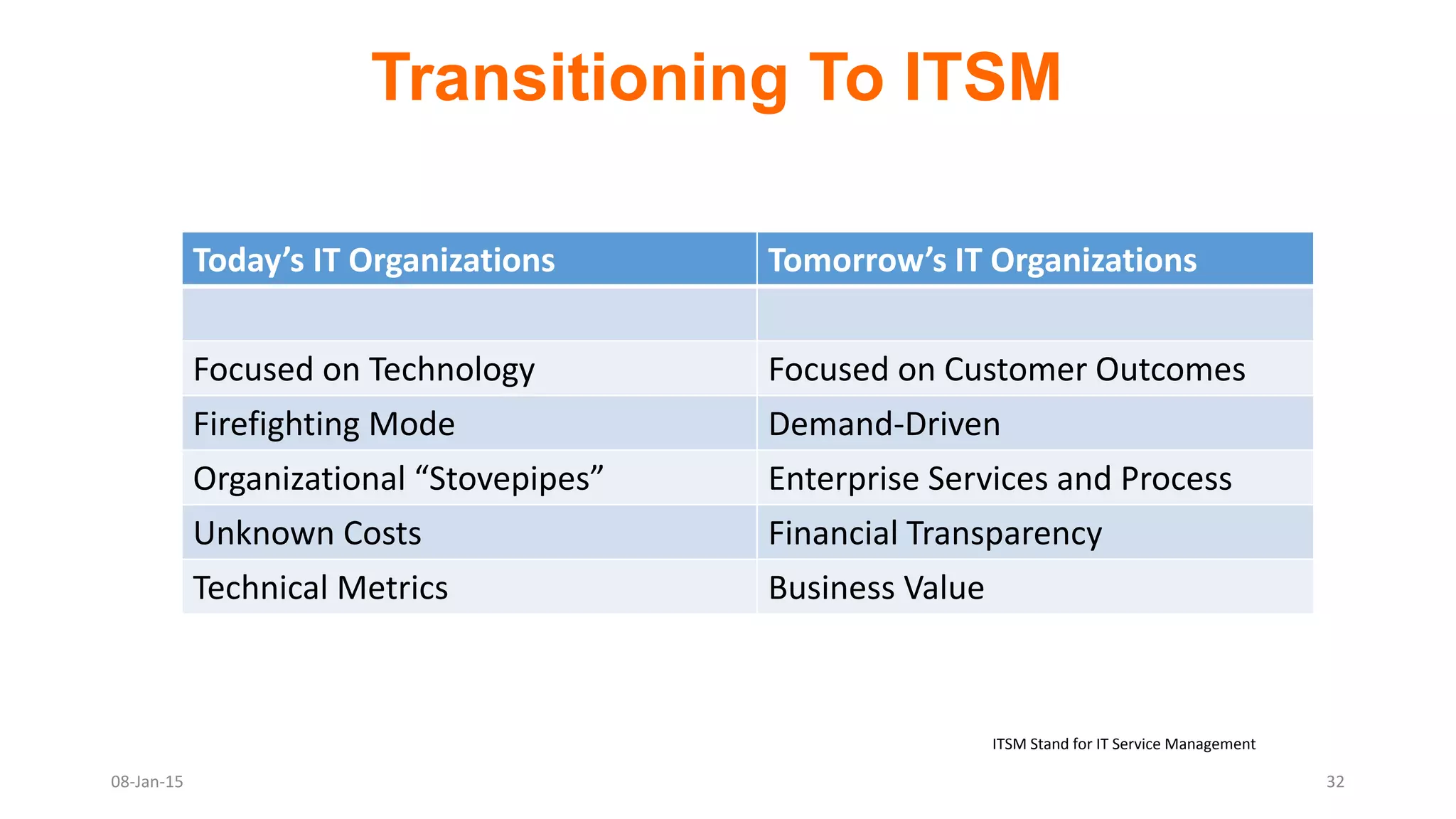
Transitioning To ITSM
Today’s IT Organizations Tomorrow’s IT Organizations
Focused on Technology Focused on Customer Outcomes
Firefighting Mode Demand-Driven
Organizational “Stovepipes” Enterprise Services and Process
Unknown Costs Financial Transparency
Technical Metrics Business Value
08-Jan-15
ITSM Stand for IT Service Management
32
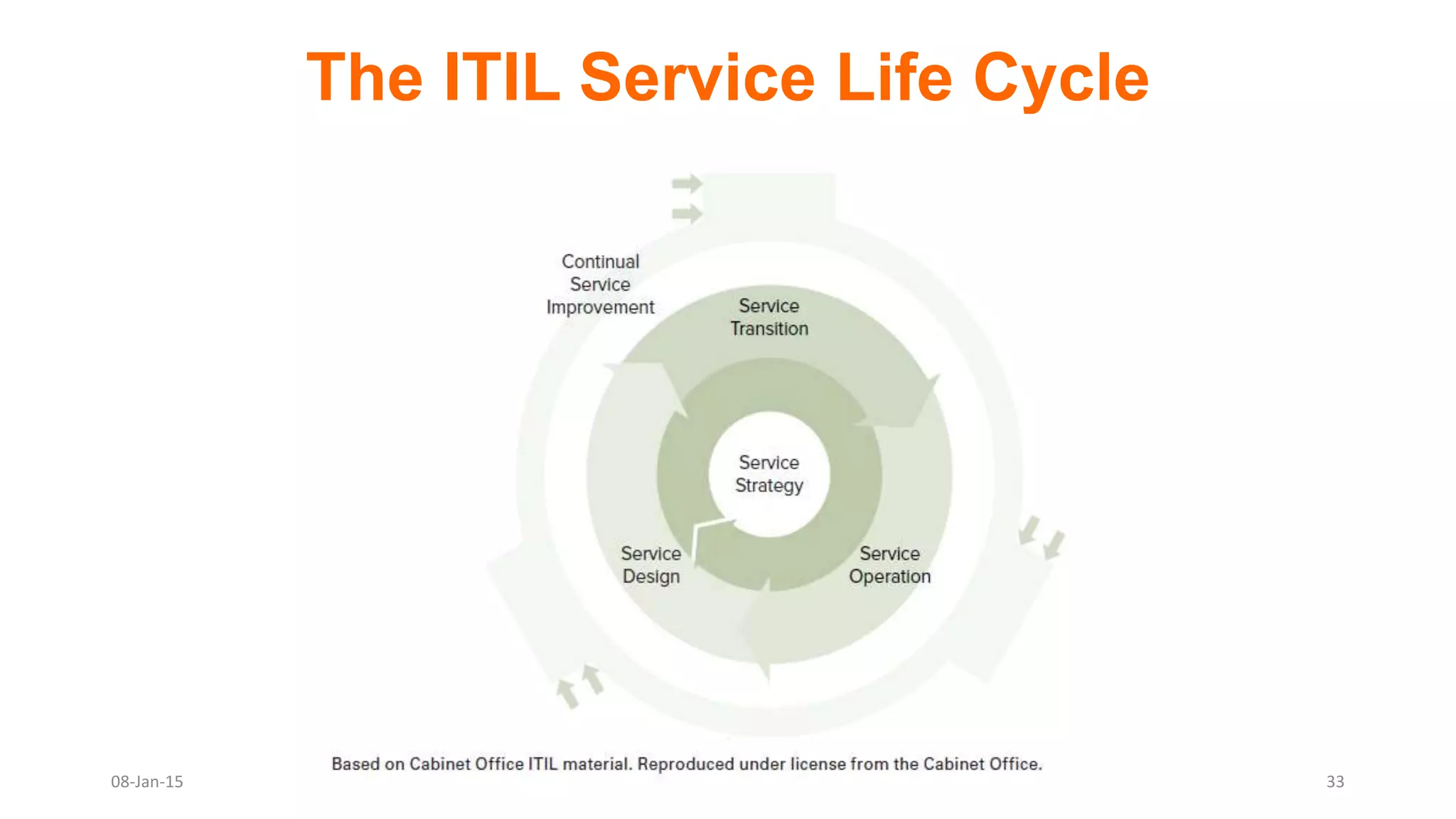
The ITIL Service Life Cycle
08-Jan-15 33
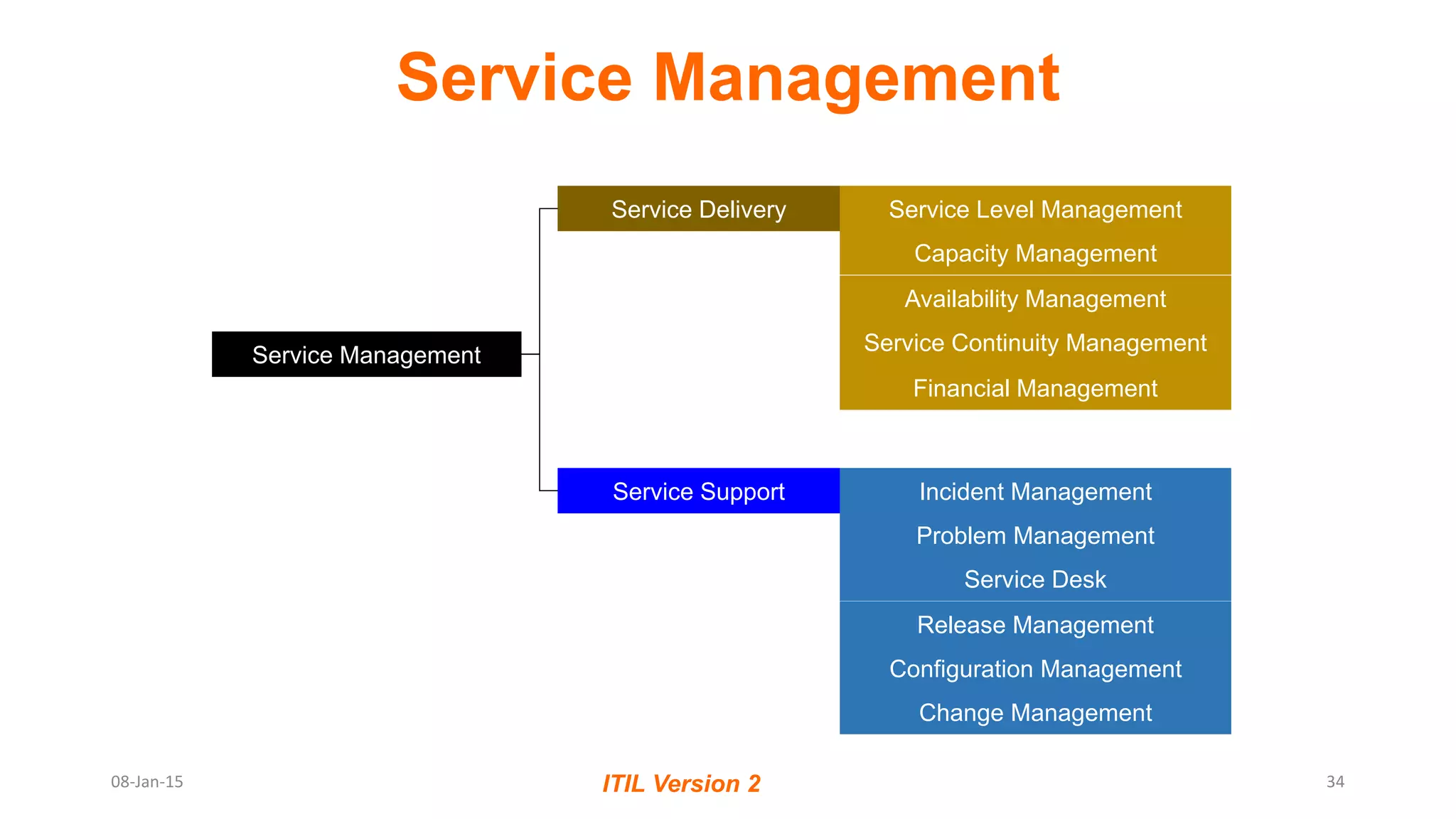
ITIL Version 2
Service Level Management
Capacity Management
Availability Management
Financial Management
Service Continuity Management
Incident Management
Problem Management
Service Desk
Configuration Management
Release Management
Service Management
Service Delivery
Service Support
Change Management
08-Jan-15 34
Service Management
Service Level Management (SLM)
 Customer requirements are
documented within the SLR (Service
Level Requirements) document
 The process is then responsible for
determining whether these
requirements are achievable by
reference to OLAs (Operational Level
Agreement) and Contracts
 This ensures that SLA targets are
achievable prior to customer sign off
 Gaps in capability are addressed
through a CSIP
SLA
Users
IT Service
Provider
Desktop
Network
Server
Network
Telephony
Security
Application
Database
Internal or 3rd party Technical Providers
OLA
ContractSLR
08-Jan-15 35
Service Desk
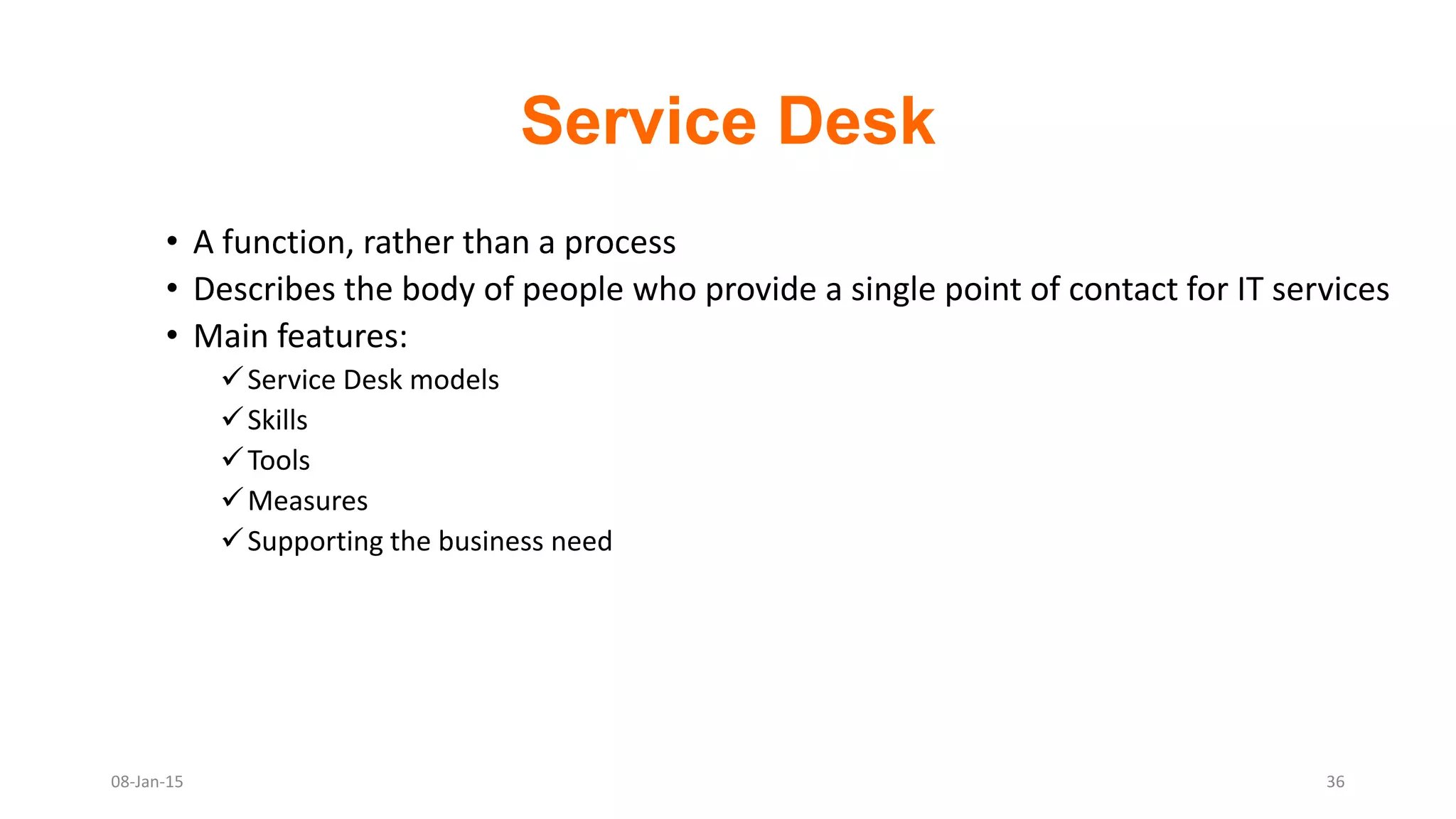
• A function, rather than a process
• Describes the body of people who provide a single point of contact for IT services
• Main features:
Service Desk models
Skills
Tools
Measures
Supporting the business need
08-Jan-15 36
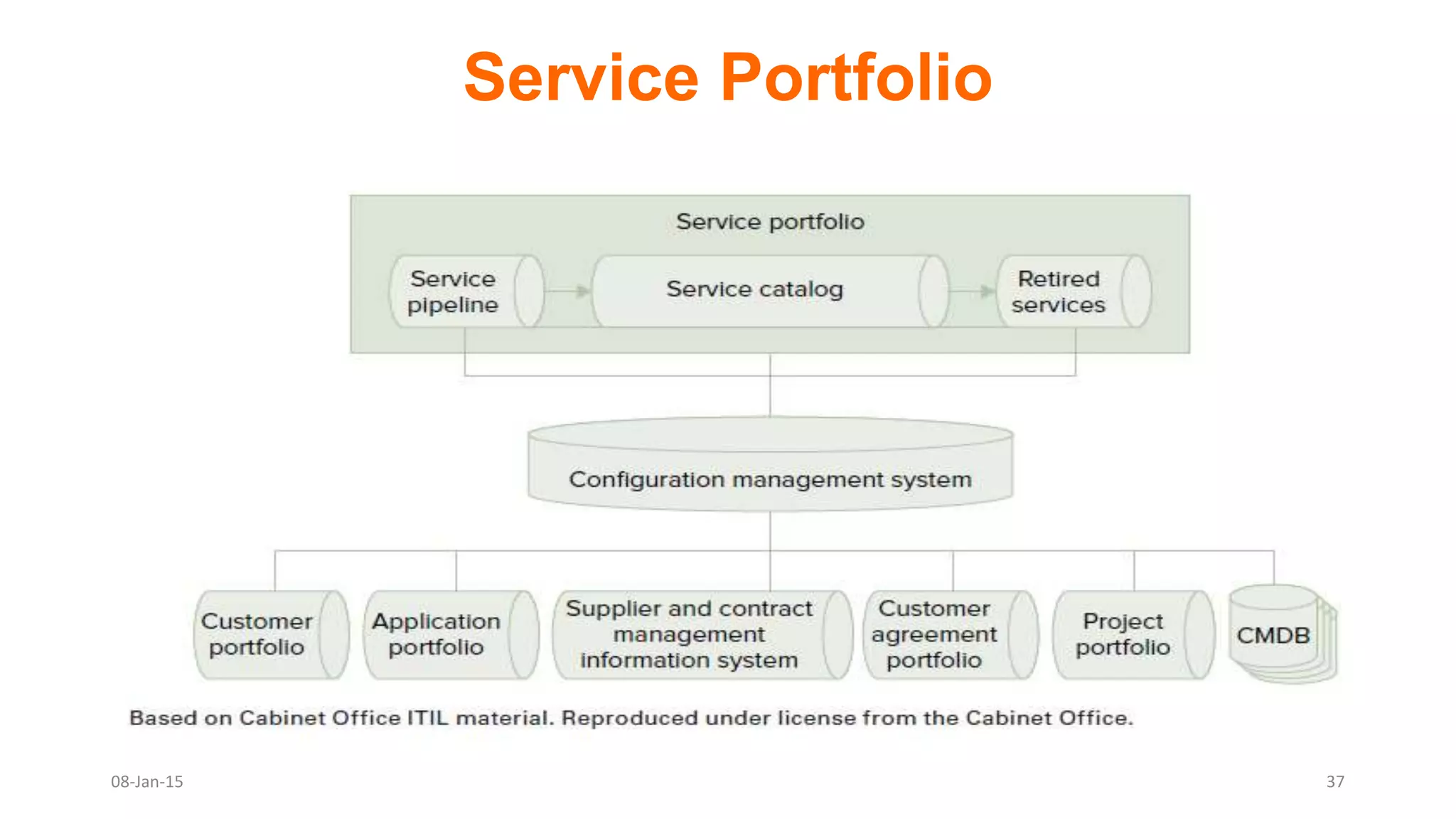
Service Portfolio
08-Jan-15 37
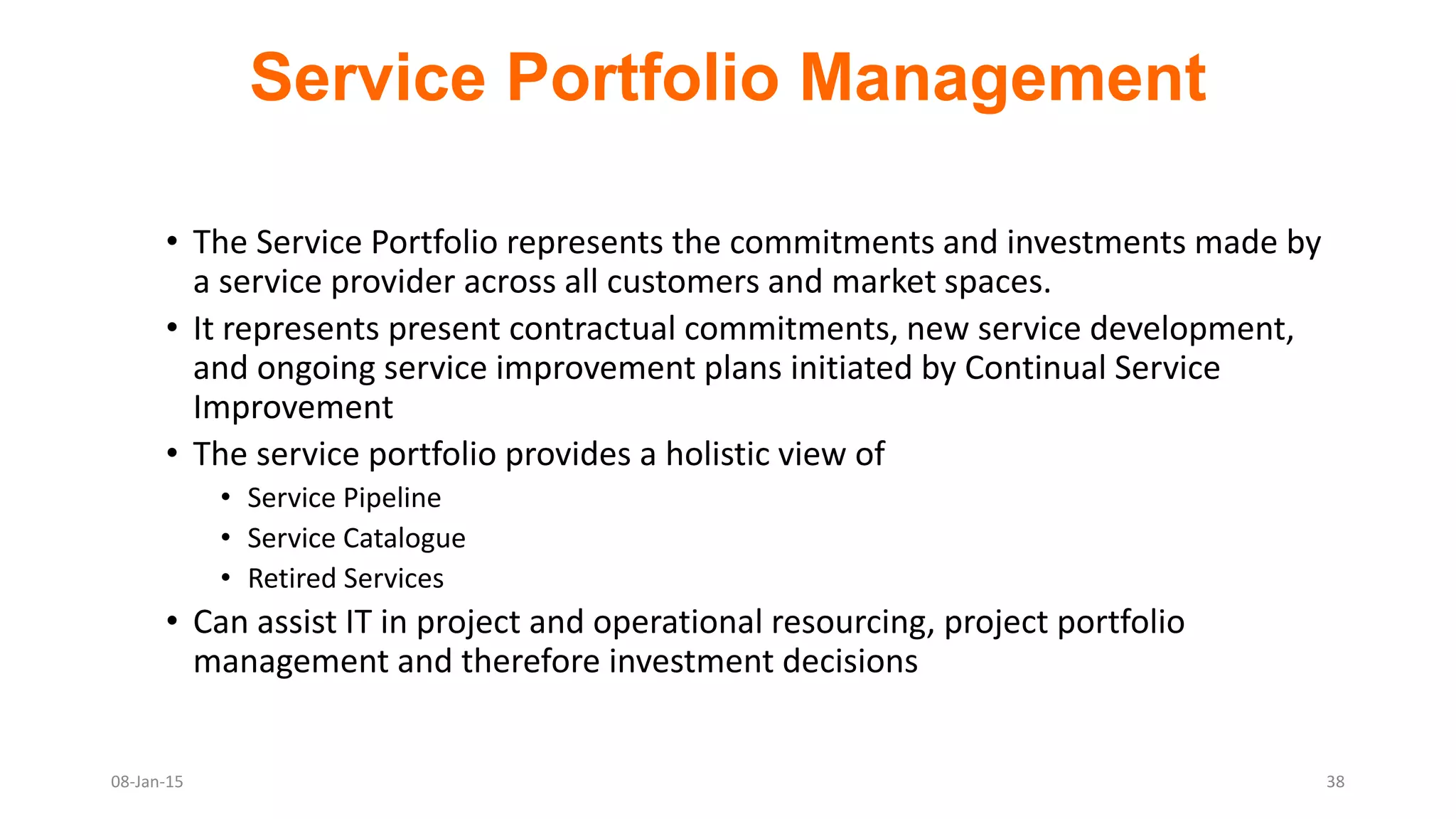
• The Service Portfolio represents the commitments and investments made by
a service provider across all customers and market spaces.
• It represents present contractual commitments, new service development,
and ongoing service improvement plans initiated by Continual Service
Improvement
• The service portfolio provides a holistic view of
• Service Pipeline
• Service Catalogue
• Retired Services
• Can assist IT in project and operational resourcing, project portfolio
management and therefore investment decisions
Service Portfolio Management
08-Jan-15 38
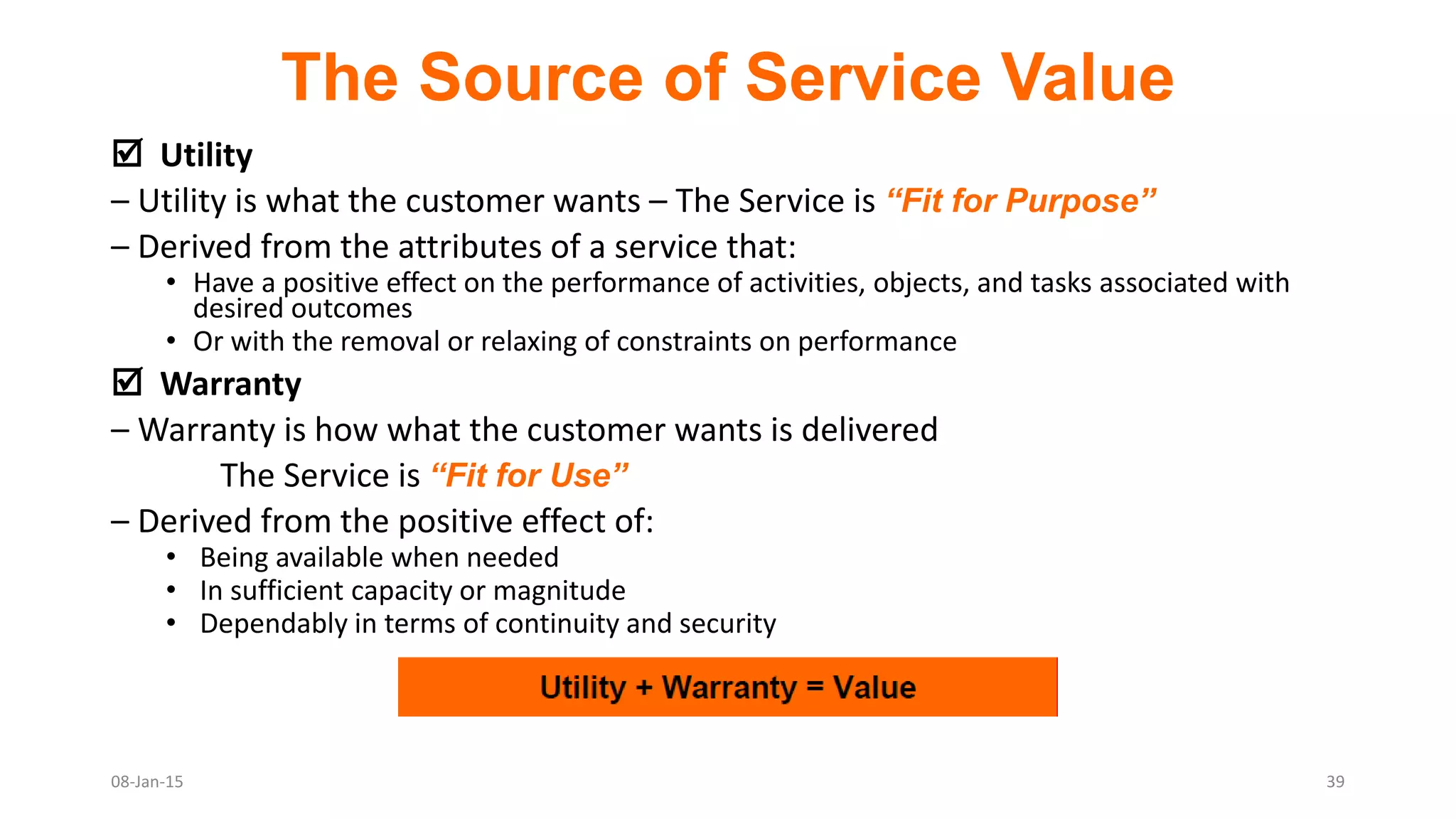
The Source of Service Value
 Utility
– Utility is what the customer wants – The Service is “Fit for Purpose”
– Derived from the attributes of a service that:
• Have a positive effect on the performance of activities, objects, and tasks associated with
desired outcomes
• Or with the removal or relaxing of constraints on performance
 Warranty
– Warranty is how what the customer wants is delivered
The Service is “Fit for Use”
– Derived from the positive effect of:
• Being available when needed
• In sufficient capacity or magnitude
• Dependably in terms of continuity and security
08-Jan-15 39
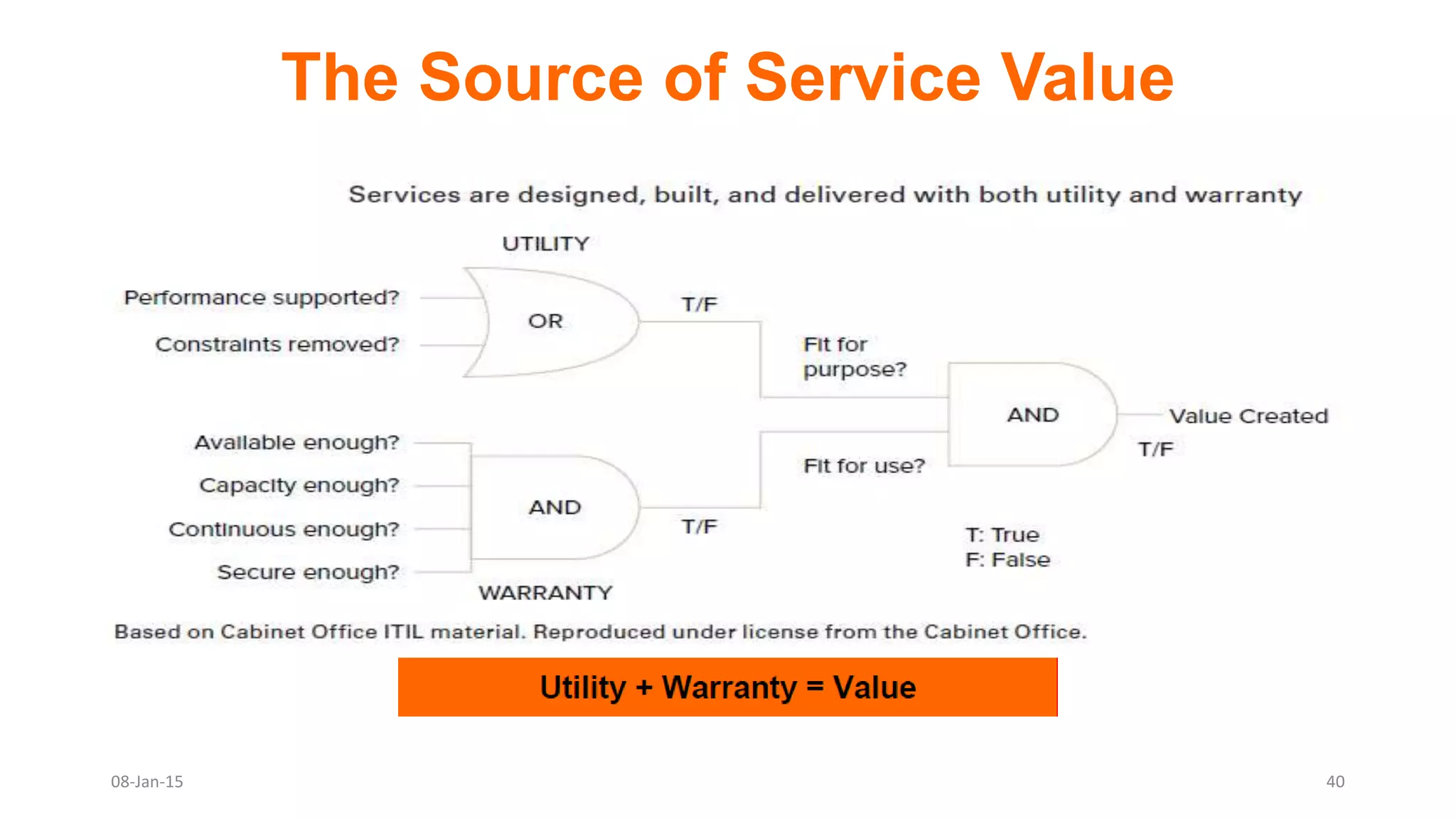
The Source of Service Value
08-Jan-15 40
Service Catalog
08-Jan-15
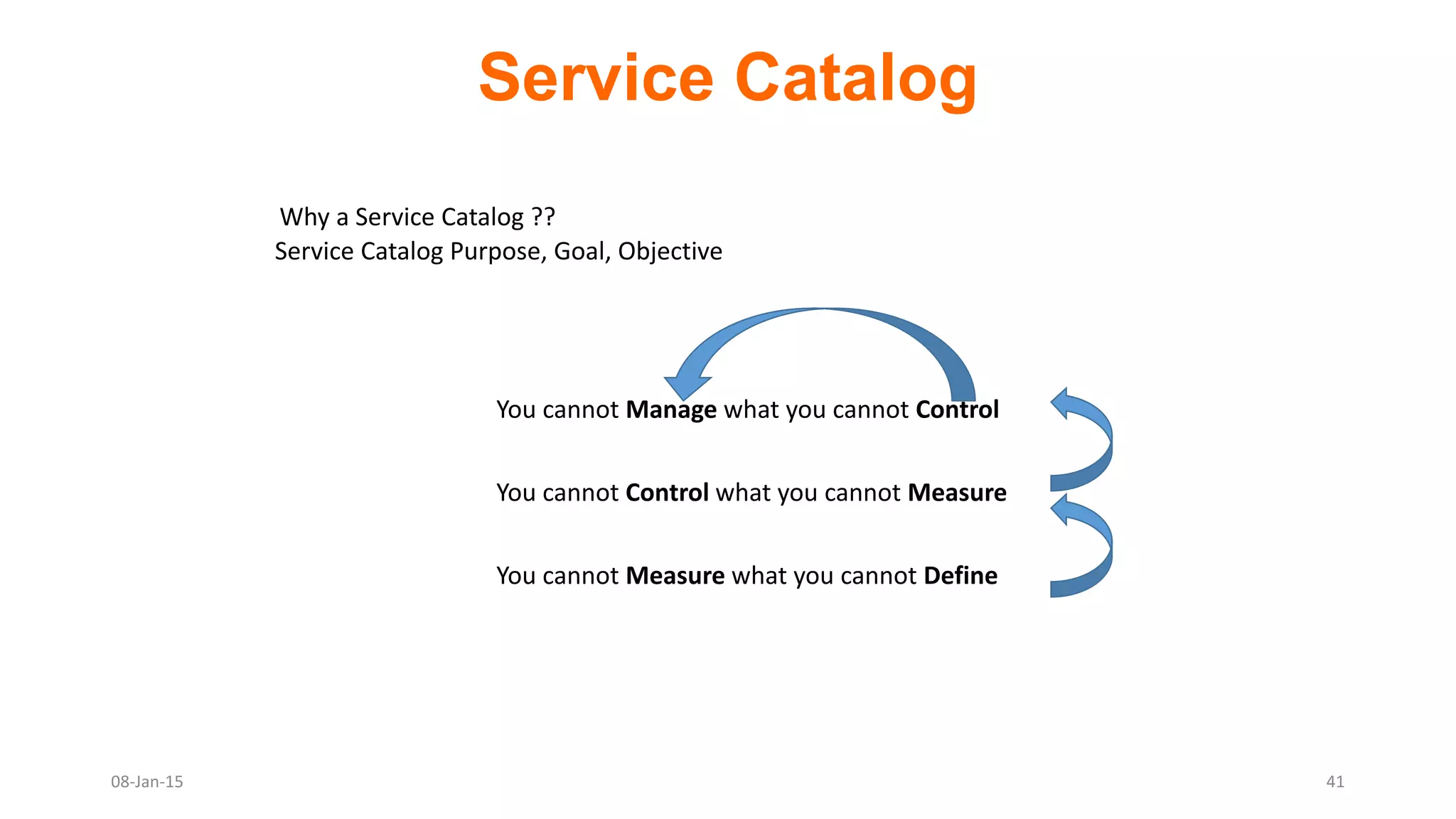
Why a Service Catalog ??
You cannot Manage what you cannot Control
You cannot Control what you cannot Measure
You cannot Measure what you cannot Define
Service Catalog Purpose, Goal, Objective
41
A Service Catalogue contains:
Details of the IT Services being provided
Details of the various groups who consume those services
Details of the technical elements necessary to deliver those services
High level view of expectations versus capabilities
Service Catalogue
08-Jan-15 42
Service Catalogue
08-Jan-15
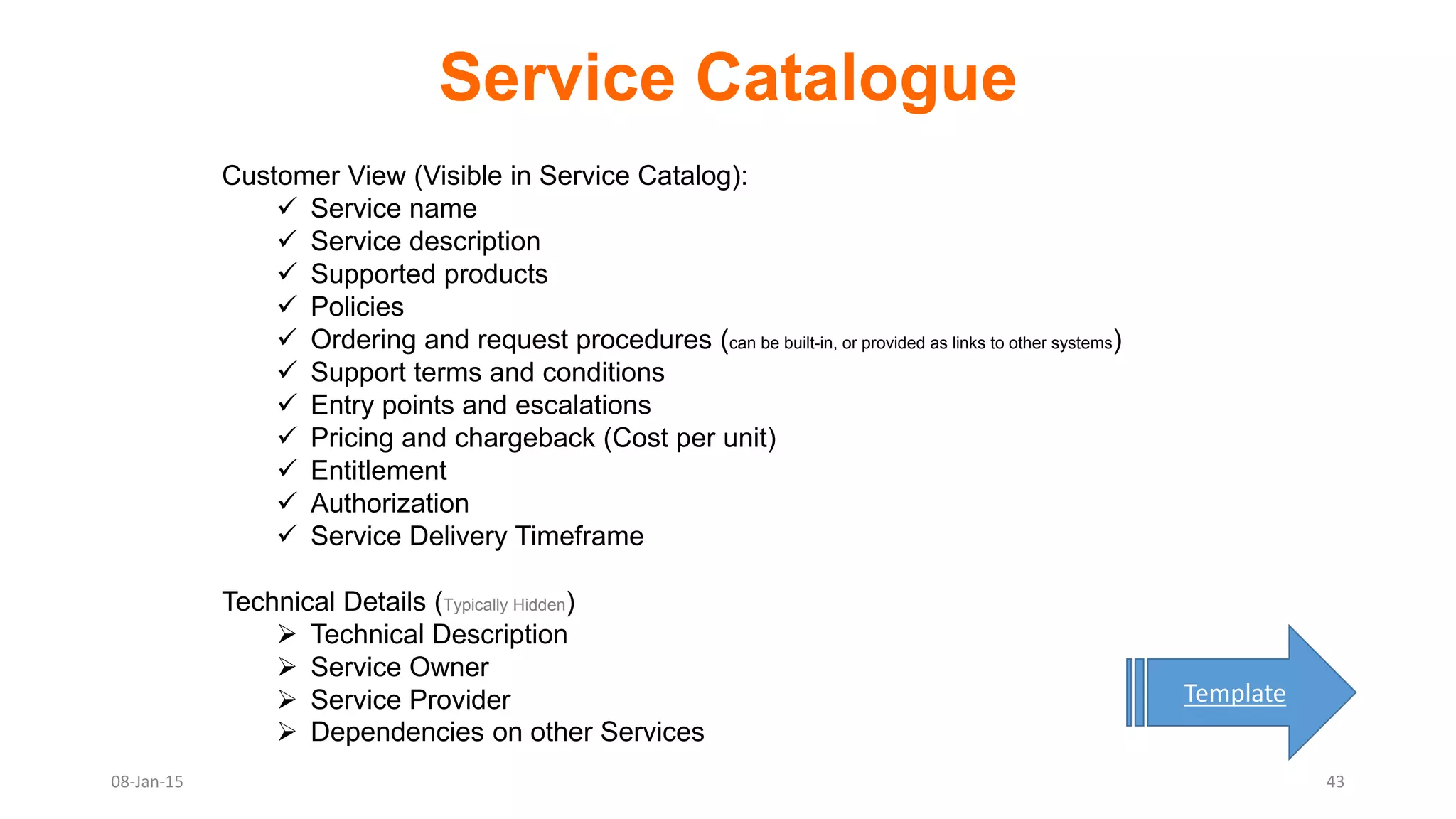
Customer View (Visible in Service Catalog):
 Service name
 Service description
 Supported products
 Policies
 Ordering and request procedures (can be built-in, or provided as links to other systems)
 Support terms and conditions
 Entry points and escalations
 Pricing and chargeback (Cost per unit)
 Entitlement
 Authorization
 Service Delivery Timeframe
Technical Details (Typically Hidden)
 Technical Description
 Service Owner
 Service Provider
 Dependencies on other Services
Template
43
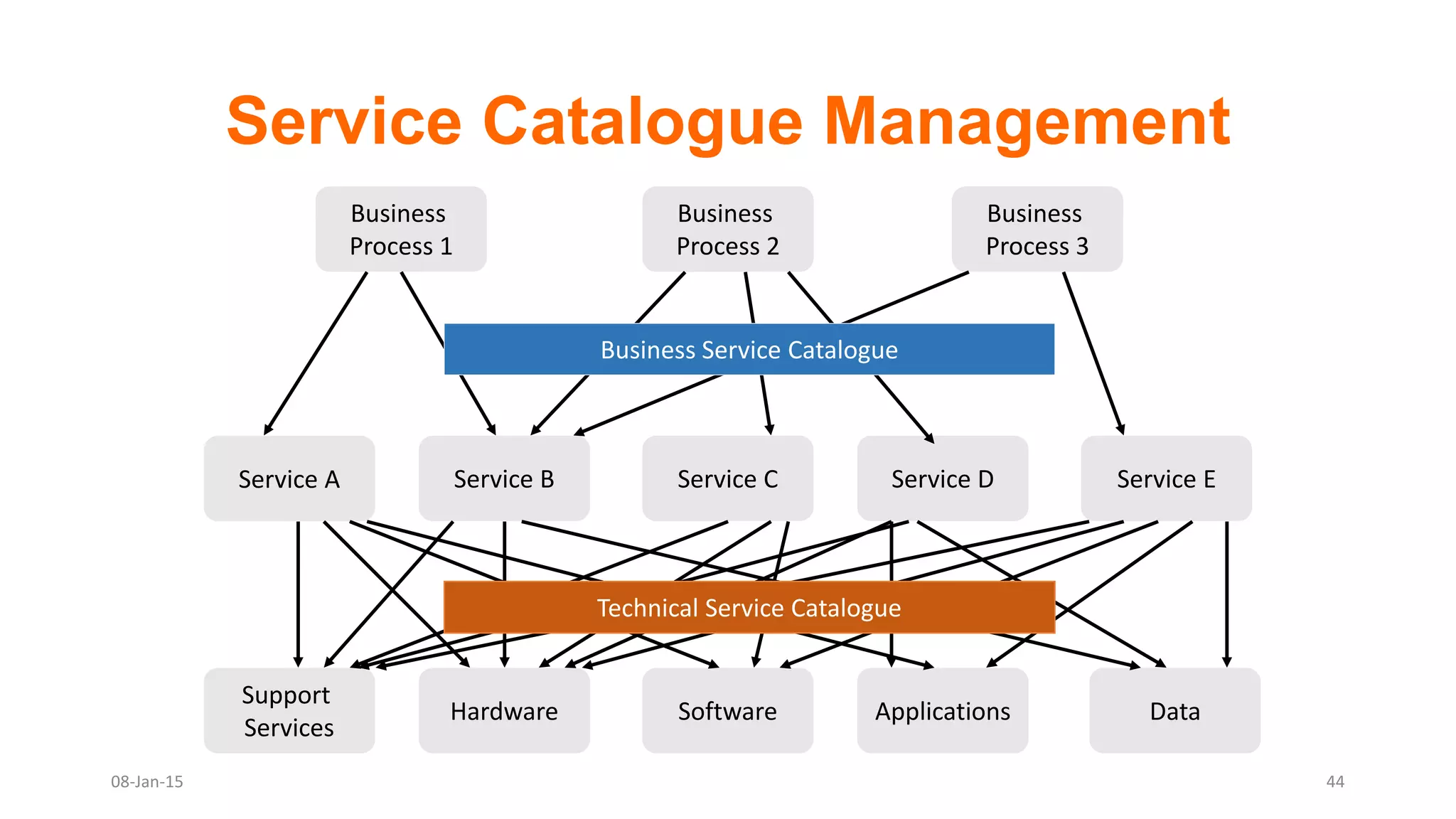
Service Catalogue Management
Business
Process 1
Business
Process 2
Business
Process 3
Service A Service B Service DService C Service E
Support
Services
Hardware Software Applications Data
Business Service Catalogue
Technical Service Catalogue
08-Jan-15 44
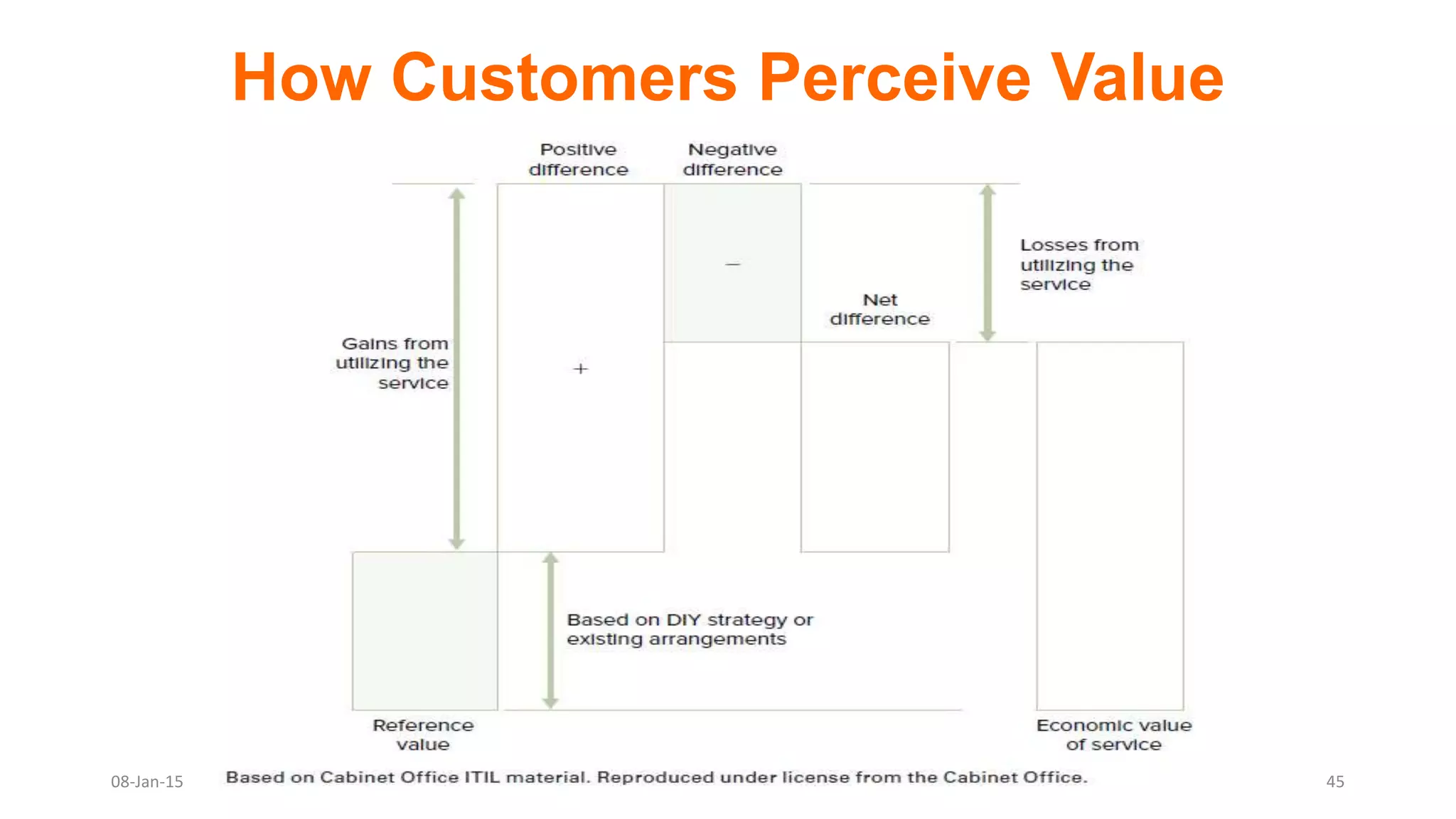
How Customers Perceive Value
08-Jan-15 45
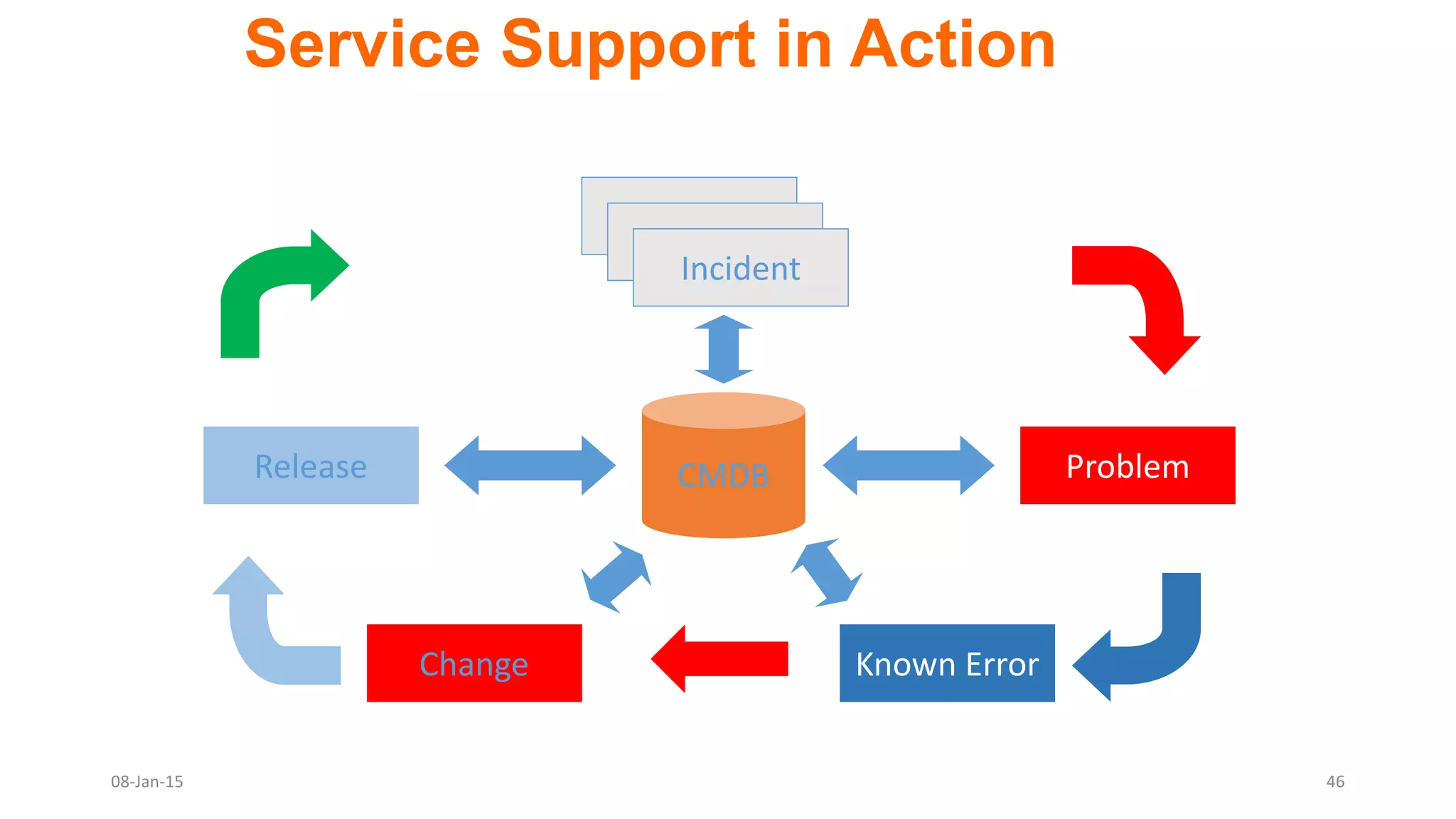
Incident
Problem
Known ErrorChange
Release CMDB
Service Support in Action
08-Jan-15 46
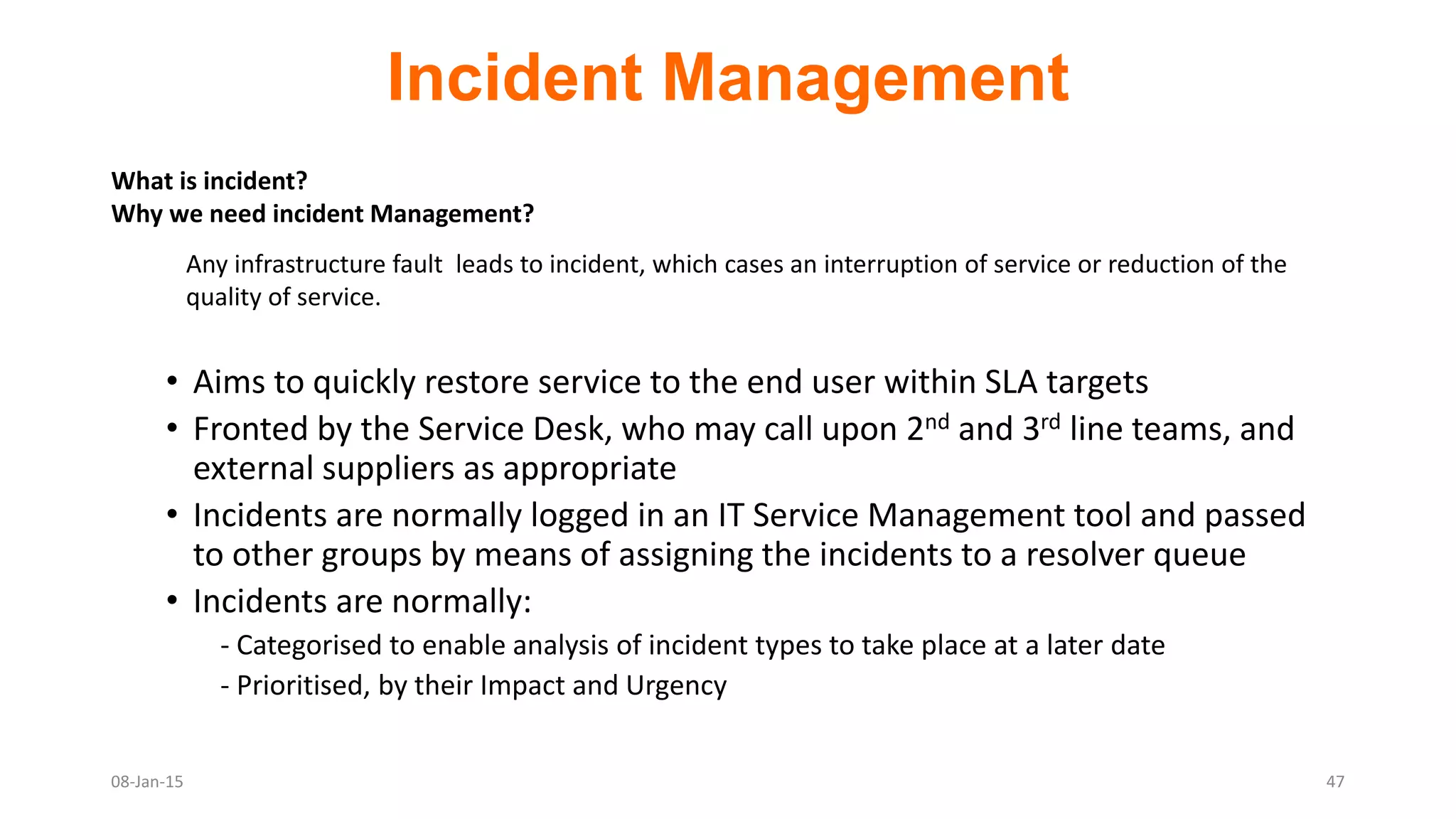
Incident Management
• Aims to quickly restore service to the end user within SLA targets
• Fronted by the Service Desk, who may call upon 2nd and 3rd line teams, and
external suppliers as appropriate
• Incidents are normally logged in an IT Service Management tool and passed
to other groups by means of assigning the incidents to a resolver queue
• Incidents are normally:
- Categorised to enable analysis of incident types to take place at a later date
- Prioritised, by their Impact and Urgency
08-Jan-15 47
What is incident?
Why we need incident Management?
Any infrastructure fault leads to incident, which cases an interruption of service or reduction of the
quality of service.
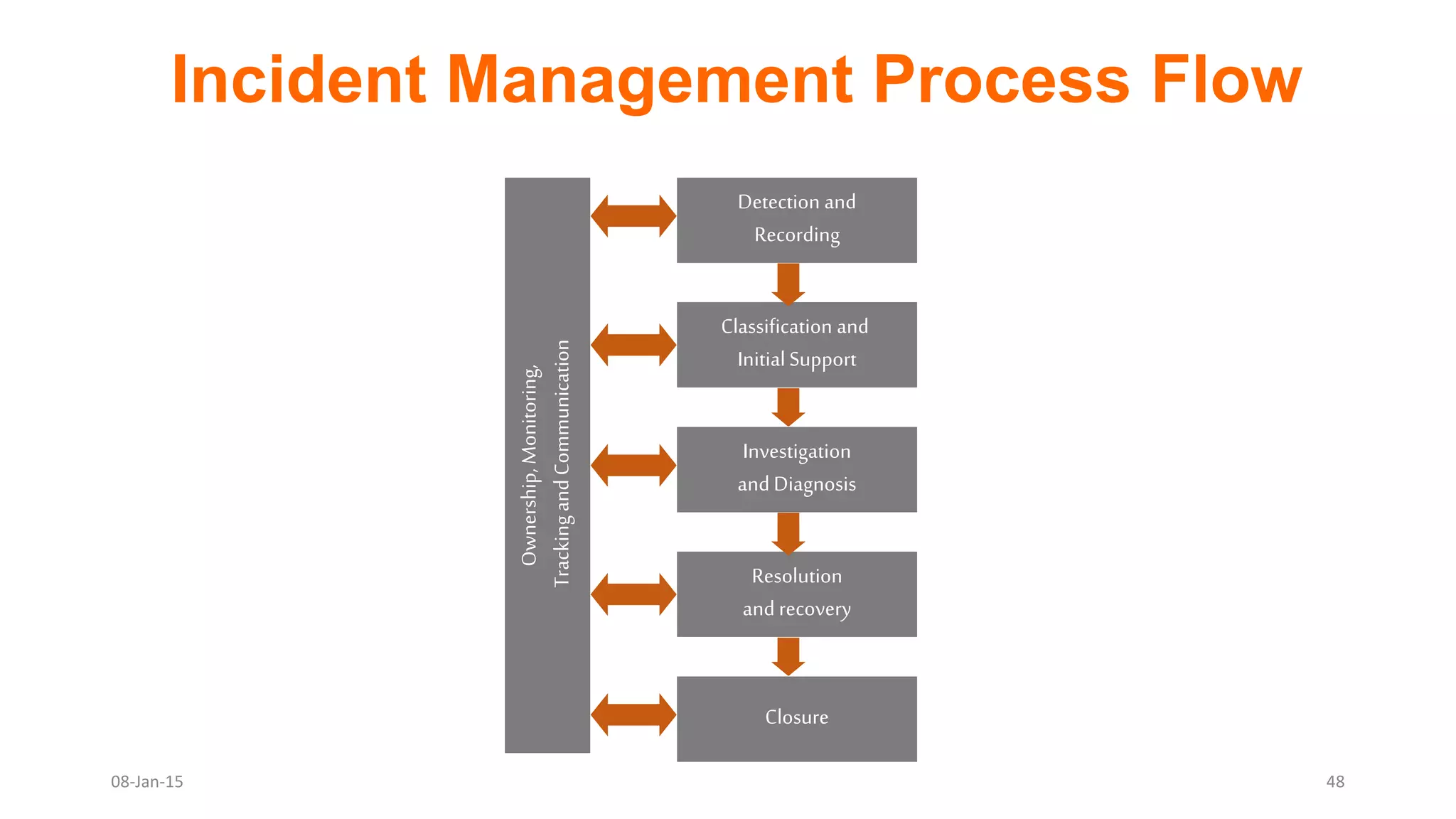
Classification and
InitialSupport
Incident Management Process Flow
Detection and
Recording
Investigation
and Diagnosis
Resolution
and recovery
Closure
Ownership,Monitoring,
TrackingandCommunication
08-Jan-15 48
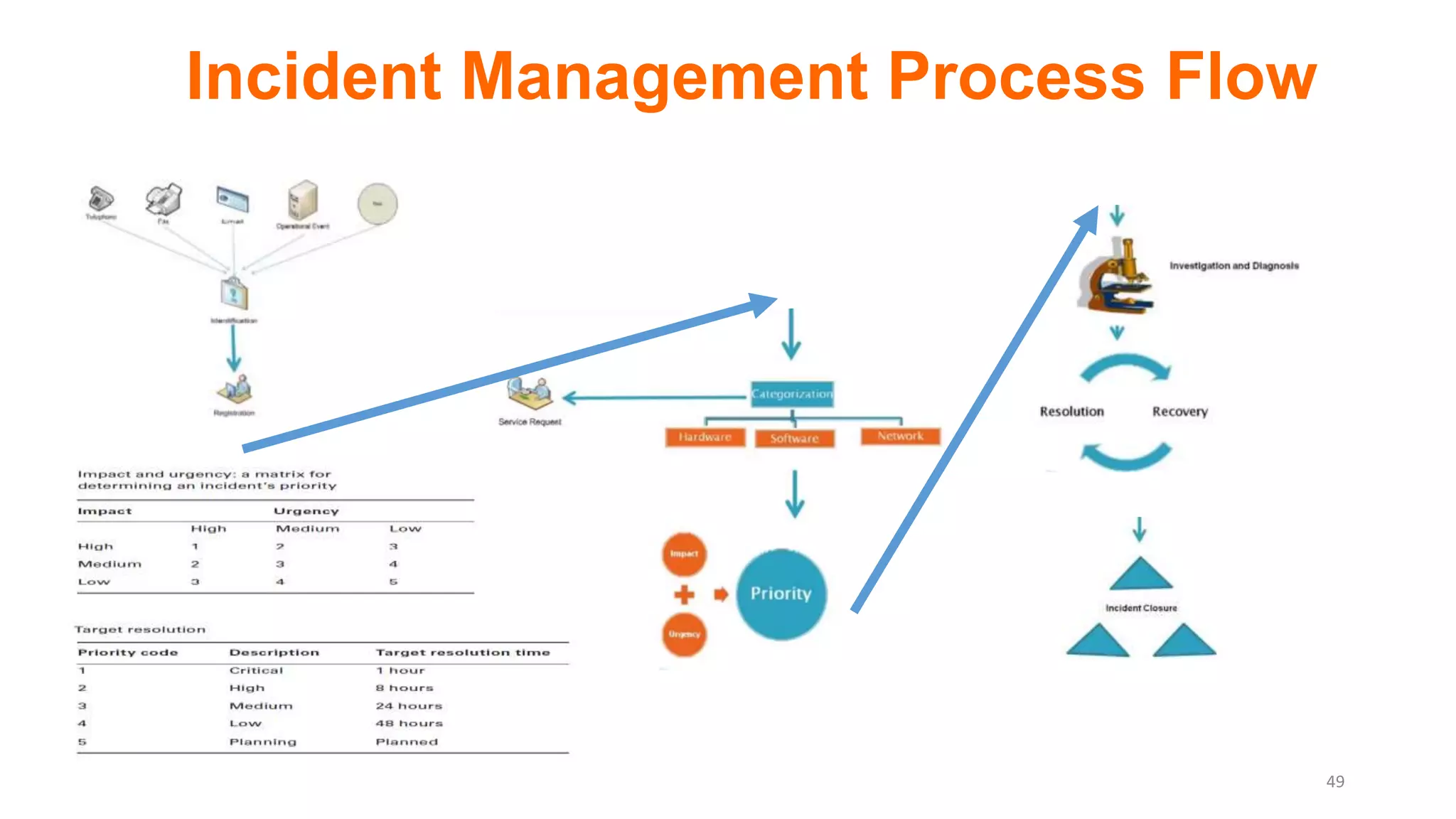
Incident Management Process Flow
49
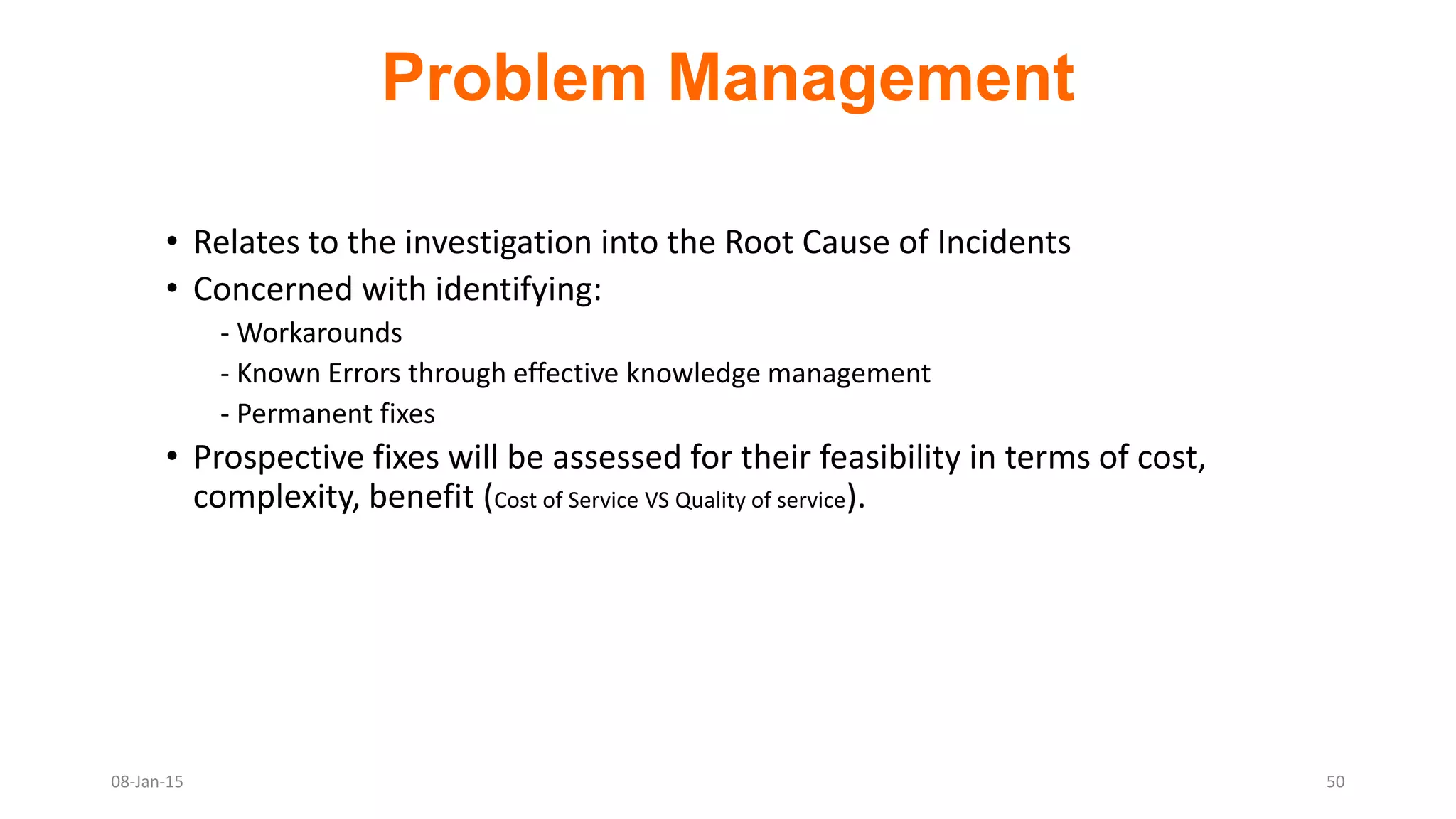
Problem Management
• Relates to the investigation into the Root Cause of Incidents
• Concerned with identifying:
- Workarounds
- Known Errors through effective knowledge management
- Permanent fixes
• Prospective fixes will be assessed for their feasibility in terms of cost,
complexity, benefit (Cost of Service VS Quality of service).
08-Jan-15 50
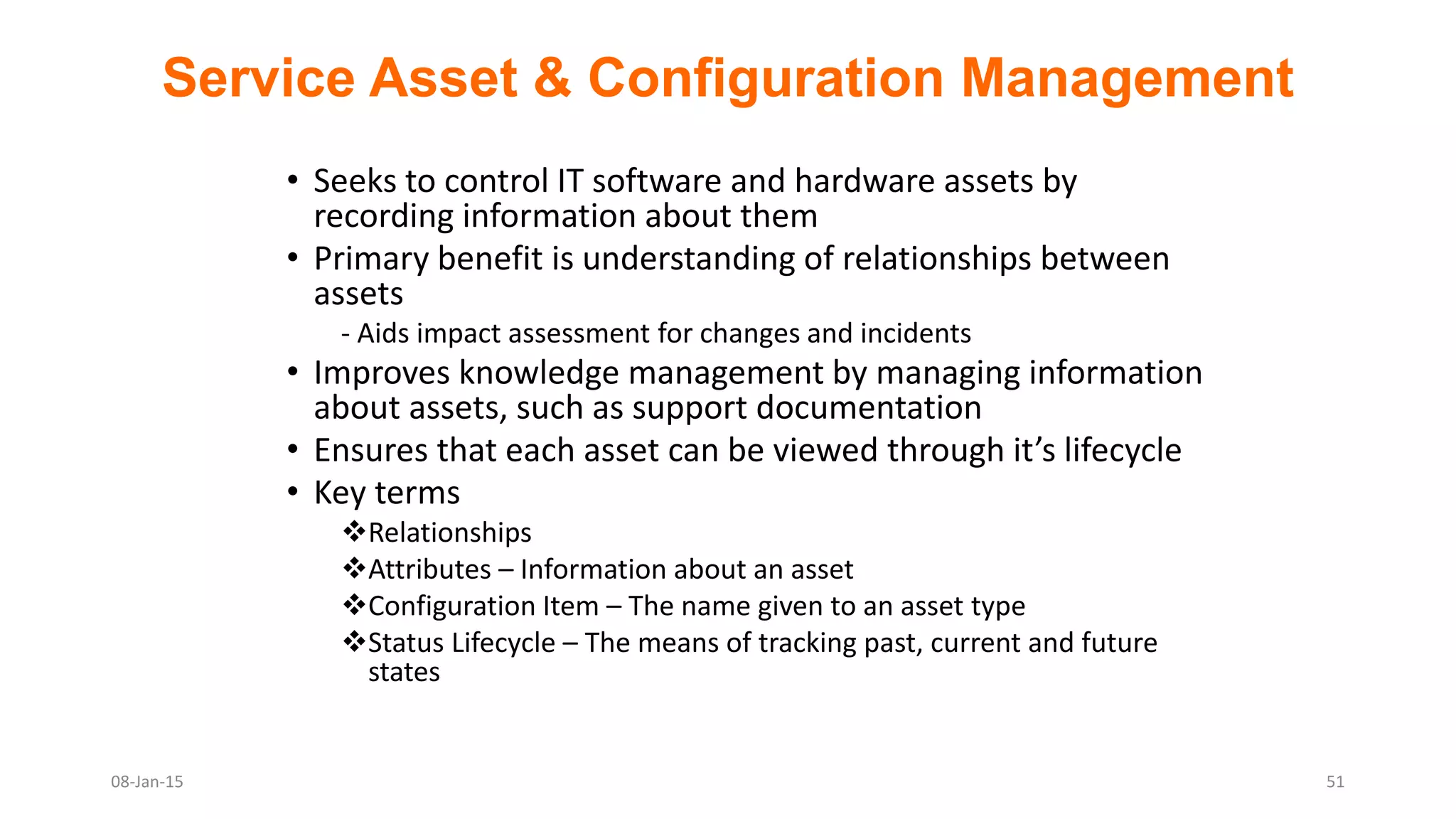
Service Asset & Configuration Management
• Seeks to control IT software and hardware assets by
recording information about them
• Primary benefit is understanding of relationships between
assets
- Aids impact assessment for changes and incidents
• Improves knowledge management by managing information
about assets, such as support documentation
• Ensures that each asset can be viewed through it’s lifecycle
• Key terms
Relationships
Attributes – Information about an asset
Configuration Item – The name given to an asset type
Status Lifecycle – The means of tracking past, current and future
states
08-Jan-15 51
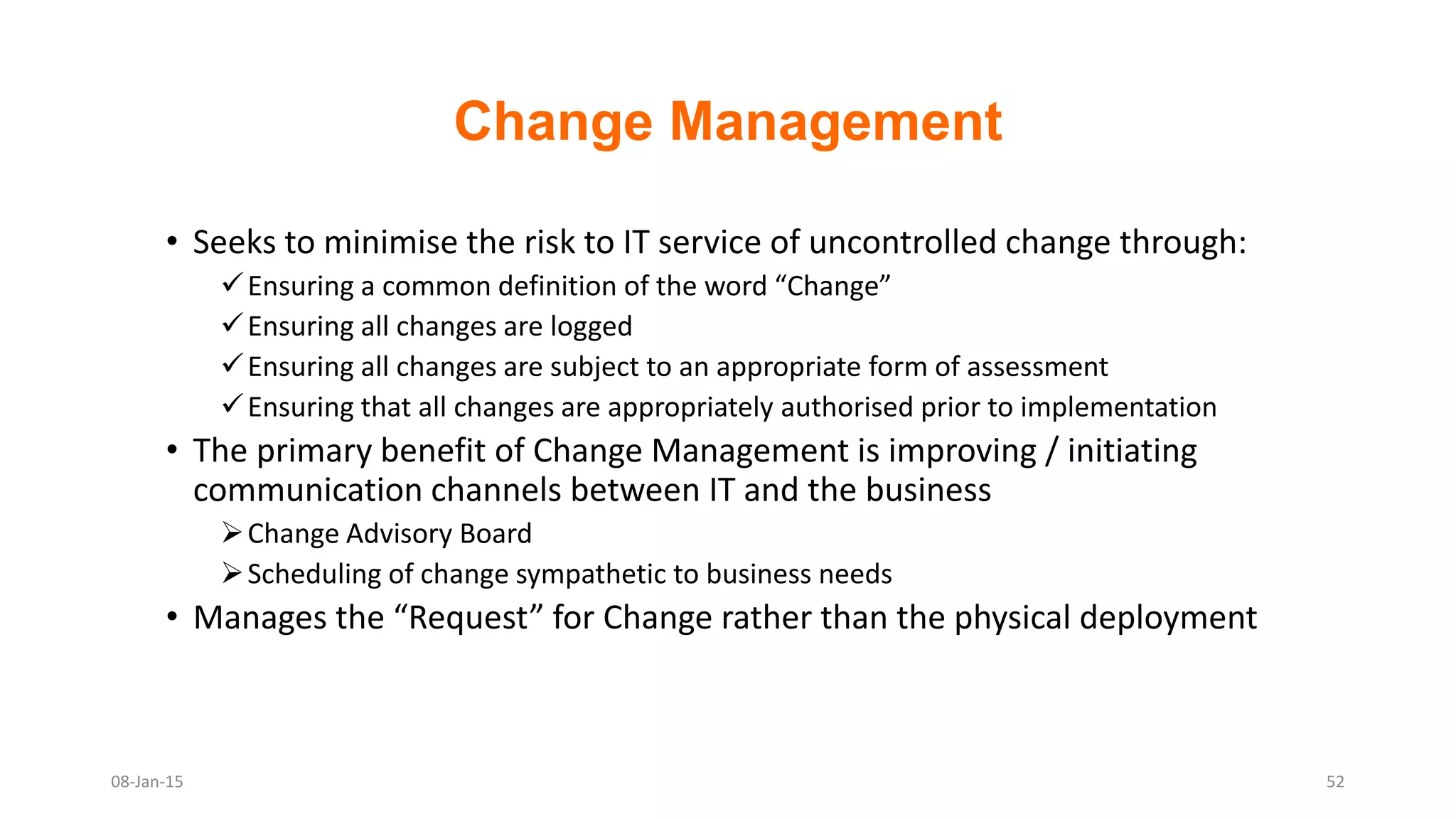
Change Management
• Seeks to minimise the risk to IT service of uncontrolled change through:
Ensuring a common definition of the word “Change”
Ensuring all changes are logged
Ensuring all changes are subject to an appropriate form of assessment
Ensuring that all changes are appropriately authorised prior to implementation
• The primary benefit of Change Management is improving / initiating
communication channels between IT and the business
Change Advisory Board
Scheduling of change sympathetic to business needs
• Manages the “Request” for Change rather than the physical deployment
08-Jan-15 52
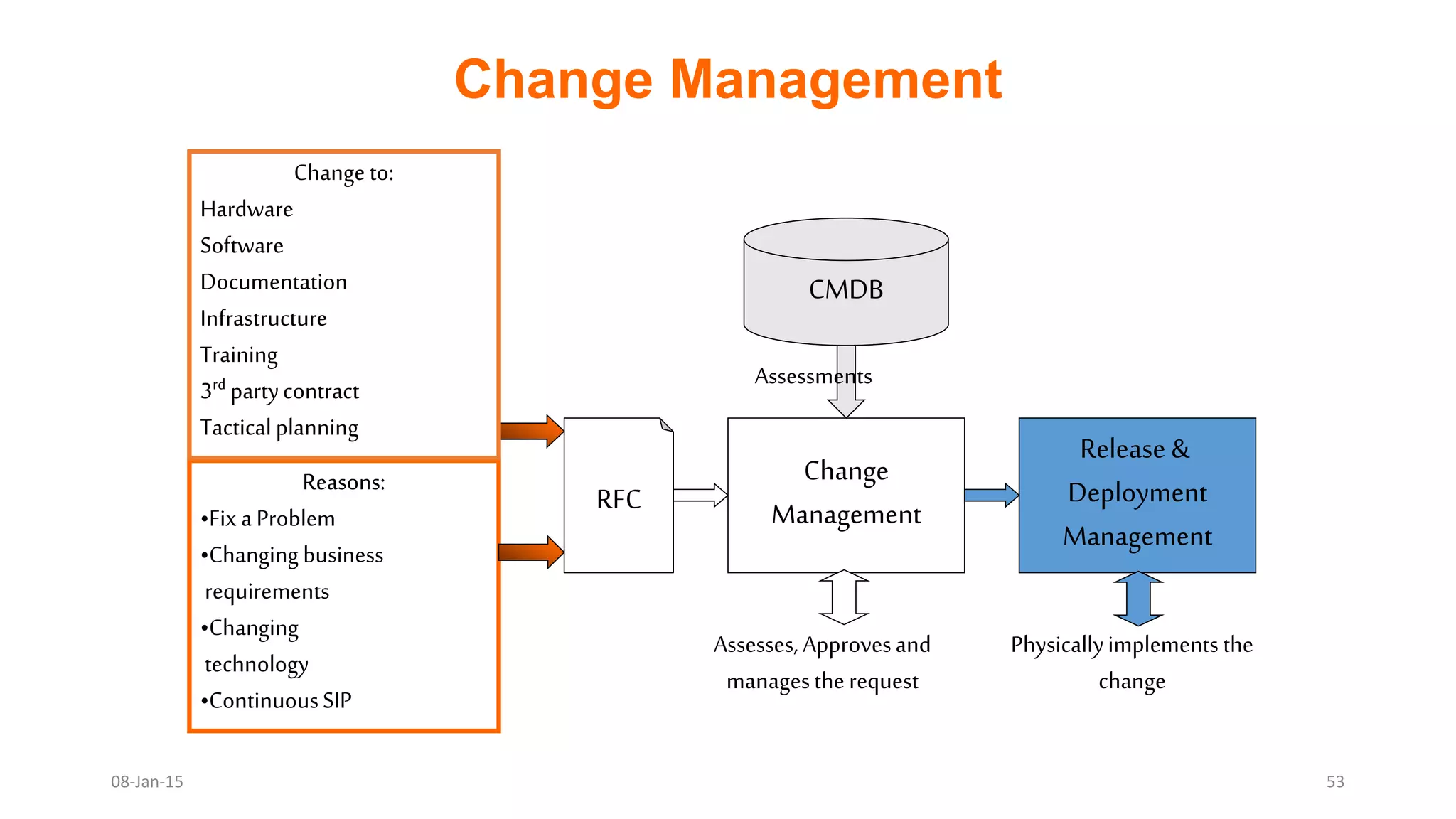
Assesses, Approvesand
managesthe request
Change Management
Change
ManagementRFC
CMDB
Assessments
Reasons:
•Fix aProblem
•Changing business
requirements
•Changing
technology
•ContinuousSIP
Changeto:
Hardware
Software
Documentation
Infrastructure
Training
3rd partycontract
Tacticalplanning
Physicallyimplements the
change
Release &
Deployment
Management
08-Jan-15 53
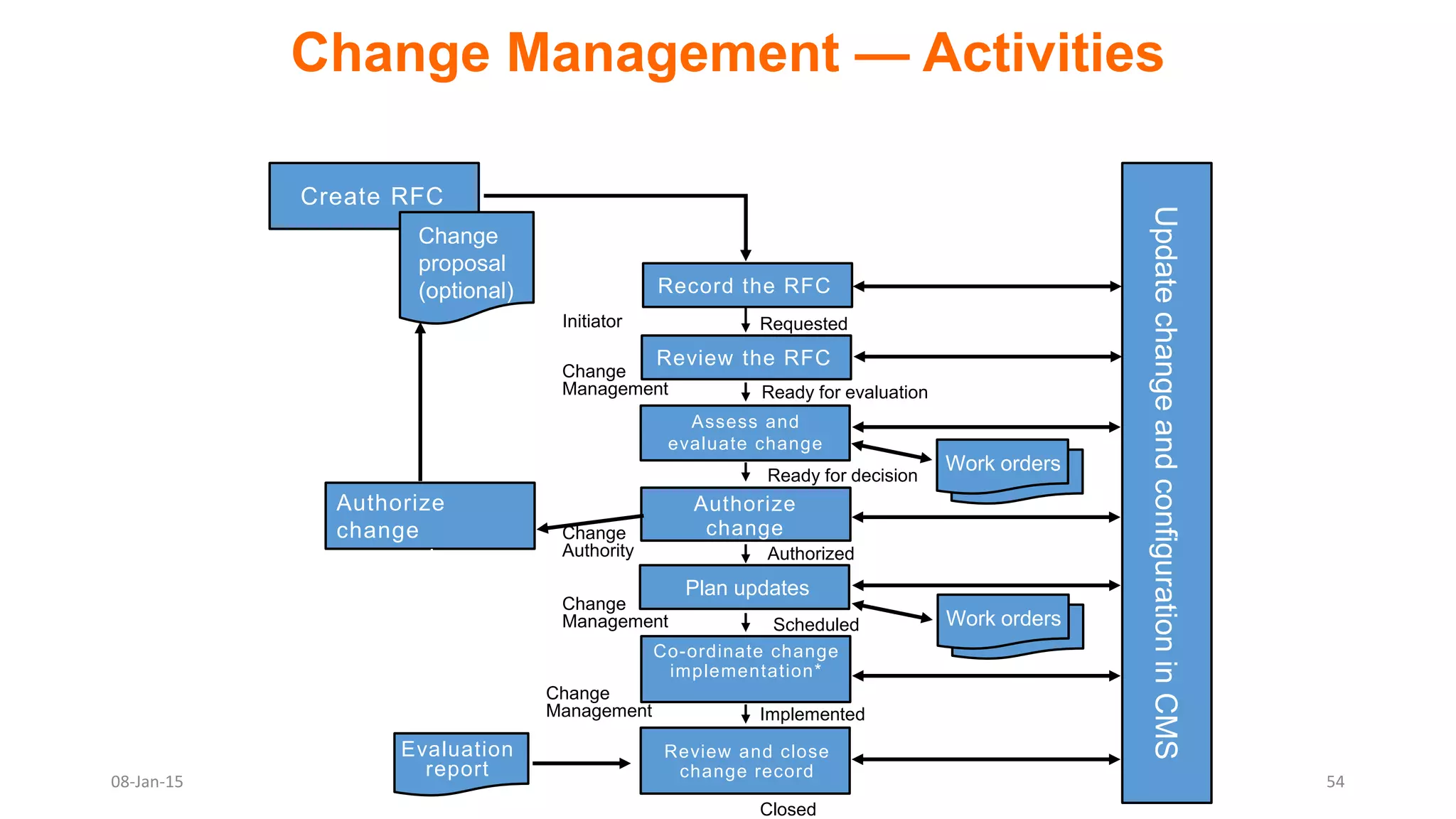
Change Management — Activities
Initiator Requested
Record the RFC
Change
Management Ready for evaluation
Review the RFC
Ready for decision
Assess and
evaluate change
Change
Management Scheduled
Plan updates
Change
Management Implemented
Co-ordinate change
implementation*
Closed
Review and close
change record
Evaluation
report
Work orders
Work orders
UpdatechangeandconfigurationinCMS
Authorized
Change
Authority
Authorize
change
Authorize
change
proposal
Create RFC
Change
proposal
(optional)
08-Jan-15 54
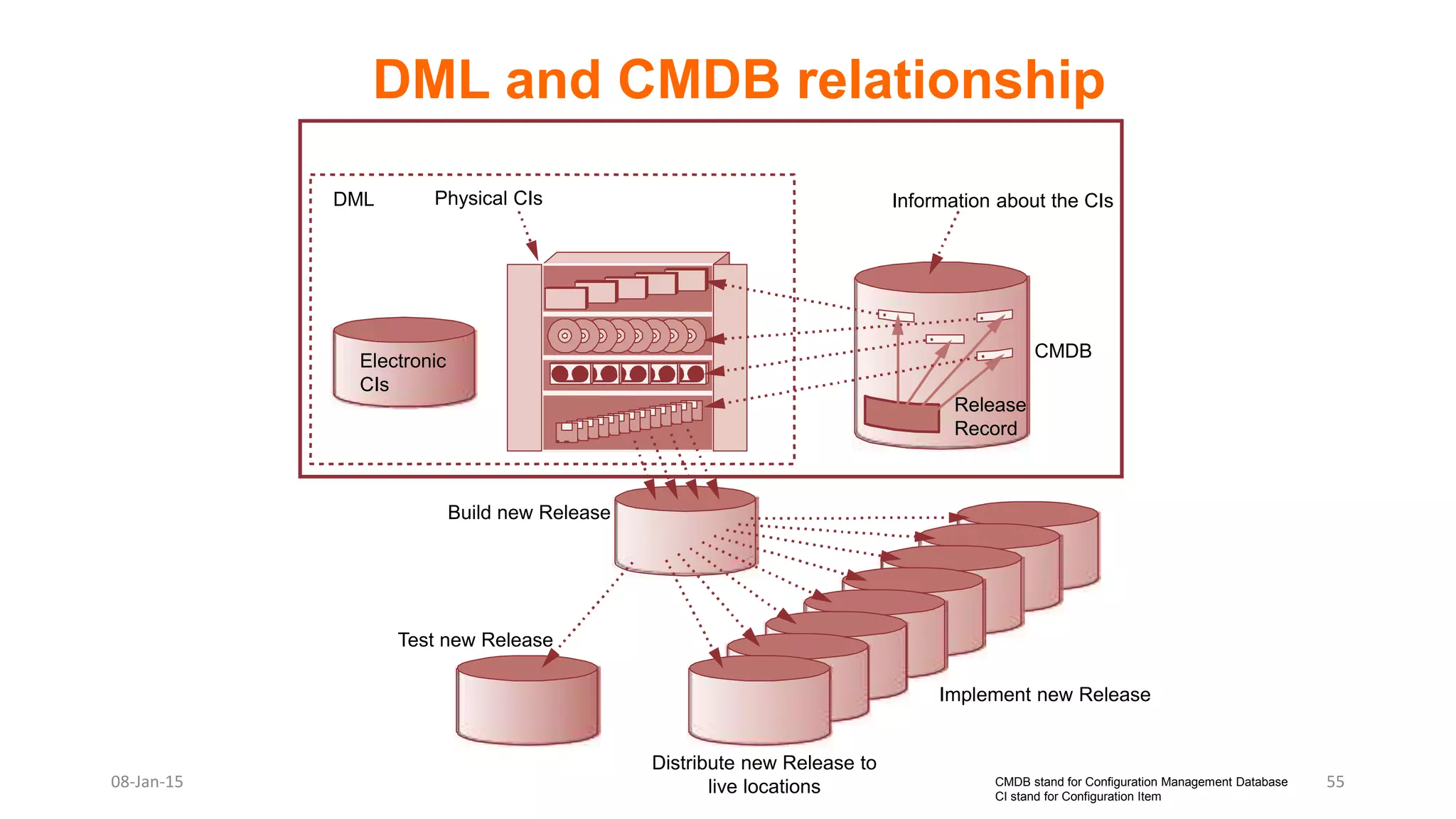
CMDB
Information about the CIsPhysical CIsDML
Release
Record
Electronic
CIs
Build new Release
Test new Release
Implement new Release
Distribute new Release to
live locations
DML and CMDB relationship
08-Jan-15 55CMDB stand for Configuration Management Database
CI stand for Configuration Item
Release & Deployment Management
• Focussed upon the physical aspects of delivering a change
• Commonly misinterpreted as focussing solely on software / application
- Principles apply equally to hardware, documentation or any other type of change
08-Jan-15 56
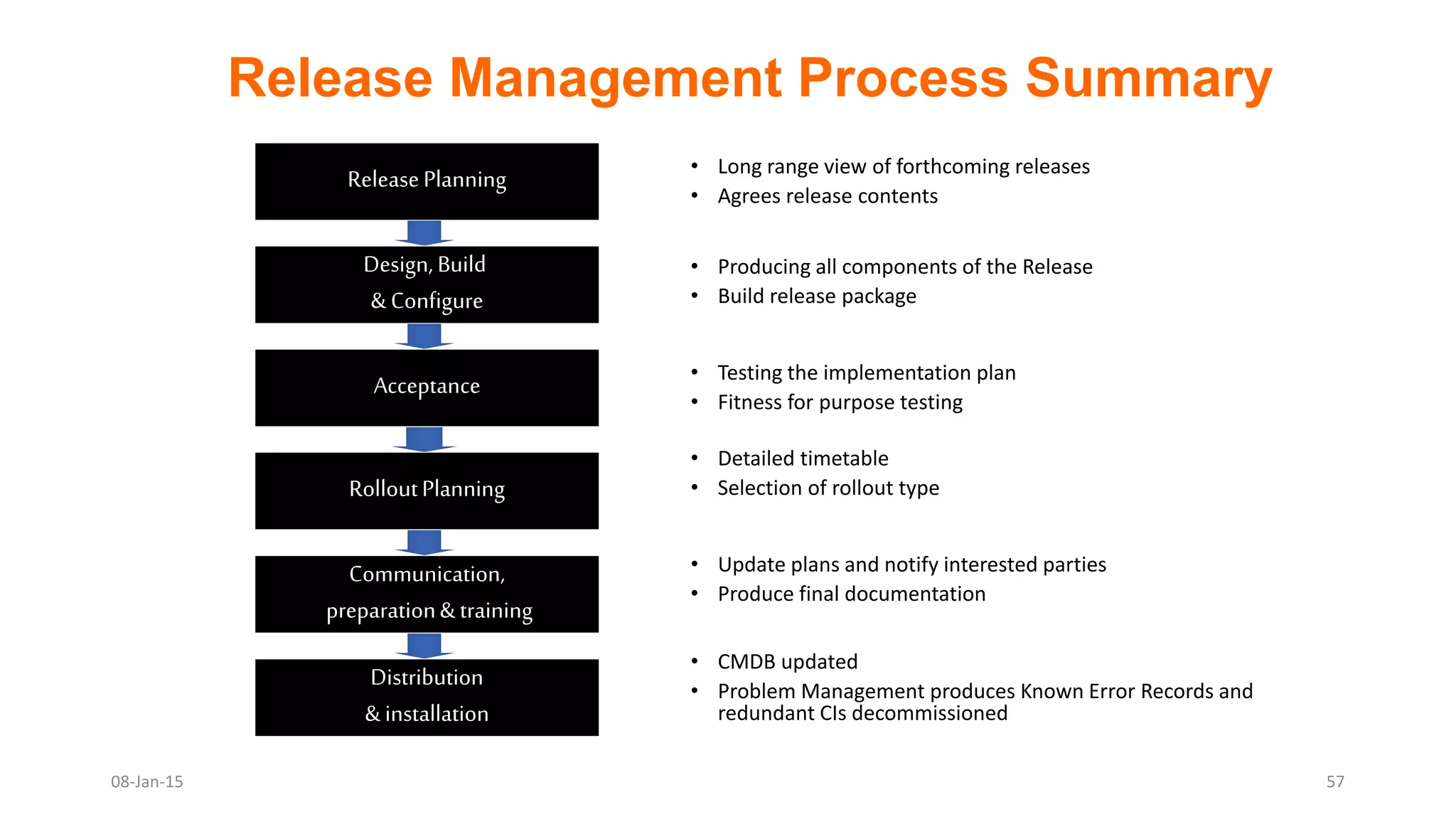
Release Management Process Summary
• Long range view of forthcoming releases
• Agrees release contents
• Producing all components of the Release
• Build release package
• Testing the implementation plan
• Fitness for purpose testing
• Detailed timetable
• Selection of rollout type
• Update plans and notify interested parties
• Produce final documentation
• CMDB updated
• Problem Management produces Known Error Records and
redundant CIs decommissioned
Communication,
preparation& training
ReleasePlanning
RolloutPlanning
Acceptance
Design, Build
& Configure
Distribution
& installation
08-Jan-15 57
IT Financial Management
• Focussed upon understanding IT costs
o Where costs are being spent
What are the biggest IT costs in your organisation?
o Identification of cost-effective services and support techniques
• Three main elements
Budgeting
Accounting
Charging
• Provides a formal basis for the Business – Service Provider relationship
• Can help IT influence user behaviour through demand management
08-Jan-15 58
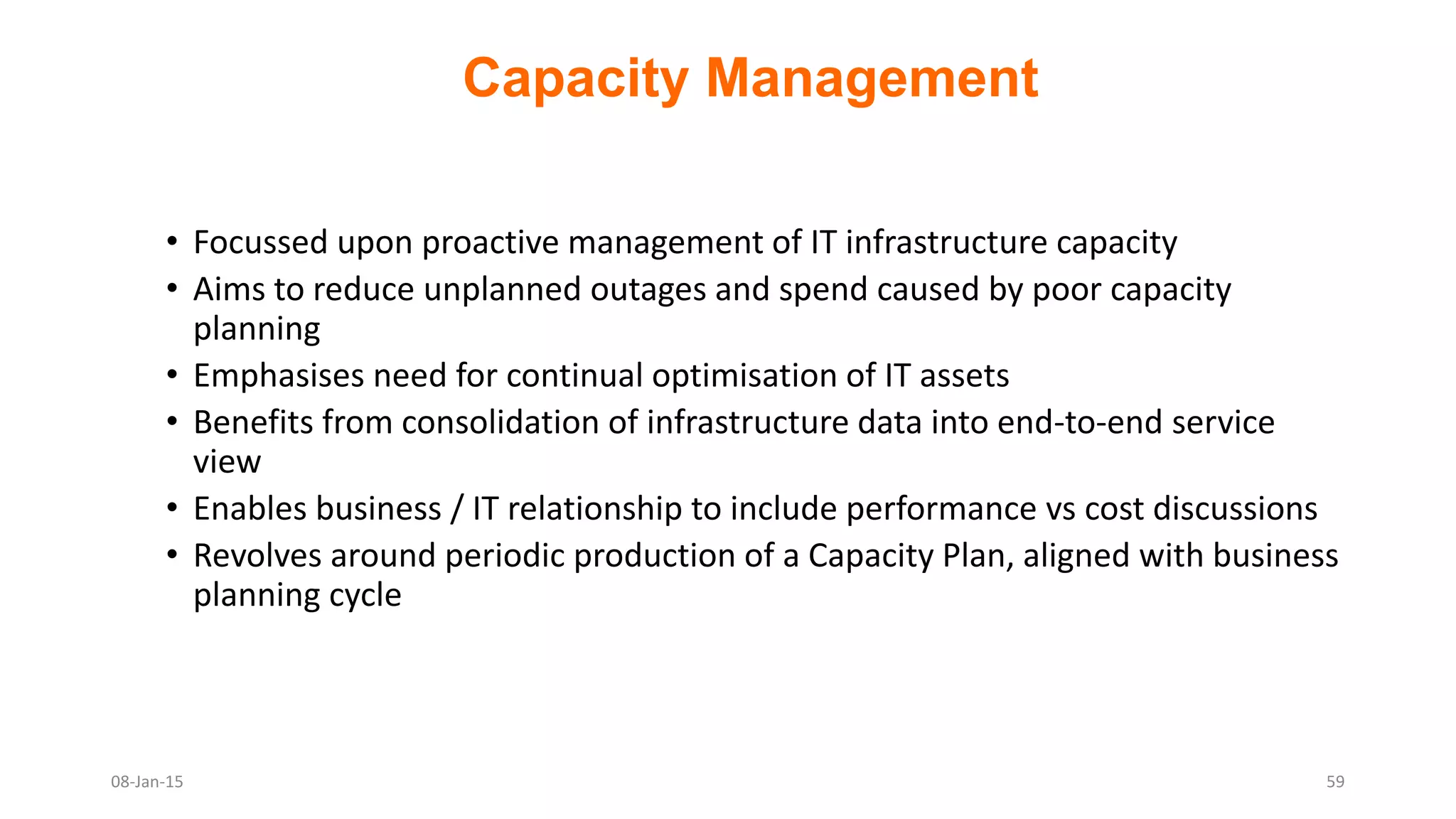
Capacity Management
• Focussed upon proactive management of IT infrastructure capacity
• Aims to reduce unplanned outages and spend caused by poor capacity
planning
• Emphasises need for continual optimisation of IT assets
• Benefits from consolidation of infrastructure data into end-to-end service
view
• Enables business / IT relationship to include performance vs cost discussions
• Revolves around periodic production of a Capacity Plan, aligned with business
planning cycle
08-Jan-15 59
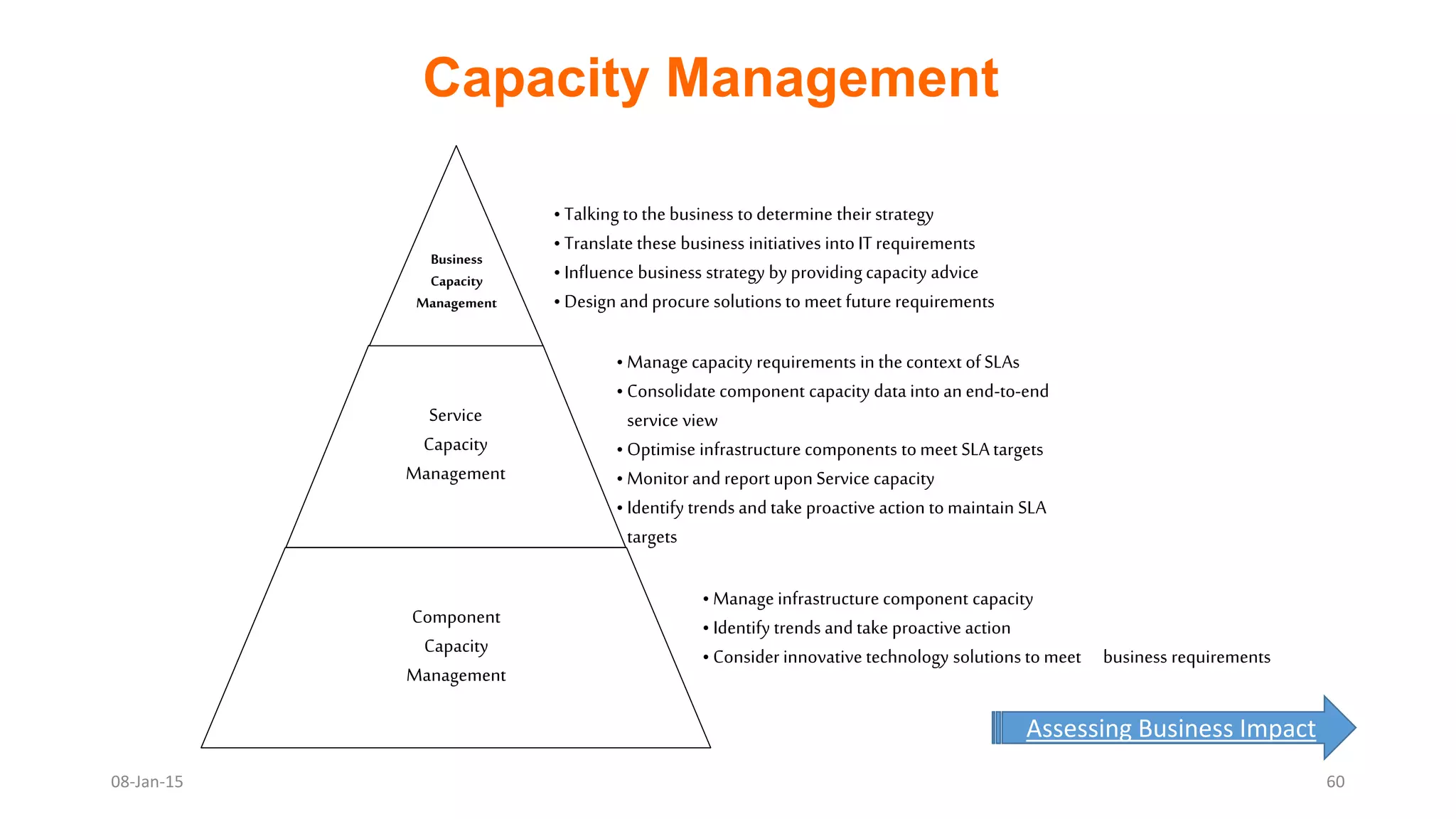
Capacity Management
Component
Capacity
Management
Service
Capacity
Management
Business
Capacity
Management
• Talking tothe business todetermine their strategy
• Translate these business initiatives intoIT requirements
• Influence business strategy by providingcapacity advice
• Design andprocure solutions to meet future requirements
• Manage capacity requirements in the context ofSLAs
• Consolidate component capacity data into an end-to-end
service view
• Optimise infrastructure components tomeet SLAtargets
• Monitorandreport upon Service capacity
• Identify trends andtake proactive action tomaintain SLA
targets
• Manage infrastructure component capacity
• Identify trends andtake proactive action
• Consider innovative technology solutions to meet business requirements
08-Jan-15 60
Assessing Business Impact
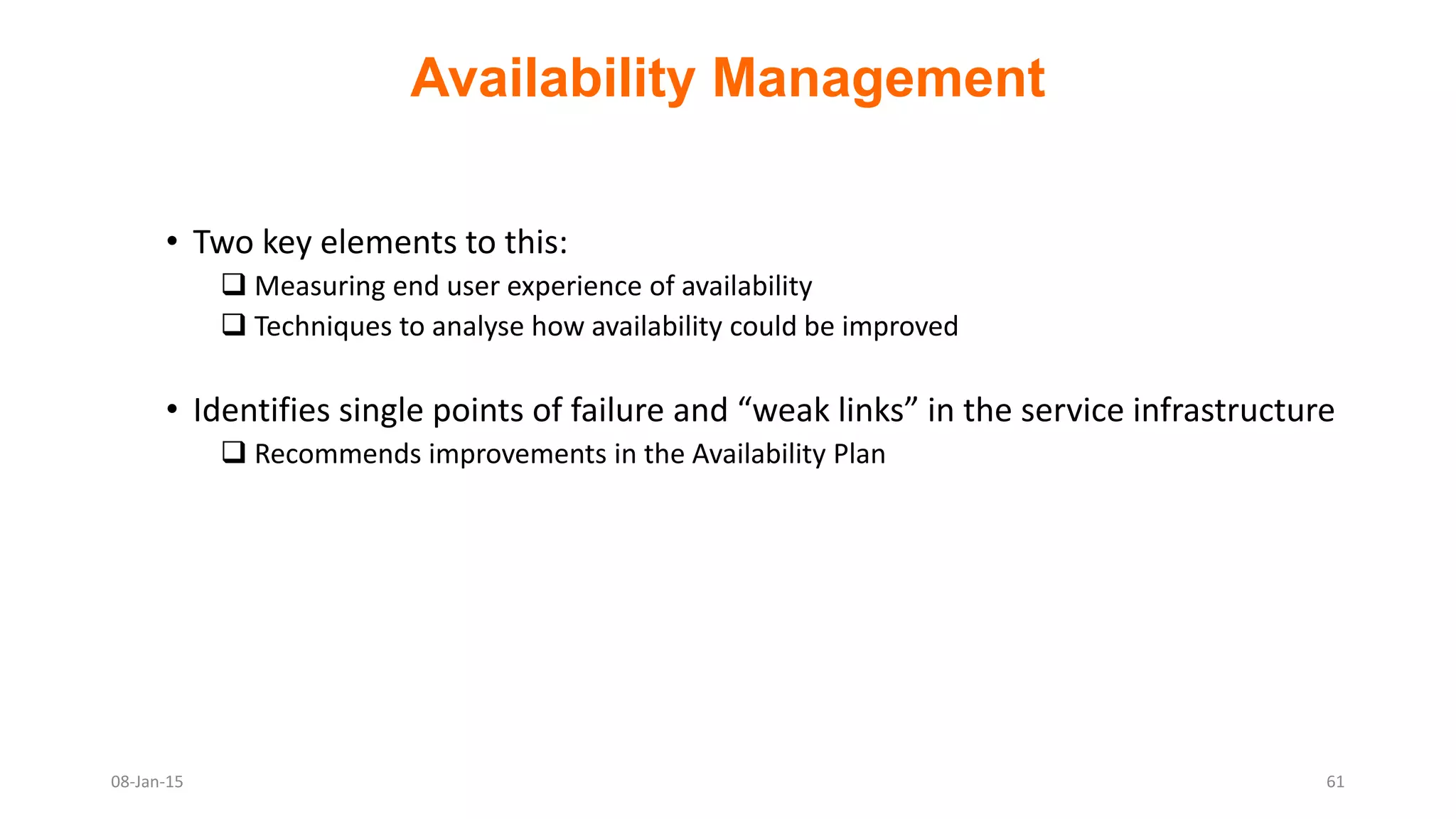
Availability Management
• Two key elements to this:
 Measuring end user experience of availability
 Techniques to analyse how availability could be improved
• Identifies single points of failure and “weak links” in the service infrastructure
 Recommends improvements in the Availability Plan
08-Jan-15 61
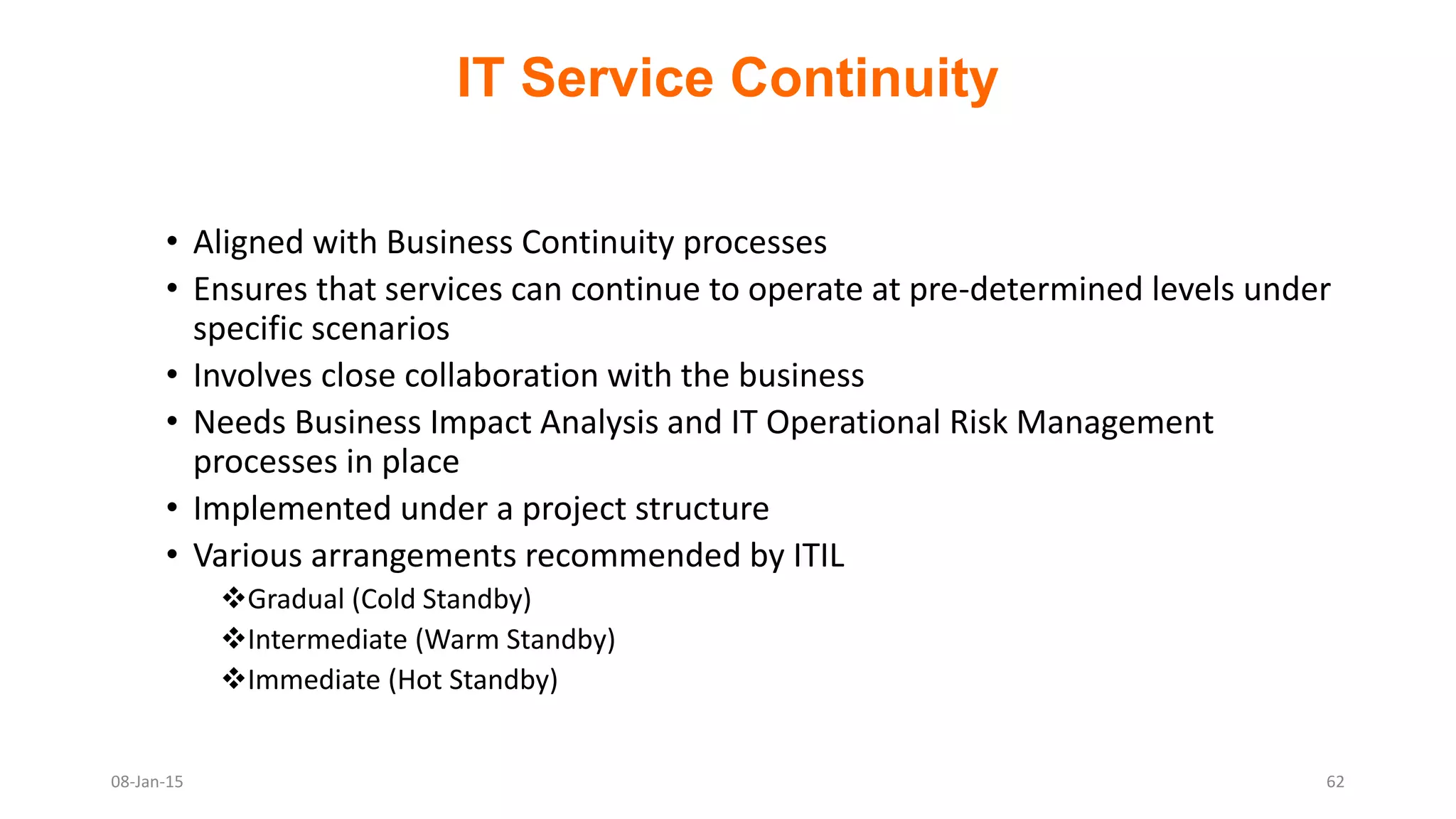
IT Service Continuity
• Aligned with Business Continuity processes
• Ensures that services can continue to operate at pre-determined levels under
specific scenarios
• Involves close collaboration with the business
• Needs Business Impact Analysis and IT Operational Risk Management
processes in place
• Implemented under a project structure
• Various arrangements recommended by ITIL
Gradual (Cold Standby)
Intermediate (Warm Standby)
Immediate (Hot Standby)
08-Jan-15 62
ITIL v3 Publications
08-Jan-15 63
08-Jan-15 64
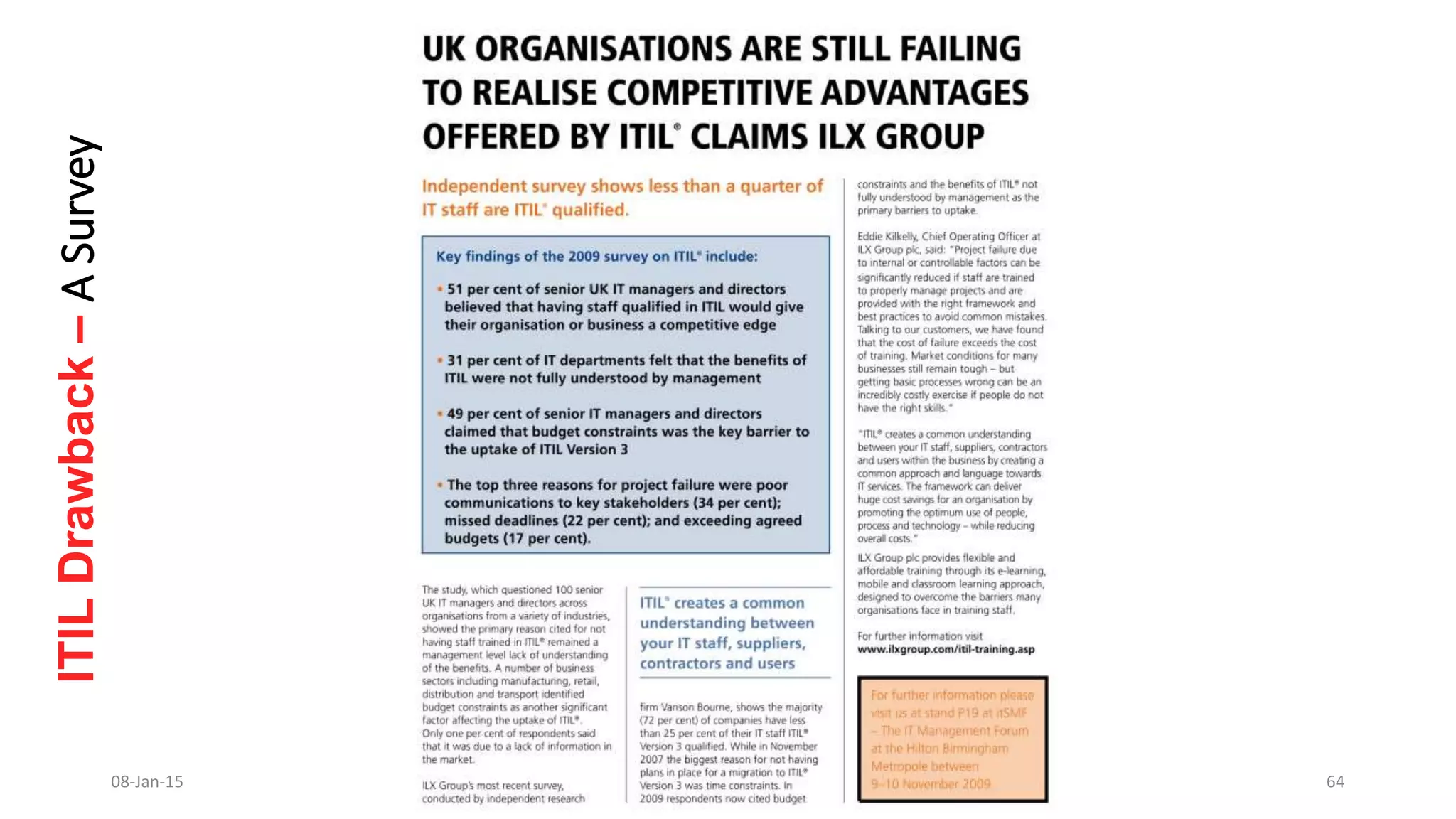
ITILDrawback–ASurvey
ITIL Drawback - ITIL Fixes Everything
CIOs and IT Management are always looking for a quick fix for
controlling and managing IT activities, projects and programs.
In reality ITIL processes are a significant change to employees work and
transition projects will run for months or years.
If projects are not setup properly
the chaos will be even worse in the beginning.
08-Jan-15 65
IT service providers claiming “ITIL compliance” give the false impression
that ITIL is somewhat of an IT standard.
Reality is that ITIL is a set of “good practices”. As ITIL is no standard
there is no ITIL compliance. ITIL compliance is no more than a
marketing slogan.
ISO/IEC 20000is the international standard for IT service management.
ISO/IEC 20000 provides guidance on the implementation and
application of service management systems.
ITIL Drawback - ITIL is the IT industry Standard
08-Jan-15 66
The ITIL lifecycle suggests that the entire process framework has to be
implemented to gain any business benefits.
Reality is that many enterprises and organizations benefit from
implementing only some ITIL processes such as incident management
and change management.
ITIL Drawback - ITIL is an "all inclusive" package
08-Jan-15 67
Getting IT activities, projects and programs under control with the help
of ITIL is an essential step in facilitating the implementation of IT
governance.
Reality is that ITIL does not address IT governance in a comprehensive
way.
ITIL Drawback - ITIL is a governance framework
08-Jan-15 68
ITIL consists of a series of books that describe good practices in the IT
domain.
Reality is the ITIL describes WHAT to do, not HOW to do it.
ITIL is not a hand book for organizations to improve IT services and
daily operations.
ITIL Drawback - ITIL can be implemented out of the box
08-Jan-15 69
ITIL provides a set of good practices that can be applied in a few weeks
time.
Reality is that ITIL is not a list of simple tips and tricks.
ITIL implementations require an extensive change management
project to adjust people’s mind sets.
ITIL Drawback - ITIL is a quick fix
08-Jan-15 70
ITIL will rectify all issues occurring in IT operations and software
development.
Reality is that ITIL is focusing on IT operations and does not bridge the
gap to software engineering, e.g. the book about Service Design does
not address the area of requirements engineering.
ITIL Drawback - ITIL will fix ALL IT issues
08-Jan-15 71
ITIL will make IT operation cheaper.
Reality is that ITIL will align IT services and business. Hidden cost may
be identified, over engineered IT services may be identified but cost
may not necessarily go down.
ITIL Drawback - ITIL is a cost-cutting initiative
08-Jan-15 72
A full blown implementation project of ITIL processes requires a huge
amount of man power and resources.
It’s a fact that a full blown implementation is expensive – but why not
start small?
• Setting up incident management and change management will
provide higher customer satisfaction in a few weeks time.
ITIL Drawback - ITIL projects cost a fortune
08-Jan-15 73
ITIL can be implemented with no more than an inventory list.
Reality is that a Configuration Management Database (CMDB) is the
foundation of all ITIL processes. ITIL projects without setting up a
proper CMDB are doomed to fail in the long term.
ITIL Drawback - I can do ITIL without a CMDB
08-Jan-15 74
08-Jan-15 75
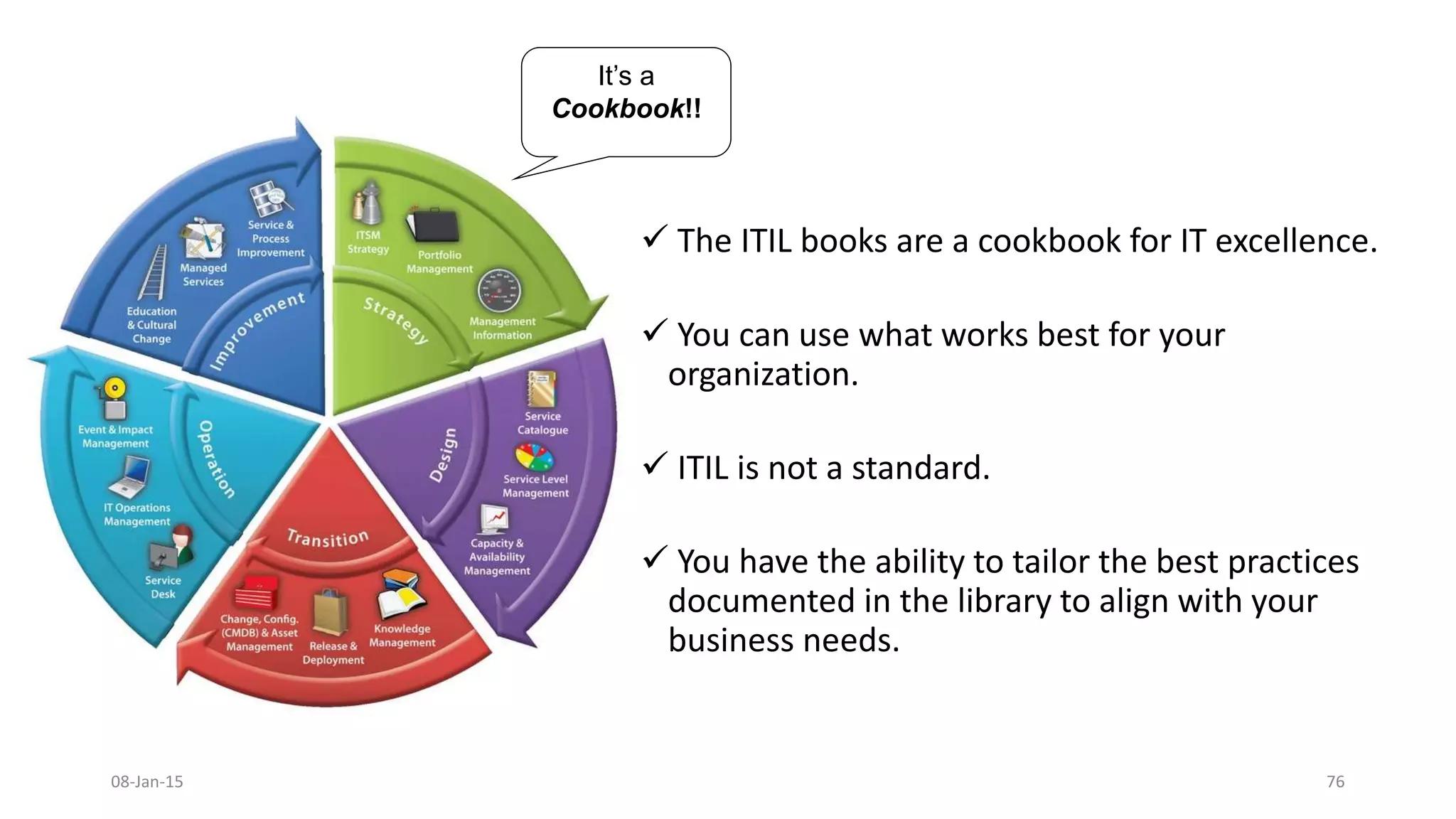
ITIL as Glimpse
 The ITIL books are a cookbook for IT excellence.
 You can use what works best for your
organization.
 ITIL is not a standard.
 You have the ability to tailor the best practices
documented in the library to align with your
business needs.
08-Jan-15 76
It’s a
Cookbook!!
Thank you!
08-Jan-15 77
Mohammad Nur Alam
ICT Specialist
Sulaiman Al Rajhi Colleges
+966-0558534728
narubel@gmail.com
m.nuralam@sr.edu.sa
Have questions?
Need more assistance?
Please write me on - - -
ON WEB @ Facebook (Social):
http://www.facebook.com/narubel
@ LinkedIn (Professional):
http://sa.linkedin.com/in/narubel

ITIL [V3]

  • 1.
  • 2.
  • 3.
    Definition of ITIL ITILstands for Information Technology Infrastructure Library. ITIL is a framework for IT Service Management and provides a set of specialized organizational capabilities for providing value to customers in the form of IT services. 08-Jan-15 3
  • 4.
    ITIL - Origins& Evolution Late 1980s – UK government (CCTA / OGC) project started – Organizations outside of government became interested – First books published Early 1990s – The library completed Late 1990s – ITIL Version 2 Published – Pink Elephant introduced ITIL to North America (1997) Where is it going? – Early industry adopters (Financial Government Utilities Medical) – Global adoption – now defined as ISO 20000 – Major Vendor Support – Tool Compatibility to ITIL – ITIL V3 – Just Published on 05/30/07 & launched 06/05/07! 08-Jan-15 4
  • 5.
  • 6.
    Capabilities Knowledge Risk Resources Capabilities: Processes, Knowledge,Management, Organization Resources: Financial, Capital, Infrastructure, Applications, People, Information ITIL Manage 08-Jan-15 6
  • 7.
  • 8.
    Life cycle modules ServiceStrategy Service Design Service Transition Service Operations Continuous Service Integration Capability modules SOA (service offering & Agreement)  PPO (Planning, Protection & Optimization) RCV (Release, Control & Validation) OSA (Operation, Support & Analysis) ITIL Modules 08-Jan-15 8
  • 9.
    oPortfolio Management oDemand Management oFinancialManagement Service Strategy, Service Design , Service Transition, Service Operations, Continuous Service Integration Life Cycle Modules 08-Jan-15 9
  • 10.
    oAvailability Management oCapacity Management oContinuityManagement oCatalog Management oSupplier Management oSecurity Management oService Level Management Service Strategy, Service Design, Service Transition, Service Operations, Continuous Service Integration Life Cycle Modules 08-Jan-15 10
  • 11.
    oChange Management oConfiguration Management oReleaseManagement Service Strategy, Service Design, Service Transition, Service Operations, Continuous Service Integration Life Cycle Modules 08-Jan-15 11
  • 12.
    oAccess Management oEvent Management oIncidentManagement oProblem Management Service Strategy, Service Design, Service Transition, Service Operations, Continuous Service Integration oService Desk (Function) oTechnical Management (Function) oApplication Management (Function) oIT Ops Management (Function) Life Cycle Modules 08-Jan-15 12
  • 13.
    CSI Model 1. Whatis the vision 2. Where are we Now 3. Where do we want to be 4. How do we get there 5. Did we get there 6. How do we maintain momentum Service Strategy, Service Design, Service Transition, Service Operations, Continuous Service Integration CSI 7 Steps 1. Define what you should measure 2. Define what you can measure 3. Gather the data 4. Process the data 5. Analyze the data 6. Present the data 7. Implement improvement or Corrective Actions Life Cycle Modules 08-Jan-15 13
  • 14.
    Service Manager Product Manager ServiceOwner Process Owner ITIL Roles 08-Jan-15 14
  • 15.
  • 16.
    V3 Overview  Servicemanagement as a practice  Service lifecycle  Role of processes in the lifecycle  Role of functions in the lifecycle  Practice fundamentals  Practice principles  Processes  Organizational design and structures roles and responsibilities  Challenges, critical success factors, risks 08-Jan-15 16
  • 17.
    Introducing ITIL Service Design ITIL Service Strategies Continual Service Improvement Continual Service Improvement ContinualService Improvement Service Operation Service Transition Governance Methods Standard Alignment Case Studies Templates Scalability Quick WinsQualifications Study Aids Executive Introduction Speciality Topics Knowledge & Skills • Service Lifecycle Approach • Continual Service Improvement throughout • Complementary Guidance published / underway • Key Element Guides • Study Guides • Case Studies • Templates
  • 18.
    The lifecycle ofIT Service Service design How service is deployed Possible service incidents How service is utilized Requests for change Requests for change Usage guidelines, policies, and incentives to change utilization patterns Service transition How service is delivered How service is supported Service operation Design limitations Guidelines, policies, and information for Service Desk to support incidents (Filtering) Compensating resources and requests for change Requests for change Service improvement Requests for change Service strategy Objectives, policies and guidelines 08-Jan-15 18
  • 19.
    Benefits of UsingITIL  Reduced Costs  Improved IT Services  Improved customer satisfaction  Documented process and procedures  Improved productivity  Improved use of staff skills and experience 08-Jan-15 19
  • 20.
    Benefits of ITITLto the Customer and User  Provision of IT Services becomes more customer focused  Services are described in customer language  Quality, availability, reliability and cost of services are managed better 08-Jan-15 20
  • 21.
    Benefits of ITILto ICT  Clearer Structure  More efficient and more focused on corporate objectives  More in control of infrastructure and services  More service oriented  Improved communications 08-Jan-15 21
  • 22.
    Seven Disciplines ofITIL 1. Service Support 2. Service Delivery 3. Security Management 4. ICT Infrastructure Management 5. Applications Management 6. Planning to Implement Service Management 7. The Business Perspective 08-Jan-15 22
  • 23.
    Some important definitions •What is the ITIL framework? • A set of guidelines to which we can align • Something which we can adopt and adapt • What is a service? • The collection of IT elements which come together to deliver something that the user perceives, which supports a business process • What is a process? • A collection of steps which, when executed, deliver a defined outcome • What’s a KPI? • A Key Performance Indicator which is used to measure process performance 08-Jan-15 23
  • 24.
    Processes ITIL Technology Infra- structureincluding tools Critical Components Efficient, Effective and Economic People Culture, Attitude, Belief, Knowledgeand Skills 08-Jan-15 24
  • 25.
    The V2 ProcessWorld 08-Jan-15 25
  • 26.
    The Service SupportProcess Model 08-Jan-15 26
  • 27.
  • 28.
  • 29.
    ITIL Processes • ServiceStrategy • IT Financial Management • Demand Management • Service Portfolio Management • Strategy Generation • Service Transition • Transition Planning & Support • Change Management • Service Asset & Configuration Management • Release & Deployment Management • Service Validation & Testing • Evaluation • Knowledge Management Continual Service Improvement  The 7-steps Improvement Process  Service Reporting  Service Measurement  Return on Investment for CSI Service Operation  Event Management  Incident Management  Request Fulfillment  Problem Management  Access Management Service Design  Service Catalogue Management  Service Level Management  Capacity Management  Availability Management  IT Service Continuity Management  Information Security Management  Supplier Management 08-Jan-15 29 Study More
  • 30.
  • 31.
    The “New” Processes& Functions To Consider Processes:  Service Strategy (SS)  Return on Investment (SS)  Service Portfolio Management (SS)  Demand Management (SS)  Service Catalog Management (SD)  Supplier Management (SD)  Application Management (SD)  Data & Information Management (SD)  Requirements Engineering (SD)  Transition Planning & Support (ST)  Configuration Management System (ST)  Service Validation & Testing (ST)  Valuation (ST)  Knowledge Management (ST)  Event Management (SO)  Request Fulfillment (SO)  Access Management (SO)  Monitor & Control, IT Operations, Technology  Domain Management (SO)  7 step Continuous Improvement (CSI)  Service Reporting (CSI)  Service Measurement (CSI)  ROI for CSI (CSI)  Service Improvement (CSI) Functions:  Technical Management function (SO)  IT Operations Management function (SO)  Applications Management function (SO) 08-Jan-15 31
  • 32.
    Transitioning To ITSM Today’sIT Organizations Tomorrow’s IT Organizations Focused on Technology Focused on Customer Outcomes Firefighting Mode Demand-Driven Organizational “Stovepipes” Enterprise Services and Process Unknown Costs Financial Transparency Technical Metrics Business Value 08-Jan-15 ITSM Stand for IT Service Management 32
  • 33.
    The ITIL ServiceLife Cycle 08-Jan-15 33
  • 34.
    ITIL Version 2 ServiceLevel Management Capacity Management Availability Management Financial Management Service Continuity Management Incident Management Problem Management Service Desk Configuration Management Release Management Service Management Service Delivery Service Support Change Management 08-Jan-15 34 Service Management
  • 35.
    Service Level Management(SLM)  Customer requirements are documented within the SLR (Service Level Requirements) document  The process is then responsible for determining whether these requirements are achievable by reference to OLAs (Operational Level Agreement) and Contracts  This ensures that SLA targets are achievable prior to customer sign off  Gaps in capability are addressed through a CSIP SLA Users IT Service Provider Desktop Network Server Network Telephony Security Application Database Internal or 3rd party Technical Providers OLA ContractSLR 08-Jan-15 35
  • 36.
    Service Desk • Afunction, rather than a process • Describes the body of people who provide a single point of contact for IT services • Main features: Service Desk models Skills Tools Measures Supporting the business need 08-Jan-15 36
  • 37.
  • 38.
    • The ServicePortfolio represents the commitments and investments made by a service provider across all customers and market spaces. • It represents present contractual commitments, new service development, and ongoing service improvement plans initiated by Continual Service Improvement • The service portfolio provides a holistic view of • Service Pipeline • Service Catalogue • Retired Services • Can assist IT in project and operational resourcing, project portfolio management and therefore investment decisions Service Portfolio Management 08-Jan-15 38
  • 39.
    The Source ofService Value  Utility – Utility is what the customer wants – The Service is “Fit for Purpose” – Derived from the attributes of a service that: • Have a positive effect on the performance of activities, objects, and tasks associated with desired outcomes • Or with the removal or relaxing of constraints on performance  Warranty – Warranty is how what the customer wants is delivered The Service is “Fit for Use” – Derived from the positive effect of: • Being available when needed • In sufficient capacity or magnitude • Dependably in terms of continuity and security 08-Jan-15 39
  • 40.
    The Source ofService Value 08-Jan-15 40
  • 41.
    Service Catalog 08-Jan-15 Why aService Catalog ?? You cannot Manage what you cannot Control You cannot Control what you cannot Measure You cannot Measure what you cannot Define Service Catalog Purpose, Goal, Objective 41
  • 42.
    A Service Cataloguecontains: Details of the IT Services being provided Details of the various groups who consume those services Details of the technical elements necessary to deliver those services High level view of expectations versus capabilities Service Catalogue 08-Jan-15 42
  • 43.
    Service Catalogue 08-Jan-15 Customer View(Visible in Service Catalog):  Service name  Service description  Supported products  Policies  Ordering and request procedures (can be built-in, or provided as links to other systems)  Support terms and conditions  Entry points and escalations  Pricing and chargeback (Cost per unit)  Entitlement  Authorization  Service Delivery Timeframe Technical Details (Typically Hidden)  Technical Description  Service Owner  Service Provider  Dependencies on other Services Template 43
  • 44.
    Service Catalogue Management Business Process1 Business Process 2 Business Process 3 Service A Service B Service DService C Service E Support Services Hardware Software Applications Data Business Service Catalogue Technical Service Catalogue 08-Jan-15 44
  • 45.
    How Customers PerceiveValue 08-Jan-15 45
  • 46.
  • 47.
    Incident Management • Aimsto quickly restore service to the end user within SLA targets • Fronted by the Service Desk, who may call upon 2nd and 3rd line teams, and external suppliers as appropriate • Incidents are normally logged in an IT Service Management tool and passed to other groups by means of assigning the incidents to a resolver queue • Incidents are normally: - Categorised to enable analysis of incident types to take place at a later date - Prioritised, by their Impact and Urgency 08-Jan-15 47 What is incident? Why we need incident Management? Any infrastructure fault leads to incident, which cases an interruption of service or reduction of the quality of service.
  • 48.
    Classification and InitialSupport Incident ManagementProcess Flow Detection and Recording Investigation and Diagnosis Resolution and recovery Closure Ownership,Monitoring, TrackingandCommunication 08-Jan-15 48
  • 49.
  • 50.
    Problem Management • Relatesto the investigation into the Root Cause of Incidents • Concerned with identifying: - Workarounds - Known Errors through effective knowledge management - Permanent fixes • Prospective fixes will be assessed for their feasibility in terms of cost, complexity, benefit (Cost of Service VS Quality of service). 08-Jan-15 50
  • 51.
    Service Asset &Configuration Management • Seeks to control IT software and hardware assets by recording information about them • Primary benefit is understanding of relationships between assets - Aids impact assessment for changes and incidents • Improves knowledge management by managing information about assets, such as support documentation • Ensures that each asset can be viewed through it’s lifecycle • Key terms Relationships Attributes – Information about an asset Configuration Item – The name given to an asset type Status Lifecycle – The means of tracking past, current and future states 08-Jan-15 51
  • 52.
    Change Management • Seeksto minimise the risk to IT service of uncontrolled change through: Ensuring a common definition of the word “Change” Ensuring all changes are logged Ensuring all changes are subject to an appropriate form of assessment Ensuring that all changes are appropriately authorised prior to implementation • The primary benefit of Change Management is improving / initiating communication channels between IT and the business Change Advisory Board Scheduling of change sympathetic to business needs • Manages the “Request” for Change rather than the physical deployment 08-Jan-15 52
  • 53.
    Assesses, Approvesand managesthe request ChangeManagement Change ManagementRFC CMDB Assessments Reasons: •Fix aProblem •Changing business requirements •Changing technology •ContinuousSIP Changeto: Hardware Software Documentation Infrastructure Training 3rd partycontract Tacticalplanning Physicallyimplements the change Release & Deployment Management 08-Jan-15 53
  • 54.
    Change Management —Activities Initiator Requested Record the RFC Change Management Ready for evaluation Review the RFC Ready for decision Assess and evaluate change Change Management Scheduled Plan updates Change Management Implemented Co-ordinate change implementation* Closed Review and close change record Evaluation report Work orders Work orders UpdatechangeandconfigurationinCMS Authorized Change Authority Authorize change Authorize change proposal Create RFC Change proposal (optional) 08-Jan-15 54
  • 55.
    CMDB Information about theCIsPhysical CIsDML Release Record Electronic CIs Build new Release Test new Release Implement new Release Distribute new Release to live locations DML and CMDB relationship 08-Jan-15 55CMDB stand for Configuration Management Database CI stand for Configuration Item
  • 56.
    Release & DeploymentManagement • Focussed upon the physical aspects of delivering a change • Commonly misinterpreted as focussing solely on software / application - Principles apply equally to hardware, documentation or any other type of change 08-Jan-15 56
  • 57.
    Release Management ProcessSummary • Long range view of forthcoming releases • Agrees release contents • Producing all components of the Release • Build release package • Testing the implementation plan • Fitness for purpose testing • Detailed timetable • Selection of rollout type • Update plans and notify interested parties • Produce final documentation • CMDB updated • Problem Management produces Known Error Records and redundant CIs decommissioned Communication, preparation& training ReleasePlanning RolloutPlanning Acceptance Design, Build & Configure Distribution & installation 08-Jan-15 57
  • 58.
    IT Financial Management •Focussed upon understanding IT costs o Where costs are being spent What are the biggest IT costs in your organisation? o Identification of cost-effective services and support techniques • Three main elements Budgeting Accounting Charging • Provides a formal basis for the Business – Service Provider relationship • Can help IT influence user behaviour through demand management 08-Jan-15 58
  • 59.
    Capacity Management • Focussedupon proactive management of IT infrastructure capacity • Aims to reduce unplanned outages and spend caused by poor capacity planning • Emphasises need for continual optimisation of IT assets • Benefits from consolidation of infrastructure data into end-to-end service view • Enables business / IT relationship to include performance vs cost discussions • Revolves around periodic production of a Capacity Plan, aligned with business planning cycle 08-Jan-15 59
  • 60.
    Capacity Management Component Capacity Management Service Capacity Management Business Capacity Management • Talkingtothe business todetermine their strategy • Translate these business initiatives intoIT requirements • Influence business strategy by providingcapacity advice • Design andprocure solutions to meet future requirements • Manage capacity requirements in the context ofSLAs • Consolidate component capacity data into an end-to-end service view • Optimise infrastructure components tomeet SLAtargets • Monitorandreport upon Service capacity • Identify trends andtake proactive action tomaintain SLA targets • Manage infrastructure component capacity • Identify trends andtake proactive action • Consider innovative technology solutions to meet business requirements 08-Jan-15 60 Assessing Business Impact
  • 61.
    Availability Management • Twokey elements to this:  Measuring end user experience of availability  Techniques to analyse how availability could be improved • Identifies single points of failure and “weak links” in the service infrastructure  Recommends improvements in the Availability Plan 08-Jan-15 61
  • 62.
    IT Service Continuity •Aligned with Business Continuity processes • Ensures that services can continue to operate at pre-determined levels under specific scenarios • Involves close collaboration with the business • Needs Business Impact Analysis and IT Operational Risk Management processes in place • Implemented under a project structure • Various arrangements recommended by ITIL Gradual (Cold Standby) Intermediate (Warm Standby) Immediate (Hot Standby) 08-Jan-15 62
  • 63.
  • 64.
  • 65.
    ITIL Drawback -ITIL Fixes Everything CIOs and IT Management are always looking for a quick fix for controlling and managing IT activities, projects and programs. In reality ITIL processes are a significant change to employees work and transition projects will run for months or years. If projects are not setup properly the chaos will be even worse in the beginning. 08-Jan-15 65
  • 66.
    IT service providersclaiming “ITIL compliance” give the false impression that ITIL is somewhat of an IT standard. Reality is that ITIL is a set of “good practices”. As ITIL is no standard there is no ITIL compliance. ITIL compliance is no more than a marketing slogan. ISO/IEC 20000is the international standard for IT service management. ISO/IEC 20000 provides guidance on the implementation and application of service management systems. ITIL Drawback - ITIL is the IT industry Standard 08-Jan-15 66
  • 67.
    The ITIL lifecyclesuggests that the entire process framework has to be implemented to gain any business benefits. Reality is that many enterprises and organizations benefit from implementing only some ITIL processes such as incident management and change management. ITIL Drawback - ITIL is an "all inclusive" package 08-Jan-15 67
  • 68.
    Getting IT activities,projects and programs under control with the help of ITIL is an essential step in facilitating the implementation of IT governance. Reality is that ITIL does not address IT governance in a comprehensive way. ITIL Drawback - ITIL is a governance framework 08-Jan-15 68
  • 69.
    ITIL consists ofa series of books that describe good practices in the IT domain. Reality is the ITIL describes WHAT to do, not HOW to do it. ITIL is not a hand book for organizations to improve IT services and daily operations. ITIL Drawback - ITIL can be implemented out of the box 08-Jan-15 69
  • 70.
    ITIL provides aset of good practices that can be applied in a few weeks time. Reality is that ITIL is not a list of simple tips and tricks. ITIL implementations require an extensive change management project to adjust people’s mind sets. ITIL Drawback - ITIL is a quick fix 08-Jan-15 70
  • 71.
    ITIL will rectifyall issues occurring in IT operations and software development. Reality is that ITIL is focusing on IT operations and does not bridge the gap to software engineering, e.g. the book about Service Design does not address the area of requirements engineering. ITIL Drawback - ITIL will fix ALL IT issues 08-Jan-15 71
  • 72.
    ITIL will makeIT operation cheaper. Reality is that ITIL will align IT services and business. Hidden cost may be identified, over engineered IT services may be identified but cost may not necessarily go down. ITIL Drawback - ITIL is a cost-cutting initiative 08-Jan-15 72
  • 73.
    A full blownimplementation project of ITIL processes requires a huge amount of man power and resources. It’s a fact that a full blown implementation is expensive – but why not start small? • Setting up incident management and change management will provide higher customer satisfaction in a few weeks time. ITIL Drawback - ITIL projects cost a fortune 08-Jan-15 73
  • 74.
    ITIL can beimplemented with no more than an inventory list. Reality is that a Configuration Management Database (CMDB) is the foundation of all ITIL processes. ITIL projects without setting up a proper CMDB are doomed to fail in the long term. ITIL Drawback - I can do ITIL without a CMDB 08-Jan-15 74
  • 75.
  • 76.
     The ITILbooks are a cookbook for IT excellence.  You can use what works best for your organization.  ITIL is not a standard.  You have the ability to tailor the best practices documented in the library to align with your business needs. 08-Jan-15 76 It’s a Cookbook!!
  • 77.
    Thank you! 08-Jan-15 77 MohammadNur Alam ICT Specialist Sulaiman Al Rajhi Colleges +966-0558534728 narubel@gmail.com m.nuralam@sr.edu.sa Have questions? Need more assistance? Please write me on - - - ON WEB @ Facebook (Social): http://www.facebook.com/narubel @ LinkedIn (Professional): http://sa.linkedin.com/in/narubel